
Chainlink token value estimate for the next ten years
Chainlink Token Value Peak Expected in 2023 – Could Reach $11.00
Chainlink Value Outlook to 2026 – Forecast to Reach a High of $34.43
Looking ahead to Chainlink’s potential peak value in 2029 – up to $108.37
Chainlink Price Outlook for 2032 – Expected to Rise to $329.44
In the cold season of the crypto market, it is still unpredictable to accurately judge when the market will warm up. However, we can try to find the dawn of industry recovery from some positive signs. The CoinShares report pointed out that after 11 consecutive weeks of capital withdrawal, ETH has ushered in three consecutive weeks of capital inflow. In the face of uncertainty, let us look forward to the future price trend of Chainlink.

Current Chainlink Market Value
Chainlink is currently priced at $15.96 and has a trading volume of $909,580,620 in the past 24 hours. In the most recent day, Chainlink recorded a 3.91% increase. According to CoinMarketCap, Chainlink's market capitalization ranks 12th, reaching $8,889,990,630. The number of LINK tokens in circulation is 556,849,970, and the total issuance of the currency is capped at 1,000,000,000 LINK tokens.
Chainlink market price trend prediction: LINK price falls after being under pressure
According to the latest market price trend, Chainlink's future performance does not look optimistic
LINK’s current trading value has dropped to $15.96, a drop of 3.91%
LINK is currently facing a price resistance of $17.06
Chainlink market price analysis on December 10 reveals a weak market signal. LINK is now trading at $15.96, down 3.91% today after an unsuccessful attempt to break through the $17.06 price resistance set in the morning and falling below the key $17.00 level. The market trend is dominated by bears, with the trading price remaining in a range for most of the day.
Chainlink Price Analysis for One-Day Trend: LINK Finds Support at $16.16 Amid Ongoing Bearish Pressure
The daily chart shows that the price of Chainlink is developing along a descending trendline. Failure to surpass the $17.06 resistance level has made bearish investors look forward to fully influencing the market. If the existing support level is broken, the bearish momentum may push the price further down to the $16.16 level.
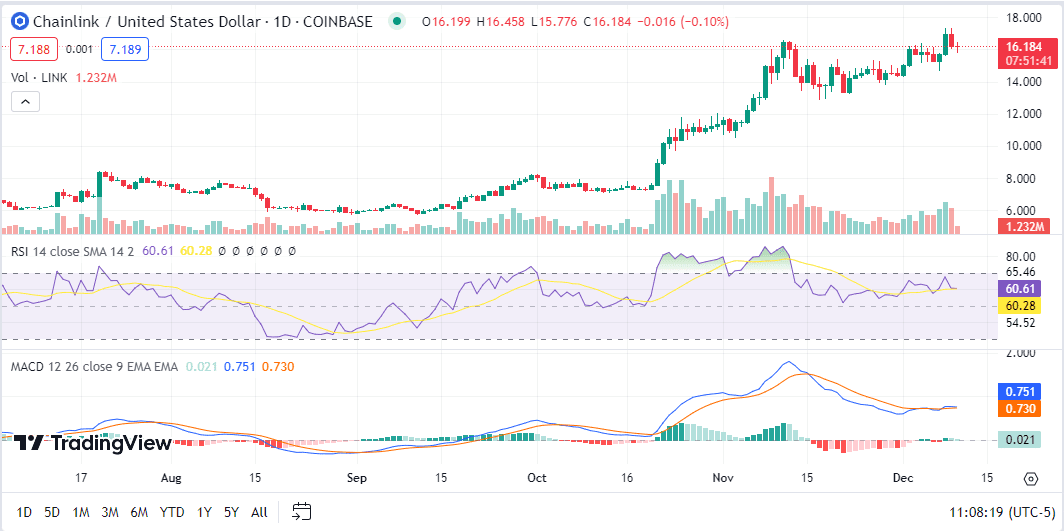
The Relative Strength Index and Moving Average Convergence Dispersion Indicator are conveying signs of weakness, with the RSI hovering around neutral levels. Potential buying power could push the RSI back into overbought territory, providing support for LINK. The MACD indicator is currently showing a downward trend, and its signal line is also sinking. At the same time, the width of the Bollinger Bands is shrinking, suggesting that LINK trading is becoming less volatile. LINK encountered significant resistance at the middle Bollinger Band and the price showed a downward trend.
Chainlink market cap short-term chart analysis: Bearish forces attempt to undermine the main $16.00 support level
On the 4-hour market chart, Chainlink’s pricing analysis highlights that the downtrend remains in place. In today’s market, sellers have repeatedly attempted to break through the major support level of $16.16, but so far, these attempts have failed to achieve their goal.
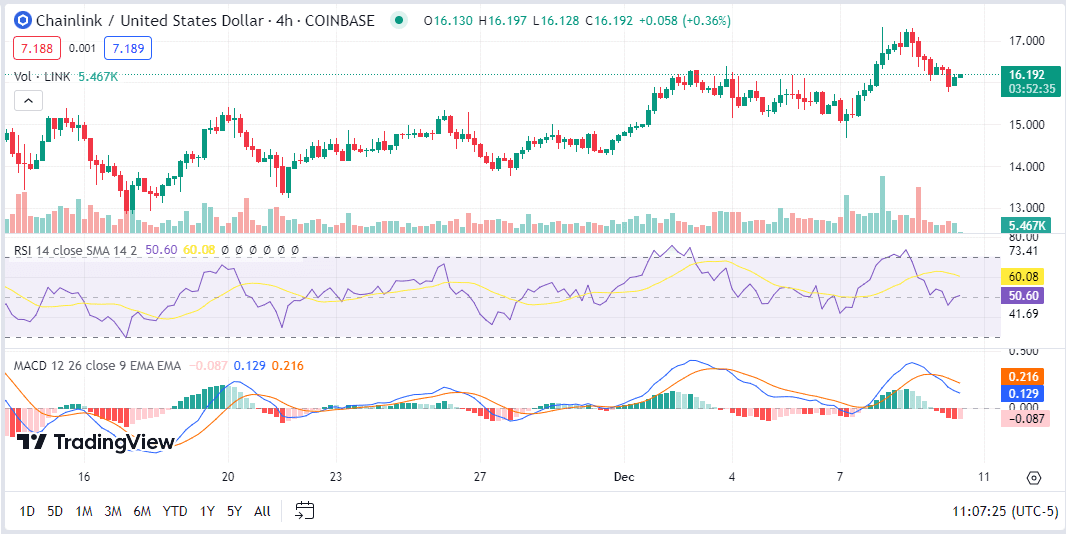
The RSI is trending down and approaching the sell line, while the MACD indicator is declining and the signal line is following, which suggests that the market may be leaning bearish. The Bollinger Bands are starting to widen, indicating that market volatility is increasing as the LINK price approaches the lower Bollinger Band at $16.09.
How Chainlink’s price is expected to move
The current price analysis shows that Chainlink’s market trend is in a downtrend. In recent trading, the price has been suppressed by the key level of $16.16. However, if the buying forces can break through this barrier, then the price of LINK has the potential to move higher again.
Chainlink's latest market updates and insights
LINK token sparks interest from top whale investors in staking activity due to expected staking mechanism update
Chainlink’s native cryptocurrency LINK has grown 189% since the beginning of the year, outperforming major market assets including Bitcoin, which has grown 139% over the same period. The rally was driven primarily by Chainlink’s expected v0.2 staking mechanism update. The change prompted large investors, often referred to as whales, to buy large amounts of LINK.
The latest data shows that the top 200 LINK addresses have increased their holdings by $50 million, with a total of $11.84 billion, equivalent to 746.57 million LINK. The increase in holding addresses and the decrease in TOKEN balances have boosted the market's bullish attitude towards this cryptocurrency.
Investors view LINK as an asset to hold for the long term rather than an object of short-term profit, which reduces the possible selling pressure in the market. On-chain data reveals that after the introduction of the staking mechanism, nearly 20 million LINK were locked and pledged, with the supply falling to 102 million tokens.
Chainlink’s price growth has also benefited from the adoption of the Chainlink Cross-Chain Protocol (CCIP) by prominent institutions including Swift and Wemade. Chainlink co-founder Sergey Nazarov sees CCIP as a solution that can revolutionize both decentralized and traditional finance.
Chainlink has leapt into the top 10 cryptocurrencies on the back of a strong finish to November and growing popularity among mainstream investors. As the ecosystem transitions to Chainlink Stake v0.2, and a nine-day migration priority and trial period begins on December 7, LINK is expected to maintain its upward momentum, especially after it is opened to general users on December 11. The inherently volatile LINK price is hovering above key resistance levels in the market, setting positive expectations for its performance in December.
Anzen advances real-world asset lending with Chainlink protocol
Anzen officially announced that it has joined Chainlink's BUILD program to deepen the growth of the decentralized lending market driven by real-world assets (RWA). By integrating Chainlink's leading oracle network, Anzen has gained enhanced security and reliability.
The integration of Chainlink provides Anzen with access to professional oracle architecture, including automated execution of smart contracts based on interest payments, CCIP for cross-chain communication, and off-chain proof of collateral. In addition, Anzen can also enjoy the new features presented by Chainlink during the alpha/beta testing phase.
In return for participating in the BUILD program, Anzen provides network fees and other incentives to the Chainlink community, creating value for node operators and users.
Anzen is committed to transplanting the lending activities of real-world assets to the blockchain. By building a sound lending framework based on RWA, it aims to provide depositors with profit opportunities and provide institutional borrowers with stable credit resources. The expansion of RWA crypto loans is expected to have a positive impact on the wider economy.
By partnering with Chainlink BUILD, Anzen can take advantage of the high reliability of Chainlink’s price feeds. This allows RWA loan pricing to be based on objective market data, preventing price manipulation. The automated process also helps ensure that repayment schedules are accurately tracked, eliminating human error.
Anzen CEO Ben Shyong is excited about the goal of integrating Chainlink oracles to achieve mainstream RWA trading, as Chainlink's tested oracles ensure the safety of the operation. While ensuring security, Anzen's protocol can bring attractive benefits to users.
As an industry-recognized oracle giant, Chainlink provides services for top DeFi applications with its tamper-resistant and high-quality data support. Anzen’s choice further proves that Chainlink has an unshakable position in the field of crypto financial services that require powerful and transparent inputs.
This collaboration reflects a long-term shared vision to securely migrate real-world markets to blockchain through decentralized infrastructure.
Well-known crypto whale buys over 300,000 Chainlink tokens amid market turmoil
A well-known cryptocurrency investor made a large purchase in the market, acquiring 312,901 Chainlink tokens, with a valuation of approximately $3.81 million, which attracted great attention in the crypto circle. The purchase cost an average of $12.17 per token, close to Chainlink's current price level. According to CoinGecko tracking data, Chainlink's current market value is approximately $6.89 billion, and its daily trading volume has reached $729.95 million.
The investor, who has been noted for his huge influence in the market and his long-standing crypto trading profits, has previously made more than $3.9 million from trading different types of tokens. Of particular note, this includes $2.15 million from Rollbit’s RLB trading and $1.8 million from Flexacoin’s FLEX.
Meanwhile, there has been a lot of interest in the crypto community over a massive Chainlink transaction, in which approximately 3.8 million LINK tokens (worth about $46 million) were transferred between two different anonymous wallets. Such major transfers recorded on the Ethereum blockchain typically mark major turning points in market activity, and therefore attract attention and close monitoring from investors and analysts.
Chainlink Price Prediction 2023-2032
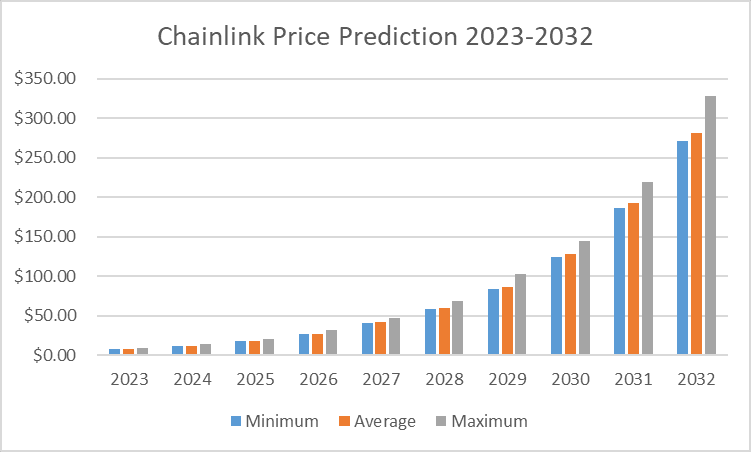
Cryptopolitan’s Chainlink (LINK) price analysis report delves into the future growth opportunities for the crypto asset. Chainlink is a well-known decentralized oracle network that is closely watched by experts to predict possible market movements.
The report provides an in-depth perspective and comprehensive trend forecasts, which are valuable information for those who want to make smart investment decisions in the volatile world of digital currencies. We invite you to learn more about the detailed forecast of the potential path of LINK price between 2023 and 2032, which are based on a wide range of market factors and assumptions.
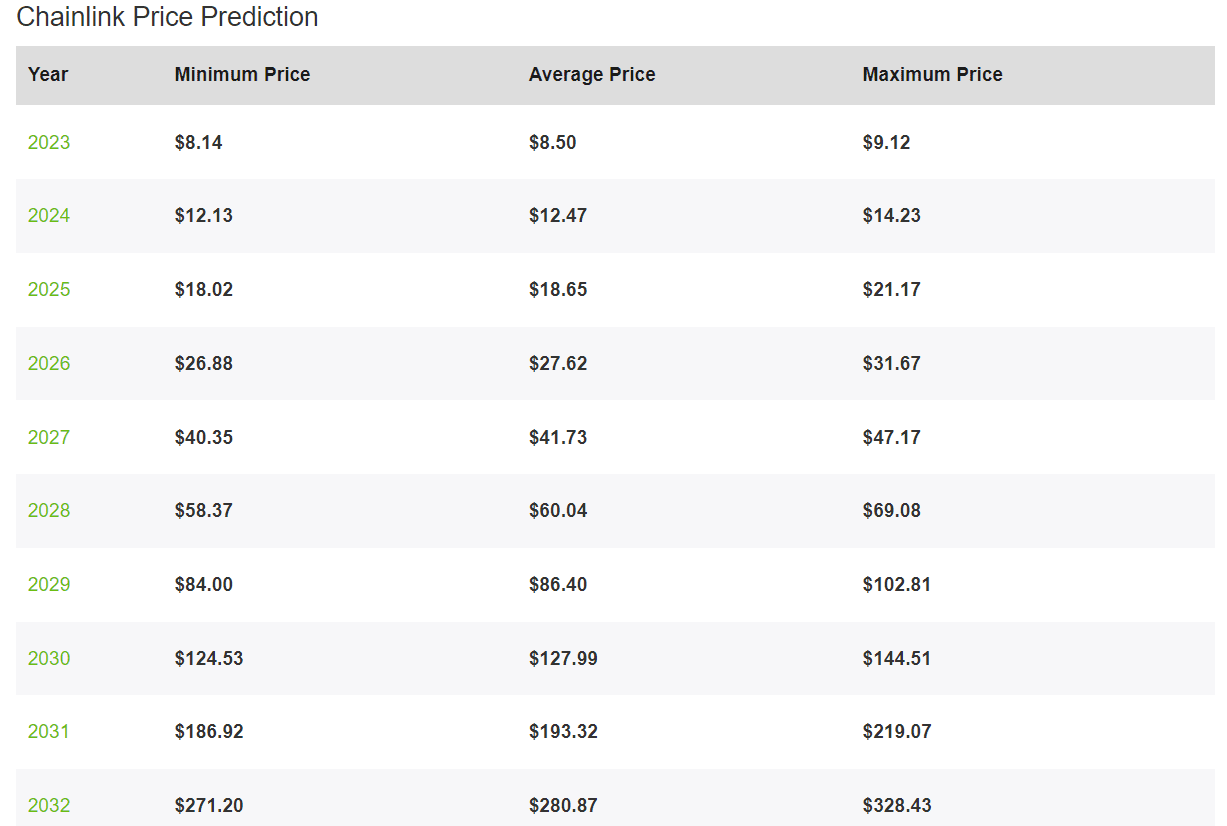
In the 2023 forecast, although LINK is currently experiencing downward pressure, the chain is expected to improve, with the minimum price possibly dropping to $8.14, the price generally expected to be around $8.50, and the highest trading price possibly reaching $9.12.
Recent activity on the Chainlink system has given the market positive signals, such as its innovative tokenized asset trading partnership with ANZ Bank. Such developments, coupled with the leaps forward in smart contract technology, are expected to drive LINK prices higher this year.
Looking ahead to 2024, LINK is expected to continue to rise, with the lowest price expected to be $12.13, the average price to reach $12.47, and the highest price perhaps rising to $9.12.
By 2025, the price forecast shows a minimum exchange rate of $18.02, an average of $18.65, and a maximum of $21.17.
For 2026, the chain is expected to continue its strong momentum, with a minimum price of $26.88, an average of $27.62, and a possible maximum of $31.67. Considering Chainlink's high attention in the DeFi field and its expanded partnerships with core industry players, its future is particularly bright.
Looking further ahead, the forecast for 2027 points to a minimum of $40.35 for LINK, an average of $41.73, and a maximum price estimate of $47.17. The popularity of smart contract technology and the key role Chainlink plays in bringing real-world information to the blockchain show its future potential.
The forecast for 2028 shows that the minimum price will rise to $60.58, the average price will be $62.63, and the peak price may reach $71.13. Chainlink's prestige in the DeFi community and its innovative technology may bring huge demand for LINK.
Going into 2029, LINK is expected to maintain its upward momentum with a minimum price of $84.00, an average of $86.40, and a possible maximum of $102.81.
By 2030, the price is expected to rise further, with the minimum possible value being $124.53, the average price being $127.99, and the maximum price being $144.51. With the popularity of blockchain technology and decentralized applications, the oracle service provided by Chainlink is particularly important.
By 2031, the LINK price is expected to fluctuate between a minimum of $186.92, an average of $193.32, and a possible maximum of $219.07.
Entering 2032, the price of LINK is expected to be at a minimum of $271.20, an average of $280.87, and a peak of $328.43. The widespread adoption of blockchain technology in many industries may bring a surge in demand for Chainlink's oracle network.
Market experts hold different views on Chainlink's future growth, but certain factors may affect this trend. Positive factors such as on-chain upgrades and cooperation with well-known institutions may drive prices up, while potential LINK token selling pressure may put pressure on prices. Chainlink expects a minimum price of $11 and a maximum of $19 in the short term, and may fluctuate between $20 and $28 in 2025.
Chainlink Overview
Chainlink Price History
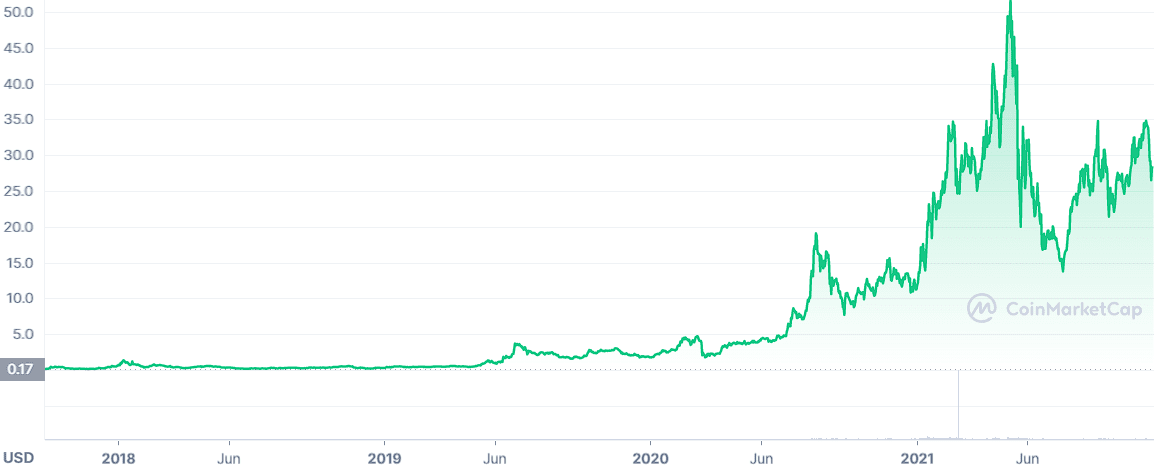
In early 2018, the cryptocurrency market was generally bullish, with many cryptocurrencies climbing to new heights, and Chainlink’s LINK coin also rising. However, this surge was followed by a period of wild volatility in the coin space, with billions of dollars lost in market value.
We are currently seeing a similar pattern, with most coins trading at 25% to 50% of their historical peak market caps. Only a few projects, such as Ethereum and Chainlink, have managed to survive the harsh crypto winter and are slowly climbing in value again.
For Chainlink in particular, 2019 was a turning point. LINK’s performance in the market has been very eye-catching, and it has a lot to do with the groundbreaking DApps developed on the Chainlink network and several initial exchange listings completed last year.
This allowed LINK to climb from $0.3 at the beginning of the year to a new high of $1.13 in May 2019. Later that year, LINK’s value surged again, reaching an all-time high of $4,540 on June 24. This growth was mainly driven by the launch of the Chainlink network on the Ethereum mainnet.
Then in 2020, the Chainlink project won again and again, surpassing major digital currencies such as Bitcoin and Ethereum for the second consecutive year, and performed the best. LINK was trading at around $1.70 and rose to $4.570 in February. In mid-July, LINK broke out with strong momentum and the price rose to a new high of $8.40. The price then continued to climb, almost reaching the $20 threshold, but was eventually resisted and fell back below $12.
In 2021, Chainlink price ushered in a strong bull run, with sharp price fluctuations, rising from $12 to a high near $36. However, Coinlink has since faced strong resistance at $36 and was rejected, with the price falling to $23.50, however, rebounding on the support of $30. Although it reached an all-time high of $52.88 in May, it began to fall back soon after. Chainlink fell below $30, which was also dragged down by the decline in Bitcoin prices.
By early 2022, the value of the token began to rise again.
Is Chainlink helping to drive innovation in Web3? This week, Chainlink’s four services were integrated eight times on five different chains, including Arbitrum, Avalanche Fuji testnet, BNBChain, Ethereum, and Polygon. Chainlink Functions has been launched on the Avalanche Fuji testnet, aiming to introduce a global API to Web3 (May 1 to May 7).
The market watcher asked: “Why is $LINK still falling against ETH and BTC despite continued adoption? Why are billions of dollars of tokens being dumped in the market?”
Meanwhile, Chainlink’s 2023 Spring Hackathon kicked off last week with over 200 countries participating. Don’t miss out and join us to explore new frontiers in the combination of AI and blockchain.
More about Chainlink:
Chainlink is a decentralized oracle network, sometimes referred to as an abstraction layer for blockchains. Chainlink uses blockchain technology to ensure the security of on-chain and off-chain computing and supports hybrid smart contracts. With Chainlink, companies can connect to major blockchains, including Ethereum and Solana.
Applications of Chainlink
Chainlink’s smart contracts make it possible to integrate it into every aspect of our lives. These smart contracts are designed to solve the so-called oracle problem, which concerns the isolation of blockchain from the outside world. Smart contracts in Ethereum and other cryptocurrencies can only read data stored on the blockchain, but cannot access non-deterministic data (i.e. data outside the blockchain database). However, with the middleware solution introduced by Chainlink, data can be obtained from outside the blockchain database without affecting the on-chain.
Chainlink’s technological innovations indicate that its application prospects are very broad, with potential areas including military satellite imagery collection, insurance claims, global transactions, direct transactions without transaction processing intermediaries, employee compensation payments, election voting, and gaming platform transactions.
Where to buy Chainlink (LINK)?
To use Chainlink's oracle system, you need to have Chainlink's native token LINK as a payment tool for the service. The Chainlink network is based on Ethereum and uses the ERC677 protocol, which derives more functions from the ERC20 token standard, enabling token transfers to be accompanied by data payloads. ERC677 is also the standard for settlement with Chainlink node operators, who provide data to the chain and pay for it, and the fees are paid by the buyer who requests the service.
Many investors wonder where they can buy Chainlink tokens. In addition to earning them by participating in oracles or node operators, they can be obtained through major cryptocurrency exchanges. Large trading platforms such as Binance, Coinbase, and Gemini allow users to purchase LINK using fiat currency through credit cards, debit cards, or bank transfers. Ways to safely store LINK tokens include using hardware wallets.
When Will Chainlink Reach a New All-Time High?
LINK reached a new all-time high of $52 on January 23, 2021, as blockchain technology and Ethereum upgrades drove a surge in demand for smart contracts. Soon after, its trading price soared to over $30, and on February 14, it hit a high of $35.58, setting a new record. However, the price has since fallen back. After a slight decline, the trading price reached a high of $52.43 again on May 10, setting a new record. But after reaching this high, the price has slipped back to over $25.
What are the driving factors of LINK price?
The market value of any cryptocurrency is affected by a range of factors, including economic news, market sentiment, and policy regulations. In addition to these common factors affecting asset value, there are other specific factors that affect the trend of LINK prices.
The Future of Chainlink
Chainlink serves as a magnet for developers, with over 300 integrations with nodes, data providers, DeFi, and blockchain-based projects. Each integration of Chainlink strengthens its market value, and it is expected to do so in the future. The more projects that link to Chainlink, the higher the market price of LINK, especially if these projects can successfully scale. In 2021, Chainlink integrated more than 700 partner projects and added 140 more in the first three months of 2022.
Speculation and interest
The surge in LINK's price is often associated with a rise in interest in it. It is an open secret in the cryptocurrency market that when institutional investors bet on an asset, its price will rise. In addition, speculation on any asset will undoubtedly have an impact on its price. LINK's value will react to rumors and news in the cryptocurrency space, as well as public discussions among miners, investors, and developers.
Oracle Service Function
The output of a smart contract is closely tied to its external data source. If the data source is malicious, the output of the smart contract will be inaccurate. Chainlink ensures the validity of data sources through its Oracle service, providing accurate results. The expansion of Chainlink's functionality may have a significant impact on LINK's market value. For example, in 2019, Google announced that Integrated Chainlink would exceed the growth of LINK's value.
Future integrations and utilities will certainly impact LINK price.
LINK storage location
You can choose software wallets, such as MetaMask, Trust Wallet, or hardware wallets, such as Ledger, Trezor. Generally speaking, crypto wallets are more ideal than exchange storage, but these options require certain technical knowledge and have certain risks. Once you lose your private key, you will not be able to recover it. However, since crypto wallets provide you with full control over your coins and are less vulnerable to hacker attacks, they are still recommended for cryptocurrency investors.
in conclusion
In theory, Chainlink as a cryptocurrency is against the entire market. But in reality, the Chainlink project currently faces three main competitors: Band Protocol, API3 and WINKlink. The main task of these Oracle networks is to connect different projects, and their competitiveness depends on how many partners they are compatible with. Chainlink has ten times more cooperation and integration than the other three projects combined, which makes it firmly at the top of the list.
Long-term price predictions show that LINK has the potential to reach a new all-time high in the coming years as cryptocurrency popularity increases. However, in-depth analysis and tracking of historical data are required before this can happen. These predictions do not constitute investment advice. Investors should conduct detailed research before making a decision.
Is this investment in Chainlink worthwhile?
Forecasts show that LINK prices are expected to rise steadily over time and in line with the overall growth trend of the crypto market. However, a variety of factors, such as technological advances, changes in market trends, and government regulation, may affect its price fluctuations. Therefore, you should be cautious when investing in LINK and be sure to do your own research before investing.
Will Chainlink’s Value Collapse?
It is impossible to accurately predict the future price movement of cryptocurrencies. However, with the cryptocurrency market expected to grow in the coming years, it is likely that the value of LINK will climb along with it.
Can Chainlink Rise to $1,000?
It’s possible, but predictions and algorithms cannot predict exactly where news and industry developments are headed, which are the main drivers of a token’s value in the end.