
Recently, the largest NFT marketplace OpenSea announced that the company will begin to stop paying royalty fees on secondary sales of NFTs on its platform which will begin on August 31.
This new policy will have consequences for artists and teams who previously earned passive income from resales.
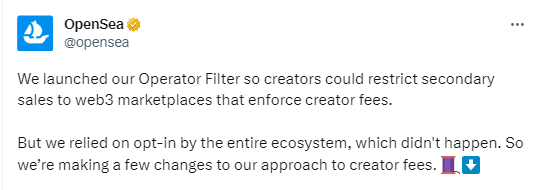
Currently, OpenSea typically provides creators with a royalty fee of around 2.5% to 10% of NFT resales. However, the NFT marketplace is now showing a new approach where artists have the freedom to determine royalty fees according to their wishes. This change will convert those fees into an optional form of tip that shoppers can choose to contribute.
Apart from that, this decision was also influenced by changes in competitive dynamics in the NFT industry which continues to develop. Previously, OpenSea was committed to providing royalties to creators as a form of support for artists and their work. However, currently, this commitment is being reconsidered.
At the same time, this move will also end Operator OpenSea's filter that previously prevented NFTs on the platform from being sold to other marketplace competitors.
Meanwhile, for collections that have implemented the OpenSea Operator Filter before August 31, as well as for collections that already exist on blockchain networks other than Ethereum, OpenSea will allow the application of an optional royalty fee on all secondary sales transactions from August 31, 2023 to February 29, 2024.
NFT Community Reaction
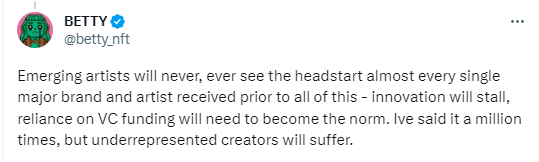
Various critics argue that this change damages the bond between buyers and artists. Apart from that, there are also views that voice concern about the potential negative impact on the financial stability of artists.
OpenSea's enforced removal of creator royalties is a reflection of the challenges the company has faced recently. In addition, the main NFT trading flow has shifted to Blur, causing OpenSea to seek to reduce royalty fees to maintain its competitiveness. This response also includes reactions from content creators who have expressed their views through posts on social media, highlighting the importance of artists' rights.
From a different point of view, OpenSea CEO, Devin Finzer, explained that this change is a step towards giving strength to innovation and adaptability. Additionally, it acknowledges the limitations of previous models and encourages content creators to explore alternative strategies.