
#4212
4212
3 views
2 Discussing
Hot
Latest

·
--
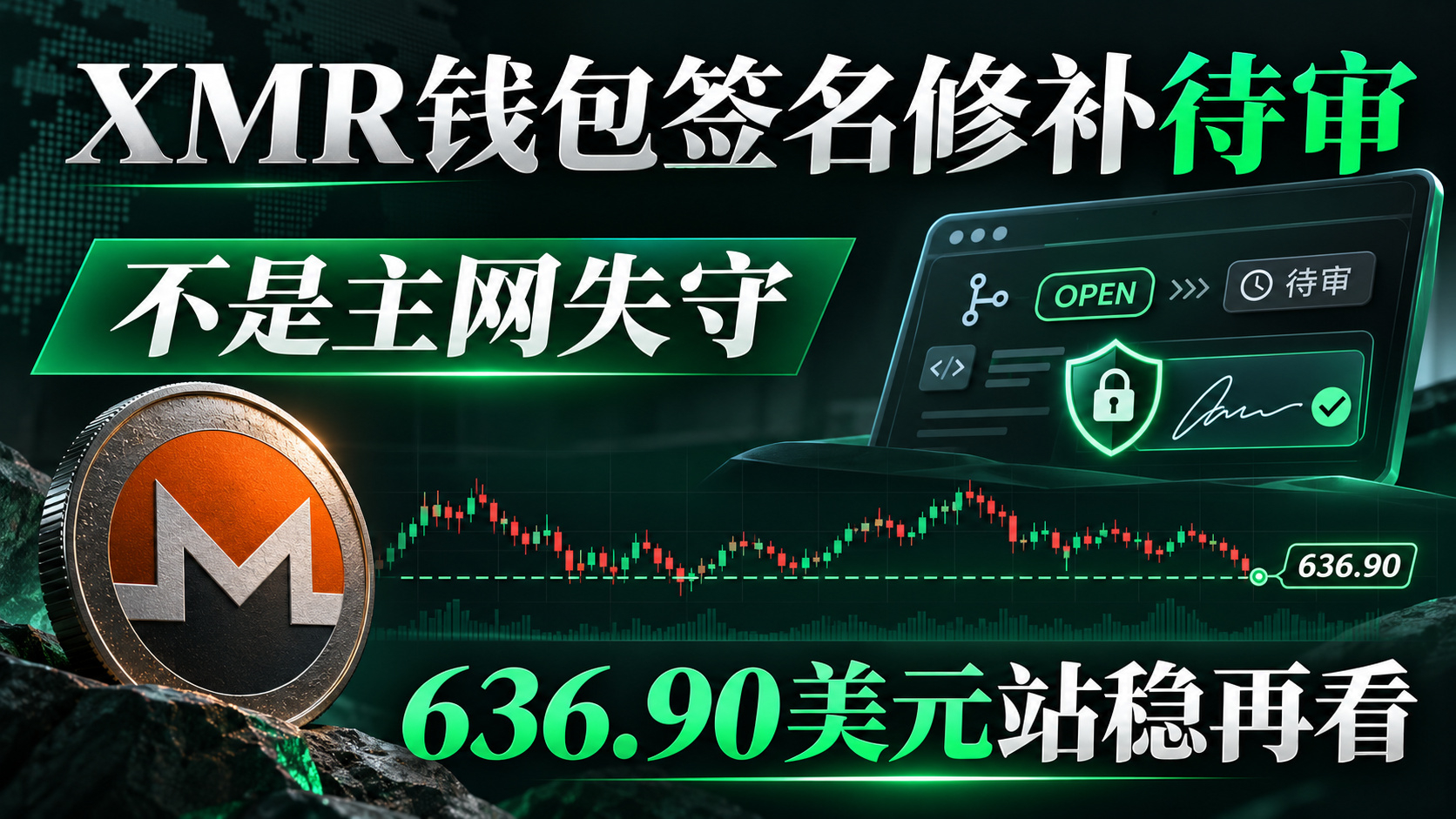
XMR wallet signature fix enters review|Not a mainnet breach|Consider a test position only above $636.90
My approach is to verify the risk boundaries first, then look at the price—not chase a code-related headline. Today, Binance Square’s trending topics are still mainly about platform withdrawals, a French tax case, and macroeconomics. XMR is not marked as “trending upward” among the six-hour Most Searched results, so I won’t force an irrelevant trending tag onto this piece; instead, I’ll focus on a specific change that just appeared in Monero’s official code repository.
A new PR, #11675, was opened in Monero’s main repository on November 3. Titled “wallet: reject unverifiable message signatures,” it was still Open and pending review when I wrote this. The submitter explains that a view-only wallet has no spend private key available. If the wallet API or RPC signs using the spend private key by default, a production build may return a message signature that cannot be verified. The proposed patch checks before signing whether the selected private key corresponds to the address’s public key, and has the API or RPC return an error if they do not match. It also checks both public keys for an explicitly specified address to prevent a signature from failing to match that address. This concerns the feature for “proving that a particular message was signed by a particular address”; it is not an on-chain transaction signature, and there is no evidence that private keys were exposed as a result, that the mainnet was compromised, or that funds were stolen.
I also checked an older issue, #4212, in the Monero GUI repository from 2023. It had already documented the scenario in which a view-only wallet mistakenly uses a spend key and produces a signature that cannot prove its own validity. The CLI/RPC has an explicit option to select a view key for signing. The new PR addresses this edge case; it does not mean the problem only arose today. The claim that the PR passes tests comes from the submitter, and pending review does not mean it has already been merged or released. The latest official version on the website is 0.18.5.4, released on October 16, and I have not seen an official announcement that this fix has made it into a stable release. Anyone using a view-only wallet to prove ownership of assets should verify that the signature actually passes verification rather than treating “a string was generated” as proof that the process is complete.
Why does this matter for trading? XMR’s privacy features mean third parties rely more heavily on compliant channels, wallets, and verifiable evidence of operations. The credibility of proof processes matters for custody and over-the-counter settlement, but a wallet fix that has not yet been merged does not automatically change on-chain supply or create buying demand in the short term. Recent FATF reviews of virtual asset service providers did not single out XMR, so we should not invent a ban or a bullish catalyst based on that. The Federal Reserve’s latest decision kept the target range at 3.75% to 4%, and macro liquidity remains a background variable. At the time of writing, XMR/USD was around $632.47 on Kraken, with a daily open of $630.00 and a 24-hour range of $602.20 to $636.90. It is slightly stronger than the daily open, but has not broken the top of the range, so the rise cannot be attributed to this PR.
If I were trading this myself, I would stay out for now and consider only a leveraged-free spot long. I would wait for an hourly close to hold above $636.90 and a pullback to hold at $635, while also confirming that quotes and deposits and withdrawals are operating normally on the trading channel I use. Then I would test the position with no more than 2% of my total capital. The first target is $650, where I would halve the position; the second is $665, with a trailing stop on the remainder. The initial stop-loss is $624. If the price breaks below $630 and fails to recover, the PR review reveals more serious security information, or the channel suddenly tightens restrictions, I would close the position early. If none of these conditions are met, I would remain in cash. I will not present a plan as if it were an executed trade.
#XMR
The above is solely my personal market observation and does not constitute investment advice.
73
Log in to explore more content
Join global crypto users on Binance Square
⚡️ Get latest and useful information about crypto.
💬 Trusted by the world’s largest crypto exchange.
👍 Discover real insights from verified creators.
Email / Phone number
Trending Topics
1
#BTCRebounds80K
30,966 views
554 Discussing
2
#Binance98PercentReplenished
26,998 views
482 Discussing
3
#USMidterms-WhatAreMarketsExpecting?
302,141 views
1,975 Discussing
4
#USOctoberNFP-AreRateCutsStillPossible
375,522 views
2,777 Discussing
5
#AMDBeatsExpectations-AINarrativeContinues
87,293 views
754 Discussing
6
#CircleQ3Revenue865M
23,674 views
422 Discussing
7
#BinanceIncidentReport
508,461 views
2,093 Discussing
8
#USStocksOpenHigherAsDowGains1.9%
3,989 views
68 Discussing
9
#ADPUSPrivateEmployersAdd86000JobsInOctober
2,956 views
46 Discussing
10
#FrenchAssemblyPassesSelfCustodiedCryptoReportingAmendment
816 views
22 Discussing