
#11707
11707
1 views
2 Discussing
Hot
Latest

·
--
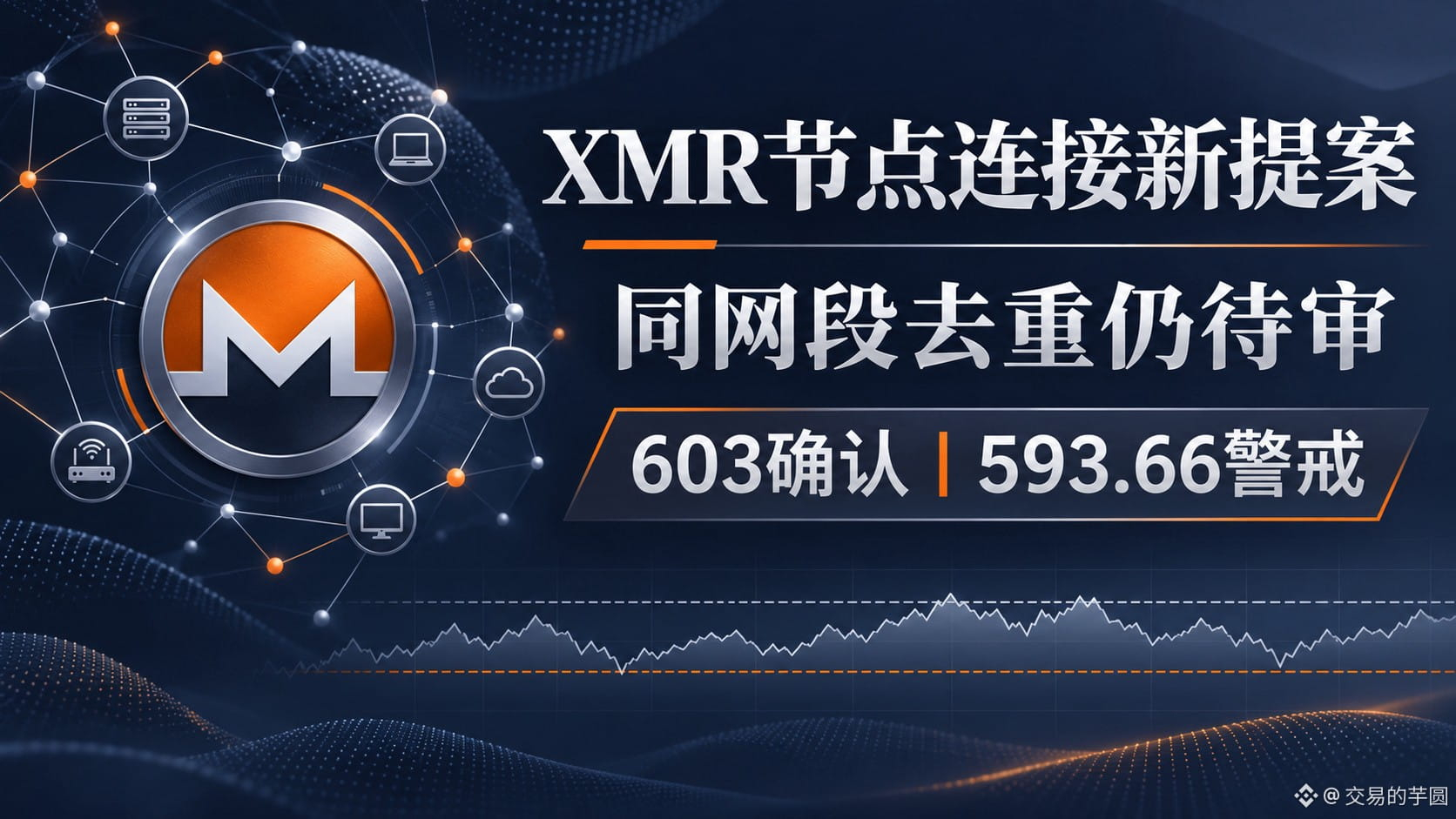
XMR node-connection proposal makes progress | Outbound subnet deduplication still under review | I’m not chasing near $600
My stance is to wait and see whether the project’s security improvements are actually merged, rather than treating code review as a price catalyst. A new PR, #11707, opened today in Monero’s official code repository proposes changes to P2P outbound connections and node-list management: deduplicating outbound nodes by network group, using /16 for IPv4 and /32 for IPv6, and bucketing the graylist by source and the whitelist by network group. The goal is to reduce the chance that a single source or network group occupies too many candidate slots. The PR description also lists other node-selection and offline-node cleanup changes on which it depends. The PR is currently still Open and has not been merged; this does not mean the mainnet has been upgraded, nor does it confirm that a large-scale attack has occurred. My previous article discussed a proposed warning for suspected double-spends on merchant payment screens. This one covers node-connection diversity—a different risk area.
Why should traders care? The value of a privacy coin depends not only on its transaction format, but also on wallets being able to connect reliably to a trustworthy view of the network. If outbound connections are overly concentrated in the same hosting network, the information nodes see may lack source diversity, affecting both connection quality and resilience to disruption. The proposed subnet deduplication and list bucketing are network-resilience measures: they reduce the chance of a single network group dominating the available slots, but they could also shrink the pool of usable connections in some regions or under certain provider structures. That is why code review and real-world network testing are needed. The design goal should not be presented as a proven protective effect, let alone as a solution to every privacy or censorship risk. For ordinary holders, the practical steps remain using a trusted wallet, checking node synchronization status, and distinguishing proposals from official releases.
The price gives me no reason to chase. At the time of writing, XMR/USD on Kraken was around $599.99, with a rolling 24-hour open of $600.02, a high of $614.75, and a low of $593.66. It has pulled back from its high to around $600, but this move alone does not show that the PR caused it, nor can we infer that the market has fully priced in the developer discussion. The main trending topics on Binance Square this round are exchange withdrawals, wallet security, macroeconomics, and regulation; XMR also does not appear in the six-hour Most Searched list, so I’m not adding unrelated trending tags. More importantly, I’ll be watching whether the PR passes review, whether reproducible tests are available, and whether an official release follows. If the review uncovers new connection-degradation issues, I’ll withdraw my positive assessment of this improvement. On the price side, $614.75 is the 24-hour high and $593.66 the low; $600 is not inherently support.
If I were trading this myself, I’d stay out for now, remain neutral, keep my position at 0%, and avoid high leverage. I’d consider buying spot XMR only if an hourly candle closes back above $603, the price retests and holds between $600 and $603, and exchange quotes and deposit/withdrawal services are normal—with a maximum allocation of 0.4% of total capital. The first target is $608, where I’d sell half; the second is $614, where I’d close the rest. Hard stop at $596. If, after entry, the price closes back below $600 for a full hour, I’d also close the remaining position. If the price breaks below $593.66 before entry, this plan is canceled; I’d wait for a new structure before making another plan. The code is still a proposal under review, so any position must be small. No trigger means no trade, and certainly no profit to record.
#XMR
The above is solely my personal market observation and does not constitute investment advice.
1
Log in to explore more content
Join global crypto users on Binance Square
⚡️ Get latest and useful information about crypto.
💬 Trusted by the world’s largest crypto exchange.
👍 Discover real insights from verified creators.
Email / Phone number
Trending Topics
1
#BinanceReopensWithdrawalsForHYPE&APT
38,086 views
610 Discussing
2
#SouthKoreaDraftLawTargets15To20%ShareholderCap
42,320 views
417 Discussing
3
#TradFiForBeginners
149,101 views
1,575 Discussing
4
#KeplrAdvisesSocialLoginUsersToTransferAssets
26,656 views
394 Discussing
5
#TetherPlans€28.8MForJuventusCapitalIncrease
15,404 views
303 Discussing
6
#JobsReportRaisesHikeOdds
780,039 views
4,296 Discussing
7
#CPITestsDecemberRateOutlook
301,023 views
1,794 Discussing
8
#US Data Center Rules May Constrain AI Expansion
115,779 views
257 Discussing
9
#ARKPlans14ThematicETFsCoveringAIAndTokenizedMarkets
7,982 views
86 Discussing
10
#WillAnthropicListOnTime
249,762 views
1,836 Discussing