


When I try to understand a blockchain, I usually start by asking a simple question: what role does its native token actually play? Not in theory, not in whitepaper language, but in the day-to-day mechanics of how the network operates. With Plasma, that question leads inevitably to XPL. And the more I look at it, the clearer it becomes that XPL is not an abstract asset layered on top of the system — it is embedded into how Plasma functions, scales, and stays secure.
Plasma is a Layer 1 blockchain designed for stablecoin settlement. Its priorities are speed, predictability, and usability. Stablecoins are the primary medium of exchange, and gas abstraction reduces friction for users. In that context, XPL doesn’t exist to compete with stablecoins or replace them. It exists to coordinate the network itself.
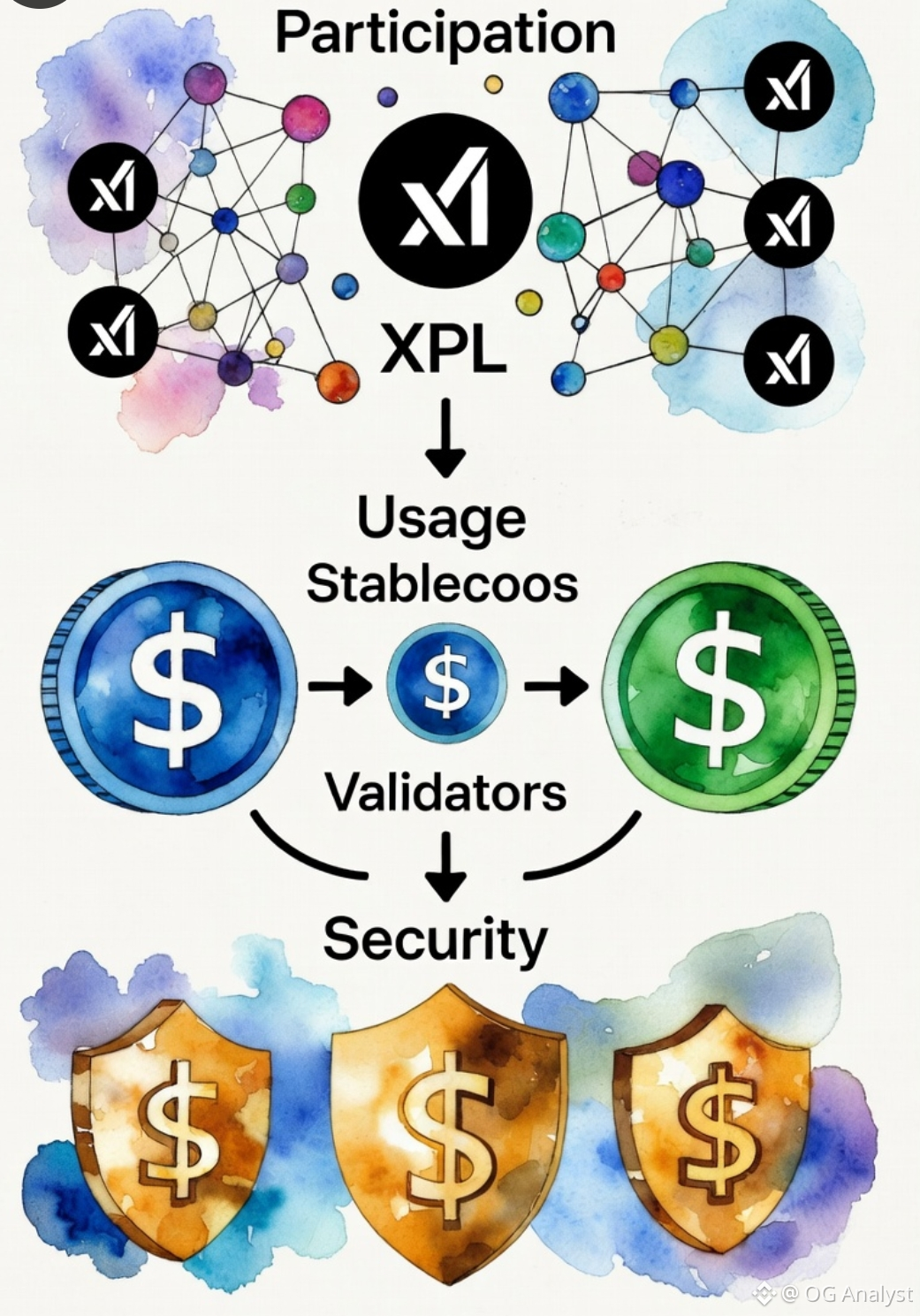
Participation Starts with XPL
Every decentralized network needs a way to decide who participates and how. In Plasma, XPL serves as that entry point. Validators stake XPL to take part in consensus, aligning their economic incentives with the health of the network. This staking requirement isn’t decorative — it ensures that those producing and finalizing blocks have something tangible at risk.
From my perspective, this is where XPL’s role becomes concrete. Participation isn’t open-ended or symbolic. It is earned through commitment. By staking XPL, validators signal long-term alignment with Plasma’s mission as a stablecoin settlement layer, rather than short-term opportunism. That design choice matters for a network that aims to process real economic value at scale.
Usage Without Friction, Backed by XPL
One of Plasma’s defining characteristics is its stablecoin-first experience. Users can transact in USD₮ without worrying about native token balances, volatile gas fees, or complex onboarding steps. But removing friction at the surface doesn’t remove the need for structure underneath.
XPL quietly supports this usability. It absorbs complexity so users don’t have to. Whether through validator incentives, protocol-level gas abstraction, or internal accounting, XPL ensures the network can offer a smooth experience without sacrificing sustainability. In that sense, it functions like infrastructure — rarely visible, but essential.
I find this separation deliberate and thoughtful. Plasma doesn’t ask users to care about XPL to make a payment, but it relies on XPL to make that payment reliable.

Security Rooted in Economic Reality
Security in Plasma is layered. PlasmaBFT provides fast, deterministic finality. Bitcoin anchoring strengthens long-term immutability. XPL fits into this picture as the economic glue that binds participants to honest behavior.
Staked XPL creates consequences. Misbehavior isn’t just reputational; it is economic. This is especially important for a settlement layer, where trust assumptions need to be minimized and clearly defined. XPL turns abstract protocol rules into enforceable commitments, reinforcing Plasma’s credibility as a financial network rather than just a technical experiment.
A Token With a Narrow, Intentional Scope
What stands out to me most is what XPL doesn’t try to be. It isn’t positioned as digital money for everyday spending. It doesn’t compete with stablecoins for transactional dominance. Instead, it stays focused on protocol health, participation, and security.
That restraint is a strength. By narrowing its scope, XPL avoids unnecessary complexity and aligns tightly with Plasma’s broader design philosophy: stablecoins for value transfer, infrastructure tokens for coordination.
Conclusion
Ultimately, XPL is the key that unlocks participation, usage, and security in the Plasma ecosystem — not by demanding attention, but by quietly enabling everything else to work. It anchors incentives, secures consensus, and supports a user experience centered on stablecoins rather than speculation.
In a landscape where many tokens struggle to justify their existence, XPL feels intentionally placed. Its relevance comes not from visibility, but from necessity. And in systems built to move real money at scale, that kind of quiet importance is exactly what lasts.
XPL as Signal: Reading Market Confidence in Plasma’s Vision
When I look at the performance of XPL, I don’t treat it as a scoreboard. I see it more as a signal — an imperfect, shifting reflection of how the market interprets Plasma’s technical and product decisions over time. Price movements alone don’t tell the full story, but they often reveal whether participants believe the system underneath is coherent, durable, and useful.
Plasma is not a general-purpose blockchain chasing every trend. It is a Layer 1 built deliberately for stablecoin settlement, optimized for speed, predictability, and low-friction usage. XPL exists within that context, not above it. Its behavior in the market often mirrors how clearly that vision is understood — and how credible it feels to those watching from the outside.

Beyond Price, Toward Interpretation
I’ve learned to be cautious about drawing direct conclusions from token charts. Short-term movements are noisy, influenced by sentiment, liquidity, and macro conditions far beyond any single protocol’s control. Still, over longer periods, patterns begin to emerge.
When confidence grows in Plasma’s ability to deliver sub-second finality, stablecoin-first gas models, and Bitcoin-anchored security, that confidence tends to surface indirectly through XPL. Not as a promise of returns, but as a measure of perceived relevance. In that sense, XPL’s performance becomes a proxy for belief — belief that Plasma’s design choices are practical, not theoretical.
Why Vision Matters More Than Narrative
What makes this interesting is that Plasma’s vision is relatively narrow. It does not attempt to redefine every aspect of blockchain. It focuses on settlement — a part of the stack that only works if it is reliable, boring, and predictable.
XPL reflects that restraint. Its role is tied to participation, security, and protocol economics, not everyday payments. When the market assigns value to XPL, it is implicitly acknowledging that Plasma’s specialization has merit. That the problem it is solving — efficient stablecoin settlement — is real, persistent, and underserved.
This kind of validation tends to be quieter than hype-driven cycles. It accumulates slowly, through usage, integrations, and operational clarity.
Technical Credibility as Economic Feedback
From my perspective, the most meaningful moments for XPL are not speculative spikes but periods of stability following tangible progress. Improvements in network performance, validator participation, or developer adoption feed into how the token is perceived.
Because XPL is embedded in Plasma’s core operations, its performance is sensitive to whether the protocol feels technically sound. If PlasmaBFT continues to deliver consistent finality, if gas abstraction remains sustainable, if Bitcoin anchoring strengthens trust — those are the factors that gradually influence confidence.
In that way, XPL acts as economic feedback. Not instantaneous, not always fair, but informative.
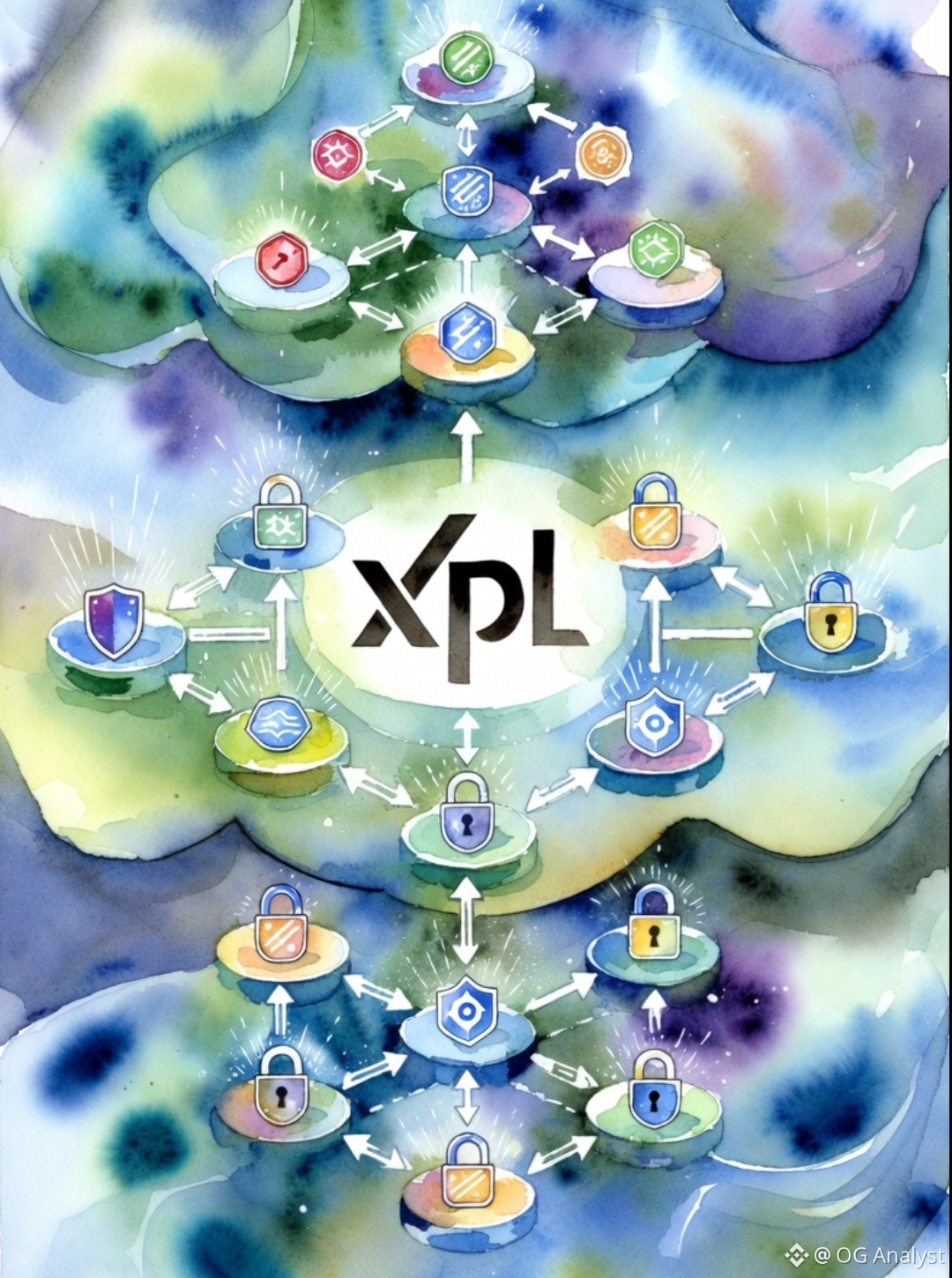
Market Belief Is Earned, Not Declared
What I appreciate about Plasma’s approach is that it doesn’t try to force belief. There is no attempt to overstate what XPL represents. Its role is clearly defined, its scope intentionally limited.
That clarity allows the market to evaluate Plasma on its own terms. When participants choose to engage with XPL, they are effectively endorsing Plasma’s technical discipline and product focus. When they hesitate, it signals areas where trust or understanding still needs to be built.
Conclusion
XPL’s performance is not a verdict, but it is a conversation. It reflects how the market interprets Plasma’s choices — its architecture, its priorities, and its commitment to stablecoin settlement as infrastructure rather than spectacle.
Viewed this way, XPL becomes less about momentum and more about meaning. A proxy not for excitement, but for confidence. And in systems designed to move real value at scale, confidence grounded in execution is the signal that matters most.
