

The Place Your Crypto Life Leaks First
Most people in crypto don’t fear “storage.” They fear liquidation, bad fills, smart contract bugs, a chain halt, an exchange freezing withdrawals. Storage feels like the boring part you outsource to the universe. You assume the bytes will be there when you come back. You assume the trail you leave behind isn’t part of the threat model. Walrus shows why that assumption is the softest surface in the room, because storage isn’t just where data lives. Storage is where behavior becomes legible.
Walrus feels different to live with because it doesn’t treat data like a passive object. It treats data like an obligation. When you push something into a system like this, you’re not just saving a file. You’re asking a network of strangers to hold a promise for you, across time, upgrades, churn, and all the boring chaos that eventually breaks “good enough” infrastructure. Walrus went to mainnet in March 2025 with a decentralized network of over 100 storage nodes, and the emotional shift matters: you stop relying on a single operator’s goodwill and start relying on a process you can verify. 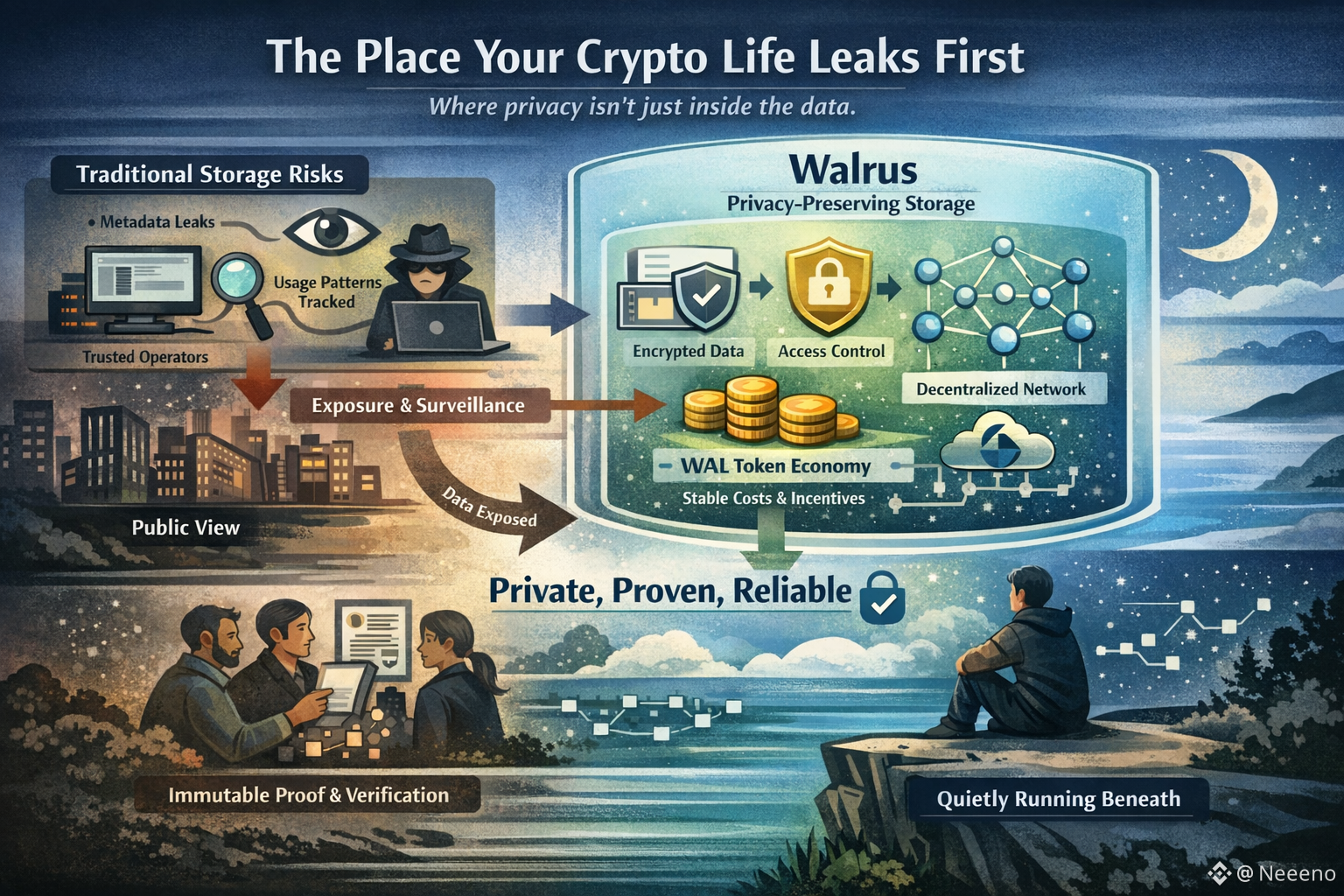
What changes everything is realizing that privacy isn’t only about what’s inside the data. It’s also about the shape of your life around it.
When you access or update data, you’re quietly giving away clues—your priorities, your habits, your connections, and your intentions. The file might be encrypted, but the “who/when/how often” can still be visible, and that can tell a story. Most systems are content-focused, so they congratulate themselves when the payload is unreadable. Walrus forces the more uncomfortable question: what does the network learn anyway, just by watching you exist?
If you’ve ever built something social onchain, you’ve felt the tension. People want permanence until permanence turns into exposure. They want receipts until receipts turn into surveillance. They want public composability until the publicness starts to feel like living with the curtains open. In the Walrus world, the goal isn’t to make everyone’s life perfectly private in some absolute way. The goal is to reduce how much the infrastructure itself betrays you by default, so privacy isn’t a special request you have to remember to make when you’re tired and shipping under pressure.
This is where Walrus stops being an abstract “storage layer” and becomes a human system. Under stress—during a market event, a community conflict, a compliance scare—people don’t carefully re-architect their data flows. They react. They patch. They delete. They scramble to prove what happened. Storage becomes the battleground because it’s where claims get anchored. When someone says, “That screenshot is fake,” or “That dataset was altered,” or “We never said that,” you don’t solve the disagreement with vibes. You solve it with durable evidence. Walrus is built around making that evidence harder to quietly rewrite, while still giving builders room to keep sensitive context from becoming public collateral damage.
The quiet trick of Walrus being built inside the Sui ecosystem is that “practical” starts to replace “theoretical.” Fast finality and parallel execution don’t feel like marketing terms when you’re dealing with real users and flaky networks. They feel like the difference between an upload that fails three times on mobile and an upload that completes before the user loses patience. Walrus’s own mainnet announcement called out changes like letting storage nodes present publicly trusted certificates so web clients can interact more directly, and adding token-based authentication for publishers so access isn’t an afterthought.
It’s not flashy work, but it’s the kind you do when you’re designing for real users, not just experts. Privacy also doesn’t come from one simple switch in the real world.
It’s a layered discipline. Walrus leaned into that in 2025 by pushing access control and encryption into the core experience, framing it as necessary for real-world data—health data, financial workflows, agent activity—where “just encrypt it yourself” isn’t enough if the surrounding system still leaks who can touch what. In their 2025 review, the Walrus Foundation made privacy a central theme and positioned built-in access control as a turning point for what developers could safely build on top
But the more honest you get about privacy, the more you have to admit what doesn’t go away. Inference risk is stubborn. Even the best access control can’t magically erase every behavioral trace if your application is constantly broadcasting patterns elsewhere. That’s why Walrus matters: it doesn’t pretend storage is neutral. It treats storage as part of the privacy budget. It tries to shrink what the network must learn in order to do its job, because the easiest leak is the one nobody thinks to plug.
Then there’s the part traders notice: the token. WAL is not just a badge or a governance checkbox in the Walrus story. It is the way the system translates long-term responsibility into something measurable. Walrus explicitly frames WAL as a payment token designed so storage costs can stay stable in fiat terms even if the token itself is volatile, with users paying upfront for a fixed duration and those payments being distributed over time to the network participants who keep the promise alive. This matters because predictable costs are a form of emotional safety for builders—if you can’t forecast the bill, you can’t responsibly commit to permanence.
And volatility is real, not theoretical. As of the latest public market data, WAL has a circulating supply around 1.577 billion and a market cap in the low-to-mid $200M range, updating continuously with price and volume. That’s not a flex; it’s context. It means the token is liquid enough to be traded, emotional enough to be mispriced, and public enough to drag its own noise into every conversation about the protocol. The job of Walrus is to keep the storage promise coherent even when WAL is being treated like a mood ring.
Walrus also leaned into token design as narrative discipline. In its 2025 year-in-review, the Foundation highlighted broader exchange access and institutional interest, and stated that WAL would be deflationary by design, with burns tied to network usage. There’s a psychological angle here: it’s a way of telling participants, “If you want value, you have to want the network to be used, not just talked about.” Whether you love or hate that framing, it’s an attempt to align attention with responsibility.
The best way to understand what Walrus is doing is to imagine the moment something goes wrong in public. A creator claims their media was swapped. A team claims their training data was tampered with. A DAO claims an opponent is rewriting history. In those moments, the debate isn’t only technical. It’s social.
During conflict, people quickly label others as reliable, dishonest, or dangerous. But if the system can keep strong evidence while still protecting what should stay private, the argument feels less personal and more solvable.. It makes disagreements resolvable without requiring everyone to pick a side based on personality.
That’s also why Walrus’s push into “making it easier to build” is not a convenience story—it’s a safety story. In 2025, the Foundation talked about improving the experience of handling small files efficiently and smoothing uploads so apps don’t need fragile workarounds. The immediate benefit is developer speed. The deeper benefit is fewer custom pipelines that silently leak metadata, fewer ad-hoc gateways that become surveillance chokepoints, fewer “temporary” decisions that later turn into permanent vulnerabilities.
The ecosystem choices reinforce the same theme. The Walrus Foundation launched a Request for Proposals program to fund work that advances the protocol and its surrounding tooling—because a storage network doesn’t become trustworthy just because the core protocol exists. It becomes trustworthy when the boring glue gets built: the things that make correct behavior easier than incorrect behavior. Incentives aren’t only about rewarding nodes; they’re about rewarding builders who reduce the surface area where humans make mistakes.
You can see the shape of that adoption in how projects talk about Walrus when they’re not trying to impress you. The Sui Foundation highlighted Talus selecting Walrus as its default decentralized storage platform for AI agents, framing Walrus as a place to keep agent memory, datasets, and other heavy artifacts that shouldn’t live directly in execution paths. That’s not just “AI narrative.” It’s an admission that autonomous systems need an accountable memory if you want to audit what they did when something goes wrong at 2AM.
And this is where Walrus circles back to the point you started with: privacy isn’t weakest where we expect it. It’s weakest where we stop paying attention. People obsess over execution because execution is where money moves. But storage is where meaning moves. Storage is where your relationships, your history, your proof, your context, and your future audit trail quietly accumulate. Walrus keeps reminding the ecosystem that “encrypted” is not the same as “safe,” and “available” is not the same as “trustworthy.”
If you live inside crypto long enough, you start to recognize the pattern: the infrastructure that gets attention is rarely the infrastructure that keeps you safe. Quiet systems do their work with no celebration, no dopamine hit, no chart-driven adrenaline. Walrus is aiming for that kind of quiet. WAL is the economic language of that quiet—paying for time, paying for custody, paying for behavior that stays honest when nobody is watching. The real milestone isn’t when everyone is talking about it. It’s when nobody is talking about it because nothing is breaking, nobody is panicking, and the data is simply there—private where it should be, provable where it must be, and reliable enough that people stop rehearsing disaster in every design meeting.
That’s the kind of responsibility that doesn’t trend well, but it’s the kind that makes systems worth living in.

