


It started with something small.
I was playing @Pixels the way I usually do — slow, routine, almost automatic. Plant, harvest, complete a few tasks, check what changed. Nothing unusual.
But at some point, I noticed a quiet gap.
Not a bug. Not a mistake.
Just a feeling that what I was putting in… didn’t always match what I was getting back.
At first, I brushed it off.
Games aren’t supposed to feel perfectly linear. A bit of unpredictability keeps things interesting. But the more I played, the more the pattern stayed.
Some sessions felt efficient without much effort.
Others felt heavy — more time, more actions — but somehow less return.
It wasn’t random enough to ignore.
But not clear enough to understand.
Maybe it’s not what it looks like.
That’s when I started looking at it differently.
Not as a player trying to maximize rewards — but as someone trying to understand the system itself.
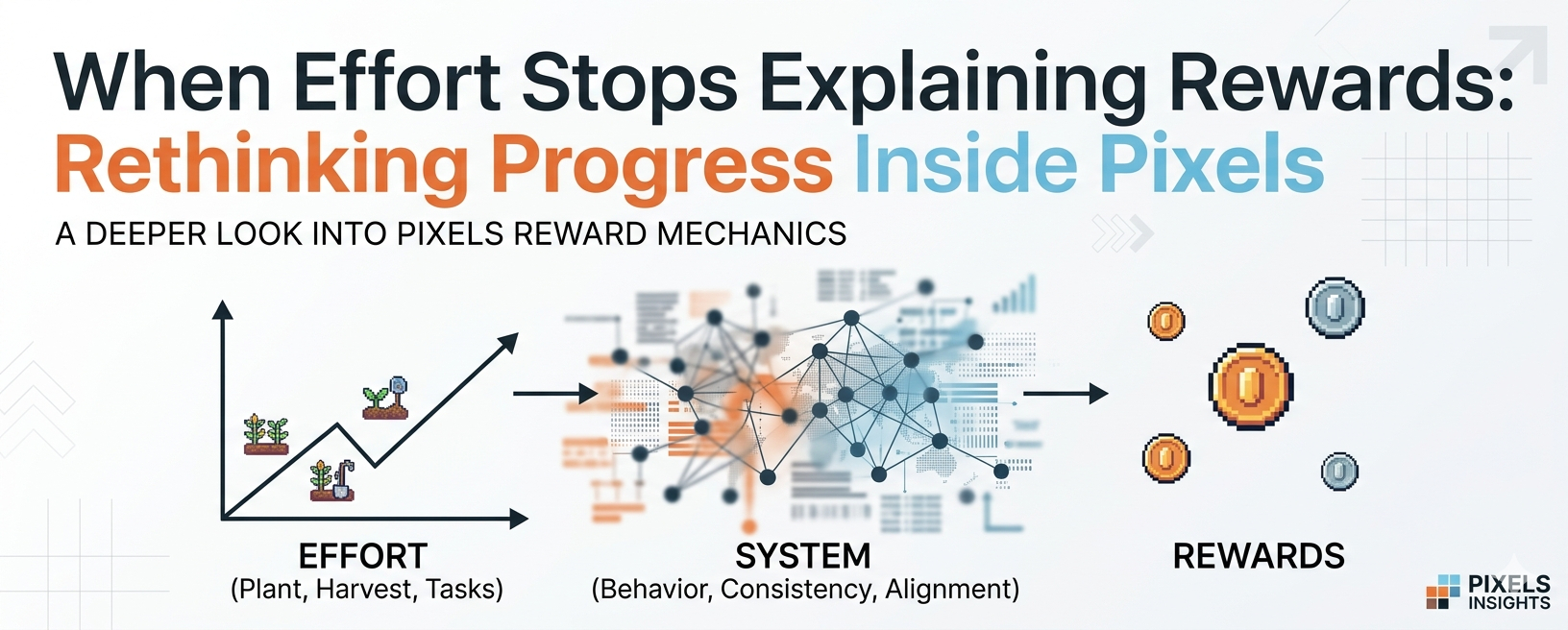
Because on the surface, Pixels feels like a familiar loop:
Do tasks → earn rewards → progress.
But underneath, that relationship feels… softer.
Less direct.
Almost like effort is not the main variable being measured.
The idea of effort vs reward mismatch sounds negative at first.
Like something is broken.
But what if it isn’t?
What if the system is working exactly as intended — just not in the way we expect?
Most reward systems fail for a simple reason.
They make effort too predictable.
And once something becomes predictable, it becomes exploitable.
Players optimize.
Bots arrive.
Economies collapse.
We’ve seen this pattern repeat across Web3 games again and again.
So what if Pixels is trying to avoid that outcome?
What if the system intentionally weakens the direct link between effort and reward — not to frustrate players, but to protect the economy?
That would explain a lot.
The inconsistency.
The subtle friction.
The feeling that doing “more” doesn’t always mean getting “more
Because maybe the system isn’t rewarding effort in the obvious sense.
Maybe it’s tracking something else entirely.
Patterns over time.
Behavior consistency.
Engagement quality.
Decisions that aren’t visible in a single session.
And if that’s true, then the mismatch isn’t real.
It just feels real from the player’s perspective.
Because we’re measuring effort based on what we can see:
Time spent.
Tasks completed.
Energy used.
But the system might be measuring something deeper — something we don’t have direct access to.
Something here doesn’t fully add up.
This becomes even more interesting when you think about how modern game systems are evolving.
Pixels isn’t just a standalone game anymore. It’s part of a broader infrastructure approach, where reward logic is shaped by systems like Stacked — an engine designed to distribute rewards based on behavior, timing, and long-term impact rather than simple task completion.
In that context, rewards stop being fixed outputs.
They become adaptive responses.
And that changes the meaning of progress.
It’s no longer just about doing more.
It’s about aligning — even unconsciously — with what the system values.
But the system never fully explains those values.
Which creates a strange dynamic.
Players are optimizing…without fully knowing what they’re optimizing for...I kept playing, but with a different mindset.
Less focused on maximizing returns.
More focused on observing patterns.
Trying to notice when rewards felt “aligned” — and when they didn’t.
And over time, the system started to feel less like a machine…and more like a conversation.
Not a clear one.
But something responsive.
Still, there’s a tension here.
Because while this design might protect the economy from being exploited…it also introduces uncertainty for the player.
If effort doesn’t clearly translate into reward, then what builds trust?
Clarity?
Consistency?
Or just the belief that the system is fair, even if it’s not fully transparent?
Maybe that’s the real trade-off.
A perfectly fair system is easy to break.
A resilient system is harder to understand.....And Pixels seems to be leaning toward resilience.
Even if it means players sometimes feel that quiet mismatch......I don’t think this is something most players will notice immediately.
It’s subtle.
It builds slowly.
A small doubt here, a question there.
A moment where you stop and think — was that actually worth it?
But once you see it, it’s hard to unsee.
The rewards are there.
The progress exists.
But the connection between effort and outcome feels… indirect.
Almost like something else is shaping the results behind the scenes....So now I’m left with a different kind of question.
Not how to earn more......But how to understand what “earning” even means in a system like this.
Because if effort isn’t the full story…then what is the system really rewarding?$PIXEL
