


Most Layer 1 chain ecosystems refer to theirs as forests, stating, lots of projects will grow here. But builders have frequently gone astray, not merely because of the presence of a forest, but because they must have a shorter and cheaper and less risky route between idea and product and users.
The most important strength of Vanar is that it is commercializing this route. It does not require its teams to go in search of audits, wallets, infrastructure, listings, growth, compliance, and partnerships individually, but rather puts all those needs in a single go-to-market system called Kickstart. This transforms ecosystem into a repeat process and in my notion, it will be a better strategy than introducing another feature.
Should Vanar succeed, it will not be the fastest chain in theory that will be successful, but the one that is easiest to launch on and to keep, so to speak, upon.
The actual bottleneck of Web3 is not the building, it is the assembling.
What most non-builders fail to understand is that code is rarely what fits in the shipment of a Web3 product, it is the lack of pieces that fit in.
You require quality infrastructure. You require security support. You should have pocket-friendly wallets. You need analytics. You need on‑ramps. You require compliance in case you are dealing with payments. You must have distribution, or you will die out unmarked.
On the majority of chains, you get a scavenger hunt: select vendors, agree on costs, assemble tools together, and wish that your launch will not be affected by integration malfunctions.
Vanar is interested in removing that assembly tax by positioning the ecosystem as a bundle platform, rather than a vibe. Kickstart provides one-stop solutions in the agent tools, storage, exchange listing, marketing, compliance/KYC and more.
That is another way of thinking: not quantifying projects, but the speed at which projects can be shipped.
Kickstart does not appear as a crypto grant program but rather as an accelerator menu.
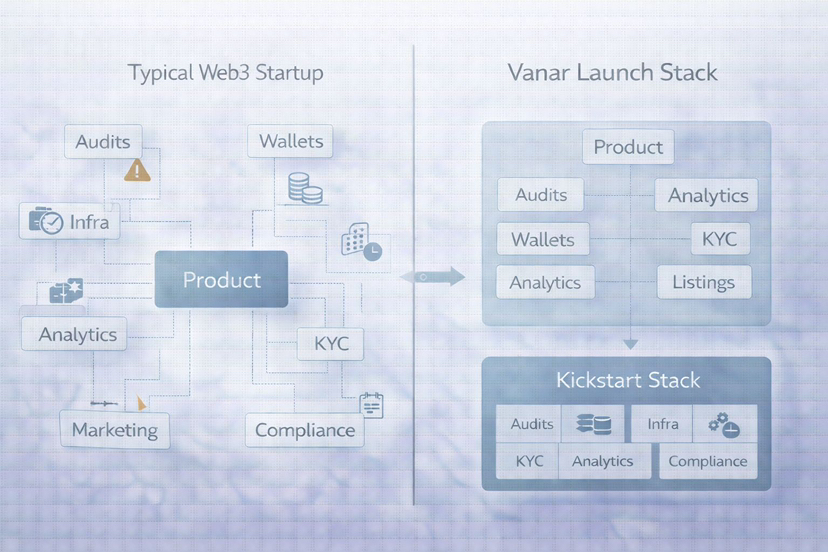 The majority of the chains follow the same playbook - grants, hackathons, shoutouts. Useful, but insufficient.
Kickstart is a partner network that is accelerator based. Service providers offer physical incentives such as discounts, free months, priority services, co-marketing and projects enter a formal course towards them.
This shifts incentives. Partners cannot be mere logos on the wall; they are also looking to find real clients within the ecosystem of Vanar. In exchange Vanar becomes the distributor.
The secret product is that: a market place that provides leverage to builders and new deals to service providers.
It is not partnership announcements but perks that decrease burn rate.
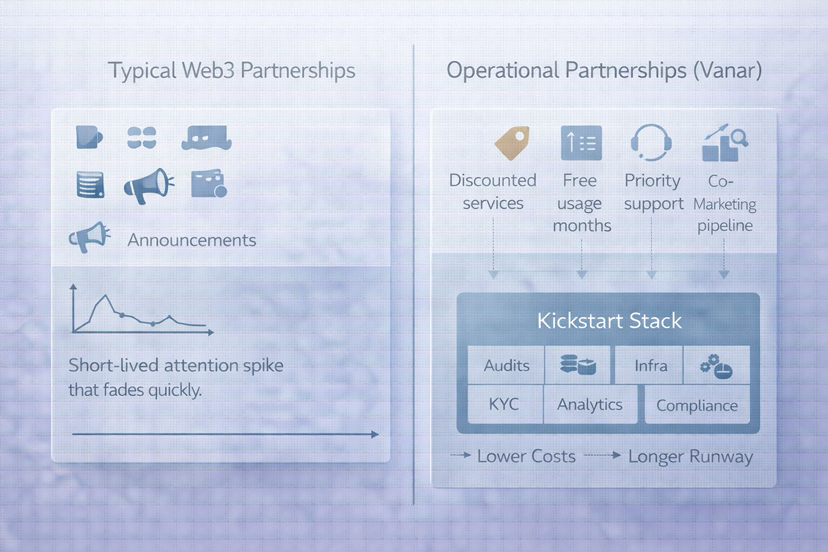 It is simple to write a partnership headline; it is difficult to make it actual assistance to startups.
In Kickstart, the story is told in details. As an example, one of the posts on Kickstart talks about the partners such as Plena Finance, and mentions actual advantages - discounted subscriptions, co-marketing, priority support. Yet another source lists incentives including discounts and early access to features in Plena projects to Kickstarter.
This is a new kind of eco system: it reduces operating expenses and accelerates the launch. Constructors do not require community; they require less time and reduced bills.
When dozens of teams observe the difference, a good standing is made: this chain assists you to ship.
It is treating distribution as infrastructure as opposed to marketing.
It is distribution that makes SaaS companies win. Product does not always win the best distribution does.
The message that Vanar sends in Kickstart is straightforward: we are not going to leave distribution to chance. The program provides growth support and partners in co-branding.
This is important since most L1 ecosystems are delicate, and there are some giant applications, noisy creators and vacuity. An ecosystem is densified by a distribution system that supports numerous small teams to reach the users.
Vanar takes a bet that the density triumphs over celebrity.
The other half of distribution is talent pipeline and Vanar is developing one locally.
The thing is that people overlook the fact that ecosystems are not projects, but people.
Vanar implements community initiatives, which are similar to workforce development, like an AI Excellence Program an internship of AI talent in line with Vanar. It also has pages in which its developer programs and builder programs are advertised.
That is important since the chain that has more trained builders is the long-run winner and not the one that has more announcements.
Vanar also has a regional advantage. It collaborates with clubs in London, Lahore and Dubai. When it transforms local talent into a consistent production, it creates an ecosystem engine that is not dependent on external cycles.
Why this "launch stack" strategy would be relevant to Vanar as a larger enterprise.
Vanar desires to be a product-ready chain - predictable charges, organized information, tools, and corporate tone. An identity is in line with a packaged launch stack.
It is also addressing a classic Web3 problem: builders are drawn to chains, yet cannot onboard users since there is no onboarding, wallets or distribution. According to Kickstart, the chain is not the only part of the product.
That honesty is rare.
The danger: it is possible to make the ecosystems a benefit page without actual success stories.
Any partner network has one risk; it may seem good on a website, but it may be bad in performance.
Discounts and perks are not the final objective. They’re the beginning. The ultimate target is to be successful with apps and revenue. Provided that Kickstart generates actual wins it is a flywheel: additional builders join the program as they get evidence and additional partners join the program as they get deal flow.
Unless Kickstart makes visible launches and retention, it runs the risk of becoming a directory.
Therefore the measure of success is not in the number of partners. It is the number of projects shipped, increased and remained.
The thesis: Vanar is attempting to be the default operating environment of small teams.
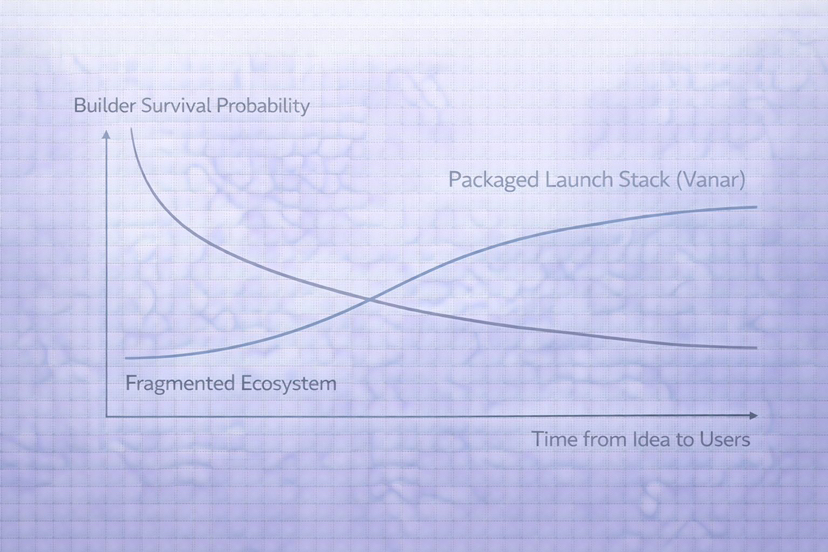 When as you zoom out the ecosystem strategy of Vanar appears like a software platform strategy.
Make the base layer stable. Make developer entry easy. Thereafter provide a packaged path that incorporates pieces that are found on the ground: audits, wallets, infra, growth, compliance, and distribution. That is what makes you the default option when it comes to teams that cannot afford a lengthy integration process.
And that is a strong wedge in an overcrowded L1 market. Since not all teams select the best chain. They select the chain that enables them to ship before time and money elapse.
Conclusion: the chain which assists the builders to survive will grow the chain only promising the builders.
The Kickstart strategy of Vanar is a bet on a very simple thing, which is that builders do not need another narrative. They require a reduced route to production and users.
Vanar is attempting to make ecosystem building a real product by bundling partner perks, support lanes, and distribution engines into one system. Assuming that they continue to do this as a real platform, with results, as opposed to pages, it makes it one of the most powerful, realistic differentiators in Web3.
Since eventually, it is not hype that makes things adopted. It is a gift of numerous teams delivering numerous useful things- and a chain that makes shipping seem natural.
