

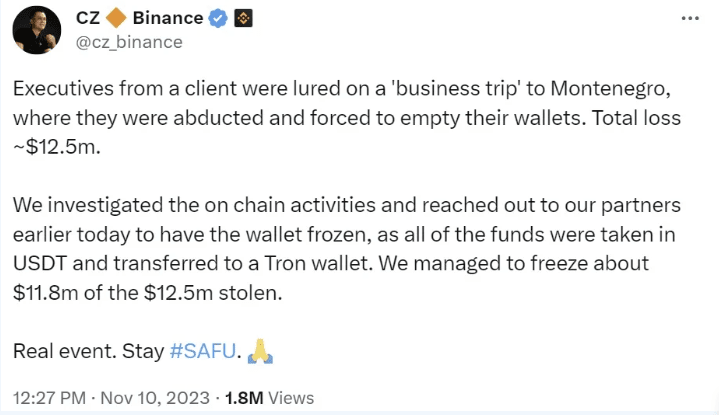
Binance CEO Changpeng Zhao recently shared a story of how some executives of Binance were abducted and forced to empty their crypto wallets.
@CZ detailed how the cryptocurrency exchange was able to track the transactions and freeze over 94% of the stolen funds.
Changpeng Zhao recently shared a story illustrating how Binance successfully froze stolen funds after executives of one of the exchange's clients were abducted and compelled to empty their crypto wallets.
The incident, as detailed by CZ, resulted in the loss of approximately $12.5 million for the affected executives.
In response to this unfortunate event, Binance took immediate action by investigating the on-chain activities of the crypto transactions.

Subsequently, the exchange collaborated with its partners to freeze the wallet containing the stolen funds.
Remarkably, Binance was able to freeze an impressive $11.8 million, equating to 94.4% of the total stolen amount. Notably, all the funds were in tether #USDT and had been transferred to a #TRON wallet.
#CZ further elaborated on the balance between the security of crypto assets and the flexibility of fiat currencies in banks. He emphasized the importance of choice, noting that the use of certain cryptocurrencies, such as Monero $XMR , might provide users with a greater degree of privacy and autonomy.
Additionally, he highlighted the traceability of $BTC and the potential for temporary freezes when transacted through centralized exchanges.
The response protocol of Binance in the event of stolen funds being sent to the exchange was also clarified by Binance Customer Support. They explained the standard procedure, including the possibility of a temporary courtesy freeze of allegedly stolen assets, contingent upon the provision of relevant information.
Notably, to sustain the frozen status of stolen assets, users are required to furnish a police report within a specific timeframe, with the potential for extensions on a case-by-case basis to accommodate the acquisition of said report.
In the midst of these developments, Binance unveiled a #Web3Wallet designed to simplify self-custody practices. The Web3 wallet, integrated within the Binance app, was described as a self-custodial crypto wallet featuring a distinctive security measure where a user's private keys are divided into three smaller parts known as key-shares.
Ultimately, two out of the three key-shares are under the control of the users, emphasizing the intentional design of the Web3 Wallet to empower users with increased control over their assets.
By effectively recounting this remarkable story, CZ has provided an insightful perspective on Binance's proactive measures in safeguarding assets and reinforcing the importance of choice and control in the world of #cryptocurrency
What do you think about the story shared by CZ?
Let us know in the comments below.👇