
Haneul 하늘
6.1k Posts

Haneul 하늘
Open Trade
Frequent Trader
10.4 Months
1 Following
13.7K+ Followers
5.2K+ Liked
Posts
Portfolio
All
Live
Lately, I’ve been paying more attention to what actually sits underneath the privacy narrative in crypto.
A lot of projects talk about ZK, but when I looked deeper into $DUSK , the architecture caught my attention.
It’s not just one fancy cryptographic tool doing everything.
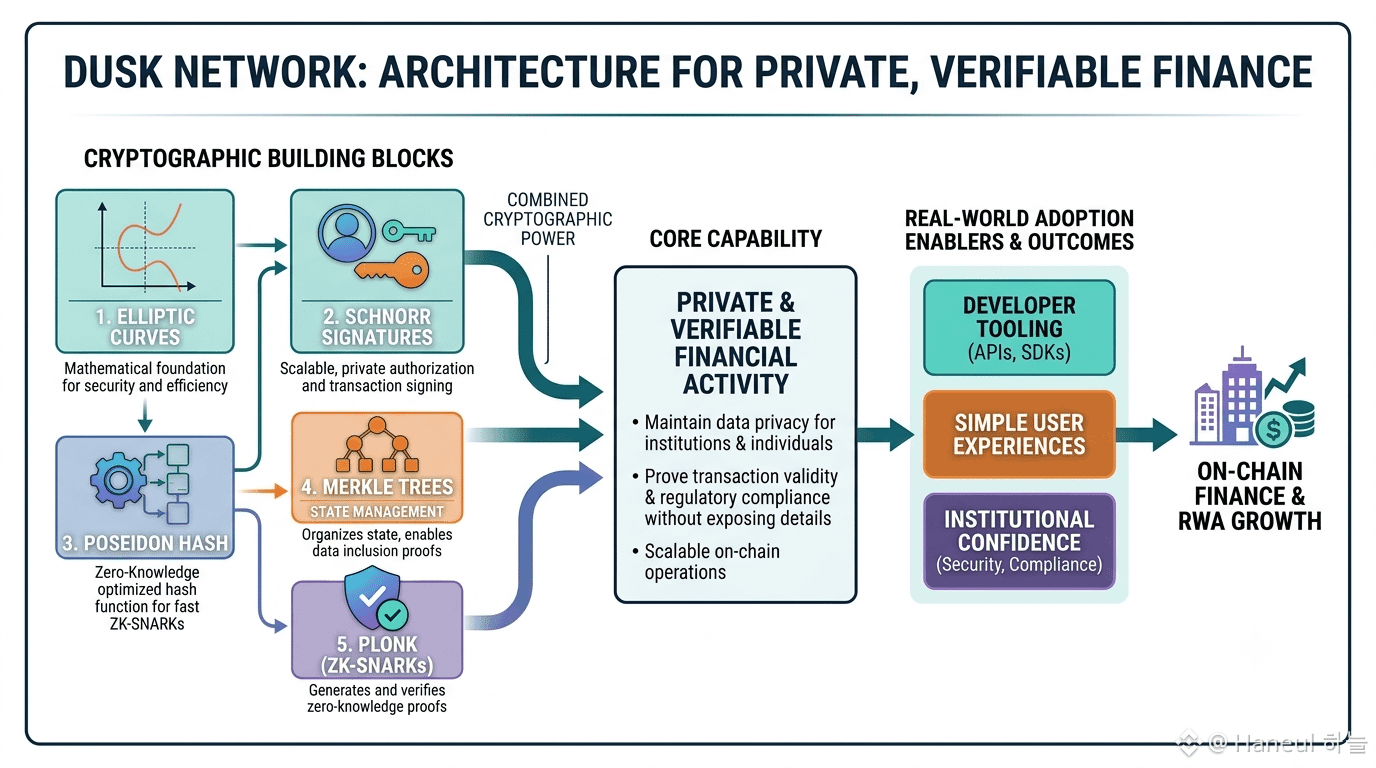
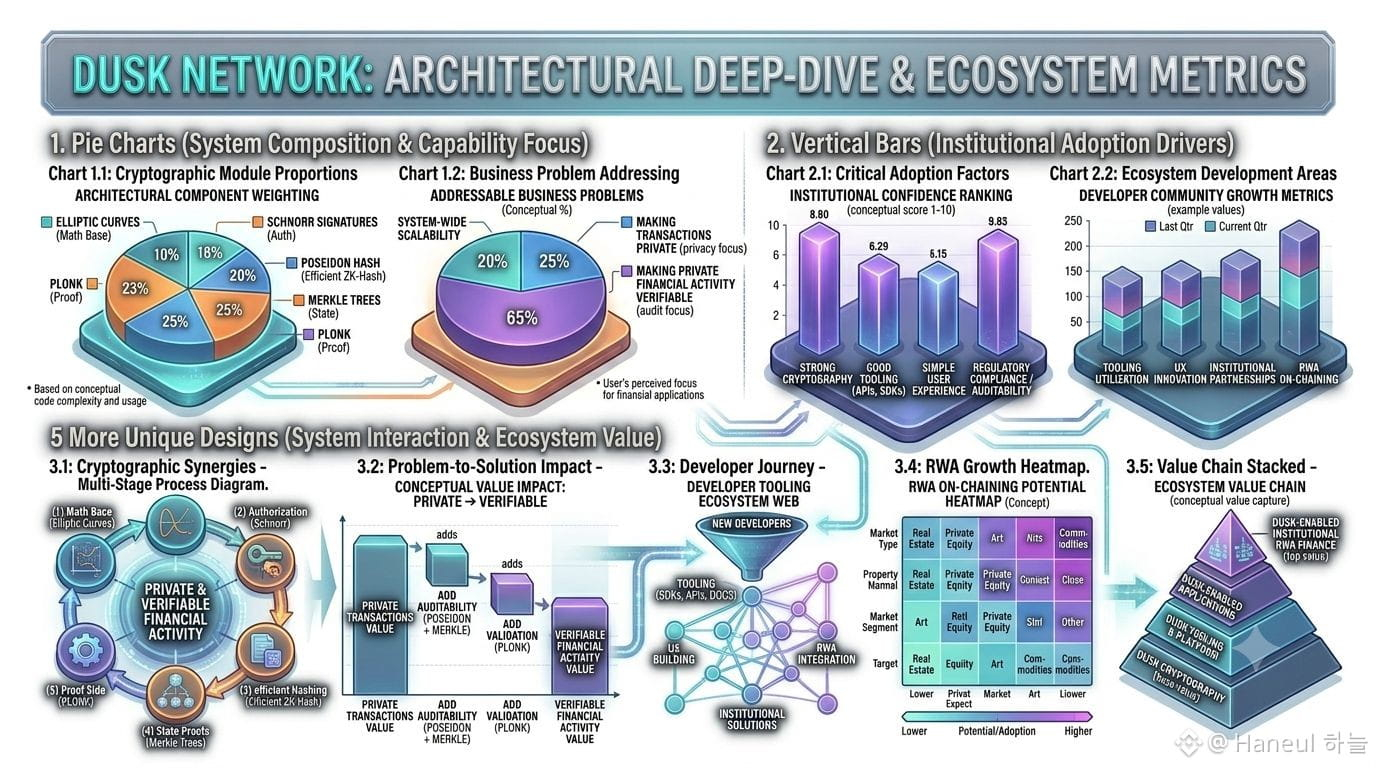
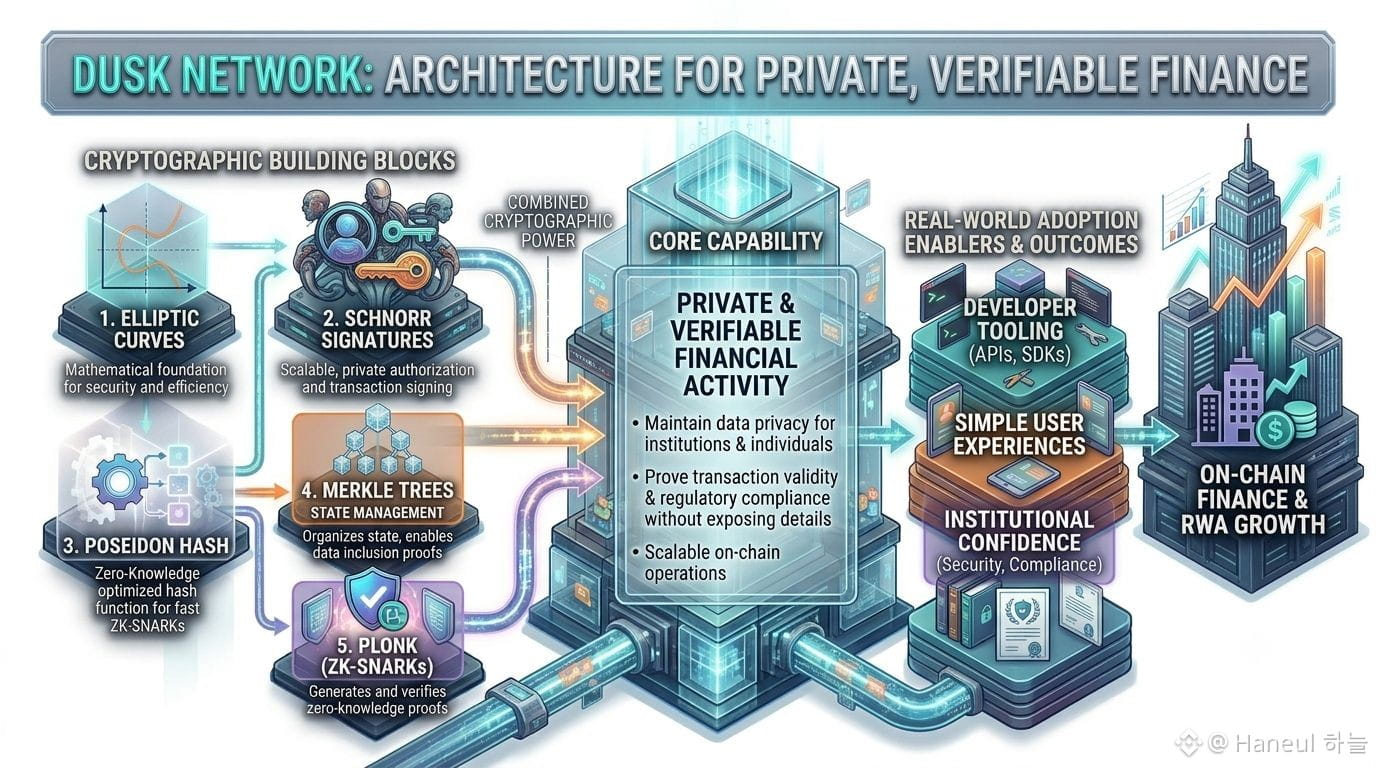
The curves provide the mathematical base. Schnorr helps with authorization. Poseidon is built for efficient hashing in ZK systems. Merkle trees keep state organized and verifiable, while PLONK handles the proof side.
I think that combination is where things get interesting.
For financial apps, privacy alone isn’t enough. You also need to prove that something is valid without exposing everything behind it.
That’s the part I find easy to overlook.
I’ll be honest, though: strong cryptography doesn’t automatically mean adoption. Developers still need good tooling, users need simple experiences, and real financial institutions need confidence in the whole system.
From what I’ve seen, #dusk is trying to solve a much more practical problem than simply “making transactions private.”
It’s trying to make private financial activity verifiable.
And honestly, I think that distinction could matter a lot as RWAs and on-chain finance keep growing.
#dusk
@Dusk
$DUSK
A lot of projects talk about ZK, but when I looked deeper into $DUSK , the architecture caught my attention.
It’s not just one fancy cryptographic tool doing everything.
The curves provide the mathematical base. Schnorr helps with authorization. Poseidon is built for efficient hashing in ZK systems. Merkle trees keep state organized and verifiable, while PLONK handles the proof side.
I think that combination is where things get interesting.
For financial apps, privacy alone isn’t enough. You also need to prove that something is valid without exposing everything behind it.
That’s the part I find easy to overlook.
I’ll be honest, though: strong cryptography doesn’t automatically mean adoption. Developers still need good tooling, users need simple experiences, and real financial institutions need confidence in the whole system.
From what I’ve seen, #dusk is trying to solve a much more practical problem than simply “making transactions private.”
It’s trying to make private financial activity verifiable.
And honestly, I think that distinction could matter a lot as RWAs and on-chain finance keep growing.
#dusk
@Dusk
$DUSK
I started looking deeper into $DUSK while researching the broader privacy narrative, but the part that stayed in my mind wasn’t even privacy itself.
It was how Dusk handles different kinds of transactions.
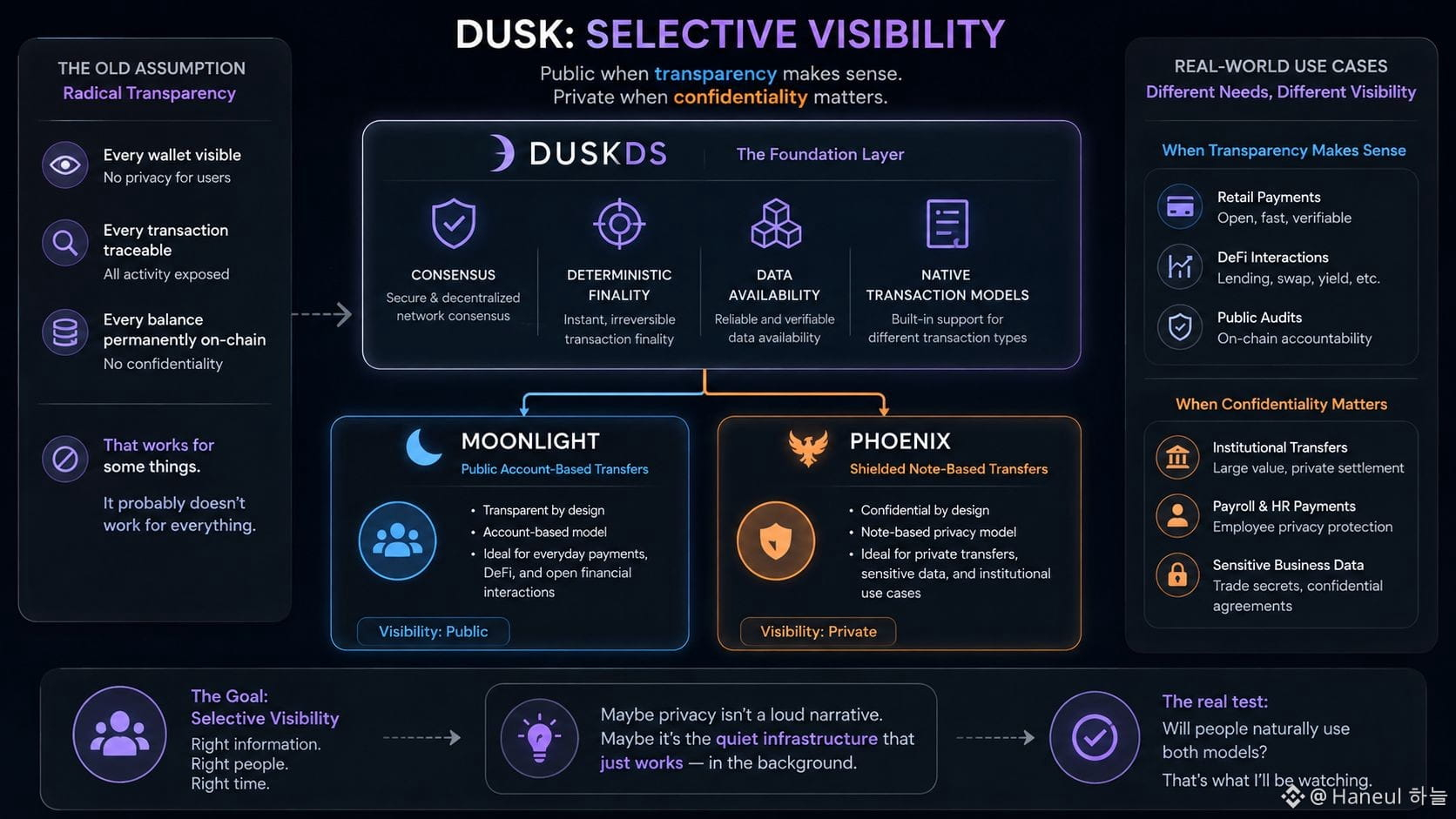
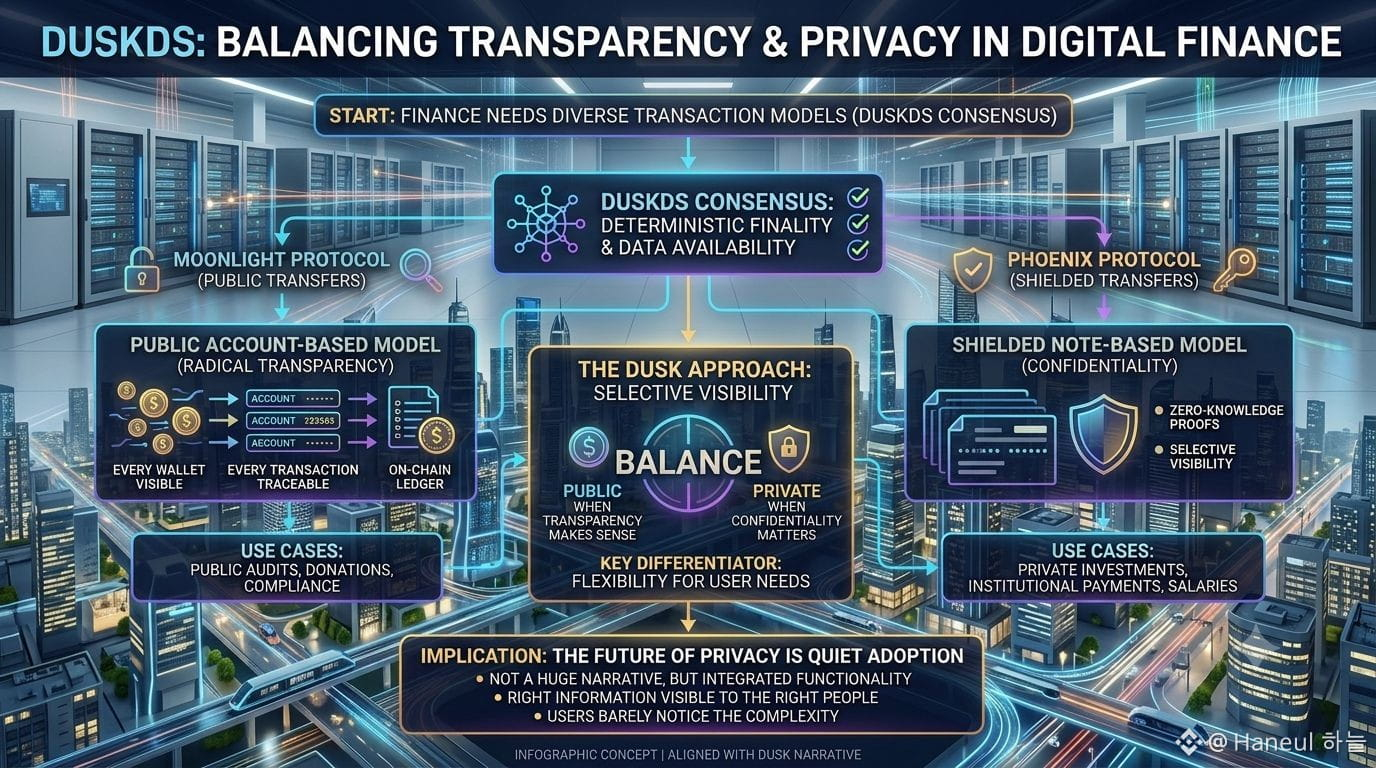
DuskDS brings consensus, deterministic finality, data availability and native transaction models together. Moonlight supports public account-based transfers, while Phoenix handles shielded note-based transfers.
The more I thought about it, the more this made sense.
Not everything in finance should be public. But not everything needs to be private either.
Crypto spent years assuming radical transparency was automatically better. Every wallet visible. Every transaction traceable. Every balance sitting permanently on-chain.
That works for some things.
It probably doesn’t work for everything.
I think #dusk ’s more interesting idea is selective visibility. Public when transparency makes sense. Private when confidentiality actually matters.
The real test isn’t whether the technology is impressive. It’s whether people naturally use both models.
That’s what I’ll be watching.
Maybe privacy won’t become some huge narrative where everyone suddenly starts talking about private chains.
Maybe it becomes something quieter.
Something users barely notice because the right information is visible to the right people, while everything else stays private.
And honestly, that might be the stronger future.
#dusk
@Dusk
$DUSK
It was how Dusk handles different kinds of transactions.
DuskDS brings consensus, deterministic finality, data availability and native transaction models together. Moonlight supports public account-based transfers, while Phoenix handles shielded note-based transfers.
The more I thought about it, the more this made sense.
Not everything in finance should be public. But not everything needs to be private either.
Crypto spent years assuming radical transparency was automatically better. Every wallet visible. Every transaction traceable. Every balance sitting permanently on-chain.
That works for some things.
It probably doesn’t work for everything.
I think #dusk ’s more interesting idea is selective visibility. Public when transparency makes sense. Private when confidentiality actually matters.
The real test isn’t whether the technology is impressive. It’s whether people naturally use both models.
That’s what I’ll be watching.
Maybe privacy won’t become some huge narrative where everyone suddenly starts talking about private chains.
Maybe it becomes something quieter.
Something users barely notice because the right information is visible to the right people, while everything else stays private.
And honestly, that might be the stronger future.
#dusk
@Dusk
$DUSK
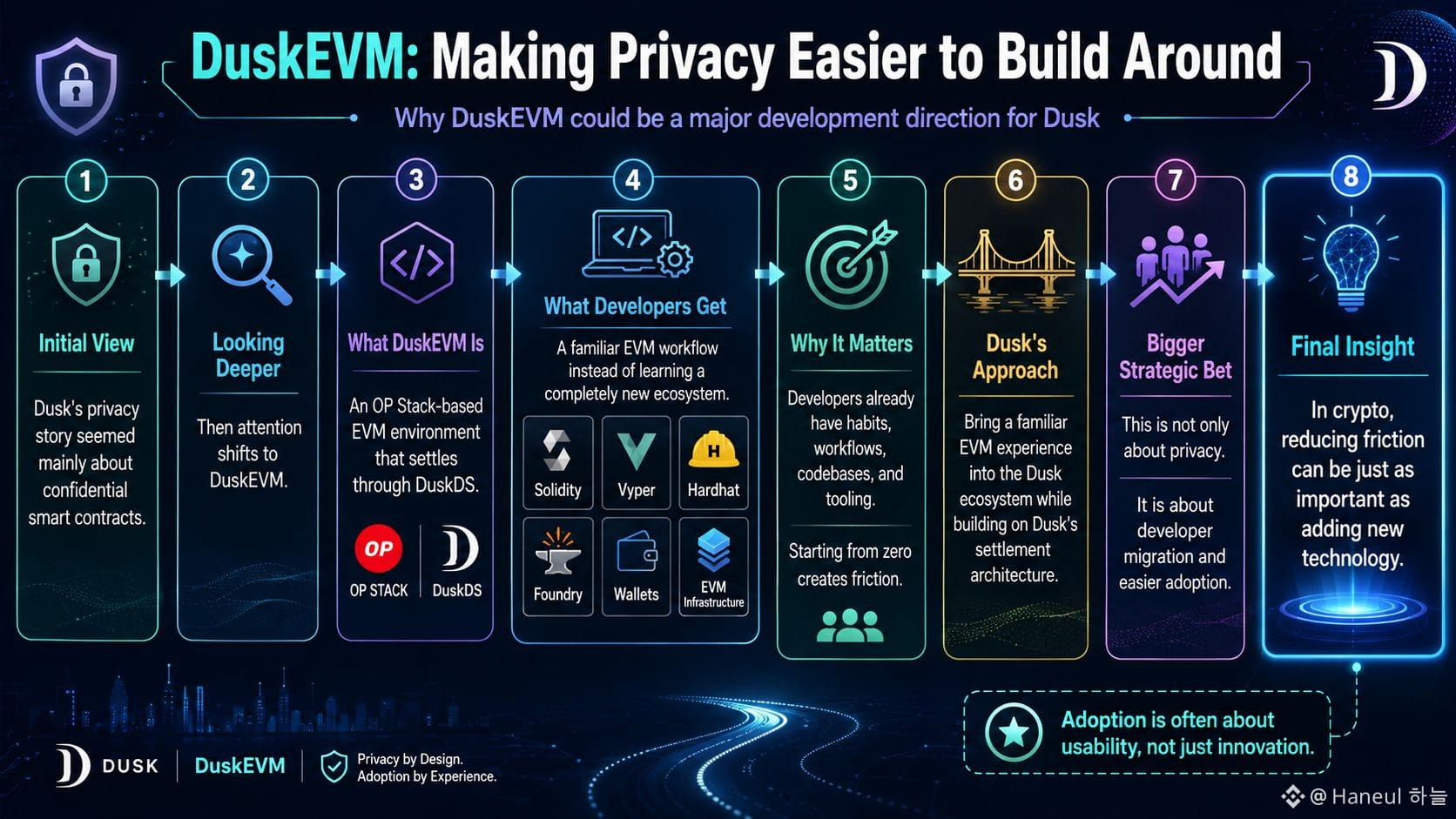
At first, I thought #dusk ’s privacy story was mainly about confidential smart contracts.
Then I started looking at DuskEVM.
The bigger development direction might be making that privacy vision easier to build around.
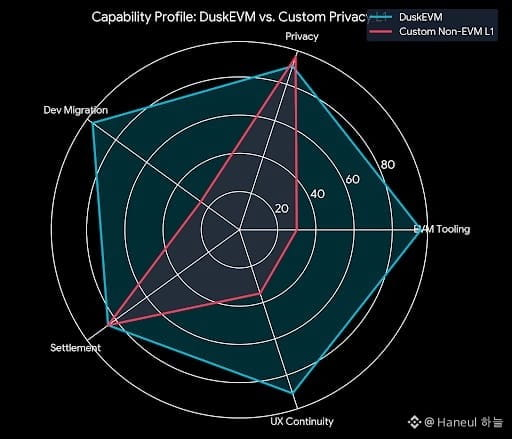
DuskEVM uses an OP Stack-based EVM environment and settles through DuskDS. That means developers don’t have to abandon the tools they already understand just to experiment with Dusk.
Solidity. Vyper. Hardhat. Foundry. Existing wallets and familiar EVM infrastructure.
That matters more than it sounds.
Crypto developers already have habits, workflows, codebases and tooling. Asking them to learn an entirely new environment creates friction, even when the technology is good.
DuskEVM seems to take a different approach: bring a familiar EVM experience into the Dusk ecosystem while building on its settlement architecture.
Maybe that’s the real strategic shift here.
The hardest part of adoption is not always building something new. Sometimes it’s making sure people can actually use it without starting from zero.
The more I read about DuskEVM, the more it feels like #dusk is thinking beyond privacy itself.
They’re thinking about developer migration.
And in crypto, reducing friction can be just as important as adding new technology.
#dusk
@Dusk
$DUSK $PROM $PIEVERSE
Then I started looking at DuskEVM.
The bigger development direction might be making that privacy vision easier to build around.
DuskEVM uses an OP Stack-based EVM environment and settles through DuskDS. That means developers don’t have to abandon the tools they already understand just to experiment with Dusk.
Solidity. Vyper. Hardhat. Foundry. Existing wallets and familiar EVM infrastructure.
That matters more than it sounds.
Crypto developers already have habits, workflows, codebases and tooling. Asking them to learn an entirely new environment creates friction, even when the technology is good.
DuskEVM seems to take a different approach: bring a familiar EVM experience into the Dusk ecosystem while building on its settlement architecture.
Maybe that’s the real strategic shift here.
The hardest part of adoption is not always building something new. Sometimes it’s making sure people can actually use it without starting from zero.
The more I read about DuskEVM, the more it feels like #dusk is thinking beyond privacy itself.
They’re thinking about developer migration.
And in crypto, reducing friction can be just as important as adding new technology.
#dusk
@Dusk
$DUSK $PROM $PIEVERSE
30D trade $DUSK 254.8 USDT
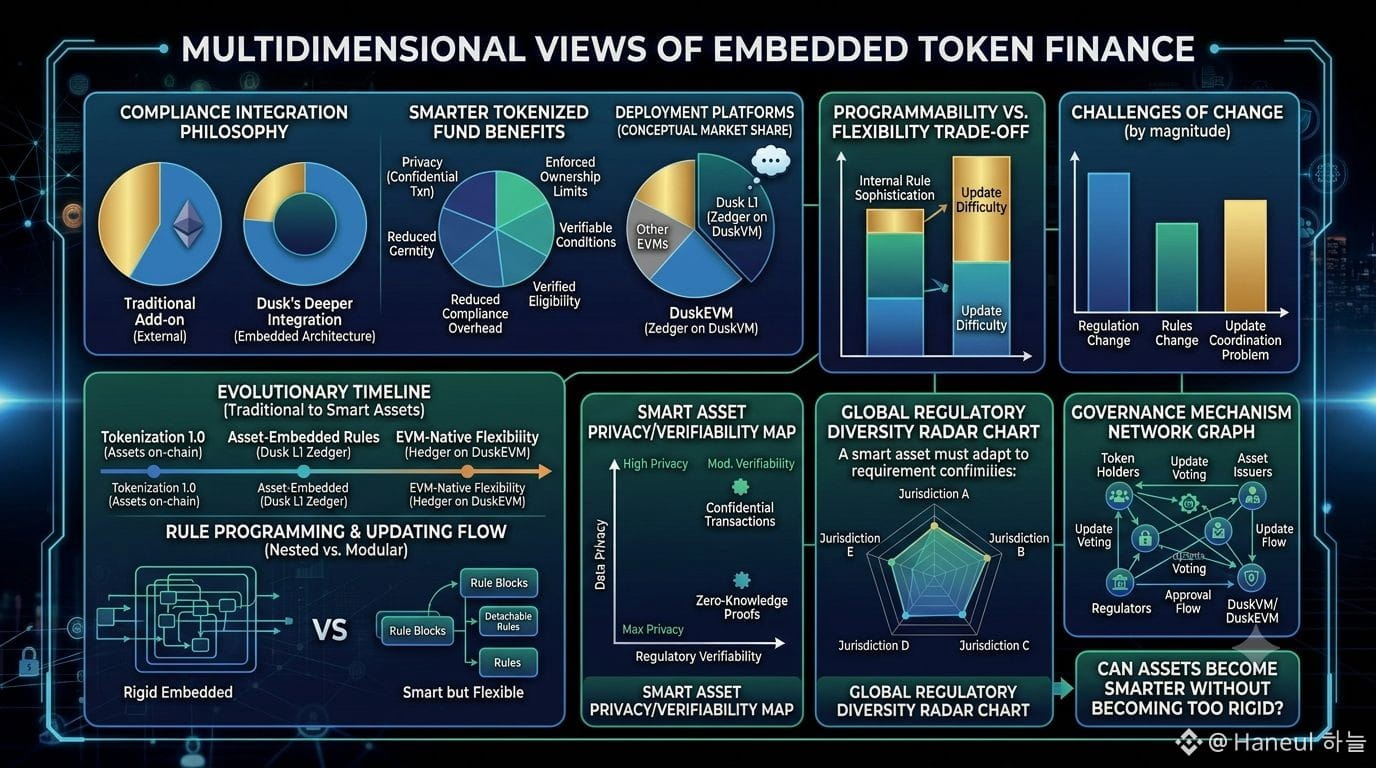
Lately, one thing has been on my mind: what if the biggest change in tokenized finance isn't putting assets on-chain, but redesigning how the assets work?
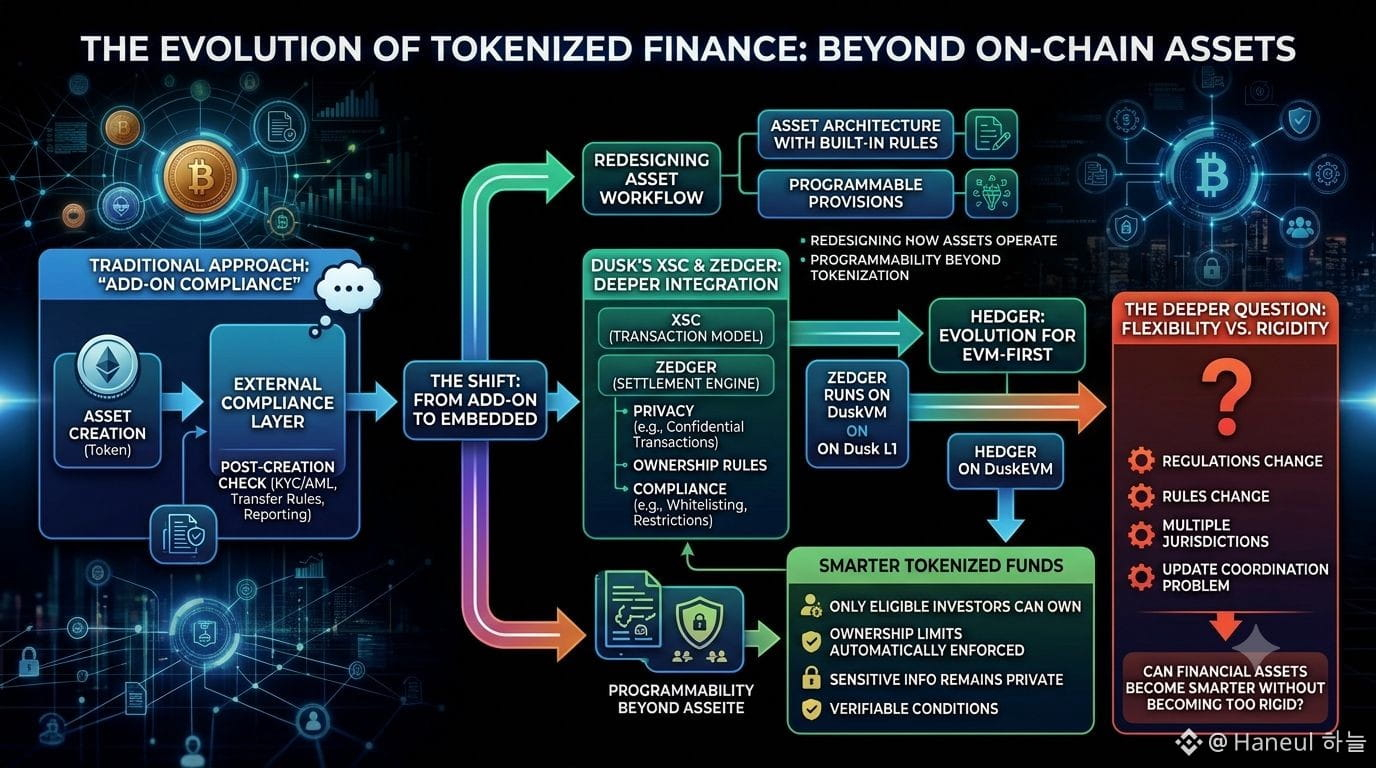
Firstly, I thought compliance would always be something added around the token. Previously, the model seemed simple: create the asset first, then check who can buy, hold, or transfer it.
But $DUSK ’s XSC and Zedger approach appears to go deeper.
Privacy, ownership rules, and compliance can become part of the asset architecture itself. Zedger currently runs on DuskVM directly on the #dusk L1, while Hedger is described as its evolution for an EVM-first environment on @Dusk EVM.
The more I think about it, the interesting question isn't just whether these rules can be programmed.
Imagine a tokenized fund where only eligible investors can own it, ownership limits are enforced automatically, and sensitive information remains private while required conditions can still be verified.
That sounds useful. But it also creates a new challenge.
Rules change. Regulations change. Different countries may require different conditions. So if rules become part of the asset itself, updating them could become a bigger coordination problem.
Maybe that’s the deeper question: can financial assets become smarter without becoming too rigid?
#dusk
@Dusk
$DUSK
Firstly, I thought compliance would always be something added around the token. Previously, the model seemed simple: create the asset first, then check who can buy, hold, or transfer it.
But $DUSK ’s XSC and Zedger approach appears to go deeper.
Privacy, ownership rules, and compliance can become part of the asset architecture itself. Zedger currently runs on DuskVM directly on the #dusk L1, while Hedger is described as its evolution for an EVM-first environment on @Dusk EVM.
The more I think about it, the interesting question isn't just whether these rules can be programmed.
Imagine a tokenized fund where only eligible investors can own it, ownership limits are enforced automatically, and sensitive information remains private while required conditions can still be verified.
That sounds useful. But it also creates a new challenge.
Rules change. Regulations change. Different countries may require different conditions. So if rules become part of the asset itself, updating them could become a bigger coordination problem.
Maybe that’s the deeper question: can financial assets become smarter without becoming too rigid?
#dusk
@Dusk
$DUSK
Verified
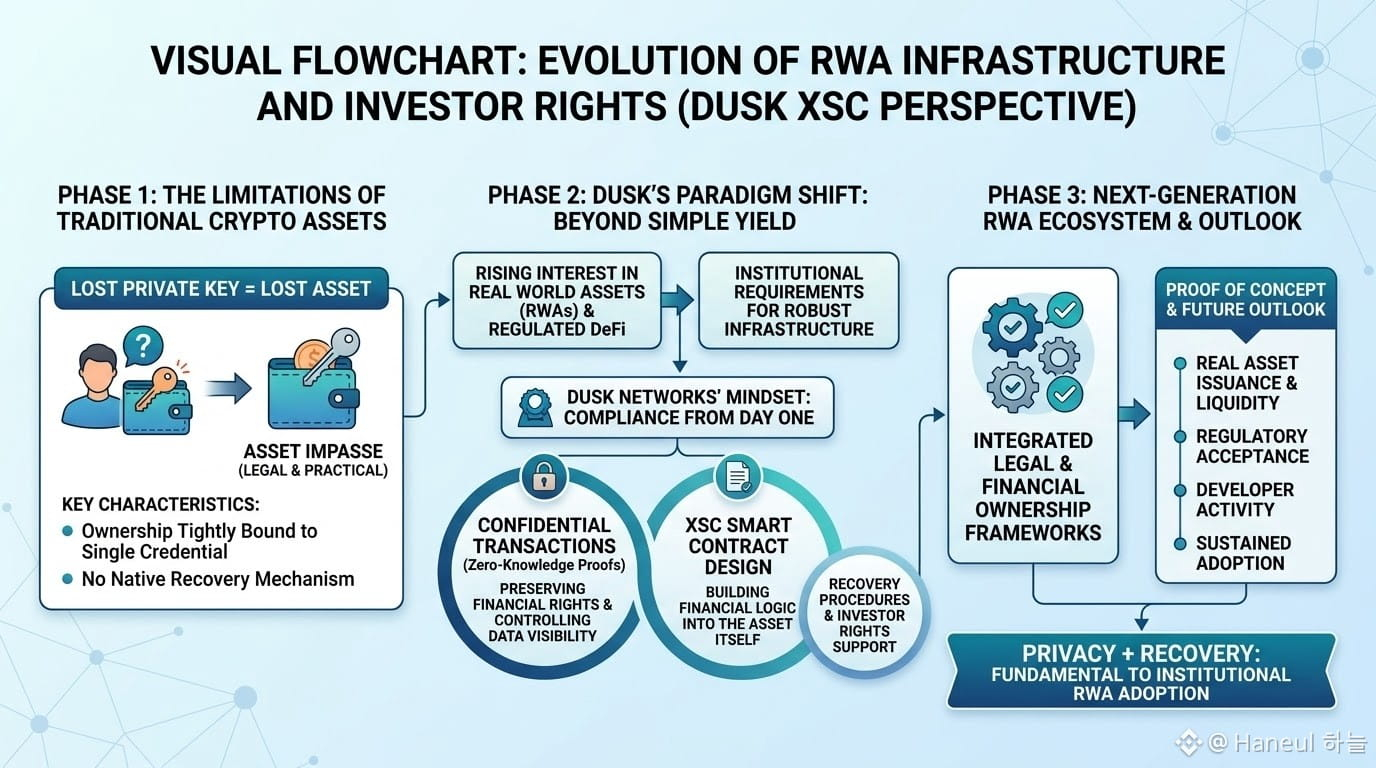
Lately, I’ve noticed crypto narratives moving beyond simple yield chasing. Liquidity is starting to care more about whether infrastructure can handle real financial use, especially as RWAs and regulated DeFi keep gaining attention.
That’s where $DUSK catches my eye.
A problem people rarely discuss is what happens when an investor loses access to their private key. In normal crypto thinking, lost key often means lost asset. But financial markets don’t always work that way. Legal ownership, recovery procedures, compliance, and investor rights can still matter.
#dusk ’s XSC design takes this seriously. From what I’ve seen, the idea is to build financial logic into the asset itself, including confidential transactions and mechanisms that can recognize ownership beyond a single lost credential.
I think that’s a surprisingly important institutional detail.
I’ll be honest, this doesn’t automatically make @Dusk successful. Adoption, regulatory acceptance, developer activity, liquidity, and real asset issuance still have to prove themselves.
But the unique part is the mindset: privacy isn’t just about hiding information. It’s about preserving financial rights while controlling who gets to see what.
My takeaway? The next generation of RWAs may need recovery and compliance designed in from day one, not patched on later.
#dusk
@Dusk
$DUSK
That’s where $DUSK catches my eye.
A problem people rarely discuss is what happens when an investor loses access to their private key. In normal crypto thinking, lost key often means lost asset. But financial markets don’t always work that way. Legal ownership, recovery procedures, compliance, and investor rights can still matter.
#dusk ’s XSC design takes this seriously. From what I’ve seen, the idea is to build financial logic into the asset itself, including confidential transactions and mechanisms that can recognize ownership beyond a single lost credential.
I think that’s a surprisingly important institutional detail.
I’ll be honest, this doesn’t automatically make @Dusk successful. Adoption, regulatory acceptance, developer activity, liquidity, and real asset issuance still have to prove themselves.
But the unique part is the mindset: privacy isn’t just about hiding information. It’s about preserving financial rights while controlling who gets to see what.
My takeaway? The next generation of RWAs may need recovery and compliance designed in from day one, not patched on later.
#dusk
@Dusk
$DUSK
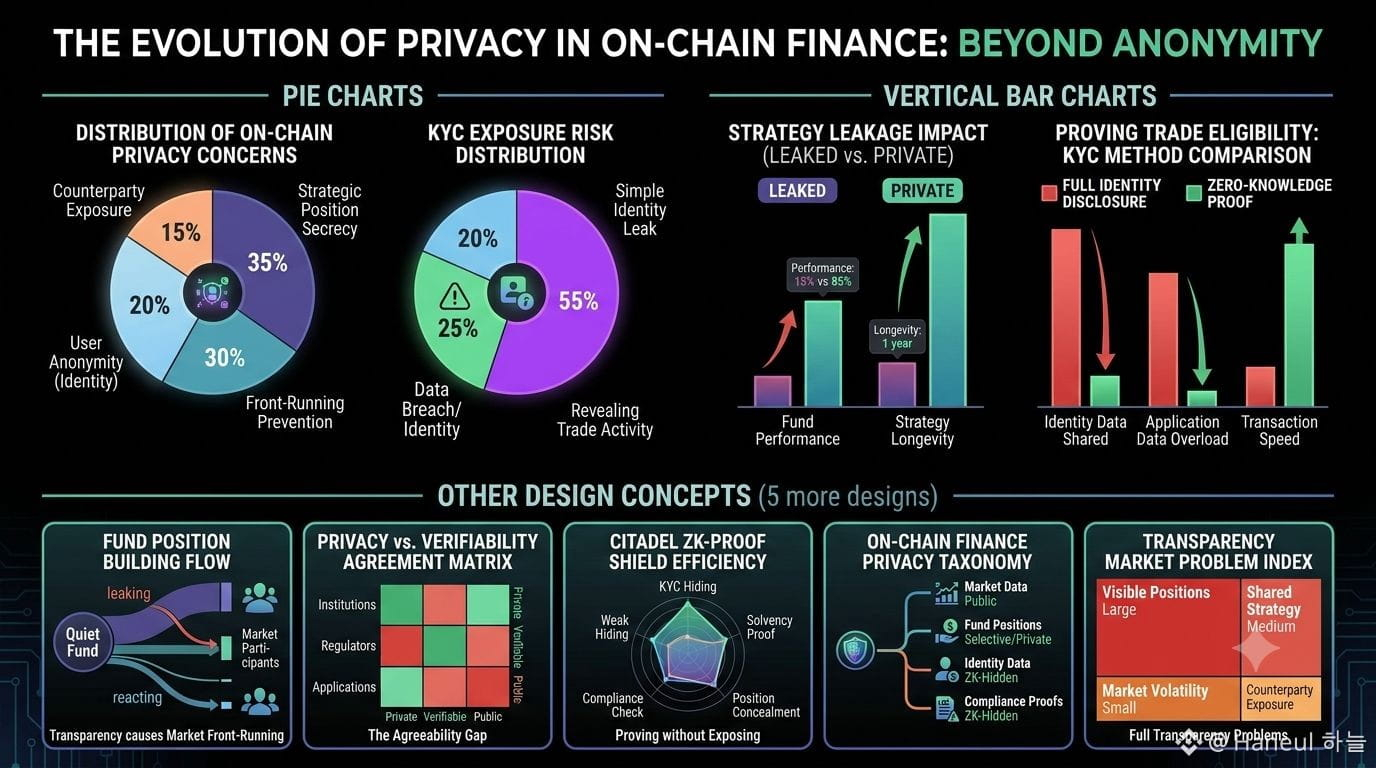
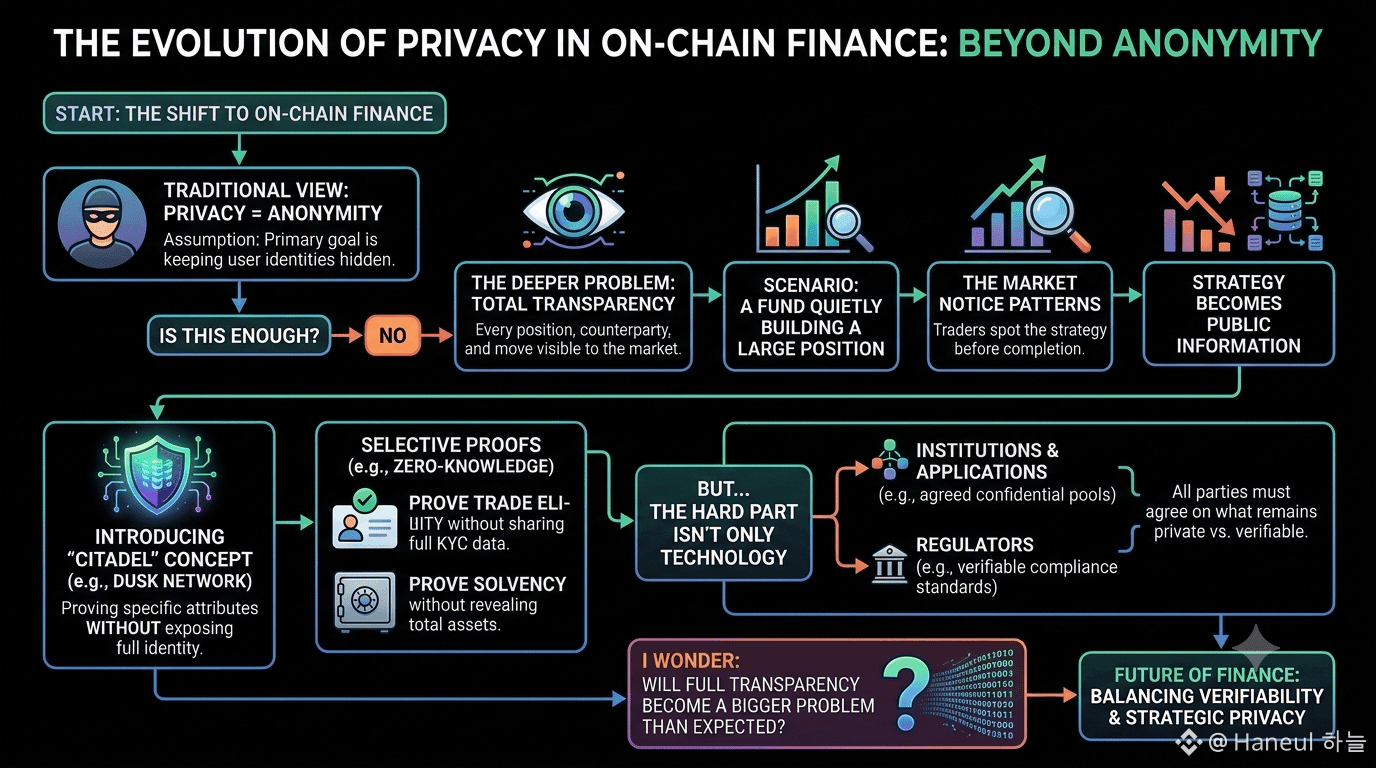
Lately, I’ve been thinking about something that seems easy to overlook when people talk about on-chain finance: privacy is not only about hiding identity.
Firstly, I assumed confidential transactions were mainly for keeping users anonymous. But a deeper issue is what happens when every position, counterparty and trading move becomes visible to the entire market.
Imagine a fund quietly building a large position. On a fully transparent chain, other traders might notice the pattern before the position is complete. The strategy itself becomes public information.
The more I read about $DUSK , the more I think its Citadel concept points toward another layer of the problem: proving something about yourself without exposing everything about yourself.
For example, proving you are eligible to trade without handing your full identity or KYC data to every application.
Maybe that's true.
But I'm not sure the hard part is only the technology. Institutions, regulators and applications still need to agree on what should remain private and what must be verifiable.
Still, if financial markets keep moving on-chain, I wonder if full transparency will eventually become a bigger problem than people currently expect.
#dusk
@Dusk
$DUSK
Firstly, I assumed confidential transactions were mainly for keeping users anonymous. But a deeper issue is what happens when every position, counterparty and trading move becomes visible to the entire market.
Imagine a fund quietly building a large position. On a fully transparent chain, other traders might notice the pattern before the position is complete. The strategy itself becomes public information.
The more I read about $DUSK , the more I think its Citadel concept points toward another layer of the problem: proving something about yourself without exposing everything about yourself.
For example, proving you are eligible to trade without handing your full identity or KYC data to every application.
Maybe that's true.
But I'm not sure the hard part is only the technology. Institutions, regulators and applications still need to agree on what should remain private and what must be verifiable.
Still, if financial markets keep moving on-chain, I wonder if full transparency will eventually become a bigger problem than people currently expect.
#dusk
@Dusk
$DUSK
Lately, I’ve been thinking about how new technology often gets the attention, while timing gets ignored.
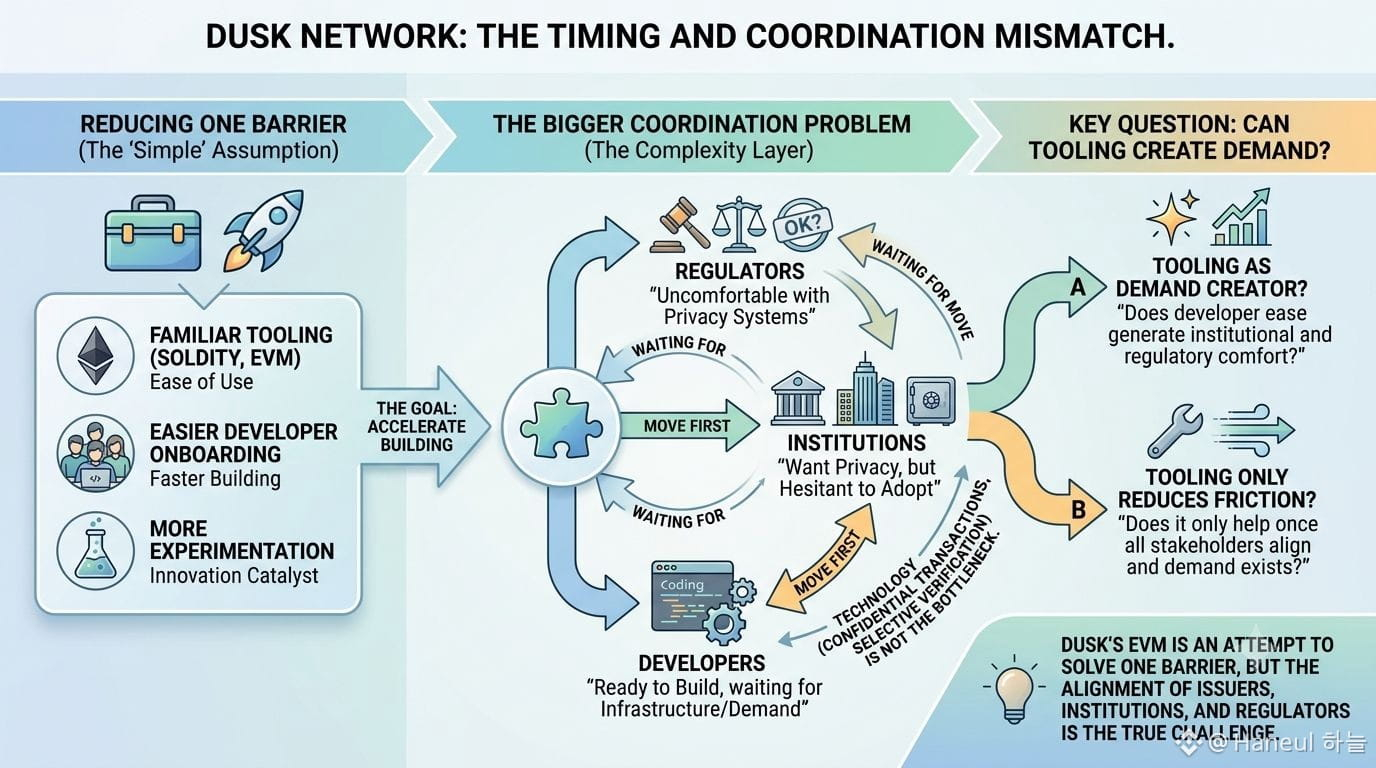
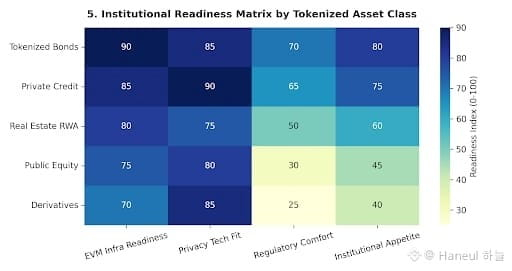
At first I assumed $DUSK launching an EVM testnet on August 10 was mostly about making things easier for #Ethereum developers. Familiar tools, easier onboarding, more developers experimenting. Simple.
The more I read, the more I think the interesting part might be what Dusk is actually trying to make those developers build.
$DUSK already focuses heavily on privacy for regulated financial applications. Now the idea is to bring more familiar Ethereum tooling into that environment.
That creates an interesting mismatch.
Developers might be ready to build before institutions are ready to use the applications.
Institutions might want privacy before regulators are comfortable with the systems.
And everyone could be waiting for someone else to move first.
I keep coming back to that.
Imagine a developer building infrastructure for tokenized securities. The technology may already support confidential transactions and selective verification. But technology isn't necessarily the bottleneck. The harder part could be getting issuers, institutions, developers, and regulators aligned at roughly the same time.
Maybe that’s true.
Perhaps I’m focusing on the wrong thing.
Still, Dusk’s EVM move feels less like “another EVM chain” and more like an attempt to reduce one barrier while the bigger coordination problem remains.
I’m not sure whether familiar tooling can create demand.
Or whether it only helps once the demand is already there.
#dusk
@Dusk
$DUSK
At first I assumed $DUSK launching an EVM testnet on August 10 was mostly about making things easier for #Ethereum developers. Familiar tools, easier onboarding, more developers experimenting. Simple.
The more I read, the more I think the interesting part might be what Dusk is actually trying to make those developers build.
$DUSK already focuses heavily on privacy for regulated financial applications. Now the idea is to bring more familiar Ethereum tooling into that environment.
That creates an interesting mismatch.
Developers might be ready to build before institutions are ready to use the applications.
Institutions might want privacy before regulators are comfortable with the systems.
And everyone could be waiting for someone else to move first.
I keep coming back to that.
Imagine a developer building infrastructure for tokenized securities. The technology may already support confidential transactions and selective verification. But technology isn't necessarily the bottleneck. The harder part could be getting issuers, institutions, developers, and regulators aligned at roughly the same time.
Maybe that’s true.
Perhaps I’m focusing on the wrong thing.
Still, Dusk’s EVM move feels less like “another EVM chain” and more like an attempt to reduce one barrier while the bigger coordination problem remains.
I’m not sure whether familiar tooling can create demand.
Or whether it only helps once the demand is already there.
#dusk
@Dusk
$DUSK
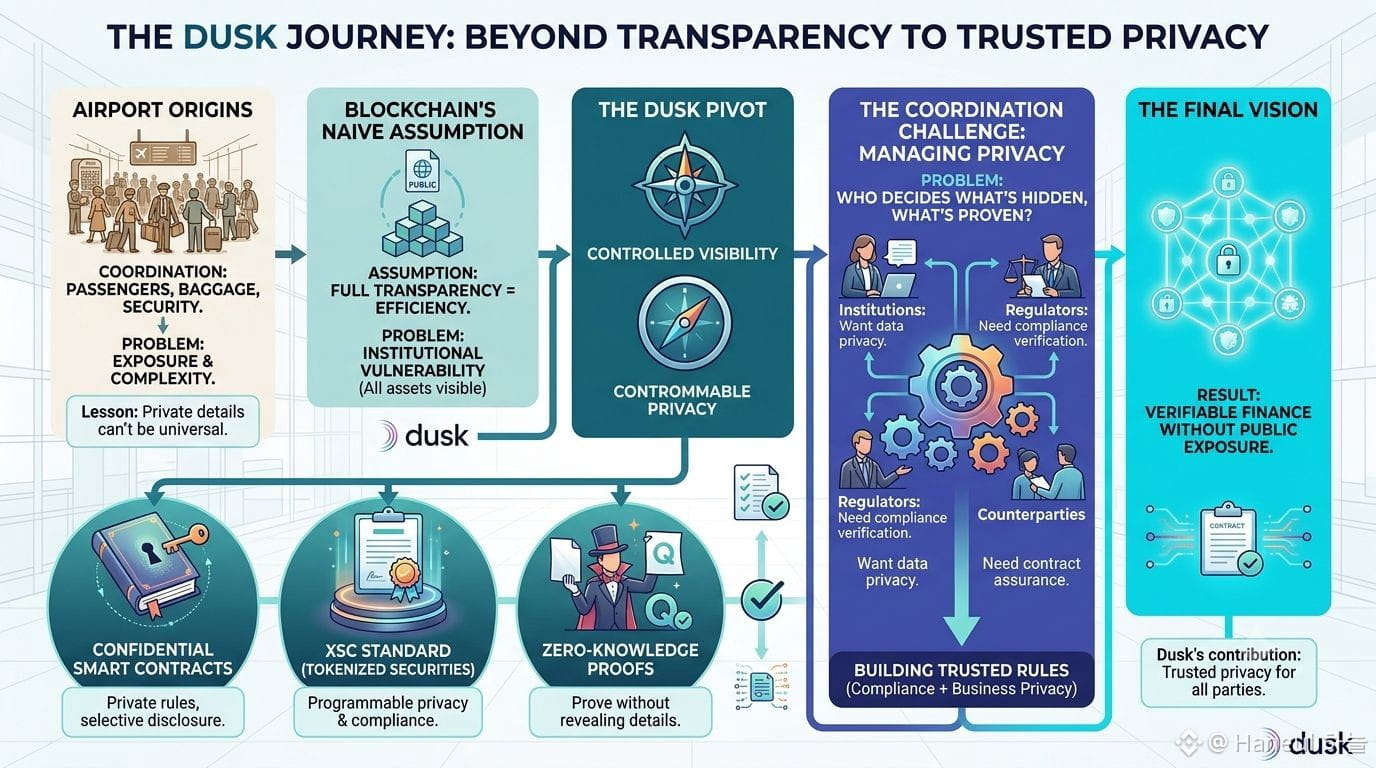
I once read about how airports became more complicated as flying became normal.
The plane was never the only problem. The real challenge was coordinating passengers, luggage, security, airlines, schedules, and information without exposing everything to everyone.
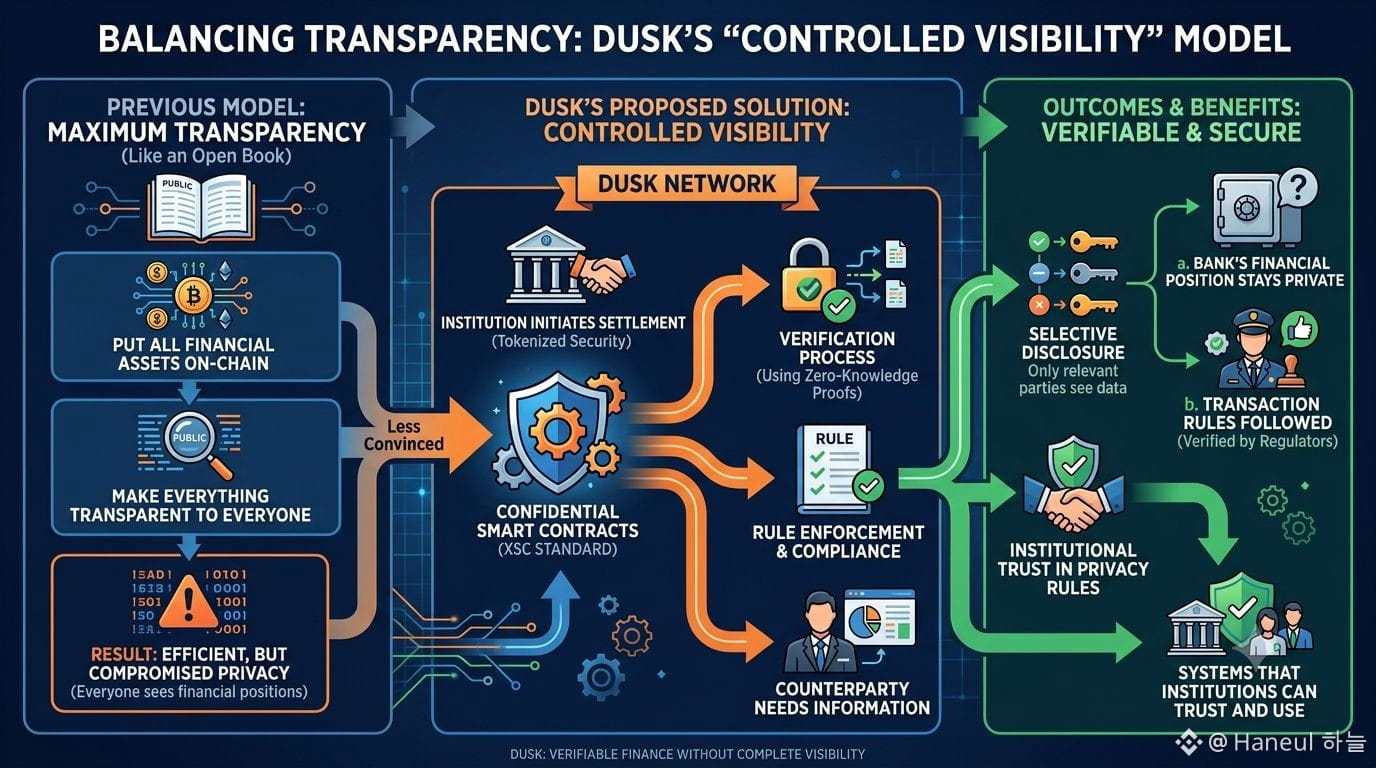
At first I assumed blockchain finance had a similar problem: just put financial assets on-chain, make everything transparent, and efficiency would follow.
The more I read about @Dusk , the less convinced I am.
Imagine a bank settling a tokenized security. It wants the transaction verified. Regulators need confidence that the rules were followed. The counterparty needs enough information to complete the deal.
But does everyone really need to see the bank's entire financial position?
Probably not.
That is where #Dusk gets interesting to me. Its focus on confidential smart contracts and the XSC standard suggests a different idea: maybe financial blockchains don't need maximum transparency. They need controlled visibility.
Maybe that's true.
I'm not sure, though, because privacy creates another coordination problem. Who decides what can be hidden, what must be proven, and who gets to verify it?
I keep coming back to that.
Perhaps the difficult part isn't building private transactions.
Perhaps it's creating a system where institutions can trust the rules around privacy enough to actually use it.
Still, that's the question I find more interesting: can blockchain make finance verifiable without making every detail visible?
#dusk
@Dusk
$DUSK $RICE $RE
The plane was never the only problem. The real challenge was coordinating passengers, luggage, security, airlines, schedules, and information without exposing everything to everyone.
At first I assumed blockchain finance had a similar problem: just put financial assets on-chain, make everything transparent, and efficiency would follow.
The more I read about @Dusk , the less convinced I am.
Imagine a bank settling a tokenized security. It wants the transaction verified. Regulators need confidence that the rules were followed. The counterparty needs enough information to complete the deal.
But does everyone really need to see the bank's entire financial position?
Probably not.
That is where #Dusk gets interesting to me. Its focus on confidential smart contracts and the XSC standard suggests a different idea: maybe financial blockchains don't need maximum transparency. They need controlled visibility.
Maybe that's true.
I'm not sure, though, because privacy creates another coordination problem. Who decides what can be hidden, what must be proven, and who gets to verify it?
I keep coming back to that.
Perhaps the difficult part isn't building private transactions.
Perhaps it's creating a system where institutions can trust the rules around privacy enough to actually use it.
Still, that's the question I find more interesting: can blockchain make finance verifiable without making every detail visible?
#dusk
@Dusk
$DUSK $RICE $RE
When aviation became more complex, the goal wasn’t to put more information in front of pilots. It was deciding what actually needed to be visible.
At first I assumed blockchain finance would work differently. Put securities on-chain, make ownership transparent, and let everyone verify everything.
The more I read about #dusk , the less certain I am.
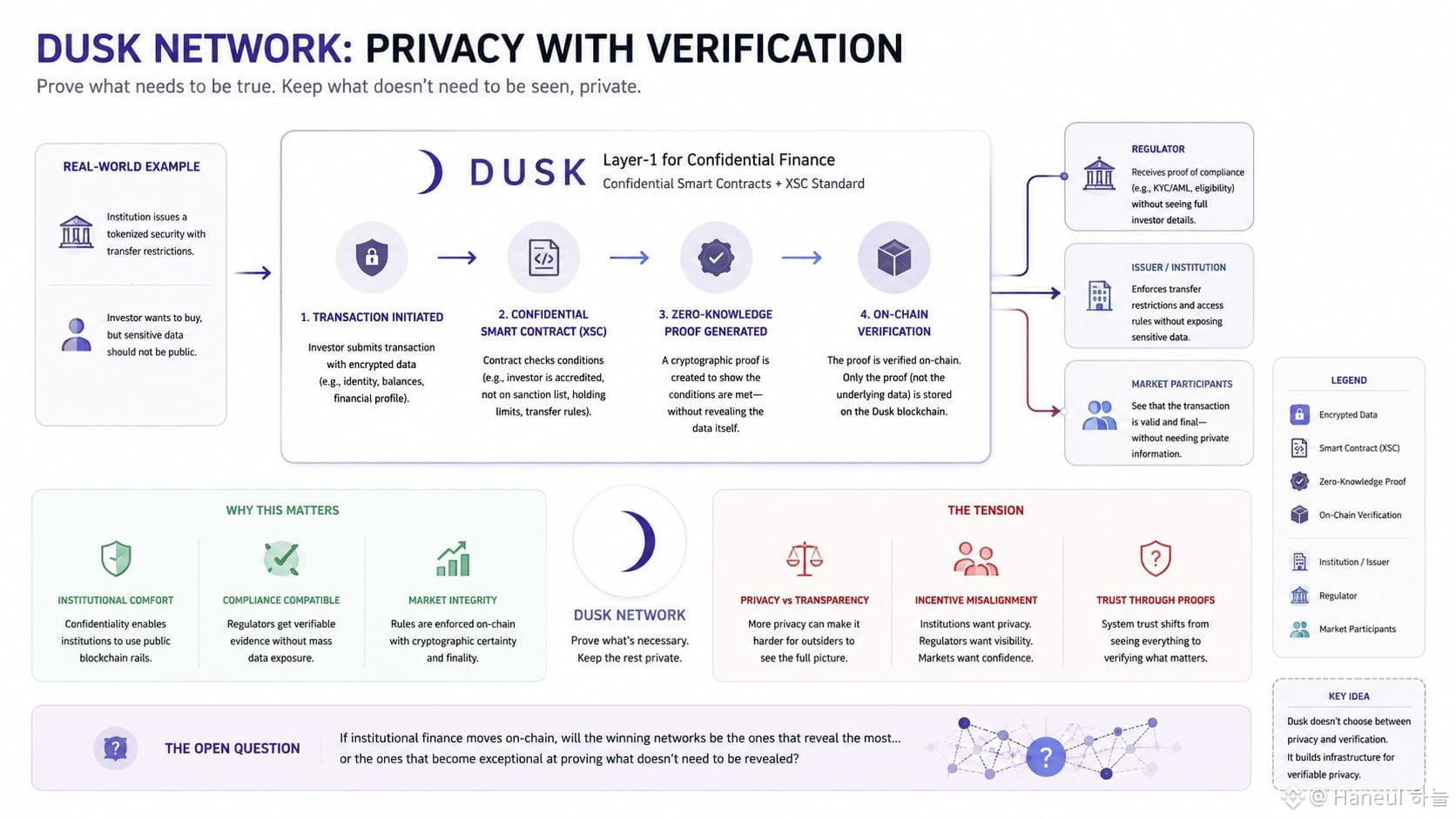
@Dusk is building a Layer-1 around confidential financial applications, including confidential smart contracts and its Confidential Security Contract (XSC) standard.
What interests me isn’t simply “privacy.”
It’s the tension between privacy and verification.
Imagine a tokenized security where a regulator needs to know an investor is eligible, while the issuer doesn’t need to expose the investor’s entire financial profile to everyone watching the chain.
That sounds simple until incentives collide.
Institutions want confidentiality. Regulators want auditability. Markets want reliable information.
Maybe that’s true. But putting everything behind privacy can create another problem: how do outsiders know enough to trust what they cannot see?
I keep coming back to the idea that Dusk isn’t really choosing between transparency and privacy.
Perhaps I'm focusing on the wrong thing.
Maybe the harder problem is building infrastructure where you can prove something is valid without revealing everything that made it valid.
Still, if that becomes possible at scale, I wonder whether financial blockchains will look less like public ledgers and more like controlled windows into verified information.
#dusk
@Dusk
$DUSK
$CLO
$BTW
At first I assumed blockchain finance would work differently. Put securities on-chain, make ownership transparent, and let everyone verify everything.
The more I read about #dusk , the less certain I am.
@Dusk is building a Layer-1 around confidential financial applications, including confidential smart contracts and its Confidential Security Contract (XSC) standard.
What interests me isn’t simply “privacy.”
It’s the tension between privacy and verification.
Imagine a tokenized security where a regulator needs to know an investor is eligible, while the issuer doesn’t need to expose the investor’s entire financial profile to everyone watching the chain.
That sounds simple until incentives collide.
Institutions want confidentiality. Regulators want auditability. Markets want reliable information.
Maybe that’s true. But putting everything behind privacy can create another problem: how do outsiders know enough to trust what they cannot see?
I keep coming back to the idea that Dusk isn’t really choosing between transparency and privacy.
Perhaps I'm focusing on the wrong thing.
Maybe the harder problem is building infrastructure where you can prove something is valid without revealing everything that made it valid.
Still, if that becomes possible at scale, I wonder whether financial blockchains will look less like public ledgers and more like controlled windows into verified information.
#dusk
@Dusk
$DUSK
$CLO
$BTW
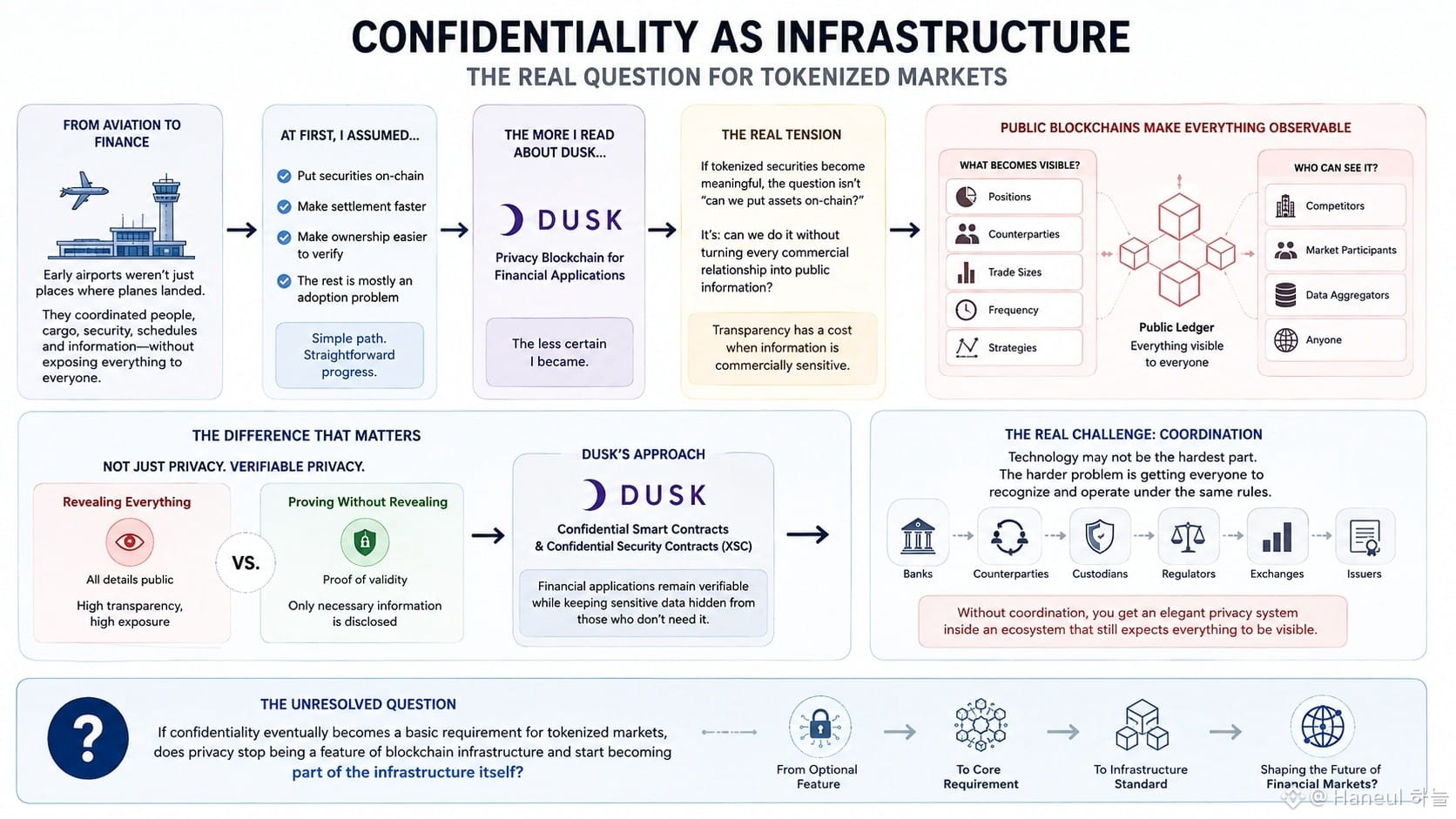
Airports taught me something I didn’t expect about blockchain.
A plane landing is simple compared with everything happening around it: schedules, security, cargo, passengers, identities and coordination. The hard part was never just moving the aircraft.
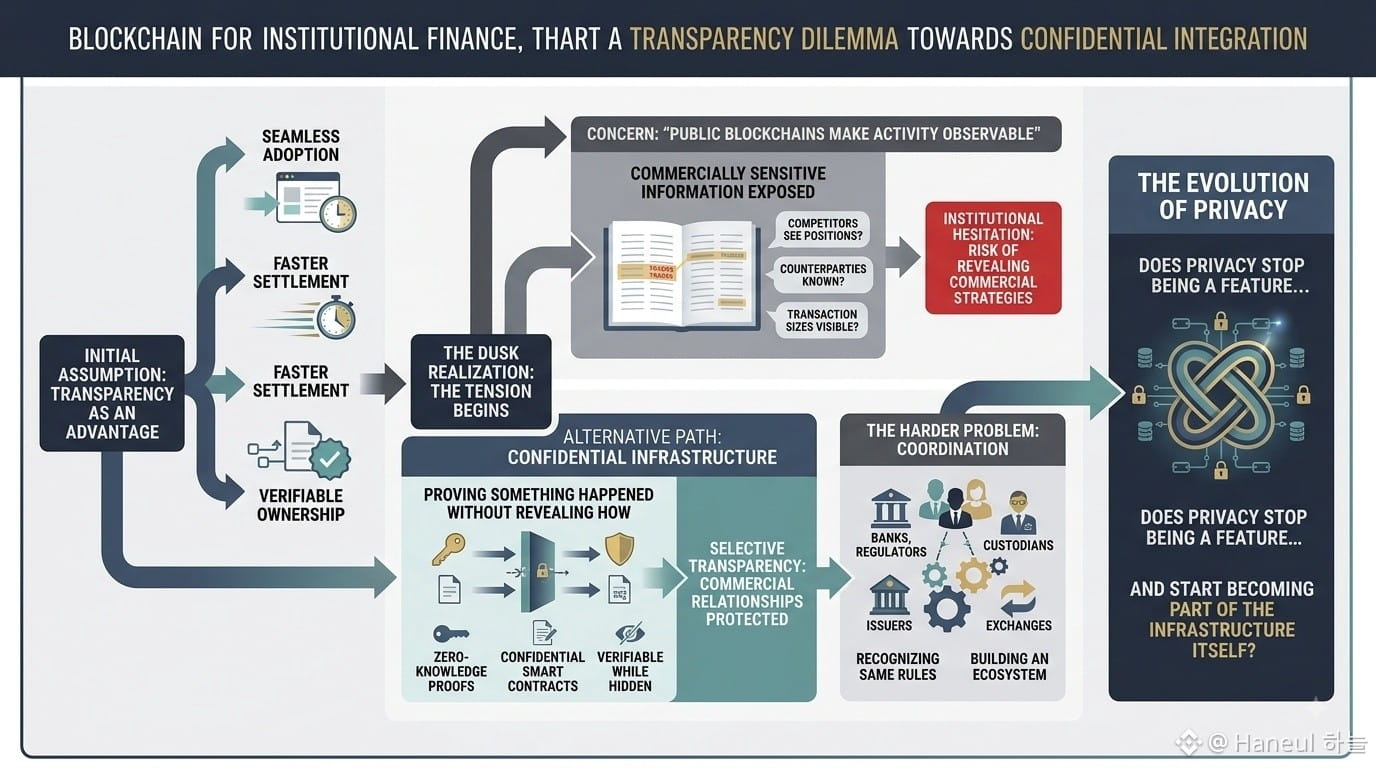
At first I assumed tokenized finance would be similar. Put securities on-chain, make settlement faster, make ownership easier to verify, and institutional adoption would mostly follow.
The more I read about #dusk , the less certain I became.
If tokenized securities become meaningful, institutions may not want every position, trade size, counterparty and financial relationship exposed on a public ledger.
Transparency helps. Regulators can verify activity, participants can reduce reliance on intermediaries, and settlement becomes easier to audit.
But transparency also creates a strange problem: proving something happened isn't necessarily the same as revealing everything about how it happened.
I keep coming back to that distinction.
Dusk's approach with confidential smart contracts and the Confidential Security Contract model makes the question more interesting. Can financial activity remain verifiable while sensitive information stays hidden from people who don't need access to it?
Maybe that's the real institutional bottleneck.
I'm not sure.
Perhaps privacy won't be an extra feature of blockchain finance at all. Perhaps the bigger question is whether markets can become on-chain without becoming completely exposed.
#dusk
@Dusk
$DUSK
$GPS
$SNXXB
A plane landing is simple compared with everything happening around it: schedules, security, cargo, passengers, identities and coordination. The hard part was never just moving the aircraft.
At first I assumed tokenized finance would be similar. Put securities on-chain, make settlement faster, make ownership easier to verify, and institutional adoption would mostly follow.
The more I read about #dusk , the less certain I became.
If tokenized securities become meaningful, institutions may not want every position, trade size, counterparty and financial relationship exposed on a public ledger.
Transparency helps. Regulators can verify activity, participants can reduce reliance on intermediaries, and settlement becomes easier to audit.
But transparency also creates a strange problem: proving something happened isn't necessarily the same as revealing everything about how it happened.
I keep coming back to that distinction.
Dusk's approach with confidential smart contracts and the Confidential Security Contract model makes the question more interesting. Can financial activity remain verifiable while sensitive information stays hidden from people who don't need access to it?
Maybe that's the real institutional bottleneck.
I'm not sure.
Perhaps privacy won't be an extra feature of blockchain finance at all. Perhaps the bigger question is whether markets can become on-chain without becoming completely exposed.
#dusk
@Dusk
$DUSK
$GPS
$SNXXB
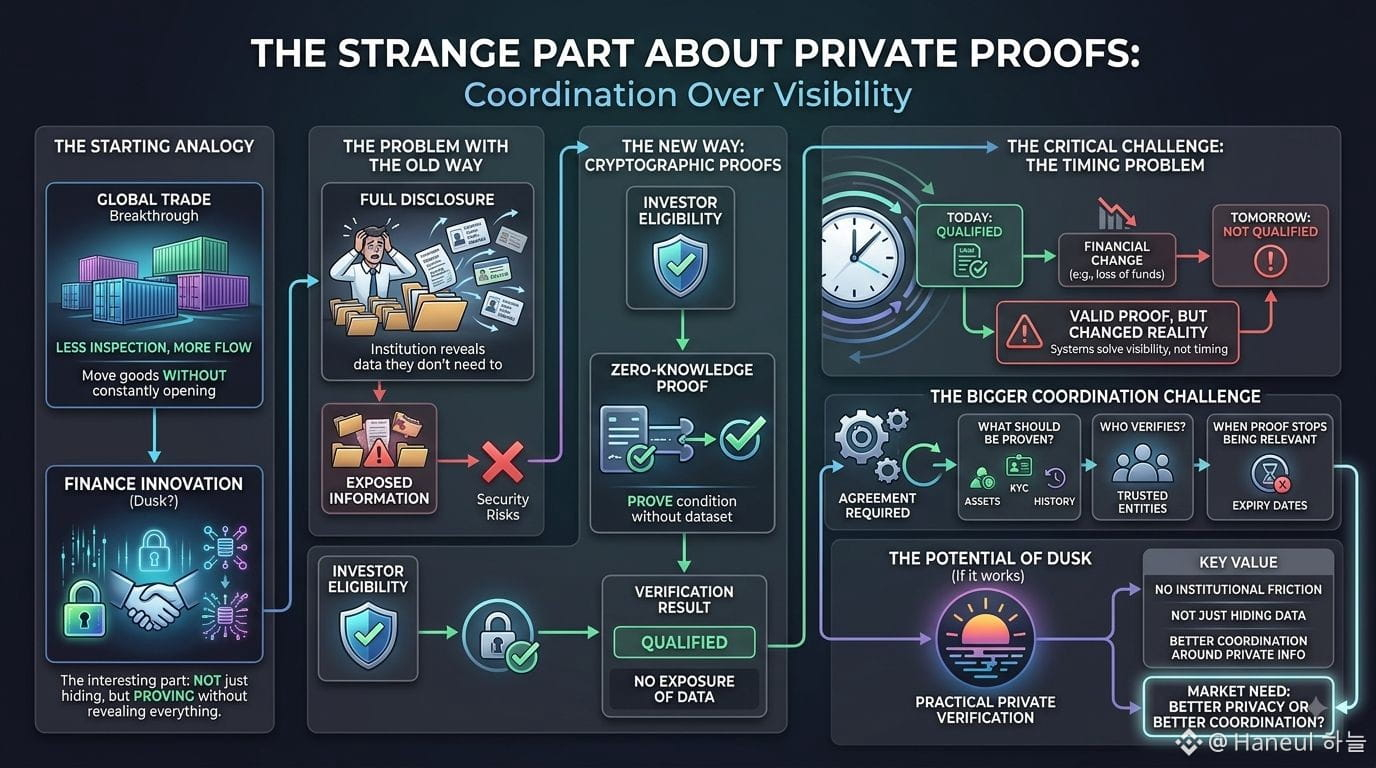
The Strange Part About Private Proofs
I remember how container shipping changed global trade. The breakthrough wasn’t really the container itself. It was being able to move goods around without constantly opening everything up for inspection.
At first I assumed #dusk was mainly trying to bring more privacy into finance. The more I read, the more I think the interesting part is slightly different.
It’s about proving something without handing over everything behind that proof.
Say an institution needs to show that an investor is eligible for a financial product. Normally, that can mean exposing far more information than the other side actually needs.
With cryptographic proofs, the idea is that you can prove the condition was met without revealing the entire dataset.
That sounds great, but there’s a catch I keep coming back to.
Financial information changes.
Someone can qualify today and not qualify tomorrow. A proof can be perfectly valid while the underlying reality has already moved.
Maybe that’s true of most privacy systems: they solve the visibility problem, but not necessarily the timing problem.
I’m not sure.
Perhaps I’m focusing on the wrong thing. The bigger challenge may be getting institutions to agree on what should be proven, who verifies it, and when that proof stops being relevant.
Still, if #Dusk can make private verification practical without creating another layer of institutional friction, that feels more important than simply hiding data.
The question is whether the market actually needs better privacy, or better coordination around private information.
#dusk
@Dusk
$DUSK
$KILO
$BTW
#BNBChainToActivatePasteurHardFork
#SP500EarningsBeatExpectations
I remember how container shipping changed global trade. The breakthrough wasn’t really the container itself. It was being able to move goods around without constantly opening everything up for inspection.
At first I assumed #dusk was mainly trying to bring more privacy into finance. The more I read, the more I think the interesting part is slightly different.
It’s about proving something without handing over everything behind that proof.
Say an institution needs to show that an investor is eligible for a financial product. Normally, that can mean exposing far more information than the other side actually needs.
With cryptographic proofs, the idea is that you can prove the condition was met without revealing the entire dataset.
That sounds great, but there’s a catch I keep coming back to.
Financial information changes.
Someone can qualify today and not qualify tomorrow. A proof can be perfectly valid while the underlying reality has already moved.
Maybe that’s true of most privacy systems: they solve the visibility problem, but not necessarily the timing problem.
I’m not sure.
Perhaps I’m focusing on the wrong thing. The bigger challenge may be getting institutions to agree on what should be proven, who verifies it, and when that proof stops being relevant.
Still, if #Dusk can make private verification practical without creating another layer of institutional friction, that feels more important than simply hiding data.
The question is whether the market actually needs better privacy, or better coordination around private information.
#dusk
@Dusk
$DUSK
$KILO
$BTW
#BNBChainToActivatePasteurHardFork
#SP500EarningsBeatExpectations
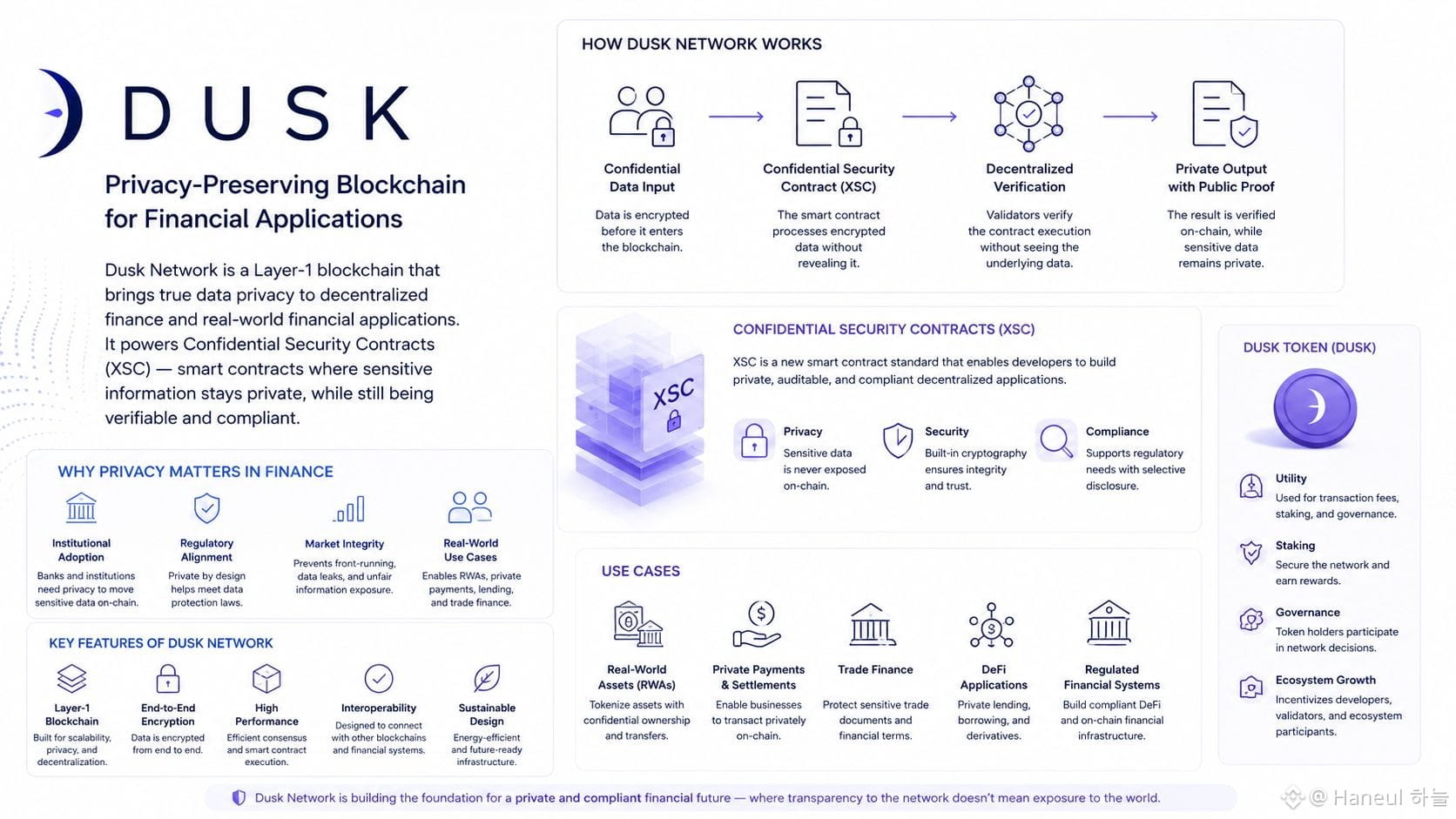
I kept seeing privacy come up in crypto conversations, but mostly around users hiding wallets or transactions. Then I looked closer at Dusk and realized the bigger question is what happens when financial markets actually move on-chain.
$DUSK is interesting because it isn’t treating privacy as an optional feature. Its Layer-1 is built around confidential smart contracts and the XSC standard, aiming to let financial activity remain verifiable without making every sensitive detail public.
That feels increasingly relevant as RWAs and regulated finance keep moving toward blockchain infrastructure. Institutions probably don’t want a system where every trade, balance, or business relationship becomes permanent public data.
But I’m not convinced privacy alone guarantees adoption. Dusk still has to prove developers, institutions, and users actually need its approach enough to build around it.
That’s the part I’m watching most closely. The technology is interesting. Real demand is the harder test.
@Dusk #dusk $DUSK
$DOT
$DUSK is interesting because it isn’t treating privacy as an optional feature. Its Layer-1 is built around confidential smart contracts and the XSC standard, aiming to let financial activity remain verifiable without making every sensitive detail public.
That feels increasingly relevant as RWAs and regulated finance keep moving toward blockchain infrastructure. Institutions probably don’t want a system where every trade, balance, or business relationship becomes permanent public data.
But I’m not convinced privacy alone guarantees adoption. Dusk still has to prove developers, institutions, and users actually need its approach enough to build around it.
That’s the part I’m watching most closely. The technology is interesting. Real demand is the harder test.
@Dusk #dusk $DUSK
$DOT
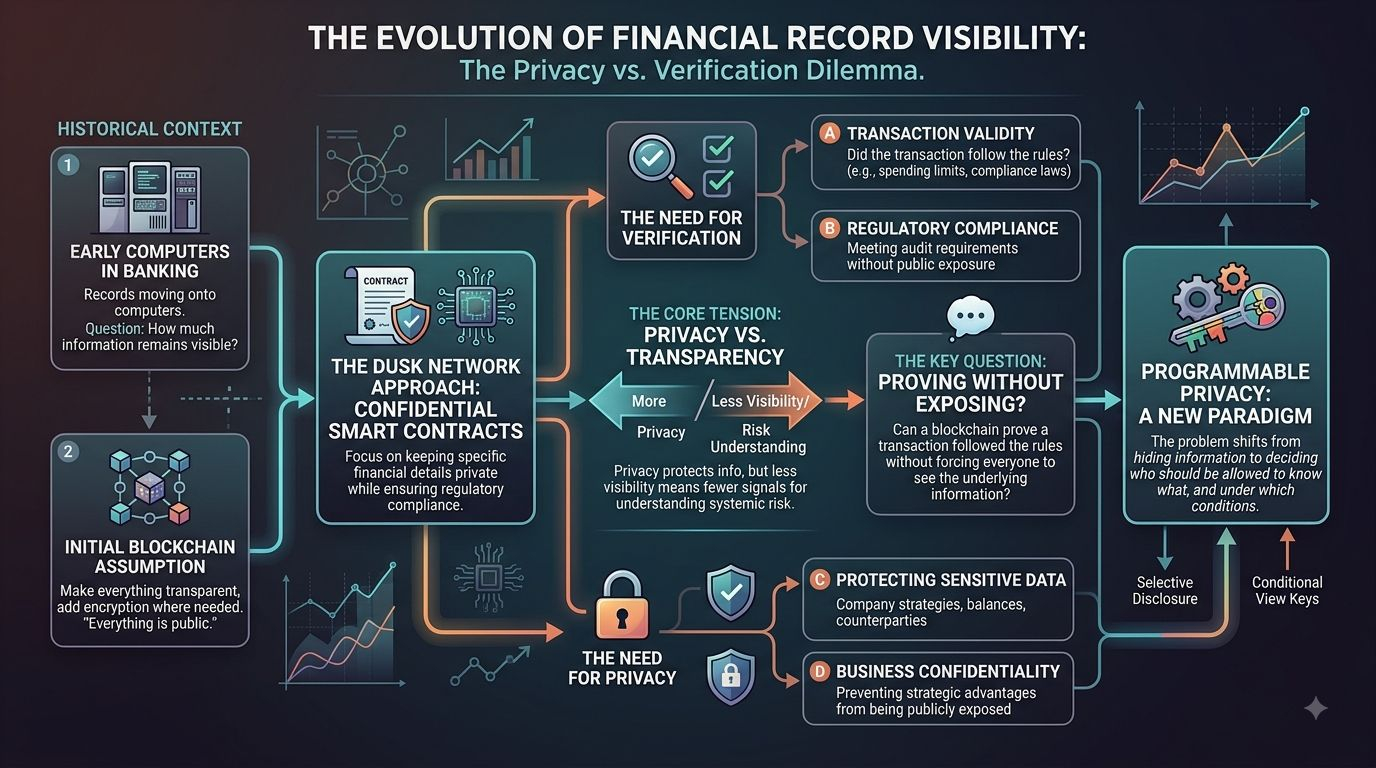
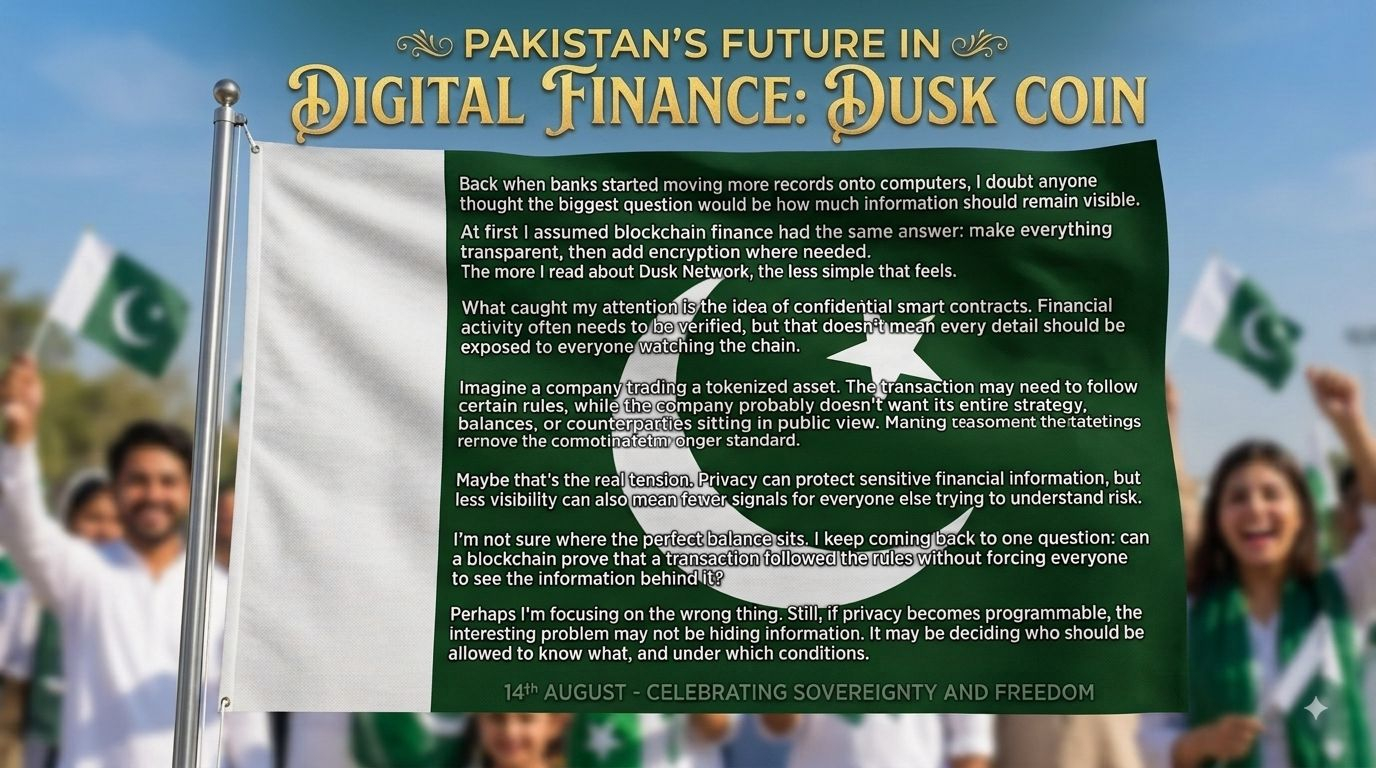
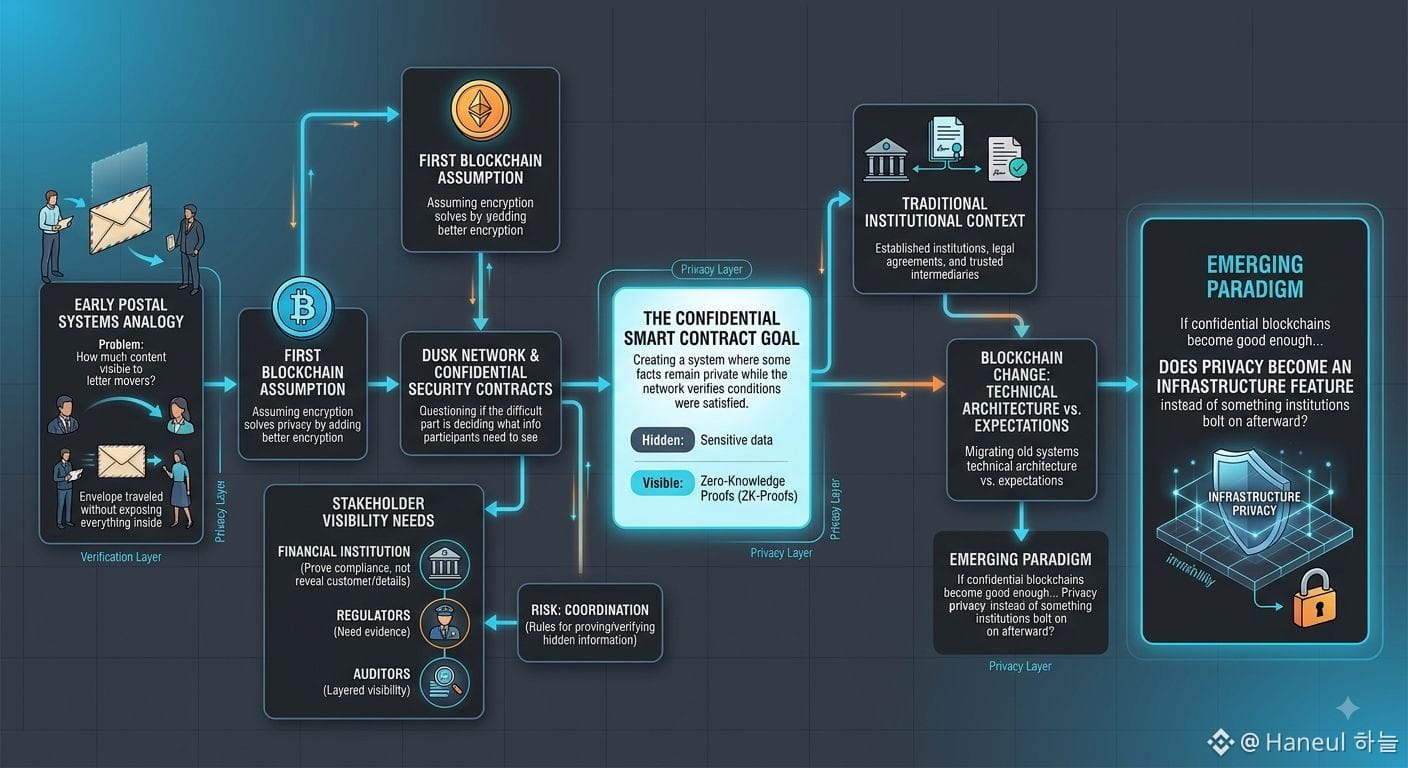
Back when banks started moving more records onto computers, I doubt anyone thought the biggest question would be how much information should remain visible.
At first I assumed blockchain finance had the same answer: make everything transparent, then add encryption where needed.
The more I read about $DUSK Network, the less simple that feels.
What caught my attention is the idea of confidential smart contracts. Financial activity often needs to be verified, but that doesn't mean every detail should be exposed to everyone watching the chain.
Imagine a company trading a tokenized asset. The transaction may need to follow certain rules, while the company probably doesn't want its entire strategy, balances, or counterparties sitting in public view.
Maybe that's the real tension.
Privacy can protect sensitive financial information, but less visibility can also mean fewer signals for everyone else trying to understand risk.
I'm not sure where the perfect balance sits.
I keep coming back to one question: can a blockchain prove that a transaction followed the rules without forcing everyone to see the information behind it?
Perhaps I'm focusing on the wrong thing.
Still, if privacy becomes programmable, the interesting problem may not be hiding information. It may be deciding who should be allowed to know what, and under which conditions.
#dusk
@Dusk
$DUSK
At first I assumed blockchain finance had the same answer: make everything transparent, then add encryption where needed.
The more I read about $DUSK Network, the less simple that feels.
What caught my attention is the idea of confidential smart contracts. Financial activity often needs to be verified, but that doesn't mean every detail should be exposed to everyone watching the chain.
Imagine a company trading a tokenized asset. The transaction may need to follow certain rules, while the company probably doesn't want its entire strategy, balances, or counterparties sitting in public view.
Maybe that's the real tension.
Privacy can protect sensitive financial information, but less visibility can also mean fewer signals for everyone else trying to understand risk.
I'm not sure where the perfect balance sits.
I keep coming back to one question: can a blockchain prove that a transaction followed the rules without forcing everyone to see the information behind it?
Perhaps I'm focusing on the wrong thing.
Still, if privacy becomes programmable, the interesting problem may not be hiding information. It may be deciding who should be allowed to know what, and under which conditions.
#dusk
@Dusk
$DUSK
The more I look at traditional finance, the more I notice how much of it depends on controlled visibility. Banks, auditors, regulators and counterparties don't all need to see the same information. They just need enough information to trust that something is valid.
At first I assumed blockchain finance would eventually solve this with better encryption and leave it there. But $DUSK Network made me rethink that.
Its focus on confidential smart contracts isn't really about hiding everything. It's about keeping sensitive financial information private while still allowing important conditions to be verified.
The more I read, the more interesting that tradeoff becomes. Imagine two institutions settling a tokenized asset. They need to know the transaction follows the rules, but neither side necessarily wants to expose its entire financial position.
Maybe that's where privacy becomes more than a nice feature.
I'm not sure, though. Making information private also creates questions around verification, regulation and coordination. Someone still needs to prove that the hidden information is legitimate.
I keep coming back to that tension. Perhaps the real challenge isn't making blockchain private, but figuring out how much privacy financial markets can have while everyone still feels confident enough to participate.
#dusk
@Dusk
$DUSK
At first I assumed blockchain finance would eventually solve this with better encryption and leave it there. But $DUSK Network made me rethink that.
Its focus on confidential smart contracts isn't really about hiding everything. It's about keeping sensitive financial information private while still allowing important conditions to be verified.
The more I read, the more interesting that tradeoff becomes. Imagine two institutions settling a tokenized asset. They need to know the transaction follows the rules, but neither side necessarily wants to expose its entire financial position.
Maybe that's where privacy becomes more than a nice feature.
I'm not sure, though. Making information private also creates questions around verification, regulation and coordination. Someone still needs to prove that the hidden information is legitimate.
I keep coming back to that tension. Perhaps the real challenge isn't making blockchain private, but figuring out how much privacy financial markets can have while everyone still feels confident enough to participate.
#dusk
@Dusk
$DUSK
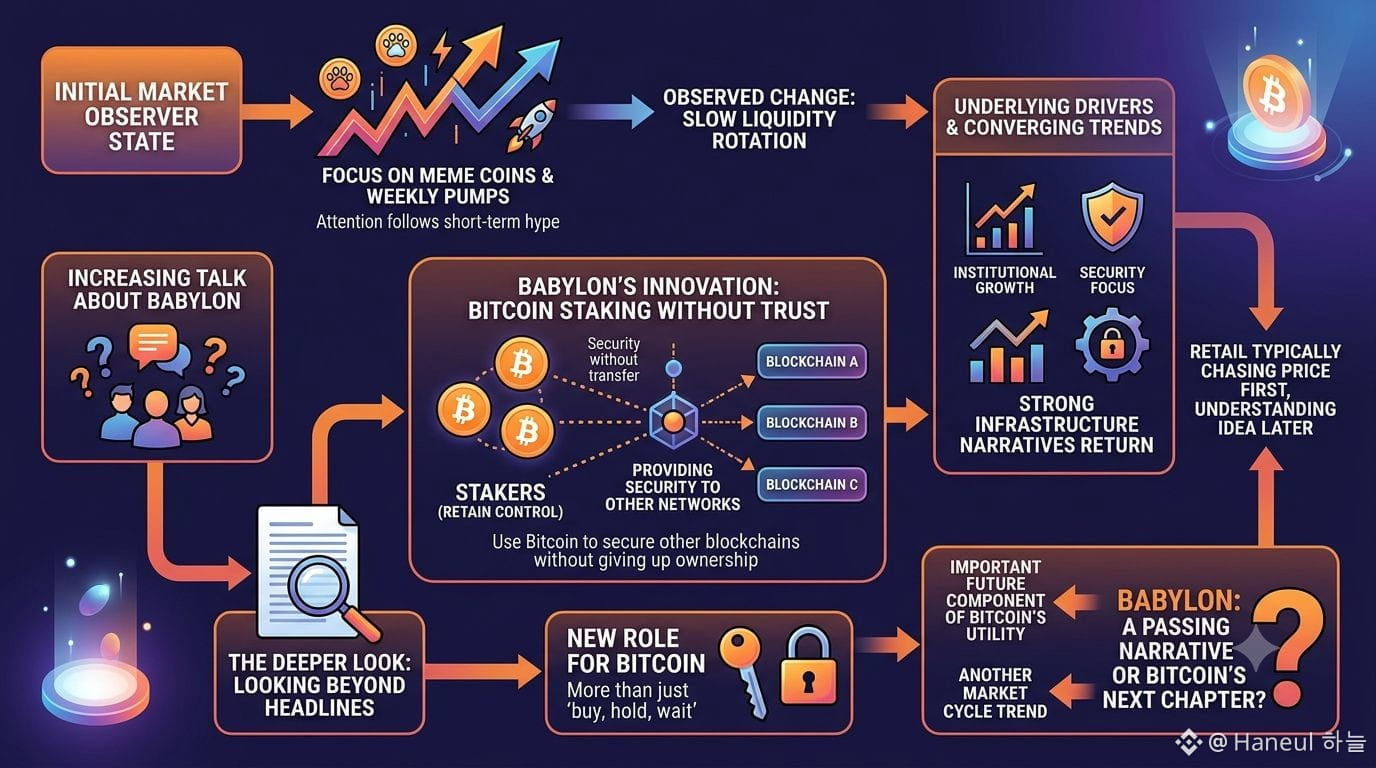
The market has been acting differently lately. For a while it felt like all the attention was going to meme coins and whatever was pumping that week, but over the past few weeks I've noticed liquidity slowly rotating back into infrastructure projects. I kept ignoring it for a while, but recently something changed. I kept wondering why people suddenly started talking about @BabylonLabs_io , so I decided to look beyond the headlines instead of just watching the price.
What caught my attention wasn't another Bitcoin token. It was the idea that people can use their Bitcoin to help secure other blockchains without giving up control of it. That felt different from the usual Bitcoin stories where the only plan is to buy, hold, and wait. It started making more sense the deeper I looked into it, and I realized the conversation wasn't really about $BABY alone. It was about whether Bitcoin could play a bigger role across crypto while still staying on its own network.
There's definitely hype around it, but I think there's more happening underneath. Institutions seem more focused on Bitcoin again, security is becoming a bigger topic, and stronger infrastructure narratives are returning. At the same time, I know adoption takes time, new security ideas still need to prove themselves, and there are other Bitcoin infrastructure projects competing for attention.
Retail usually chases price first and understands the idea later, while projects like this often don't get noticed until much further down the road. I still don't think most people fully understand where this could go, and I'm honestly still trying to figure out whether @BabylonLabs_io is just another market narrative or one of those projects we'll look back on as an important part of Bitcoin's next chapter.
#baby
@BabylonLabs_io
$BABY
What caught my attention wasn't another Bitcoin token. It was the idea that people can use their Bitcoin to help secure other blockchains without giving up control of it. That felt different from the usual Bitcoin stories where the only plan is to buy, hold, and wait. It started making more sense the deeper I looked into it, and I realized the conversation wasn't really about $BABY alone. It was about whether Bitcoin could play a bigger role across crypto while still staying on its own network.
There's definitely hype around it, but I think there's more happening underneath. Institutions seem more focused on Bitcoin again, security is becoming a bigger topic, and stronger infrastructure narratives are returning. At the same time, I know adoption takes time, new security ideas still need to prove themselves, and there are other Bitcoin infrastructure projects competing for attention.
Retail usually chases price first and understands the idea later, while projects like this often don't get noticed until much further down the road. I still don't think most people fully understand where this could go, and I'm honestly still trying to figure out whether @BabylonLabs_io is just another market narrative or one of those projects we'll look back on as an important part of Bitcoin's next chapter.
#baby
@BabylonLabs_io
$BABY
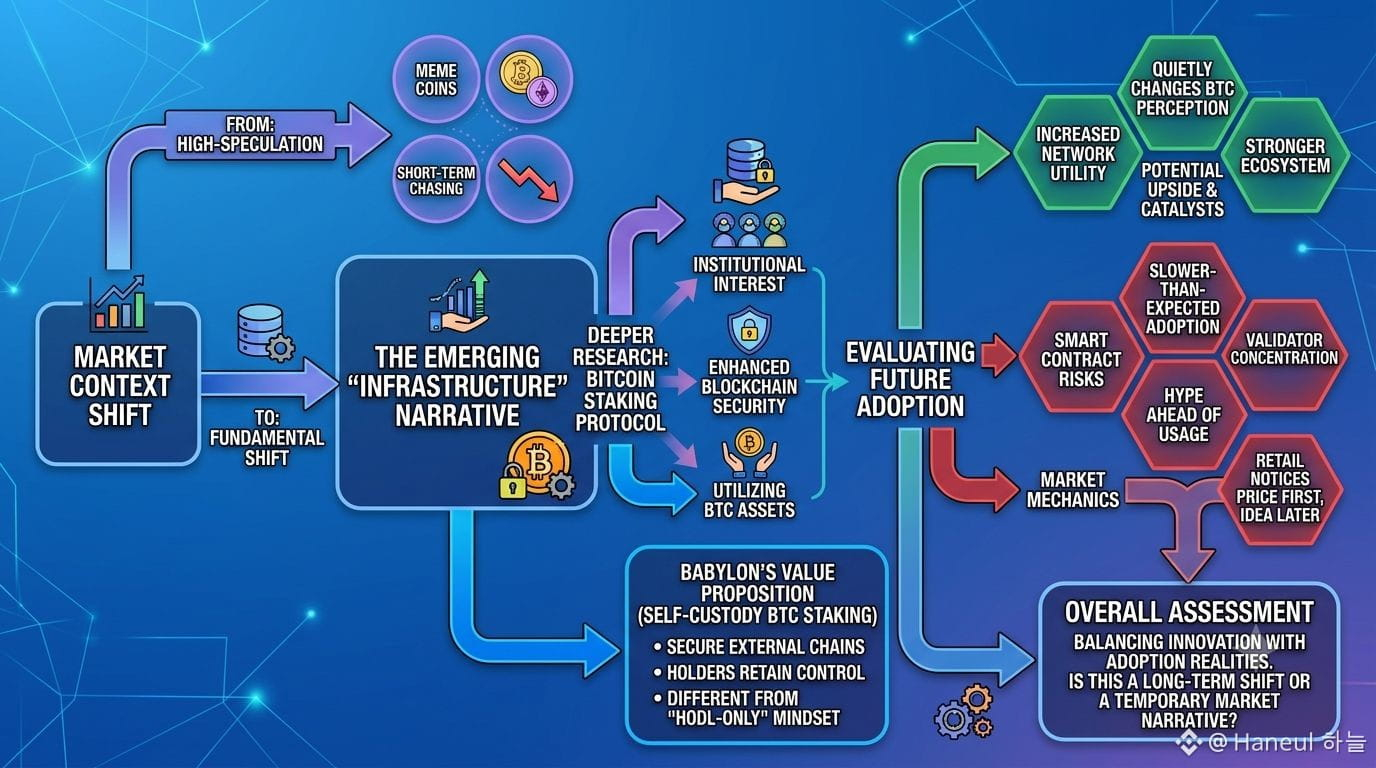
The market has been acting differently lately. A few months ago it felt like everyone was chasing meme coins, but now I keep seeing liquidity slowly move toward projects that are building the boring stuff behind the scenes. I kept ignoring $BABY for a while because I thought it was just another Bitcoin story, but recently something changed. I kept wondering why people suddenly started talking about it, so I decided to dig a little deeper.
What caught my attention wasn't the token itself. It was the idea that Bitcoin holders can help secure other blockchains without giving up control of their $BTC . That honestly felt different from the usual "buy Bitcoin and forget about it" mindset. The more I read, the more it started making sense, and I still don't think most people fully understand where this could go.
There's definitely hype around it, but I think there's something bigger happening underneath. More people seem to care about infrastructure again, institutions are paying closer attention to Bitcoin, and stronger blockchain security is becoming a real conversation. That doesn't mean everything will work perfectly. Adoption could take longer than people expect, smart contracts still need to prove themselves over time, validator concentration is worth watching, and hype can easily run ahead of real usage. Retail usually notices the price first and the idea later. I'm still not sure if @BabylonLabs_io is just another market narrative or one of those projects we'll look back on in a few years and realize it quietly changed how people think about Bitcoin.
#baby
@BabylonLabs_io
$BABY
What caught my attention wasn't the token itself. It was the idea that Bitcoin holders can help secure other blockchains without giving up control of their $BTC . That honestly felt different from the usual "buy Bitcoin and forget about it" mindset. The more I read, the more it started making sense, and I still don't think most people fully understand where this could go.
There's definitely hype around it, but I think there's something bigger happening underneath. More people seem to care about infrastructure again, institutions are paying closer attention to Bitcoin, and stronger blockchain security is becoming a real conversation. That doesn't mean everything will work perfectly. Adoption could take longer than people expect, smart contracts still need to prove themselves over time, validator concentration is worth watching, and hype can easily run ahead of real usage. Retail usually notices the price first and the idea later. I'm still not sure if @BabylonLabs_io is just another market narrative or one of those projects we'll look back on in a few years and realize it quietly changed how people think about Bitcoin.
#baby
@BabylonLabs_io
$BABY
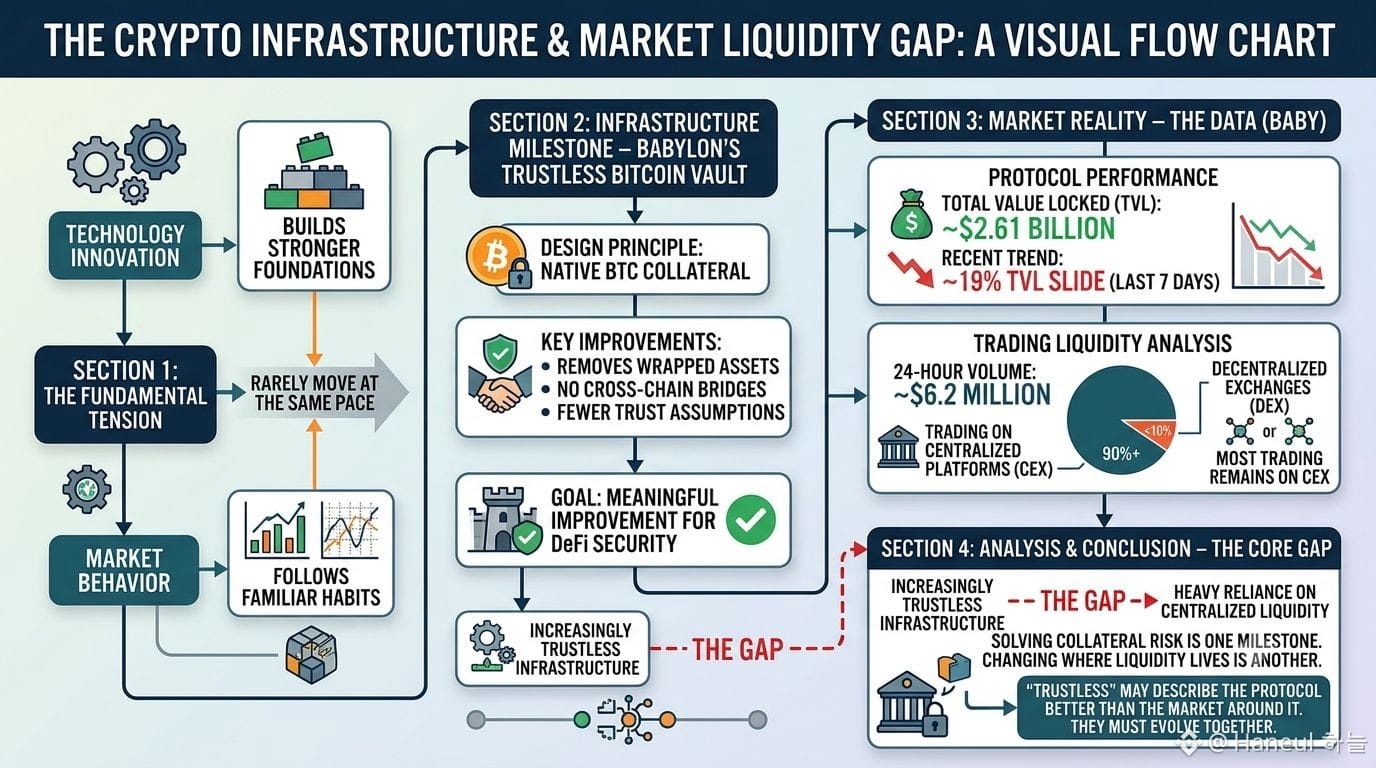
The more time I spend researching crypto infrastructure, the more I realize that technology and market behavior rarely move at the same pace. I think that's exactly what we're seeing right now. Projects are building stronger foundations, but liquidity still follows familiar habits.
Today I took a closer look at @BabylonLabs_io Trustless Bitcoin Vault design. Instead of depending on wrapped assets or cross-chain bridges, the goal is to let native $BTC serve as collateral with fewer trust assumptions. From what I've seen, that's a meaningful improvement for DeFi security.
Then I looked beyond the concept and into the numbers. Around $2.61 billion is still locked in the protocol, but TVL has slipped nearly 19% over the last seven days. Another detail stood out even more. $BABY processed roughly $6.2 million in 24-hour volume, yet only a small portion came from decentralized exchanges while most trading remained on centralized platforms.
I'll be honest, that's the part I can't stop thinking about. The infrastructure is becoming increasingly trustless, but the market that prices it still relies heavily on centralized liquidity.
I'm seeing a gap that many people ignore. Solving collateral risk is one milestone. Changing where liquidity lives is another. Until both evolve together, "trustless" may describe the protocol better than the market around it.
#baby
@BabylonLabs_io
$BABY
Today I took a closer look at @BabylonLabs_io Trustless Bitcoin Vault design. Instead of depending on wrapped assets or cross-chain bridges, the goal is to let native $BTC serve as collateral with fewer trust assumptions. From what I've seen, that's a meaningful improvement for DeFi security.
Then I looked beyond the concept and into the numbers. Around $2.61 billion is still locked in the protocol, but TVL has slipped nearly 19% over the last seven days. Another detail stood out even more. $BABY processed roughly $6.2 million in 24-hour volume, yet only a small portion came from decentralized exchanges while most trading remained on centralized platforms.
I'll be honest, that's the part I can't stop thinking about. The infrastructure is becoming increasingly trustless, but the market that prices it still relies heavily on centralized liquidity.
I'm seeing a gap that many people ignore. Solving collateral risk is one milestone. Changing where liquidity lives is another. Until both evolve together, "trustless" may describe the protocol better than the market around it.
#baby
@BabylonLabs_io
$BABY
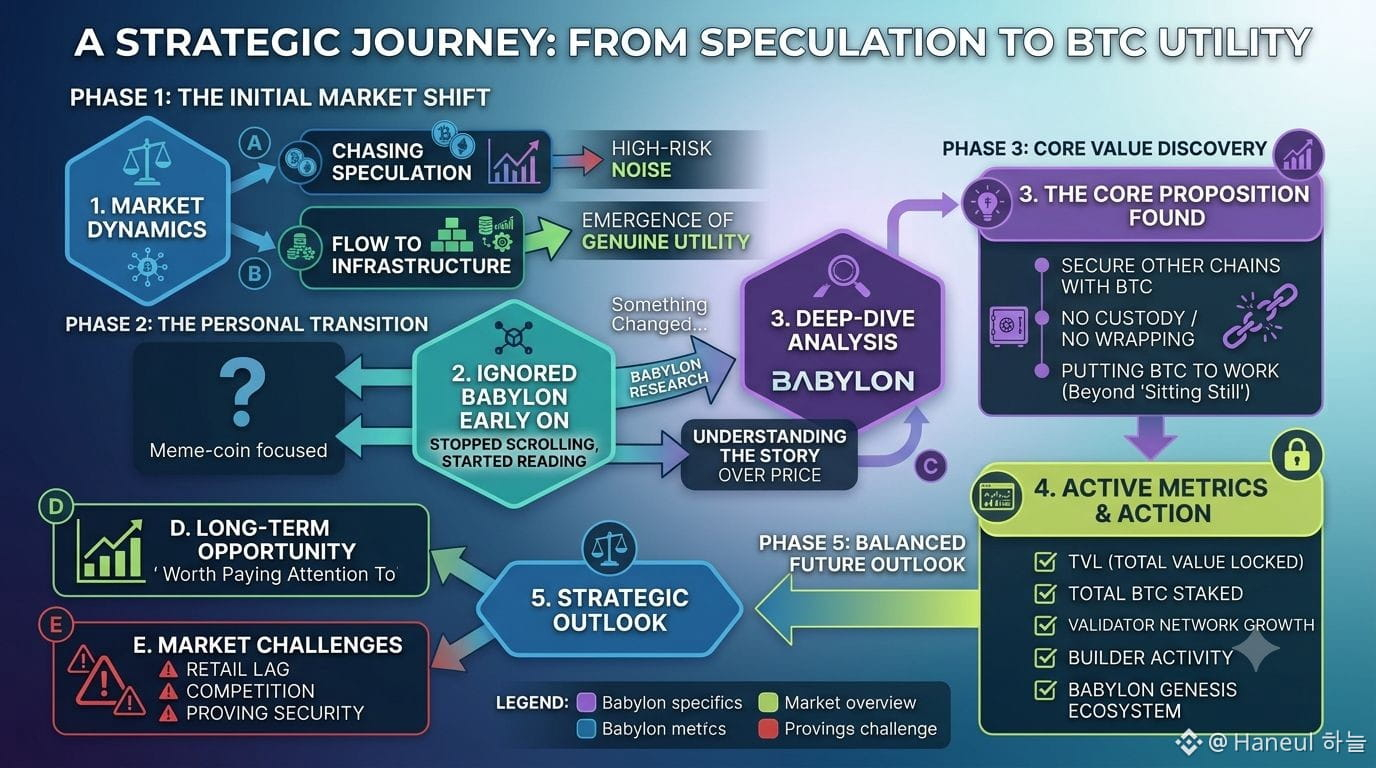
The market has been acting differently lately.
I've noticed money slowly moving back into infrastructure instead of only chasing meme coins.
I kept ignoring @BabylonLabs_io for a while, but recently something changed.
I kept wondering why people suddenly started talking about it.
So I stopped scrolling and started reading.
It made more sense the deeper I looked.
What caught my attention wasn't another Bitcoin token.
It was the idea of using $BTC to help secure other blockchains without giving up control of it.
Now I'm watching TVL, BTC staked, validator growth, new builders, and how @BabylonLabs_io Genesis is growing the ecosystem, not just the price.
There's definitely hype, but I think there's more happening underneath.
At the same time, adoption will take time, security still needs to prove itself, and competition is real.
Retail usually chases price before understanding the story.
I'm still not sure where this goes, but it feels like one of those ideas that's worth paying attention to.
#baby
@BabylonLabs_io
$BABY
I've noticed money slowly moving back into infrastructure instead of only chasing meme coins.
I kept ignoring @BabylonLabs_io for a while, but recently something changed.
I kept wondering why people suddenly started talking about it.
So I stopped scrolling and started reading.
It made more sense the deeper I looked.
What caught my attention wasn't another Bitcoin token.
It was the idea of using $BTC to help secure other blockchains without giving up control of it.
Now I'm watching TVL, BTC staked, validator growth, new builders, and how @BabylonLabs_io Genesis is growing the ecosystem, not just the price.
There's definitely hype, but I think there's more happening underneath.
At the same time, adoption will take time, security still needs to prove itself, and competition is real.
Retail usually chases price before understanding the story.
I'm still not sure where this goes, but it feels like one of those ideas that's worth paying attention to.
#baby
@BabylonLabs_io
$BABY
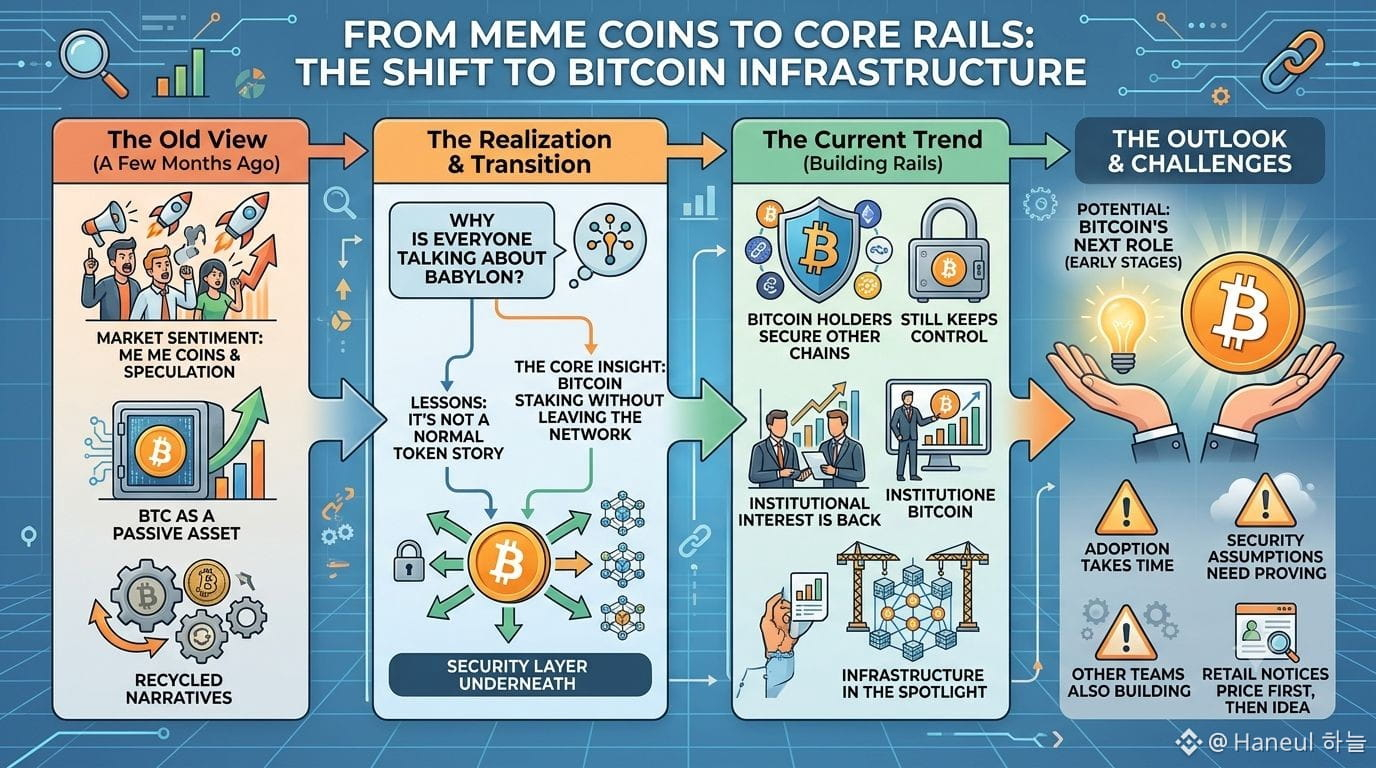
The market has felt different to me lately. A few months ago it seemed like every conversation was about the next meme coin, but now I keep noticing more people paying attention to the projects quietly building the rails underneath crypto. I kept ignoring @BabylonLabs_io for a while because I assumed it was just another Bitcoin narrative getting recycled. Then I started asking myself why people suddenly wouldn't stop talking about it.
The more I read, the less it felt like a normal token story. What grabbed my attention was the idea that Bitcoin holders can help secure other blockchains while still keeping control of their own $BTC . That sounds simple, but it changes the way I think about Bitcoin. For years it always felt like something you bought, stored, and hopefully watched grow. Now I'm wondering if Bitcoin can do more without ever leaving its own network.
There's definitely hype around @BabylonLabs_io , but I think something bigger is happening in the background. Institutions seem more interested in Bitcoin again, security is becoming a bigger priority, and infrastructure is getting attention after spending so long in the shadows. At the same time, I'm not convinced everything will play out smoothly. Adoption takes time, security assumptions still need to prove themselves, and there are plenty of other teams trying to build Bitcoin infrastructure too. Retail usually notices price first and the idea later.
I still don't think most people fully understand where this could go. Maybe it's just another cycle, or maybe we're watching the early pieces of Bitcoin's next role come together before most people even realize it.
#baby
@BabylonLabs_io
$BABY
The more I read, the less it felt like a normal token story. What grabbed my attention was the idea that Bitcoin holders can help secure other blockchains while still keeping control of their own $BTC . That sounds simple, but it changes the way I think about Bitcoin. For years it always felt like something you bought, stored, and hopefully watched grow. Now I'm wondering if Bitcoin can do more without ever leaving its own network.
There's definitely hype around @BabylonLabs_io , but I think something bigger is happening in the background. Institutions seem more interested in Bitcoin again, security is becoming a bigger priority, and infrastructure is getting attention after spending so long in the shadows. At the same time, I'm not convinced everything will play out smoothly. Adoption takes time, security assumptions still need to prove themselves, and there are plenty of other teams trying to build Bitcoin infrastructure too. Retail usually notices price first and the idea later.
I still don't think most people fully understand where this could go. Maybe it's just another cycle, or maybe we're watching the early pieces of Bitcoin's next role come together before most people even realize it.
#baby
@BabylonLabs_io
$BABY
The market has been acting differently lately. I've been noticing liquidity rotating back into infrastructure projects instead of everyone only chasing meme coins and whatever is trending for a few days. I kept ignoring it for a while, but recently something changed. I kept wondering why people suddenly started talking about @BabylonLabs_io . At first I thought it was just another Bitcoin narrative, but it started making more sense the deeper I looked into it. What caught my attention wasn't another token. It was the idea that #bitcoin holders can help secure Proof-of-Stake blockchains while still keeping control of their own $BTC instead of wrapping it or sending it across bridges. That feels important because bridges have been one of the biggest weak points in crypto over the years.
I also realized a lot of people mix up $BABY staking with BTC staking. The two aren't the same. BABY has its own unbonding timeline, while BTC follows Bitcoin's own rules, so they don't unlock in the same way. I think that confusion hides what the project is actually trying to build. Bitcoin has mostly been something people buy and hold, but now people are asking if it can help protect other networks without leaving the Bitcoin network itself. There's definitely hype around it, but I think there's more happening underneath. At the same time, adoption will take time, the security model still needs to prove itself in practice, and competition isn't going away. Retail usually chases price before understanding the idea, while infrastructure often gets noticed much later. I still don't think most people fully understand where this could go, and I'm honestly curious whether @BabylonLabs_io ends up being another short-lived narrative or something people eventually point to as an important part of Bitcoin's next chapter.
#baby
@BabylonLabs_io
$BABY
Babylon is??
I also realized a lot of people mix up $BABY staking with BTC staking. The two aren't the same. BABY has its own unbonding timeline, while BTC follows Bitcoin's own rules, so they don't unlock in the same way. I think that confusion hides what the project is actually trying to build. Bitcoin has mostly been something people buy and hold, but now people are asking if it can help protect other networks without leaving the Bitcoin network itself. There's definitely hype around it, but I think there's more happening underneath. At the same time, adoption will take time, the security model still needs to prove itself in practice, and competition isn't going away. Retail usually chases price before understanding the idea, while infrastructure often gets noticed much later. I still don't think most people fully understand where this could go, and I'm honestly curious whether @BabylonLabs_io ends up being another short-lived narrative or something people eventually point to as an important part of Bitcoin's next chapter.
#baby
@BabylonLabs_io
$BABY
Babylon is??
🔹 Underrated🤔
20%
🔹 Overhyped🔥
20%
🔹 Too Early🧐
0%
🔹 Not Sure🤷
60%
5 votes • Voting closed
Log in to explore more content