
AtsouLuc
94 Posts

AtsouLuc
Report
Block User
Faire la lumière autour de cette chose: Blockchain | content creator | comunity manager| Binance Angel |blockchain analyst
| Parlant anglais et français.
0 Following
4 Followers
9 Liked
Posts
·
--
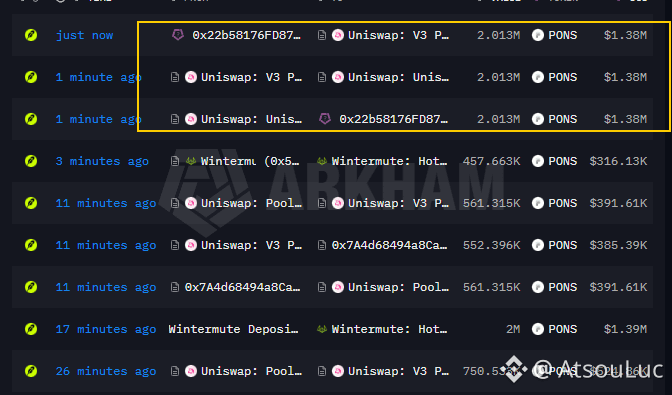
$PONS Dumps 19% Back to Key Lows While 2M Token Liquidity Shuffles on Uniswap.
Wallet withdrew 2.013M $PONS ($1.38M) from the Uniswap V3 Pool and is now routing it back on-chain.
So far, this wallet has cycled 2,013,000 $PONS ($1.38M) through Uniswap contracts at an average price of $0.685.
Wintermute also swept 2.45M $PONS ($1.70M) into its Hot Wallet over the last 20 minutes.
Execution route: Uniswap V3 Pool ↔ Uniswap Router
$PONS down -19% from the $0.85 high, directly re-testing key range support at $0.6800.
$PONS Dumps 19% Back to Key Lows While 2M Token Liquidity Shuffles on Uniswap.
Wallet withdrew 2.013M $PONS ($1.38M) from the Uniswap V3 Pool and is now routing it back on-chain.
So far, this wallet has cycled 2,013,000 $PONS ($1.38M) through Uniswap contracts at an average price of $0.685.
Wintermute also swept 2.45M $PONS ($1.70M) into its Hot Wallet over the last 20 minutes.
Execution route: Uniswap V3 Pool ↔ Uniswap Router
$PONS down -19% from the $0.85 high, directly re-testing key range support at $0.6800.
Wallet withdrew 2.013M $PONS ($1.38M) from the Uniswap V3 Pool and is now routing it back on-chain.
So far, this wallet has cycled 2,013,000 $PONS ($1.38M) through Uniswap contracts at an average price of $0.685.
Wintermute also swept 2.45M $PONS ($1.70M) into its Hot Wallet over the last 20 minutes.
Execution route: Uniswap V3 Pool ↔ Uniswap Router
$PONS down -19% from the $0.85 high, directly re-testing key range support at $0.6800.
58
·
--
The British investor who watched his “lost” Bitcoin turn into $4.5 million after 12 years.
Chris is a regular British guy who quietly became one of crypto’s most unexpected millionaires after a decade of thinking his Bitcoin was gone forever.
Back in 2011, when Bitcoin was still trading below $4, he spent around £1,500 (roughly $2,000) buying BTC through the early UK exchange Britcoin, later known as Intersango.
Then the exchange shut down. Access vanished. For more than 12 years he watched Bitcoin explode in value, convinced his coins were permanently lost.
In 2026, CEL Solicitors and specialist crypto-tracing experts tracked down a dormant wallet linked to former Intersango users holding over 5,500 BTC.
After proving ownership, Chris recovered his share, now worth $4.5 million.Other early Intersango users may still be able to claim their funds if they can prove they owned them.
The real question is: how many more “lost forever” fortunes are still sitting out there waiting to be found?
The British investor who watched his “lost” Bitcoin turn into $4.5 million after 12 years.
Chris is a regular British guy who quietly became one of crypto’s most unexpected millionaires after a decade of thinking his Bitcoin was gone forever.
Back in 2011, when Bitcoin was still trading below $4, he spent around £1,500 (roughly $2,000) buying BTC through the early UK exchange Britcoin, later known as Intersango.
Then the exchange shut down. Access vanished. For more than 12 years he watched Bitcoin explode in value, convinced his coins were permanently lost.
In 2026, CEL Solicitors and specialist crypto-tracing experts tracked down a dormant wallet linked to former Intersango users holding over 5,500 BTC.
After proving ownership, Chris recovered his share, now worth $4.5 million.Other early Intersango users may still be able to claim their funds if they can prove they owned them.
The real question is: how many more “lost forever” fortunes are still sitting out there waiting to be found?
Chris is a regular British guy who quietly became one of crypto’s most unexpected millionaires after a decade of thinking his Bitcoin was gone forever.
Back in 2011, when Bitcoin was still trading below $4, he spent around £1,500 (roughly $2,000) buying BTC through the early UK exchange Britcoin, later known as Intersango.
Then the exchange shut down. Access vanished. For more than 12 years he watched Bitcoin explode in value, convinced his coins were permanently lost.
In 2026, CEL Solicitors and specialist crypto-tracing experts tracked down a dormant wallet linked to former Intersango users holding over 5,500 BTC.
After proving ownership, Chris recovered his share, now worth $4.5 million.Other early Intersango users may still be able to claim their funds if they can prove they owned them.
The real question is: how many more “lost forever” fortunes are still sitting out there waiting to be found?
59
·
--
🚨 BTCLOAN launches a global platform allowing users to borrow money using their Bitcoin as collateral, without having to sell them.
BTCLOAN does not directly grant loans but connects borrowers with several institutional players, including Tether, Galaxy, Cantor, Arch Lending, Antalpha, and EquitiesFirst, in order to compare their offers.
Loans can be disbursed in dollars or USDT, with a loan-to-value ratio generally between 65 and 70%. BTCLOAN also claims to have already facilitated more than $200 million in loans and now accepts other collateral such as ETH, XRP, or SOL.
🚨 BTCLOAN launches a global platform allowing users to borrow money using their Bitcoin as collateral, without having to sell them.
BTCLOAN does not directly grant loans but connects borrowers with several institutional players, including Tether, Galaxy, Cantor, Arch Lending, Antalpha, and EquitiesFirst, in order to compare their offers.
Loans can be disbursed in dollars or USDT, with a loan-to-value ratio generally between 65 and 70%. BTCLOAN also claims to have already facilitated more than $200 million in loans and now accepts other collateral such as ETH, XRP, or SOL.
BTCLOAN does not directly grant loans but connects borrowers with several institutional players, including Tether, Galaxy, Cantor, Arch Lending, Antalpha, and EquitiesFirst, in order to compare their offers.
Loans can be disbursed in dollars or USDT, with a loan-to-value ratio generally between 65 and 70%. BTCLOAN also claims to have already facilitated more than $200 million in loans and now accepts other collateral such as ETH, XRP, or SOL.

15
·
--
Market order, limit order or Convert, what's the difference? 👀
If you're just getting started with crypto trading, understanding the basics can make the process much easier.
After funding your account, the general journey is:
Choose a crypto → Convert or Trade → Select your order → Review the details → Confirm
With Spot trading, you're generally buying and selling crypto assets directly.
A Market Order is designed to execute at the currently available market price.
A Limit Order lets you set the price at which you want to buy or sell.
Binance Convert can provide a simpler way to swap one supported asset for another.
Before placing an order, don't just click confirm. Understand the trading pair, check the order details and make sure you understand what you're using.
Crypto prices can move quickly, and the wider crypto market can change rapidly.
Some users explore purchasing smaller amounts over time, but whatever approach you consider, understanding the product and associated risks should come first.
Educational only. DYOR and make sure you understand what you're using.
Market order or limit order, which one did you learn first?
#Binance #BinanceAcademy #LearnWithBinance
Market order, limit order or Convert, what's the difference? 👀
If you're just getting started with crypto trading, understanding the basics can make the process much easier.
After funding your account, the general journey is:
Choose a crypto → Convert or Trade → Select your order → Review the details → Confirm
With Spot trading, you're generally buying and selling crypto assets directly.
A Market Order is designed to execute at the currently available market price.
A Limit Order lets you set the price at which you want to buy or sell.
Binance Convert can provide a simpler way to swap one supported asset for another.
Before placing an order, don't just click confirm. Understand the trading pair, check the order details and make sure you understand what you're using.
Crypto prices can move quickly, and the wider crypto market can change rapidly.
Some users explore purchasing smaller amounts over time, but whatever approach you consider, understanding the product and associated risks should come first.
Educational only. DYOR and make sure you understand what you're using.
Market order or limit order, which one did you learn first?
#Binance #BinanceAcademy #LearnWithBinance
If you're just getting started with crypto trading, understanding the basics can make the process much easier.
After funding your account, the general journey is:
Choose a crypto → Convert or Trade → Select your order → Review the details → Confirm
With Spot trading, you're generally buying and selling crypto assets directly.
A Market Order is designed to execute at the currently available market price.
A Limit Order lets you set the price at which you want to buy or sell.
Binance Convert can provide a simpler way to swap one supported asset for another.
Before placing an order, don't just click confirm. Understand the trading pair, check the order details and make sure you understand what you're using.
Crypto prices can move quickly, and the wider crypto market can change rapidly.
Some users explore purchasing smaller amounts over time, but whatever approach you consider, understanding the product and associated risks should come first.
Educational only. DYOR and make sure you understand what you're using.
Market order or limit order, which one did you learn first?
#Binance #BinanceAcademy #LearnWithBinance
82
·
--
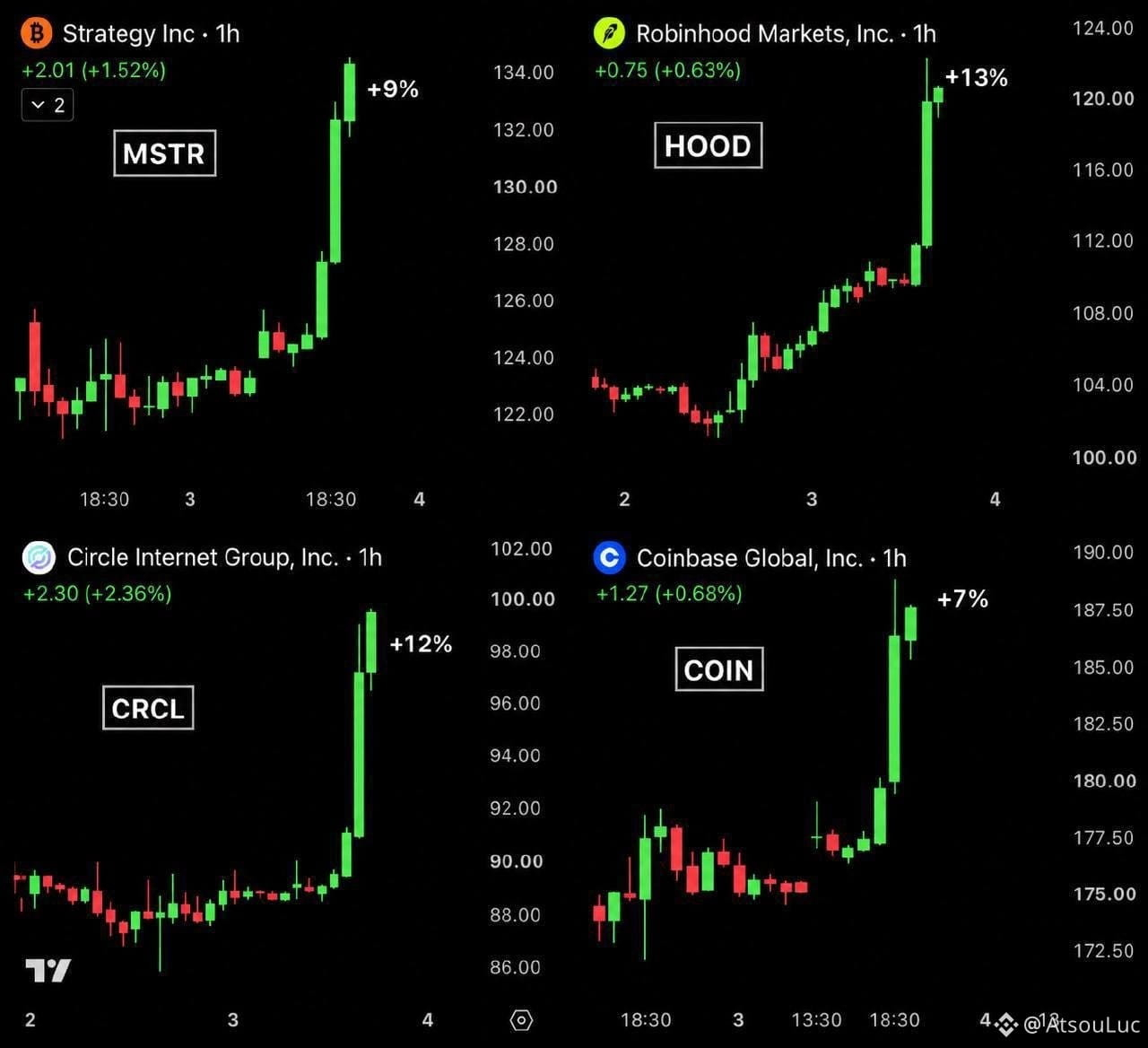
📈 Crypto-related stocks are soaring on Wall Street.
Robinhood $HOOD, Coinbase $COIN, Strategy $MSTR and Circle $CRCL are all benefiting from renewed risk appetite around the crypto market.
The move follows Bitcoin’s return above $81,000, before edging slightly lower this afternoon.
This phenomenon shows how much the crypto ecosystem has now spread into traditional markets.
📈 Crypto-related stocks are soaring on Wall Street.
Robinhood $HOOD, Coinbase $COIN, Strategy $MSTR and Circle $CRCL are all benefiting from renewed risk appetite around the crypto market.
The move follows Bitcoin’s return above $81,000, before edging slightly lower this afternoon.
This phenomenon shows how much the crypto ecosystem has now spread into traditional markets.
Robinhood $HOOD, Coinbase $COIN, Strategy $MSTR and Circle $CRCL are all benefiting from renewed risk appetite around the crypto market.
The move follows Bitcoin’s return above $81,000, before edging slightly lower this afternoon.
This phenomenon shows how much the crypto ecosystem has now spread into traditional markets.
78
·
--
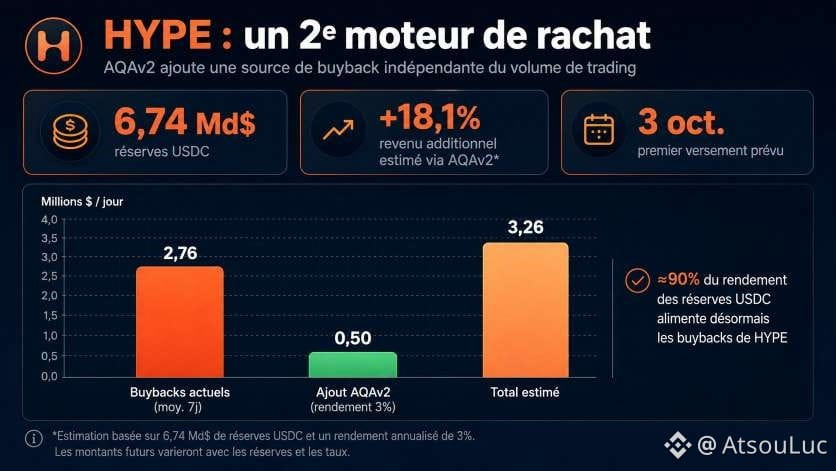
Hyperliquid has just added a second buyback engine for HYPE — and it changes the token’s mechanics.
Until now, buybacks mainly depended on trading fees: more volume = more HYPE bought back.
With AQAv2, ~90% of the return generated by the 6.74 Md$ de USDC reserves now also feeds into buybacks.
The difference is significant: this new engine depends on reserves and rates, not on trading activity.
➡️ Hyperliquid therefore moves from a cyclical buyback model to a two-source demand model.
Hyperliquid has just added a second buyback engine for HYPE — and it changes the token’s mechanics.
Until now, buybacks mainly depended on trading fees: more volume = more HYPE bought back.
With AQAv2, ~90% of the return generated by the 6.74 Md$ de USDC reserves now also feeds into buybacks.
The difference is significant: this new engine depends on reserves and rates, not on trading activity.
➡️ Hyperliquid therefore moves from a cyclical buyback model to a two-source demand model.
Until now, buybacks mainly depended on trading fees: more volume = more HYPE bought back.
With AQAv2, ~90% of the return generated by the 6.74 Md$ de USDC reserves now also feeds into buybacks.
The difference is significant: this new engine depends on reserves and rates, not on trading activity.
➡️ Hyperliquid therefore moves from a cyclical buyback model to a two-source demand model.
54
·
--
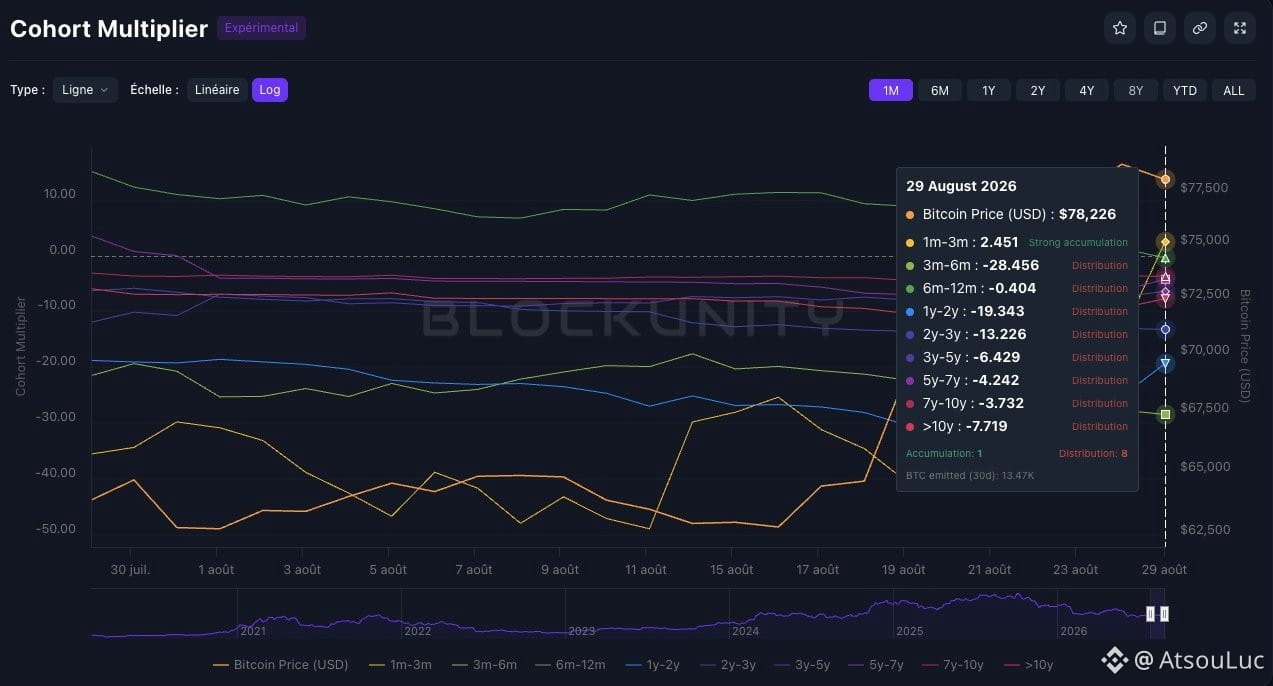
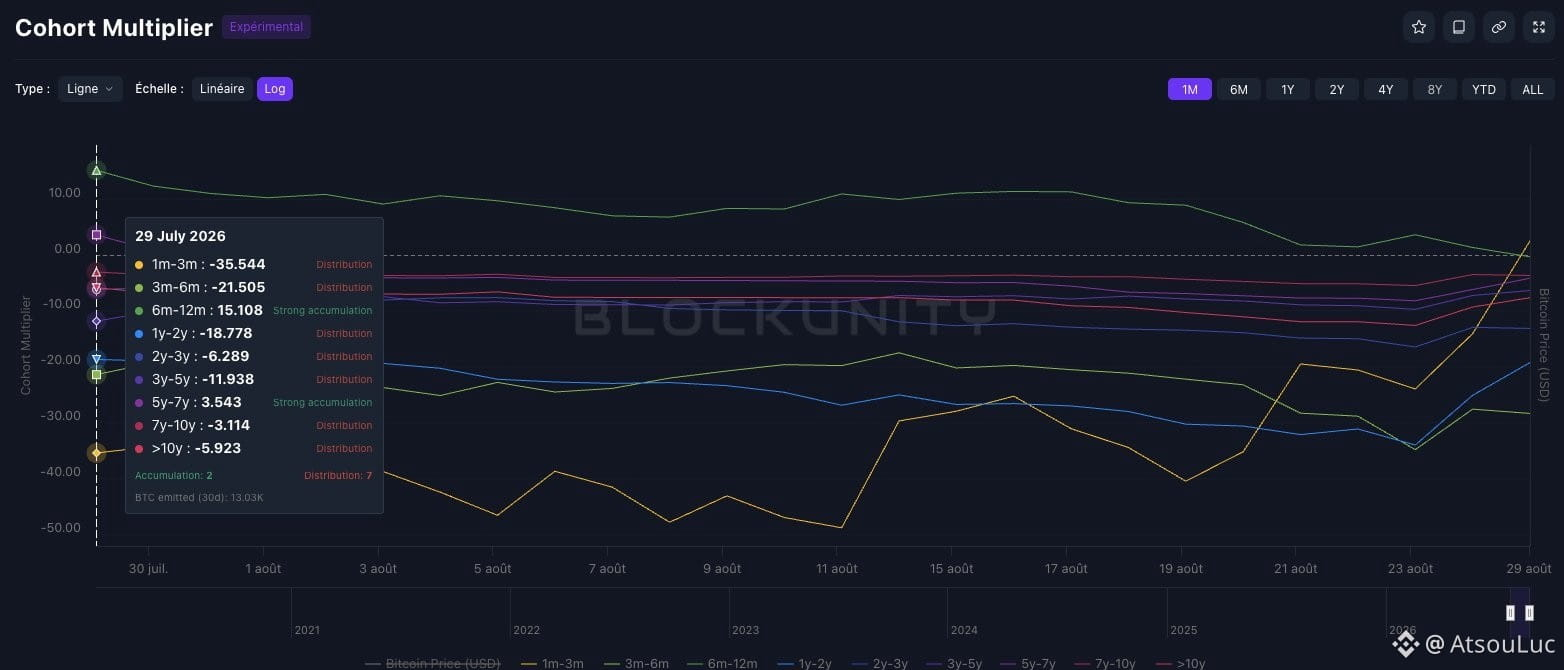
In one month, the accumulation has shifted toward BTC held for only the last 1 to 3 months, while older cohorts mostly move into distribution.
This suggests that long-time holders are taking advantage of the rally to sell part of their positions, while a new wave of buyers absorbs this supply.
➡️ As long as this new demand remains strong enough, this transfer can remain healthy.
The risk arises if the older holders continue to distribute just as new entrants start slowing their purchases.
At that point, the market would lose its main absorption mechanism.
In one month, the accumulation has shifted toward BTC held for only the last 1 to 3 months, while older cohorts mostly move into distribution.
This suggests that long-time holders are taking advantage of the rally to sell part of their positions, while a new wave of buyers absorbs this supply.
➡️ As long as this new demand remains strong enough, this transfer can remain healthy.
The risk arises if the older holders continue to distribute just as new entrants start slowing their purchases.
At that point, the market would lose its main absorption mechanism.
This suggests that long-time holders are taking advantage of the rally to sell part of their positions, while a new wave of buyers absorbs this supply.
➡️ As long as this new demand remains strong enough, this transfer can remain healthy.
The risk arises if the older holders continue to distribute just as new entrants start slowing their purchases.
At that point, the market would lose its main absorption mechanism.
73
·
--
🤯 He had invested only £1,500 in Bitcoin in 2011. Twelve years after believing his lost BTC were gone forever, he has just recovered a fortune of more than £3 million.
The Brit, identified under the pseudonym “Chris,” bought his first Bitcoins when the BTC was worth about £2.94.
But the British platform Intersango, where they were held, collapsed and, in 2014, he found himself unable to retrieve his funds.
At the time, his investment was still worth only around £4,000.
For more than a decade, Chris watched as Bitcoin exploded...
In 2026, he makes a final attempt with specialized lawyers. By gathering his old purchase records and tracing the funds, they finally manage to have his ownership recognized and to return 61 BTC to him.
At the time of their return, the total value of his BTC was exactly £3,331,618.
Now a millionaire, Chris plans to buy a bigger house and keep some of his BTC.
🤯 He had invested only £1,500 in Bitcoin in 2011. Twelve years after believing his lost BTC were gone forever, he has just recovered a fortune of more than £3 million.
The Brit, identified under the pseudonym “Chris,” bought his first Bitcoins when the BTC was worth about £2.94.
But the British platform Intersango, where they were held, collapsed and, in 2014, he found himself unable to retrieve his funds.
At the time, his investment was still worth only around £4,000.
For more than a decade, Chris watched as Bitcoin exploded...
In 2026, he makes a final attempt with specialized lawyers. By gathering his old purchase records and tracing the funds, they finally manage to have his ownership recognized and to return 61 BTC to him.
At the time of their return, the total value of his BTC was exactly £3,331,618.
Now a millionaire, Chris plans to buy a bigger house and keep some of his BTC.
The Brit, identified under the pseudonym “Chris,” bought his first Bitcoins when the BTC was worth about £2.94.
But the British platform Intersango, where they were held, collapsed and, in 2014, he found himself unable to retrieve his funds.
At the time, his investment was still worth only around £4,000.
For more than a decade, Chris watched as Bitcoin exploded...
In 2026, he makes a final attempt with specialized lawyers. By gathering his old purchase records and tracing the funds, they finally manage to have his ownership recognized and to return 61 BTC to him.
At the time of their return, the total value of his BTC was exactly £3,331,618.
Now a millionaire, Chris plans to buy a bigger house and keep some of his BTC.
1
·
--
🤯 He had invested only £1,500 in Bitcoin in 2011. Twelve years after giving up hope on his lost BTC forever, he has just recovered a fortune of more than £3 million.
The Brit, identified under the pseudonym “Chris,” bought his first Bitcoins when the BTC was worth about £2.94.
But the British platform Intersango, where they were held, collapsed, and in 2014 he found himself unable to recover his funds.
At the time, his investment was still only worth around £4,000.
For more than a decade, Chris watched Bitcoin explode...
In 2026, he makes one last attempt with specialized lawyers. By gathering his old purchase evidence and tracing the funds, they finally manage to have his ownership recognized and return 61 BTC to him.
At the time of their return, the total value of his BTC was exactly £3,331,618.
Now a millionaire, Chris plans to buy a bigger house and keep some of his BTC.
🤯 He had invested only £1,500 in Bitcoin in 2011. Twelve years after giving up hope on his lost BTC forever, he has just recovered a fortune of more than £3 million.
The Brit, identified under the pseudonym “Chris,” bought his first Bitcoins when the BTC was worth about £2.94.
But the British platform Intersango, where they were held, collapsed, and in 2014 he found himself unable to recover his funds.
At the time, his investment was still only worth around £4,000.
For more than a decade, Chris watched Bitcoin explode...
In 2026, he makes one last attempt with specialized lawyers. By gathering his old purchase evidence and tracing the funds, they finally manage to have his ownership recognized and return 61 BTC to him.
At the time of their return, the total value of his BTC was exactly £3,331,618.
Now a millionaire, Chris plans to buy a bigger house and keep some of his BTC.
The Brit, identified under the pseudonym “Chris,” bought his first Bitcoins when the BTC was worth about £2.94.
But the British platform Intersango, where they were held, collapsed, and in 2014 he found himself unable to recover his funds.
At the time, his investment was still only worth around £4,000.
For more than a decade, Chris watched Bitcoin explode...
In 2026, he makes one last attempt with specialized lawyers. By gathering his old purchase evidence and tracing the funds, they finally manage to have his ownership recognized and return 61 BTC to him.
At the time of their return, the total value of his BTC was exactly £3,331,618.
Now a millionaire, Chris plans to buy a bigger house and keep some of his BTC.
·
--
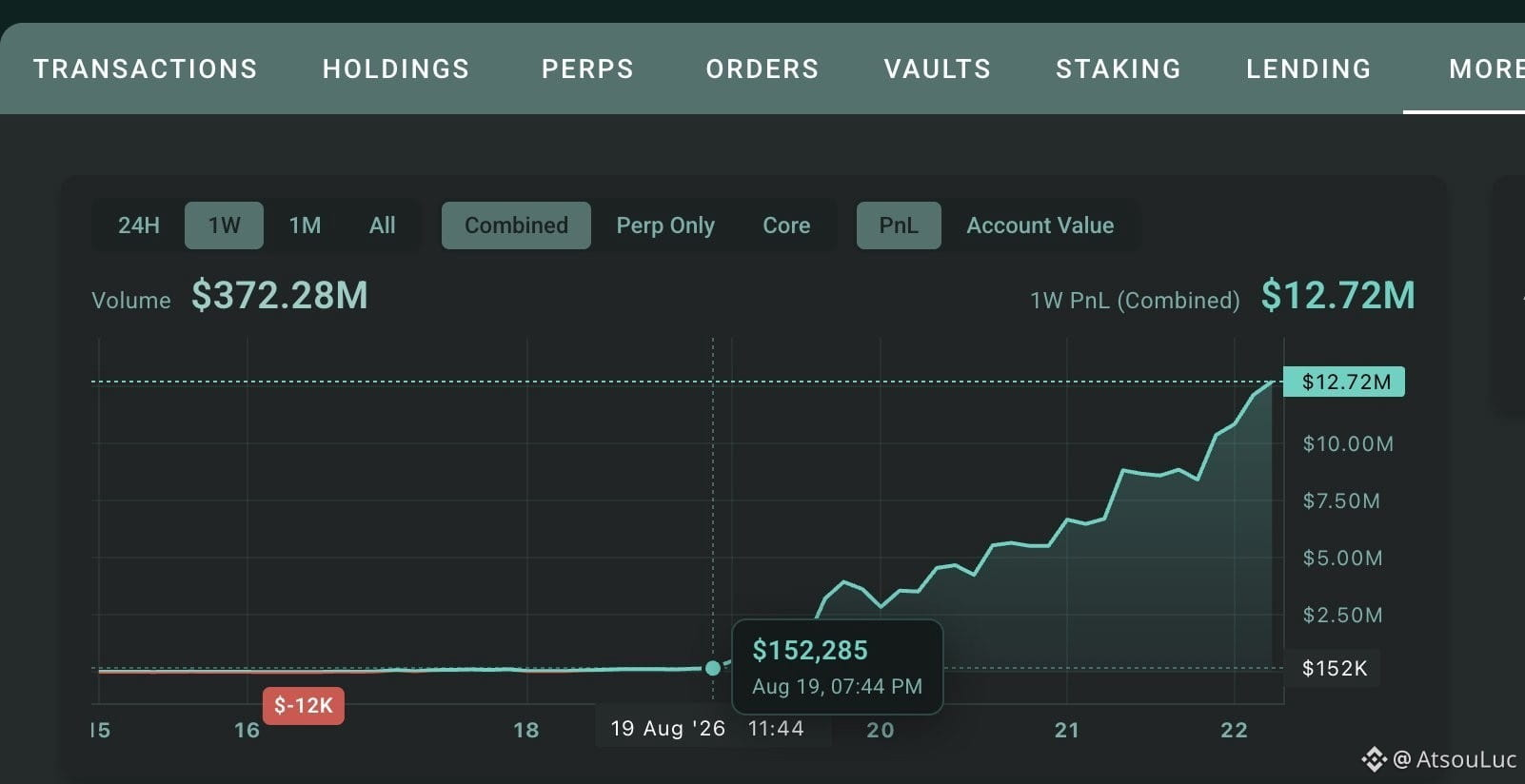
🚨 After undergoing nearly 500 liquidations, Machibigbrother has just managed to turn only 152 000 $ en 12.72 million dollars, i.e. more than 12.5 million dollars in gains in just three days, thanks to its LONG leveraged positions on Hyperliquid.
A few days earlier, he was still selling Bored Apes to defend his positions threatened by liquidation.
🚨 After undergoing nearly 500 liquidations, Machibigbrother has just managed to turn only 152 000 $ en 12.72 million dollars, i.e. more than 12.5 million dollars in gains in just three days, thanks to its LONG leveraged positions on Hyperliquid.
A few days earlier, he was still selling Bored Apes to defend his positions threatened by liquidation.
A few days earlier, he was still selling Bored Apes to defend his positions threatened by liquidation.
64
·
--
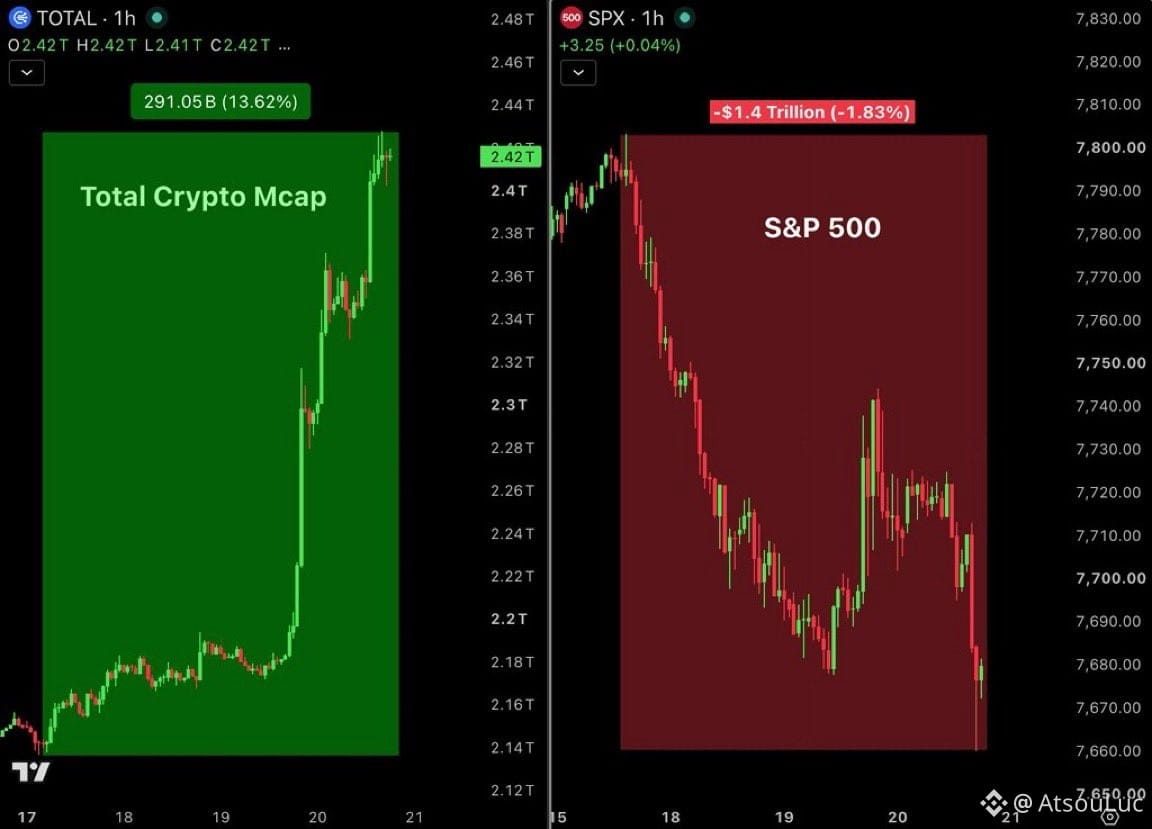
Money rotation from stocks to crypto?
This Week:
The crypto market added +$291 billion
While the US Stocks erased -$1.4 trillion.
Money rotation from stocks to crypto?
This Week:
The crypto market added +$291 billion
While the US Stocks erased -$1.4 trillion.
This Week:
The crypto market added +$291 billion
While the US Stocks erased -$1.4 trillion.
59
·
--
🇺🇸 The FBI may already have identified the hacker behind the first wave of the Coldcard hack.
The July 30 attack would have allowed the theft of $1,082.65 BTC during the first wave, by exploiting a serious weakness in the seed generation of certain Coldcard devices. In total, the different waves would have affected thousands of addresses.
But the hacker made a mistake: they used a paid account with a major blockchain services provider to query the addresses before moving the BTC. The provider’s logs match with remarkable accuracy the timing and sequence of the hacker’s operations. This information has since been shared with authorities.
A lead that could allow investigators to trace directly back to his identity.
🇺🇸 The FBI may already have identified the hacker behind the first wave of the Coldcard hack.
The July 30 attack would have allowed the theft of $1,082.65 BTC during the first wave, by exploiting a serious weakness in the seed generation of certain Coldcard devices. In total, the different waves would have affected thousands of addresses.
But the hacker made a mistake: they used a paid account with a major blockchain services provider to query the addresses before moving the BTC. The provider’s logs match with remarkable accuracy the timing and sequence of the hacker’s operations. This information has since been shared with authorities.
A lead that could allow investigators to trace directly back to his identity.
The July 30 attack would have allowed the theft of $1,082.65 BTC during the first wave, by exploiting a serious weakness in the seed generation of certain Coldcard devices. In total, the different waves would have affected thousands of addresses.
But the hacker made a mistake: they used a paid account with a major blockchain services provider to query the addresses before moving the BTC. The provider’s logs match with remarkable accuracy the timing and sequence of the hacker’s operations. This information has since been shared with authorities.
A lead that could allow investigators to trace directly back to his identity.


77
·
--
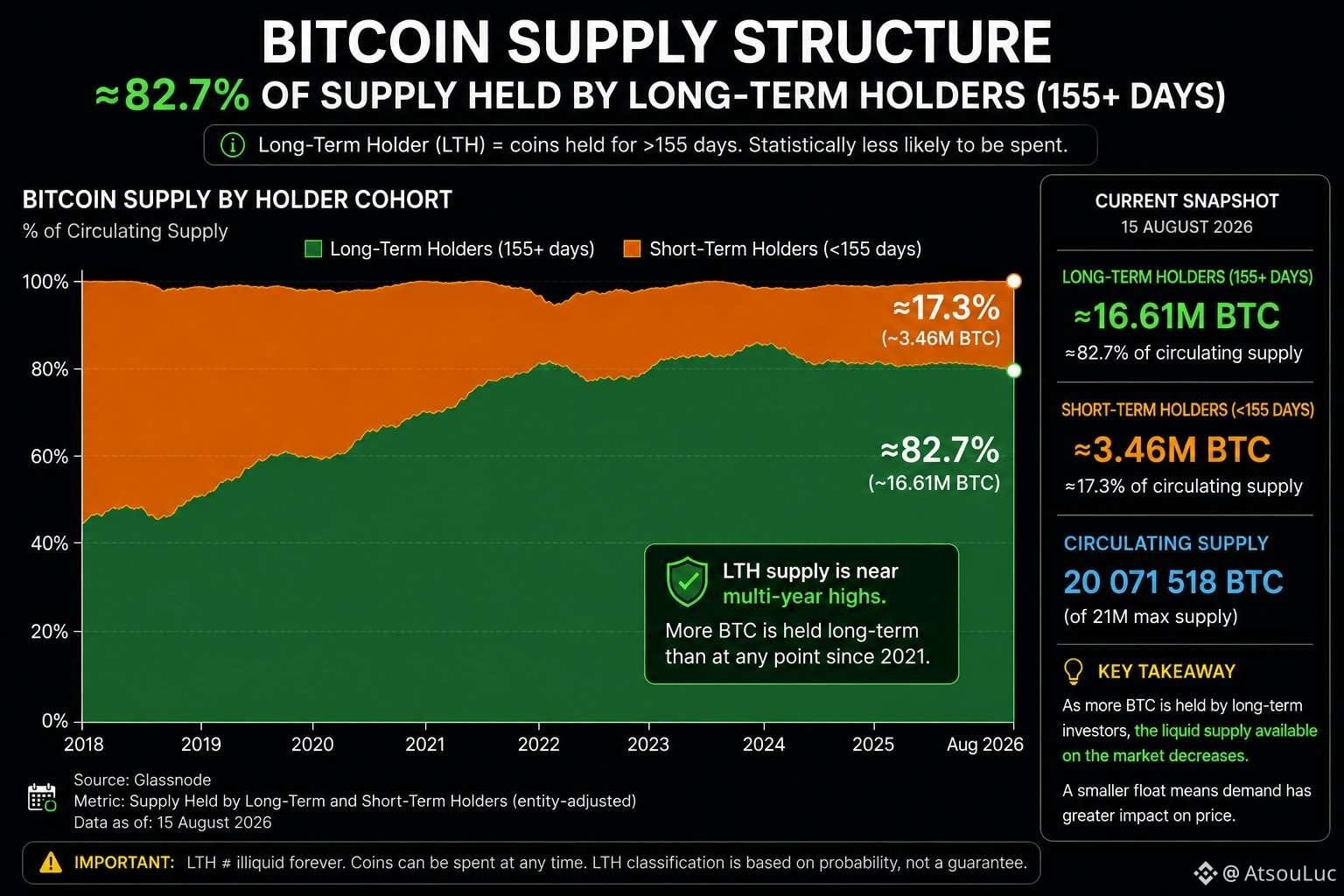
🧱 More than 16.6M BTC are now held by Long-Term Holders.
That represents about 82.7% of the 20.07M BTC in circulation.
According to Glassnode, these BTC belong to the LTH cohort: coins old enough to be statistically less likely to be spent.
Why does it matter?
The more the supply stays in the hands of LTHs, the more the actual sellable float can shrink.
So if a strong incremental demand surge comes in (ETFs, institutions, corporate treasuries), it has to compete for a much smaller amount of available BTC than the total supply.
➡️ A reduced available supply can strongly amplify the impact of a demand rebound.
🧱 More than 16.6M BTC are now held by Long-Term Holders.
That represents about 82.7% of the 20.07M BTC in circulation.
According to Glassnode, these BTC belong to the LTH cohort: coins old enough to be statistically less likely to be spent.
Why does it matter?
The more the supply stays in the hands of LTHs, the more the actual sellable float can shrink.
So if a strong incremental demand surge comes in (ETFs, institutions, corporate treasuries), it has to compete for a much smaller amount of available BTC than the total supply.
➡️ A reduced available supply can strongly amplify the impact of a demand rebound.
That represents about 82.7% of the 20.07M BTC in circulation.
According to Glassnode, these BTC belong to the LTH cohort: coins old enough to be statistically less likely to be spent.
Why does it matter?
The more the supply stays in the hands of LTHs, the more the actual sellable float can shrink.
So if a strong incremental demand surge comes in (ETFs, institutions, corporate treasuries), it has to compete for a much smaller amount of available BTC than the total supply.
➡️ A reduced available supply can strongly amplify the impact of a demand rebound.
69
·
--
🪙 6 BTC are currently locked in a Bitcoin wallet… and they will belong to whoever manages to “crack” it.
This is Bitcoin Puzzle #71, a challenge created in 2015 in which the private key is deliberately placed in a reduced search space.
Developer Simon Males has just created Krackpot, a tool that lets anyone use the power of their GPU directly from their browser to try to find this key. No account or deposit required: if your machine finds the right combination, 6 BTC are sent to your address, while the rest of the wallet goes back to the developer.
But as fun as playing the lottery: there are still about 2⁷⁰ possibilities, or 1.18 sextillion keys. According to the estimates shown by the project, even a powerful GPU could take nearly a million years to find the key.
With a million GPUs working simultaneously, the order of magnitude would drop to around a year. x.com/simonmales/sta…
🪙 6 BTC are currently locked in a Bitcoin wallet… and they will belong to whoever manages to “crack” it.
This is Bitcoin Puzzle #71, a challenge created in 2015 in which the private key is deliberately placed in a reduced search space.
Developer Simon Males has just created Krackpot, a tool that lets anyone use the power of their GPU directly from their browser to try to find this key. No account or deposit required: if your machine finds the right combination, 6 BTC are sent to your address, while the rest of the wallet goes back to the developer.
But as fun as playing the lottery: there are still about 2⁷⁰ possibilities, or 1.18 sextillion keys. According to the estimates shown by the project, even a powerful GPU could take nearly a million years to find the key.
With a million GPUs working simultaneously, the order of magnitude would drop to around a year. x.com/simonmales/sta…
This is Bitcoin Puzzle #71, a challenge created in 2015 in which the private key is deliberately placed in a reduced search space.
Developer Simon Males has just created Krackpot, a tool that lets anyone use the power of their GPU directly from their browser to try to find this key. No account or deposit required: if your machine finds the right combination, 6 BTC are sent to your address, while the rest of the wallet goes back to the developer.
But as fun as playing the lottery: there are still about 2⁷⁰ possibilities, or 1.18 sextillion keys. According to the estimates shown by the project, even a powerful GPU could take nearly a million years to find the key.
With a million GPUs working simultaneously, the order of magnitude would drop to around a year. x.com/simonmales/sta…
72
·
--
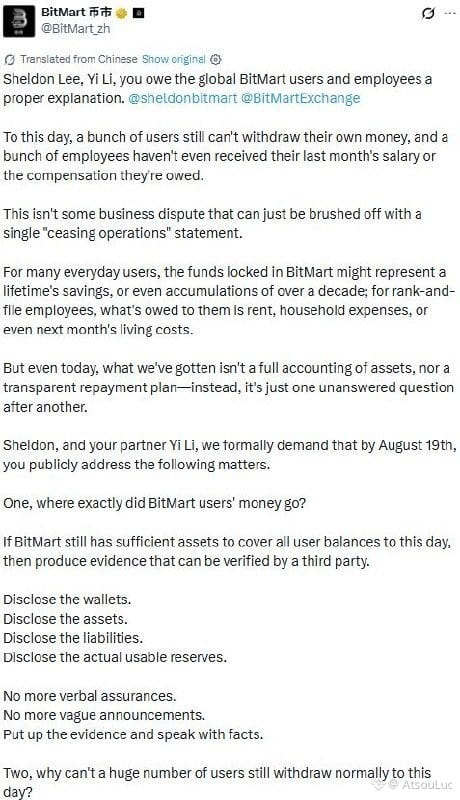
🚨 An open letter published today from BitMart’s Chinese account claims that users are still unable to recover their funds, and that many employees may not have received their latest salary or severance payments.
The authors specifically demand verifiable proof of reserves, a statement of assets and liabilities, and a precise repayment schedule before August 19.
But founder Sheldon Xia has since entirely disputed the authenticity of this letter. He claims that BitMart’s Chinese account was compromised and that the message does not come from current employees, saying he intends to file a complaint with law enforcement and request a technical expert review from X.
🚨 An open letter published today from BitMart’s Chinese account claims that users are still unable to recover their funds, and that many employees may not have received their latest salary or severance payments.
The authors specifically demand verifiable proof of reserves, a statement of assets and liabilities, and a precise repayment schedule before August 19.
But founder Sheldon Xia has since entirely disputed the authenticity of this letter. He claims that BitMart’s Chinese account was compromised and that the message does not come from current employees, saying he intends to file a complaint with law enforcement and request a technical expert review from X.
The authors specifically demand verifiable proof of reserves, a statement of assets and liabilities, and a precise repayment schedule before August 19.
But founder Sheldon Xia has since entirely disputed the authenticity of this letter. He claims that BitMart’s Chinese account was compromised and that the message does not come from current employees, saying he intends to file a complaint with law enforcement and request a technical expert review from X.
68
·
--
🇪🇺 Bitpanda is hit with a €70,000 fine for breaching the MiCA rules.
The Austrian financial regulator (FMA) reproaches the crypto platform for not having submitted a document within the deadline set by MiCA and for having published marketing communications too early or without certain mandatory mentions.
The decision is now final and, according to the FMA, is its first MiCA sanction that has been published and has become final.
Bitpanda states that this involves only failings related to the timing and publication formalities: no client funds would have been affected, no security flaw is involved, and no financial harm would have been suffered by users. The company says it corrected the issues after being contacted by the regulator.
🇪🇺 Bitpanda is hit with a €70,000 fine for breaching the MiCA rules.
The Austrian financial regulator (FMA) reproaches the crypto platform for not having submitted a document within the deadline set by MiCA and for having published marketing communications too early or without certain mandatory mentions.
The decision is now final and, according to the FMA, is its first MiCA sanction that has been published and has become final.
Bitpanda states that this involves only failings related to the timing and publication formalities: no client funds would have been affected, no security flaw is involved, and no financial harm would have been suffered by users. The company says it corrected the issues after being contacted by the regulator.
The Austrian financial regulator (FMA) reproaches the crypto platform for not having submitted a document within the deadline set by MiCA and for having published marketing communications too early or without certain mandatory mentions.
The decision is now final and, according to the FMA, is its first MiCA sanction that has been published and has become final.
Bitpanda states that this involves only failings related to the timing and publication formalities: no client funds would have been affected, no security flaw is involved, and no financial harm would have been suffered by users. The company says it corrected the issues after being contacted by the regulator.
·
--
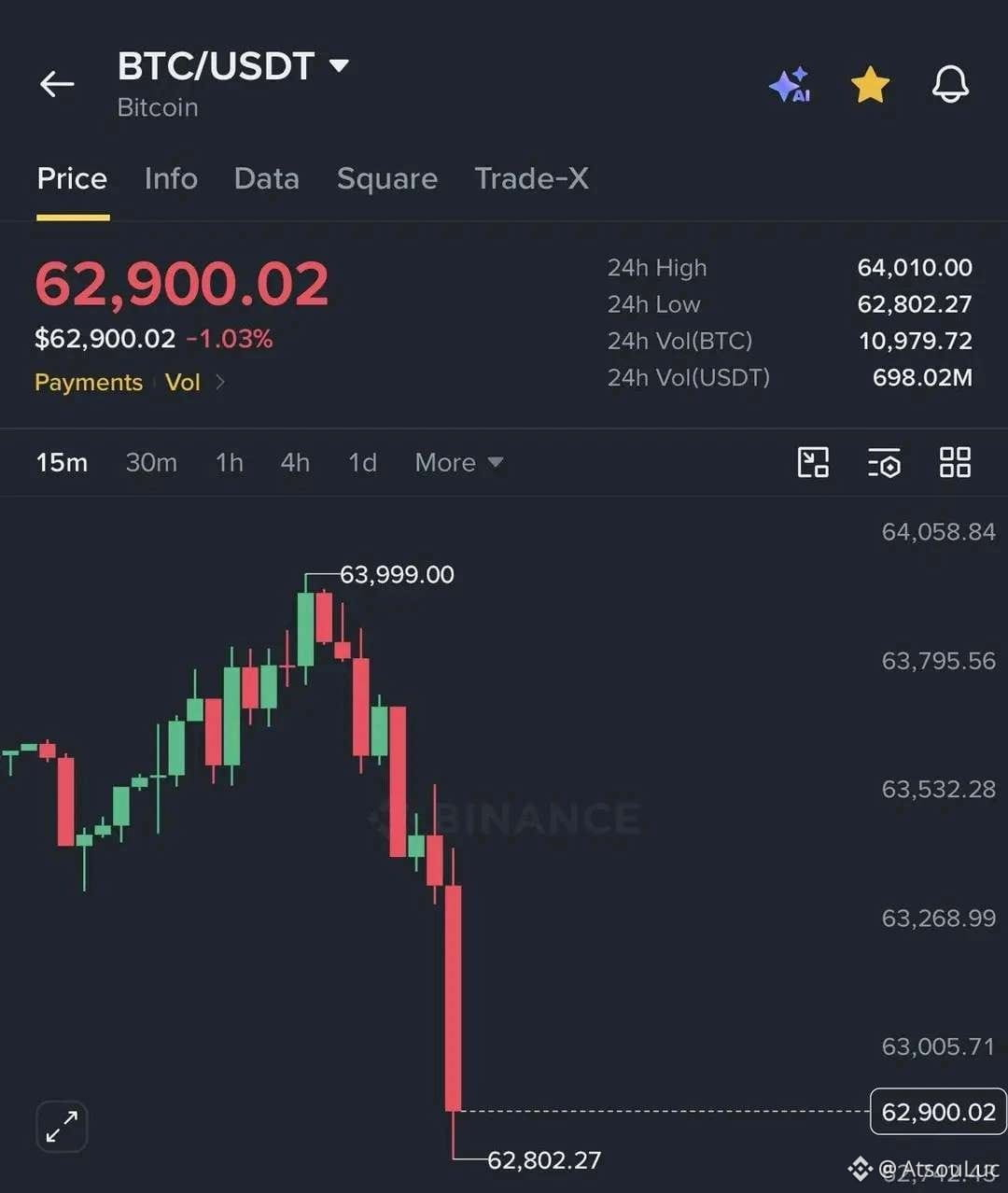
BITCOIN JUST DROPPED BELOW $63,000 WHILE THE STOCK MARKET IS HITTING ALL-TIME HIGHS. 📉
THIS HAS TO BE ONE OF THE WORST BEAR MARKETS EVER. 💀
BITCOIN JUST DROPPED BELOW $63,000 WHILE THE STOCK MARKET IS HITTING ALL-TIME HIGHS. 📉
THIS HAS TO BE ONE OF THE WORST BEAR MARKETS EVER. 💀
THIS HAS TO BE ONE OF THE WORST BEAR MARKETS EVER. 💀
75
·
--
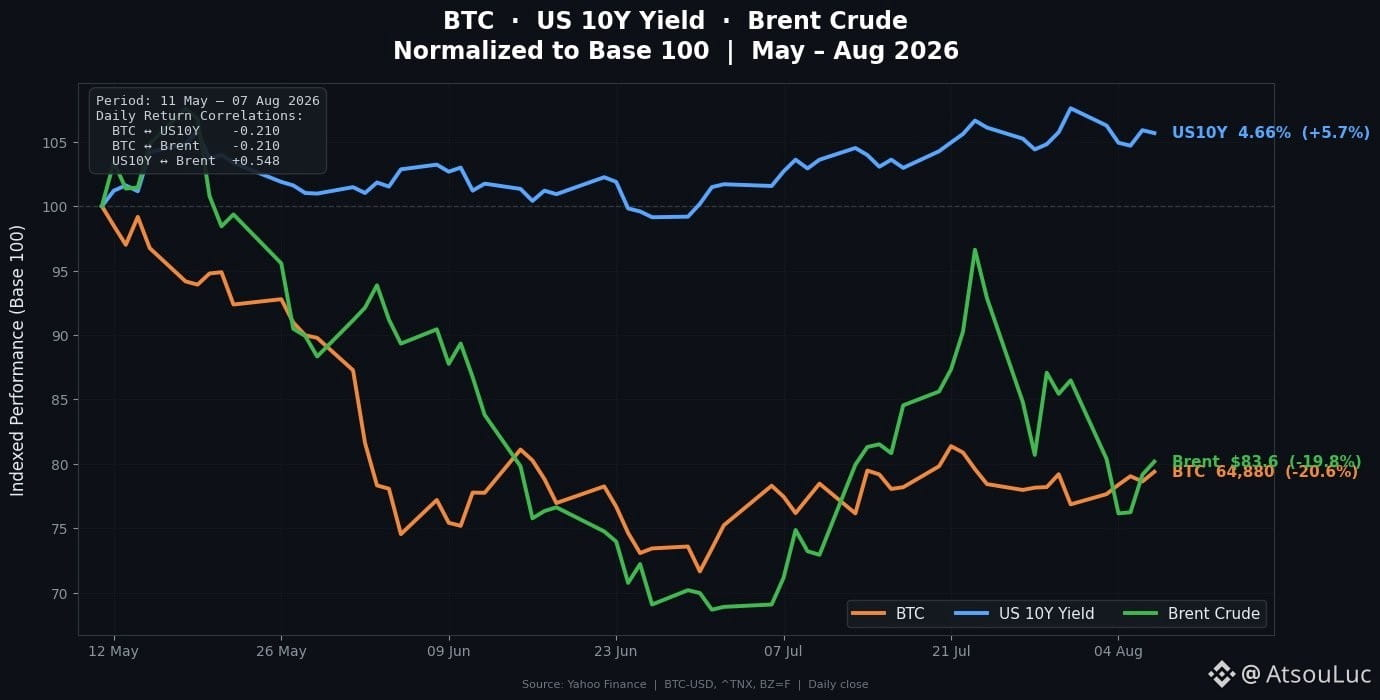
Why is Bitcoin struggling to break out of its range?
U.S. employment figures point toward a more accommodative Fed, which is generally positive for markets.
On the other hand, rising oil prices reignite inflation worries and could keep rates elevated for longer.
Two opposing signals. As long as this macro standoff continues, it’s hard for Bitcoin to find a real catalyst.
Why is Bitcoin struggling to break out of its range?
U.S. employment figures point toward a more accommodative Fed, which is generally positive for markets.
On the other hand, rising oil prices reignite inflation worries and could keep rates elevated for longer.
Two opposing signals. As long as this macro standoff continues, it’s hard for Bitcoin to find a real catalyst.
U.S. employment figures point toward a more accommodative Fed, which is generally positive for markets.
On the other hand, rising oil prices reignite inflation worries and could keep rates elevated for longer.
Two opposing signals. As long as this macro standoff continues, it’s hard for Bitcoin to find a real catalyst.
81
·
--
💬 « Bitcoin is the anti-gold. The higher gold goes, the more Bitcoin will fall. »
Peter Schiff remains faithful to his anti-Bitcoin stance and believes that the drop in $BTC should continue, while gold and silver could rise.
According to him, the recent market dynamics confirm his theory: «when gold started its rally, Bitcoin fell. When gold corrected, Bitcoin bounced back. Now that gold is starting to rise again, the BTC is beginning to fall again.»
💬 « Bitcoin is the anti-gold. The higher gold goes, the more Bitcoin will fall. »
Peter Schiff remains faithful to his anti-Bitcoin stance and believes that the drop in $BTC should continue, while gold and silver could rise.
According to him, the recent market dynamics confirm his theory: «when gold started its rally, Bitcoin fell. When gold corrected, Bitcoin bounced back. Now that gold is starting to rise again, the BTC is beginning to fall again.»
Peter Schiff remains faithful to his anti-Bitcoin stance and believes that the drop in $BTC should continue, while gold and silver could rise.
According to him, the recent market dynamics confirm his theory: «when gold started its rally, Bitcoin fell. When gold corrected, Bitcoin bounced back. Now that gold is starting to rise again, the BTC is beginning to fall again.»

70
·
--
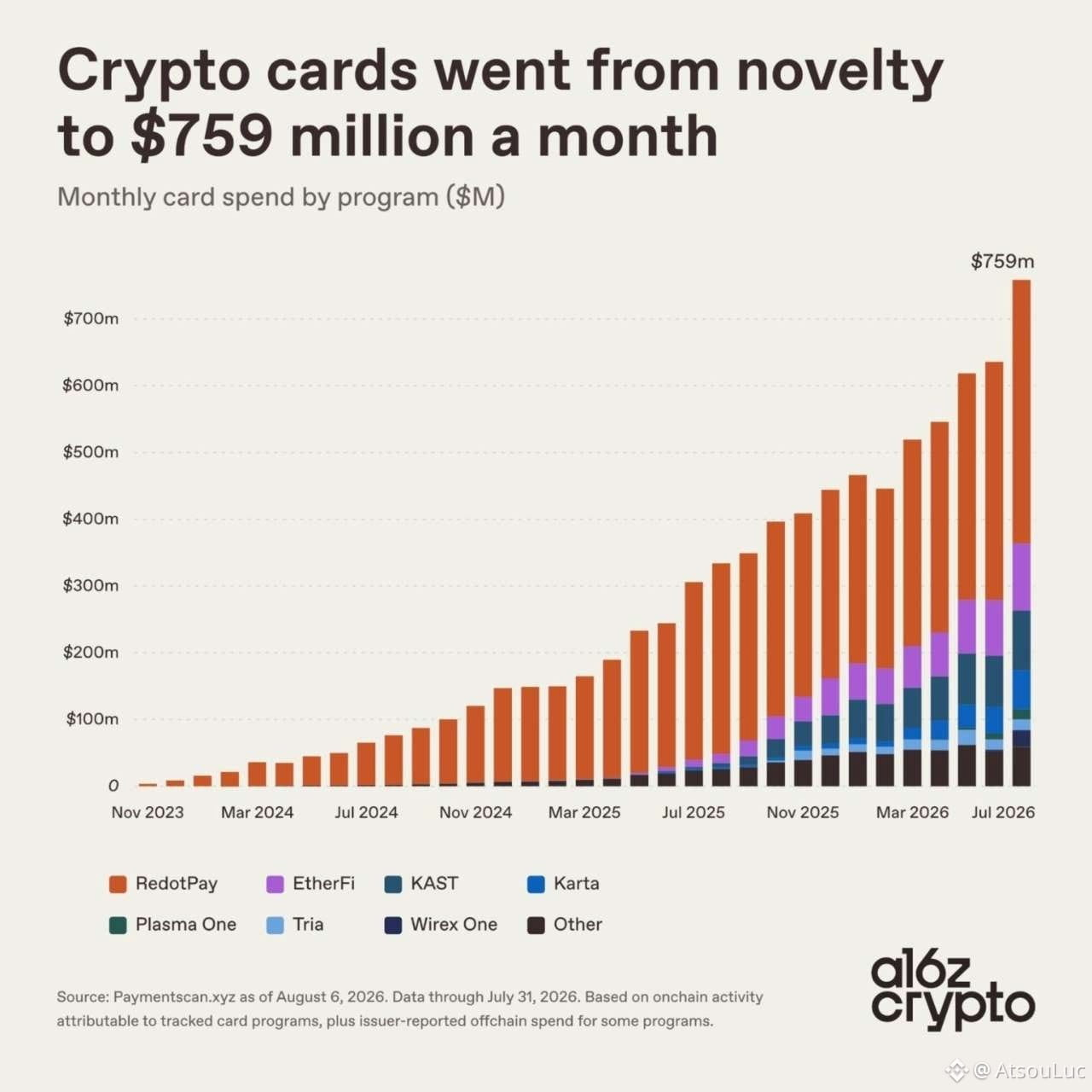
💳 Crypto cards are exploding: $759 million was spent in a single month, a new all-time record.
According to PaymentScan data published by a16z crypto, spending through the main crypto card programs reached $759 million in July 2026.
By way of comparison, it was around $300 million per month a year earlier: the volume has therefore more than doubled in just 12 months.
💳 Crypto cards are exploding: $759 million was spent in a single month, a new all-time record.
According to PaymentScan data published by a16z crypto, spending through the main crypto card programs reached $759 million in July 2026.
By way of comparison, it was around $300 million per month a year earlier: the volume has therefore more than doubled in just 12 months.
According to PaymentScan data published by a16z crypto, spending through the main crypto card programs reached $759 million in July 2026.
By way of comparison, it was around $300 million per month a year earlier: the volume has therefore more than doubled in just 12 months.
71
Log in to explore more content
Join global crypto users on Binance Square
⚡️ Get latest and useful information about crypto.
💬 Trusted by the world’s largest crypto exchange.
👍 Discover real insights from verified creators.
Email / Phone number
Trending Topics
US10YTreasuryYieldHitsHighestSinceNov2023
498 views
22 Discussing
#us10ytreasuryyieldhitshighestsincenov2023 You can't make this up.
The
US Treasury
just announced it is tripling long-term buybacks to $6 billion and yields STILL rallied on the news.
That means the
US Treasury
went from doubling, to "at least doubling," to tripling long-term bond buybacks and yields are still rising.
This puts the 10Y Note Yield above 4.85% for the first time since November 2023, up +15 basis points from pre-announcement levels.
The bond market is quite literally fighting the US Treasury as the Iran War continues, with the 10Y Note Yield nearing a +100 basis point move since the war began.
Without an end to the Iran War, we are on track to see the 10Y Note Yield above 5.00% by next week.
American consumers, homebuyers, and borrowers are in for a rude awakening.$KAT $MINA $NET
Isabella-I
·0 Likes
·30 views
USTreasuryToBuyBackUpTo$6BLongDatedDebt
7,538 views
121 Discussing
BitcoinSurpasses$79K
50,484 views
243 Discussing