
The market volatility was extremely convergent over the weekend. The debt ceiling negotiations reached a deadlock and were suspended. The Republicans hoped that the Biden administration could cut spending in the future as a condition for raising the debt ceiling. For this reason, Biden had already returned to the United States urgently after the G7 summit on the 21st.
Based on past experience, Xiong Ge thinks that the probability of a US debt default is extremely low, but once it happens, the impact on the financial market will be too great, resulting in a very strong wait-and-see sentiment. The volatility of mainstream currencies has fallen to the level at the end of last year. It can be foreseen that a big market is about to appear, and the event that drives this wave of market is basically determined to be the debt ceiling negotiations. Will it be a default, or will an agreement be reached before ‘X-date’?
The previous strategy has taken into account the possibility of extreme risks, so this layout is not leveraged. The high-probability events worth betting on are still conducive to the rise of the market. Just continue to wait patiently. If a low-probability event occurs, it is inevitable to be deeply trapped in the short term.
However, because there is no leverage, there is no risk of liquidation. The default of US debt is also a long-term positive factor for the crypto market. Combined with other positive factors next year, even if you are deeply trapped, it is highly likely that you will turn losses into profits in the future. There is no need to worry too much. The funds that have been reduced can continue to be kept in your hands and bargain hunting after the occurrence of low-probability events
The issue facing the US stock market right now is not entirely about interest rates. The issue of interest rate hikes has already been resolved. On Friday, the tone of Mr. Powell’s speech was relatively soft, and he did not intend to continue raising interest rates. Everything depends on the data. On the other hand, when it comes to the government debt issue, after all the arguments, there will be a compromise in the end. Now it is just a show. But the negotiations have not been successful recently, so the US stock market has been a bit up and down.
However, in the case of Nasdaq, funds have already started to increase their bets in the future, which also includes stock markets such as Japan and Germany. Now people are relatively optimistic about the future, or very optimistic about the long term, because interest rate hikes are basically over. Funds dare to bet on some stock markets, and AI has also successfully stimulated the narrative imagination of a new round of bull market. So the situation seems to be obvious, the long-term bull market has arrived, which is a long-term benefit for risky assets.

The short-term problem is the debt ceiling negotiations, but it does not affect the long-term. We all know that it is a short-term thing. As long as there is a decline, there will be funds to buy, so this is not a risk in the short term. The debt negotiations have an even smaller impact on cryptocurrencies. The medium-term risk is still the problem of data in the second half of the year. Inflation will definitely have a sudden black swan impact on the trend if the data is not good.
The Fed will only dare to release money if there is a strong expectation of a major recession in the economy, but it has not happened yet. Therefore, changes in future data will determine the expected trend in the second half of the year. Therefore, there is no need to be too subjective to say that global assets have entered a bull market. Brother Xiong can only say that if there is a mid-term decline, then the possibility of an opportunity is very large and you can seize it well. The current bull market in the U.S. stock market is that funds are laying out the next round of bull market, and it has not yet involved a comprehensive bull market, so there is no overflow of funds into the crypto market, which is a rather embarrassing thing. Recently, Bitcoin has basically not followed the movement of the U.S. stock market, perhaps because of this.
The above shows that there is uncertainty in the medium-term encryption. In the short term, the support below will be tested next week. In the long term, the external market has basically shown an optimistic attitude. Therefore, there is no big problem for encryption in the long run, but you have to survive the medium-term twists and turns.

Will there really be a big drop in the second half of the year?
Many people expect a collapse in the second half of the year. Brother Xiong thinks that is impossible. This has always been the scenario throughout history, without exception: the collapse always occurs after the interest rate cut, which will not happen until 2024. Then the market will have another wave of escape. The U.S. stock market will even break through the previous high, an all-time high. Institutions will start selling, and then there will be a collapse. The real black swan will come at the latest in 2025 or 2026.
Regarding interest rate cuts, traditional misconceptions that are taken for granted:
1. Interest rate cuts are good for the stock market. Indeed, there will be a wave of escape after the interest rate cut, with sharp rises, but also sharp falls afterwards;
2. The interest rate was lowered because the stock market crashed and it was necessary to lower the interest rate.
The Federal Reserve cut interest rates because there was a problem with the financial system. There is a time lag between the problem in the financial system and the stock market crash. Problems in the financial system must have occurred first before an economic crisis would occur. Without an economic crisis, there would be no stock market crash.
The most classic example is the collapse of the U.S. stock market that began in 2005. The Federal Reserve cut interest rates in September 2007 due to the subprime mortgage crisis. On October 9, 2007, the S&P 500 index hit an all-time high of 1565.15 points. The U.S. stock market did not begin to collapse until the 2008 economic crisis. It bottomed out in March 2009, one and a half years after the interest rate cut.
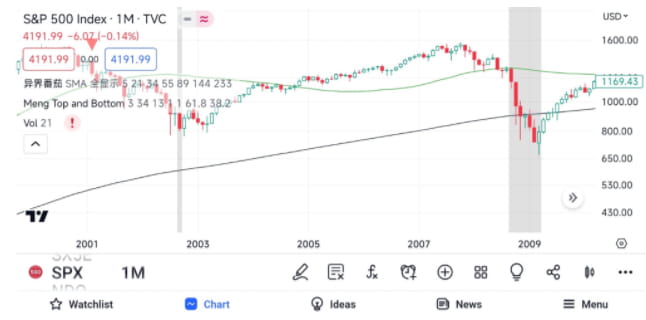
After the all-time high, there is a normal correction and decline, and there is still a time difference before the real collapse