

Currently, the USD currency and its related stablecoins are the primary on-ramp channels to the cryptocurrency markets. However, the market dominance could be challenged in the future, particularly for the dollar, given the unfriendly banking environment in the US, as well as increased regulatory pressure.
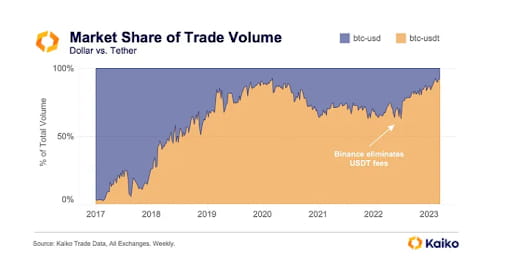
Source: Kaiko
It’s Becoming More Difficult to Deploy USD in Crypto
Behind FTX's demise, the use of USD in the cryptocurrency markets has consistently dropped relative to USD stablecoins, including euro trading pairs, according to a recent report by Kaiko. Last year, the number of new USD-denominated trading pairs declined by 18% across all exchanges, from 400 to 326. There is also a chance that the USD market share will plunge further in the near future, considering the ongoing situation at Silvergate, one of the few banking institutions widely used by crypto companies to process USD on-ramps. On March 3rd, Silvergate discontinued its flagship instant payment network SEN - Silvergate Exchange Network - reportedly used 94 exchanges and 894 institutional investors, making it even more challenging to process USD payments in the cryptocurrency markets, as there is a scant option left. The suspension of USD bank transfers by some exchanges also intensifies the complications with USD payment rails. On March 6th, Bybit announced it’s temporarily suspending USD deposits via Wire Transfer (including SWIFT). Binance announced a similar service disruption in January, saying it will no longer process USD transfers below $100,000 via SWIFT.
Stablecoins, Euro Could Benefit From USD’s Fall
Amidst the growing complications in USD on-ramps lies an opportunity for stablecoins and the euro. “With the death of SEN, stablecoins will likely become even more ubiquitous among traders. Rather than deposit your dollars with an exchange, you deposit them with a stablecoin issuer, receive stablecoins, and then transfer those to an exchange,” Kaiko explained. The fall of the USD could also give rise to euro dominance in crypto. While the dollar trading pairs fell 18% last year, new euro-denominated trading pairs rose by 71% from 96 to 165.