

Original article: Validator Health Report: October 2023
Author: Solana Foundation
Compiled by: Odaily Planet Daily Husband
Recently, the Solana Foundation released the "Validator Health Report".
The report shows that the Solana validator network is continuing to grow, as measured by metrics such as the number of nodes, Nakamoto coefficient, and client diversity. The health of the validator network is an ongoing focus for the Solana Foundation, which provides tools and education to help validators and stakeholders around the world participate in the security of the network. In addition, the Foundation also encourages community participation and contributions.
Solana has seen a significant increase in validator network participation. The community has organized regular conference calls and e-meetings to facilitate communication and share best practices among validators. In addition, the Foundation plans to host Block 0 conferences in the future to further strengthen community connections.
The Solana network has developed multiple validator clients, including Solana Labs, Jito Labs, Firedancer, Sig, and lightweight clients. Client diversity is critical to the health and decentralization of the network, mitigating the risk of single points of failure and increasing the resilience of the network.
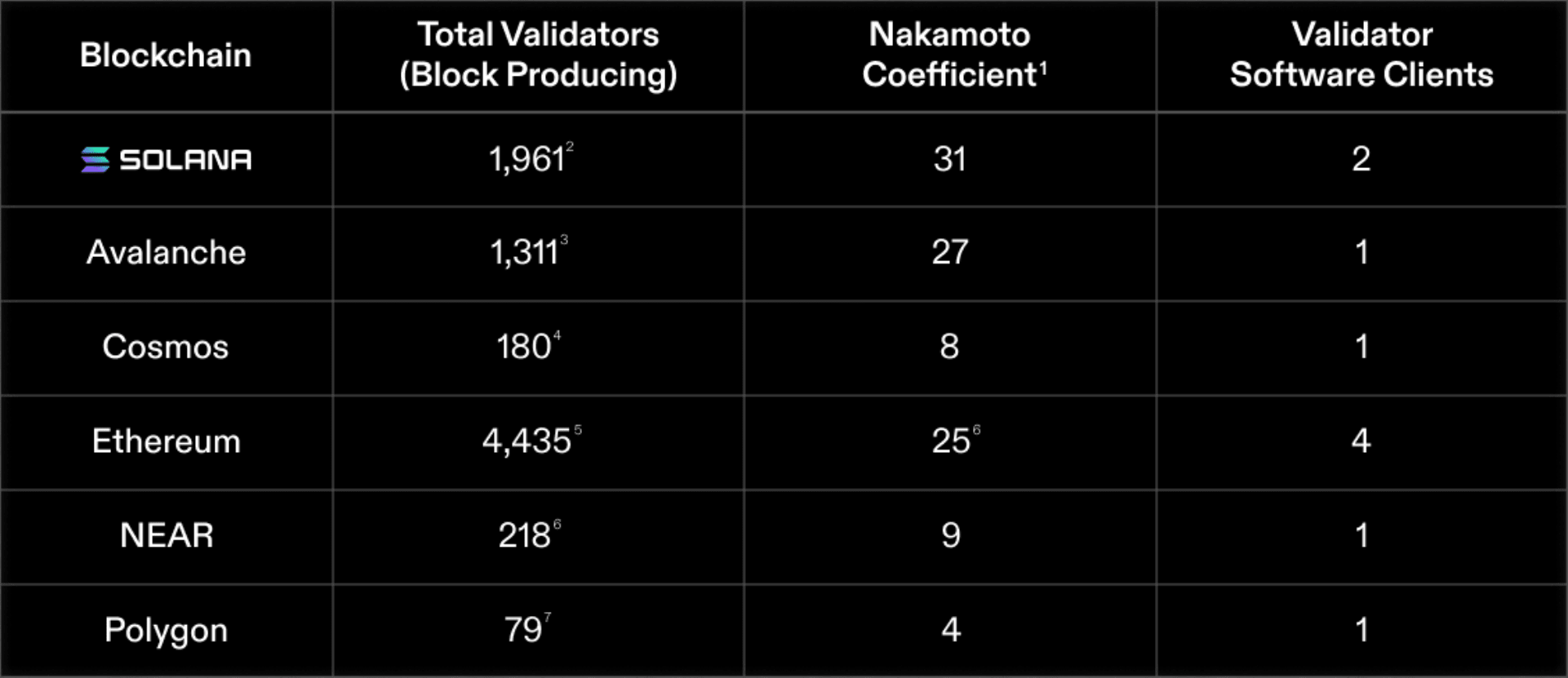
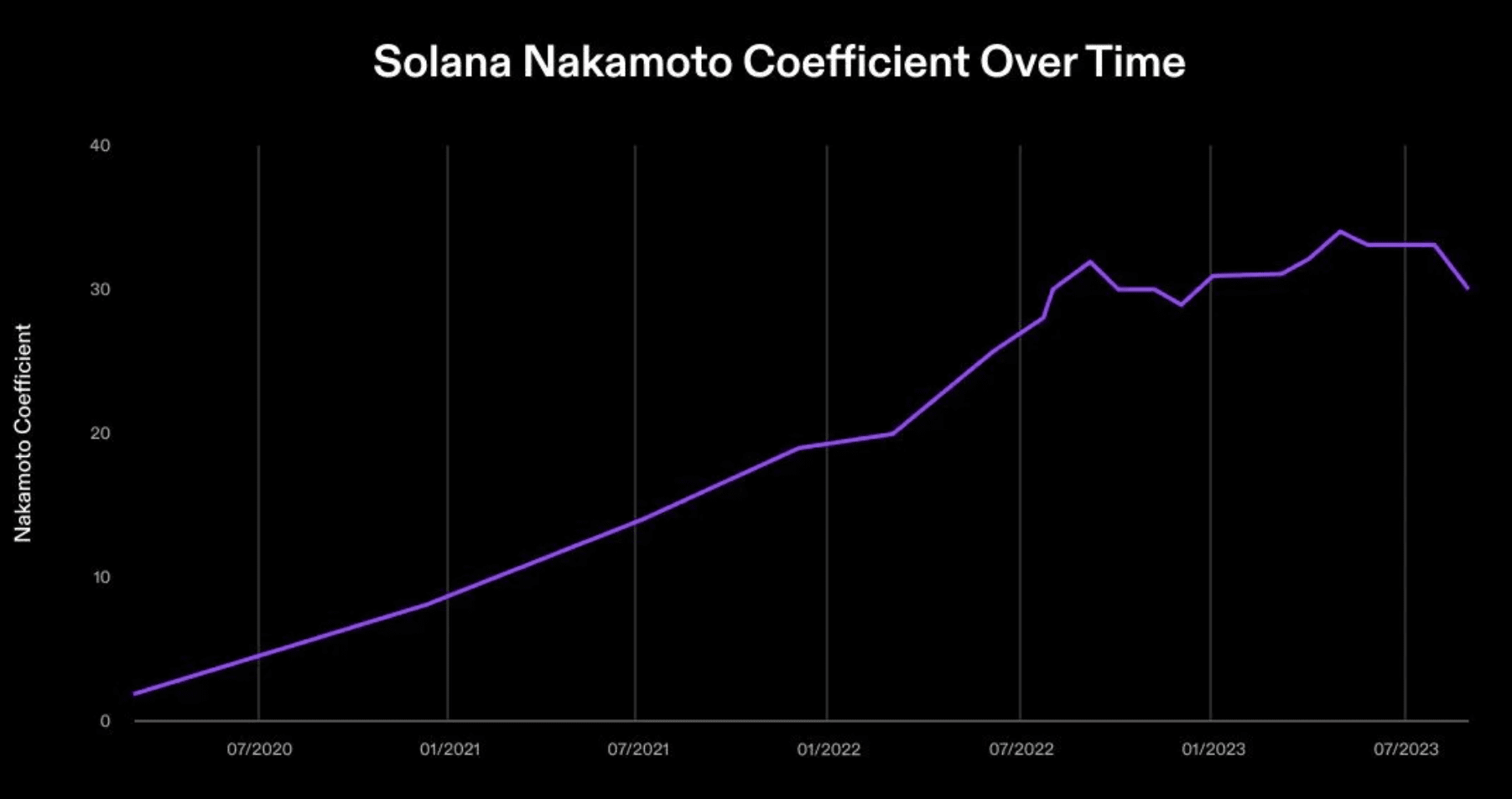
The Nakamoto coefficient is an important indicator for measuring network security. Solana’s current Nakamoto coefficient is 31, but the foundation still hopes to further increase this number to enhance the decentralization of the network.
In terms of Solana’s stake distribution, the network is geographically evenly distributed, with no one country having an absolute dominant position. The Foundation is closely monitoring the distribution of stake and taking actions to increase geographic diversity.
The following is the original report, translated by Odaily Planet Daily.
Overview
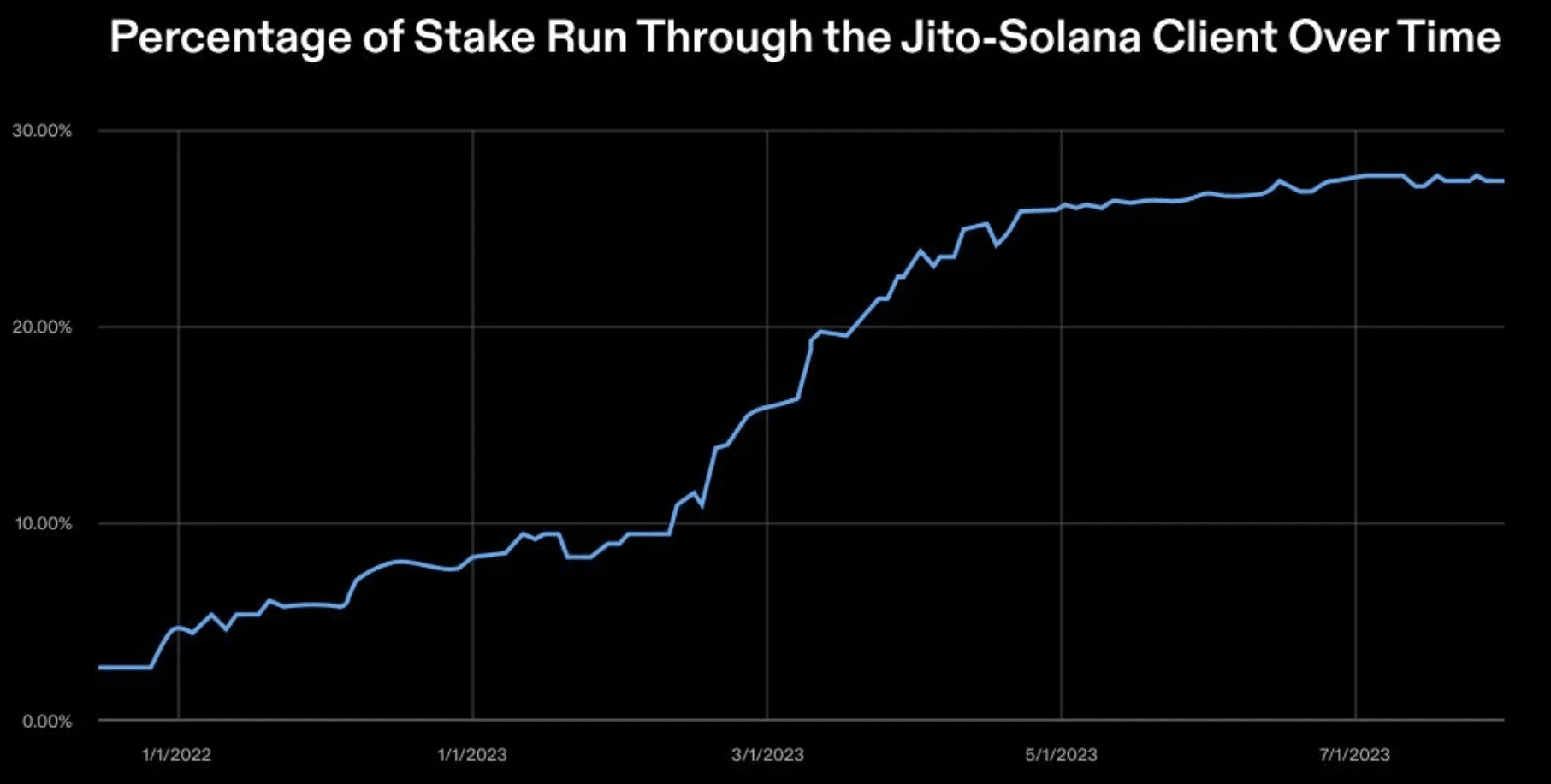
The Solana validator network continues to grow and is measured by metrics such as number of nodes, N distribution, and diversity. Notably, since the last validator health report: Solana has made rapid progress as a multi-client network, with over 31% of stake running through Jito Labs. Additionally, two additional validator clients are in development, a significant increase from 0% a year ago. The network has achieved 100% uptime. As of February 26, 2023, various new software upgrade procedures have been implemented and the network has not experienced any performance degradation since then. As of September 6, 2023, Solana remains one of the largest PoS networks in the world, with a large number of nodes and wide distribution, as measured by Nakamoto coefficient and validator software clients.
The Solana Foundation has also noticed a clear increase in validator network participation in recent months. While difficult to measure with hard data, some indicators of validator community participation include:
Regular community-led validator calls: Starting in March 2023, the validator ecosystem will begin planning and convening regular calls for the validator community to share notes and best practices.
Block 0 Meeting: The validator community will host the first Block 0 meeting in Amsterdam on October 30, 2023. This is a fully community-organized event to discuss the development of the Solana network and strengthen social connections.
The Solana mainnet beta was launched in March 2020, and has made remarkable progress in the three and a half years since then. During this time, the ecosystem has grown significantly. The Solana Foundation strives to be rigorous and rational when assessing the health of the network and improving its resilience and opportunities, and encourages the community to share their thoughts.
Core client development
In previous validator health reports, the Foundation discussed changes in thinking about the best ways to measure and assess network health. In particular, the Foundation has recently spent a lot of effort strengthening validator network health at the software level. In this regard, the Foundation is focused on encouraging the development of new software clients and strengthening the core network of contributing developers from multiple organizations.
Validators are computers running the Solana Validator Client, which is the operating system for the Solana network. In any blockchain network, having multiple software clients is critical to the resilience and decentralization of the network, helping to ensure that there is no single point of failure for the network software. One of the most important wins for the ecosystem is that Solana has become a multi-client network, which means that validators can choose to run different clients.
Solana’s Current Status
There are currently four different validator client implementations in active development, built on three separate codebases. Notably, Jito Labs’ client is used by over 31% of Solana validators, up from 16% in March 2023 (last Validator Health Report) and from 0% since the client’s initial mainnet launch in August 2022.

Diversity in validator clients is critical to the long-term health and operation of the network. With multiple validator clients, the risk of bugs or harmful code existing in a single client can be mitigated by other independent clients that are unlikely to have the same bugs or malware attacks, thus reducing the likelihood of an outage of the entire network.
The first validator client on Solana was initially developed by Solana Labs. Since then, there have been several independent efforts to create additional full or lightweight validator clients on the Solana network.
Jito Labs: In August 2022, Jito Labs released a second Solana mainnet validator client. This is a forked version of the Solana Labs code, maintained, modified, and deployed by Jito Labs. However, since this is a forked version of an existing independent build, bugs in the Solana Labs client are likely to exist in this client as well.
Firedancer: Also in August 2022, Jump Crypto announced plans to build a new validator client on Solana. This validator client was developed from the ground up and features significant performance improvements. In a test environment, Firedancer processed up to a million transactions per second (for comparison, the original Solana Labs client processed approximately 55,000 transactions per second in a similar test environment).
Sig: In July 2023, Syndica announced that it was developing Sig, a Solana network validator client written in the Zig programming language. In September 2023, Syndica's validator team released an initial implementation of Sig, including an implementation of the Gossip protocol.
Lightweight clients (such as TinyDancer): In addition to these four validator clients, TinyDancer is a lightweight client for Solana that is under active development. TinyDancer does not participate in the block construction and state maintenance of the blockchain consensus, but enables users to more easily validate without having to run a full node themselves.
Total number of validators
Blockchains with more validators are generally more resilient. When users execute contracts on a blockchain, they need to be confident that their transactions will be recorded. Ideally, every transaction added to a blockchain would be recorded by every validator on that chain, which is why having more validators is important; a large and diverse set of validators protects against catastrophic events like a data center power outage.
There are two types of validators: Consensus nodes: Consensus nodes play a central role in the operation of the network, providing two basic functions:
Create and propose new blocks to other nodes in the network
Vote on the validity of new blocks proposed by other nodes.
RPC Nodes: Remote Procedure Call (RPC) nodes are the interface between applications and the Solana infrastructure. These nodes are similar to consensus nodes and independently validate all new blocks and network changes, but they do not vote.
Solana’s Current Status: In March 2023, the total number of consensus nodes dropped from ~2,200 to ~1,700. This drop was due to a large amount of stake being reallocated to nodes that were charging 100% commissions. Stakeholders became aware of the issue and reallocated their delegations to more active validators. Following this drop, the number of consensus nodes has gradually and steadily increased to a total of 1,961 consensus nodes and 2,874 validator nodes as of September 13th.
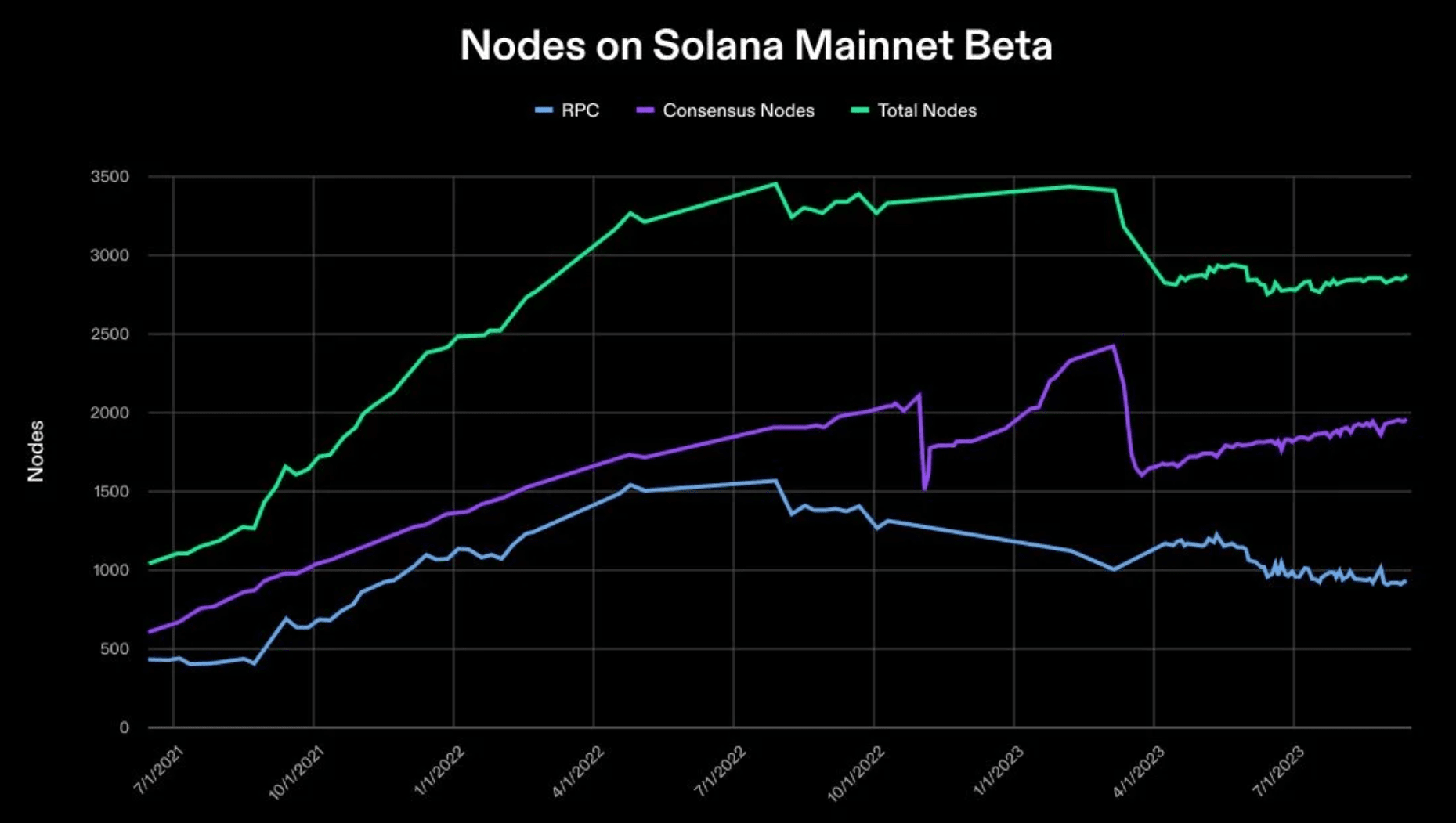
Relative to other proof-of-stake blockchains, Solana’s node count is definitely high. The Foundation expects to adjust its program in the coming months to encourage the quality of nodes, not just quantity.
What constitutes a “high-quality validator” is subjective, but some examples include node uptime, hardware performance, service levels in the event of user issues, and how active the validator operator is in the broader validator community. The Foundation has identified a number of opportunities to encourage validators to meet these standards and will be sharing and rolling out these opportunities with the community over the next few months.
Nakamoto coefficient of voting power
The Nakamoto coefficient of voting power is defined as the minimum number of nodes that need to be compromised in the network to enforce censorship or halt consensus, thereby preventing some or all new blocks (and the transactions within them) from being confirmed. In most proof-of-stake networks, this is the minimum percentage of voting power, requiring nodes representing at least 33.4%.
When the stake distribution is highly concentrated, a small number of validators might represent 33.4% of the total delegates (a very small fraction). In a more decentralized distribution of stake and consensus power, this set is larger, making it difficult for corporations, bad actors, or other entities to manipulate the blockchain through censorship.
Solana’s Current Status:
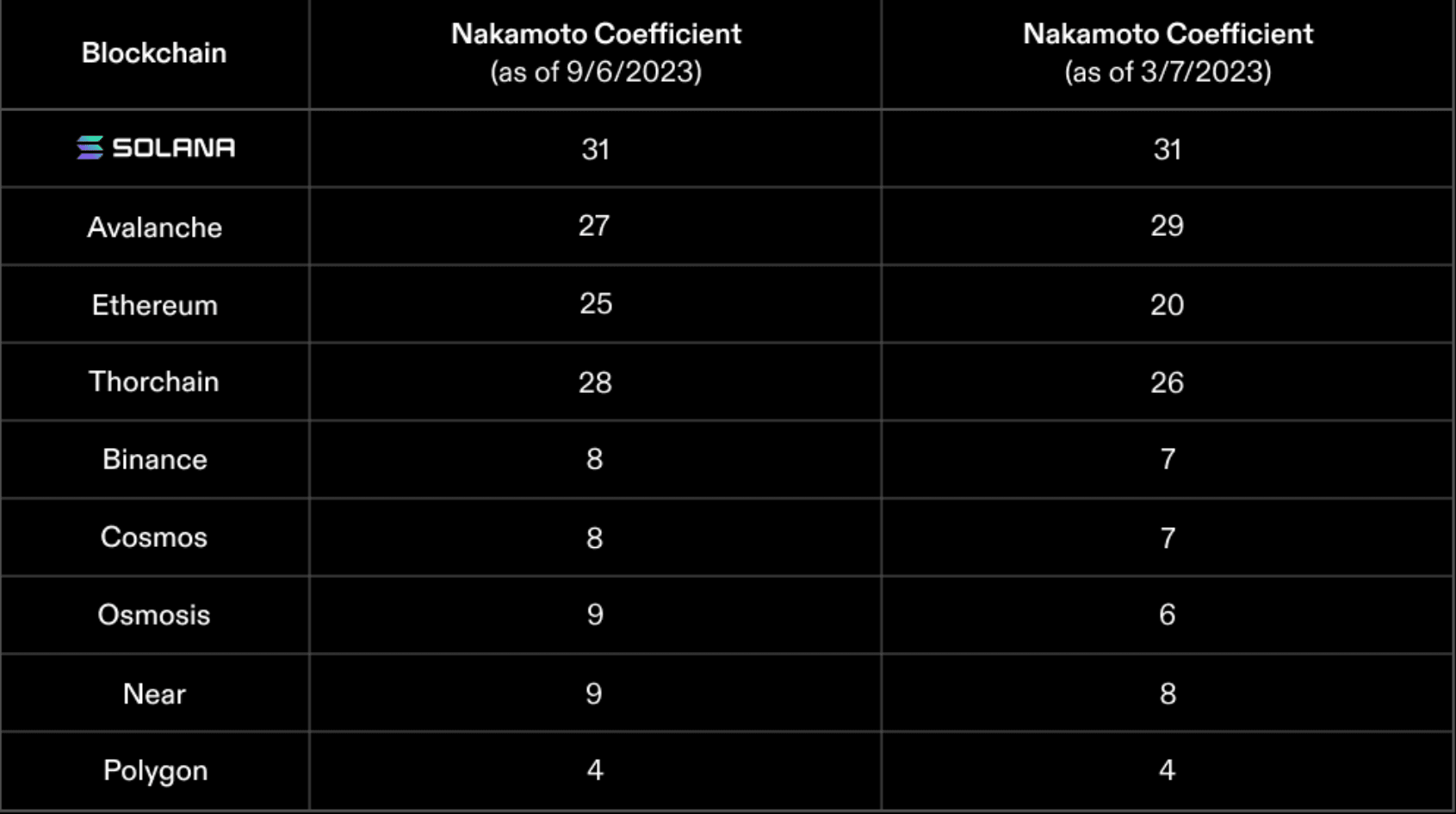
In the survey on September 6, 2023, Solana had a Nakamoto coefficient of 31. This means that a minimum of 31 validators would need to collude (as of March 2023) to censor the network. This Nakamoto coefficient is the same as the result of the last validator health report, which was also 31.
Solana’s Nakamoto coefficient has been growing steadily since launch in March 2020, continuing through September 2022, and remaining relatively stable since then. A Nakamoto coefficient of 31 is strong. While the Foundation expects this number to increase over time, the growth of the number is not a leading indicator of network decentralization because the Solana network is viewed from a staking perspective.
Here is a list of Nakamoto coefficients for some other proof-of-stake blockchains for benchmark comparison:
Even a large, highly distributed network with multiple software clients is susceptible to several exogenous factors that can affect the resilience of the blockchain. These factors are discussed in the next and final section.
distributed
Nakamoto coefficients and client diversity are key metrics, but they fail to capture the human factors involved in running a blockchain. Few appreciate the role of external factors, such as geopolitics, natural disasters, and corporate incentives, in validator network health.
In this final section, we will look at the resilience of the Solana network from the perspective of several external factors and how they may impact a Proof-of-Stake network like Solana.
Data center provider equity distribution
Anyone can run a Solana node. Because the Solana protocol requires high-performance hardware, validator operators typically rent server space from third-party data centers to run their nodes. This is not uncommon; computing power on most blockchains is done on servers in large data centers owned by third parties.
The risk of using a third-party data center to run validator nodes means that the owner of the data center has disproportionate power over the operation of the blockchain. To minimize the risk that one company could harm the chain, stake should be relatively evenly distributed among the private companies that rent server space.
This risk was demonstrated in November 2022 when server provider Hetzner blocked Solana nodes. Remarkably, the network continued to operate during this period. This was equivalent to a 20% attack on the network and demonstrates why it is so important to distribute stake among multiple server providers.
Solana’s Current Status:
Data center providers typically operate multiple data centers and Autonomous System Numbers (ASNs). The data below is segmented by the ASN of the major data centers based on publicly available data.
An Autonomous System (AS) is a network of servers with a single routing number. Different autonomous systems are identified by unique ASNs. Depending on how the internal network or routing is configured, an autonomous system can span multiple physical locations in different geographical locations.
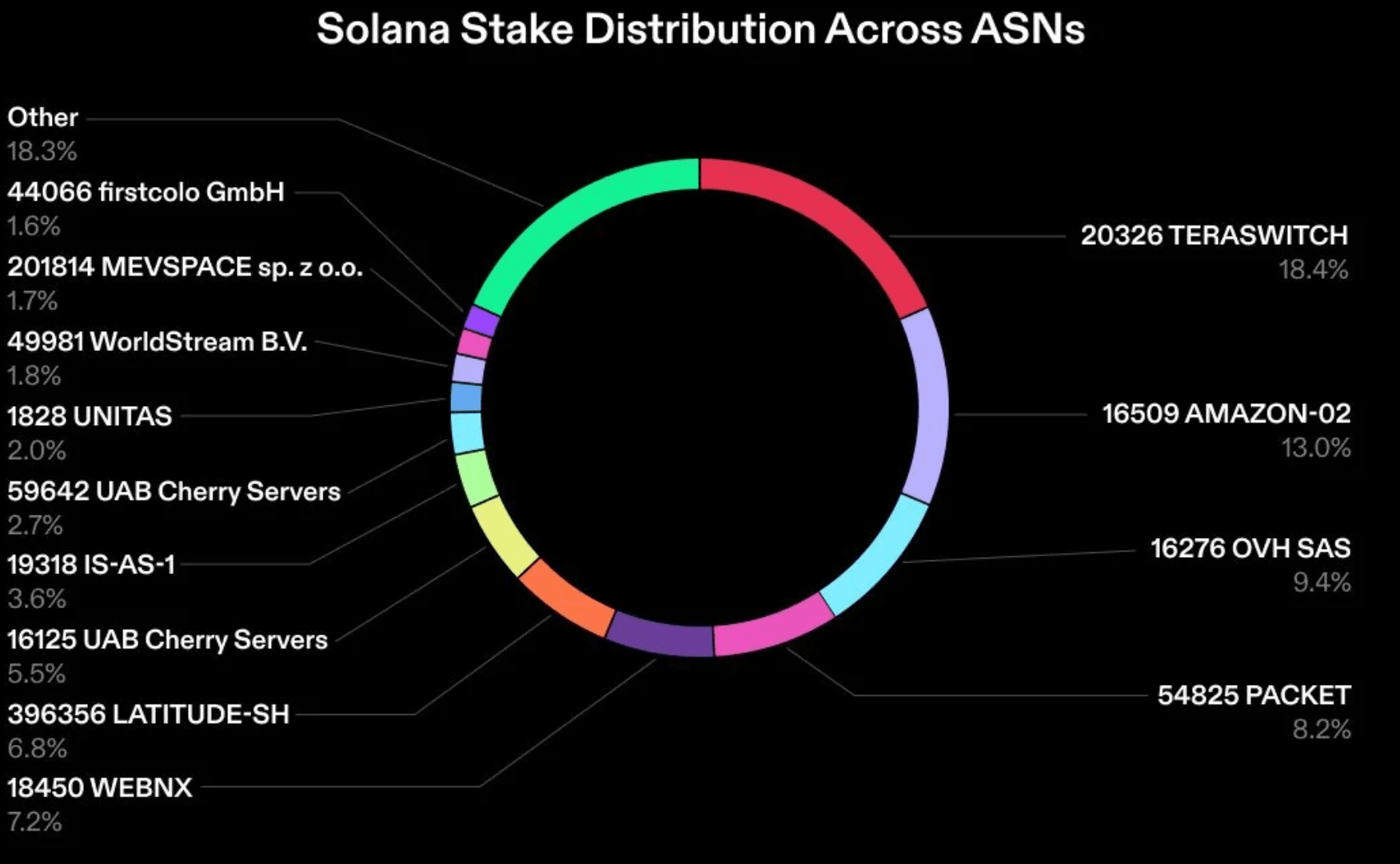
Solana’s stake is relatively distributed across Autonomous Systems (ASNs), with no single ASN hosting anywhere near 33.3% of active stake. Currently, it would take collusion from at least three data centers to combine more than 33.3% of stake and halt the network.
Distribution of interests by geographic region
A globally resilient blockchain must continue to operate regardless of events in one part of the world. Consider the following scenario:
A government attacks underwater fiber optic cables that carry the internet and causes internet outages across an entire region. A globally resilient blockchain must be able to continue operating, unaffected by events in that region.
An authoritarian regime hunting down a dissident must be confident that she can access the funds if the regime chooses to shut down blockchain servers running within the country.
A natural disaster disrupts all nodes in a particular region. No matter which region of the world uses a blockchain, users still need to be confident that the chain will continue to operate even if many validators unexpectedly go offline.
In these cases, people still need to feel confident that the blockchain will continue to operate even if many validators unexpectedly go offline.
The Current State of Solana: Below is a snapshot of the network’s geographic distribution, organized by stake percentage in each country.
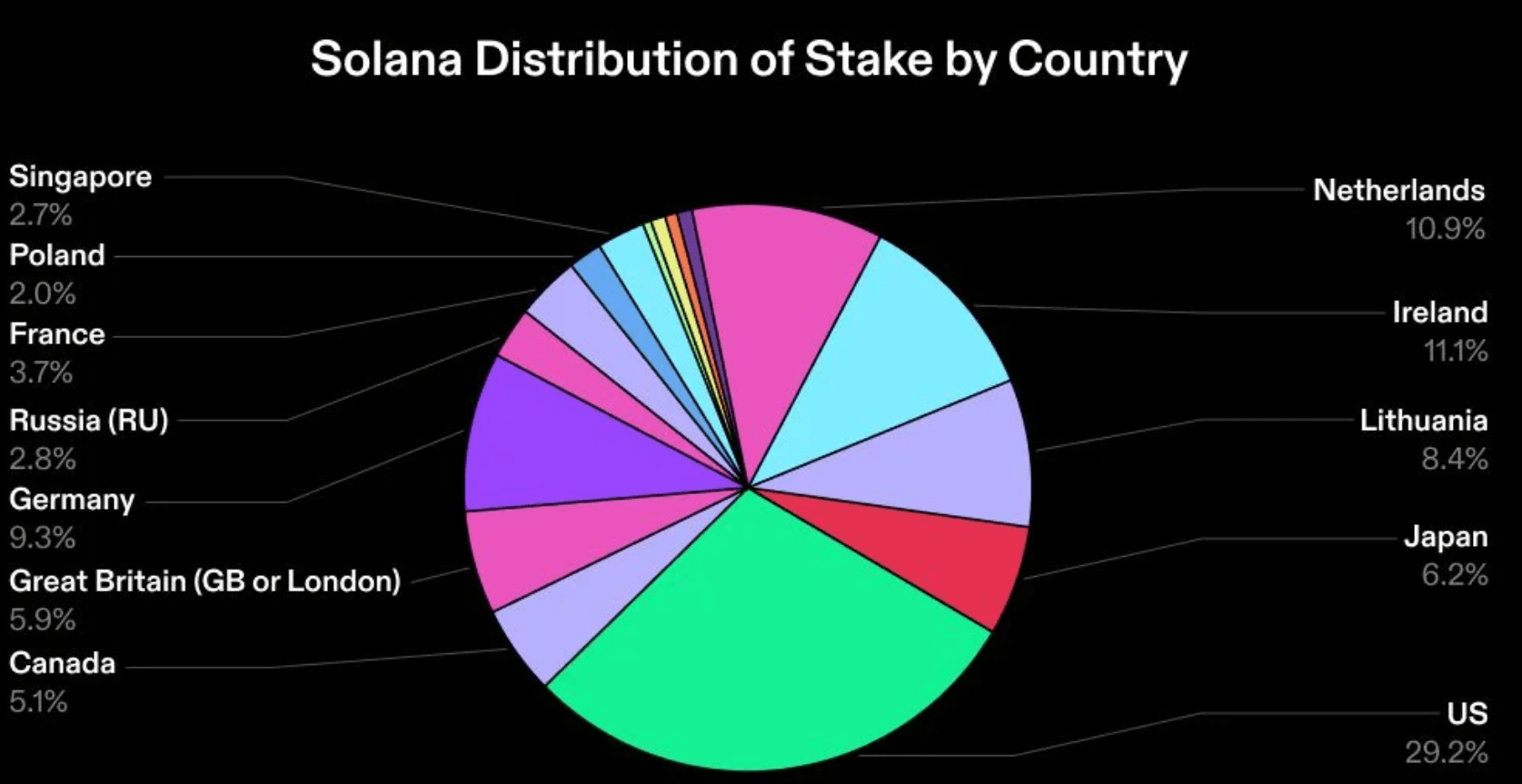
The network is evenly distributed geographically, with no single country holding 33.3% of active interest, although recent gains in the United States suggest they may eventually reach that percentage. Notably, total active interest in the United States and Canada is 34.3%. Here the percentage of equity by country differs significantly from the absolute number of data centers in each country.
Stake through the United States increased significantly, from 23.5% in the last report to 29.2%. The Foundation is working to address this by, for example, closely monitoring this change, assisting stake pools in optimizing decentralization, and taking action to adjust their scoring algorithms to account for geography.
Looking ahead
The Solana Foundation continues to work to improve the health of the validator network by providing tools and education to validators and stakeholders around the world, encouraging community members to become thoughtful participants in network security. The Foundation’s focus has expanded beyond just community growth and Nakamoto coefficients to include harder-to-quantify ways to improve the health of the network.
The Solana validator community has launched several new initiatives to improve the health of the network, including organizing Block 0 (electronic meetings of validators), community-led validator convenings, and new governance practices.
In the coming months, the Foundation will support community efforts with its own initiatives aimed at improving the health of the validator network, including changes to the Solana Foundation Delanation program, helping validators become more self-sufficient and sustainable, and strengthening the network’s community orientation.