
👍

Post

zyki
·
--
BullishWhat Is ADA? A Brief History of the Proof-of-Stake Blockchain Network Cardano
On October 6, 2023, the cryptocurrency Cardano, known by its ticker ADA, is ranked as the eighth-largest in market capitalization, valued at just over $9 billion, or 0.817% of the $1.08 trillion cryptocurrency market. As the digital currency landscape evolves, ADA has emerged as a key contender. This article delves into Cardano’s origins, its native cryptocurrency ADA, its history, and its functionality.
Introduction to Cardano: Origins and Founders
Cardano is a decentralized, open-source blockchain platform that enables peer-to-peer transactions with its native cryptocurrency, ADA. The Cardano project was launched in 2015 by Ethereum co-founder Charles Hoskinson. Through Cardano, Hoskinson sought to tackle challenges posed by earlier blockchain systems.
Cardano’s journey started in 2015 when Hoskinson and Jeremy Wood founded IOHK (Input Output Hong Kong), a research and development firm. Their mission was to leverage peer-reviewed academic research to construct a more secure and scalable blockchain. After extensive research and development, the Cardano blockchain officially debuted in September 2017.
Technical Foundations: Ouroboros and Plutus, and the Native Cryptocurrency ADA
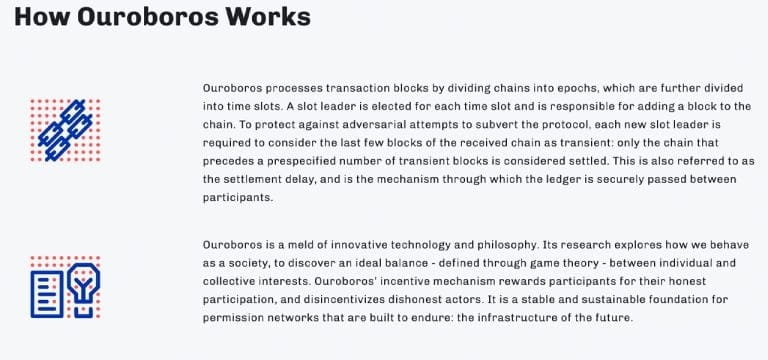
A hallmark of Cardano is its consensus mechanism, Ouroboros, a proof-of-stake (PoS) algorithm. Unlike Bitcoin’s proof-of-work (PoW) consensus, Ouroboros PoS lets users validate transactions and earn rewards. Cardano’s developers contend that Ouroboros, segmented into various versions, is the first PoS protocol with proven security based on peer-reviewed research.
The network employs Haskell for Plutus, its native smart contract language. ADA functions as the native cryptocurrency on the Cardano platform, facilitating value transfer and being used for staking, transaction fees, and governance. The total ADA supply is capped at 45 billion, with a current circulation of 35 billion. Since its inception, ADA has seen 76,098,522 transactions.
#BTC
On October 6, 2023, the cryptocurrency Cardano, known by its ticker ADA, is ranked as the eighth-largest in market capitalization, valued at just over $9 billion, or 0.817% of the $1.08 trillion cryptocurrency market. As the digital currency landscape evolves, ADA has emerged as a key contender. This article delves into Cardano’s origins, its native cryptocurrency ADA, its history, and its functionality.
Introduction to Cardano: Origins and Founders
Cardano is a decentralized, open-source blockchain platform that enables peer-to-peer transactions with its native cryptocurrency, ADA. The Cardano project was launched in 2015 by Ethereum co-founder Charles Hoskinson. Through Cardano, Hoskinson sought to tackle challenges posed by earlier blockchain systems.
Cardano’s journey started in 2015 when Hoskinson and Jeremy Wood founded IOHK (Input Output Hong Kong), a research and development firm. Their mission was to leverage peer-reviewed academic research to construct a more secure and scalable blockchain. After extensive research and development, the Cardano blockchain officially debuted in September 2017.
Technical Foundations: Ouroboros and Plutus, and the Native Cryptocurrency ADA
A hallmark of Cardano is its consensus mechanism, Ouroboros, a proof-of-stake (PoS) algorithm. Unlike Bitcoin’s proof-of-work (PoW) consensus, Ouroboros PoS lets users validate transactions and earn rewards. Cardano’s developers contend that Ouroboros, segmented into various versions, is the first PoS protocol with proven security based on peer-reviewed research.
The network employs Haskell for Plutus, its native smart contract language. ADA functions as the native cryptocurrency on the Cardano platform, facilitating value transfer and being used for staking, transaction fees, and governance. The total ADA supply is capped at 45 billion, with a current circulation of 35 billion. Since its inception, ADA has seen 76,098,522 transactions.
#BTC
Disclaimer: Includes third-party opinions. No advice. Binance AI may be used without guarantee. See T&Cs.