
CoinPulseHq
428 පෝස්ටු

CoinPulseHq
වාර්තා කරන්න
පරිශීලක අවහිර කරන්න
CoinPulseHQ is an independent digital newsroom covering cryptocurrency, blockchain and artificial intelligence.
3 හඹා යමින්
14 හඹා යන්නන්
19 කැමති විය
පෝස්ටු
·
--
ලිපිය
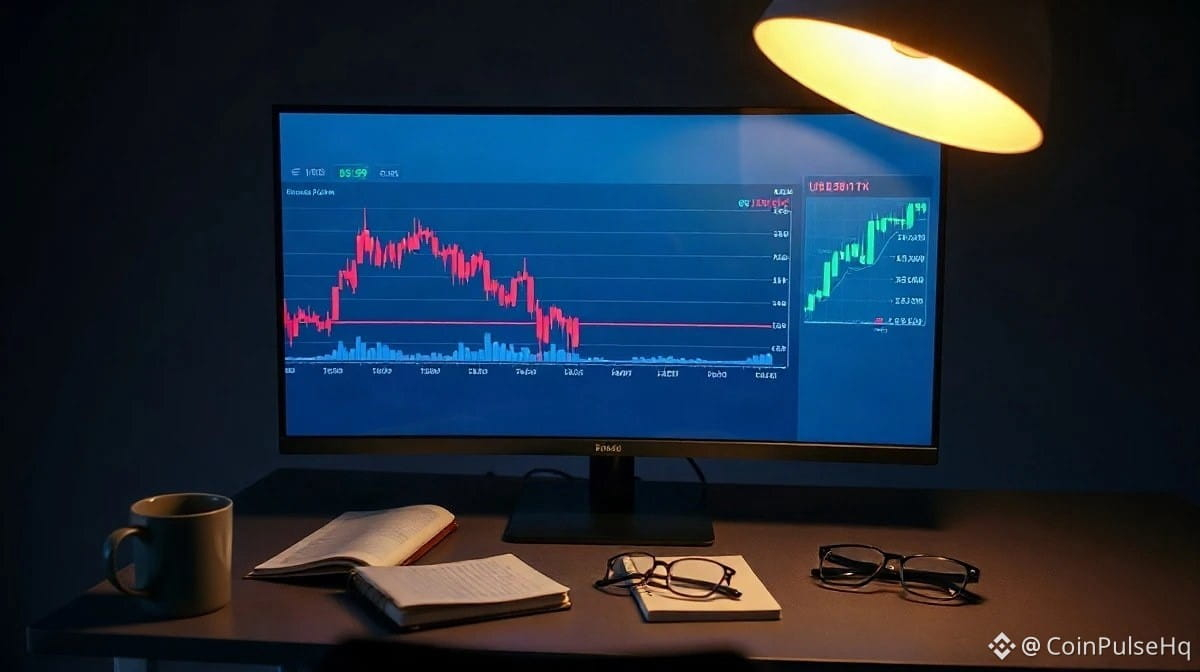
Bitcoin drops below $75K as jobs data lifts Fed hike oddsBitcoin fell to $74,762 shortly after Friday's US stock market open, its weakest level since Aug. 21, as cryptocurrencies failed to follow a rebound in technology shares, Cointelegraph reported. The decline came after October's US employment report beat forecasts by a wide margin.
Cointelegraph noted that the total value of the crypto market slipped 0.5% over the day, while US equities moved in the opposite direction. The S&P 500 was up 0.6% and the Nasdaq Composite up 1.2% at the time of writing.
Key facts
• BTC/USD reached $74,762, its lowest price since Aug. 21, and traded back below $75,000.
• US nonfarm payrolls showed 165,000 jobs added in October versus expectations of 65,000, with September's figure revised up to 60,000 from 29,000.
• The unemployment rate came in at 4.1%, below the 4.2% forecast.
• Odds of a 25-basis-point Fed hike in December rose from 66.9% to 76.8% on CME Group's FedWatch Tool.
• Tech names SanDisk and Micron Technologies each gained 6.3%.
Jobs surprise lifts rate-hike expectations
According to the Bureau of Labor Statistics release, hiring rose in professional and business services, health care, and transportation and warehousing. A firmer labour market can weigh on crypto and other risk assets, since it suggests the economy can absorb tighter financial policy, which can limit the liquidity flowing into markets.
That read was reflected in rate expectations. A comparison of target-rate probabilities for the December Federal Open Market Committee meeting, published through the CME FedWatch Tool, showed the chance of a hike climbing to 76.8% from 66.9% before the data.
Bitcoin tests the 50-week moving average
Bitcoin touched support around its 50-week simple moving average at $77,533. Keith Alan, cofounder of trading platform Material Indicators, said the trend line had held since mid-September, but he cautioned that its strength could not be confirmed before the weekly close.
Alan said BTC/USD could fall as far as $69,000 if the region near $75,500 gives way. A recovery, in his view, would require the pair to print a run of higher highs and higher lows on shorter time frames.
Why it matters
The session showed bitcoin detaching from the equity market it has often tracked, a pattern that leaves crypto holders more exposed to rate expectations than to stock sentiment. Traders who bought into the post-election advance are now watching a key technical level decide whether the pullback deepens. The gap matters for leveraged positions and for funds that treat bitcoin as a risk proxy.
What to watch
The weekly candle close will show whether the 50-week moving average holds as support. The December FOMC meeting is the next major policy marker, with rate expectations now leaning further toward tightening.
Price levels discussed here reflect analyst views and are not financial advice; crypto markets are volatile and can move sharply in either direction.
Originally published on CoinPulseHQ: https://coinpulsehq.com/bitcoin-below-75k-jobs-data-fed-hike-odds/?utm_source=binance_square&utm_medium=social&utm_campaign=auto_post
Bitcoin drops below $75K as jobs data lifts Fed hike odds
Bitcoin fell to $74,762 shortly after Friday's US stock market open, its weakest level since Aug. 21, as cryptocurrencies failed to follow a rebound in technology shares, Cointelegraph reported. The decline came after October's US employment report beat forecasts by a wide margin.
Cointelegraph noted that the total value of the crypto market slipped 0.5% over the day, while US equities moved in the opposite direction. The S&P 500 was up 0.6% and the Nasdaq Composite up 1.2% at the time of writing.
Key facts
• BTC/USD reached $74,762, its lowest price since Aug. 21, and traded back below $75,000.
• US nonfarm payrolls showed 165,000 jobs added in October versus expectations of 65,000, with September's figure revised up to 60,000 from 29,000.
• The unemployment rate came in at 4.1%, below the 4.2% forecast.
• Odds of a 25-basis-point Fed hike in December rose from 66.9% to 76.8% on CME Group's FedWatch Tool.
• Tech names SanDisk and Micron Technologies each gained 6.3%.
Jobs surprise lifts rate-hike expectations
According to the Bureau of Labor Statistics release, hiring rose in professional and business services, health care, and transportation and warehousing. A firmer labour market can weigh on crypto and other risk assets, since it suggests the economy can absorb tighter financial policy, which can limit the liquidity flowing into markets.
That read was reflected in rate expectations. A comparison of target-rate probabilities for the December Federal Open Market Committee meeting, published through the CME FedWatch Tool, showed the chance of a hike climbing to 76.8% from 66.9% before the data.
Bitcoin tests the 50-week moving average
Bitcoin touched support around its 50-week simple moving average at $77,533. Keith Alan, cofounder of trading platform Material Indicators, said the trend line had held since mid-September, but he cautioned that its strength could not be confirmed before the weekly close.
Alan said BTC/USD could fall as far as $69,000 if the region near $75,500 gives way. A recovery, in his view, would require the pair to print a run of higher highs and higher lows on shorter time frames.
Why it matters
The session showed bitcoin detaching from the equity market it has often tracked, a pattern that leaves crypto holders more exposed to rate expectations than to stock sentiment. Traders who bought into the post-election advance are now watching a key technical level decide whether the pullback deepens. The gap matters for leveraged positions and for funds that treat bitcoin as a risk proxy.
What to watch
The weekly candle close will show whether the 50-week moving average holds as support. The December FOMC meeting is the next major policy marker, with rate expectations now leaning further toward tightening.
Price levels discussed here reflect analyst views and are not financial advice; crypto markets are volatile and can move sharply in either direction.
Originally published on CoinPulseHQ: https://coinpulsehq.com/bitcoin-below-75k-jobs-data-fed-hike-odds/?utm_source=binance_square&utm_medium=social&utm_campaign=auto_post
·
--

ලිපිය
Magnificent 7 Lose $1 Trillion; Devere CEO Sees More Selective MarketThe Magnificent 7 lost more than $1 trillion in market value on Thursday, Nov. 5, and Devere Group CEO Nigel Green said the group's lead in technology stocks is not finished — only the habit of buying all seven as a single trade. Green's assessment was sent to Bitcoin.com News on Nov. 6, the day after the sell-off.
Green said a $1 trillion one-day loss naturally raises the question of whether the group's reign is over, and answered that it is not. He argued that each company will now be judged on its own numbers, and that many investors will treat the decline as a chance to buy the dip.
Key facts
• Tesla fell 10.77% and Nvidia 9.26% on Nov. 5; Apple slipped just 1.53%, with Microsoft down 3.58%, Meta 3.96%, Amazon 2.19% and Alphabet 2.20%.
• The Nasdaq Composite dropped 5.52% to 24,315.00, entering correction territory and notching its worst session since April 2025, while the S&P 500 fell 4.36% to 7,353.73 and the Dow lost 1,833.06 points to 51,523.06.
• Green said the selling showed signs of capitulation, pointing to a spike in the VIX and widespread share declines as evidence that forced sellers were clearing positions.
• By about 9:42 a.m. EST on Nov. 6, Nvidia had rebounded 6.9% and Tesla 2.8%, while Apple and Microsoft were still lower by 1.3% and 1.1%.
• Bitcoin traded near $75,249 on Nov. 6 after touching $74,762, about 11.3% below the $84,843 level reached in late October.
Uneven losses put company results in focus
Green's case rests on the split inside the group. Even during the panic, he said, investors picked their targets, and the market began sorting the seven into stronger and weaker hands. Customer ownership, secured electricity supplies and revenue from artificial intelligence spending are the tests he proposes for each company, rather than the group's collective momentum.
BusinessLine reported a larger overall figure for the same session, putting the US stock market value wiped out at around $2.5 trillion, and traced the trigger to fears that Democratic gains in the midterm elections could lead to restrictions on data centre expansion. Broadcom fell 10% and Oracle almost 7%, the outlet reported. Bitcoin.com News did not give a total market-value figure, describing the Magnificent 7 loss as above $1 trillion and noting that all 11 S&P 500 sectors closed lower. Keith Lerner, chief investment officer at Truist Advisory Services, characterised the week's swings to BusinessLine as more of a knee-jerk reaction than a clear signal of how technology stocks would perform under Democratic control of Congress.
Financing costs added a separate pressure. Bitcoin.com News cited a Bitfinex analysis published Nov. 2 that flagged rising concerns about borrowing costs and a growing reliance on credit to fund capital spending, a point that reinforces Green's argument for judging companies one by one.
Why it matters
The sell-off reversed the post-election rally of the previous day, when the Dow had jumped more than 1,500 points, so investors now face the same companies with a different question: whether AI spending is producing revenue rather than only costs. That matters beyond equities, because the same data centre buildout, power supply and credit conditions shape demand for bitcoin mining and computing infrastructure. Green's view is that a sharper, more selective market should make the group's next run more durable than the last one, and that the leadership of the AI boom may reorder at the top, though he expected further volatility along the way.
What to watch
Individual earnings and revenue disclosures will now carry more weight than index-level moves, since Green's tests turn on customer ownership, electricity access and AI revenue. Watch also how proposals to restrict data centres develop after the midterms, and whether credit costs for AI infrastructure keep climbing. Prices remain volatile, and this article is not financial advice.
Originally published on CoinPulseHQ: https://coinpulsehq.com/magnificent-7-1-trillion-loss-devere-green/?utm_source=binance_square&utm_medium=social&utm_campaign=auto_post
Magnificent 7 Lose $1 Trillion; Devere CEO Sees More Selective Market
The Magnificent 7 lost more than $1 trillion in market value on Thursday, Nov. 5, and Devere Group CEO Nigel Green said the group's lead in technology stocks is not finished — only the habit of buying all seven as a single trade. Green's assessment was sent to Bitcoin.com News on Nov. 6, the day after the sell-off.
Green said a $1 trillion one-day loss naturally raises the question of whether the group's reign is over, and answered that it is not. He argued that each company will now be judged on its own numbers, and that many investors will treat the decline as a chance to buy the dip.
Key facts
• Tesla fell 10.77% and Nvidia 9.26% on Nov. 5; Apple slipped just 1.53%, with Microsoft down 3.58%, Meta 3.96%, Amazon 2.19% and Alphabet 2.20%.
• The Nasdaq Composite dropped 5.52% to 24,315.00, entering correction territory and notching its worst session since April 2025, while the S&P 500 fell 4.36% to 7,353.73 and the Dow lost 1,833.06 points to 51,523.06.
• Green said the selling showed signs of capitulation, pointing to a spike in the VIX and widespread share declines as evidence that forced sellers were clearing positions.
• By about 9:42 a.m. EST on Nov. 6, Nvidia had rebounded 6.9% and Tesla 2.8%, while Apple and Microsoft were still lower by 1.3% and 1.1%.
• Bitcoin traded near $75,249 on Nov. 6 after touching $74,762, about 11.3% below the $84,843 level reached in late October.
Uneven losses put company results in focus
Green's case rests on the split inside the group. Even during the panic, he said, investors picked their targets, and the market began sorting the seven into stronger and weaker hands. Customer ownership, secured electricity supplies and revenue from artificial intelligence spending are the tests he proposes for each company, rather than the group's collective momentum.
BusinessLine reported a larger overall figure for the same session, putting the US stock market value wiped out at around $2.5 trillion, and traced the trigger to fears that Democratic gains in the midterm elections could lead to restrictions on data centre expansion. Broadcom fell 10% and Oracle almost 7%, the outlet reported. Bitcoin.com News did not give a total market-value figure, describing the Magnificent 7 loss as above $1 trillion and noting that all 11 S&P 500 sectors closed lower. Keith Lerner, chief investment officer at Truist Advisory Services, characterised the week's swings to BusinessLine as more of a knee-jerk reaction than a clear signal of how technology stocks would perform under Democratic control of Congress.
Financing costs added a separate pressure. Bitcoin.com News cited a Bitfinex analysis published Nov. 2 that flagged rising concerns about borrowing costs and a growing reliance on credit to fund capital spending, a point that reinforces Green's argument for judging companies one by one.
Why it matters
The sell-off reversed the post-election rally of the previous day, when the Dow had jumped more than 1,500 points, so investors now face the same companies with a different question: whether AI spending is producing revenue rather than only costs. That matters beyond equities, because the same data centre buildout, power supply and credit conditions shape demand for bitcoin mining and computing infrastructure. Green's view is that a sharper, more selective market should make the group's next run more durable than the last one, and that the leadership of the AI boom may reorder at the top, though he expected further volatility along the way.
What to watch
Individual earnings and revenue disclosures will now carry more weight than index-level moves, since Green's tests turn on customer ownership, electricity access and AI revenue. Watch also how proposals to restrict data centres develop after the midterms, and whether credit costs for AI infrastructure keep climbing. Prices remain volatile, and this article is not financial advice.
Originally published on CoinPulseHQ: https://coinpulsehq.com/magnificent-7-1-trillion-loss-devere-green/?utm_source=binance_square&utm_medium=social&utm_campaign=auto_post
66
·
--

ලිපිය
Russia caps retail crypto buying at 300,000 rubles from Nov. 17Russia's central bank signed a directive on Nov. 6 setting the final terms for regulated cryptocurrency trading, fixing the eligible assets at bitcoin, ether and Tether's USDT and limiting non-qualified investors to 300,000 rubles of purchases per intermediary in a calendar year. Trading organisers may admit the three assets to public circulation from Nov. 17, Cointelegraph reported.
The instruction, an ukazanie signed by Bank of Russia governor Elvira Nabiullina under Federal Law No. 282-FZ of Aug. 4, takes effect ten days after publication, which turns the Nov. 6 signing into a Nov. 17 start date. The retail ceiling applies to the ruble cost of purchases, not to the value of what an investor holds.
Key facts
• Non-qualified investors may buy up to 300,000 rubles (about $3,700, per Cointelegraph) per intermediary each year; qualified investors face no purchase limit.
• Every investor, regardless of status, must pass a mandatory test before buying, according to the Bank of Russia.
• Sberbank was cleared by the central bank in October to offer crypto exchange services, Cointelegraph reported.
• The Moscow Exchange plans to begin crypto trading on Dec. 1 with pilot transactions in the three assets.
• The asset list requires market capitalisation, average daily volume and at least five years of pricing history on foreign venues to qualify, per the directive.
How the short list was built
The three-asset menu is the substance of the rule, not a footnote. The Bank of Russia said only the most liquid assets made the list and that the criteria are written into the law. USDT is treated in the directive as a foreign digital instrument rather than as a digital currency, a classification that determines its register entry but whose practical effect for a buyer the text does not explain.
Blockchain Reporter noted that the eligibility arithmetic ties the list to foreign data: market capitalisation is measured from a foreign trading organiser's daily figures, and average volume is calculated across that venue's trading. Because a five-year pricing history is required, any asset without foreign quotes stretching back before late 2021 cannot qualify this year regardless of its size.
What 300,000 rubles buys
At the central bank's official rate for Nov. 7 of 82.1386 rubles per dollar, the annual allowance was worth about $3,652, Blockchain Reporter calculated. Using CoinGecko quotes for Nov. 6, that is roughly 0.048 bitcoin at $75,983.91 or 1.64 ether at $2,225.94, meaning a full year of permitted buying comes to less than one-twentieth of a single bitcoin.
The drafting leaves an open question. Clause 2 of the directive frames the limit around purchases made through a broker, while the central bank's public statement extends the same ceiling to asset managers and crypto exchanges. Blockchain Reporter noted that a client using all three channels would, on a literal reading, face three separate limits, totaling about $10,957, and that no published rule aggregates purchases across intermediaries.
Coins stay on an intermediary's books
Buying is only part of the regime. The central bank's guidance, last updated Nov. 3, bars transfers of digital currency from an individual to a non-custodial wallet and prohibits transfers between individuals. Coins bought from Nov. 17 therefore sit in a digital depository account with a licensed intermediary rather than in a personal wallet. Lending against digital currency is restricted to brokers, managers, crypto exchanges and clearing houses.
Direct peer-to-peer trading will be prohibited from July 1, 2027, and Russia maintains its ban on using cryptocurrency to pay for goods and services.
Why it matters
Russia is opening a regulated retail channel for crypto while closing the unregulated one, and the two halves take effect on different schedules. For retail buyers, the shift means price exposure to three assets without custody, plus a questionnaire and a cap; for brokers, managers and exchanges, it creates a licensed business that was previously off limits. Sberbank has projected that regulated crypto trading could reach as much as $46 billion in the first year, a bank estimate rather than an observed result, and Blockchain Reporter noted that figure would require around 12.6 million retail investors spending the full allowance if they alone generated it. That framing is not financial advice, and crypto markets remain volatile and uncertain.
What to watch
The first concrete test is Nov. 17, when exchanges gain the right to admit the three assets. The Moscow Exchange's Dec. 1 pilot launch follows, and the July 1, 2027 peer-to-peer ban marks the closing half of the regime. How the per-intermediary ceiling is enforced across multiple venues remains unanswered in the text published on Nov. 6.
Originally published on CoinPulseHQ: https://coinpulsehq.com/russia-crypto-trading-rules-november-17/?utm_source=binance_square&utm_medium=social&utm_campaign=auto_post
Russia caps retail crypto buying at 300,000 rubles from Nov. 17
Russia's central bank signed a directive on Nov. 6 setting the final terms for regulated cryptocurrency trading, fixing the eligible assets at bitcoin, ether and Tether's USDT and limiting non-qualified investors to 300,000 rubles of purchases per intermediary in a calendar year. Trading organisers may admit the three assets to public circulation from Nov. 17, Cointelegraph reported.
The instruction, an ukazanie signed by Bank of Russia governor Elvira Nabiullina under Federal Law No. 282-FZ of Aug. 4, takes effect ten days after publication, which turns the Nov. 6 signing into a Nov. 17 start date. The retail ceiling applies to the ruble cost of purchases, not to the value of what an investor holds.
Key facts
• Non-qualified investors may buy up to 300,000 rubles (about $3,700, per Cointelegraph) per intermediary each year; qualified investors face no purchase limit.
• Every investor, regardless of status, must pass a mandatory test before buying, according to the Bank of Russia.
• Sberbank was cleared by the central bank in October to offer crypto exchange services, Cointelegraph reported.
• The Moscow Exchange plans to begin crypto trading on Dec. 1 with pilot transactions in the three assets.
• The asset list requires market capitalisation, average daily volume and at least five years of pricing history on foreign venues to qualify, per the directive.
How the short list was built
The three-asset menu is the substance of the rule, not a footnote. The Bank of Russia said only the most liquid assets made the list and that the criteria are written into the law. USDT is treated in the directive as a foreign digital instrument rather than as a digital currency, a classification that determines its register entry but whose practical effect for a buyer the text does not explain.
Blockchain Reporter noted that the eligibility arithmetic ties the list to foreign data: market capitalisation is measured from a foreign trading organiser's daily figures, and average volume is calculated across that venue's trading. Because a five-year pricing history is required, any asset without foreign quotes stretching back before late 2021 cannot qualify this year regardless of its size.
What 300,000 rubles buys
At the central bank's official rate for Nov. 7 of 82.1386 rubles per dollar, the annual allowance was worth about $3,652, Blockchain Reporter calculated. Using CoinGecko quotes for Nov. 6, that is roughly 0.048 bitcoin at $75,983.91 or 1.64 ether at $2,225.94, meaning a full year of permitted buying comes to less than one-twentieth of a single bitcoin.
The drafting leaves an open question. Clause 2 of the directive frames the limit around purchases made through a broker, while the central bank's public statement extends the same ceiling to asset managers and crypto exchanges. Blockchain Reporter noted that a client using all three channels would, on a literal reading, face three separate limits, totaling about $10,957, and that no published rule aggregates purchases across intermediaries.
Coins stay on an intermediary's books
Buying is only part of the regime. The central bank's guidance, last updated Nov. 3, bars transfers of digital currency from an individual to a non-custodial wallet and prohibits transfers between individuals. Coins bought from Nov. 17 therefore sit in a digital depository account with a licensed intermediary rather than in a personal wallet. Lending against digital currency is restricted to brokers, managers, crypto exchanges and clearing houses.
Direct peer-to-peer trading will be prohibited from July 1, 2027, and Russia maintains its ban on using cryptocurrency to pay for goods and services.
Why it matters
Russia is opening a regulated retail channel for crypto while closing the unregulated one, and the two halves take effect on different schedules. For retail buyers, the shift means price exposure to three assets without custody, plus a questionnaire and a cap; for brokers, managers and exchanges, it creates a licensed business that was previously off limits. Sberbank has projected that regulated crypto trading could reach as much as $46 billion in the first year, a bank estimate rather than an observed result, and Blockchain Reporter noted that figure would require around 12.6 million retail investors spending the full allowance if they alone generated it. That framing is not financial advice, and crypto markets remain volatile and uncertain.
What to watch
The first concrete test is Nov. 17, when exchanges gain the right to admit the three assets. The Moscow Exchange's Dec. 1 pilot launch follows, and the July 1, 2027 peer-to-peer ban marks the closing half of the regime. How the per-intermediary ceiling is enforced across multiple venues remains unanswered in the text published on Nov. 6.
Originally published on CoinPulseHQ: https://coinpulsehq.com/russia-crypto-trading-rules-november-17/?utm_source=binance_square&utm_medium=social&utm_campaign=auto_post
31
·
--

ලිපිය
Strive Posts $509M Q3 Profit on Bitcoin GainsStrive Inc. (Nasdaq: ASST) reported net income of $509 million for the third quarter of 2026, or $5.24 per diluted common share, according to Bitcoin.com News. The result rested mainly on $533.7 million of unrealized gains on the company's digital assets rather than on its operating businesses, which brought in $2.7 million of revenue against $38.7 million in operating expenses.
Adjusted net income attributable to common shareholders was $494.6 million, or $5.46 per diluted share, Bitcoin.com News reported. The split between mark-to-market gains and thin operating revenue shows how much of the quarter's headline figure came from bitcoin's price rather than from customers.
Key facts
• Strive’s digital asset holdings were valued at $2.34 billion at quarter-end, up from $668.5 million at the end of 2025; total assets reached $2.68 billion.
• The company bought 8,136 BTC during the quarter and 20,373 BTC over the first nine months of 2026.
• Between Oct. 1 and Oct. 30 it added 15,124 BTC, lifting holdings to 43,000 BTC, more than 54% above the Sept. 30 level of 27,876 BTC.
• A Oct. 26 disclosure covered 6,182 BTC bought for roughly $511.4 million; a further 124 BTC for about $10 million took holdings to 43,124 BTC as of Nov. 2.
• On Oct. 20 Strive completed a 7 million-share public offering of SATS preferred stock, raising $609 million in net proceeds from a $630 million gross offering at a 15% annual dividend rate.
Preferred stock funds the buying
Strive's expansion has been financed largely through preferred equity. The SATS offering was followed by continued use of the company's SATA variable-rate preferred program. As of Oct. 30, Strive held $490.4 million in cash and cash equivalents and about $50.1 million in Strategy's STRC preferred shares, according to Bitcoin.com News.
The structure avoids conventional borrowing but obliges Strive to keep paying dividends even in a falling bitcoin market. Chairman and CEO Matthew Cole, in the company's quarterly release, credited the treasury strategy and the SATS issuance for the common stock's performance against bitcoin this year and said the company is reviewing banking, brokerage, decentralized finance, reinsurance, asset-backed securities and tokenization as uses for its balance sheet.
American Bitcoin's paper profit
A second bitcoin treasury and mining company told a similar story in the same earnings season. Bitcoin Magazine reported that American Bitcoin Corp. (Nasdaq: ABTC), majority-owned by Hut 8 Corp., posted about $126 million of third-quarter net income, a reversal from a $57.2 million loss in the prior quarter.
American Bitcoin's profit leaned on a $197.3 million gain on its bitcoin holdings, against a $71.2 million loss on that line in the second quarter. Mining revenue fell to about $63.4 million from about $67.0 million, and the company mined about 891 bitcoin at roughly $42,100 each, up from about $36,500. Holdings reached about 8,427 BTC as of Sept. 30, including about 3,090 BTC pledged for miner purchases under agreements with Bitmain, Bitcoin Magazine reported. Management said satoshis per share rose about 5% to roughly 11,572.
Why it matters
For shareholders, both results tie reported earnings to bitcoin's price, and the gap between headline profit and operating income is the clearest measure of that exposure. Strive's preferred dividends add a fixed cost that its $2.7 million of quarterly operating revenue does not cover on its own. The filings also show how quickly the corporate treasury sector has grown: Strive, which held $668.5 million of digital assets a year earlier, closed the quarter with $2.34 billion and has kept buying since.
What to watch
Strive's next quarterly filing will show whether its Oct. 20 preferred offering and $490.4 million cash pile translate into further purchases, and whether the dividend obligations on SATS and SATA stay covered as bitcoin moves. American Bitcoin's next report will test whether its mining margins hold up after the rise in per-coin costs.
This article is not financial advice; cryptocurrency prices are volatile and can move sharply in either direction.
Originally published on CoinPulseHQ: https://coinpulsehq.com/strive-509m-q3-profit-bitcoin-holdings/?utm_source=binance_square&utm_medium=social&utm_campaign=auto_post
Strive Posts $509M Q3 Profit on Bitcoin Gains
Strive Inc. (Nasdaq: ASST) reported net income of $509 million for the third quarter of 2026, or $5.24 per diluted common share, according to Bitcoin.com News. The result rested mainly on $533.7 million of unrealized gains on the company's digital assets rather than on its operating businesses, which brought in $2.7 million of revenue against $38.7 million in operating expenses.
Adjusted net income attributable to common shareholders was $494.6 million, or $5.46 per diluted share, Bitcoin.com News reported. The split between mark-to-market gains and thin operating revenue shows how much of the quarter's headline figure came from bitcoin's price rather than from customers.
Key facts
• Strive’s digital asset holdings were valued at $2.34 billion at quarter-end, up from $668.5 million at the end of 2025; total assets reached $2.68 billion.
• The company bought 8,136 BTC during the quarter and 20,373 BTC over the first nine months of 2026.
• Between Oct. 1 and Oct. 30 it added 15,124 BTC, lifting holdings to 43,000 BTC, more than 54% above the Sept. 30 level of 27,876 BTC.
• A Oct. 26 disclosure covered 6,182 BTC bought for roughly $511.4 million; a further 124 BTC for about $10 million took holdings to 43,124 BTC as of Nov. 2.
• On Oct. 20 Strive completed a 7 million-share public offering of SATS preferred stock, raising $609 million in net proceeds from a $630 million gross offering at a 15% annual dividend rate.
Preferred stock funds the buying
Strive's expansion has been financed largely through preferred equity. The SATS offering was followed by continued use of the company's SATA variable-rate preferred program. As of Oct. 30, Strive held $490.4 million in cash and cash equivalents and about $50.1 million in Strategy's STRC preferred shares, according to Bitcoin.com News.
The structure avoids conventional borrowing but obliges Strive to keep paying dividends even in a falling bitcoin market. Chairman and CEO Matthew Cole, in the company's quarterly release, credited the treasury strategy and the SATS issuance for the common stock's performance against bitcoin this year and said the company is reviewing banking, brokerage, decentralized finance, reinsurance, asset-backed securities and tokenization as uses for its balance sheet.
American Bitcoin's paper profit
A second bitcoin treasury and mining company told a similar story in the same earnings season. Bitcoin Magazine reported that American Bitcoin Corp. (Nasdaq: ABTC), majority-owned by Hut 8 Corp., posted about $126 million of third-quarter net income, a reversal from a $57.2 million loss in the prior quarter.
American Bitcoin's profit leaned on a $197.3 million gain on its bitcoin holdings, against a $71.2 million loss on that line in the second quarter. Mining revenue fell to about $63.4 million from about $67.0 million, and the company mined about 891 bitcoin at roughly $42,100 each, up from about $36,500. Holdings reached about 8,427 BTC as of Sept. 30, including about 3,090 BTC pledged for miner purchases under agreements with Bitmain, Bitcoin Magazine reported. Management said satoshis per share rose about 5% to roughly 11,572.
Why it matters
For shareholders, both results tie reported earnings to bitcoin's price, and the gap between headline profit and operating income is the clearest measure of that exposure. Strive's preferred dividends add a fixed cost that its $2.7 million of quarterly operating revenue does not cover on its own. The filings also show how quickly the corporate treasury sector has grown: Strive, which held $668.5 million of digital assets a year earlier, closed the quarter with $2.34 billion and has kept buying since.
What to watch
Strive's next quarterly filing will show whether its Oct. 20 preferred offering and $490.4 million cash pile translate into further purchases, and whether the dividend obligations on SATS and SATA stay covered as bitcoin moves. American Bitcoin's next report will test whether its mining margins hold up after the rise in per-coin costs.
This article is not financial advice; cryptocurrency prices are volatile and can move sharply in either direction.
Originally published on CoinPulseHQ: https://coinpulsehq.com/strive-509m-q3-profit-bitcoin-holdings/?utm_source=binance_square&utm_medium=social&utm_campaign=auto_post
2
·
--
ලිපිය
Democrats’ Midterm Sweep Puts CLARITY Act Back in PlayDemocrats won both chambers of Congress in the 2026 US midterms and will take control in January, handing them a chance to rewrite the stalled CLARITY Act, the bill meant to set federal rules for crypto markets, Cointelegraph reported on Nov. 6. Crypto companies spent $233 million on political committees during the cycle, according to Public Citizen's analysis of federal filings cited by the outlet.
That money did not buy the result the industry wanted in Ohio. Democrat Sherrod Brown, a longtime crypto skeptic, defeated Republican Sen. Jon Husted, even though crypto-backed political action committees spent $64 million trying to beat him. Cointelegraph also reported that Sen. Elizabeth Warren, among crypto's loudest critics in Washington and the most senior Democrat on the Senate Banking Committee, is expected to chair the panel next Congress.
Key facts
• Crypto interests contributed $233 million to political committees in the 2026 midterm cycle, per Public Citizen's analysis of federal filings.
• Democrats won both chambers and take control in January, giving them leverage over the CLARITY Act, which the Senate failed to advance in September over ethics provisions.
• Crypto-backed PACs spent $64 million to defeat Sherrod Brown in Ohio; he won anyway.
• Sen. Elizabeth Warren is expected to chair the Senate Banking Committee in the next Congress.
• The Binance hack of Oct. 29, in which over $6.3 billion was stolen, landed as lawmakers were already weighing the bill.
A different bargain for market structure
House Democrats are said to be considering expanding proposals from Rep. Maxine Waters into a full market structure bill, according to Cointelegraph. Such a bill could carry tougher consumer protections, a larger role for the Securities and Exchange Commission and new ethics restrictions on public officials' crypto dealings. Rep. Shri Thanedar told the outlet he still believes the CLARITY Act can pass, but only with stronger ethics requirements, and said President Trump's conduct had set back crypto legislation.
Hadley Stern, head of institutions at Silence Laboratories and a founder of Fidelity Digital Assets, told Cointelegraph that Democrats are right to pursue the Trump family's crypto ventures, calling them the thing poisoning the bipartisan deal. Paul Brody of Nightfall Networks, a former global blockchain lead at EY, expects banks to come out ahead and said the industry would be wise to accept consumer-protection conditions similar to those imposed on banks.
Election jitters reach AI and data centers
Fox Business reported that investors and business leaders gave the Democratic sweep mixed reviews. US stock futures dipped overnight on fears of tighter rules for AI, crypto and data centers, then recovered after President Trump said he would accept the results, according to Reuters as cited by Fox Business. Capital.com analyst Daniela Hathorn told Reuters the outcome eased worries about prolonged political gridlock, while Federated Hermes' Deborah Cunningham said divided government could form a blockade against new legislation.
Fox Business reported that Elon Musk, who spent more than $400 million backing Republican candidates, reacted on X to several of his picks losing. It also reported that Texas Gov.-elect Gina Hinojosa campaigned on keeping a moratorium on new data center construction, and that Altimeter Capital's Brad Gerstner estimated 10 to 15 gigawatts of expected AI capacity could be affected, per MarketWatch. Continental CFO Roland Welzbacher told Reuters that what US operations need is stability and a reliable economic framework.
Why it matters
The industry's Washington spending is now measured against a Congress that will write the rules it has to live under. A Democratic majority does not have to bury market structure legislation, but the price of passage has shifted toward consumer protection and ethics language aimed at the White House as much as at exchanges. Brody told Cointelegraph a presidential veto remains possible and that crypto is likely a low priority next to corruption investigations and budget fights.
What to watch
The next test is the coming vote on CLARITY and whether House Democrats formally fold Waters' proposals into a broader bill. 1inch deputy general counsel Maylea Ma told Cointelegraph the Binance hack is likely to affect that vote and could harden lawmakers against a bill without stronger safeguards.
This article is not financial advice, and crypto markets are volatile and uncertain.
Originally published on CoinPulseHQ: https://coinpulsehq.com/democrats-midterm-sweep-clarity-act-2026/?utm_source=binance_square&utm_medium=social&utm_campaign=auto_post
Democrats’ Midterm Sweep Puts CLARITY Act Back in Play
Democrats won both chambers of Congress in the 2026 US midterms and will take control in January, handing them a chance to rewrite the stalled CLARITY Act, the bill meant to set federal rules for crypto markets, Cointelegraph reported on Nov. 6. Crypto companies spent $233 million on political committees during the cycle, according to Public Citizen's analysis of federal filings cited by the outlet.
That money did not buy the result the industry wanted in Ohio. Democrat Sherrod Brown, a longtime crypto skeptic, defeated Republican Sen. Jon Husted, even though crypto-backed political action committees spent $64 million trying to beat him. Cointelegraph also reported that Sen. Elizabeth Warren, among crypto's loudest critics in Washington and the most senior Democrat on the Senate Banking Committee, is expected to chair the panel next Congress.
Key facts
• Crypto interests contributed $233 million to political committees in the 2026 midterm cycle, per Public Citizen's analysis of federal filings.
• Democrats won both chambers and take control in January, giving them leverage over the CLARITY Act, which the Senate failed to advance in September over ethics provisions.
• Crypto-backed PACs spent $64 million to defeat Sherrod Brown in Ohio; he won anyway.
• Sen. Elizabeth Warren is expected to chair the Senate Banking Committee in the next Congress.
• The Binance hack of Oct. 29, in which over $6.3 billion was stolen, landed as lawmakers were already weighing the bill.
A different bargain for market structure
House Democrats are said to be considering expanding proposals from Rep. Maxine Waters into a full market structure bill, according to Cointelegraph. Such a bill could carry tougher consumer protections, a larger role for the Securities and Exchange Commission and new ethics restrictions on public officials' crypto dealings. Rep. Shri Thanedar told the outlet he still believes the CLARITY Act can pass, but only with stronger ethics requirements, and said President Trump's conduct had set back crypto legislation.
Hadley Stern, head of institutions at Silence Laboratories and a founder of Fidelity Digital Assets, told Cointelegraph that Democrats are right to pursue the Trump family's crypto ventures, calling them the thing poisoning the bipartisan deal. Paul Brody of Nightfall Networks, a former global blockchain lead at EY, expects banks to come out ahead and said the industry would be wise to accept consumer-protection conditions similar to those imposed on banks.
Election jitters reach AI and data centers
Fox Business reported that investors and business leaders gave the Democratic sweep mixed reviews. US stock futures dipped overnight on fears of tighter rules for AI, crypto and data centers, then recovered after President Trump said he would accept the results, according to Reuters as cited by Fox Business. Capital.com analyst Daniela Hathorn told Reuters the outcome eased worries about prolonged political gridlock, while Federated Hermes' Deborah Cunningham said divided government could form a blockade against new legislation.
Fox Business reported that Elon Musk, who spent more than $400 million backing Republican candidates, reacted on X to several of his picks losing. It also reported that Texas Gov.-elect Gina Hinojosa campaigned on keeping a moratorium on new data center construction, and that Altimeter Capital's Brad Gerstner estimated 10 to 15 gigawatts of expected AI capacity could be affected, per MarketWatch. Continental CFO Roland Welzbacher told Reuters that what US operations need is stability and a reliable economic framework.
Why it matters
The industry's Washington spending is now measured against a Congress that will write the rules it has to live under. A Democratic majority does not have to bury market structure legislation, but the price of passage has shifted toward consumer protection and ethics language aimed at the White House as much as at exchanges. Brody told Cointelegraph a presidential veto remains possible and that crypto is likely a low priority next to corruption investigations and budget fights.
What to watch
The next test is the coming vote on CLARITY and whether House Democrats formally fold Waters' proposals into a broader bill. 1inch deputy general counsel Maylea Ma told Cointelegraph the Binance hack is likely to affect that vote and could harden lawmakers against a bill without stronger safeguards.
This article is not financial advice, and crypto markets are volatile and uncertain.
Originally published on CoinPulseHQ: https://coinpulsehq.com/democrats-midterm-sweep-clarity-act-2026/?utm_source=binance_square&utm_medium=social&utm_campaign=auto_post
3
·
--
ලිපිය
Elliptic: $3.1B of Stolen Binance Funds Still Not LaunderedRoughly half of the $6.43 billion taken from Binance in October had still not been laundered as of Friday, when blockchain analytics firm Elliptic published an update on the flow of funds. About $3.11 billion sits in addresses tied to the theft, mostly in ether and bitcoin, and Elliptic said those holdings are very likely still in North Korean hands, Decrypt reported.
The attackers have begun routing the stolen XRP into bitcoin. Bitcoin Magazine reported that about 42 million XRP, worth roughly $50 million, had already been swapped, mostly through cross-chain service THORChain, leaving about 192 million XRP (around $226 million) unswapped. The FBI attributed the October 29 theft to North Korean hackers it calls TraderTraitor; Pyongyang has denied involvement.
Key facts
• Elliptic put about $3.11 billion still in addresses linked to the Binance theft, versus $2.85 billion (44% of the haul) frozen or seized, chiefly stablecoins locked by issuers including Tether and Circle within an hour of the breach.
• The laundering trail covers more than 20,000 wallets on 16 blockchains, at least 36 services and at least 65,000 transactions — about one new wallet every 30 seconds, per Elliptic.
• All of the stolen Solana, about $87 million at current prices, has been swapped, bridged or mixed, and about $220 million in TRX moved through Tron via a single distribution wallet that sent 684.6 million TRX over 51 hours.
• Bitcoin Magazine reported that five hot wallets sent 233.46 million XRP to an attacker address between 20:05 and 20:09 UTC on October 29, and that all of it shifted into six new addresses on November 2 before two of them began forwarding funds on November 5.
• Binance said users can now verify balances at least 1:1 through the zero-knowledge proof in its latest proof-of-reserves snapshot, and it aims to reopen withdrawals for all tokens on restored networks by the end of next week, per its post on withdrawal restoration.
The big pools have stayed put
The two largest stashes have not moved. Binance's 18,270 BTC, worth about $1.5 billion at the time of the hack, was split across 19 addresses on the day of the theft and has sat untouched since, while the nine biggest Ethereum addresses holding 89% of the attacker's ETH have not moved since October 30. Elliptic's Friday update tracked the XRP conversion through its post on the laundering progress.
Elliptic said the converted bitcoin pile from other stolen assets reached about 1,650 BTC, roughly $124 million, nearly double the figure a day earlier, with most of the jump coming from the XRP route. Some funds have been mixed: about 33 BTC, around $2.5 million, passed through Wasabi-style coinjoins, and about $1.1 million in ETH and SOL went into the Privacy Cash pool before it paused deposits for about a day.
The two firms' wallets do not quite line up on the size of the theft. Decrypt cited $6.43 billion, while Bitcoin Magazine put Binance's own figure at $6.34 billion.
Automation, not AI, Elliptic says
The pace of the transfers has prompted speculation that AI agents are running the laundering. Elliptic rejected that, saying the activity is clearly automated but that nothing observed shows an AI agent making decisions. Bitcoin Magazine described the pattern as fixed timing, set amounts, blind retries and new tactics introduced hours apart.
Elliptic expects the attacker to keep converting ether into bitcoin before attempting to cash out through over-the-counter brokers and exchanges over months. It compared the case to the Bybit hack of February 2025, when roughly 3% of the $1.5 billion haul was frozen, against 44% this time. After Bybit, North Korea moved all 499,000 stolen ETH within 10 days but took months to cash out, the firm noted.
Why it matters
The gap between how much was frozen this time and how little was frozen after Bybit shows how much faster stablecoin issuers now react to a large breach. The remaining risk sits with bitcoin and ether, which cannot be frozen the way stablecoins can, so the speed at which bridges and exchanges block flagged addresses will decide whether the rest of the XRP follows the first $50 million into BTC.
What to watch
Elliptic and Bitcoin Magazine both point to the roughly 192 million XRP still unconverted as the next measurable step, along with any movement in the parked ether and bitcoin. Binance's stated target of reopening withdrawals for all tokens on restored networks by the end of next week is the other deadline to track.
Originally published on CoinPulseHQ: https://coinpulsehq.com/binance-hack-3-1b-unlaundered-elliptic/?utm_source=binance_square&utm_medium=social&utm_campaign=auto_post
Elliptic: $3.1B of Stolen Binance Funds Still Not Laundered
Roughly half of the $6.43 billion taken from Binance in October had still not been laundered as of Friday, when blockchain analytics firm Elliptic published an update on the flow of funds. About $3.11 billion sits in addresses tied to the theft, mostly in ether and bitcoin, and Elliptic said those holdings are very likely still in North Korean hands, Decrypt reported.
The attackers have begun routing the stolen XRP into bitcoin. Bitcoin Magazine reported that about 42 million XRP, worth roughly $50 million, had already been swapped, mostly through cross-chain service THORChain, leaving about 192 million XRP (around $226 million) unswapped. The FBI attributed the October 29 theft to North Korean hackers it calls TraderTraitor; Pyongyang has denied involvement.
Key facts
• Elliptic put about $3.11 billion still in addresses linked to the Binance theft, versus $2.85 billion (44% of the haul) frozen or seized, chiefly stablecoins locked by issuers including Tether and Circle within an hour of the breach.
• The laundering trail covers more than 20,000 wallets on 16 blockchains, at least 36 services and at least 65,000 transactions — about one new wallet every 30 seconds, per Elliptic.
• All of the stolen Solana, about $87 million at current prices, has been swapped, bridged or mixed, and about $220 million in TRX moved through Tron via a single distribution wallet that sent 684.6 million TRX over 51 hours.
• Bitcoin Magazine reported that five hot wallets sent 233.46 million XRP to an attacker address between 20:05 and 20:09 UTC on October 29, and that all of it shifted into six new addresses on November 2 before two of them began forwarding funds on November 5.
• Binance said users can now verify balances at least 1:1 through the zero-knowledge proof in its latest proof-of-reserves snapshot, and it aims to reopen withdrawals for all tokens on restored networks by the end of next week, per its post on withdrawal restoration.
The big pools have stayed put
The two largest stashes have not moved. Binance's 18,270 BTC, worth about $1.5 billion at the time of the hack, was split across 19 addresses on the day of the theft and has sat untouched since, while the nine biggest Ethereum addresses holding 89% of the attacker's ETH have not moved since October 30. Elliptic's Friday update tracked the XRP conversion through its post on the laundering progress.
Elliptic said the converted bitcoin pile from other stolen assets reached about 1,650 BTC, roughly $124 million, nearly double the figure a day earlier, with most of the jump coming from the XRP route. Some funds have been mixed: about 33 BTC, around $2.5 million, passed through Wasabi-style coinjoins, and about $1.1 million in ETH and SOL went into the Privacy Cash pool before it paused deposits for about a day.
The two firms' wallets do not quite line up on the size of the theft. Decrypt cited $6.43 billion, while Bitcoin Magazine put Binance's own figure at $6.34 billion.
Automation, not AI, Elliptic says
The pace of the transfers has prompted speculation that AI agents are running the laundering. Elliptic rejected that, saying the activity is clearly automated but that nothing observed shows an AI agent making decisions. Bitcoin Magazine described the pattern as fixed timing, set amounts, blind retries and new tactics introduced hours apart.
Elliptic expects the attacker to keep converting ether into bitcoin before attempting to cash out through over-the-counter brokers and exchanges over months. It compared the case to the Bybit hack of February 2025, when roughly 3% of the $1.5 billion haul was frozen, against 44% this time. After Bybit, North Korea moved all 499,000 stolen ETH within 10 days but took months to cash out, the firm noted.
Why it matters
The gap between how much was frozen this time and how little was frozen after Bybit shows how much faster stablecoin issuers now react to a large breach. The remaining risk sits with bitcoin and ether, which cannot be frozen the way stablecoins can, so the speed at which bridges and exchanges block flagged addresses will decide whether the rest of the XRP follows the first $50 million into BTC.
What to watch
Elliptic and Bitcoin Magazine both point to the roughly 192 million XRP still unconverted as the next measurable step, along with any movement in the parked ether and bitcoin. Binance's stated target of reopening withdrawals for all tokens on restored networks by the end of next week is the other deadline to track.
Originally published on CoinPulseHQ: https://coinpulsehq.com/binance-hack-3-1b-unlaundered-elliptic/?utm_source=binance_square&utm_medium=social&utm_campaign=auto_post
·
--

ලිපිය
Crypto ETFs Shed $530M as Wall Street Rout Hits BitcoinUS spot Bitcoin and Ether exchange-traded funds bled $530 million in net outflows on November 5, 2026, the same session a broad Wall Street selloff erased nearly $3 trillion in market value, according to Cointribune. Bitcoin slipped below $76,000 and Ether traded near $2,237 as the risk-off move reached crypto.
The twelve US Bitcoin ETFs accounted for $430.23 million of the withdrawals, with Ether funds losing a further $99.98 million. Not a single Bitcoin ETF booked positive inflows for the session, Cointribune reported.
Key facts
• Bitcoin ETFs lost $430.23 million and Ether ETFs $99.98 million on November 5, 2026, for a combined $530 million in net outflows (Cointribune).
• Fidelity's FBTC led losses at $199.87 million, followed by BlackRock's IBIT at $105 million, Grayscale's GBTC at $49.9 million, Franklin Templeton at $32.92 million and VanEck at $23.64 million (Cointribune).
• On the Ether side, BlackRock's ETHA shed $75.2 million and its staking Ether product ETHB lost $22 million (Cointribune).
• The Nasdaq 100 plunged more than 6% on Thursday, its worst single-day fall since March 2020, while the S&P 500 fell 4.4%, per Mint.
• India's Nifty 50 opened at 24,538.20 on November 6 and was down 51.65 points at 24,484.95, while Japan's Nikkei 225 fell about 5.9% and South Korea's Kospi dropped more than 8.5%, triggering a circuit breaker, BusinessLine reported.
A one-day inflow gives way to a longer run of redemptions
The reversal was sharp. Bitcoin and Ether ETFs had pulled in $127.6 million the day before, as investors appeared to welcome the end of uncertainty around the US midterm elections. Fidelity's FBTC alone took in $236.7 million on November 4 before surrendering close to $200 million the next session, Cointribune noted — a round trip the outlet read as tactical repositioning rather than durable accumulation.
The trend started earlier. BlackRock's IBIT had already logged five straight sessions of outflows totalling about $1.04 billion, and the full US Bitcoin ETF pool had lost nearly $1.51 billion since October 30. Through early November, Bitcoin funds showed roughly $869.8 million in net outflows and Ether funds nearly $272 million, despite the prior day's inflows.
AI stocks set off a wider deleveraging
Mint reported the selloff began with AI-related names and widened well beyond Big Tech. A Goldman Sachs basket of the most-shorted US stocks fell nearly 8%, unprofitable tech companies dropped 7.7%, and the Russell 2000 slipped 4.5% into correction territory. The iShares MSCI USA Momentum Factor ETF lost 8.2%, its worst day since 2020.
Democratic wins in the midterms added a political layer: candidates campaigned on slowing data-centre expansion and tightening AI oversight, and took both chambers, Mint reported. The outlet also cited Saxo UK strategist Neil Wilson saying fund managers were cutting AI exposure, and Morgan Stanley data showing equity long/short hedge funds posted their biggest gross-flow drawdown since 2016. The VIX closed at 28.18, up 11.57 points.
Differences between outlets are worth noting. Cointribune put the Nasdaq loss at 5.5%, its worst since April 2025; Mint said the Nasdaq 100 fell more than 6%; BusinessLine cited 5.52% for the Nasdaq and 3.45% for the Dow. Each figure reflects a different index or source.
Why it matters
Spot crypto ETFs were sold as a bridge between digital assets and traditional portfolios. November 5 showed the bridge works in both directions: when a manager trims risk, Bitcoin and Ether funds can be sold alongside tech stocks in the same rebalancing. Cointribune noted that more than $1 billion in leveraged crypto positions were forcibly closed during the session.
Asia carried the shock into Friday. BusinessLine said Japan's Nikkei 225 fell roughly 20% from its June peak, nearing bear-market territory, while Taiwan's benchmark dropped 7.5%. Dr V K Vijayakumar of Geojit Investments told the outlet the tech rout "will turn out to be beneficial for India," pointing to continued foreign buying of $35,781 crore over five sessions.
What to watch
Cointribune framed the test as ETF flows once Wall Street steadies: renewed inflows would make November 5 look like a risk adjustment, while continued outflows would signal deeper institutional disengagement. Crypto investors are also watching whether US equities extend the correction after a session that President Donald Trump called "one of the worst days in market history." This is not financial advice, and crypto and equity markets remain volatile and uncertain.
Originally published on CoinPulseHQ: https://coinpulsehq.com/crypto-etfs-530m-outflows-wall-street-rout/?utm_source=binance_square&utm_medium=social&utm_campaign=auto_post
Crypto ETFs Shed $530M as Wall Street Rout Hits Bitcoin
US spot Bitcoin and Ether exchange-traded funds bled $530 million in net outflows on November 5, 2026, the same session a broad Wall Street selloff erased nearly $3 trillion in market value, according to Cointribune. Bitcoin slipped below $76,000 and Ether traded near $2,237 as the risk-off move reached crypto.
The twelve US Bitcoin ETFs accounted for $430.23 million of the withdrawals, with Ether funds losing a further $99.98 million. Not a single Bitcoin ETF booked positive inflows for the session, Cointribune reported.
Key facts
• Bitcoin ETFs lost $430.23 million and Ether ETFs $99.98 million on November 5, 2026, for a combined $530 million in net outflows (Cointribune).
• Fidelity's FBTC led losses at $199.87 million, followed by BlackRock's IBIT at $105 million, Grayscale's GBTC at $49.9 million, Franklin Templeton at $32.92 million and VanEck at $23.64 million (Cointribune).
• On the Ether side, BlackRock's ETHA shed $75.2 million and its staking Ether product ETHB lost $22 million (Cointribune).
• The Nasdaq 100 plunged more than 6% on Thursday, its worst single-day fall since March 2020, while the S&P 500 fell 4.4%, per Mint.
• India's Nifty 50 opened at 24,538.20 on November 6 and was down 51.65 points at 24,484.95, while Japan's Nikkei 225 fell about 5.9% and South Korea's Kospi dropped more than 8.5%, triggering a circuit breaker, BusinessLine reported.
A one-day inflow gives way to a longer run of redemptions
The reversal was sharp. Bitcoin and Ether ETFs had pulled in $127.6 million the day before, as investors appeared to welcome the end of uncertainty around the US midterm elections. Fidelity's FBTC alone took in $236.7 million on November 4 before surrendering close to $200 million the next session, Cointribune noted — a round trip the outlet read as tactical repositioning rather than durable accumulation.
The trend started earlier. BlackRock's IBIT had already logged five straight sessions of outflows totalling about $1.04 billion, and the full US Bitcoin ETF pool had lost nearly $1.51 billion since October 30. Through early November, Bitcoin funds showed roughly $869.8 million in net outflows and Ether funds nearly $272 million, despite the prior day's inflows.
AI stocks set off a wider deleveraging
Mint reported the selloff began with AI-related names and widened well beyond Big Tech. A Goldman Sachs basket of the most-shorted US stocks fell nearly 8%, unprofitable tech companies dropped 7.7%, and the Russell 2000 slipped 4.5% into correction territory. The iShares MSCI USA Momentum Factor ETF lost 8.2%, its worst day since 2020.
Democratic wins in the midterms added a political layer: candidates campaigned on slowing data-centre expansion and tightening AI oversight, and took both chambers, Mint reported. The outlet also cited Saxo UK strategist Neil Wilson saying fund managers were cutting AI exposure, and Morgan Stanley data showing equity long/short hedge funds posted their biggest gross-flow drawdown since 2016. The VIX closed at 28.18, up 11.57 points.
Differences between outlets are worth noting. Cointribune put the Nasdaq loss at 5.5%, its worst since April 2025; Mint said the Nasdaq 100 fell more than 6%; BusinessLine cited 5.52% for the Nasdaq and 3.45% for the Dow. Each figure reflects a different index or source.
Why it matters
Spot crypto ETFs were sold as a bridge between digital assets and traditional portfolios. November 5 showed the bridge works in both directions: when a manager trims risk, Bitcoin and Ether funds can be sold alongside tech stocks in the same rebalancing. Cointribune noted that more than $1 billion in leveraged crypto positions were forcibly closed during the session.
Asia carried the shock into Friday. BusinessLine said Japan's Nikkei 225 fell roughly 20% from its June peak, nearing bear-market territory, while Taiwan's benchmark dropped 7.5%. Dr V K Vijayakumar of Geojit Investments told the outlet the tech rout "will turn out to be beneficial for India," pointing to continued foreign buying of $35,781 crore over five sessions.
What to watch
Cointribune framed the test as ETF flows once Wall Street steadies: renewed inflows would make November 5 look like a risk adjustment, while continued outflows would signal deeper institutional disengagement. Crypto investors are also watching whether US equities extend the correction after a session that President Donald Trump called "one of the worst days in market history." This is not financial advice, and crypto and equity markets remain volatile and uncertain.
Originally published on CoinPulseHQ: https://coinpulsehq.com/crypto-etfs-530m-outflows-wall-street-rout/?utm_source=binance_square&utm_medium=social&utm_campaign=auto_post
27
·
--
ලිපිය
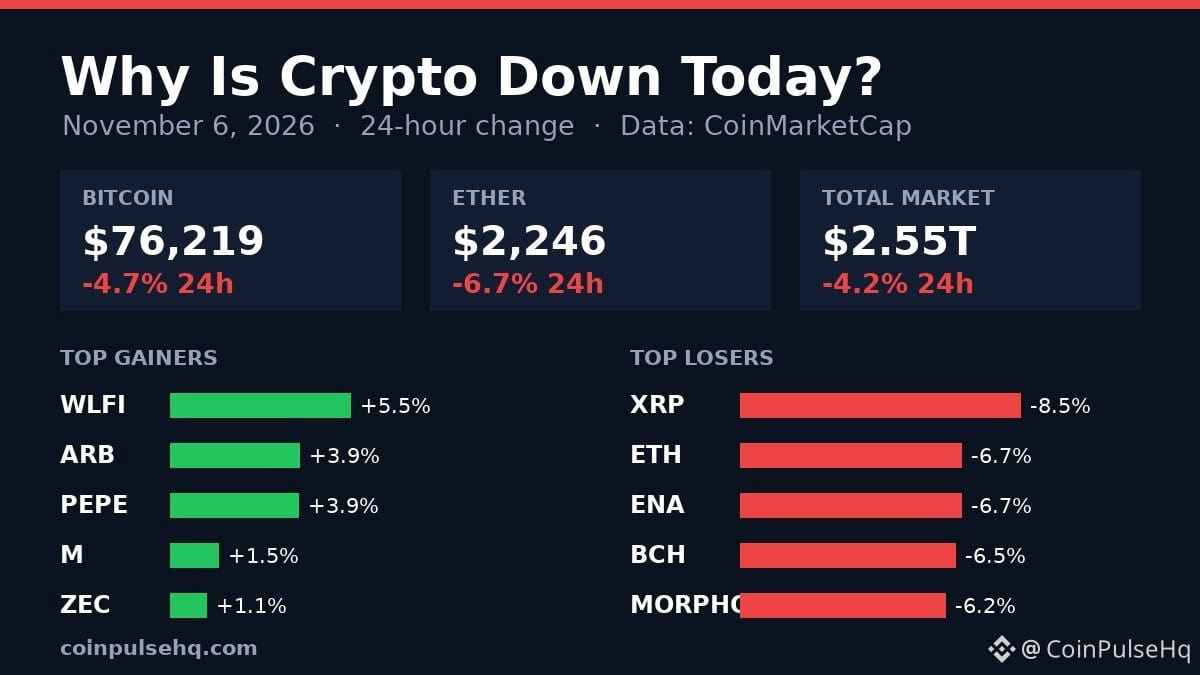
Why Is Crypto Down Today, Nov 6, 2026? Bitcoin Falls 4.7% to $76.2KCrypto is down today. Total market value fell 4.2% in 24 hours to $2.55 trillion as of 13:00 UTC on Friday, November 6, 2026. Bitcoin traded at $76,219 (-4.7%) and Ether at $2,246 (-6.7%). 6 of the 50 largest coins were higher, and the median move was -3.2%.
Why is crypto down today? What the numbers show
• Breadth. The move was broad: 44 of 50 large coins fell, so selling was market-wide rather than limited to one coin.
• Bitcoin versus altcoins. 35 of the other 49 large coins did better than Bitcoin, a sign of appetite for smaller, riskier assets. Bitcoin dominance stands at 59.9%, and Ether underperformed Bitcoin by 2.0 percentage points.
• Trading activity. 24-hour volume across the market was $109.3 billion, up 27.6% on the previous day. A price move on sharply higher volume carries more weight than one on thin trading.
• Bitcoin's 24-hour range. From $75,279 (07:30 UTC) to $79,790 (13:50 UTC, Nov 5), a 6.0% swing. The low came after the high.
Stocks, the dollar and gold
Crypto often trades alongside other risk assets. Latest session for each (the date is the market's last close or update):
Market Level Change As of
S&P 500 7,353.73 -4.4% Nov 5
Nasdaq Composite 24,315.00 -5.5% Nov 5
Gold 4,072.60 -1.0% Nov 6
US 10-year Treasury yield 4.872% +3.5 bp Nov 6
The Nasdaq fell 5.5% in its latest session, so crypto moved in the same direction as tech stocks. That points to a broad shift in risk appetite rather than a crypto-only story.
Biggest movers in the top 50
Gainers
Coin Price 24 hours 7 days
World Liberty Financial (WLFI) $0.04686 +5.5% -7.2%
Arbitrum (ARB) $0.1685 +3.9% +2.4%
Pepe (PEPE) $0.000005127 +3.9% -2.2%
MemeCore (M) $0.8272 +1.5% -15.7%
Zcash (ZEC) $1,327 +1.1% +6.5%
Losers
Coin Price 24 hours 7 days
XRP (XRP) $1.20 -8.5% -3.8%
Ethereum (ETH) $2,246 -6.7% +0.6%
Ethena (ENA) $0.1675 -6.7% -10.7%
Bitcoin Cash (BCH) $270.70 -6.5% -4.3%
Morpho (MORPHO) $2.10 -6.2% +2.4%
The stories behind today's moves
What CoinPulseHQ reported in the past 24 hours:
• American Bitcoin Posts $126M Q3 Profit as ABTC Shares Slide — American Bitcoin reported $126M in Q3 net income and 8,427 BTC held, but ABTC shares fell nearly 17% as mining costs rose 15.3% and margins narrowed.
• GOPAX Halts Trading After Hack Threat, Moves Assets to Cold Storage — GOPAX halted trading and withdrawals on Nov 6 after a hack threat and will move all customer crypto to cold wallets, days after Binance's $6.3B theft.
• Zcash NU7 goes live, stranding 12,224 ZEC in Sprout pool — Zcash's NU7 upgrade went live at block 3,543,405, rejecting v4 transactions and freezing roughly 12,224 ZEC in the legacy Sprout pool.
• Core Scientific to Finish Bitcoin Mining Exit by End of 2026 — Core Scientific targets a full Bitcoin mining exit by end of 2026, CFO Jim Nygaard said, as colocation reached $215.4M of Q3 revenue.
• Keel Infrastructure Sells All 2,520 BTC for $192M in AI Shift — Keel Infrastructure sold its full Bitcoin treasury in Q3 — 2,520 BTC for $192 million — as it pivots to AI data centers and revenue fell to $28 million.
Live prices for the top 50 coins are on our Markets page, and today's biggest movers are on top crypto gainers and losers. Every daily report is collected on Crypto Market Today, and the previous one is Why Is Crypto Up Today, Nov 5, 2026? Bitcoin Rises 2.4% to $80.1K. For the bigger picture, read our weekly market wraps, and if you are wondering about trading hours, see is the crypto market open on weekends.
How this report is made
CoinPulseHQ calculates every figure in this report from CoinMarketCap and CoinGecko market data recorded at 13:00 UTC on Friday, November 6, 2026, and stock, dollar, gold and bond levels from CNBC quotes. Stablecoins and wrapped or staked versions of other coins are left out of the rankings. Changes are over the previous 24 hours. The report describes what prices did and which measurable factors moved with them; it does not claim a single cause and does not predict prices. It is not financial advice.
Originally published on CoinPulseHQ: https://coinpulsehq.com/why-is-crypto-down-today-2026-11-06/?utm_source=binance_square&utm_medium=social&utm_campaign=auto_post
Why Is Crypto Down Today, Nov 6, 2026? Bitcoin Falls 4.7% to $76.2K
Crypto is down today. Total market value fell 4.2% in 24 hours to $2.55 trillion as of 13:00 UTC on Friday, November 6, 2026. Bitcoin traded at $76,219 (-4.7%) and Ether at $2,246 (-6.7%). 6 of the 50 largest coins were higher, and the median move was -3.2%.
Why is crypto down today? What the numbers show
• Breadth. The move was broad: 44 of 50 large coins fell, so selling was market-wide rather than limited to one coin.
• Bitcoin versus altcoins. 35 of the other 49 large coins did better than Bitcoin, a sign of appetite for smaller, riskier assets. Bitcoin dominance stands at 59.9%, and Ether underperformed Bitcoin by 2.0 percentage points.
• Trading activity. 24-hour volume across the market was $109.3 billion, up 27.6% on the previous day. A price move on sharply higher volume carries more weight than one on thin trading.
• Bitcoin's 24-hour range. From $75,279 (07:30 UTC) to $79,790 (13:50 UTC, Nov 5), a 6.0% swing. The low came after the high.
Stocks, the dollar and gold
Crypto often trades alongside other risk assets. Latest session for each (the date is the market's last close or update):
Market Level Change As of
S&P 500 7,353.73 -4.4% Nov 5
Nasdaq Composite 24,315.00 -5.5% Nov 5
Gold 4,072.60 -1.0% Nov 6
US 10-year Treasury yield 4.872% +3.5 bp Nov 6
The Nasdaq fell 5.5% in its latest session, so crypto moved in the same direction as tech stocks. That points to a broad shift in risk appetite rather than a crypto-only story.
Biggest movers in the top 50
Gainers
Coin Price 24 hours 7 days
World Liberty Financial (WLFI) $0.04686 +5.5% -7.2%
Arbitrum (ARB) $0.1685 +3.9% +2.4%
Pepe (PEPE) $0.000005127 +3.9% -2.2%
MemeCore (M) $0.8272 +1.5% -15.7%
Zcash (ZEC) $1,327 +1.1% +6.5%
Losers
Coin Price 24 hours 7 days
XRP (XRP) $1.20 -8.5% -3.8%
Ethereum (ETH) $2,246 -6.7% +0.6%
Ethena (ENA) $0.1675 -6.7% -10.7%
Bitcoin Cash (BCH) $270.70 -6.5% -4.3%
Morpho (MORPHO) $2.10 -6.2% +2.4%
The stories behind today's moves
What CoinPulseHQ reported in the past 24 hours:
• American Bitcoin Posts $126M Q3 Profit as ABTC Shares Slide — American Bitcoin reported $126M in Q3 net income and 8,427 BTC held, but ABTC shares fell nearly 17% as mining costs rose 15.3% and margins narrowed.
• GOPAX Halts Trading After Hack Threat, Moves Assets to Cold Storage — GOPAX halted trading and withdrawals on Nov 6 after a hack threat and will move all customer crypto to cold wallets, days after Binance's $6.3B theft.
• Zcash NU7 goes live, stranding 12,224 ZEC in Sprout pool — Zcash's NU7 upgrade went live at block 3,543,405, rejecting v4 transactions and freezing roughly 12,224 ZEC in the legacy Sprout pool.
• Core Scientific to Finish Bitcoin Mining Exit by End of 2026 — Core Scientific targets a full Bitcoin mining exit by end of 2026, CFO Jim Nygaard said, as colocation reached $215.4M of Q3 revenue.
• Keel Infrastructure Sells All 2,520 BTC for $192M in AI Shift — Keel Infrastructure sold its full Bitcoin treasury in Q3 — 2,520 BTC for $192 million — as it pivots to AI data centers and revenue fell to $28 million.
Live prices for the top 50 coins are on our Markets page, and today's biggest movers are on top crypto gainers and losers. Every daily report is collected on Crypto Market Today, and the previous one is Why Is Crypto Up Today, Nov 5, 2026? Bitcoin Rises 2.4% to $80.1K. For the bigger picture, read our weekly market wraps, and if you are wondering about trading hours, see is the crypto market open on weekends.
How this report is made
CoinPulseHQ calculates every figure in this report from CoinMarketCap and CoinGecko market data recorded at 13:00 UTC on Friday, November 6, 2026, and stock, dollar, gold and bond levels from CNBC quotes. Stablecoins and wrapped or staked versions of other coins are left out of the rankings. Changes are over the previous 24 hours. The report describes what prices did and which measurable factors moved with them; it does not claim a single cause and does not predict prices. It is not financial advice.
Originally published on CoinPulseHQ: https://coinpulsehq.com/why-is-crypto-down-today-2026-11-06/?utm_source=binance_square&utm_medium=social&utm_campaign=auto_post
35
·
--
ලිපිය
GOPAX Halts Trading After Hack Threat, Moves Assets to Cold StorageSouth Korea's GOPAX halted trading, deposits and standard withdrawals on Friday, November 6, 2026, after an email threatened a hack, according to Cointelegraph, which cited the newspaper Kyunghyang Shinmun. A GOPAX representative told the paper that no hack or attempted theft had occurred at that point.
Deposits and normal withdrawals stopped at 5:55 am UTC and trading ceased at 6:53 UTC, per a second exchange notice. All unfilled orders were canceled. Customers can still ask for withdrawals through the support center, though GOPAX warned that manual checks and approvals could slow processing.
Key facts
• GOPAX suspended deposits and standard withdrawals at 5:55 am UTC and trading at 6:53 UTC on November 6, 2026, canceling all unfilled orders.
• The exchange said it would move all crypto assets into offline wallets, citing financial regulators' recommendations and recent leaks and hacks at financial institutions.
• Days earlier, South Korea's Financial Services Commission urged domestic exchanges to raise cold-wallet holdings after the $6.3 billion Binance hack; South Korean exchanges must keep at least 80% of customer crypto offline.
• Financial Supervisory Service data showed GOPAX held 80.54% of user assets offline at the end of September, near the required minimum.
• The FSC named GOPAX operator Streami and exchange Prabang among 16 companies tied to earlier security incidents, per Cointelegraph.
Regulators push exchanges toward cold wallets
The halt came in a week when custody practices drew fresh attention. Bitcoin.com News reported that Coinbase said on November 4 that more than 99% of customer assets sit in offline cold storage after the Binance breach on October 29. Coinbase said the incident did not affect its infrastructure or customer funds and reported $377 billion in platform assets as of September 30, along with $8.6 billion in cash and equivalents and $2.2 billion in crypto held for investment.
CoinCentral reported that Coinbase described a multiparty computation setup that splits signing power, plus withdrawal limits, anomaly detection and controls that can stop transaction signing, and that Coinbase Vault can require several approvals before a withdrawal. Bitcoin.com News noted the 99% figure is self-reported and has not been independently established by third parties. Both the Bitcoin.com News and CoinCentral accounts put Binance's theft in the billions and describe a social engineering campaign that began with a fake job interview; CoinCentral added that Binance said on Wednesday it had replenished about 98% of affected assets.
Why it matters
GOPAX's move turns a threat email into a self-imposed outage, showing how quickly a warning can shut an exchange in a market where regulators are already pressing for offline custody. The rule that South Korean exchanges must keep at least 80% of customer crypto in cold storage puts GOPAX's 80.54% figure close to the line, so shifting the remainder offline is a direct response to both the email and the regulator's stance. For users, the practical change is slower access: trading is paused and withdrawals are manual. It also arrives days after the Binance theft and alongside a separate incident at Prabang, another South Korean venue, which suspended services after detecting abnormal hot-wallet withdrawals on October 24 and reported about 100 million won ($70,000) in losses, according to Yonhap News Agency via Cointelegraph.
What to watch
Whether GOPAX restores deposits and automated withdrawals, and when the planned transfer of assets to offline wallets is completed, are the next concrete markers. Also worth watching: the FSC's tighter cybersecurity oversight plans for the 16 companies it identified after reviewing 555 financial firms, of which it reported deficiencies at 130 in October.
Originally published on CoinPulseHQ: https://coinpulsehq.com/gopax-halts-trading-hack-threat-cold-storage/?utm_source=binance_square&utm_medium=social&utm_campaign=auto_post
GOPAX Halts Trading After Hack Threat, Moves Assets to Cold Storage
South Korea's GOPAX halted trading, deposits and standard withdrawals on Friday, November 6, 2026, after an email threatened a hack, according to Cointelegraph, which cited the newspaper Kyunghyang Shinmun. A GOPAX representative told the paper that no hack or attempted theft had occurred at that point.
Deposits and normal withdrawals stopped at 5:55 am UTC and trading ceased at 6:53 UTC, per a second exchange notice. All unfilled orders were canceled. Customers can still ask for withdrawals through the support center, though GOPAX warned that manual checks and approvals could slow processing.
Key facts
• GOPAX suspended deposits and standard withdrawals at 5:55 am UTC and trading at 6:53 UTC on November 6, 2026, canceling all unfilled orders.
• The exchange said it would move all crypto assets into offline wallets, citing financial regulators' recommendations and recent leaks and hacks at financial institutions.
• Days earlier, South Korea's Financial Services Commission urged domestic exchanges to raise cold-wallet holdings after the $6.3 billion Binance hack; South Korean exchanges must keep at least 80% of customer crypto offline.
• Financial Supervisory Service data showed GOPAX held 80.54% of user assets offline at the end of September, near the required minimum.
• The FSC named GOPAX operator Streami and exchange Prabang among 16 companies tied to earlier security incidents, per Cointelegraph.
Regulators push exchanges toward cold wallets
The halt came in a week when custody practices drew fresh attention. Bitcoin.com News reported that Coinbase said on November 4 that more than 99% of customer assets sit in offline cold storage after the Binance breach on October 29. Coinbase said the incident did not affect its infrastructure or customer funds and reported $377 billion in platform assets as of September 30, along with $8.6 billion in cash and equivalents and $2.2 billion in crypto held for investment.
CoinCentral reported that Coinbase described a multiparty computation setup that splits signing power, plus withdrawal limits, anomaly detection and controls that can stop transaction signing, and that Coinbase Vault can require several approvals before a withdrawal. Bitcoin.com News noted the 99% figure is self-reported and has not been independently established by third parties. Both the Bitcoin.com News and CoinCentral accounts put Binance's theft in the billions and describe a social engineering campaign that began with a fake job interview; CoinCentral added that Binance said on Wednesday it had replenished about 98% of affected assets.
Why it matters
GOPAX's move turns a threat email into a self-imposed outage, showing how quickly a warning can shut an exchange in a market where regulators are already pressing for offline custody. The rule that South Korean exchanges must keep at least 80% of customer crypto in cold storage puts GOPAX's 80.54% figure close to the line, so shifting the remainder offline is a direct response to both the email and the regulator's stance. For users, the practical change is slower access: trading is paused and withdrawals are manual. It also arrives days after the Binance theft and alongside a separate incident at Prabang, another South Korean venue, which suspended services after detecting abnormal hot-wallet withdrawals on October 24 and reported about 100 million won ($70,000) in losses, according to Yonhap News Agency via Cointelegraph.
What to watch
Whether GOPAX restores deposits and automated withdrawals, and when the planned transfer of assets to offline wallets is completed, are the next concrete markers. Also worth watching: the FSC's tighter cybersecurity oversight plans for the 16 companies it identified after reviewing 555 financial firms, of which it reported deficiencies at 130 in October.
Originally published on CoinPulseHQ: https://coinpulsehq.com/gopax-halts-trading-hack-threat-cold-storage/?utm_source=binance_square&utm_medium=social&utm_campaign=auto_post
27
·
--
සත්යායනය කළ
ලිපිය
Zcash NU7 goes live, stranding 12,224 ZEC in Sprout poolZcash's NU7 network upgrade activated on Friday at block 3,543,405, at 02:34 UTC, cutting off the only transaction format that can move funds out of the network's original Sprout shielded pool. According to Cointelegraph, blockchain tracker ZecStats lists about 12,224 ZEC still in Sprout, valued at roughly $15 million and now unusable.
The coins were not destroyed and no private keys were taken, per Crypto Briefing. They still count toward supply, but they cannot be transferred under the new rules.
Key facts
• Under Zcash Improvement Proposal 2003, which Cointelegraph identified as the governing rule, NU7 rejects version 4 transactions, the sole format that supports spending Sprout funds.
• The upgrade also moves Zcash's target block interval from 75 seconds to 25 seconds; real intervals will drift toward the new target as mining difficulty adjusts.
• NU7 adds a Network Sustainability Mechanism that removes 60% of transaction fees from circulation for reissuance through future mining rewards, beginning around February 2031.
• Crypto Briefing reported that Sprout held roughly 22,300 ZEC in mid-October, meaning holders withdrew close to half the balance before activation.
• The supply cap of 21 million ZEC and the halving schedule are unchanged, and limits on shielded activity are meant to reduce wallet synchronization demands.
Where the two reports diverge
The outlets differ on the size of the frozen stash. Cointelegraph, citing ZecStats, put the Sprout balance at about 12,224 ZEC and the value at about $15 million. Crypto Briefing cited approximately 12,226 ZEC and about $16 million, based on ZEC trading between roughly $1,300 and $1,320. Both descriptions trace to a snapshot of the pool around activation, so the gap is small in coin terms but visible in the dollar figure.
Crypto Briefing also gave background the other report did not: Sprout launched in 2016 and has been limited to withdrawals for several years, and only version 4 transactions are affected, leaving the newer Sapling, Orchard and Ironwood pools running unchanged.
Why it matters
Sprout was Zcash's first privacy pool, and its retirement is the network's most consequential step yet toward shedding legacy code. The people most exposed are probably not active traders but early users who shielded coins years ago and have not opened those wallets since, per Crypto Briefing. Coins that can never move cannot circulate, so a large stranded balance could tighten the pool of spendable ZEC even though total supply is unchanged.
The upgrade also changes how the chain funds itself. Diverting most transaction fees for later reissuance through mining rewards, alongside the shorter block interval, alters the network's economics without touching the 21 million cap.
What to watch
The active question is whether any recovery path gets proposed. ZIP 2003 states that "the ability to spend Sprout funds may never be re-enabled." Meanwhile, watch whether wallet providers make it easier for remaining holders to move funds into supported pools, and track the Sprout balance, last near 12,224 ZEC, on ZecStats.
Originally published on CoinPulseHQ: https://coinpulsehq.com/zcash-nu7-sprout-pool-frozen/?utm_source=binance_square&utm_medium=social&utm_campaign=auto_post
Zcash NU7 goes live, stranding 12,224 ZEC in Sprout pool
Zcash's NU7 network upgrade activated on Friday at block 3,543,405, at 02:34 UTC, cutting off the only transaction format that can move funds out of the network's original Sprout shielded pool. According to Cointelegraph, blockchain tracker ZecStats lists about 12,224 ZEC still in Sprout, valued at roughly $15 million and now unusable.
The coins were not destroyed and no private keys were taken, per Crypto Briefing. They still count toward supply, but they cannot be transferred under the new rules.
Key facts
• Under Zcash Improvement Proposal 2003, which Cointelegraph identified as the governing rule, NU7 rejects version 4 transactions, the sole format that supports spending Sprout funds.
• The upgrade also moves Zcash's target block interval from 75 seconds to 25 seconds; real intervals will drift toward the new target as mining difficulty adjusts.
• NU7 adds a Network Sustainability Mechanism that removes 60% of transaction fees from circulation for reissuance through future mining rewards, beginning around February 2031.
• Crypto Briefing reported that Sprout held roughly 22,300 ZEC in mid-October, meaning holders withdrew close to half the balance before activation.
• The supply cap of 21 million ZEC and the halving schedule are unchanged, and limits on shielded activity are meant to reduce wallet synchronization demands.
Where the two reports diverge
The outlets differ on the size of the frozen stash. Cointelegraph, citing ZecStats, put the Sprout balance at about 12,224 ZEC and the value at about $15 million. Crypto Briefing cited approximately 12,226 ZEC and about $16 million, based on ZEC trading between roughly $1,300 and $1,320. Both descriptions trace to a snapshot of the pool around activation, so the gap is small in coin terms but visible in the dollar figure.
Crypto Briefing also gave background the other report did not: Sprout launched in 2016 and has been limited to withdrawals for several years, and only version 4 transactions are affected, leaving the newer Sapling, Orchard and Ironwood pools running unchanged.
Why it matters
Sprout was Zcash's first privacy pool, and its retirement is the network's most consequential step yet toward shedding legacy code. The people most exposed are probably not active traders but early users who shielded coins years ago and have not opened those wallets since, per Crypto Briefing. Coins that can never move cannot circulate, so a large stranded balance could tighten the pool of spendable ZEC even though total supply is unchanged.
The upgrade also changes how the chain funds itself. Diverting most transaction fees for later reissuance through mining rewards, alongside the shorter block interval, alters the network's economics without touching the 21 million cap.
What to watch
The active question is whether any recovery path gets proposed. ZIP 2003 states that "the ability to spend Sprout funds may never be re-enabled." Meanwhile, watch whether wallet providers make it easier for remaining holders to move funds into supported pools, and track the Sprout balance, last near 12,224 ZEC, on ZecStats.
Originally published on CoinPulseHQ: https://coinpulsehq.com/zcash-nu7-sprout-pool-frozen/?utm_source=binance_square&utm_medium=social&utm_campaign=auto_post
1
1
657
·
--
ලිපිය
Core Scientific to Finish Bitcoin Mining Exit by End of 2026Core Scientific expects to finish winding down Bitcoin mining during the fourth quarter of 2026 and begin 2027 as a high-density colocation provider, chief financial officer Jim Nygaard said on the company's Q3 earnings call, according to Cointelegraph. The company reported $232.9 million in third-quarter revenue, of which mining and mining hosting contributed $17.5 million, or 7.5%.
Colocation accounted for the remaining $215.4 million. The figures show how far the business has moved from its mining origins, and they landed a day after the company published its third-quarter results. Blockchain Reporter calculated that colocation made up 92.5% of revenue, against 18.5% a year earlier, when the same business reported $81.1 million in total revenue and $15.0 million from colocation.
Key facts
• Third-quarter self-mining revenue fell to $12.3 million from $57.4 million a year earlier, while hosting revenue for other miners dropped to $5.2 million from $8.7 million.
• Core Scientific had nearly 50% fewer miners online at the end of September than at the end of 2025, Nygaard said.
• The company recorded $266.5 million in mining-related asset impairments in the first quarter of 2026, citing weaker Bitcoin prices and low hashprice, and took a $41.9 million loss in the second quarter when it terminated its mining equipment agreement with Block and Proto.
• Blockchain Reporter reported that net income was $1,178.1 million, driven primarily by the change in fair value of warrants, and that $985.1 million went to property, plant, equipment, land and development rights in the quarter.
• Coinpedia reported that MARA Holdings, Riot Platforms and HIVE Digital have also shifted toward AI and HPC infrastructure, and that at least 35 EH/s of computing power is scheduled to leave publicly listed Bitcoin miners.
A revenue mix that flipped in two quarters
Publishing its third-quarter 2026 results, Core Scientific said it is "in the process of repurposing its remaining mining facilities to support its high-density colocation services business as circumstances allow." Blockchain Reporter noted that the release does not use the word "exit" and that the phrasing ties timing to construction schedules rather than a public shutdown date, while Cointelegraph reported the July filing had already put hosted mining's end at December 31.
Capacity has moved steadily. Blockchain Reporter reported billing capacity of 120 megawatts in the fourth quarter of 2025, then 225 MW, 395 MW and 485 MW in the third quarter of 2026, with colocation revenue of $31.3 million, $77.5 million, $136.7 million and $215.4 million across the same quarters. Chief executive Adam Sullivan said in the release that the company is nearing full delivery under its first colocation agreement while construction under its second is underway across five campuses.
Two tenants, more than $24 billion contracted
Blockchain Reporter reported that contracted revenue exceeds $24 billion across about 1.1 gigawatts of customer-contracted power, split between roughly 590 MW leased to CoreWeave — across Denton, Texas; Dalton, Georgia; Muskogee, Oklahoma; Marble, North Carolina; and Austin, Texas — and an AMD-backed block of about 530 MW. Of the CoreWeave capacity, 485 MW was billing on November 5, with the remaining 105 MW at Dalton scheduled to complete early in 2027.
Coinpedia reported an additional AMD reservation for 1,925 MW of potential capacity, a figure Blockchain Reporter's summary of the deck does not state. Coinpedia also reported a separate 20-year Riot Platforms lease for 191 MW with an estimated $9.1 billion in contract revenue, which Blockchain Reporter described as the largest version of the trade announced this year.
Why it matters
For a public miner, the same power capacity now supports a different product: long-dated rental of space, power and cooling to AI tenants. Coinpedia cited an energy infrastructure analyst's estimate that one megawatt of power can generate roughly $1.9 million over five years from Bitcoin mining against about $7.9 million from AI workloads, which helps explain why miners with grid connections are finding buyers for capacity rather than hashpower. Coin Scientific's shift also changes what investors own — a colocation landlord whose reported earnings can swing with its warrant liabilities, not a company whose results track the price of Bitcoin.
The planned exit coincides with new political uncertainty. Cointelegraph reported that opponents of data-center development were among the winners in the Democrats' midterm gains, with the backlash centering partly on electricity bills and the demands large facilities place on local resources.
What to watch
The fourth-quarter filing and the early-2027 completion of the remaining 105 MW at Dalton will show whether the company states a dated mining shutdown on the record. Core Scientific's current disclosure describes an ongoing conversion, not a completed one.
This article is for information only and is not financial advice; markets for crypto assets and related equities are volatile and uncertain.
Originally published on CoinPulseHQ: https://coinpulsehq.com/core-scientific-bitcoin-mining-exit-2026/?utm_source=binance_square&utm_medium=social&utm_campaign=auto_post
Core Scientific to Finish Bitcoin Mining Exit by End of 2026
Core Scientific expects to finish winding down Bitcoin mining during the fourth quarter of 2026 and begin 2027 as a high-density colocation provider, chief financial officer Jim Nygaard said on the company's Q3 earnings call, according to Cointelegraph. The company reported $232.9 million in third-quarter revenue, of which mining and mining hosting contributed $17.5 million, or 7.5%.
Colocation accounted for the remaining $215.4 million. The figures show how far the business has moved from its mining origins, and they landed a day after the company published its third-quarter results. Blockchain Reporter calculated that colocation made up 92.5% of revenue, against 18.5% a year earlier, when the same business reported $81.1 million in total revenue and $15.0 million from colocation.
Key facts
• Third-quarter self-mining revenue fell to $12.3 million from $57.4 million a year earlier, while hosting revenue for other miners dropped to $5.2 million from $8.7 million.
• Core Scientific had nearly 50% fewer miners online at the end of September than at the end of 2025, Nygaard said.
• The company recorded $266.5 million in mining-related asset impairments in the first quarter of 2026, citing weaker Bitcoin prices and low hashprice, and took a $41.9 million loss in the second quarter when it terminated its mining equipment agreement with Block and Proto.
• Blockchain Reporter reported that net income was $1,178.1 million, driven primarily by the change in fair value of warrants, and that $985.1 million went to property, plant, equipment, land and development rights in the quarter.
• Coinpedia reported that MARA Holdings, Riot Platforms and HIVE Digital have also shifted toward AI and HPC infrastructure, and that at least 35 EH/s of computing power is scheduled to leave publicly listed Bitcoin miners.
A revenue mix that flipped in two quarters
Publishing its third-quarter 2026 results, Core Scientific said it is "in the process of repurposing its remaining mining facilities to support its high-density colocation services business as circumstances allow." Blockchain Reporter noted that the release does not use the word "exit" and that the phrasing ties timing to construction schedules rather than a public shutdown date, while Cointelegraph reported the July filing had already put hosted mining's end at December 31.
Capacity has moved steadily. Blockchain Reporter reported billing capacity of 120 megawatts in the fourth quarter of 2025, then 225 MW, 395 MW and 485 MW in the third quarter of 2026, with colocation revenue of $31.3 million, $77.5 million, $136.7 million and $215.4 million across the same quarters. Chief executive Adam Sullivan said in the release that the company is nearing full delivery under its first colocation agreement while construction under its second is underway across five campuses.
Two tenants, more than $24 billion contracted
Blockchain Reporter reported that contracted revenue exceeds $24 billion across about 1.1 gigawatts of customer-contracted power, split between roughly 590 MW leased to CoreWeave — across Denton, Texas; Dalton, Georgia; Muskogee, Oklahoma; Marble, North Carolina; and Austin, Texas — and an AMD-backed block of about 530 MW. Of the CoreWeave capacity, 485 MW was billing on November 5, with the remaining 105 MW at Dalton scheduled to complete early in 2027.
Coinpedia reported an additional AMD reservation for 1,925 MW of potential capacity, a figure Blockchain Reporter's summary of the deck does not state. Coinpedia also reported a separate 20-year Riot Platforms lease for 191 MW with an estimated $9.1 billion in contract revenue, which Blockchain Reporter described as the largest version of the trade announced this year.
Why it matters
For a public miner, the same power capacity now supports a different product: long-dated rental of space, power and cooling to AI tenants. Coinpedia cited an energy infrastructure analyst's estimate that one megawatt of power can generate roughly $1.9 million over five years from Bitcoin mining against about $7.9 million from AI workloads, which helps explain why miners with grid connections are finding buyers for capacity rather than hashpower. Coin Scientific's shift also changes what investors own — a colocation landlord whose reported earnings can swing with its warrant liabilities, not a company whose results track the price of Bitcoin.
The planned exit coincides with new political uncertainty. Cointelegraph reported that opponents of data-center development were among the winners in the Democrats' midterm gains, with the backlash centering partly on electricity bills and the demands large facilities place on local resources.
What to watch
The fourth-quarter filing and the early-2027 completion of the remaining 105 MW at Dalton will show whether the company states a dated mining shutdown on the record. Core Scientific's current disclosure describes an ongoing conversion, not a completed one.
This article is for information only and is not financial advice; markets for crypto assets and related equities are volatile and uncertain.
Originally published on CoinPulseHQ: https://coinpulsehq.com/core-scientific-bitcoin-mining-exit-2026/?utm_source=binance_square&utm_medium=social&utm_campaign=auto_post
48
·
--
ලිපිය
Keel Infrastructure Sells All 2,520 BTC for $192M in AI ShiftKeel Infrastructure sold 2,520 BTC for $192 million during the quarter ended Sept. 30, emptying a bitcoin treasury it had built as a miner and redirecting its balance sheet toward AI and high-performance computing data centers, according to Bitcoin.com News. The total included the company's entire treasury position of 2,261 BTC plus 259 BTC produced by mining operations it still runs in Quebec.
The former Bitfarms said in its third-quarter results release that it timed the sales to catch periods of market strength, and that it finished September with nominal bitcoin holdings. Bitcoin.com News reported the disclosure on Nov. 5, the same day KEEL shares fell 21% in a wider sell-off across technology, mining and AI infrastructure stocks.
Key facts
• Keel sold 2,520 BTC for $192 million in Q3, including its full 2,261 BTC treasury and 259 BTC mined during the quarter.
• Revenue fell to $28 million from $68 million a year earlier; the loss from continuing operations was $62 million versus $11 million.
• Adjusted EBITDA was negative $27 million, compared with positive $19 million in Q3 2025, and G&A expenses doubled to $34 million.
• Keel held about $780 million in unrestricted cash as of Nov. 4 and expects first AI data center revenue in 2027.
• Shares traded near $1.65, down more than 52% over the past month.
From miner to landlord
Keel has been unwinding its mining business in stages. It shut down U.S. mining operations in the second quarter and pointed those sites at AI development, and it previously sold 1,085 BTC between April 1 and Aug. 7, leaving 1,861 BTC on the books at that point. The earlier period carried about $819 million in total liquidity across cash and bitcoin.
Going forward, the company plans to sell bitcoin from its Quebec operations daily, which removes treasury exposure to price swings entirely. Construction started in September at Moses Lake, Washington, which Keel expects to be its first revenue-generating HPC facility in 2027. Permitting has moved forward at Sharon and Panther Creek in Pennsylvania, tenant talks continue across all three sites, and the company is studying expansions that could lift secured data center power capacity from 478 megawatts to as much as 1,928 megawatts.
CEO Ben Gagnon said competition for electricity is strengthening Keel's hand with prospective customers, noting that power supply is getting scarcer while demand keeps climbing. The financial picture shows the gap before AI revenue arrives: revenue dropped on the U.S. shutdown and lower average bitcoin prices, and administrative costs rose as the company built out its management team and project pipeline.
Why it matters
Keel is not alone in selling coins. Riot Platforms and Hut 8 disclosed large third-quarter bitcoin sales on the same earnings cycle, signaling that miners are converting reserves into construction capital. Vaneck argued in a Wednesday note that miners supplying powered data center space have been punished disproportionately, falling about 35% on average in October, even though no signed leases among the public companies it analyzed had been canceled. The firm cited a Morgan Stanley estimate of a potential 38-gigawatt U.S. data center capacity shortfall through 2028, while flagging roughly $23 billion in construction debt that may need refinancing in 2027 and 2028.
For Keel, converting electricity access and a permitting pipeline into contracted leases is the test; its cash position gives it room, but the emptied treasury marks how far it has moved from the business that funded its expansion.
What to watch
Any announcement of long-term AI leases at Moses Lake, Sharon or Panther Creek would be the first hard evidence of replacement revenue, and the 2027 start of HPC revenue is the company's own target date.
This is not financial advice, and markets for bitcoin and related equities are volatile and uncertain.
Originally published on CoinPulseHQ: https://coinpulsehq.com/keel-infrastructure-sells-bitcoin-treasury-192m-ai-pivot/?utm_source=binance_square&utm_medium=social&utm_campaign=auto_post
Keel Infrastructure Sells All 2,520 BTC for $192M in AI Shift
Keel Infrastructure sold 2,520 BTC for $192 million during the quarter ended Sept. 30, emptying a bitcoin treasury it had built as a miner and redirecting its balance sheet toward AI and high-performance computing data centers, according to Bitcoin.com News. The total included the company's entire treasury position of 2,261 BTC plus 259 BTC produced by mining operations it still runs in Quebec.
The former Bitfarms said in its third-quarter results release that it timed the sales to catch periods of market strength, and that it finished September with nominal bitcoin holdings. Bitcoin.com News reported the disclosure on Nov. 5, the same day KEEL shares fell 21% in a wider sell-off across technology, mining and AI infrastructure stocks.
Key facts
• Keel sold 2,520 BTC for $192 million in Q3, including its full 2,261 BTC treasury and 259 BTC mined during the quarter.
• Revenue fell to $28 million from $68 million a year earlier; the loss from continuing operations was $62 million versus $11 million.
• Adjusted EBITDA was negative $27 million, compared with positive $19 million in Q3 2025, and G&A expenses doubled to $34 million.
• Keel held about $780 million in unrestricted cash as of Nov. 4 and expects first AI data center revenue in 2027.
• Shares traded near $1.65, down more than 52% over the past month.
From miner to landlord
Keel has been unwinding its mining business in stages. It shut down U.S. mining operations in the second quarter and pointed those sites at AI development, and it previously sold 1,085 BTC between April 1 and Aug. 7, leaving 1,861 BTC on the books at that point. The earlier period carried about $819 million in total liquidity across cash and bitcoin.
Going forward, the company plans to sell bitcoin from its Quebec operations daily, which removes treasury exposure to price swings entirely. Construction started in September at Moses Lake, Washington, which Keel expects to be its first revenue-generating HPC facility in 2027. Permitting has moved forward at Sharon and Panther Creek in Pennsylvania, tenant talks continue across all three sites, and the company is studying expansions that could lift secured data center power capacity from 478 megawatts to as much as 1,928 megawatts.
CEO Ben Gagnon said competition for electricity is strengthening Keel's hand with prospective customers, noting that power supply is getting scarcer while demand keeps climbing. The financial picture shows the gap before AI revenue arrives: revenue dropped on the U.S. shutdown and lower average bitcoin prices, and administrative costs rose as the company built out its management team and project pipeline.
Why it matters
Keel is not alone in selling coins. Riot Platforms and Hut 8 disclosed large third-quarter bitcoin sales on the same earnings cycle, signaling that miners are converting reserves into construction capital. Vaneck argued in a Wednesday note that miners supplying powered data center space have been punished disproportionately, falling about 35% on average in October, even though no signed leases among the public companies it analyzed had been canceled. The firm cited a Morgan Stanley estimate of a potential 38-gigawatt U.S. data center capacity shortfall through 2028, while flagging roughly $23 billion in construction debt that may need refinancing in 2027 and 2028.
For Keel, converting electricity access and a permitting pipeline into contracted leases is the test; its cash position gives it room, but the emptied treasury marks how far it has moved from the business that funded its expansion.
What to watch
Any announcement of long-term AI leases at Moses Lake, Sharon or Panther Creek would be the first hard evidence of replacement revenue, and the 2027 start of HPC revenue is the company's own target date.
This is not financial advice, and markets for bitcoin and related equities are volatile and uncertain.
Originally published on CoinPulseHQ: https://coinpulsehq.com/keel-infrastructure-sells-bitcoin-treasury-192m-ai-pivot/?utm_source=binance_square&utm_medium=social&utm_campaign=auto_post
84
·
--

ලිපිය
American Bitcoin Posts $126M Q3 Profit as ABTC Shares SlideAmerican Bitcoin Corp. (Nasdaq: ABTC), the bitcoin miner co-founded by Eric Trump, reported roughly $126 million in third-quarter net income and approximately $221 million in adjusted EBITDA for the three months ended September 30, according to Bitcoin.com News. The result reverses a $57.2 million net loss in the second quarter, when adjusted EBITDA was negative $45 million.
The headline turnaround did not lift the stock. ABTC shares fell nearly 17% on Thursday to a recent price of $5.18 amid a wider sell-off in technology and mining stocks, and are down more than 40% over the past month, Bitcoin.com News reported.
Key facts
• Net income of about $126 million in Q3 2026, versus a $57.2 million loss in Q2 2026.
• Bitcoin holdings of 8,427 BTC at September 30, up roughly 425 BTC from 8,002 BTC at June 30.
• Mining revenue fell to $63.4 million from $67 million, and gross profit slipped to $25.8 million from $33 million.
• Cost to mine one bitcoin rose to $42,100 from $36,500, a 15.3% quarterly increase.
• Production declined 4.4%, from about 932 BTC to 891 BTC.
Where the profit came from
The profit was driven less by mining than by accounting gains on the company's bitcoin reserve. Coverage by crypto.news put a $197.3 million digital-asset valuation gain in the quarter, reversing a $71.2 million loss on holdings in the prior period, against a $64.3 million derivative loss tied mainly to Bitcoin redemption and put options linked to equipment supplier Bitmain. American Bitcoin carries its bitcoin at fair value, so price moves flow through earnings whether or not coins are sold.
Bitcoin.com News reported adjusted EBITDA of approximately $221 million; crypto.news gave the figure as $220.8 million, a rounding difference. Both outlets put gross margin at 41%, down from 49% in the second quarter, which American Bitcoin attributed to seasonal electricity costs.
CEO Mike Ho said the company expanded its reserve without buying bitcoin on the open market or issuing shares under its at-the-market program during the quarter, and that operations kept mining at a structural discount to spot prices despite seasonal power costs. Satoshis per share rose about 5%, from 10,989 to 11,572.
Treasury ranking and equipment
BitcoinTreasuries.net ranked American Bitcoin 13th among public corporate bitcoin holders, ahead of GD Culture Group and Galaxy Digital Holdings. About 3,090 BTC of the total were pledged under Bitmain miner-purchase agreements, split into 2,385 BTC as current assets and 705 BTC as noncurrent, crypto.news reported, citing the SEC filing. The company's owned fleet stood at roughly 89,242 machines and 28.1 EH/s of capacity at quarter-end.
crypto.news also reported details from the filing that Bitcoin.com News did not carry: 7.76 million Class A shares sold under the at-the-market program in the first nine months of 2026 for $144.7 million in gross proceeds, and $72.4 million in net cash used by operating activities over that period.
Why it matters
The quarter separates accounting income from mining economics: earnings rose sharply while revenue, output and margins all fell. Shareholders are exposed to that gap because reported profit on held bitcoin does not add coins, and further share issuance would dilute per-share holdings. Placing 3,090 BTC as collateral for mining hardware also ties part of the treasury to equipment commitments.
What to watch
Next up is whether Q4 electricity costs ease and whether the company resumes share sales under its at-the-market program. Peer results in the same reporting period — Hut 8's $189.5 million net income and Riot Platforms' $181.4 million in revenue — set a comparison point for how much of sector earnings depends on valuation gains.
Bitcoin traded around $76,111 on November 5, according to Bitcoin.com News. This article is not financial advice; cryptocurrency prices are volatile and the figures above describe reported results, not expected future performance.
Originally published on CoinPulseHQ: https://coinpulsehq.com/american-bitcoin-q3-profit-abtc-shares-slide/?utm_source=binance_square&utm_medium=social&utm_campaign=auto_post
American Bitcoin Posts $126M Q3 Profit as ABTC Shares Slide
American Bitcoin Corp. (Nasdaq: ABTC), the bitcoin miner co-founded by Eric Trump, reported roughly $126 million in third-quarter net income and approximately $221 million in adjusted EBITDA for the three months ended September 30, according to Bitcoin.com News. The result reverses a $57.2 million net loss in the second quarter, when adjusted EBITDA was negative $45 million.
The headline turnaround did not lift the stock. ABTC shares fell nearly 17% on Thursday to a recent price of $5.18 amid a wider sell-off in technology and mining stocks, and are down more than 40% over the past month, Bitcoin.com News reported.
Key facts
• Net income of about $126 million in Q3 2026, versus a $57.2 million loss in Q2 2026.
• Bitcoin holdings of 8,427 BTC at September 30, up roughly 425 BTC from 8,002 BTC at June 30.
• Mining revenue fell to $63.4 million from $67 million, and gross profit slipped to $25.8 million from $33 million.
• Cost to mine one bitcoin rose to $42,100 from $36,500, a 15.3% quarterly increase.
• Production declined 4.4%, from about 932 BTC to 891 BTC.
Where the profit came from
The profit was driven less by mining than by accounting gains on the company's bitcoin reserve. Coverage by crypto.news put a $197.3 million digital-asset valuation gain in the quarter, reversing a $71.2 million loss on holdings in the prior period, against a $64.3 million derivative loss tied mainly to Bitcoin redemption and put options linked to equipment supplier Bitmain. American Bitcoin carries its bitcoin at fair value, so price moves flow through earnings whether or not coins are sold.
Bitcoin.com News reported adjusted EBITDA of approximately $221 million; crypto.news gave the figure as $220.8 million, a rounding difference. Both outlets put gross margin at 41%, down from 49% in the second quarter, which American Bitcoin attributed to seasonal electricity costs.
CEO Mike Ho said the company expanded its reserve without buying bitcoin on the open market or issuing shares under its at-the-market program during the quarter, and that operations kept mining at a structural discount to spot prices despite seasonal power costs. Satoshis per share rose about 5%, from 10,989 to 11,572.
Treasury ranking and equipment
BitcoinTreasuries.net ranked American Bitcoin 13th among public corporate bitcoin holders, ahead of GD Culture Group and Galaxy Digital Holdings. About 3,090 BTC of the total were pledged under Bitmain miner-purchase agreements, split into 2,385 BTC as current assets and 705 BTC as noncurrent, crypto.news reported, citing the SEC filing. The company's owned fleet stood at roughly 89,242 machines and 28.1 EH/s of capacity at quarter-end.
crypto.news also reported details from the filing that Bitcoin.com News did not carry: 7.76 million Class A shares sold under the at-the-market program in the first nine months of 2026 for $144.7 million in gross proceeds, and $72.4 million in net cash used by operating activities over that period.
Why it matters
The quarter separates accounting income from mining economics: earnings rose sharply while revenue, output and margins all fell. Shareholders are exposed to that gap because reported profit on held bitcoin does not add coins, and further share issuance would dilute per-share holdings. Placing 3,090 BTC as collateral for mining hardware also ties part of the treasury to equipment commitments.
What to watch
Next up is whether Q4 electricity costs ease and whether the company resumes share sales under its at-the-market program. Peer results in the same reporting period — Hut 8's $189.5 million net income and Riot Platforms' $181.4 million in revenue — set a comparison point for how much of sector earnings depends on valuation gains.
Bitcoin traded around $76,111 on November 5, according to Bitcoin.com News. This article is not financial advice; cryptocurrency prices are volatile and the figures above describe reported results, not expected future performance.
Originally published on CoinPulseHQ: https://coinpulsehq.com/american-bitcoin-q3-profit-abtc-shares-slide/?utm_source=binance_square&utm_medium=social&utm_campaign=auto_post
BTC-0.25%
ABTCUS+1.87%
46
·
--

ලිපිය
Binance Revokes SignalPlus API Keys After Security WarningBinance removed every API key connected to third-party trading platform SignalPlus on Nov. 5, 2026, after SignalPlus reported a potential security issue, according to Bitcoin.com News. The exchange said its internal systems were unaffected and that customer funds stayed safe.
In an announcement posted on X, Binance described the removal of the SignalPlus-linked keys as an immediate precautionary measure. crypto.news reported that the decision applies specifically to API keys tied to SignalPlus, which lets traders connect exchange accounts to outside trading tools.
Key facts
• Binance revoked all SignalPlus API keys on Thursday, Nov. 5, 2026, after the platform reported a possible security problem.
• Binance said its own systems were unaffected and user funds remained safe.
• Founder Changpeng Zhao urged traders using SignalPlus on any other exchange to revoke their API keys as well.
• Binance has not established a link between the SignalPlus issue and its $6.34 billion hack of Oct. 29.
• Affected customers were told to check positions and open orders directly in their Binance accounts and to enable IP whitelisting before reconnecting.
What SignalPlus users were told to do
SignalPlus is a Hong Kong-based fintech company that offers AI-enabled trading tools, options analytics and execution services. Its software plugs into exchanges through APIs, which let customers trade without moving assets off the exchange.
Binance advised users to review their positions and outstanding orders in their own accounts and to wait until SignalPlus confirms the problem is resolved before setting up new API connections. It also recommended IP whitelisting, which limits API access to approved internet addresses, and asked other integrated platforms to review their security controls.
Zhao's warning went beyond Binance. In a social media post, he said traders who use SignalPlus with other exchange platforms should revoke all their API keys, and he generally advised against storing API keys with any third party. He also referenced Deribit, the options and futures exchange, noting it had reported the concern. CoinCentral and crypto.news both reported that Deribit flagged the issue earlier.
Co-founder Yi He repeated the exchange's position that Binance's own systems were unaffected and advised customers to inspect open orders, hold off reconnecting credentials and use IP whitelisting. According to crypto.news, she framed the warning as aimed at third-party integration partners in general rather than SignalPlus alone, saying on X that this was not a challenge for any single company.
The Oct. 29 breach in the background
The revocation lands a week after a separate attack. On Oct. 29, attackers drained roughly $6.34 billion in cryptocurrency from Binance, with Bitcoin.com News reporting that 17 hot wallets were compromised across multiple blockchains.
CoinCentral, citing the exchange's postmortem, reported that the campaign began in June when an engineer downloaded a tampered software package, and that in September attackers posing as recruiters sent another engineer a coding assignment that was actually malware. Access to the internal wallet-signing service followed, allowing transfers outside the normal withdrawal process.
crypto.news reported that Binance's investigation found fraudulent recruitment interviews, malicious software and compromised internal AI tools were used, and that part of the attack relied on Ethereum's EIP-7702 authorization mechanism. Stablecoin issuers and industry partners froze or intercepted about $2.85 billion, and Binance said it would absorb the losses. CoinCentral reported that 98% of affected token assets had been replenished by Oct. 31, while crypto.news put that recovery at about 98% by Nov. 4, with less-liquid tokens still being bought. The FBI attributed the theft to North Korea's TraderTraitor group; North Korea denied responsibility.
Why it matters
The two incidents are different in kind. October's breach involved Binance's own wallet infrastructure, while the latest response concerns credentials held by an independent trading platform. That distinction matters for traders who granted SignalPlus permission to place orders on their behalf, because API keys can carry transaction rights without requiring a manual login each time.
What to watch
The next marker is SignalPlus itself: Binance said users should wait for the platform to confirm the issue is resolved before connecting again. Neither the nature of the suspected vulnerability nor whether customer credentials were accessed has been established publicly.
Originally published on CoinPulseHQ: https://coinpulsehq.com/binance-revokes-signalplus-api-keys/?utm_source=binance_square&utm_medium=social&utm_campaign=auto_post
Binance Revokes SignalPlus API Keys After Security Warning
Binance removed every API key connected to third-party trading platform SignalPlus on Nov. 5, 2026, after SignalPlus reported a potential security issue, according to Bitcoin.com News. The exchange said its internal systems were unaffected and that customer funds stayed safe.
In an announcement posted on X, Binance described the removal of the SignalPlus-linked keys as an immediate precautionary measure. crypto.news reported that the decision applies specifically to API keys tied to SignalPlus, which lets traders connect exchange accounts to outside trading tools.
Key facts
• Binance revoked all SignalPlus API keys on Thursday, Nov. 5, 2026, after the platform reported a possible security problem.
• Binance said its own systems were unaffected and user funds remained safe.
• Founder Changpeng Zhao urged traders using SignalPlus on any other exchange to revoke their API keys as well.
• Binance has not established a link between the SignalPlus issue and its $6.34 billion hack of Oct. 29.
• Affected customers were told to check positions and open orders directly in their Binance accounts and to enable IP whitelisting before reconnecting.
What SignalPlus users were told to do
SignalPlus is a Hong Kong-based fintech company that offers AI-enabled trading tools, options analytics and execution services. Its software plugs into exchanges through APIs, which let customers trade without moving assets off the exchange.
Binance advised users to review their positions and outstanding orders in their own accounts and to wait until SignalPlus confirms the problem is resolved before setting up new API connections. It also recommended IP whitelisting, which limits API access to approved internet addresses, and asked other integrated platforms to review their security controls.
Zhao's warning went beyond Binance. In a social media post, he said traders who use SignalPlus with other exchange platforms should revoke all their API keys, and he generally advised against storing API keys with any third party. He also referenced Deribit, the options and futures exchange, noting it had reported the concern. CoinCentral and crypto.news both reported that Deribit flagged the issue earlier.
Co-founder Yi He repeated the exchange's position that Binance's own systems were unaffected and advised customers to inspect open orders, hold off reconnecting credentials and use IP whitelisting. According to crypto.news, she framed the warning as aimed at third-party integration partners in general rather than SignalPlus alone, saying on X that this was not a challenge for any single company.
The Oct. 29 breach in the background
The revocation lands a week after a separate attack. On Oct. 29, attackers drained roughly $6.34 billion in cryptocurrency from Binance, with Bitcoin.com News reporting that 17 hot wallets were compromised across multiple blockchains.
CoinCentral, citing the exchange's postmortem, reported that the campaign began in June when an engineer downloaded a tampered software package, and that in September attackers posing as recruiters sent another engineer a coding assignment that was actually malware. Access to the internal wallet-signing service followed, allowing transfers outside the normal withdrawal process.
crypto.news reported that Binance's investigation found fraudulent recruitment interviews, malicious software and compromised internal AI tools were used, and that part of the attack relied on Ethereum's EIP-7702 authorization mechanism. Stablecoin issuers and industry partners froze or intercepted about $2.85 billion, and Binance said it would absorb the losses. CoinCentral reported that 98% of affected token assets had been replenished by Oct. 31, while crypto.news put that recovery at about 98% by Nov. 4, with less-liquid tokens still being bought. The FBI attributed the theft to North Korea's TraderTraitor group; North Korea denied responsibility.
Why it matters
The two incidents are different in kind. October's breach involved Binance's own wallet infrastructure, while the latest response concerns credentials held by an independent trading platform. That distinction matters for traders who granted SignalPlus permission to place orders on their behalf, because API keys can carry transaction rights without requiring a manual login each time.
What to watch
The next marker is SignalPlus itself: Binance said users should wait for the platform to confirm the issue is resolved before connecting again. Neither the nature of the suspected vulnerability nor whether customer credentials were accessed has been established publicly.
Originally published on CoinPulseHQ: https://coinpulsehq.com/binance-revokes-signalplus-api-keys/?utm_source=binance_square&utm_medium=social&utm_campaign=auto_post
76
·
--
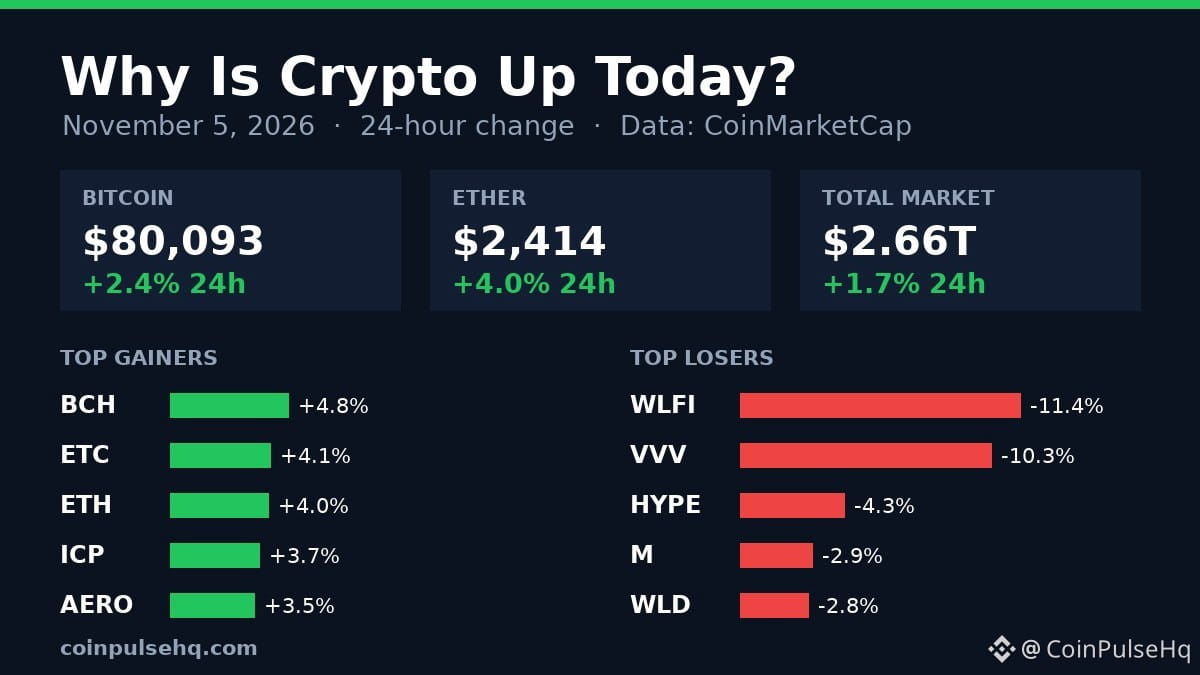
ලිපිය
Why Is Crypto Up Today, Nov 5, 2026? Bitcoin Rises 2.4% to $80.1KCrypto is up today. Total market value rose 1.7% in 24 hours to $2.66 trillion as of 13:00 UTC on Thursday, November 5, 2026. Bitcoin traded at $80,093 (+2.4%) and Ether at $2,414 (+4.0%). 35 of the 50 largest coins were higher, and the median move was +1.3%.
Why is crypto up today? What the numbers show
• Breadth. Breadth was mixed: 35 of 50 large coins rose and 15 fell, so the headline move was driven by a few large assets rather than the whole market.
• Bitcoin versus altcoins. Only 8 of the other 49 large coins did better than Bitcoin, so money favoured the largest asset. Bitcoin dominance stands at 60.1%, and Ether outperformed Bitcoin by 1.6 percentage points.
• Trading activity. 24-hour volume across the market was $85.9 billion, up 18.8% on the previous day. Volume did not change sharply, so the move was not driven by a surge of trading.
• Bitcoin's 24-hour range. From $78,217 (14:10 UTC, Nov 4) to $80,882 (22:45 UTC, Nov 4), a 3.4% swing. The high came after the low.
Stocks, the dollar and gold
Crypto often trades alongside other risk assets. Latest session for each (the date is the market's last close or update):
Market Level Change As of
S&P 500 7,688.62 +1.6% Nov 4
Nasdaq Composite 25,736.51 +1.4% Nov 4
US dollar index 101.58 +0.0% Nov 5
Gold 4,128.40 +1.4% Nov 5
US 10-year Treasury yield 4.890% -0.2 bp Nov 5
The Nasdaq rose 1.4% in its latest session, so crypto moved in the same direction as tech stocks. That points to a broad shift in risk appetite rather than a crypto-only story.
Biggest movers in the top 50
Gainers
Coin Price 24 hours 7 days
Bitcoin Cash (BCH) $288.32 +4.8% +3.4%
Ethereum Classic (ETC) $7.42 +4.1% +0.0%
Ethereum (ETH) $2,414 +4.0% +4.0%
Internet Computer (ICP) $2.63 +3.7% +2.3%
Aero (AERO) $0.6511 +3.5% -4.1%
Losers
Coin Price 24 hours 7 days
World Liberty Financial (WLFI) $0.04407 -11.4% -14.0%
Venice Token (VVV) $21.36 -10.3% -8.8%
Hyperliquid (HYPE) $82.15 -4.3% -6.0%
MemeCore (M) $0.8212 -2.9% -22.5%
Worldcoin (WLD) $0.3731 -2.8% -10.7%
The stories behind today's moves
What CoinPulseHQ reported in the past 24 hours:
• Moscow Exchange Sets Dec. 1 Bitcoin, Ether, USDT Trading Launch — Moscow Exchange confirmed it will start trading bitcoin, ether and USDT on Dec. 1, 2026, with 300,000-ruble annual limits for non-qualified retail investors.
• Aave, Kamino, Veda Ask SEC to Exempt Most DeFi Vaults — Aave, Kamino and Veda asked the SEC to treat most crypto vaults as non-securities, while Morpho-backed CCI says curators may trigger securities law.
• Bitcoin Rebounds to $78,354 After Democratic Midterm Sweep — Bitcoin rebounded to $78,354 after Democrats won both chambers of Congress, but the failed Clarity Act and $300M in crypto spending leave a harder path in Wa...
• SEC Calls Canton a Digital Commodity in No-Action Letter — SEC Division of Corporation Finance said Canton (CC) is a digital commodity in a Nov. 3 no-action letter; CC rose 5% but sellers still dominate.
• Bitcoin hits 7-week low of $75,618 as Democrats win Congress — Bitcoin fell to a seven-week low of $75,618 as Democrats swept Congress, then rebounded toward $78,000. Analysts flag the 50-week moving average.
Live prices for the top 50 coins are on our Markets page, and today's biggest movers are on top crypto gainers and losers. Every daily report is collected on Crypto Market Today, and the previous one is Crypto Market Today, Nov 4, 2026: Bitcoin Steady Near $78.2K. For the bigger picture, read our weekly market wraps, and if you are wondering about trading hours, see is the crypto market open on weekends.
How this report is made
CoinPulseHQ calculates every figure in this report from CoinMarketCap and CoinGecko market data recorded at 13:00 UTC on Thursday, November 5, 2026, and stock, dollar, gold and bond levels from CNBC quotes. Stablecoins and wrapped or staked versions of other coins are left out of the rankings. Changes are over the previous 24 hours. The report describes what prices did and which measurable factors moved with them; it does not claim a single cause and does not predict prices. It is not financial advice.
Originally published on CoinPulseHQ: https://coinpulsehq.com/why-is-crypto-up-today-2026-11-05/?utm_source=binance_square&utm_medium=social&utm_campaign=auto_post
Why Is Crypto Up Today, Nov 5, 2026? Bitcoin Rises 2.4% to $80.1K
Crypto is up today. Total market value rose 1.7% in 24 hours to $2.66 trillion as of 13:00 UTC on Thursday, November 5, 2026. Bitcoin traded at $80,093 (+2.4%) and Ether at $2,414 (+4.0%). 35 of the 50 largest coins were higher, and the median move was +1.3%.
Why is crypto up today? What the numbers show
• Breadth. Breadth was mixed: 35 of 50 large coins rose and 15 fell, so the headline move was driven by a few large assets rather than the whole market.
• Bitcoin versus altcoins. Only 8 of the other 49 large coins did better than Bitcoin, so money favoured the largest asset. Bitcoin dominance stands at 60.1%, and Ether outperformed Bitcoin by 1.6 percentage points.
• Trading activity. 24-hour volume across the market was $85.9 billion, up 18.8% on the previous day. Volume did not change sharply, so the move was not driven by a surge of trading.
• Bitcoin's 24-hour range. From $78,217 (14:10 UTC, Nov 4) to $80,882 (22:45 UTC, Nov 4), a 3.4% swing. The high came after the low.
Stocks, the dollar and gold
Crypto often trades alongside other risk assets. Latest session for each (the date is the market's last close or update):
Market Level Change As of
S&P 500 7,688.62 +1.6% Nov 4
Nasdaq Composite 25,736.51 +1.4% Nov 4
US dollar index 101.58 +0.0% Nov 5
Gold 4,128.40 +1.4% Nov 5
US 10-year Treasury yield 4.890% -0.2 bp Nov 5
The Nasdaq rose 1.4% in its latest session, so crypto moved in the same direction as tech stocks. That points to a broad shift in risk appetite rather than a crypto-only story.
Biggest movers in the top 50
Gainers
Coin Price 24 hours 7 days
Bitcoin Cash (BCH) $288.32 +4.8% +3.4%
Ethereum Classic (ETC) $7.42 +4.1% +0.0%
Ethereum (ETH) $2,414 +4.0% +4.0%
Internet Computer (ICP) $2.63 +3.7% +2.3%
Aero (AERO) $0.6511 +3.5% -4.1%
Losers
Coin Price 24 hours 7 days
World Liberty Financial (WLFI) $0.04407 -11.4% -14.0%
Venice Token (VVV) $21.36 -10.3% -8.8%
Hyperliquid (HYPE) $82.15 -4.3% -6.0%
MemeCore (M) $0.8212 -2.9% -22.5%
Worldcoin (WLD) $0.3731 -2.8% -10.7%
The stories behind today's moves
What CoinPulseHQ reported in the past 24 hours:
• Moscow Exchange Sets Dec. 1 Bitcoin, Ether, USDT Trading Launch — Moscow Exchange confirmed it will start trading bitcoin, ether and USDT on Dec. 1, 2026, with 300,000-ruble annual limits for non-qualified retail investors.
• Aave, Kamino, Veda Ask SEC to Exempt Most DeFi Vaults — Aave, Kamino and Veda asked the SEC to treat most crypto vaults as non-securities, while Morpho-backed CCI says curators may trigger securities law.
• Bitcoin Rebounds to $78,354 After Democratic Midterm Sweep — Bitcoin rebounded to $78,354 after Democrats won both chambers of Congress, but the failed Clarity Act and $300M in crypto spending leave a harder path in Wa...
• SEC Calls Canton a Digital Commodity in No-Action Letter — SEC Division of Corporation Finance said Canton (CC) is a digital commodity in a Nov. 3 no-action letter; CC rose 5% but sellers still dominate.
• Bitcoin hits 7-week low of $75,618 as Democrats win Congress — Bitcoin fell to a seven-week low of $75,618 as Democrats swept Congress, then rebounded toward $78,000. Analysts flag the 50-week moving average.
Live prices for the top 50 coins are on our Markets page, and today's biggest movers are on top crypto gainers and losers. Every daily report is collected on Crypto Market Today, and the previous one is Crypto Market Today, Nov 4, 2026: Bitcoin Steady Near $78.2K. For the bigger picture, read our weekly market wraps, and if you are wondering about trading hours, see is the crypto market open on weekends.
How this report is made
CoinPulseHQ calculates every figure in this report from CoinMarketCap and CoinGecko market data recorded at 13:00 UTC on Thursday, November 5, 2026, and stock, dollar, gold and bond levels from CNBC quotes. Stablecoins and wrapped or staked versions of other coins are left out of the rankings. Changes are over the previous 24 hours. The report describes what prices did and which measurable factors moved with them; it does not claim a single cause and does not predict prices. It is not financial advice.
Originally published on CoinPulseHQ: https://coinpulsehq.com/why-is-crypto-up-today-2026-11-05/?utm_source=binance_square&utm_medium=social&utm_campaign=auto_post
90
·
--

ලිපිය
Aave, Kamino, Veda Ask SEC to Exempt Most DeFi VaultsAave Labs, the Kamino Foundation and Veda Tech Labs Inc. have asked the U.S. Securities and Exchange Commission to treat most yield-generating crypto vaults and decentralized lending arrangements as outside federal securities law, according to AMBCrypto. The three groups submitted a confidential legal framework and requested a meeting with SEC staff, setting up a public disagreement with Morpho and the Crypto Council for Innovation over how much human discretion inside a vault should matter.
Key facts
• The submission went to the SEC's Crypto Task Force and its Division of Corporation Finance on October 26, 2026, Crypto Briefing reported; a public summary followed between November 2 and 3, 2026.
• Vault assets under management rose 61% in the second half of 2026, from $7 billion to $11 billion, per AMBCrypto.
• More than $50 billion in digital assets was reported across lending protocol markets by October 2026, according to Crypto Briefing.
• The SEC opened an investigation into the Aave protocol around 2021, and that probe concluded in December 2025 without an enforcement recommendation, Crypto Briefing reported.
• Morpho and the CCI argue that vaults run by risk curators such as Steakhouse or Gauntlet could be deemed securities, while Aave, Kamino and Veda call DAOs vehicles for governance rather than management.
Two tests for the same product
The joint framework runs decentralized lending protocols and non-custodial vaults through four standards of U.S. securities law: the Howey test for investment contracts, the Reves analysis for debt-like instruments, the Investment Company Act of 1940 and the Investment Advisers Act. On each, the groups concluded the arrangements do not qualify — no investment contract, no Reves exposure, and no advisory relationship that would require custody rules.
Their reasoning rests on ownership and control. Users keep their assets and can withdraw at will, so the vault can be treated as non-custodial even where a curator is paid to make decisions. In a post on X, Aave argued that a curator paid to make investment decisions about securities may be an investment adviser but does not have custody, because the code does not let it take users' assets. The groups said securities regulation should follow the rights, obligations and powers an arrangement actually creates.
The CCI framework backed by Morpho reads the same facts differently. Some curator-run vaults act as managers picking lending markets, which in that view can make them securities, and even DAO-run protocols may be partly seen as centralized managers. The two camps therefore agree that not all vaults are alike but split on whether human intervention alone triggers securities law.
Why it matters
The filing is a legal argument from interested parties, not an SEC ruling, guidance or approval, and the agency has not adopted its conclusions. Its weight comes from the coalition: bringing in Solana-based Kamino and vault infrastructure firm Veda turns a single-protocol request into a sector position. Aave's earlier engagement with the SEC also arrives after a long chapter closed — a probe opened around 2021 ended in December 2025 with no enforcement recommendation, as Crypto Briefing noted. If the agency engaged with the reasoning, reduced regulatory uncertainty could support liquidity and institutional interest in a market reported above $50 billion. Builders, meanwhile, have a template: the public summary lets other lending protocols test their own designs against the same four standards.
The agency has acknowledged that not all vaults are the same in a recent guideline, leaving the human-intervention question open. Vaults have also grown quickly, with AMBCrypto citing a 61% rise in assets under management in the second half of 2026, from $7 billion to $11 billion, and tying further expansion to tokenization.
What to watch
The immediate next step is whether SEC staff grant the requested meeting with Aave Labs, Kamino and Veda, and whether the Crypto Task Force or Division of Corporation Finance responds to the framework. How the SEC addresses human intervention in its guidance will decide which camp's reading holds.
This article is informational only and is not financial advice; crypto markets are volatile and uncertain, and readers should do their own research.
Originally published on CoinPulseHQ: https://coinpulsehq.com/aave-kamino-veda-sec-vault-filing/?utm_source=binance_square&utm_medium=social&utm_campaign=auto_post
Aave, Kamino, Veda Ask SEC to Exempt Most DeFi Vaults
Aave Labs, the Kamino Foundation and Veda Tech Labs Inc. have asked the U.S. Securities and Exchange Commission to treat most yield-generating crypto vaults and decentralized lending arrangements as outside federal securities law, according to AMBCrypto. The three groups submitted a confidential legal framework and requested a meeting with SEC staff, setting up a public disagreement with Morpho and the Crypto Council for Innovation over how much human discretion inside a vault should matter.
Key facts
• The submission went to the SEC's Crypto Task Force and its Division of Corporation Finance on October 26, 2026, Crypto Briefing reported; a public summary followed between November 2 and 3, 2026.
• Vault assets under management rose 61% in the second half of 2026, from $7 billion to $11 billion, per AMBCrypto.
• More than $50 billion in digital assets was reported across lending protocol markets by October 2026, according to Crypto Briefing.
• The SEC opened an investigation into the Aave protocol around 2021, and that probe concluded in December 2025 without an enforcement recommendation, Crypto Briefing reported.
• Morpho and the CCI argue that vaults run by risk curators such as Steakhouse or Gauntlet could be deemed securities, while Aave, Kamino and Veda call DAOs vehicles for governance rather than management.
Two tests for the same product
The joint framework runs decentralized lending protocols and non-custodial vaults through four standards of U.S. securities law: the Howey test for investment contracts, the Reves analysis for debt-like instruments, the Investment Company Act of 1940 and the Investment Advisers Act. On each, the groups concluded the arrangements do not qualify — no investment contract, no Reves exposure, and no advisory relationship that would require custody rules.
Their reasoning rests on ownership and control. Users keep their assets and can withdraw at will, so the vault can be treated as non-custodial even where a curator is paid to make decisions. In a post on X, Aave argued that a curator paid to make investment decisions about securities may be an investment adviser but does not have custody, because the code does not let it take users' assets. The groups said securities regulation should follow the rights, obligations and powers an arrangement actually creates.
The CCI framework backed by Morpho reads the same facts differently. Some curator-run vaults act as managers picking lending markets, which in that view can make them securities, and even DAO-run protocols may be partly seen as centralized managers. The two camps therefore agree that not all vaults are alike but split on whether human intervention alone triggers securities law.
Why it matters
The filing is a legal argument from interested parties, not an SEC ruling, guidance or approval, and the agency has not adopted its conclusions. Its weight comes from the coalition: bringing in Solana-based Kamino and vault infrastructure firm Veda turns a single-protocol request into a sector position. Aave's earlier engagement with the SEC also arrives after a long chapter closed — a probe opened around 2021 ended in December 2025 with no enforcement recommendation, as Crypto Briefing noted. If the agency engaged with the reasoning, reduced regulatory uncertainty could support liquidity and institutional interest in a market reported above $50 billion. Builders, meanwhile, have a template: the public summary lets other lending protocols test their own designs against the same four standards.
The agency has acknowledged that not all vaults are the same in a recent guideline, leaving the human-intervention question open. Vaults have also grown quickly, with AMBCrypto citing a 61% rise in assets under management in the second half of 2026, from $7 billion to $11 billion, and tying further expansion to tokenization.
What to watch
The immediate next step is whether SEC staff grant the requested meeting with Aave Labs, Kamino and Veda, and whether the Crypto Task Force or Division of Corporation Finance responds to the framework. How the SEC addresses human intervention in its guidance will decide which camp's reading holds.
This article is informational only and is not financial advice; crypto markets are volatile and uncertain, and readers should do their own research.
Originally published on CoinPulseHQ: https://coinpulsehq.com/aave-kamino-veda-sec-vault-filing/?utm_source=binance_square&utm_medium=social&utm_campaign=auto_post
112
·
--

ලිපිය
Blockchain Life 2026 Sets Dubai Agenda for December 1-2The preliminary agenda for Blockchain Life 2026 lists 34 sessions across two days at Dubai's Festival Arena on December 1 and 2, with Wall Street-adjacent institutions, exchange executives, gaming figures and UAE regulators sharing the Space Stage, Cointribune reported.
Organisers divide the schedule evenly, with 17 slots on each day, and state that the programme is provisional and subject to change. A second stage tied to the AI Future Forum is also referenced, though all detailed sessions listed so far run on the Space Stage.
Key facts
• Day one opens with a keynote by Sergei Khitrov, founder of Listing.Help, Jets.Capital and Blockchain Life; day two opens with a fireside chat with Arthur Hayes of Maelstrom, whose session title is still to be announced.
• Speakers on December 1 include Ben Zhou (Bybit), Sandeep Nailwal (Polygon), Felix Fan (Trust Wallet), Rajat Sakhuja (Mastercard) and Luke Judges (Ripple).
• December 2 brings Yat Siu (Animoca Brands) on the agent economy, Jamie King (Rockstar Games) on gaming and ownership, and a regulation panel with Ruben Bombardi (VARA) and Dmitry Fedotov (ADGM).
• A "Mining After the Halving" panel is set for 5:00 p.m. on December 2 with Naeem Aslam (Zaye Capital Markets), Davis Hui (Canaan) and Li HanQiang (SpiderPool).
• AMBCrypto reported that Toobit returns as a Premium Sponsor at Booth A10, after winning Best CEX User Interface and Best CEX Educational Platform at the Blockchain Life Awards 2025 through public voting.
Institutions and exchanges share the opening day
The first day begins with an institutional panel moderated by Danil Gaidamakin of Jets.Capital, joined by John Cahil (Galaxy Digital), Andrei Grachev (DWF Labs), Amit Mehra (Borderless) and James Wo (Digital Finance Group). A later session on trading platforms pairs a fireside chat between Alex Falcon and Bybit's Ben Zhou with a panel drawing on BingX, MEXC, KuCoin, Bybit and BitMart to discuss AI-driven trading and its attack surfaces.
Sandeep Nailwal delivers a keynote titled "The 2 Quadrillion Dollar Wave", Mert Mumtaz of Helius addresses privacy in the age of AI and quantum computing, and Felix Fan of Trust Wallet covers social wallets. Marius Smith (Ethereum Institutional) and Marcin Kaźmierczak (RedStone) each give tokenization keynotes, while a BTCFi panel features Hadir Gaber of ChainMena alongside crypto commentators including Chris MMCrypto.
Payments run through the afternoon. Koray Koska of Ether.fi Cash moderates a stablecoin cards panel with Polygon Labs, Bakkt, Bitcoin.com and Mastercard, while Nic Puckrin of Coin Bureau moderates a session on stablecoins as a cross-border rail for remittances and corporate FX with Ripple, BCG and others.
UAE regulation and mining close the forum
The second day pairs a regulatory discussion with commercial detail: Bombardi of VARA, Fedotov of ADGM and Ahmed Allam of the Ruler's Court of Dubai explain the UAE's pace-setting stance, and at 3:00 p.m. Irina Heaver of NeosLegal interviews Bombardi on building a licensed digital-asset business. A tokenization panel moderated by Marcin Matyja of BCG covers treasuries, credit and funds on-chain with CoinMarketCap, Algorand Foundation, Cardano Foundation and Oracle.
Mining appears only on day two. The day ends with the Startup Pitch ceremony at 5:35 p.m., the Blockchain Life Awards 2026 at 5:40 p.m., and a close at 6:10 p.m., followed by a VIP afterparty from 9 p.m. to 2 a.m.
Tickets are currently at the early bird rate of $189 for Standard, $329 for Business and $999 for VIP, rising to $399, $729 and $2,099 at the last-chance price. Each ticket also grants access to the AI Future Forum, and Cointribune offers readers a 10% discount with the code Cointribune.
Why it matters
The agenda is a useful read on where the industry's attention sits: stablecoins and tokenization occupy as much stage time as price and mining, and institutional allocation gets its own panel with Bitcoin Suisse, XBTO and Rakbank. It also puts UAE regulators on the same programme as the exchanges and payment firms they supervise, at a point when the country's digital-asset rules are shaping how firms set up in the region.
The two reports differ in scope. Cointribune carries the full session-by-session schedule and ticket tiers; AMBCrypto reports Toobit's sponsorship and cites Henley & Partners' 2026 Crypto Adoption Index, which placed the UAE second among 36 markets, up from fifth previously, and expects more than 15,000 attendees from over 130 countries with more than 200 speakers.
What to watch
Organisers say more sessions remain to be announced, and Arthur Hayes' fireside chat title is still unfixed. Confirmation of those slots, and whether the early bird pricing holds as tickets sell, are the next concrete signals before the doors open in Dubai.
Originally published on CoinPulseHQ: https://coinpulsehq.com/blockchain-life-2026-agenda-dubai/?utm_source=binance_square&utm_medium=social&utm_campaign=auto_post
Blockchain Life 2026 Sets Dubai Agenda for December 1-2
The preliminary agenda for Blockchain Life 2026 lists 34 sessions across two days at Dubai's Festival Arena on December 1 and 2, with Wall Street-adjacent institutions, exchange executives, gaming figures and UAE regulators sharing the Space Stage, Cointribune reported.
Organisers divide the schedule evenly, with 17 slots on each day, and state that the programme is provisional and subject to change. A second stage tied to the AI Future Forum is also referenced, though all detailed sessions listed so far run on the Space Stage.
Key facts
• Day one opens with a keynote by Sergei Khitrov, founder of Listing.Help, Jets.Capital and Blockchain Life; day two opens with a fireside chat with Arthur Hayes of Maelstrom, whose session title is still to be announced.
• Speakers on December 1 include Ben Zhou (Bybit), Sandeep Nailwal (Polygon), Felix Fan (Trust Wallet), Rajat Sakhuja (Mastercard) and Luke Judges (Ripple).
• December 2 brings Yat Siu (Animoca Brands) on the agent economy, Jamie King (Rockstar Games) on gaming and ownership, and a regulation panel with Ruben Bombardi (VARA) and Dmitry Fedotov (ADGM).
• A "Mining After the Halving" panel is set for 5:00 p.m. on December 2 with Naeem Aslam (Zaye Capital Markets), Davis Hui (Canaan) and Li HanQiang (SpiderPool).
• AMBCrypto reported that Toobit returns as a Premium Sponsor at Booth A10, after winning Best CEX User Interface and Best CEX Educational Platform at the Blockchain Life Awards 2025 through public voting.
Institutions and exchanges share the opening day
The first day begins with an institutional panel moderated by Danil Gaidamakin of Jets.Capital, joined by John Cahil (Galaxy Digital), Andrei Grachev (DWF Labs), Amit Mehra (Borderless) and James Wo (Digital Finance Group). A later session on trading platforms pairs a fireside chat between Alex Falcon and Bybit's Ben Zhou with a panel drawing on BingX, MEXC, KuCoin, Bybit and BitMart to discuss AI-driven trading and its attack surfaces.
Sandeep Nailwal delivers a keynote titled "The 2 Quadrillion Dollar Wave", Mert Mumtaz of Helius addresses privacy in the age of AI and quantum computing, and Felix Fan of Trust Wallet covers social wallets. Marius Smith (Ethereum Institutional) and Marcin Kaźmierczak (RedStone) each give tokenization keynotes, while a BTCFi panel features Hadir Gaber of ChainMena alongside crypto commentators including Chris MMCrypto.
Payments run through the afternoon. Koray Koska of Ether.fi Cash moderates a stablecoin cards panel with Polygon Labs, Bakkt, Bitcoin.com and Mastercard, while Nic Puckrin of Coin Bureau moderates a session on stablecoins as a cross-border rail for remittances and corporate FX with Ripple, BCG and others.
UAE regulation and mining close the forum
The second day pairs a regulatory discussion with commercial detail: Bombardi of VARA, Fedotov of ADGM and Ahmed Allam of the Ruler's Court of Dubai explain the UAE's pace-setting stance, and at 3:00 p.m. Irina Heaver of NeosLegal interviews Bombardi on building a licensed digital-asset business. A tokenization panel moderated by Marcin Matyja of BCG covers treasuries, credit and funds on-chain with CoinMarketCap, Algorand Foundation, Cardano Foundation and Oracle.
Mining appears only on day two. The day ends with the Startup Pitch ceremony at 5:35 p.m., the Blockchain Life Awards 2026 at 5:40 p.m., and a close at 6:10 p.m., followed by a VIP afterparty from 9 p.m. to 2 a.m.
Tickets are currently at the early bird rate of $189 for Standard, $329 for Business and $999 for VIP, rising to $399, $729 and $2,099 at the last-chance price. Each ticket also grants access to the AI Future Forum, and Cointribune offers readers a 10% discount with the code Cointribune.
Why it matters
The agenda is a useful read on where the industry's attention sits: stablecoins and tokenization occupy as much stage time as price and mining, and institutional allocation gets its own panel with Bitcoin Suisse, XBTO and Rakbank. It also puts UAE regulators on the same programme as the exchanges and payment firms they supervise, at a point when the country's digital-asset rules are shaping how firms set up in the region.
The two reports differ in scope. Cointribune carries the full session-by-session schedule and ticket tiers; AMBCrypto reports Toobit's sponsorship and cites Henley & Partners' 2026 Crypto Adoption Index, which placed the UAE second among 36 markets, up from fifth previously, and expects more than 15,000 attendees from over 130 countries with more than 200 speakers.
What to watch
Organisers say more sessions remain to be announced, and Arthur Hayes' fireside chat title is still unfixed. Confirmation of those slots, and whether the early bird pricing holds as tickets sell, are the next concrete signals before the doors open in Dubai.
Originally published on CoinPulseHQ: https://coinpulsehq.com/blockchain-life-2026-agenda-dubai/?utm_source=binance_square&utm_medium=social&utm_campaign=auto_post
GLXYUS+0.22%
·
--

ලිපිය
Strategy’s STRC Preferred Tops $100 for First Time Since MayStrategy's STRC preferred shares traded at $100 on Wednesday, the first time since May they have reached that level, Bitcoin.com News reported. The move came days after the company began paying daily dividends on the security, following shareholder approval.
The stock touched $100 during Wednesday's session, according to Google Finance data cited by Bitcoin.com News, extending a recovery from a June low of $71.25. The rebound followed months of buybacks and changes to STRC's dividend structure intended to hold its price near the $100 mark.
Key facts
• STRC reached $100 on Wednesday, Nov. 4, 2026, its first time at that level since May, after climbing from a June low of $71.25.
• STRC carries a 12% annualized dividend rate, equal to $12 per share a year at a $100 stated value; shareholder approval of daily accruals came on Oct. 28 with 99.3% of votes cast, and the new system took effect Nov. 1.
• Strategy repurchased roughly $2 billion of STRC shares between Sept. 28 and Oct. 25, bringing year-to-date buybacks to approximately $2.04 billion, per Bitcoin.com News; Bitcoin Magazine put the total retired since the discount opened at about $2.25 billion, including $204.9 million spent on STRC in the week of Oct. 19.
• Bitcoin.com News reported that Strategy held a $68 billion bitcoin stockpile; Bitcoin Magazine reported 849,327 BTC as of the story, at an average cost of about $75,446, with the position about 4% above water near $78,300 on Wednesday.
• Bitcoin Magazine reported that STRC launched in July 2025 at $90 with a 9% starting rate, and that the company's Oct. 29 filing set the November rate at 12% annualized, or $1 per share for the month.
What daily payouts changed
Before the switch, Strategy paid STRC dividends twice monthly, having moved from monthly payments earlier this year. Under the new arrangement, holders accrue dividends every calendar day, including weekends and holidays, with cash generally sent on the following business day. The company's stated rationale is that daily payments can trim the price swings tied to ex-dividend dates, improve liquidity and appeal to income-focused investors.
Bitcoin Magazine reported that daily dividends were approved for STRC and three other preferred issues, and that removing the semi-monthly ex-dividend drops had reduced price volatility. The first daily payment went out Monday, Nov. 2.
Buybacks and the bitcoin treasury
STRC had traded at a discount to par for much of the year. Bitcoin.com News reported that Strategy bought back shares rather than adding bitcoin while the preferred sat below $100. Bitcoin Magazine described the preferred stack — STRC, STRF, STRK and STRD — as carrying annual dividends in the hundreds of millions, and reported that the quarter's 5,552 BTC in sales went to fund those payouts and the buybacks. It also reported that Strategy paused bitcoin purchases in the week of Oct. 19 and spent $204.9 million on STRC alone, versus the $205 million approximate figure in Bitcoin.com News.
Bitcoin.com News reported the company held approximately $5.1 billion in U.S. dollar assets as of Oct. 25, including reserves for preferred dividends and debt payments. Bitcoin Magazine's account also noted a negative year-to-date BTC yield and a chief financial officer stepping down.
Why it matters
Crossing $100 restores the price at which Strategy says it will sell new STRC shares through its at-the-market offering, the mechanism that funds bitcoin purchases. While STRC traded below par, that program sat idle and the company spent cash shrinking its dividend obligations instead. A return to par gives Strategy the option to issue preferred stock again rather than selling coins to cover distributions. Both outlets noted the change does not force any action: new issuance and bitcoin purchases remain subject to management decisions and market conditions.
What to watch
Whether Strategy reopens the at-the-market program now that STRC is at par, and whether buyers absorb new preferred supply. The dividend rate is also a signal: Bitcoin.com News reported the company intends to hold 12% until the stock shows sustained stability around $100.
This article is not financial advice; preferred shares and crypto markets are volatile and can move sharply.
Originally published on CoinPulseHQ: https://coinpulsehq.com/strategy-strc-100-first-time-may-2026/?utm_source=binance_square&utm_medium=social&utm_campaign=auto_post
Strategy’s STRC Preferred Tops $100 for First Time Since May
Strategy's STRC preferred shares traded at $100 on Wednesday, the first time since May they have reached that level, Bitcoin.com News reported. The move came days after the company began paying daily dividends on the security, following shareholder approval.
The stock touched $100 during Wednesday's session, according to Google Finance data cited by Bitcoin.com News, extending a recovery from a June low of $71.25. The rebound followed months of buybacks and changes to STRC's dividend structure intended to hold its price near the $100 mark.
Key facts
• STRC reached $100 on Wednesday, Nov. 4, 2026, its first time at that level since May, after climbing from a June low of $71.25.
• STRC carries a 12% annualized dividend rate, equal to $12 per share a year at a $100 stated value; shareholder approval of daily accruals came on Oct. 28 with 99.3% of votes cast, and the new system took effect Nov. 1.
• Strategy repurchased roughly $2 billion of STRC shares between Sept. 28 and Oct. 25, bringing year-to-date buybacks to approximately $2.04 billion, per Bitcoin.com News; Bitcoin Magazine put the total retired since the discount opened at about $2.25 billion, including $204.9 million spent on STRC in the week of Oct. 19.
• Bitcoin.com News reported that Strategy held a $68 billion bitcoin stockpile; Bitcoin Magazine reported 849,327 BTC as of the story, at an average cost of about $75,446, with the position about 4% above water near $78,300 on Wednesday.
• Bitcoin Magazine reported that STRC launched in July 2025 at $90 with a 9% starting rate, and that the company's Oct. 29 filing set the November rate at 12% annualized, or $1 per share for the month.
What daily payouts changed
Before the switch, Strategy paid STRC dividends twice monthly, having moved from monthly payments earlier this year. Under the new arrangement, holders accrue dividends every calendar day, including weekends and holidays, with cash generally sent on the following business day. The company's stated rationale is that daily payments can trim the price swings tied to ex-dividend dates, improve liquidity and appeal to income-focused investors.
Bitcoin Magazine reported that daily dividends were approved for STRC and three other preferred issues, and that removing the semi-monthly ex-dividend drops had reduced price volatility. The first daily payment went out Monday, Nov. 2.
Buybacks and the bitcoin treasury
STRC had traded at a discount to par for much of the year. Bitcoin.com News reported that Strategy bought back shares rather than adding bitcoin while the preferred sat below $100. Bitcoin Magazine described the preferred stack — STRC, STRF, STRK and STRD — as carrying annual dividends in the hundreds of millions, and reported that the quarter's 5,552 BTC in sales went to fund those payouts and the buybacks. It also reported that Strategy paused bitcoin purchases in the week of Oct. 19 and spent $204.9 million on STRC alone, versus the $205 million approximate figure in Bitcoin.com News.
Bitcoin.com News reported the company held approximately $5.1 billion in U.S. dollar assets as of Oct. 25, including reserves for preferred dividends and debt payments. Bitcoin Magazine's account also noted a negative year-to-date BTC yield and a chief financial officer stepping down.
Why it matters
Crossing $100 restores the price at which Strategy says it will sell new STRC shares through its at-the-market offering, the mechanism that funds bitcoin purchases. While STRC traded below par, that program sat idle and the company spent cash shrinking its dividend obligations instead. A return to par gives Strategy the option to issue preferred stock again rather than selling coins to cover distributions. Both outlets noted the change does not force any action: new issuance and bitcoin purchases remain subject to management decisions and market conditions.
What to watch
Whether Strategy reopens the at-the-market program now that STRC is at par, and whether buyers absorb new preferred supply. The dividend rate is also a signal: Bitcoin.com News reported the company intends to hold 12% until the stock shows sustained stability around $100.
This article is not financial advice; preferred shares and crypto markets are volatile and can move sharply.
Originally published on CoinPulseHQ: https://coinpulsehq.com/strategy-strc-100-first-time-may-2026/?utm_source=binance_square&utm_medium=social&utm_campaign=auto_post
·
--
ලිපිය
Bitcoin Rebounds to $78,354 After Democratic Midterm SweepBitcoin traded at $78,354 early Wednesday after recovering from a six-week low, a bounce that arrived as Democrats won control of both chambers of Congress in the U.S. midterm elections, Decrypt reported. Ethereum rose to $2,323 in the same session.
Analysts who spoke to Decrypt said the Democratic sweep had been widely anticipated before polls closed, so the recovery says more about how much bad news traders had already absorbed than about any welcome for the result. U.S. stock futures also rebounded overnight, which makes it difficult to attribute the move to politics alone.
Key facts
• Bitcoin recovered to $78,354 and Ethereum to $2,323 on Wednesday after Democrats took both houses of Congress, per Decrypt.
• Senators voted 49-50 in September 2026 against advancing the Clarity Act, a federal market-structure bill, falling short of the 60 votes required to clear a procedural hurdle.
• Crypto groups have spent more than $300 million backing candidates over the 2024 and 2026 cycles, including about $176 million across more than 100 races this year.
• Coinbase alone pledged an additional $25 million to the Fairshake super PAC for the 2026 midterms, according to Crypto Briefing, which named CEO Brian Armstrong among executives with the most at stake.
• Major Bitcoin exchange-traded funds recorded $215 million in net withdrawals in October, bringing year-to-date outflows to $1.84 billion, Decrypt reported.
A technical bounce, not a political verdict
Decrypt described the recovery as a natural rebound rather than a trend reversal or a rush of buying driven by fear of missing out. On that account, Bitcoin pushed back above $80,000 at one point, reclaiming its 50-day average price after weeks of correction. Ethereum climbed 7% to $2,434, while U.S. equities rose about 1.6% overall and the Dow Jones Industrial Average gained 2.5%.
The wider market backdrop was weaker. The total value of crypto assets fell by roughly $300 billion over the past month to about $2.67 trillion, with higher borrowing costs and doubts about returns on artificial intelligence investments pushing traders toward bonds and gold. Bitcoin exchange-traded funds lost $215 million net in October, extending their year-to-date net outflows to $1.84 billion.
Washington gets harder for the industry's bill
The Democratic wins complicate the sector's push for a statutory rulebook. The Clarity Act would set out how federal regulators oversee different kinds of crypto assets and trading activity, but it stalled in September when the Senate declined to advance it. Negotiations had already snagged on limits for government officials' crypto business interests and on how rewards paid on stablecoins should be treated; President Donald Trump's personal and family crypto ventures were a particular sticking point for Democratic lawmakers.
Democratic control does not undo what the industry obtained under Trump. His administration eased enforcement, set up a strategic Bitcoin reserve and oversaw passage of a federal stablecoin law. The difference matters most for exchanges and token issuers seeking clear legal permissions rather than for Bitcoin's price, which analysts told Decrypt is still driven more by liquidity, interest rates and investment flows.
Coinbase's exposure is direct because it is a publicly traded U.S. exchange whose business depends on where regulators draw the perimeter, Crypto Briefing reported. The outlet noted that Coinbase shares and other crypto-linked stocks came under selling pressure in October 2026 as midterm regulatory uncertainty built. Crypto Briefing also reported that its sources put Democratic odds of flipping the House at roughly 90% and the Senate at over 60% before the vote, figures Decrypt did not publish; the actual result confirmed Democratic control of both chambers.
Why it matters
Control of Congress means control of committees, which decide what gets subpoenaed, which bills receive hearings and which quietly stall. For exchanges, token issuers and other firms that spent heavily to secure clear rules, the outcome shifts the fight from writing legislation to surviving oversight, and industry money spread across more than 100 races may still leave a bipartisan bloc of allies in place.
What to watch
The new Congress takes office in January 2027, so the window for a lame-duck revival of the Clarity Act closes before then. If lawmakers do not restart the bill in the current session, the industry will have to begin a fresh legislative effort with Democrats holding both chambers.
This article is not financial advice; crypto markets are volatile and prices can move sharply in either direction.
Originally published on CoinPulseHQ: https://coinpulsehq.com/bitcoin-rebounds-democratic-midterm-sweep/?utm_source=binance_square&utm_medium=social&utm_campaign=auto_post
Bitcoin Rebounds to $78,354 After Democratic Midterm Sweep
Bitcoin traded at $78,354 early Wednesday after recovering from a six-week low, a bounce that arrived as Democrats won control of both chambers of Congress in the U.S. midterm elections, Decrypt reported. Ethereum rose to $2,323 in the same session.
Analysts who spoke to Decrypt said the Democratic sweep had been widely anticipated before polls closed, so the recovery says more about how much bad news traders had already absorbed than about any welcome for the result. U.S. stock futures also rebounded overnight, which makes it difficult to attribute the move to politics alone.
Key facts
• Bitcoin recovered to $78,354 and Ethereum to $2,323 on Wednesday after Democrats took both houses of Congress, per Decrypt.
• Senators voted 49-50 in September 2026 against advancing the Clarity Act, a federal market-structure bill, falling short of the 60 votes required to clear a procedural hurdle.
• Crypto groups have spent more than $300 million backing candidates over the 2024 and 2026 cycles, including about $176 million across more than 100 races this year.
• Coinbase alone pledged an additional $25 million to the Fairshake super PAC for the 2026 midterms, according to Crypto Briefing, which named CEO Brian Armstrong among executives with the most at stake.
• Major Bitcoin exchange-traded funds recorded $215 million in net withdrawals in October, bringing year-to-date outflows to $1.84 billion, Decrypt reported.
A technical bounce, not a political verdict
Decrypt described the recovery as a natural rebound rather than a trend reversal or a rush of buying driven by fear of missing out. On that account, Bitcoin pushed back above $80,000 at one point, reclaiming its 50-day average price after weeks of correction. Ethereum climbed 7% to $2,434, while U.S. equities rose about 1.6% overall and the Dow Jones Industrial Average gained 2.5%.
The wider market backdrop was weaker. The total value of crypto assets fell by roughly $300 billion over the past month to about $2.67 trillion, with higher borrowing costs and doubts about returns on artificial intelligence investments pushing traders toward bonds and gold. Bitcoin exchange-traded funds lost $215 million net in October, extending their year-to-date net outflows to $1.84 billion.
Washington gets harder for the industry's bill
The Democratic wins complicate the sector's push for a statutory rulebook. The Clarity Act would set out how federal regulators oversee different kinds of crypto assets and trading activity, but it stalled in September when the Senate declined to advance it. Negotiations had already snagged on limits for government officials' crypto business interests and on how rewards paid on stablecoins should be treated; President Donald Trump's personal and family crypto ventures were a particular sticking point for Democratic lawmakers.
Democratic control does not undo what the industry obtained under Trump. His administration eased enforcement, set up a strategic Bitcoin reserve and oversaw passage of a federal stablecoin law. The difference matters most for exchanges and token issuers seeking clear legal permissions rather than for Bitcoin's price, which analysts told Decrypt is still driven more by liquidity, interest rates and investment flows.
Coinbase's exposure is direct because it is a publicly traded U.S. exchange whose business depends on where regulators draw the perimeter, Crypto Briefing reported. The outlet noted that Coinbase shares and other crypto-linked stocks came under selling pressure in October 2026 as midterm regulatory uncertainty built. Crypto Briefing also reported that its sources put Democratic odds of flipping the House at roughly 90% and the Senate at over 60% before the vote, figures Decrypt did not publish; the actual result confirmed Democratic control of both chambers.
Why it matters
Control of Congress means control of committees, which decide what gets subpoenaed, which bills receive hearings and which quietly stall. For exchanges, token issuers and other firms that spent heavily to secure clear rules, the outcome shifts the fight from writing legislation to surviving oversight, and industry money spread across more than 100 races may still leave a bipartisan bloc of allies in place.
What to watch
The new Congress takes office in January 2027, so the window for a lame-duck revival of the Clarity Act closes before then. If lawmakers do not restart the bill in the current session, the industry will have to begin a fresh legislative effort with Democrats holding both chambers.
This article is not financial advice; crypto markets are volatile and prices can move sharply in either direction.
Originally published on CoinPulseHQ: https://coinpulsehq.com/bitcoin-rebounds-democratic-midterm-sweep/?utm_source=binance_square&utm_medium=social&utm_campaign=auto_post
·
--
ලිපිය
SEC Calls Canton a Digital Commodity in No-Action LetterThe SEC Division of Corporation Finance said in a no-action letter dated Nov. 3 that it treats Canton (CC) as a digital commodity and will not recommend enforcement action to the commission. AMBCrypto reported the letter and its market fallout on Nov. 4.
The division said Canton's value comes from the Canton Network's operations and market dynamics rather than from profits generated by others' efforts, and that the coin lacks a central party. The position rests on facts presented by Canton, and the division stated it would not recommend enforcement action to the commission. Whether the coin is a security was not formally concluded, according to the report.
Key facts
• The SEC Division of Corporation Finance issued a no-action letter on Nov. 3, 2026, stating it views Canton as a digital commodity.
• The letter attributes Canton's value to the Canton Network's operations and market dynamics and says the coin lacks a central party.
• CC slipped to $0.093 before bouncing to a local high of $0.0986, up 5% on the daily chart as volume climbed 121% to $31 million.
• Spot sell volume exceeded 9 million over 24 hours, and sell volume on Binance perpetuals reached 8.1 million.
• RWA.xyz put Canton's real-world asset value near $348.9 billion, more than seven times the next four chains combined.
Legal clarity meets a crowded chart
Miles Jennings said in a post that the SEC's March token taxonomy and its follow-up FAQs had already created a clear pathway out of securities law, framing the Canton letter as an application of that framework.
The Canton Network reported that institutions have been active on the network in recent months. DTCC launched its tokenization service with 20 participants, including JPMorgan and Fidelity, for tokenized stocks. Uber piloted treasury cash moves using HSBC tokenized deposits and Franklin Templeton funds, and Taiwan's TDCC joined the Canton Foundation.
The price move showed the same tension. The rebound from $0.093 to $0.0986 came with heavy trading, but the spot and derivatives sell volumes both exceeded buy-side volume, a sign that holders used the news to exit rather than to add. That selling pressure limits how far the bounce can extend without a shift in positioning.
Why it matters
A no-action letter is narrower than a rule or a statute: it reflects the division's reading of the facts Canton presented, and it gives institutions a documented basis for treating CC as a commodity when they build on the network. For banks, fund managers and market infrastructure operators weighing tokenization, that removes a category of legal risk that has held back similar projects elsewhere. The letter builds on the token taxonomy the SEC issued earlier this year rather than breaking new ground.
What to watch
Watch order flow on spot and Binance perpetuals. AMBCrypto cited $0.092 as the downside level if sellers stay in control and $0.1 as the level CC must flip to target $0.11 in the short term. Any formal commission statement on the division's position would also matter for institutions using the letter as a compliance reference. This is not financial advice; cryptocurrency markets are volatile and uncertain.
Originally published on CoinPulseHQ: https://coinpulsehq.com/sec-canton-digital-commodity-no-action-letter/?utm_source=binance_square&utm_medium=social&utm_campaign=auto_post
SEC Calls Canton a Digital Commodity in No-Action Letter
The SEC Division of Corporation Finance said in a no-action letter dated Nov. 3 that it treats Canton (CC) as a digital commodity and will not recommend enforcement action to the commission. AMBCrypto reported the letter and its market fallout on Nov. 4.
The division said Canton's value comes from the Canton Network's operations and market dynamics rather than from profits generated by others' efforts, and that the coin lacks a central party. The position rests on facts presented by Canton, and the division stated it would not recommend enforcement action to the commission. Whether the coin is a security was not formally concluded, according to the report.
Key facts
• The SEC Division of Corporation Finance issued a no-action letter on Nov. 3, 2026, stating it views Canton as a digital commodity.
• The letter attributes Canton's value to the Canton Network's operations and market dynamics and says the coin lacks a central party.
• CC slipped to $0.093 before bouncing to a local high of $0.0986, up 5% on the daily chart as volume climbed 121% to $31 million.
• Spot sell volume exceeded 9 million over 24 hours, and sell volume on Binance perpetuals reached 8.1 million.
• RWA.xyz put Canton's real-world asset value near $348.9 billion, more than seven times the next four chains combined.
Legal clarity meets a crowded chart
Miles Jennings said in a post that the SEC's March token taxonomy and its follow-up FAQs had already created a clear pathway out of securities law, framing the Canton letter as an application of that framework.
The Canton Network reported that institutions have been active on the network in recent months. DTCC launched its tokenization service with 20 participants, including JPMorgan and Fidelity, for tokenized stocks. Uber piloted treasury cash moves using HSBC tokenized deposits and Franklin Templeton funds, and Taiwan's TDCC joined the Canton Foundation.
The price move showed the same tension. The rebound from $0.093 to $0.0986 came with heavy trading, but the spot and derivatives sell volumes both exceeded buy-side volume, a sign that holders used the news to exit rather than to add. That selling pressure limits how far the bounce can extend without a shift in positioning.
Why it matters
A no-action letter is narrower than a rule or a statute: it reflects the division's reading of the facts Canton presented, and it gives institutions a documented basis for treating CC as a commodity when they build on the network. For banks, fund managers and market infrastructure operators weighing tokenization, that removes a category of legal risk that has held back similar projects elsewhere. The letter builds on the token taxonomy the SEC issued earlier this year rather than breaking new ground.
What to watch
Watch order flow on spot and Binance perpetuals. AMBCrypto cited $0.092 as the downside level if sellers stay in control and $0.1 as the level CC must flip to target $0.11 in the short term. Any formal commission statement on the division's position would also matter for institutions using the letter as a compliance reference. This is not financial advice; cryptocurrency markets are volatile and uncertain.
Originally published on CoinPulseHQ: https://coinpulsehq.com/sec-canton-digital-commodity-no-action-letter/?utm_source=binance_square&utm_medium=social&utm_campaign=auto_post
16
තවත් අන්තර්ගතයන් ගවේෂණය කිරීමට ඇතුල් වන්න
Binance චතුරශ්රය හි ගෝලීය ක්රිප්ටෝ පරිශීලකයින් හා එක්වන්න
⚡️ ක්රිප්ටෝ පිළිබඳ නවතම සහ ප්රයෝජනවත් තොරතුරු ලබා ගන්න.
💬 ලොව විශාලතම ක්රිප්ටෝ හුවමාරුව මගින් විශ්වාස කෙරේ.
👍 සත්යායනය කරන ලද නිර්මාණකරුවන්ගෙන් සැබෑ විදසුන් සොයා ගන්න.
විද්යුත් තැපෑල / දුරකථන අංකය
නැගී එන මාතෘකා
BitcoinRebounds$75KAsChipsLead
7,261 නැරඹීම්
111 සාකච්ඡා කරමින්
Market Watch | Bitcoin Rebounds to $75,600 After Dip Below $75,000 as Chip Stocks Lead Rally on Jobs Beat
Binance News
·14 කැමත්ත දැක්වීම්
·4.6k නැරඹීම්
JobsReportRaisesHikeOdds
97,847 නැරඹීම්
911 සාකච්ඡා කරමින්
US Data Center Rules May Constrain AI Expansion
12,904 නැරඹීම්
97 සාකච්ඡා කරමින්