

KeyBank and tokenized deposits
It’s Saturday morning. A supplier has coffee on the desk and an eye on the account. A payment has been sent through the bank’s new deposit network. Ethereum has verified a batch of transactions. Then the network operator goes offline.
How does the supplier show that their payment was in that batch? Who can help them move the money into their regular bank account?
The coffee is easy enough to reheat. Who holds the keys to the other two jobs?
That’s where #Web3Banking gets interesting for me. Cleveland-based #KeyBank traces its roots to 1825. Its parent, KeyCorp, reported around $193 billion in assets as of September 30, 2026. Bitcoin might be the first thing that comes to mind. The three projects KeyBank is involved in deal with money its customers already keep at the bank.
A tokenized deposit represents money the bank owes its customer. The deposit stays on the bank’s balance sheet. What changes is how it’s recorded and moved, so the bank can design payments that work outside business hours.
Put the project names aside and follow the payment
Imagine a company paying its supplier. Cari looks at how the deposit moves across a network. Keystone focuses on how banks would run shared infrastructure. The Clearing House is working on how on-chain payments could connect with existing payment systems. They’re three separate projects. It’s too early to assume they work together.
Cari Network
Confirmed. Former U.S. Comptroller of the Currency Gene Ludwig founded Cari in 2025. KeyBank has been one of six design partners since September 2025, alongside First Horizon, Huntington, M&T, Old National and SouthState. Cari chose ZKsync’s Prividium for its permissioned deposit network.
On September 2, 2026, Cari announced a $32.5 million first funding tranche from banks, including all six design partners. Cari said pilot banks could issue, transfer and retire deposit tokens.
Reported. On November 6, 2026, Ludwig told GARP that about 30 banks had joined, another 50 were in talks, and he expected the design partners to go live by year-end.
Confirmed. As of November 29, Cari’s own status page described the network as a pilot running only in a test environment. Year-end is on the calendar. The supplier is still waiting for a real receipt.
FIS Project Keystone
Confirmed. On April 30, 2026, FIS named KeyBank, Citizens, Fifth Third, Huntington and M&T among the institutions designing a shared, bank-administered network. FinTech Magazine links Keystone to Lyriq, the platform FIS made available on a limited basis.
Not found. I found no public confirmation that KeyBank customers were using Keystone in production.
The Clearing House
Confirmed. KeyBank publicly backed the On-Chain Money Initiative on June 5, 2026. The Clearing House, owned by 25 financial institutions, selected Quant on September 24 to help connect interbank tokenized-deposit settlement with existing payment systems, including RTP and CHIPS.
Not found. I found no public confirmation of a production launch.
What about Bitcoin?
KeyCorp CEO Chris Gorman told CNBC in July 2025 that stablecoins had promise. Reported. The Crypto Times reported plans for Bitcoin trading and custody through third parties. Not found. I found no public confirmation that the service launched for retail customers.
The books check out. Where’s my receipt?
Think of a shop closing its till. Someone has checked that the books were updated correctly. You walk in and ask, “Was my payment in there?” Checking the books and finding your receipt are two separate jobs.
Vendor description. In ZKsync’s Prividium design, the operator orders transactions, generates cryptographic proofs and stores the full ledger off-chain. Ethereum receives a state root, a digital fingerprint of the updated ledger, and a validity proof. Authorized auditors can be given limited access.
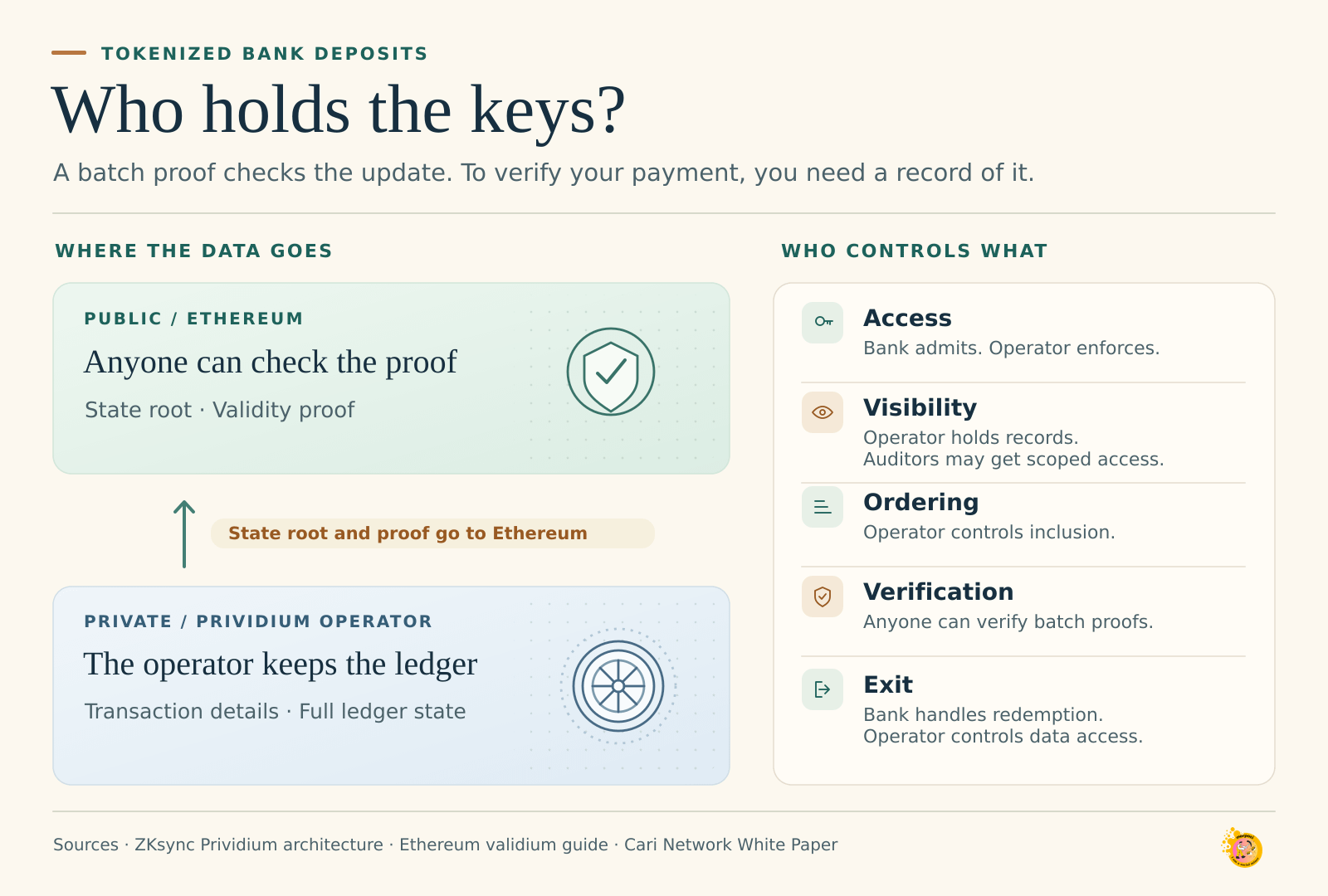
The trade-off shows up if the off-chain data becomes unavailable. As Ethereum’s validium guide explains, users may lose access to the information they need to withdraw.
One payment. Three clocks.
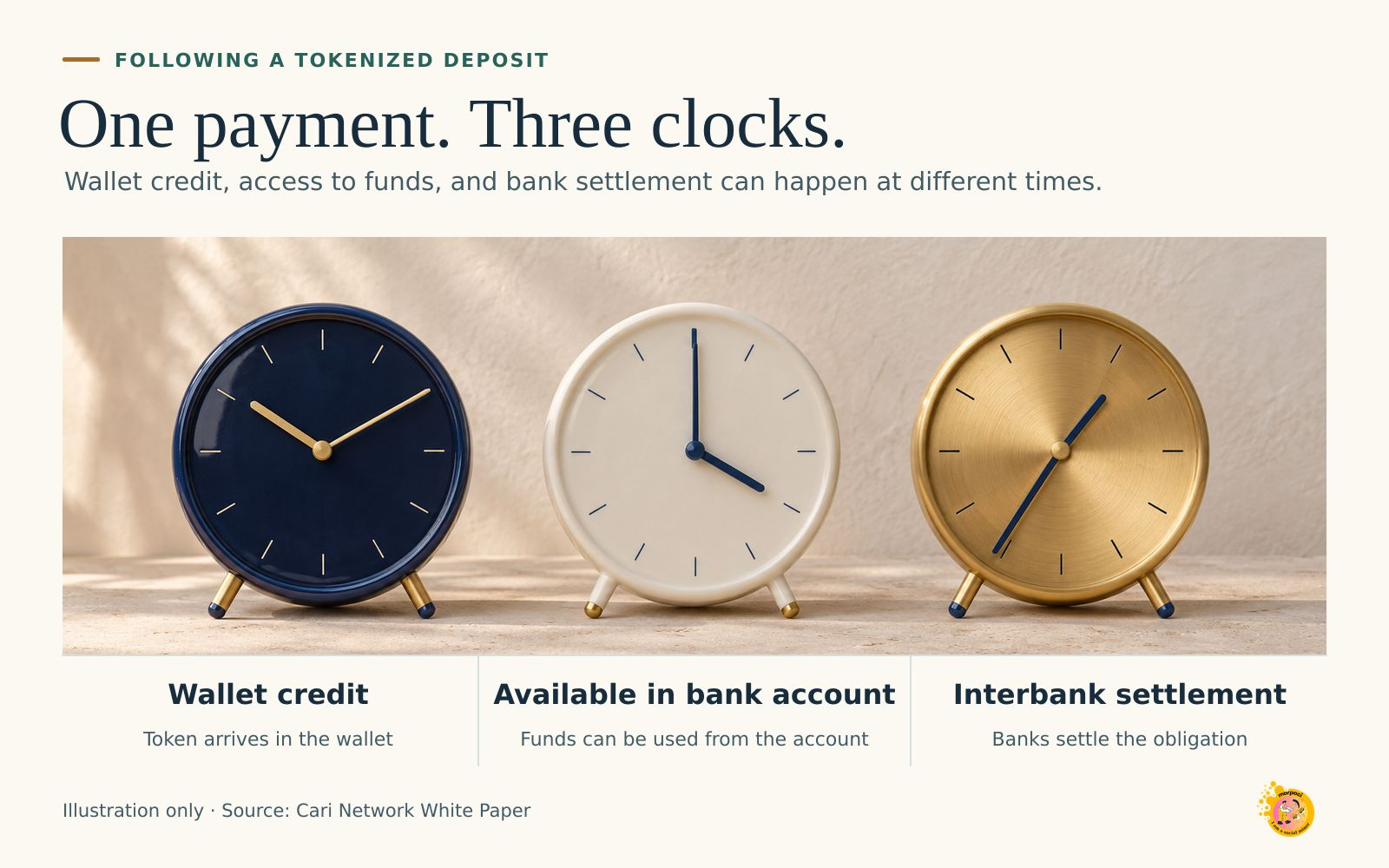
Cari’s technical paper had me reaching for three clocks.
Wallet credit. When did the token reach the supplier’s wallet?
Access to funds. When could they use the money from their regular bank account?
Interbank settlement. When did the banks settle with each other?
Cari describes those as separate steps. If the supplier has a bill to pay from their bank account on Saturday morning, they’re watching the second clock.
Deutsche Bank’s DAMA 2 blueprint uses a related approach for investment funds. Cari is trying it with bank deposits. I see a design choice that can travel across products. Keystone and The Clearing House also show how differently banks can build around it.
Which key opens which door?
My take is that a Prividium-style bank network sits closer to a traditional bank on access, ordering and exit. Ethereum gives outsiders a way to check a ledger update without seeing customer balances.
Access. Anyone can participate on public #Ethereum . In a Prividium-style network, the bank admits customers and the operator enforces permissions. In traditional banking, the bank opens the account.
Visibility. Ethereum’s on-chain records are public. The Prividium operator holds the private records and authorized auditors may get limited access. A traditional bank controls access under regulatory oversight.
Ordering. Block producers order transactions on Ethereum. The Prividium operator decides which transactions to include. A traditional bank processes instructions itself.
Verification. Anyone can inspect public Ethereum records or check a published Prividium batch proof. A Prividium customer still needs a record of their own payment to verify it. In traditional banking, the bank, auditors and regulators review records.
Exit. Ethereum users can move $ETH with their own keys. In a Prividium-style bank network, the operator controls data access and the bank handles redemption. Traditional bank customers use the bank’s payment channels.
If I sat down with KeyBank
If Cari goes offline after a payment reaches a customer’s wallet, can the bank move that money into their regular account? Through which channel, and how long would it take?
If a supplier says the money never arrived, can the customer give an independent auditor a receipt that proves the payment without exposing other transactions, even while the operator is offline?
Will Cari and Keystone support transfers between them? If a transfer stalls, which ledger shows the balance, and who fixes it?
I’d feel better if KeyBank published the results of an outage drill. How many minutes did it take the customer to access their money? What could an independent auditor verify from the receipt?
Show me both, and we’ll know which key works before the Saturday coffee goes cold.
I wrote this as part of a research task run by @DAO Labs . The analysis is my own and draws on public sources. I’m independent of the banks and technology providers covered here.