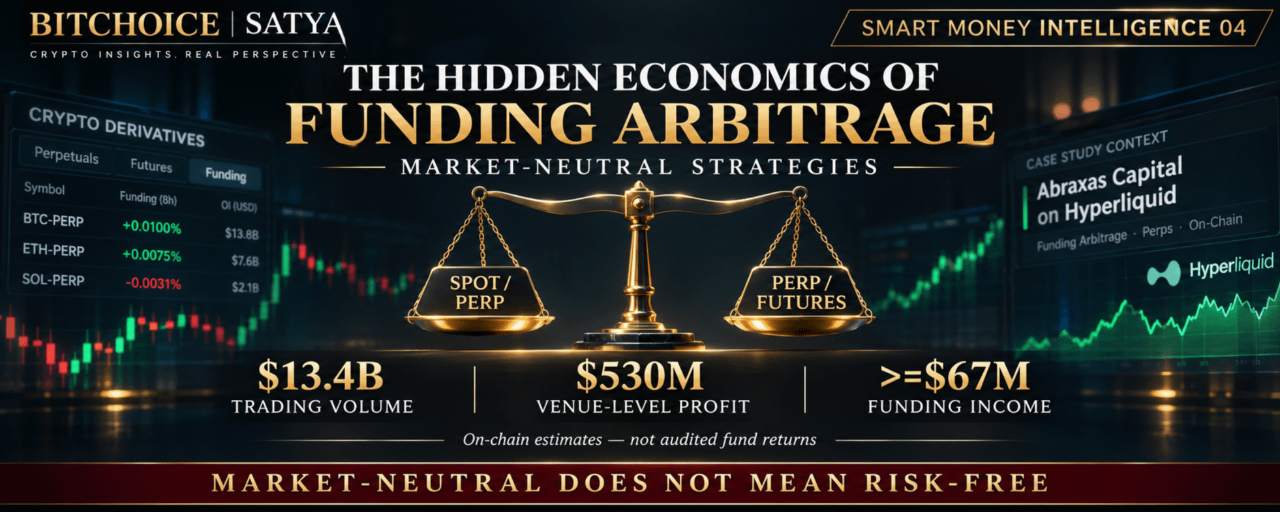

MARKET-NEUTRAL STRATEGIES: THE HIDDEN ECONOMICS OF FUNDING ARBITRAGE
How the $530 Million Abraxas Capital Case Reveals the Complexity of Institutional Crypto Trading
November 26, 2026 | BITCHOICE | SATYA
While retail traders debate whether Bitcoin has reached its bottom, institutional funds operate under a different framework: exploiting market inefficiencies rather than predicting price direction.
The recent exit of Abraxas Capital from Hyperliquid offers a compelling case study.
01 | THE $530 MILLION CASE
According to on-chain researcher MLM, Abraxas Capital closed its remaining Hyperliquid positions after nearly two years of trading.
Reported figures:
$13.4 billion in cumulative trading volume.
Approximately $530 million in platform-level profit.
At least $67 million in funding income.
These estimates reveal the scale of institutional participation in decentralized derivatives markets.
However, there is an important distinction.
The Hyperliquid portfolio represented only one component of the broader market-neutral strategy associated with the Elysium Global Arbitrage Fund.
Profits generated on Hyperliquid may have been offset by losses on other exchanges or instruments.
The reported $530 million should therefore not be interpreted as the audited net profit of the entire fund.
02 | WHAT IS MARKET-NEUTRAL ARBITRAGE?
Traditional directional trading depends on whether an asset rises or falls.
Market-neutral strategies seek to reduce this dependence by combining offsetting positions and capturing pricing inefficiencies.
These opportunities may include:
Spot versus perpetual futures.
Perpetual futures across different exchanges.
Funding rate differentials.
Futures basis and price convergence.
The objective is not necessarily to predict the next Bitcoin price movement.
It is to identify a measurable market imbalance and manage the risks associated with capturing it.
03 | THE ECONOMICS OF FUNDING ARBITRAGE
Perpetual futures use periodic funding payments to help align contract prices with their underlying markets.
When funding is positive, long positions generally pay short positions. When funding is negative, the payment direction reverses.
Funding rates can differ significantly across trading venues.
Consider a hypothetical example using comparable BTC perpetual contracts:
Exchange A:
Long exposure of $100,000.
Funding rate: +0.01%.
Exchange B:
Short exposure of $100,000.
Funding rate: +0.04%.
Assuming both rates apply to the same settlement period:
Funding paid: $10.
Funding received: $40.
Gross funding income: $30.
The opposing positions reduce directional exposure, but the funding differential is only the beginning of the calculation.
04 | GROSS INCOME IS NOT NET PROFIT
The apparent funding spread must be evaluated against the complete economics of the position.
Net PnL includes:
Gross funding income
Price convergence or divergence PnL
Trading fees
Execution slippage
Financing and borrowing costs
Operational expenses
A positive funding differential can produce a negative net result when execution costs are excessive or the relationship between contract prices deteriorates.
Funding rates can also reverse before the expected return is realized.
Institutional strategies therefore depend on continuous assessment of executable spreads, liquidity and capital efficiency.
05 | WHY FUNDING NORMALIZATION MATTERS
Different exchanges calculate and distribute funding over different intervals.
Hyperliquid, for example, settles funding hourly.
Comparing displayed funding rates without adjusting for their calculation and settlement periods can create misleading opportunities.
An institutional-grade comparison must consider:
Equivalent funding intervals.
Expected payment timing.
Available order book liquidity.
Entry and exit spreads.
Historical funding persistence.
Capital allocated across venues.
A high displayed funding rate is not automatically a high-quality arbitrage opportunity.
06 | MARKET-NEUTRAL DOES NOT MEAN RISK-FREE
Offsetting market exposure does not eliminate operational or financial risks.
Cross-exchange strategies introduce additional vulnerabilities:
Execution risk: One position may be filled before its hedge.
Basis risk: Contract prices may diverge even when the underlying asset is identical.
Liquidation risk: Margin constraints on one venue may force the closure of an otherwise hedged position.
Funding reversal: An attractive differential can disappear or change direction.
Security and counterparty risk: Infrastructure failures, compromised credentials and restricted withdrawals can disrupt the entire strategy.
The recent Lighter security incident highlights the importance of these considerations.
On November 16, Lighter attributed a security incident to a compromised trader API key. On-chain researchers suggested a possible connection to Abraxas Capital, but the identity of the affected trader and any causal link to the Hyperliquid exit remain unconfirmed.
07 | THE INSTITUTIONAL ADVANTAGE
Professional arbitrage funds compete through more than access to capital.
Their advantage comes from execution quality, risk monitoring, liquidity analysis, infrastructure reliability and disciplined capital allocation.
As decentralized derivatives markets develop, competition may increasingly shift from directional speculation toward sophisticated cross-market strategies.
However, greater competition can also compress arbitrage spreads and reduce future returns.
BITCHOICE PERSPECTIVE
The Abraxas Capital case illustrates why institutional crypto activity cannot be understood through isolated wallet balances or individual exchange profits.
A large short position does not necessarily indicate a bearish market view.
A profitable trading account does not necessarily reveal the profitability of the complete portfolio.
And a market-neutral strategy does not guarantee capital preservation.
The real edge is not simply identifying a funding differential.
It is determining whether that differential remains economically viable after execution costs, hedging requirements and operational risks.
MARKET-NEUTRAL DOES NOT MEAN RISK-FREE.
DATA OVER HYPE.
Sources:
Lookonchain and MLM on-chain estimates, November 25, 2026.
Abraxas Capital Management, Elysium Global Arbitrage Fund.
Hyperliquid official funding documentation.
The Hedge Fund Journal, Abraxas Capital Management profile.
The Block, Lighter security incident, November 17, 2026.
Illustrative calculations are educational and do not represent current funding rates or guaranteed returns.
BITCHOICE | SATYA
CRYPTO INSIGHTS. REAL PERSPECTIVE.
#Hyperliquid #AbraxasCapital #FundingArbitrage #DeFi $HYPE