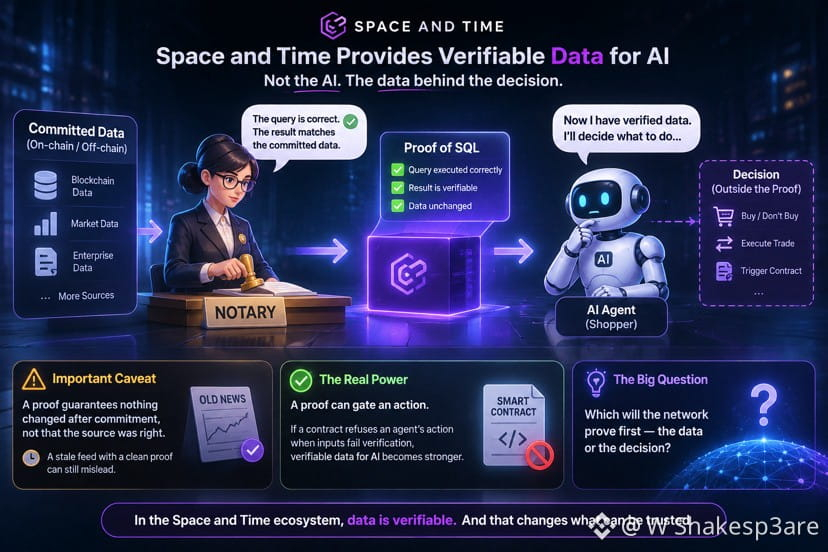
Space and Time provides verifiable data for AI. I read that line a few times before I noticed which word carries the weight. It is "data", not "AI".
Think of a notary at a shop counter. The notary checks that the receipt matches the ledger down to the last decimal. That is what Proof of SQL does: it proves a query ran correctly against committed data. The notary never asks whether the shopper should have bought anything.
An AI agent is the shopper. Space and Time can prove the query the agent sent and the result it got back. The decision, where the agent weighs that result and acts, sits outside the proof. A verified input still feeds an unverified judgment, so the sentence is true and narrower than many readers will hear.
The data side has its own edge too. A proof guarantees nothing changed after commitment, not that the source was right in the first place. A stale feed with a clean proof looks more trustworthy than it is.
That gap changes how I judge the project @SpaceandTime . If the layer stays at retrieval, it is a strong data warehouse for smart contracts, and the AI label describes where the data goes, not what gets verified. If a contract can refuse an agent's action because its inputs fail verification, verifiable data for AI becomes something stronger.
My standard: I give credit to proofs that gate an action, not proofs that decorate a report.
What I am watching next is paid query volume coming from agents, which the network analytics for fees and queries should show, and any integration where a contract will not act without a valid proof. Until one of those appears, I read the AI side as a direction, not a result.
Which will the network prove first, the data or the decision?
#sxt $SXT 🔥