

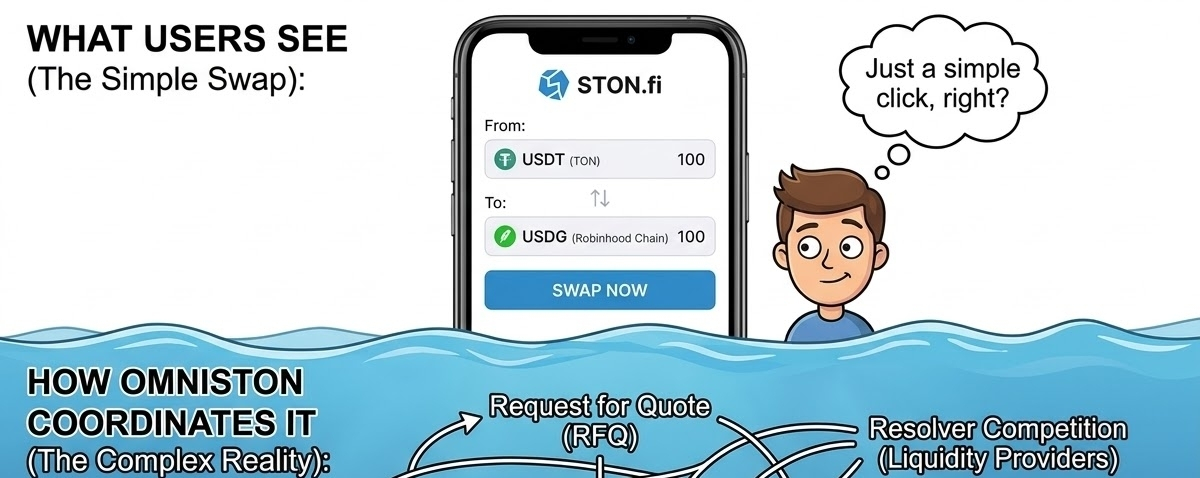

Moving assets between blockchain networks is more complicated than exchanging two tokens on the same network Each blockchain maintains its own ledger, executes its own transactions and follows its own rules.
As a result a transaction on one network does not automatically complete a corresponding transaction on another.
This is the problem cross-chain execution infrastructure aims to solve.
STON.fi addresses this challenge through Omniston a cross-chain execution layer designed to coordinate asset exchanges across supported blockchain networks.
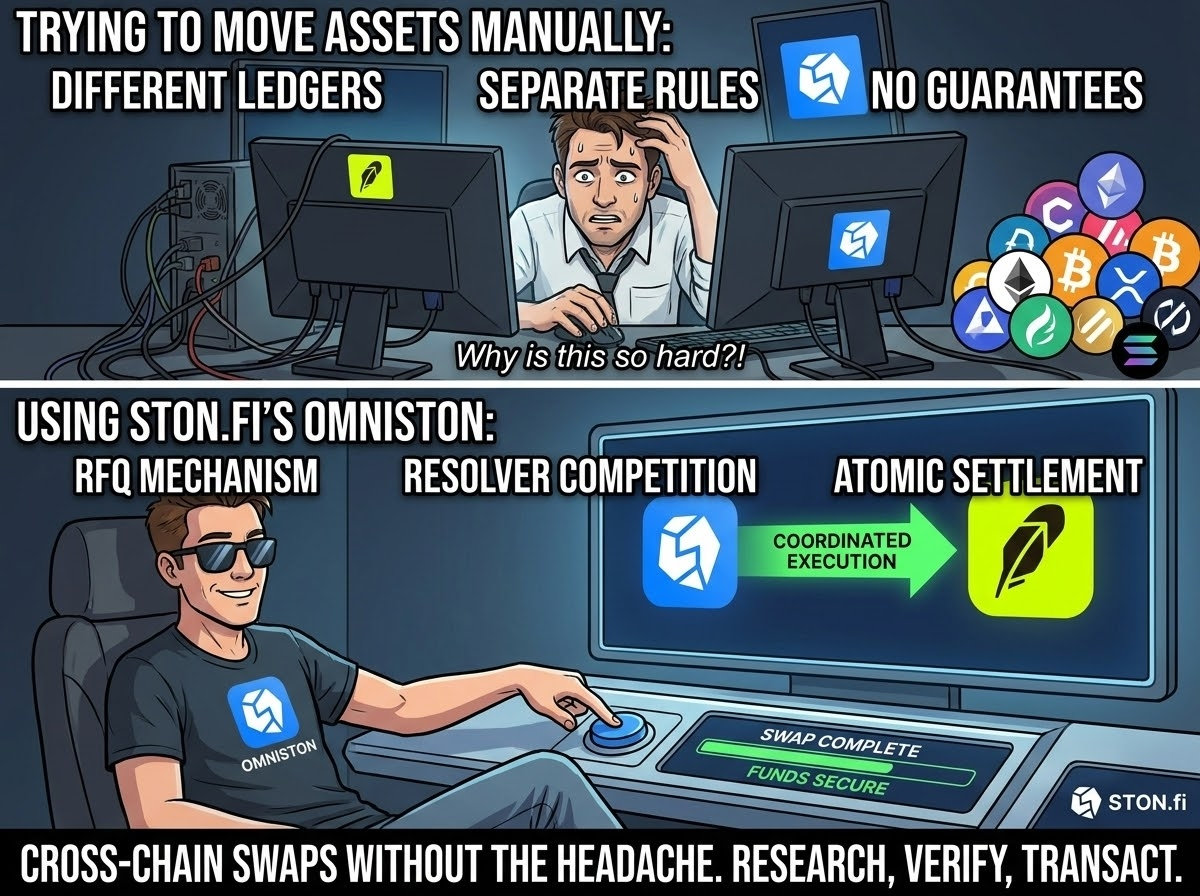
Rather than requiring users to manually coordinate separate transactions, Omniston brings together quote discovery, liquidity providers, transaction execution and settlement within a coordinated process.
Understanding how these components work together helps explain both the benefits and the risks of cross-chain swaps.
1. Request for Quote: Finding an Executable Route
The process begins when a user selects a source asset, a destination asset and the amount to exchange.
For example consider a user who wants to swap USDT on TON for USDG on Robinhood Chain.
The application requests a quote for the intended transaction.
Omniston uses a Request for Quote (RFQ) mechanism to obtain executable offers from participating liquidity providers known as resolvers.
These resolvers evaluate the requested swap and may return quotes based on their available liquidity, pricing and execution conditions.
The user can then review the available offer through the application.
This matters because the displayed price is connected to an execution proposal rather than simply being an indicative market price.
The available quotes and routes depend on participating resolvers, supported assets and current market conditions.
2. Resolver Competition: Supplying Destination Liquidity
Resolvers are independent liquidity providers that compete to execute eligible swap requests.
Each resolver determines the price and conditions it can offer based on factors such as its inventory, operational costs and the requested asset pair for a cross-chain transaction a resolver can provide the destination-side assets needed to fulfill the order.
This means the application does not necessarily need to maintain its own inventory of every supported asset across every blockchain.
Instead destination liquidity can be supplied by participating resolvers when a suitable order becomes available.
Competition among resolvers can improve pricing and execution options, although the best available offer depends on the actual quotes received.
A route may also be unavailable if no resolver is willing or able to execute it under acceptable conditions.
3. Execution Coordination: Linking Transactions Across Networks
Finding a quote is only one part of the process. The transaction must also be executed across the source and destination networks.
STON.fi describes Omniston's cross-chain settlement architecture using linked Hashed Timelock Contracts (HTLCs).
An HTLC is a smart contract mechanism that combines a cryptographic condition with a time limit.
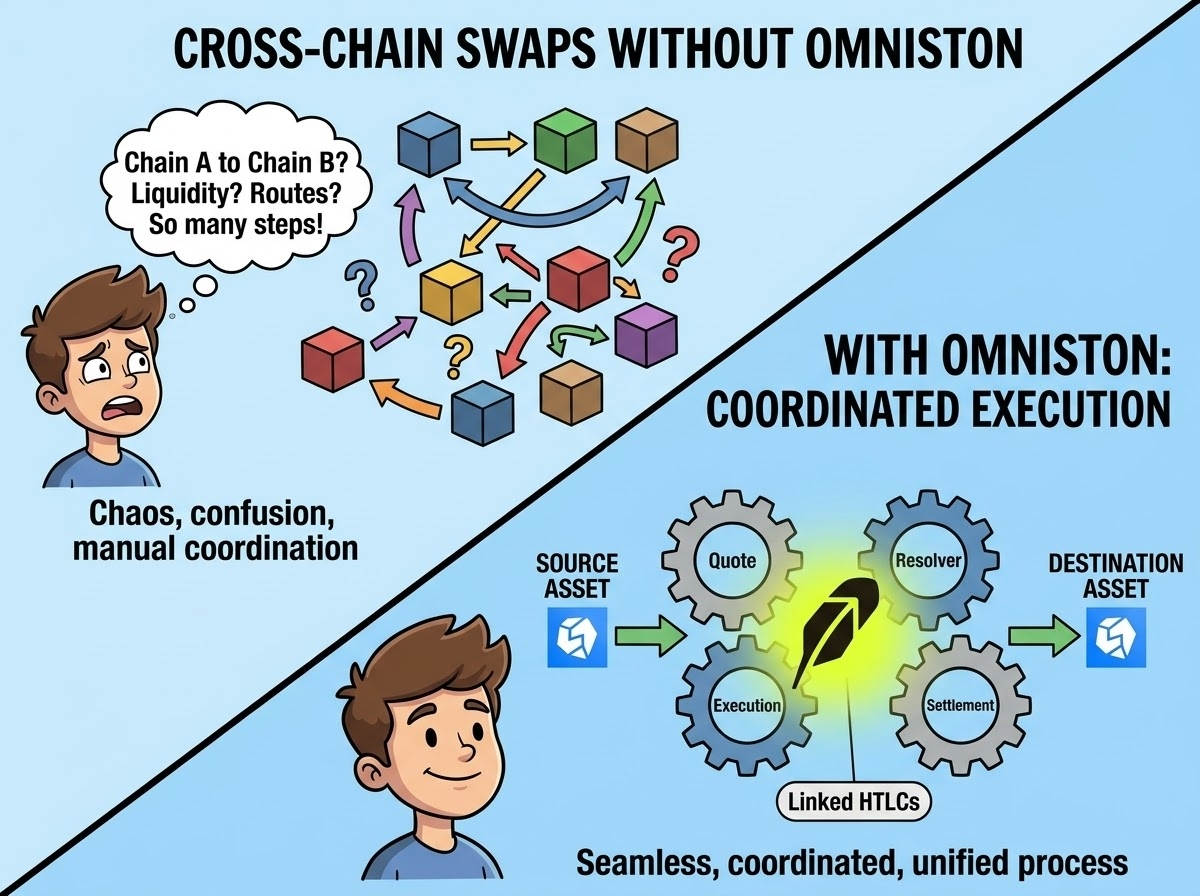
In simplified terms the contracts establish conditions under which the parties can claim their respective assets.
For a supported cross-chain swap the process can involve two linked contracts:
- A source-side contract associated with the user's asset.
- A destination-side contract associated with the resolver's asset.
Both contracts use a shared cryptographic hash condition and compatible time limits.
This links the two sides of the exchange without requiring the blockchains to share a single ledger.
The contracts enforce the specified settlement conditions on their respective networks.
The important distinction: Omniston coordinates the exchange while the underlying blockchain transactions and smart contracts enforce the relevant execution and settlement conditions.
4. Atomic Settlement: What Happens When the Swap Completes?
Atomic settlement is central to Omniston's described cross-chain design.
In this context atomicity means that the exchange is structured around linked conditions so the intended asset transfer can complete on both sides or the relevant locked assets can become refundable.
The process uses a cryptographic secret whose hash is incorporated into the linked contracts.
When the required secret is revealed and the contractual conditions are satisfied, it enables the corresponding claims.
The user can claim the destination asset, while the resolver can use the revealed secret to claim the source asset.
The shared cryptographic condition connects the two claims.
If the required settlement condition is not met within the relevant time window, the contracts provide a refund path according to their rules.
This design is intended to reduce the risk of a swap leaving one party having delivered assets without receiving the agreed counter-asset.
However atomic settlement should not be interpreted as a guarantee against every possible loss. Smart-contract vulnerabilities, implementation errors, network disruptions and other technical risks can still matter.
Users should understand the protocol's actual implementation and transaction status rather than relying on the word "atomic" alone.
5. A Practical Example: USDT on TON to USDG on Robinhood Chain
Consider a user holding USDT on TON who wants to receive USDG on Robinhood Chain.
The intended workflow illustrates how the different components fit together.
Step 1: Select the assets.
The user chooses USDT on TON as the source and USDG on Robinhood Chain as the destination provided the exact route is supported by the live application.
Step 2: Request a quote.
The application requests an executable offer for the selected assets and amount.
Step 3: Review the offer.
The user examines the expected receiving amount, applicable fees and execution conditions before authorizing the transaction.
Step 4: Coordinate execution.
If the user proceeds and the route is accepted the relevant execution process coordinates the source and destination sides according to the protocol's settlement mechanism.
Step 5: Complete or recover.
If the swap settles successfully the user receives the destination asset under the agreed conditions. If execution does not complete, the protocol's applicable refund mechanism determines how locked assets can be recovered.
The precise workflow depends on the selected route and implementation.
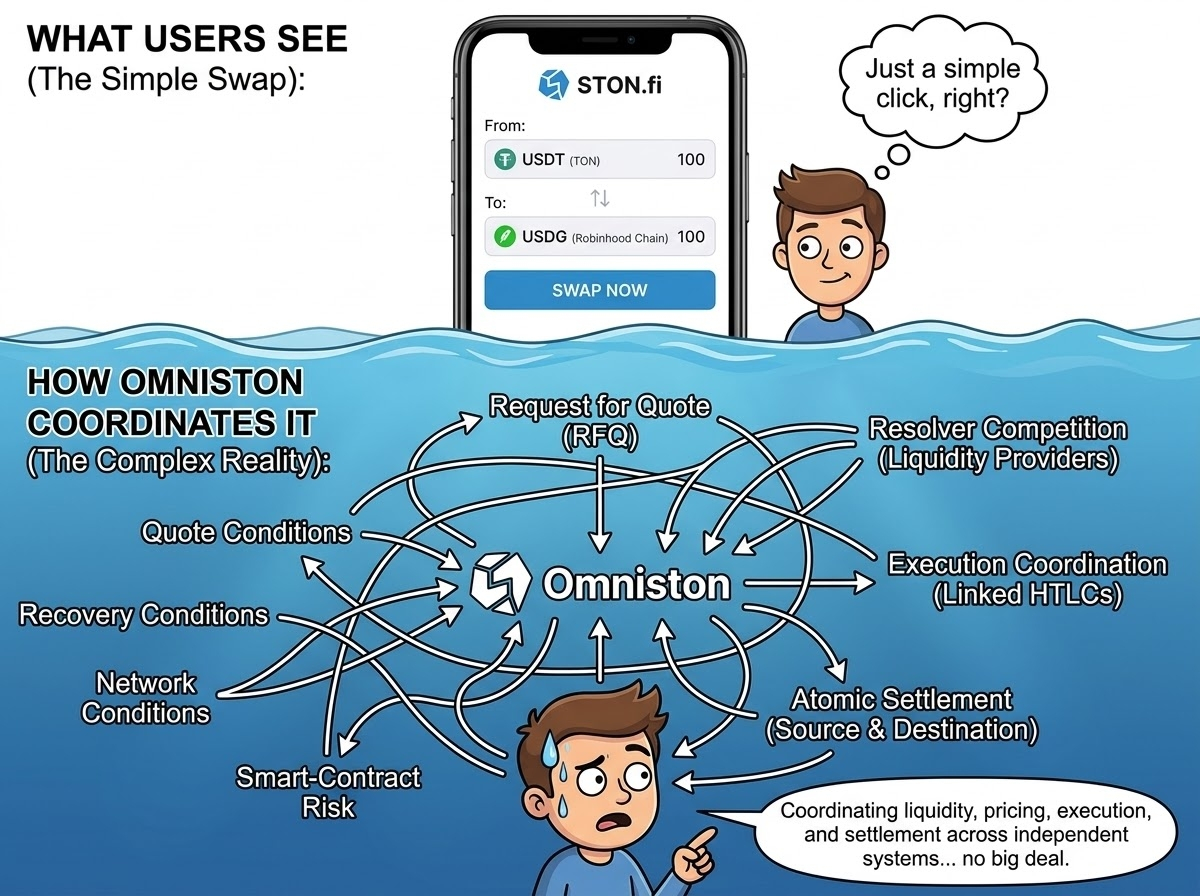
The USDT-to-USDG example is illustrative: users must verify that this specific asset pair is currently available in the live STON.fi interface before attempting the swap.
6. Why This Architecture Matters
Omniston's approach separates several responsibilities that are often handled by different systems.
Quote discovery helps identify available execution offers.
Resolver competition brings liquidity providers into the process.
Execution coordination connects the transaction's source and destination sides.
Smart-contract settlement enforces the conditions under which assets can be claimed or refunded.
Combining these functions can simplify the experience for users and reduce the need for applications to build separate infrastructure for every supported route.
It can also help integrators offer cross-chain functionality without independently maintaining destination-side liquidity for every transaction.
The benefit depends on actual route support, resolver participation and the reliability of the underlying contracts.
7. Risks and Limitations
Although Omniston is designed to coordinate cross-chain execution users should still understand the risks.
Liquidity and pricing: Resolver competition does not guarantee the best possible market price in every situation. Available offers depend on participating providers and current conditions.
Route availability: Not every asset pair or network combination is necessarily supported. A route may be unavailable when liquidity or execution capacity is insufficient.
Smart-contract risk: Linked contracts can reduce certain settlement risks, but they do not eliminate vulnerabilities or implementation failures.
Network conditions: Congestion, outages, and transaction delays can affect execution and the time required to resolve an incomplete swap.
Quote conditions: Users should review the actual quote, fees and applicable execution conditions before signing.
Recovery conditions: Refunds depend on the contract's rules, time limits and the state of the transaction.
Users should understand these conditions instead of assuming that every failure results in an immediate refund.
Understanding these limitations is essential when evaluating any cross-chain execution system.
Omniston coordinates cross-chain swaps by bringing together quote discovery, resolver-provided liquidity, execution coordination and smart-contract settlement.
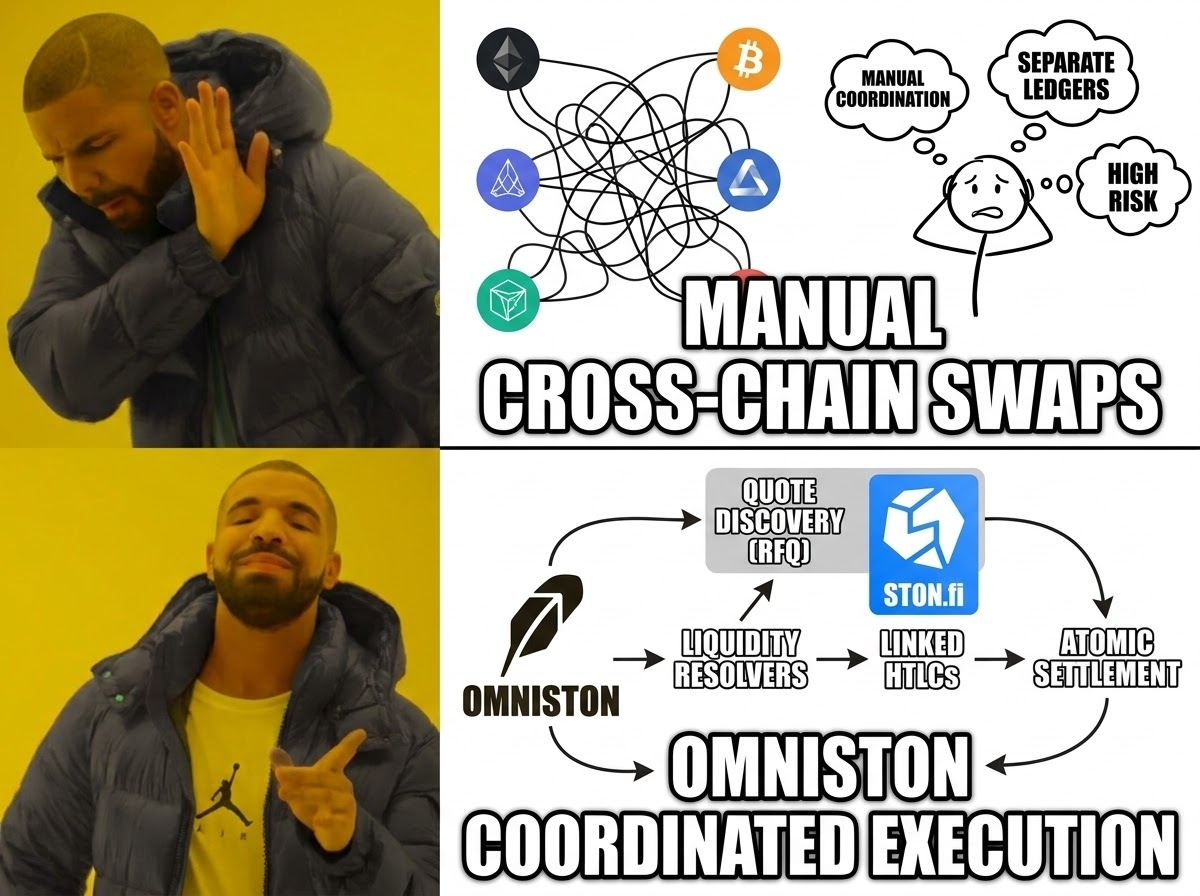
Its RFQ mechanism allows participating resolvers to propose executable offers. Its cross-chain architecture uses linked HTLCs to establish conditions for settlement or recovery on the participating networks for users the objective is straightforward: exchange an asset on one supported blockchain for an asset on another without manually coordinating every underlying operation for developers the architecture provides a way to integrate cross-chain execution without independently building every component of the routing and settlement process.
The broader lesson is that cross-chain infrastructure involves more than moving tokens between networks. It requires coordinating liquidity, pricing, transaction execution and recovery conditions across systems that operate independently.
Explore more on: https://ston.fi/cross-chain-swap-from-ton-to-base
Research the mechanism.
Verify the route.
Understand the risks before you transact.
Official resources:
Omniston's "cross-chain execution overview" (https://ston.fi/omniston)
STON.fi's "Omniston technical documentation" (https://docs.ston.fi/developer-section/omniston)
STON.fi's "explanation of cross-chain execution" (https://blog.ston.fi/omniston-explained-how-cross-chain-swaps-on-ton-work-without-a-bridge/)