

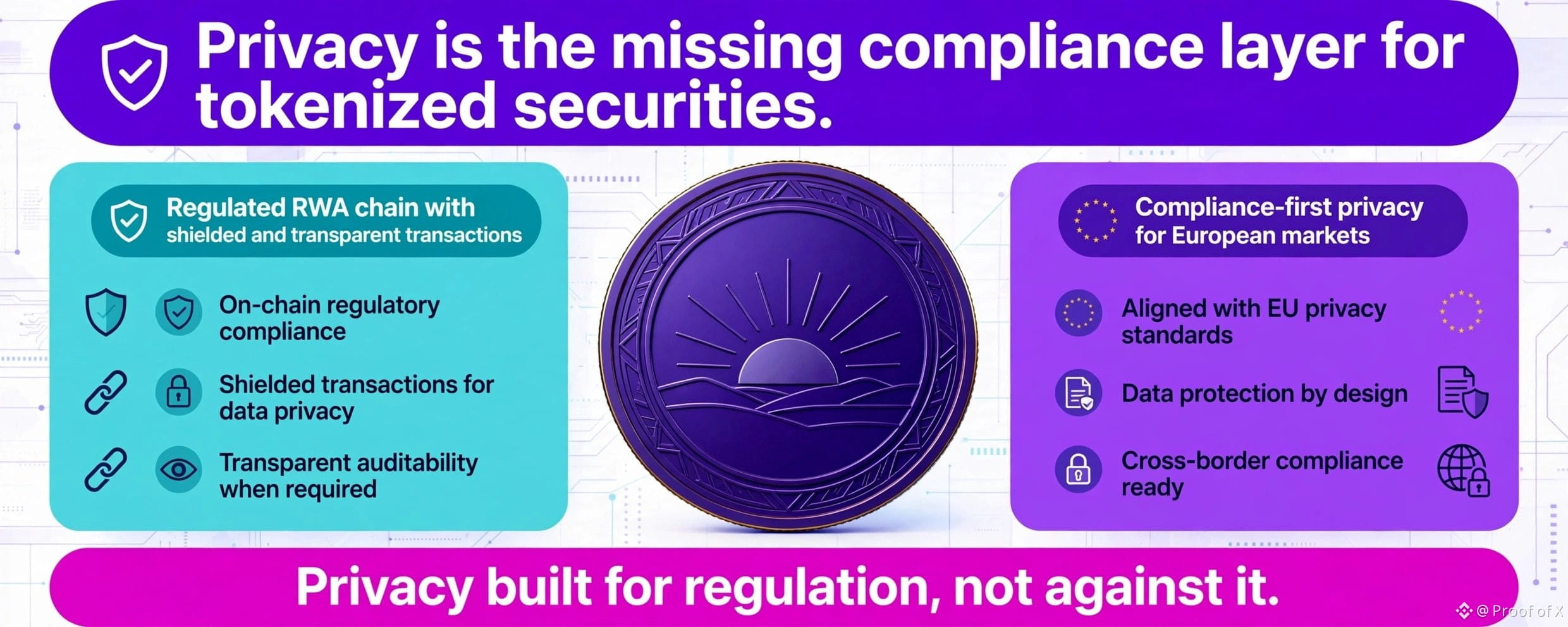
Tokenized securities keep running into the same wall: public ledgers expose every position, and private ledgers cannot prove compliance.
BUSINESS
$DUSK is the native token of Dusk, a public permissionless layer-1 blockchain built for regulated financial markets.
The network is designed for the native issuance, trading, and settlement of real-world assets such as digital securities.
Its pitch is that institutions need transaction privacy and regulatory auditability at the same time, and that neither a transparent ledger nor a fully anonymous one delivers both.
$DUSK pays for gas, secures the network through staking, and governs protocol decisions.
Partnerships anchor the go-to-market: NPEX, a Dutch exchange operating under a regulated-market license, works with Dusk on tokenized securities, and 21X is listed as a partner on the official site.
A further product is Dusk Domains, a domain service scheduled to launch on mainnet by October 18, 2026, with domain trading settled through $DUSK escrow.
Dusk Vault is the custody product aimed at institutions holding assets on the network.
TECHNOLOGY
Dusk runs a proof-of-stake consensus with privacy-preserving smart contracts built on zero-knowledge proofs.
Transactions come in two models: Phoenix, a shielded note-based model that hides sender, receiver, and amount, and Moonlight, a transparent account-based model for transactions that need to be visible.
Selective disclosure lets a recipient cryptographically prove payment details to an auditor without publishing them to everyone.
DuskEVM is the execution layer that brings Solidity applications to Dusk, so developers can reuse familiar tooling while adding privacy and compliance features.
The mainnet has been live since early 2025, after roughly six years of development.
SECTOR
Tokenized real-world assets are the sector where Dusk competes: securities, bonds, and funds moving onto ledgers that regulators can accept.
The binding constraint in that sector is not throughput, it is compliance: issuers need confidentiality for positions and audit trails for regulators.
Dusk targets the European rulebook directly, building for MiCA, MiFID II, and the DLT Pilot Regime.
That positioning is the opposite of the privacy-coin stereotype: privacy here is framed as a regulatory feature, not an escape from regulation.
COMPETITION
$ZEC offers optional shielded transactions on a general-purpose chain, while $XMR makes privacy the default for every transaction.
Neither competitor is built around regulated securities issuance, and neither offers Dusk-style selective disclosure wired into a compliance-first ledger.
The trade-off cuts the other way too: both competitors have been live far longer, and Dusk must still prove that its narrower institutional niche can generate real volume.
TOKENOMICS
Market capitalization stands near 60.9 million dollars, with a fully diluted valuation near 61.0 million dollars, per CoinGecko.
Circulating supply is about 608.9 million $DUSK against a maximum supply of 1.0 billion, so roughly 60.9 percent of the maximum supply is already circulating.
The remaining roughly 391 million tokens sit outside circulating supply.
No unlock schedule is stated here because none was verifiable from a cited source this run.
ON-CHAIN & FUNDAMENTALS
No verifiable on-chain data found this run.
The public explorer returned an access error during this run, and no staking, fee, or active-address figures could be verified.
TEAM & FUNDING
Dusk Network was founded in Amsterdam in 2018 by Emanuele Francioni and Fulvio Venturelli, together with business co-founders including Jelle Pol, Pascal Putman, and Mels Dees.
Francioni serves as founder and chief executive, and Venturelli as co-founder and director.
The company raised about 7.4 million euros in 2018, in a round led by investors including Blockwall, Maven 11, Olymp Capital, and the Wentworth Hall Family Office.
The project later secured more than 840,000 euros in 2020 to develop its blockchain technology for financial services.
RISKS
The largest risk is adoption: partnerships with regulated venues are announced, but publicly demonstrated institutional transaction volume on the network is still thin.
Roughly 391 million $DUSK of headroom between circulating and maximum supply is a long-term supply overhang.
DuskEVM is still maturing, so the developer funnel it promises is not yet proven.
Privacy features remain a regulatory lightning rod: even compliance-first privacy can face exchange delistings and shifting rules in some jurisdictions.
The token trades about 91 percent below its all-time high of 1.09 dollars from December 2021, per CoinGecko.
A small market capitalization near 61 million dollars also means thinner liquidity and sharper moves in both directions.
Not financial advice. DYOR.
$DUSK