


AI agents have stepped out of the chat box and into the corridors of the workplace.
They no longer simply answer questions. They sort emails, schedule meetings, conduct research, access files, and perform real actions across company tools. In short, they are evolving from software we talk to into digital colleagues capable of opening doors on our behalf.
But we would never hand an employee every key in the company and say, “They seem pretty smart. Hopefully, they open the right door.” With AI agents, focusing only on the quality of their decisions is no longer enough.
Who stands at the door between a decision and an action?
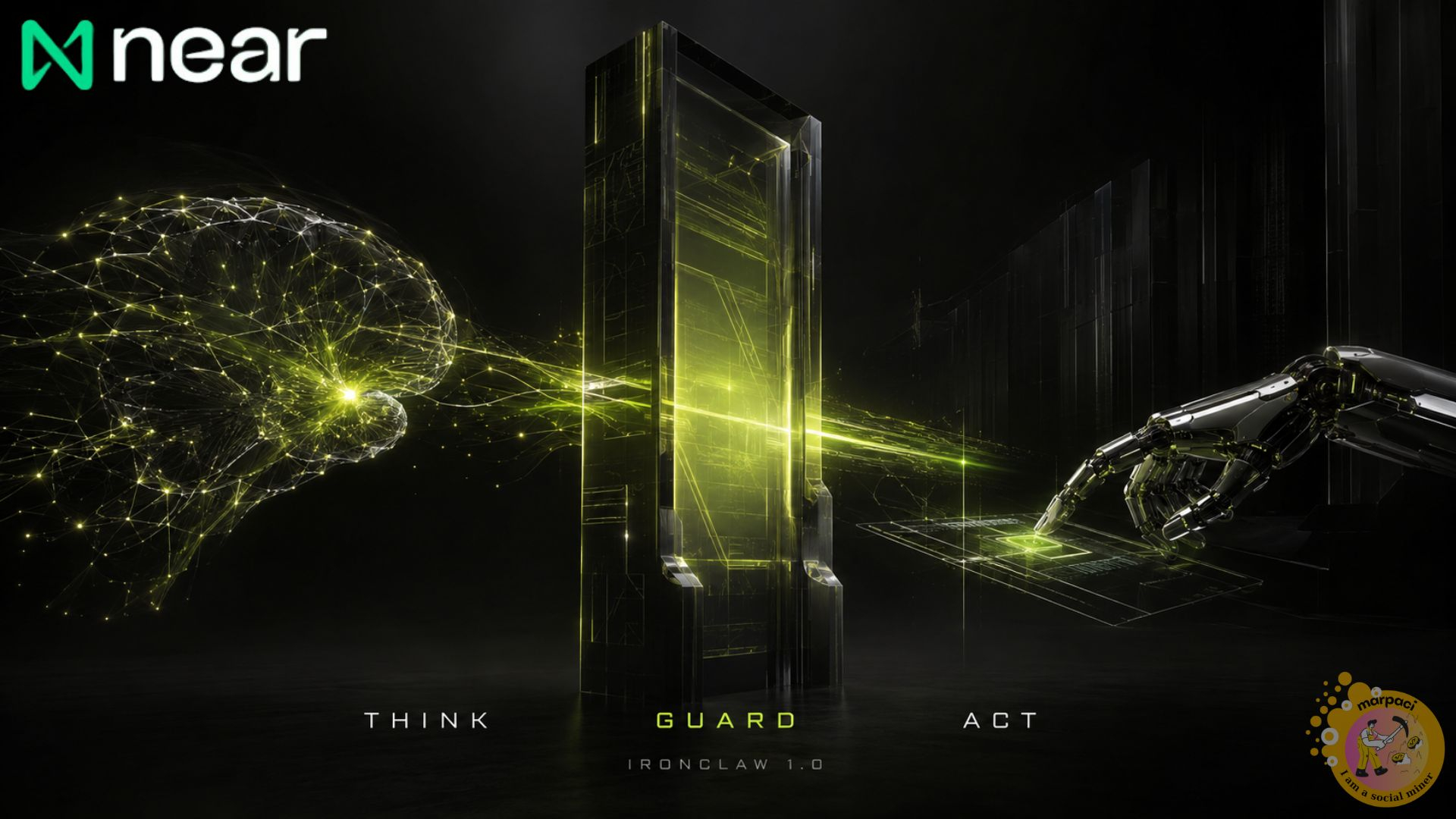
Open-source #ironclaw 1.0 , developed within @NEAR Protocol ’s #NEARAI vision, offers an architectural answer to that question. The component that makes decisions is separated from the component that acts on them in the outside world. Between the two sits a shared coordination layer called the “guard,” through which every action must pass.
🛂 The Guard at the Agent’s Security Gate
Think of the guard layer as the smart security gate of a corporate building. It is less concerned with what is being thought inside and more concerned with which permission is being used, which door someone is trying to enter, and why.
IronClaw can read an email, edit a file, or research something online. On the security side, however, three important rules come into play:
Sensitive actions require explicit user approval first.
Passwords and access tokens are single-use by default.
Once used, those secrets are scrubbed from logs, error messages, and reports.
This separation matters. When “thinking” and “doing” are tied into the same knot inside an AI agent, every new capability pulls that knot a little tighter. Eventually, you may end up with a highly capable colleague whose pockets contain plenty of keys, but no one is quite sure which key opens which door.
📊 Does Safety Put the Brakes on Performance
We often assume that more control means slower execution. IronClaw 1.0’s benchmark results suggest that fastening a seat belt does not necessarily slow down the car.
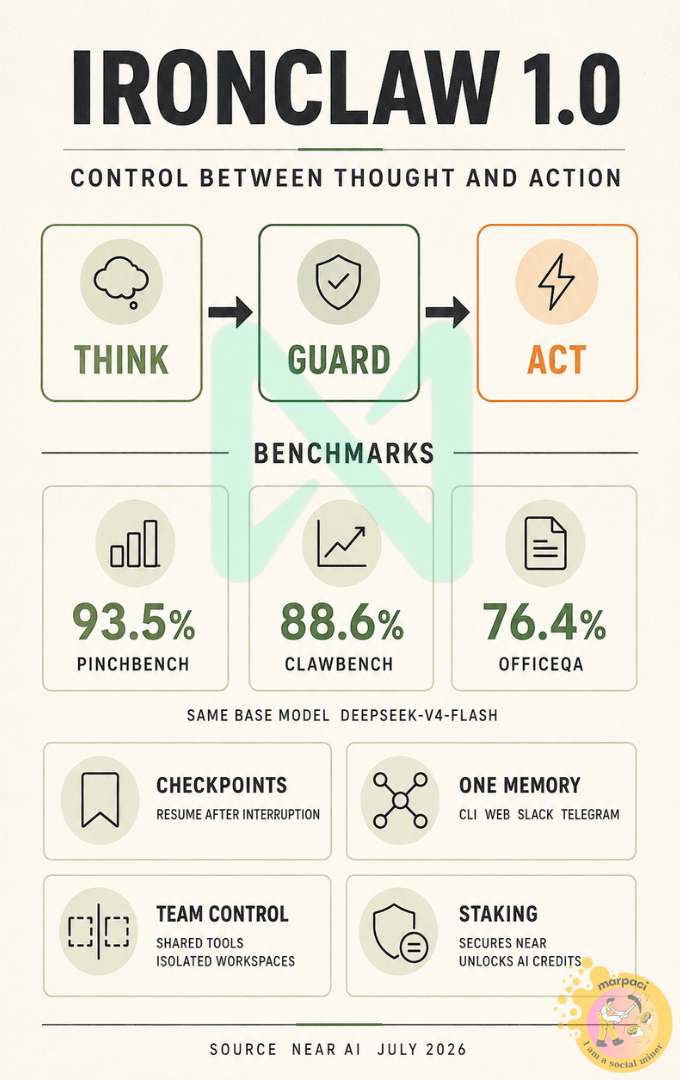
In the evaluations published by NEAR AI, every agent harness used the same base model, deepseek-v4-flash. IronClaw achieved the following results across three benchmarks:
PinchBench: 93.5%
ClawBench: 88.6%
OfficeQA: 76.4%
PinchBench measures performance across 147 real-world tasks, including meeting scheduling, email management, coding, research, and file operations. ClawBench tests agents on multi-step tasks across more than 140 live websites. OfficeQA evaluates information retrieval and reasoning across a collection of approximately 89,000 pages of enterprise documents.
The most interesting detail here is not only the scores, but the fact that every system raced with the same engine. Since the base model remained unchanged, the difference comes less from engine size and more from how the steering, brakes, and gearbox work together.
💾 No Starting Over When Work Is Interrupted
IronClaw continuously saves task progress through checkpoints. Think of them as save points from old video games adapted to corporate life. If the agent pauses for user permission or the system restarts, it does not forget the entire task and send you back to the first level. It resumes where it stopped.
In a business environment, this does more than save a few minutes. It also reduces the errors, repetition, and context loss caused by recreating unfinished work. Explaining the same task for the third time on a Monday morning is tiring enough with people; there is little reason to repeat the experience with software.
The same memory is preserved across CLI, web, Slack, and Telegram. Changing channels does not introduce you to a new intern on their first day every time. You continue speaking with the same agent, one that remembers your preferences, previous decisions, and security rules.
🧩 Team Memory Does Not Mean Opening Every Drawer
IronClaw’s team architecture addresses two different needs at the same time:
In a multi-tenant deployment, tools and skills developed by one person can be shared across the organization. The same workflow does not have to be rediscovered from scratch by every employee.
Individual workspaces are not visible to administrators by default.
A single-tenant deployment gives organizations with stricter data boundaries a fully isolated environment with no external access.
Building a shared organizational memory, therefore, does not mean opening every desk drawer for everyone to inspect.
🔐 Where NEAR AI and Staking Fit In
IronClaw is not a standalone product. NEAR AI is developing a broader infrastructure in which agents, models, and sensitive data can operate inside Trusted Execution Environments, supported by hardware-backed privacy and verifiability. This architecture is part of #Near Protocol’s vision for a more open and decentralized future in which AI systems belong to their users rather than closed platforms.
Staking plays two connected roles in this picture:
At the protocol level, users delegate $NEAR to validators, providing economic security to the Proof-of-Stake network.
On the NEAR AI side, staked NEAR can provide access to confidential inference and IronClaw hosting credits. Agent hosting credits are determined by the amount staked, while confidential inference credits are generated from staking yield.
Users retain ownership of their principal, allowing their capital to support AI services without being sold.
For that reason, treating staking as nothing more than a passive yield faucet misses part of the picture. Here, capital acts like a circuit panel connecting network security and AI usage to the same system. On one side, it helps secure the network economically. On the other, it supports wallet-based access to user-focused AI infrastructure that agents such as IronClaw and OpenClaw can use.
The competition between AI agents will not be won solely by whoever has the largest model. The systems that coordinate decisions, permissions, memory, privacy, and economic infrastructure most effectively will stand out.
That is the powerful idea behind IronClaw 1.0: before making the agent’s brain a little bigger, redesign which doors the keys in its hands are allowed to open.
In your view, will the main bottleneck for enterprise AI agents be model intelligence, or turning that intelligence into safe action?