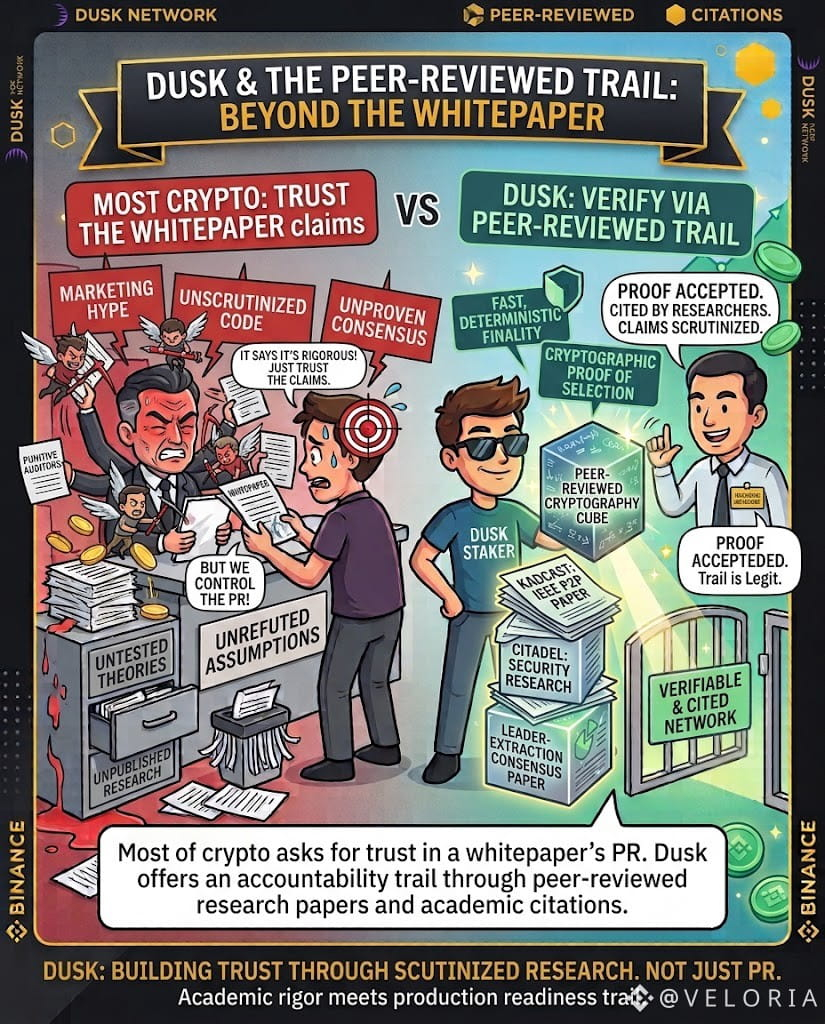

#dusk $DUSK @Dusk Really,... what caught me off guard was realizing how much of Dusk's technology exists as actual peer-reviewed research, not just whitepaper claims dressed up to sound rigorous.
Kadcast, the networking protocol Dusk uses for block propagation, isn't just a feature Dusk marketing invented — it's a paper that went through academic review, built on Kademlia's structured overlay work from the early 2000s peer-to-peer literature. Citadel, their identity system, shows up the same way, referenced in security research alongside other privacy-preserving credential systems.
That distinction matters more than it sounds like it should. Most crypto projects write a whitepaper, call it research, and never submit anything to a process where other cryptographers can actually poke holes in it before it ships. Dusk's core pieces went through something closer to the peer-review path — publish, get scrutinized, get cited by researchers working on unrelated systems.
What that enables is a kind of accountability that marketing can't fake. When someone else's paper on privacy-preserving blockchains cites Dusk's leader-extraction consensus as a comparison point, that's not a partnership announcement — that's the research community treating the work as real enough to reference.
The flip side is that academic rigor and production readiness aren't the same thing. A protocol proven sound on paper can still fail under real network conditions, adversarial actors, or the specific mess of running alongside a live financial settlement system.
But there's something reassuring in a project whose foundational claims exist outside the company's own PR, in venues where the authors don't control the review. Most of crypto asks you to trust the whitepaper. Dusk gives you a paper trail instead.
Kadcast, the networking protocol Dusk uses for block propagation, isn't just a feature Dusk marketing invented — it's a paper that went through academic review, built on Kademlia's structured overlay work from the early 2000s peer-to-peer literature. Citadel, their identity system, shows up the same way, referenced in security research alongside other privacy-preserving credential systems.
That distinction matters more than it sounds like it should. Most crypto projects write a whitepaper, call it research, and never submit anything to a process where other cryptographers can actually poke holes in it before it ships. Dusk's core pieces went through something closer to the peer-review path — publish, get scrutinized, get cited by researchers working on unrelated systems.
What that enables is a kind of accountability that marketing can't fake. When someone else's paper on privacy-preserving blockchains cites Dusk's leader-extraction consensus as a comparison point, that's not a partnership announcement — that's the research community treating the work as real enough to reference.
The flip side is that academic rigor and production readiness aren't the same thing. A protocol proven sound on paper can still fail under real network conditions, adversarial actors, or the specific mess of running alongside a live financial settlement system.
But there's something reassuring in a project whose foundational claims exist outside the company's own PR, in venues where the authors don't control the review. Most of crypto asks you to trust the whitepaper. Dusk gives you a paper trail instead.