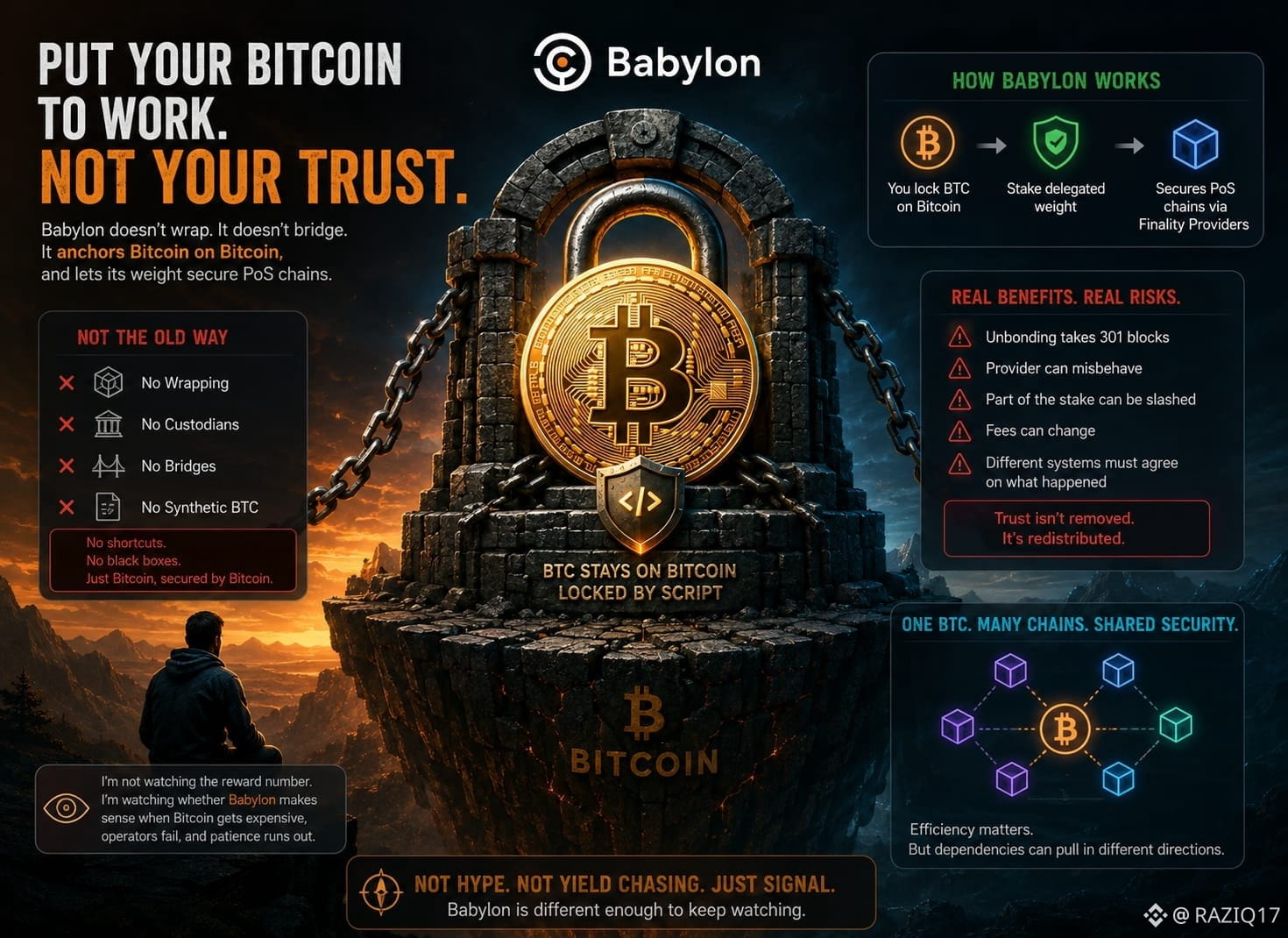
I'm noticing Babylon more than I expected because “put your Bitcoin to work” now makes me suspicious. I've heard it before. Usually it means wrapping BTC, trusting a custodian, or crossing a bridge people believe in until the day they can't.
Babylon doesn't take that shortcut. The BTC stays on Bitcoin, locked by script, while its delegated weight helps a finality provider secure a PoS chain. That catches my attention, not because risk disappears, but because something real sits behind it instead of a synthetic copy.
Still, I keep noticing the friction inside “self-custodial staking.” You keep the keys, but lose immediate access. Unbonding takes 301 blocks. A provider can misbehave, part of the stake can be slashed, fees can climb, and different systems must agree on what happened. Crypto loves saying trust was removed when it was only cut into smaller pieces.
I've seen good designs collapse under bad incentives. If rewards bring people in, security becomes a story told after the yield. Using one BTC position across several networks sounds efficient, until one dependency starts pulling on the others.
I don't fully trust $BABY yet. Maybe I'm not supposed to. But something about this feels different enough to keep on a late-night tab. I'm not watching the reward number. I'm watching whether Babylon makes sense when Bitcoin gets expensive, operators fail, and patience runs out.
#baby @BabylonLabs_io
Babylon doesn't take that shortcut. The BTC stays on Bitcoin, locked by script, while its delegated weight helps a finality provider secure a PoS chain. That catches my attention, not because risk disappears, but because something real sits behind it instead of a synthetic copy.
Still, I keep noticing the friction inside “self-custodial staking.” You keep the keys, but lose immediate access. Unbonding takes 301 blocks. A provider can misbehave, part of the stake can be slashed, fees can climb, and different systems must agree on what happened. Crypto loves saying trust was removed when it was only cut into smaller pieces.
I've seen good designs collapse under bad incentives. If rewards bring people in, security becomes a story told after the yield. Using one BTC position across several networks sounds efficient, until one dependency starts pulling on the others.
I don't fully trust $BABY yet. Maybe I'm not supposed to. But something about this feels different enough to keep on a late-night tab. I'm not watching the reward number. I'm watching whether Babylon makes sense when Bitcoin gets expensive, operators fail, and patience runs out.
#baby @BabylonLabs_io