

#whenwillbtcrebound
whenwillbtcrebound
7.4M views
51,048 සාකච්ඡා කරමින්
උණුසුම්
නවතම

·
--
උසබ තත්ත්වය
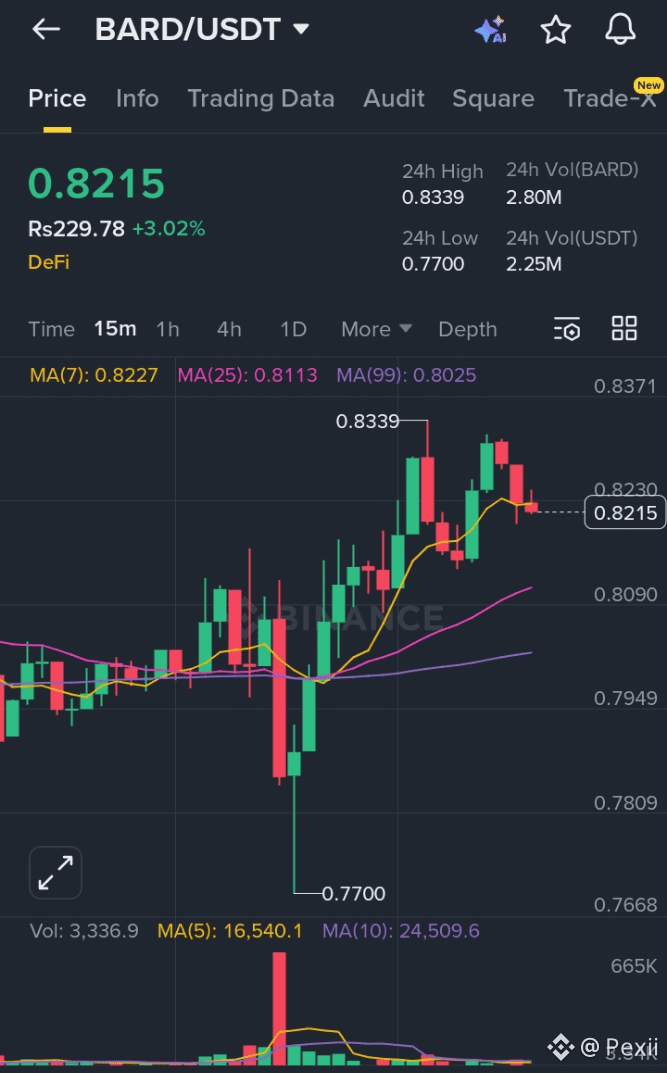
$BARD USDT — 15M Liquidity Sweep → Reclaim (BULLISH)
BARD wicked down to 0.7700, trapped sellers, then snapped back and pushed to 0.8339. Now it’s cooling off above the MA stack (MA7 0.8227 / MA25 0.8113 / MA99 0.8025) — classic continuation structure if support holds.
EP (Entry): 0.815 – 0.823 (retest buy zone)
TP:
TP1: 0.8339
TP2: 0.8450
TP3: 0.8650
SI (Invalidation): 0.804 (lose MA99 + breakdown under base)
Plan: Hold above 0.811 = bulls keep control. Break & hold over 0.834 = next leg ignites.
Let’s go!
(Not financial advice — manage risk.)
{future}(BARDUSDT)
#WhenWillBTCRebound #JPMorganSaysBTCOverGold #USIranStandoff #GoldSilverRally #WhaleDeRiskETH
$BARD USDT — 15M Liquidity Sweep → Reclaim (BULLISH)
BARD wicked down to 0.7700, trapped sellers, then snapped back and pushed to 0.8339. Now it’s cooling off above the MA stack (MA7 0.8227 / MA25 0.8113 / MA99 0.8025) — classic continuation structure if support holds.
EP (Entry): 0.815 – 0.823 (retest buy zone)
TP:
TP1: 0.8339
TP2: 0.8450
TP3: 0.8650
SI (Invalidation): 0.804 (lose MA99 + breakdown under base)
Plan: Hold above 0.811 = bulls keep control. Break & hold over 0.834 = next leg ignites.
Let’s go!
(Not financial advice — manage risk.)
#WhenWillBTCRebound #JPMorganSaysBTCOverGold #USIranStandoff #GoldSilverRally #WhaleDeRiskETH
BARD wicked down to 0.7700, trapped sellers, then snapped back and pushed to 0.8339. Now it’s cooling off above the MA stack (MA7 0.8227 / MA25 0.8113 / MA99 0.8025) — classic continuation structure if support holds.
EP (Entry): 0.815 – 0.823 (retest buy zone)
TP:
TP1: 0.8339
TP2: 0.8450
TP3: 0.8650
SI (Invalidation): 0.804 (lose MA99 + breakdown under base)
Plan: Hold above 0.811 = bulls keep control. Break & hold over 0.834 = next leg ignites.
Let’s go!
(Not financial advice — manage risk.)
#WhenWillBTCRebound #JPMorganSaysBTCOverGold #USIranStandoff #GoldSilverRally #WhaleDeRiskETH
2
127

·
--
බෙයාරිෂ්
1
27


·
--

ලිපිය
Bitcoin Shaking, Gold Flying — But ARK Is Looking From 30,000 FeetWhile everyone’s glued to red and green candles, ARK Invest is way above the noise, looking at the market from a helicopter view 🚁📊
Bitcoin chopping under pressure? Gold ripping on fear?
ARK isn’t reacting to the chaos — they’re watching money supply, capital flows, and long-term adoption.
Short-term panic doesn’t kill long-term trends.
🧠 Cathie Wood Didn’t Just Talk — She Bought
Cathie Wood and her team have been loudly bullish on Bitcoin for years 🟠
But it wasn’t just interviews and tweets.
They backed that conviction with real money — buying crypto-related companies and platforms when prices were way lower. That wasn’t hype chasing. That was positioning early.
Their long-term models still show Bitcoin far above current prices by 2030, based on:
📈 Network growth
🏦 Institutional access
🌍 Global adoption
Not vibes. Not memes. Actual structural trends.
🥇 Why GOLD Is Suddenly In The Spotlight
Here’s where it gets interesting.
ARK looked at Gold’s market value vs U.S. money supply (M2) and found levels we haven’t seen since the 1930s and around 1980 😳
Historically, extremes like that didn’t last forever.
Gold’s recent run has been fueled by fear, inflation worries, and macro stress. But when an asset gets crowded, history says momentum can flip.
That doesn’t mean Bitcoin instantly pumps.
But it does mean Gold may be closer to exhaustion than expansion.
🔄 Bitcoin & Gold Don’t Move Together Like People Think
Since 2020, the correlation between Bitcoin and Gold has been low — around 0.14. That means they usually dance to different music 🎧
But there’s a pattern traders remember:
Gold runs first when fear is high 🥇
Bitcoin often runs later when risk appetite returns 🟠🚀
This cycle? Gold surged. Bitcoin hasn’t followed yet.
So the question is:
Is capital just waiting… or still hiding?
📉 Volatility Is Loud, But The Thesis Is Quiet
Bitcoin’s drop toward the $78K area has nerves on edge. Volatility is back. Sentiment is shaky.
ARK doesn’t see a broken story.
They still see Bitcoin as a global network growing over time, not a trade based on this week’s chart.
Gold, meanwhile, is on watch for signs of overheating after a fear-driven spike.
🧩 Different Assets. Different Clocks.
ARK’s core message is simple:
🥇 Gold = fear hedge, short-term macro stress
🟠 Bitcoin = long-term adoption, tech-driven monetary shift
They move on different timelines. Judging either one by short-term price swings is missing the big picture.
Markets are loud right now 🔊
But revolutions usually grow quietly.
#BTC #GOLD #WhenWillBTCRebound #PreciousMetalsTurbulence $BTC
{future}(BTCUSDT)
$XAU
{future}(XAUUSDT)
Bitcoin Shaking, Gold Flying — But ARK Is Looking From 30,000 Feet
While everyone’s glued to red and green candles, ARK Invest is way above the noise, looking at the market from a helicopter view 🚁📊
Bitcoin chopping under pressure? Gold ripping on fear?
ARK isn’t reacting to the chaos — they’re watching money supply, capital flows, and long-term adoption.
Short-term panic doesn’t kill long-term trends.
🧠 Cathie Wood Didn’t Just Talk — She Bought
Cathie Wood and her team have been loudly bullish on Bitcoin for years 🟠
But it wasn’t just interviews and tweets.
They backed that conviction with real money — buying crypto-related companies and platforms when prices were way lower. That wasn’t hype chasing. That was positioning early.
Their long-term models still show Bitcoin far above current prices by 2030, based on:
📈 Network growth
🏦 Institutional access
🌍 Global adoption
Not vibes. Not memes. Actual structural trends.
🥇 Why GOLD Is Suddenly In The Spotlight
Here’s where it gets interesting.
ARK looked at Gold’s market value vs U.S. money supply (M2) and found levels we haven’t seen since the 1930s and around 1980 😳
Historically, extremes like that didn’t last forever.
Gold’s recent run has been fueled by fear, inflation worries, and macro stress. But when an asset gets crowded, history says momentum can flip.
That doesn’t mean Bitcoin instantly pumps.
But it does mean Gold may be closer to exhaustion than expansion.
🔄 Bitcoin & Gold Don’t Move Together Like People Think
Since 2020, the correlation between Bitcoin and Gold has been low — around 0.14. That means they usually dance to different music 🎧
But there’s a pattern traders remember:
Gold runs first when fear is high 🥇
Bitcoin often runs later when risk appetite returns 🟠🚀
This cycle? Gold surged. Bitcoin hasn’t followed yet.
So the question is:
Is capital just waiting… or still hiding?
📉 Volatility Is Loud, But The Thesis Is Quiet
Bitcoin’s drop toward the $78K area has nerves on edge. Volatility is back. Sentiment is shaky.
ARK doesn’t see a broken story.
They still see Bitcoin as a global network growing over time, not a trade based on this week’s chart.
Gold, meanwhile, is on watch for signs of overheating after a fear-driven spike.
🧩 Different Assets. Different Clocks.
ARK’s core message is simple:
🥇 Gold = fear hedge, short-term macro stress
🟠 Bitcoin = long-term adoption, tech-driven monetary shift
They move on different timelines. Judging either one by short-term price swings is missing the big picture.
Markets are loud right now 🔊
But revolutions usually grow quietly.
#BTC #GOLD #WhenWillBTCRebound #PreciousMetalsTurbulence $BTC
$XAU
Bitcoin chopping under pressure? Gold ripping on fear?
ARK isn’t reacting to the chaos — they’re watching money supply, capital flows, and long-term adoption.
Short-term panic doesn’t kill long-term trends.
🧠 Cathie Wood Didn’t Just Talk — She Bought
Cathie Wood and her team have been loudly bullish on Bitcoin for years 🟠
But it wasn’t just interviews and tweets.
They backed that conviction with real money — buying crypto-related companies and platforms when prices were way lower. That wasn’t hype chasing. That was positioning early.
Their long-term models still show Bitcoin far above current prices by 2030, based on:
📈 Network growth
🏦 Institutional access
🌍 Global adoption
Not vibes. Not memes. Actual structural trends.
🥇 Why GOLD Is Suddenly In The Spotlight
Here’s where it gets interesting.
ARK looked at Gold’s market value vs U.S. money supply (M2) and found levels we haven’t seen since the 1930s and around 1980 😳
Historically, extremes like that didn’t last forever.
Gold’s recent run has been fueled by fear, inflation worries, and macro stress. But when an asset gets crowded, history says momentum can flip.
That doesn’t mean Bitcoin instantly pumps.
But it does mean Gold may be closer to exhaustion than expansion.
🔄 Bitcoin & Gold Don’t Move Together Like People Think
Since 2020, the correlation between Bitcoin and Gold has been low — around 0.14. That means they usually dance to different music 🎧
But there’s a pattern traders remember:
Gold runs first when fear is high 🥇
Bitcoin often runs later when risk appetite returns 🟠🚀
This cycle? Gold surged. Bitcoin hasn’t followed yet.
So the question is:
Is capital just waiting… or still hiding?
📉 Volatility Is Loud, But The Thesis Is Quiet
Bitcoin’s drop toward the $78K area has nerves on edge. Volatility is back. Sentiment is shaky.
ARK doesn’t see a broken story.
They still see Bitcoin as a global network growing over time, not a trade based on this week’s chart.
Gold, meanwhile, is on watch for signs of overheating after a fear-driven spike.
🧩 Different Assets. Different Clocks.
ARK’s core message is simple:
🥇 Gold = fear hedge, short-term macro stress
🟠 Bitcoin = long-term adoption, tech-driven monetary shift
They move on different timelines. Judging either one by short-term price swings is missing the big picture.
Markets are loud right now 🔊
But revolutions usually grow quietly.
#BTC #GOLD #WhenWillBTCRebound #PreciousMetalsTurbulence $BTC
$XAU
1
1
6
1.1k

·
--
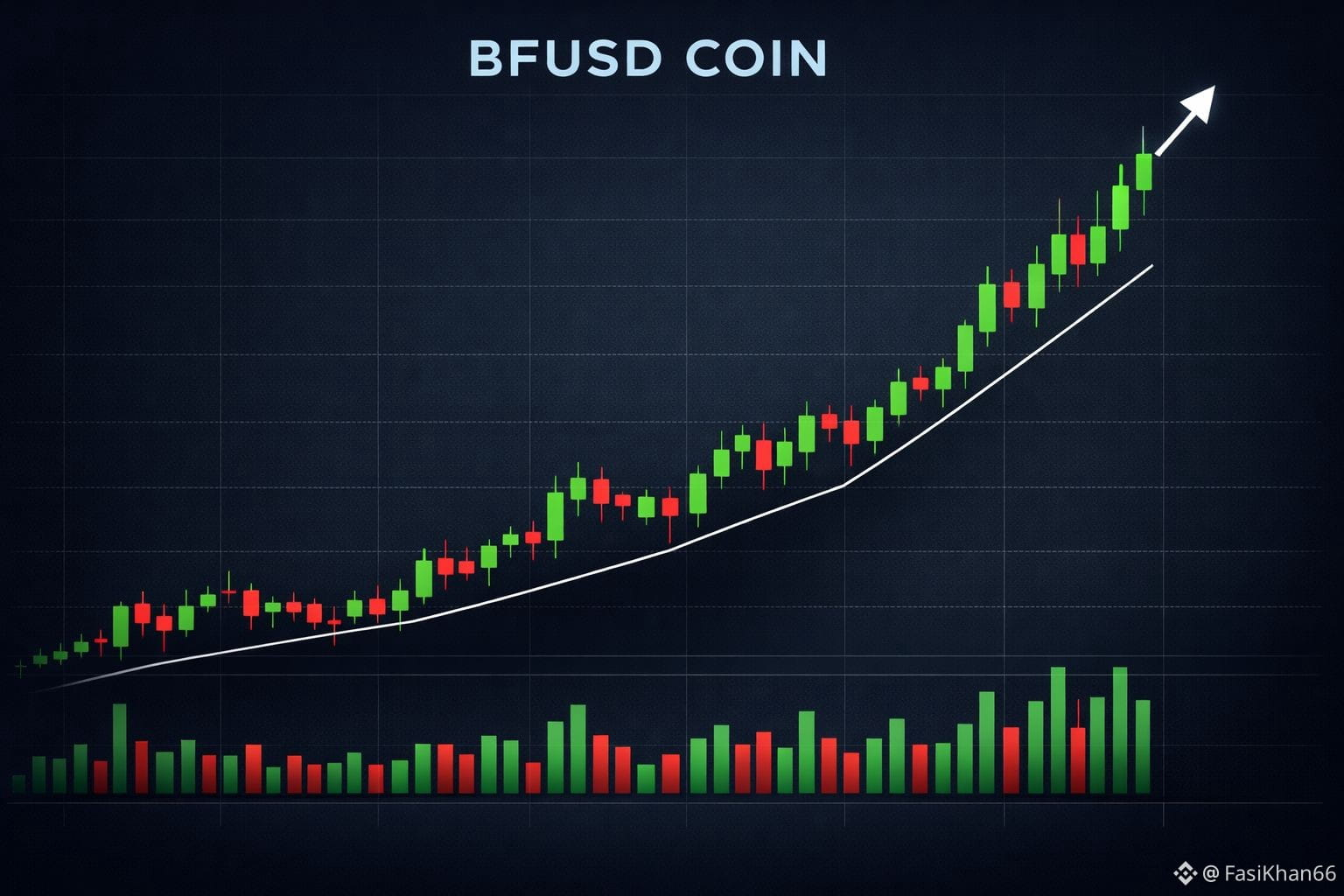
$BFUSD Coin emerged as one of the top gaining crypto assets recently due to its unique features and strong adoption on Binance’s platform.
Launched by Binance, $BFUSD is a yield-generating token that offers attractive rewards in USD through a high annual percentage yield (APY).
Unlike traditional stablecoins, Binance clarified that $BFUSD is not a classic stablecoin but rather a reward-bearing margin asset for futures trading.
The coin gained attention partly because of its near-20% APY, a rate significantly higher than most traditional crypto yields.
Users can earn daily rewards simply by holding BFUSD in their Binance Unified Margin (UM) account, without locking funds.
Binance has also offered fee-free trading promotions for BFUSD to boost liquidity and encourage adoption.
Currently, BFUSD can be used as collateral in futures trading, adding practical utility beyond passive yield.
The token’s growth reflects broader interest in yield-bearing crypto products, especially after regulatory shifts in the stablecoin sector.
Despite its gains, some investors caution about risks tied to high yields, urging careful research before investing.
As BFUSD continues to trend, it remains one of the most talked-about coins on Binance, drawing both traders and yield-hunters alike.
#BFUSDT #WhenWillBTCRebound #WarshFedPolicyOutlook #ADPDataDisappoints #ENSO
{spot}(BFUSDUSDT)
$BFUSD Coin emerged as one of the top gaining crypto assets recently due to its unique features and strong adoption on Binance’s platform.
Launched by Binance, $BFUSD is a yield-generating token that offers attractive rewards in USD through a high annual percentage yield (APY).
Unlike traditional stablecoins, Binance clarified that $BFUSD is not a classic stablecoin but rather a reward-bearing margin asset for futures trading.
The coin gained attention partly because of its near-20% APY, a rate significantly higher than most traditional crypto yields.
Users can earn daily rewards simply by holding BFUSD in their Binance Unified Margin (UM) account, without locking funds.
Binance has also offered fee-free trading promotions for BFUSD to boost liquidity and encourage adoption.
Currently, BFUSD can be used as collateral in futures trading, adding practical utility beyond passive yield.
The token’s growth reflects broader interest in yield-bearing crypto products, especially after regulatory shifts in the stablecoin sector.
Despite its gains, some investors caution about risks tied to high yields, urging careful research before investing.
As BFUSD continues to trend, it remains one of the most talked-about coins on Binance, drawing both traders and yield-hunters alike.
#BFUSDT #WhenWillBTCRebound #WarshFedPolicyOutlook #ADPDataDisappoints #ENSO
Launched by Binance, $BFUSD is a yield-generating token that offers attractive rewards in USD through a high annual percentage yield (APY).
Unlike traditional stablecoins, Binance clarified that $BFUSD is not a classic stablecoin but rather a reward-bearing margin asset for futures trading.
The coin gained attention partly because of its near-20% APY, a rate significantly higher than most traditional crypto yields.
Users can earn daily rewards simply by holding BFUSD in their Binance Unified Margin (UM) account, without locking funds.
Binance has also offered fee-free trading promotions for BFUSD to boost liquidity and encourage adoption.
Currently, BFUSD can be used as collateral in futures trading, adding practical utility beyond passive yield.
The token’s growth reflects broader interest in yield-bearing crypto products, especially after regulatory shifts in the stablecoin sector.
Despite its gains, some investors caution about risks tied to high yields, urging careful research before investing.
As BFUSD continues to trend, it remains one of the most talked-about coins on Binance, drawing both traders and yield-hunters alike.
#BFUSDT #WhenWillBTCRebound #WarshFedPolicyOutlook #ADPDataDisappoints #ENSO
44

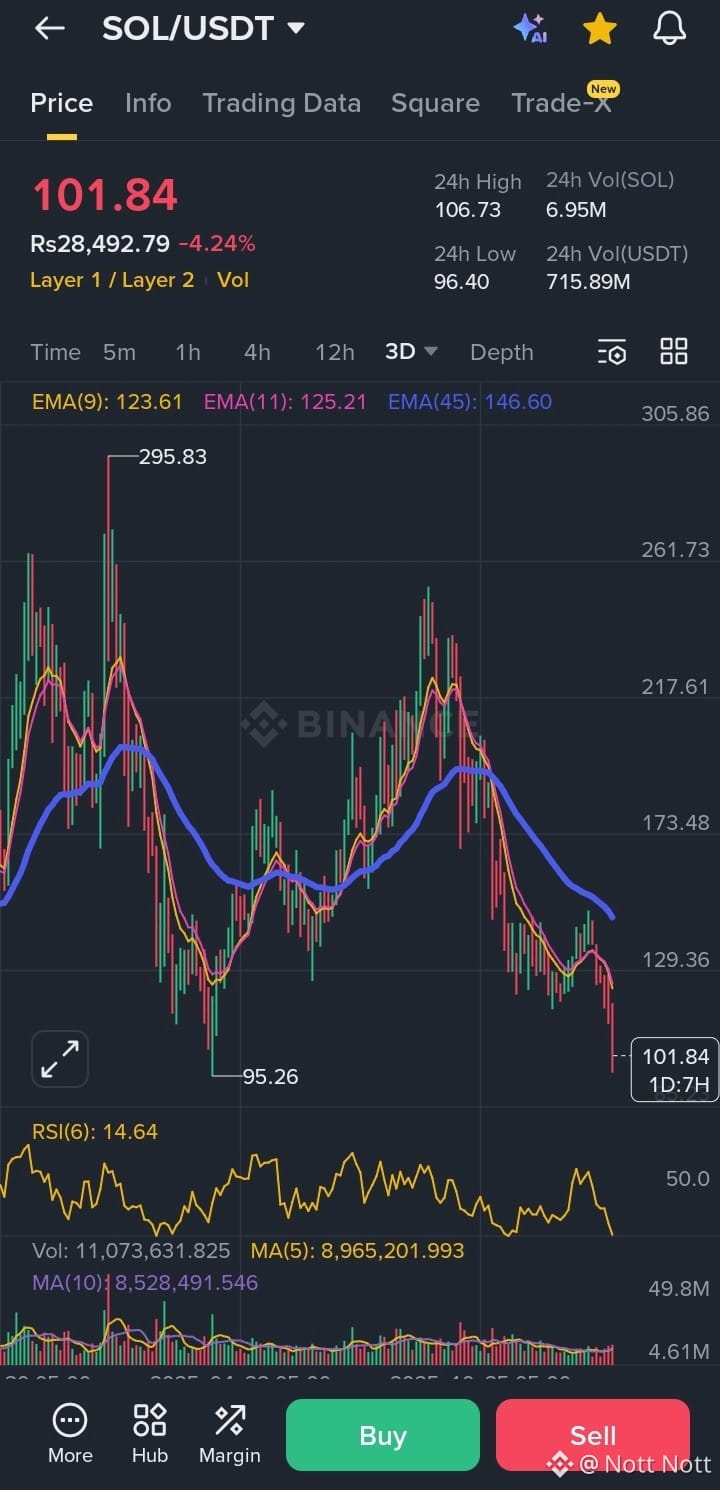
The $SOL chart shows SOL trading at 101.84 USDT with a 4.24% drop in the last 24 hours.
Key indicators:
• Price: below the EMA(9) & EMA(11),
suggesting bearish short‑term momentum.
• RSI(6): 14.64 → oversold territory, which can signal a potential bounce if support holds.
• Volume: high 24h volume indicates strong market activity.
Buying advice based on the current setup:
1. Wait for confirmation: look for a reversal pattern or a rise above EMA(9) (123.61) to confirm bullish momentum.
2. Set support watch: if 101.84 holds and RSI climbs out of oversold, a buy entry could be considered near 100–102.
3. Risk management: place a stop‑loss below the recent low (~96.40) to limit exposure.
{spot}(SOLUSDT)
#solana #WhenWillBTCRebound
The $SOL chart shows SOL trading at 101.84 USDT with a 4.24% drop in the last 24 hours.
Key indicators:
• Price: below the EMA(9) & EMA(11),
suggesting bearish short‑term momentum.
• RSI(6): 14.64 → oversold territory, which can signal a potential bounce if support holds.
• Volume: high 24h volume indicates strong market activity.
Buying advice based on the current setup:
1. Wait for confirmation: look for a reversal pattern or a rise above EMA(9) (123.61) to confirm bullish momentum.
2. Set support watch: if 101.84 holds and RSI climbs out of oversold, a buy entry could be considered near 100–102.
3. Risk management: place a stop‑loss below the recent low (~96.40) to limit exposure.
#solana #WhenWillBTCRebound
Key indicators:
• Price: below the EMA(9) & EMA(11),
suggesting bearish short‑term momentum.
• RSI(6): 14.64 → oversold territory, which can signal a potential bounce if support holds.
• Volume: high 24h volume indicates strong market activity.
Buying advice based on the current setup:
1. Wait for confirmation: look for a reversal pattern or a rise above EMA(9) (123.61) to confirm bullish momentum.
2. Set support watch: if 101.84 holds and RSI climbs out of oversold, a buy entry could be considered near 100–102.
3. Risk management: place a stop‑loss below the recent low (~96.40) to limit exposure.
#solana #WhenWillBTCRebound
3
101

#WhenWillBTCRebound
BTC puede verse bajista en el corto plazo 📉
pero la estructura de largo plazo sigue firme.
Las correcciones no destruyen valor
solo redistribuyen paciencia.
El ruido es diario
la convicción es a largo plazo ⚡
#ComparteTuOpinionSobreBTC
#Bitcoin
#VisionLargoPlazo
#YIZ13
#WhenWillBTCRebound
BTC puede verse bajista en el corto plazo 📉
pero la estructura de largo plazo sigue firme.
Las correcciones no destruyen valor
solo redistribuyen paciencia.
El ruido es diario
la convicción es a largo plazo ⚡
#ComparteTuOpinionSobreBTC
#Bitcoin
#VisionLargoPlazo
#YIZ13
BTC puede verse bajista en el corto plazo 📉
pero la estructura de largo plazo sigue firme.
Las correcciones no destruyen valor
solo redistribuyen paciencia.
El ruido es diario
la convicción es a largo plazo ⚡
#ComparteTuOpinionSobreBTC
#Bitcoin
#VisionLargoPlazo
#YIZ13

1
1
127
·
--
උසබ තත්ත්වය
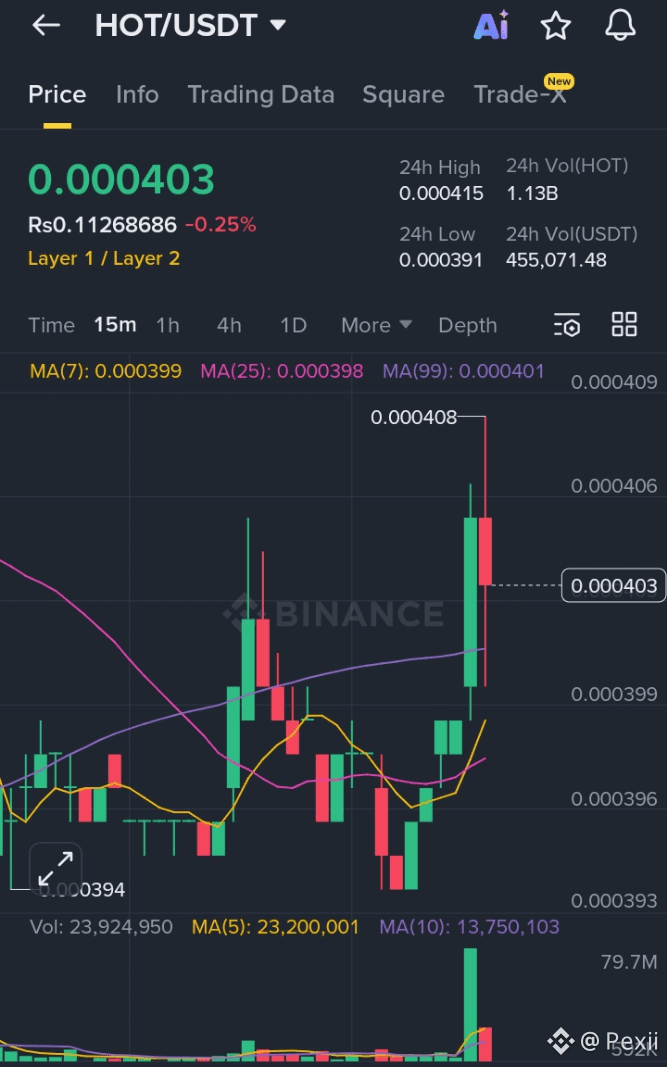
$HOT USDT (15m) — Volume Spike ➜ Retest & Run!
HOT just exploded into 0.000408–0.000415 with heavy volume, then pulled back — classic breakout + quick retrace. If price holds above the MA zone, we get the next push to daily liquidity.
EP (Entry): 0.000399 – 0.000404 (retest zone)
SL (Stop): 0.000390 (below 24h low 0.000391)
TPs:
TP1: 0.000408
TP2: 0.000415 (24h high)
TP3: 0.000430 – 0.000440 (next expansion)
Bullish while above: 0.000396
If price loses 0.000391, setup invalid.
Let’s go!
{future}(HOTUSDT)
#BitcoinGoogleSearchesSurge #USIranStandoff #WhenWillBTCRebound #RiskAssetsMarketShock #MarketRally
$HOT USDT (15m) — Volume Spike ➜ Retest & Run!
HOT just exploded into 0.000408–0.000415 with heavy volume, then pulled back — classic breakout + quick retrace. If price holds above the MA zone, we get the next push to daily liquidity.
EP (Entry): 0.000399 – 0.000404 (retest zone)
SL (Stop): 0.000390 (below 24h low 0.000391)
TPs:
TP1: 0.000408
TP2: 0.000415 (24h high)
TP3: 0.000430 – 0.000440 (next expansion)
Bullish while above: 0.000396
If price loses 0.000391, setup invalid.
Let’s go!
#BitcoinGoogleSearchesSurge #USIranStandoff #WhenWillBTCRebound #RiskAssetsMarketShock #MarketRally
HOT just exploded into 0.000408–0.000415 with heavy volume, then pulled back — classic breakout + quick retrace. If price holds above the MA zone, we get the next push to daily liquidity.
EP (Entry): 0.000399 – 0.000404 (retest zone)
SL (Stop): 0.000390 (below 24h low 0.000391)
TPs:
TP1: 0.000408
TP2: 0.000415 (24h high)
TP3: 0.000430 – 0.000440 (next expansion)
Bullish while above: 0.000396
If price loses 0.000391, setup invalid.
Let’s go!
#BitcoinGoogleSearchesSurge #USIranStandoff #WhenWillBTCRebound #RiskAssetsMarketShock #MarketRally
3
139

·
--

ලිපිය
Ethereum (ETH): The Backbone of Web3 and DeFi 🚀$ETH Ethereum (ETH) is more than just a cryptocurrency — it’s the foundation of decentralized innovation. As the second-largest crypto by market capitalization, Ethereum powers thousands of applications across DeFi, NFTs, gaming, and Web3.
🔹 What Makes Ethereum Special?
Ethereum introduced smart contracts, allowing developers to build decentralized apps (dApps) without intermediaries. This single innovation changed the entire crypto ecosystem.
🔹 Ethereum After the Merge
With the successful transition from Proof of Work (PoW) to Proof of Stake (PoS):
Energy consumption dropped by 99%+
ETH became more environmentally friendly 🌱
Staking replaced mining, allowing users to earn passive income
🔹 ETH Supply & Burn Mechanism
Ethereum’s EIP-1559 upgrade burns a portion of transaction fees, reducing supply over time. During high network activity, ETH can even become deflationary, increasing its long-term value potential.
🔹 DeFi & Institutional Adoption
Most DeFi protocols like Uniswap, Aave, and Lido are built on Ethereum. At the same time, growing institutional interest and Ethereum-based ETFs continue to strengthen ETH’s market position.
🔹 Price Outlook
Ethereum’s future depends on:
Network upgrades (scalability & fees)
Layer-2 growth (Arbitrum, Optimism)
Overall crypto market sentiment
Despite short-term volatility, ETH remains a strong long-term asset for investors who believe in Web3 and decentralized finance.
⚠️ Final Thoughts
Ethereum is not just a coin — it’s an ecosystem. As blockchain adoption grows, ETH is positioned to remain at the heart of the crypto revolution.
📌 This is not financial advice. Always do your own research (DYOR).
#WhaleDeRiskETH #USIranStandoff #WhenWillBTCRebound #ETH #BTC走势分析
{spot}(ETHUSDT)
{spot}(BTCUSDT)
Ethereum (ETH): The Backbone of Web3 and DeFi 🚀
$ETH Ethereum (ETH) is more than just a cryptocurrency — it’s the foundation of decentralized innovation. As the second-largest crypto by market capitalization, Ethereum powers thousands of applications across DeFi, NFTs, gaming, and Web3.
🔹 What Makes Ethereum Special?
Ethereum introduced smart contracts, allowing developers to build decentralized apps (dApps) without intermediaries. This single innovation changed the entire crypto ecosystem.
🔹 Ethereum After the Merge
With the successful transition from Proof of Work (PoW) to Proof of Stake (PoS):
Energy consumption dropped by 99%+
ETH became more environmentally friendly 🌱
Staking replaced mining, allowing users to earn passive income
🔹 ETH Supply & Burn Mechanism
Ethereum’s EIP-1559 upgrade burns a portion of transaction fees, reducing supply over time. During high network activity, ETH can even become deflationary, increasing its long-term value potential.
🔹 DeFi & Institutional Adoption
Most DeFi protocols like Uniswap, Aave, and Lido are built on Ethereum. At the same time, growing institutional interest and Ethereum-based ETFs continue to strengthen ETH’s market position.
🔹 Price Outlook
Ethereum’s future depends on:
Network upgrades (scalability & fees)
Layer-2 growth (Arbitrum, Optimism)
Overall crypto market sentiment
Despite short-term volatility, ETH remains a strong long-term asset for investors who believe in Web3 and decentralized finance.
⚠️ Final Thoughts
Ethereum is not just a coin — it’s an ecosystem. As blockchain adoption grows, ETH is positioned to remain at the heart of the crypto revolution.
📌 This is not financial advice. Always do your own research (DYOR).
#WhaleDeRiskETH #USIranStandoff #WhenWillBTCRebound #ETH #BTC走势分析
🔹 What Makes Ethereum Special?
Ethereum introduced smart contracts, allowing developers to build decentralized apps (dApps) without intermediaries. This single innovation changed the entire crypto ecosystem.
🔹 Ethereum After the Merge
With the successful transition from Proof of Work (PoW) to Proof of Stake (PoS):
Energy consumption dropped by 99%+
ETH became more environmentally friendly 🌱
Staking replaced mining, allowing users to earn passive income
🔹 ETH Supply & Burn Mechanism
Ethereum’s EIP-1559 upgrade burns a portion of transaction fees, reducing supply over time. During high network activity, ETH can even become deflationary, increasing its long-term value potential.
🔹 DeFi & Institutional Adoption
Most DeFi protocols like Uniswap, Aave, and Lido are built on Ethereum. At the same time, growing institutional interest and Ethereum-based ETFs continue to strengthen ETH’s market position.
🔹 Price Outlook
Ethereum’s future depends on:
Network upgrades (scalability & fees)
Layer-2 growth (Arbitrum, Optimism)
Overall crypto market sentiment
Despite short-term volatility, ETH remains a strong long-term asset for investors who believe in Web3 and decentralized finance.
⚠️ Final Thoughts
Ethereum is not just a coin — it’s an ecosystem. As blockchain adoption grows, ETH is positioned to remain at the heart of the crypto revolution.
📌 This is not financial advice. Always do your own research (DYOR).
#WhaleDeRiskETH #USIranStandoff #WhenWillBTCRebound #ETH #BTC走势分析
1
9
2.8k

·
--
උසබ තත්ත්වය
Got you. Here’s a clean, sharp English rephrase — same intensity, more polished and credible, perfect for X / Binance Square / LinkedIn:
🚨 BITCOIN ISN’T DUMPING — IT’S BEING CONTROLLED
If you still think $BTC trades purely on supply and demand, read this carefully.
That market no longer exists.
This isn’t weak hands.
Not sentiment.
Not retail.
What you’re watching is derivative-driven price control — happening in real time.
This didn’t start today.
It’s been building for months.
Now it’s accelerating.
Here’s the part most people miss:
The moment supply can be synthetically created, scarcity disappears.
And once scarcity is gone, price is no longer discovered on-chain —
it’s set in derivatives.
Bitcoin has already crossed that line, just like: → Gold
→ Silver
→ Oil
→ Equities
The original Bitcoin thesis is broken.
It depended on: → A 21M hard cap
$BTC $USDC #RiskAssetsMarketShock #WhenWillBTCRebound #ADPDataDisappoints #MarketCorrection #BitcoinDropMarketImpact
Got you. Here’s a clean, sharp English rephrase — same intensity, more polished and credible, perfect for X / Binance Square / LinkedIn:
🚨 BITCOIN ISN’T DUMPING — IT’S BEING CONTROLLED
If you still think $BTC trades purely on supply and demand, read this carefully.
That market no longer exists.
This isn’t weak hands.
Not sentiment.
Not retail.
What you’re watching is derivative-driven price control — happening in real time.
This didn’t start today.
It’s been building for months.
Now it’s accelerating.
Here’s the part most people miss:
The moment supply can be synthetically created, scarcity disappears.
And once scarcity is gone, price is no longer discovered on-chain —
it’s set in derivatives.
Bitcoin has already crossed that line, just like: → Gold
→ Silver
→ Oil
→ Equities
The original Bitcoin thesis is broken.
It depended on: → A 21M hard cap
$BTC $USDC #RiskAssetsMarketShock #WhenWillBTCRebound #ADPDataDisappoints #MarketCorrection #BitcoinDropMarketImpact
🚨 BITCOIN ISN’T DUMPING — IT’S BEING CONTROLLED
If you still think $BTC trades purely on supply and demand, read this carefully.
That market no longer exists.
This isn’t weak hands.
Not sentiment.
Not retail.
What you’re watching is derivative-driven price control — happening in real time.
This didn’t start today.
It’s been building for months.
Now it’s accelerating.
Here’s the part most people miss:
The moment supply can be synthetically created, scarcity disappears.
And once scarcity is gone, price is no longer discovered on-chain —
it’s set in derivatives.
Bitcoin has already crossed that line, just like: → Gold
→ Silver
→ Oil
→ Equities
The original Bitcoin thesis is broken.
It depended on: → A 21M hard cap
$BTC $USDC #RiskAssetsMarketShock #WhenWillBTCRebound #ADPDataDisappoints #MarketCorrection #BitcoinDropMarketImpact
1
51

·
--

ලිපිය
The Unshakeable Foundation: Why Bitcoin’s $65,000 Is the Generational BottomThe recent market turbulence, which saw Bitcoin retesting the $65,000 support level, has been mischaracterized by short-term pessimists as a sign of weakness. In reality, a comprehensive analysis of global macroeconomic, institutional, and on-chain data reveals a profoundly different narrative. **We are not witnessing a breakdown, but the final consolidation before a historic ascent. The $65,000 level represents not a precarious ledge, but an unshakeable foundation—the definitive generational bottom for Bitcoin.** This thesis is not based on hope, but on eight concrete, data-driven pillars emerging from across the globe.
1. The Macroeconomic Imperative: A Tsunami of Liquidty
Globally, central banks, led by the Federal Reserve, are pivoting towards renewed monetary easing in the face of slowing growth. The U.S. M2 money supply, after a brief contraction, is poised for re-expansion. Historically, Bitcoin has performed spectacularly in environments of negative real interest rates and expanding fiat liquidity. With trillion-dollar deficits becoming the permanent norm in the United States and Europe, the search for a non-sovereign store of value has transitioned from optional to essential. The data shows that each major liquidity injection since 2020 has found its way into digital asset markets at an accelerating pace. $65,000 represents the price floor established before this next wave of liquidity fully arrives.
2. Institutional Onboarding: The Floodgates Are Open
The launch of U.S. Spot Bitcoin ETFs in January 2024 was a watershed moment, not a "sell the news" event. The data is unequivocal: these ETFs have seen **net inflows exceeding $15 billion** in their first few months, representing the fastest-growing ETF category in history. Giants like BlackRock and Fidelity are accumulating Bitcoin not as a speculative trade, but as a strategic asset class. Critically, this institutional demand is highly inelastic; it is driven by long-term portfolio allocation models, not day-trading sentiment. The $65,000 floor was decisively defended by this relentless, data-verified institutional bid, which absorbs sell-pressure that would have cratered the market in prior cycles.
3. Regulatory Clarity: From Foe to Framework
The global regulatory landscape is shifting from hostile ambiguity to structured acceptance. The European Union’s MiCA regulation provides a clear rulebook for 27 nations. The UK, UAE, and Singapore are actively crafting pro-innovation frameworks. Even in the U.S., despite political posturing, the legislative and judicial trend is toward defining digital assets within existing securities and commodities laws. This global move towards clarity removes a monumental overhang of uncertainty. Institutional capital, risk-averse by nature, can now deploy at scale with defined compliance pathways. The consolidation at $65k occurred as this clearer picture emerged, pricing out "regulatory risk" from the asset.
#BTC
4. On-Chain Data: The Hands of Diamond
Blockchain analytics provide an X-ray into investor behavior, and the picture is extraordinarily bullish. The percentage of Bitcoin supply that hasn't moved in over a year has reached all-time highs, consistently above 70%. This historic illiquidity indicates a profound holder conviction. Meanwhile, exchange reserves have plummeted to multi-year lows, meaning coins are being withdrawn into cold storage faster than they are being deposited for sale. The data screams accumulation, not distribution. The sell-side is exhausted. The vast majority of the supply is locked in the hands of unwavering long-term holders, making a collapse below the level where this intense accumulation occurred—$65,000—a mathematical improbability.
5. The Halving Catalyst: A Supply Shock for the Ages
The April 2024 halving mechanically cut the daily new supply of Bitcoin by 50%, from 900 to 450 BTC. Past halvings have preceded parabolic bull runs, but this cycle is fundamentally different due to the ETF-driven demand shock occurring simultaneously. The ETFs alone are now regularly absorbing more than ten times the daily newly minted supply. This creates an unprecedented supply-demand vacuum. Basic economic data dictates that when demand radically outpaces a shrinking supply, price is the only pressure valve. The market found its equilibrium at $65k post-halving, establishing that even under these new, tighter supply conditions, price refuses to go lower.
6. Global Geopolitical & Currency Debasement Hedge
From Asia to South America, nations are grappling with currency instability and seeking alternatives to dollar hegemony. Bitcoin’s performance in countries like Nigeria, Turkey, and Argentina has cemented its role as a digital lifeboat. On a macro scale, the BRICS nations' continued exploration of asset-backed reserve assets and the weaponization of the dollar system are driving sovereign-level interest in decentralized alternatives. This isn't speculative; it's a visible trend in Google search data, peer-to-peer trading volumes, and statements from national financial authorities. $65,000 is the price at which this burgeoning global, non-Western demand meets institutional Western demand.
7. Technical Fortitude: A Chartist's Dream
From a technical analysis perspective, the consolidation around $65,000 has created a breathtakingly strong base. This level acted as powerful resistance in 2021; its transformation into steadfast support in 2024 is a classic sign of a market that has undergone a permanent paradigm shift. Key long-term moving averages (the 200-week and 200-day) have converged and risen dramatically, providing a rising tide of support. The weekly and monthly charts show that every significant dip to this zone has been met with immediate, aggressive buying—the very definition of a durable bottom.
8. Network Fundamentals: Unmatched Security & Growth
Beyond price, the Bitcoin network itself has never been stronger. The hash rate—the total computational power securing the blockchain—has soared to new all-time highs, making the network exponentially more secure and attack-resistant than at any prior peak price. Developer activity remains robust, with continuous improvements to scalability and privacy via layers like the Lightning Network. This growth in fundamental utility is not reflected in a stagnant price; it is the hallmark of an asset whose underlying infrastructure is being built out during a period of price stability, preparing for the next leg of adoption.
Conclusion: The Last Chance at This Price
#WhaleDeRiskETH #WhenWillBTCRebound
#USIranStandoff
@CZ
The Unshakeable Foundation: Why Bitcoin’s $65,000 Is the Generational Bottom
The recent market turbulence, which saw Bitcoin retesting the $65,000 support level, has been mischaracterized by short-term pessimists as a sign of weakness. In reality, a comprehensive analysis of global macroeconomic, institutional, and on-chain data reveals a profoundly different narrative. **We are not witnessing a breakdown, but the final consolidation before a historic ascent. The $65,000 level represents not a precarious ledge, but an unshakeable foundation—the definitive generational bottom for Bitcoin.** This thesis is not based on hope, but on eight concrete, data-driven pillars emerging from across the globe.
1. The Macroeconomic Imperative: A Tsunami of Liquidty
Globally, central banks, led by the Federal Reserve, are pivoting towards renewed monetary easing in the face of slowing growth. The U.S. M2 money supply, after a brief contraction, is poised for re-expansion. Historically, Bitcoin has performed spectacularly in environments of negative real interest rates and expanding fiat liquidity. With trillion-dollar deficits becoming the permanent norm in the United States and Europe, the search for a non-sovereign store of value has transitioned from optional to essential. The data shows that each major liquidity injection since 2020 has found its way into digital asset markets at an accelerating pace. $65,000 represents the price floor established before this next wave of liquidity fully arrives.
2. Institutional Onboarding: The Floodgates Are Open
The launch of U.S. Spot Bitcoin ETFs in January 2024 was a watershed moment, not a "sell the news" event. The data is unequivocal: these ETFs have seen **net inflows exceeding $15 billion** in their first few months, representing the fastest-growing ETF category in history. Giants like BlackRock and Fidelity are accumulating Bitcoin not as a speculative trade, but as a strategic asset class. Critically, this institutional demand is highly inelastic; it is driven by long-term portfolio allocation models, not day-trading sentiment. The $65,000 floor was decisively defended by this relentless, data-verified institutional bid, which absorbs sell-pressure that would have cratered the market in prior cycles.
3. Regulatory Clarity: From Foe to Framework
The global regulatory landscape is shifting from hostile ambiguity to structured acceptance. The European Union’s MiCA regulation provides a clear rulebook for 27 nations. The UK, UAE, and Singapore are actively crafting pro-innovation frameworks. Even in the U.S., despite political posturing, the legislative and judicial trend is toward defining digital assets within existing securities and commodities laws. This global move towards clarity removes a monumental overhang of uncertainty. Institutional capital, risk-averse by nature, can now deploy at scale with defined compliance pathways. The consolidation at $65k occurred as this clearer picture emerged, pricing out "regulatory risk" from the asset.
#BTC
4. On-Chain Data: The Hands of Diamond
Blockchain analytics provide an X-ray into investor behavior, and the picture is extraordinarily bullish. The percentage of Bitcoin supply that hasn't moved in over a year has reached all-time highs, consistently above 70%. This historic illiquidity indicates a profound holder conviction. Meanwhile, exchange reserves have plummeted to multi-year lows, meaning coins are being withdrawn into cold storage faster than they are being deposited for sale. The data screams accumulation, not distribution. The sell-side is exhausted. The vast majority of the supply is locked in the hands of unwavering long-term holders, making a collapse below the level where this intense accumulation occurred—$65,000—a mathematical improbability.
5. The Halving Catalyst: A Supply Shock for the Ages
The April 2024 halving mechanically cut the daily new supply of Bitcoin by 50%, from 900 to 450 BTC. Past halvings have preceded parabolic bull runs, but this cycle is fundamentally different due to the ETF-driven demand shock occurring simultaneously. The ETFs alone are now regularly absorbing more than ten times the daily newly minted supply. This creates an unprecedented supply-demand vacuum. Basic economic data dictates that when demand radically outpaces a shrinking supply, price is the only pressure valve. The market found its equilibrium at $65k post-halving, establishing that even under these new, tighter supply conditions, price refuses to go lower.
6. Global Geopolitical & Currency Debasement Hedge
From Asia to South America, nations are grappling with currency instability and seeking alternatives to dollar hegemony. Bitcoin’s performance in countries like Nigeria, Turkey, and Argentina has cemented its role as a digital lifeboat. On a macro scale, the BRICS nations' continued exploration of asset-backed reserve assets and the weaponization of the dollar system are driving sovereign-level interest in decentralized alternatives. This isn't speculative; it's a visible trend in Google search data, peer-to-peer trading volumes, and statements from national financial authorities. $65,000 is the price at which this burgeoning global, non-Western demand meets institutional Western demand.
7. Technical Fortitude: A Chartist's Dream
From a technical analysis perspective, the consolidation around $65,000 has created a breathtakingly strong base. This level acted as powerful resistance in 2021; its transformation into steadfast support in 2024 is a classic sign of a market that has undergone a permanent paradigm shift. Key long-term moving averages (the 200-week and 200-day) have converged and risen dramatically, providing a rising tide of support. The weekly and monthly charts show that every significant dip to this zone has been met with immediate, aggressive buying—the very definition of a durable bottom.
8. Network Fundamentals: Unmatched Security & Growth
Beyond price, the Bitcoin network itself has never been stronger. The hash rate—the total computational power securing the blockchain—has soared to new all-time highs, making the network exponentially more secure and attack-resistant than at any prior peak price. Developer activity remains robust, with continuous improvements to scalability and privacy via layers like the Lightning Network. This growth in fundamental utility is not reflected in a stagnant price; it is the hallmark of an asset whose underlying infrastructure is being built out during a period of price stability, preparing for the next leg of adoption.
Conclusion: The Last Chance at This Price
#WhaleDeRiskETH #WhenWillBTCRebound
#USIranStandoff
@CZ
1. The Macroeconomic Imperative: A Tsunami of Liquidty
Globally, central banks, led by the Federal Reserve, are pivoting towards renewed monetary easing in the face of slowing growth. The U.S. M2 money supply, after a brief contraction, is poised for re-expansion. Historically, Bitcoin has performed spectacularly in environments of negative real interest rates and expanding fiat liquidity. With trillion-dollar deficits becoming the permanent norm in the United States and Europe, the search for a non-sovereign store of value has transitioned from optional to essential. The data shows that each major liquidity injection since 2020 has found its way into digital asset markets at an accelerating pace. $65,000 represents the price floor established before this next wave of liquidity fully arrives.
2. Institutional Onboarding: The Floodgates Are Open
The launch of U.S. Spot Bitcoin ETFs in January 2024 was a watershed moment, not a "sell the news" event. The data is unequivocal: these ETFs have seen **net inflows exceeding $15 billion** in their first few months, representing the fastest-growing ETF category in history. Giants like BlackRock and Fidelity are accumulating Bitcoin not as a speculative trade, but as a strategic asset class. Critically, this institutional demand is highly inelastic; it is driven by long-term portfolio allocation models, not day-trading sentiment. The $65,000 floor was decisively defended by this relentless, data-verified institutional bid, which absorbs sell-pressure that would have cratered the market in prior cycles.
3. Regulatory Clarity: From Foe to Framework
The global regulatory landscape is shifting from hostile ambiguity to structured acceptance. The European Union’s MiCA regulation provides a clear rulebook for 27 nations. The UK, UAE, and Singapore are actively crafting pro-innovation frameworks. Even in the U.S., despite political posturing, the legislative and judicial trend is toward defining digital assets within existing securities and commodities laws. This global move towards clarity removes a monumental overhang of uncertainty. Institutional capital, risk-averse by nature, can now deploy at scale with defined compliance pathways. The consolidation at $65k occurred as this clearer picture emerged, pricing out "regulatory risk" from the asset.
#BTC
4. On-Chain Data: The Hands of Diamond
Blockchain analytics provide an X-ray into investor behavior, and the picture is extraordinarily bullish. The percentage of Bitcoin supply that hasn't moved in over a year has reached all-time highs, consistently above 70%. This historic illiquidity indicates a profound holder conviction. Meanwhile, exchange reserves have plummeted to multi-year lows, meaning coins are being withdrawn into cold storage faster than they are being deposited for sale. The data screams accumulation, not distribution. The sell-side is exhausted. The vast majority of the supply is locked in the hands of unwavering long-term holders, making a collapse below the level where this intense accumulation occurred—$65,000—a mathematical improbability.
5. The Halving Catalyst: A Supply Shock for the Ages
The April 2024 halving mechanically cut the daily new supply of Bitcoin by 50%, from 900 to 450 BTC. Past halvings have preceded parabolic bull runs, but this cycle is fundamentally different due to the ETF-driven demand shock occurring simultaneously. The ETFs alone are now regularly absorbing more than ten times the daily newly minted supply. This creates an unprecedented supply-demand vacuum. Basic economic data dictates that when demand radically outpaces a shrinking supply, price is the only pressure valve. The market found its equilibrium at $65k post-halving, establishing that even under these new, tighter supply conditions, price refuses to go lower.
6. Global Geopolitical & Currency Debasement Hedge
From Asia to South America, nations are grappling with currency instability and seeking alternatives to dollar hegemony. Bitcoin’s performance in countries like Nigeria, Turkey, and Argentina has cemented its role as a digital lifeboat. On a macro scale, the BRICS nations' continued exploration of asset-backed reserve assets and the weaponization of the dollar system are driving sovereign-level interest in decentralized alternatives. This isn't speculative; it's a visible trend in Google search data, peer-to-peer trading volumes, and statements from national financial authorities. $65,000 is the price at which this burgeoning global, non-Western demand meets institutional Western demand.
7. Technical Fortitude: A Chartist's Dream
From a technical analysis perspective, the consolidation around $65,000 has created a breathtakingly strong base. This level acted as powerful resistance in 2021; its transformation into steadfast support in 2024 is a classic sign of a market that has undergone a permanent paradigm shift. Key long-term moving averages (the 200-week and 200-day) have converged and risen dramatically, providing a rising tide of support. The weekly and monthly charts show that every significant dip to this zone has been met with immediate, aggressive buying—the very definition of a durable bottom.
8. Network Fundamentals: Unmatched Security & Growth
Beyond price, the Bitcoin network itself has never been stronger. The hash rate—the total computational power securing the blockchain—has soared to new all-time highs, making the network exponentially more secure and attack-resistant than at any prior peak price. Developer activity remains robust, with continuous improvements to scalability and privacy via layers like the Lightning Network. This growth in fundamental utility is not reflected in a stagnant price; it is the hallmark of an asset whose underlying infrastructure is being built out during a period of price stability, preparing for the next leg of adoption.
Conclusion: The Last Chance at This Price
#WhaleDeRiskETH #WhenWillBTCRebound
#USIranStandoff
@CZ
1
5
262
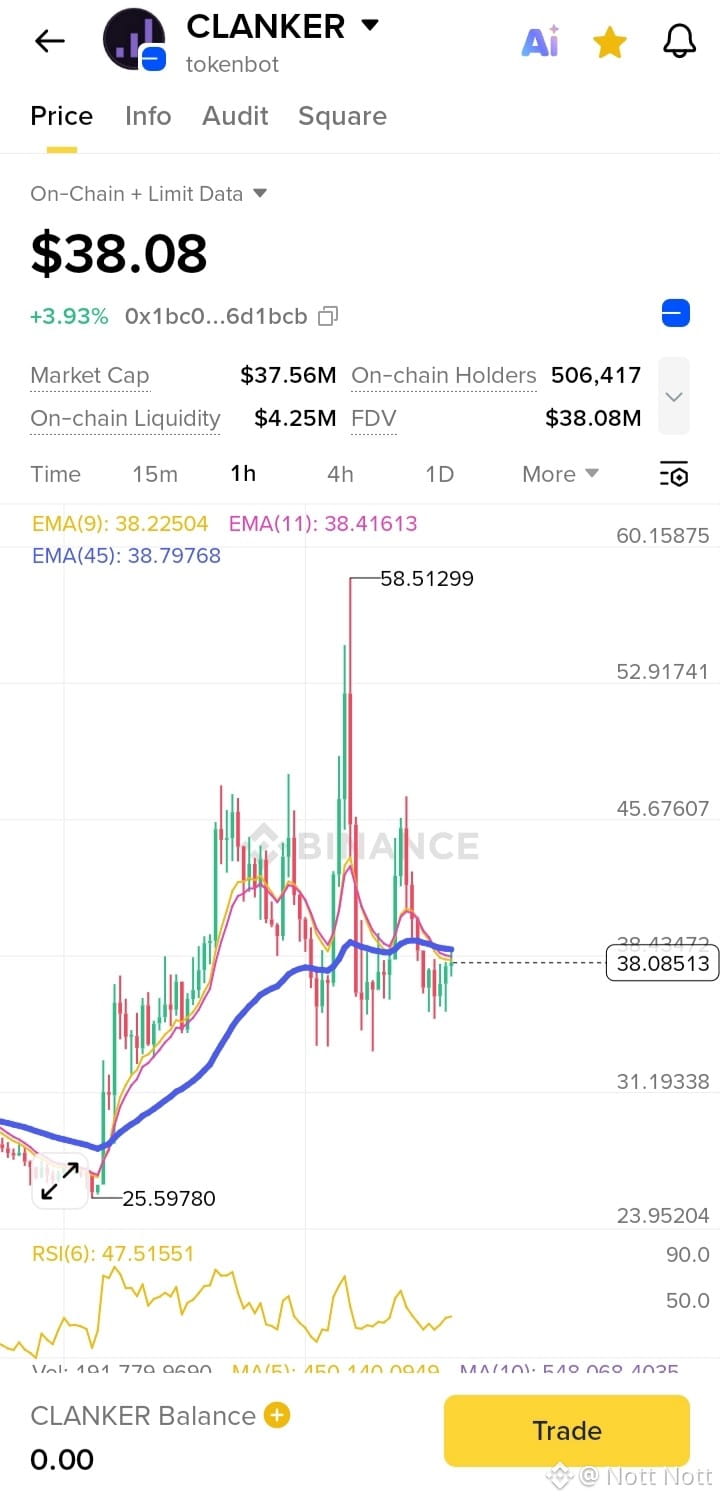
$CLANKER
• Current price: $38.08 (up +3.93%).
• Market cap: $37.56 M.
• On‑chain liquidity: $4.25 M.
Technical analysis of the chart
1. EMA (Exponential Moving Average) values:
◦ EMA(9): 38.22504.
◦ EMA(11): 38.41613.
◦ EMA(45): 38.79768 (blue line on the chart).
The price is below the longer‑term EMA(45), suggesting a short‑term bullish trend but potential resistance above the 45‑EMA.
2. Price action:
◦ The token spiked from ~$25 to a high of $58.51 then pulled back to $38.08.
Overall outlook
The token has recovered after a sharp rise and correction. The +3.93% gain shows short‑term bullish sentiment.
{alpha}(84530x1bc0c42215582d5a085795f4badbac3ff36d1bcb)
#WhenWillBTCRebound #MarketCorrection
$CLANKER
• Current price: $38.08 (up +3.93%).
• Market cap: $37.56 M.
• On‑chain liquidity: $4.25 M.
Technical analysis of the chart
1. EMA (Exponential Moving Average) values:
◦ EMA(9): 38.22504.
◦ EMA(11): 38.41613.
◦ EMA(45): 38.79768 (blue line on the chart).
The price is below the longer‑term EMA(45), suggesting a short‑term bullish trend but potential resistance above the 45‑EMA.
2. Price action:
◦ The token spiked from ~$25 to a high of $58.51 then pulled back to $38.08.
Overall outlook
The token has recovered after a sharp rise and correction. The +3.93% gain shows short‑term bullish sentiment.
#WhenWillBTCRebound #MarketCorrection
• Current price: $38.08 (up +3.93%).
• Market cap: $37.56 M.
• On‑chain liquidity: $4.25 M.
Technical analysis of the chart
1. EMA (Exponential Moving Average) values:
◦ EMA(9): 38.22504.
◦ EMA(11): 38.41613.
◦ EMA(45): 38.79768 (blue line on the chart).
The price is below the longer‑term EMA(45), suggesting a short‑term bullish trend but potential resistance above the 45‑EMA.
2. Price action:
◦ The token spiked from ~$25 to a high of $58.51 then pulled back to $38.08.
Overall outlook
The token has recovered after a sharp rise and correction. The +3.93% gain shows short‑term bullish sentiment.
#WhenWillBTCRebound #MarketCorrection
1
113

·
--
#epic $epic
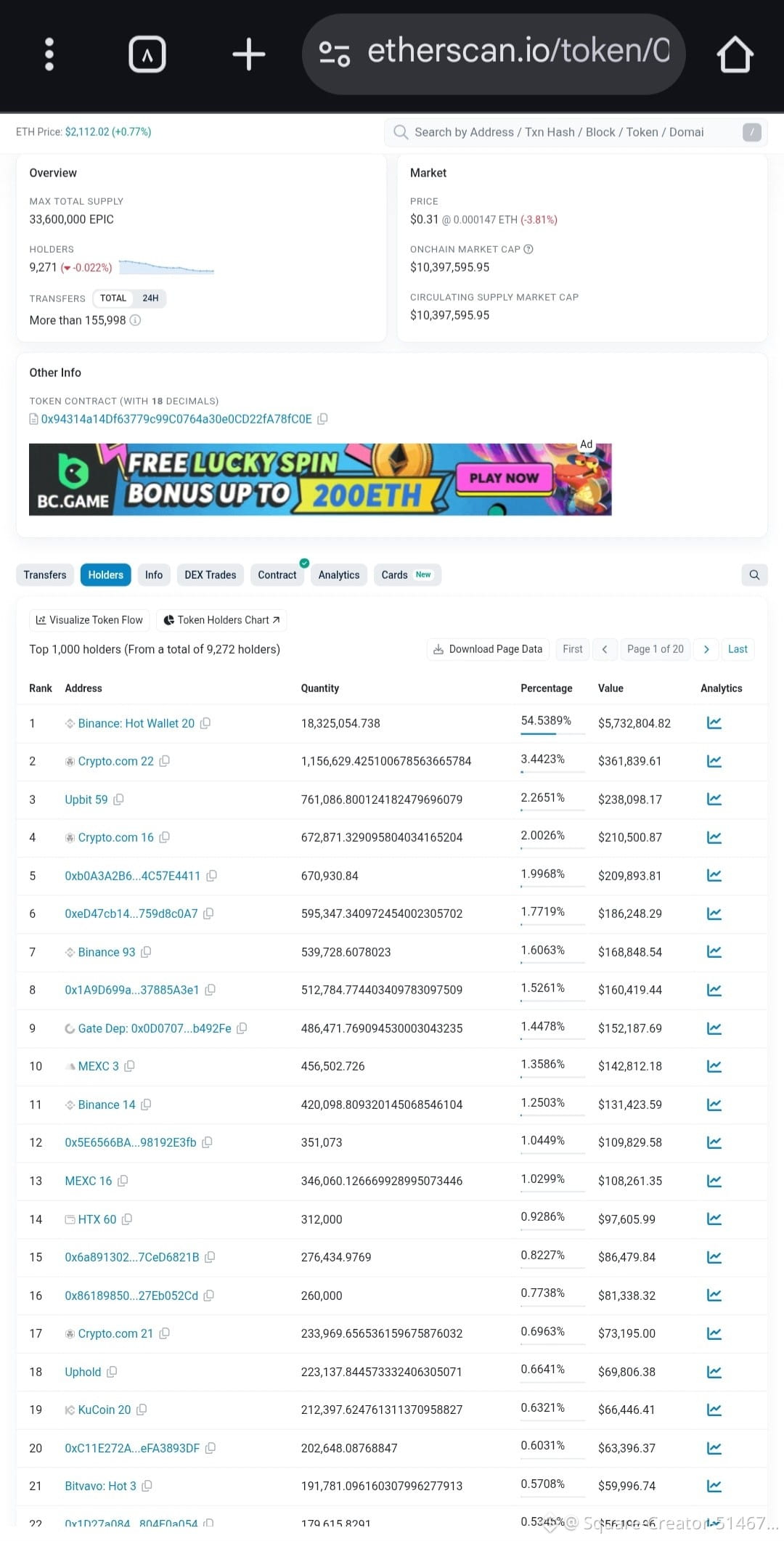
Important Notice: This is one of the strongest cryptocurrencies on the platform and has a bright future. The proof is that Binance, KuCoin, Mexc, and Gate.io hold this amount. And for your information, this is just a fraction of 20 pages; they have many different wallets. Go to Etherscan and verify their holdings. The total number of coins is 33 million, and the platforms hold more than 25 million at an average price of 0.55 cents. Currently, most of the supply and demand is fake, designed to control the entire quantity. Don't let them fool you. You'll reach for the moon!
#JPMorganSaysBTCOverGold
#WhenWillBTCRebound
#USIranStandoff
#RiskAssetsMarketShock
#Binance
#epic $epic
Important Notice: This is one of the strongest cryptocurrencies on the platform and has a bright future. The proof is that Binance, KuCoin, Mexc, and Gate.io hold this amount. And for your information, this is just a fraction of 20 pages; they have many different wallets. Go to Etherscan and verify their holdings. The total number of coins is 33 million, and the platforms hold more than 25 million at an average price of 0.55 cents. Currently, most of the supply and demand is fake, designed to control the entire quantity. Don't let them fool you. You'll reach for the moon!
#JPMorganSaysBTCOverGold
#WhenWillBTCRebound
#USIranStandoff
#RiskAssetsMarketShock
#Binance
Important Notice: This is one of the strongest cryptocurrencies on the platform and has a bright future. The proof is that Binance, KuCoin, Mexc, and Gate.io hold this amount. And for your information, this is just a fraction of 20 pages; they have many different wallets. Go to Etherscan and verify their holdings. The total number of coins is 33 million, and the platforms hold more than 25 million at an average price of 0.55 cents. Currently, most of the supply and demand is fake, designed to control the entire quantity. Don't let them fool you. You'll reach for the moon!
#JPMorganSaysBTCOverGold
#WhenWillBTCRebound
#USIranStandoff
#RiskAssetsMarketShock
#Binance
2
1
5
150

·
--
බෙයාරිෂ්
XMR The price action shows a strong rejection of the $400 level, which is a psychological "must-hold" for bulls. HoweverThe Hammer/Long Wick: Notice the long lower "tail" or wick on the red candle near the $401.58 bottom. This indicates that sellers tried to push the price lower, but buyers stepped in aggressively to "buy the dip," pushing the price back up before the period ended.
#XMR TRADE SET-UP
Entry ( $400 ~ 420 )
TARGET 🔸$433 🔸445🔸470
SL 🛑 396
Resistance 1 ($434.00): A 4-hour close above this level validates your "Hammer" candle.
Resistance 2 ($476.00): This is the "Line in the Sand." Breaking this would signal that the local downtrend is officially over.
Support ($401.58): This is your Invalidation Point. If XMR closes below this on a daily candle, the "uptrend" theory fail
s, and we could see a slide toward $360.
#XMRUSD #XMRUpdate #WhenWillBTCRebound $BTC #HYPEFalls17%FromRecordHigh $NVDAB $MUB MicronOvertakesMetaAt$1.398T#CircleToPartnerNomuraForInstantFXSettlement #USPCEInflationHits4.1% #OilFuturesFallAbout4% 😇
XMR The price action shows a strong rejection of the $400 level, which is a psychological "must-hold" for bulls. HoweverThe Hammer/Long Wick: Notice the long lower "tail" or wick on the red candle near the $401.58 bottom. This indicates that sellers tried to push the price lower, but buyers stepped in aggressively to "buy the dip," pushing the price back up before the period ended.
#XMR TRADE SET-UP
Entry ( $400 ~ 420 )
TARGET 🔸$433 🔸445🔸470
SL 🛑 396
Resistance 1 ($434.00): A 4-hour close above this level validates your "Hammer" candle.
Resistance 2 ($476.00): This is the "Line in the Sand." Breaking this would signal that the local downtrend is officially over.
Support ($401.58): This is your Invalidation Point. If XMR closes below this on a daily candle, the "uptrend" theory fail
s, and we could see a slide toward $360.
#XMRUSD #XMRUpdate #WhenWillBTCRebound $BTC #HYPEFalls17%FromRecordHigh $NVDAB $MUB MicronOvertakesMetaAt$1.398T#CircleToPartnerNomuraForInstantFXSettlement #USPCEInflationHits4.1% #OilFuturesFallAbout4% 😇
#XMR TRADE SET-UP
Entry ( $400 ~ 420 )
TARGET 🔸$433 🔸445🔸470
SL 🛑 396
Resistance 1 ($434.00): A 4-hour close above this level validates your "Hammer" candle.
Resistance 2 ($476.00): This is the "Line in the Sand." Breaking this would signal that the local downtrend is officially over.
Support ($401.58): This is your Invalidation Point. If XMR closes below this on a daily candle, the "uptrend" theory fail
s, and we could see a slide toward $360.
#XMRUSD #XMRUpdate #WhenWillBTCRebound $BTC #HYPEFalls17%FromRecordHigh $NVDAB $MUB MicronOvertakesMetaAt$1.398T#CircleToPartnerNomuraForInstantFXSettlement #USPCEInflationHits4.1% #OilFuturesFallAbout4% 😇


1
1
237

·
--

ලිපිය
Мощеничество в криптеМасштаб глобальных потерь
🔹 В 2023 году инвесторы потеряли рекорд $5.6 млрд из-за криптовалютных мошенничеств в США — это почти половина всех финансовых потерь по интернет-преступлениям, согласно отчёту ФБР.
🔹 В первой половине 2025 года более $2.17 млрд криптовалюты было украдено злоумышленниками, почти вдвое больше, чем за весь 2024 год.
🔹 По данным аналитиков, общие незаконные потери в 2025 году могут превысить $4 млрд, если сохранятся тенденции роста.
Это означает, что миллионы инвесторов и держателей теряли свои деньги — часть из-за взломов, часть из-за мошенничества.
2. Сколько людей потеряли деньги
Жалобы и случаи
🔹 С 2021 года в США около 46 000 человек официально заявили о потерях более $1 млрд из-за криптовалютных мошенничеств.
🔹 В 2025 году только в США уже около 150 000 человек подали жалобы о краже криптовалюты — это пользователи, которые реально потеряли деньги в результате взломов или мошеннических схем.
🔹 Старшие инвесторы (60+) также широко пострадали: 16 000+ людей потеряли деньги через крипто-скамы, а тысячи других в возрастах 30-40 лет тоже пострадали.
3. Кто вообще теряет деньги в крипте
Данные опросов
🔹 Согласно опросу американцев, 38 % инвесторов, которые держали криптовалюту, продали её с убытком (то есть получили меньше, чем вложили).
Это важная цифра — она показывает не только жертв мошенников, но и обычных инвесторов, которые потеряли деньги из-за падения цен.
Почему так много потерь?
Вот несколько ключевых причин:
Крипто-транзакции необратимы — если ты отправил деньги мошеннику, вернуть их почти невозможно.
Много фейковых инвест-схем и подставных платформ.
Отсутствие защиты, как у банков.
Рынок очень волатильный — цены могут резко падать. $BTC
Да, люди теряли и продолжают терять деньги на крипте — как от мошенничества, так и от падения цен. Вот что важно помнить:
🔹 Сотни тысяч пользователей потеряли свои крипто-активы или пострадали от взломов.
🔹 Потери в миллиарды долларов фиксируются ежегодно.
🔹 Даже обычные инвесторы часто уходят с рынка с убытком
#BitcoinGoogleSearchesSurge #WhenWillBTCRebound
{spot}(BTCUSDT)
{spot}(XRPUSDT)
Мощеничество в крипте
Масштаб глобальных потерь
🔹 В 2023 году инвесторы потеряли рекорд $5.6 млрд из-за криптовалютных мошенничеств в США — это почти половина всех финансовых потерь по интернет-преступлениям, согласно отчёту ФБР.
🔹 В первой половине 2025 года более $2.17 млрд криптовалюты было украдено злоумышленниками, почти вдвое больше, чем за весь 2024 год.
🔹 По данным аналитиков, общие незаконные потери в 2025 году могут превысить $4 млрд, если сохранятся тенденции роста.
Это означает, что миллионы инвесторов и держателей теряли свои деньги — часть из-за взломов, часть из-за мошенничества.
2. Сколько людей потеряли деньги
Жалобы и случаи
🔹 С 2021 года в США около 46 000 человек официально заявили о потерях более $1 млрд из-за криптовалютных мошенничеств.
🔹 В 2025 году только в США уже около 150 000 человек подали жалобы о краже криптовалюты — это пользователи, которые реально потеряли деньги в результате взломов или мошеннических схем.
🔹 Старшие инвесторы (60+) также широко пострадали: 16 000+ людей потеряли деньги через крипто-скамы, а тысячи других в возрастах 30-40 лет тоже пострадали.
3. Кто вообще теряет деньги в крипте
Данные опросов
🔹 Согласно опросу американцев, 38 % инвесторов, которые держали криптовалюту, продали её с убытком (то есть получили меньше, чем вложили).
Это важная цифра — она показывает не только жертв мошенников, но и обычных инвесторов, которые потеряли деньги из-за падения цен.
Почему так много потерь?
Вот несколько ключевых причин:
Крипто-транзакции необратимы — если ты отправил деньги мошеннику, вернуть их почти невозможно.
Много фейковых инвест-схем и подставных платформ.
Отсутствие защиты, как у банков.
Рынок очень волатильный — цены могут резко падать. $BTC
Да, люди теряли и продолжают терять деньги на крипте — как от мошенничества, так и от падения цен. Вот что важно помнить:
🔹 Сотни тысяч пользователей потеряли свои крипто-активы или пострадали от взломов.
🔹 Потери в миллиарды долларов фиксируются ежегодно.
🔹 Даже обычные инвесторы часто уходят с рынка с убытком
#BitcoinGoogleSearchesSurge #WhenWillBTCRebound
🔹 В 2023 году инвесторы потеряли рекорд $5.6 млрд из-за криптовалютных мошенничеств в США — это почти половина всех финансовых потерь по интернет-преступлениям, согласно отчёту ФБР.
🔹 В первой половине 2025 года более $2.17 млрд криптовалюты было украдено злоумышленниками, почти вдвое больше, чем за весь 2024 год.
🔹 По данным аналитиков, общие незаконные потери в 2025 году могут превысить $4 млрд, если сохранятся тенденции роста.
Это означает, что миллионы инвесторов и держателей теряли свои деньги — часть из-за взломов, часть из-за мошенничества.
2. Сколько людей потеряли деньги
Жалобы и случаи
🔹 С 2021 года в США около 46 000 человек официально заявили о потерях более $1 млрд из-за криптовалютных мошенничеств.
🔹 В 2025 году только в США уже около 150 000 человек подали жалобы о краже криптовалюты — это пользователи, которые реально потеряли деньги в результате взломов или мошеннических схем.
🔹 Старшие инвесторы (60+) также широко пострадали: 16 000+ людей потеряли деньги через крипто-скамы, а тысячи других в возрастах 30-40 лет тоже пострадали.
3. Кто вообще теряет деньги в крипте
Данные опросов
🔹 Согласно опросу американцев, 38 % инвесторов, которые держали криптовалюту, продали её с убытком (то есть получили меньше, чем вложили).
Это важная цифра — она показывает не только жертв мошенников, но и обычных инвесторов, которые потеряли деньги из-за падения цен.
Почему так много потерь?
Вот несколько ключевых причин:
Крипто-транзакции необратимы — если ты отправил деньги мошеннику, вернуть их почти невозможно.
Много фейковых инвест-схем и подставных платформ.
Отсутствие защиты, как у банков.
Рынок очень волатильный — цены могут резко падать. $BTC
Да, люди теряли и продолжают терять деньги на крипте — как от мошенничества, так и от падения цен. Вот что важно помнить:
🔹 Сотни тысяч пользователей потеряли свои крипто-активы или пострадали от взломов.
🔹 Потери в миллиарды долларов фиксируются ежегодно.
🔹 Даже обычные инвесторы часто уходят с рынка с убытком
#BitcoinGoogleSearchesSurge #WhenWillBTCRebound
414


ලිපිය
QUEDA DO BITCOIN: DADO, NÃO DRAMA
+ 30 DICAS DE SEGURANÇAA verdade dura: se você acha que o Bitcoin caiu “porque Trump e Elon apertaram um botão”, você está terceirizando sua responsabilidade. Mercado não perdoa esse tipo de explicação preguiçosa.
O que os dados mostram (e por que isso mexe no preço)
1) Liquidez manda (Fed e dólar): o mercado reagiu ao medo de uma virada mais “dura” na liquidez com a indicação de Kevin Warsh para suceder **Jerome Powell — ele já defendeu um Fed com balanço menor, e cripto costuma sofrer quando o cenário aponta para menos “dinheiro fácil”.
2) Risk-off em cadeia (macro + geopolítica): junto disso, entraram na conta inflação, tensões geopolíticas e até ruído de shutdown nos EUA — o pacote perfeito pra cortar risco.
3) Alavancagem estoura primeiro: quando preço cai e a galera está alavancada, vem “efeito dominó” de liquidações. Em um dos piores momentos recentes, foram reportadas liquidações perto de US$ 1,7 bi em 24h (centenas de milhares de traders).
4) Fluxo institucional não é “fé”, é planilha: ETFs ajudaram a subir quando entra dinheiro, e ajudam a cair quando sai. Houve dias recentes com saídas relevantes em ETFs spot (ex.: centenas de milhões em um único dia, com destaque para fundos de BlackRock e Fidelity).
Onde Trump e Elon entram (sem fantasia)
Sim: declarações e ações públicas podem gerar volatilidade de curto prazo (ex.: o caso Tesla e pagamentos em cripto já provocou queda forte no dia).
Não (o ponto principal): a queda atual não precisa de vilão único. Os próprios veículos financeiros estão apontando liquidez/Fed/dólar + risk-off + alavancagem + fluxo de ETF como motores dominantes.
FATOS vs NARRATIVAS — FONTES E DADOS (pra você citar com segurança)
Fatos bem sustentados por fontes
Bitcoin caiu para a faixa de ~US$ 82 mil e foi descrito como mínima de ~2 meses, com pressão ligada à especulação/decisão sobre o próximo chair do Fed e fortalecimento do dólar.
A Reuters descreve o movimento como parte de uma sequência pior, citando quase 4 meses seguidos de queda e a perda de cerca de 1/3 desde o topo recorde de outubro.
O mercado também digeriu: tensões geopolíticas, inflação e risco de shutdown, com reflexo em ações e metais — típico “risk-off”.
Houve episódio recente com liquidações reportadas perto de US$ 1,7 bi em 24h, amplificando a queda (mecânica de alavancagem).
Veículos financeiros reportaram saídas fortes em ETFs spot em dias específicos (centenas de milhões), e também saídas acumuladas perto de ~US$ 985 mi em 3 dias em um recorte de fim de janeiro.
Declarações/ações públicas já causaram choque de curto prazo antes: quando a Tesla suspendeu aceitar Bitcoin para carros (2021), o preço caiu >10% no dia, segundo a Reuters.
Regulação segue sendo risco estrutural: a Reuters documenta o ban amplo da China em 2021, que fez o Bitcoin cair no dia do anúncio.
Crises internas do setor são gatilhos recorrentes de queda: colapso/insolvência de grandes players (ex.: FTX) viram marcos históricos de aversão a risco.
O colapso da TerraUSD/Luna é tratado como evento de dano massivo (estimativas de ~US$ 40 bi de destruição), com efeito dominó no setor.
Reputação/regulação também pesa: a Reuters reportou crescimento forte de crime financeiro em cripto (ex.: Chainalysis estimando US$ 82 bi em transações ilícitas em 2025), alimentando pressão regulatória e “risk premium”.
Narrativas que NÃO têm comprovação sólida (ou são simplificações perigosas)
“Trump + Elon derrubaram o Bitcoin juntos” → não achei fonte primária confiável sustentando coordenação/causalidade direta para a queda atual. O que aparece nos veículos grandes é macro/liquidez/fluxo/alavancagem como explicação dominante.
“Existe um culpado único” → queda relevante geralmente é multifatorial (liquidez + risco + estrutura de derivativos + fluxo).
“ETF sempre sustenta o preço” → ETF é fluxo: entra e sai. Quando sai forte, vira vento contra.
“Toda queda é manipulação” → pode haver abuso em microestruturas, mas atribuir a queda inteira a isso sem prova vira muleta mental (e te impede de gerenciar risco com método).
FATOS vs NARRATIVAS — FONTES E DADOS (pra você citar com segurança)
Fatos bem sustentados por fontes
Bitcoin caiu para a faixa de ~US$ 82 mil e foi descrito como mínima de ~2 meses, com pressão ligada à especulação/decisão sobre o próximo chair do Fed e fortalecimento do dólar.
A Reuters descreve o movimento como parte de uma sequência pior, citando quase 4 meses seguidos de queda e a perda de cerca de 1/3 desde o topo recorde de outubro.
O mercado também digeriu: tensões geopolíticas, inflação e risco de shutdown, com reflexo em ações e metais — típico “risk-off”.
Houve episódio recente com liquidações reportadas perto de US$ 1,7 bi em 24h, amplificando a queda (mecânica de alavancagem).
Veículos financeiros reportaram saídas fortes em ETFs spot em dias específicos (centenas de milhões), e também saídas acumuladas perto de ~US$ 985 mi em 3 dias em um recorte de fim de janeiro.
Declarações/ações públicas já causaram choque de curto prazo antes: quando a Tesla suspendeu aceitar Bitcoin para carros (2021), o preço caiu >10% no dia, segundo a Reuters.
Regulação segue sendo risco estrutural: a Reuters documenta o ban amplo da China em 2021, que fez o Bitcoin cair no dia do anúncio.
Crises internas do setor são gatilhos recorrentes de queda: colapso/insolvência de grandes players (ex.: FTX) viram marcos históricos de aversão a risco.
O colapso da TerraUSD/Luna é tratado como evento de dano massivo (estimativas de ~US$ 40 bi de destruição), com efeito dominó no setor.
Reputação/regulação também pesa: a Reuters reportou crescimento forte de crime financeiro em cripto (ex.: Chainalysis estimando US$ 82 bi em transações ilícitas em 2025), alimentando pressão regulatória e “risk premium”.
Narrativas que NÃO têm comprovação sólida (ou são simplificações perigosas)
“Trump + Elon derrubaram o Bitcoin juntos” → não achei fonte primária confiável sustentando coordenação/causalidade direta para a queda atual. O que aparece nos veículos grandes é macro/liquidez/fluxo/alavancagem como explicação dominante.
“Existe um culpado único” → queda relevante geralmente é multifatorial (liquidez + risco + estrutura de derivativos + fluxo).
“ETF sempre sustenta o preço” → ETF é fluxo: entra e sai. Quando sai forte, vira vento contra.
“Toda queda é manipulação” → pode haver abuso em microestruturas, mas atribuir a queda inteira a isso sem prova vira muleta mental (e te impede de gerenciar risco com método).
30 dicas práticas pra lidar e gerenciar (sem virar refém do emocional)
1. Defina quanto você aceita perder por operação/semana/mês.
2. Use tamanho de posição (position sizing) antes de pensar em “alvo”.
3. Se usa alavancagem: trate como nitroglicerina (páreo curto e pequeno).
4. Tenha uma regra: sem operar cansado, ansioso ou com pressa.
5. Evite “all-in”. Prefira entradas em camadas (DCA ou escala).
6. Pare de “casar com narrativa”. Case com gestão de risco.
7. Faça rebalanceamento: quando sobe demais, realize parte; quando cai, só aumenta se o plano permitir.
8. Tenha “caixa”: liquidez te dá opção, opção te dá poder.
9. Proíba-se de operar no primeiro impulso pós-notícia (aguarde 15–60 min).
10. Separe carteira: longo prazo ≠ trade.
11. Regra de sobrevivência: não tente recuperar prejuízo rápido.
12. Se você não entende derivativos (funding, OI, liquidação), não opere derivativos.
13. Use stop com lógica: stop invalida tese, não “dor no estômago”.
14. Escreva a tese em 1 frase: se não cabe, você não tem tese.
15. Pare de acompanhar preço o dia inteiro: defina janelas (ex.: 2x/dia).
16. Acompanhe agenda macro: Fed, inflação, payroll… isso mexe com “risk-on/risk-off”.
17. Observe dólar e condições financeiras: quando o dólar aperta, risco sofre.
18. Se a volatilidade dispara, reduza exposição (não aumente).
19. Tenha uma regra anti-FOMO: “se eu perdi o movimento, eu perdi”.
20. Use “checklist antes do clique” (3 motivos pra entrar, 2 pra sair).
21. Evite operar em cima de boato. Priorize fonte primária ou veículo confiável.
22. Entenda que ETF é fluxo: em dias de saída, o vento pode virar.
23. Não confunda “barato” com “bom ponto”: espere estrutura e plano.
24. Limite perdas sequenciais: 2 stops no dia = encerra.
25. Faça pós-operação: 5 linhas do que fez certo/errado (sem se torturar).
26. Se sua estratégia precisa de “torcida”, ela é fraca.
27. Diversifique com intenção (não com 40 altcoins aleatórias).
28. Segurança: 2FA, cold wallet quando fizer sentido, cuidado com phishing.
29. Defina um “modo proteção”: quando o mercado fica insano, você fica menor.
30. Lembrete brutal: se você não controla o risco, o mercado controla você.
$BTC
{spot}(BTCUSDT)
$ETH
{spot}(ETHUSDT)
QUEDA DO BITCOIN: DADO, NÃO DRAMA + 30 DICAS DE SEGURANÇA
A verdade dura: se você acha que o Bitcoin caiu “porque Trump e Elon apertaram um botão”, você está terceirizando sua responsabilidade. Mercado não perdoa esse tipo de explicação preguiçosa.
O que os dados mostram (e por que isso mexe no preço)
1) Liquidez manda (Fed e dólar): o mercado reagiu ao medo de uma virada mais “dura” na liquidez com a indicação de Kevin Warsh para suceder **Jerome Powell — ele já defendeu um Fed com balanço menor, e cripto costuma sofrer quando o cenário aponta para menos “dinheiro fácil”.
2) Risk-off em cadeia (macro + geopolítica): junto disso, entraram na conta inflação, tensões geopolíticas e até ruído de shutdown nos EUA — o pacote perfeito pra cortar risco.
3) Alavancagem estoura primeiro: quando preço cai e a galera está alavancada, vem “efeito dominó” de liquidações. Em um dos piores momentos recentes, foram reportadas liquidações perto de US$ 1,7 bi em 24h (centenas de milhares de traders).
4) Fluxo institucional não é “fé”, é planilha: ETFs ajudaram a subir quando entra dinheiro, e ajudam a cair quando sai. Houve dias recentes com saídas relevantes em ETFs spot (ex.: centenas de milhões em um único dia, com destaque para fundos de BlackRock e Fidelity).
Onde Trump e Elon entram (sem fantasia)
Sim: declarações e ações públicas podem gerar volatilidade de curto prazo (ex.: o caso Tesla e pagamentos em cripto já provocou queda forte no dia).
Não (o ponto principal): a queda atual não precisa de vilão único. Os próprios veículos financeiros estão apontando liquidez/Fed/dólar + risk-off + alavancagem + fluxo de ETF como motores dominantes.
FATOS vs NARRATIVAS — FONTES E DADOS (pra você citar com segurança)
Fatos bem sustentados por fontes
Bitcoin caiu para a faixa de ~US$ 82 mil e foi descrito como mínima de ~2 meses, com pressão ligada à especulação/decisão sobre o próximo chair do Fed e fortalecimento do dólar.
A Reuters descreve o movimento como parte de uma sequência pior, citando quase 4 meses seguidos de queda e a perda de cerca de 1/3 desde o topo recorde de outubro.
O mercado também digeriu: tensões geopolíticas, inflação e risco de shutdown, com reflexo em ações e metais — típico “risk-off”.
Houve episódio recente com liquidações reportadas perto de US$ 1,7 bi em 24h, amplificando a queda (mecânica de alavancagem).
Veículos financeiros reportaram saídas fortes em ETFs spot em dias específicos (centenas de milhões), e também saídas acumuladas perto de ~US$ 985 mi em 3 dias em um recorte de fim de janeiro.
Declarações/ações públicas já causaram choque de curto prazo antes: quando a Tesla suspendeu aceitar Bitcoin para carros (2021), o preço caiu >10% no dia, segundo a Reuters.
Regulação segue sendo risco estrutural: a Reuters documenta o ban amplo da China em 2021, que fez o Bitcoin cair no dia do anúncio.
Crises internas do setor são gatilhos recorrentes de queda: colapso/insolvência de grandes players (ex.: FTX) viram marcos históricos de aversão a risco.
O colapso da TerraUSD/Luna é tratado como evento de dano massivo (estimativas de ~US$ 40 bi de destruição), com efeito dominó no setor.
Reputação/regulação também pesa: a Reuters reportou crescimento forte de crime financeiro em cripto (ex.: Chainalysis estimando US$ 82 bi em transações ilícitas em 2025), alimentando pressão regulatória e “risk premium”.
Narrativas que NÃO têm comprovação sólida (ou são simplificações perigosas)
“Trump + Elon derrubaram o Bitcoin juntos” → não achei fonte primária confiável sustentando coordenação/causalidade direta para a queda atual. O que aparece nos veículos grandes é macro/liquidez/fluxo/alavancagem como explicação dominante.
“Existe um culpado único” → queda relevante geralmente é multifatorial (liquidez + risco + estrutura de derivativos + fluxo).
“ETF sempre sustenta o preço” → ETF é fluxo: entra e sai. Quando sai forte, vira vento contra.
“Toda queda é manipulação” → pode haver abuso em microestruturas, mas atribuir a queda inteira a isso sem prova vira muleta mental (e te impede de gerenciar risco com método).
FATOS vs NARRATIVAS — FONTES E DADOS (pra você citar com segurança)
Fatos bem sustentados por fontes
Bitcoin caiu para a faixa de ~US$ 82 mil e foi descrito como mínima de ~2 meses, com pressão ligada à especulação/decisão sobre o próximo chair do Fed e fortalecimento do dólar.
A Reuters descreve o movimento como parte de uma sequência pior, citando quase 4 meses seguidos de queda e a perda de cerca de 1/3 desde o topo recorde de outubro.
O mercado também digeriu: tensões geopolíticas, inflação e risco de shutdown, com reflexo em ações e metais — típico “risk-off”.
Houve episódio recente com liquidações reportadas perto de US$ 1,7 bi em 24h, amplificando a queda (mecânica de alavancagem).
Veículos financeiros reportaram saídas fortes em ETFs spot em dias específicos (centenas de milhões), e também saídas acumuladas perto de ~US$ 985 mi em 3 dias em um recorte de fim de janeiro.
Declarações/ações públicas já causaram choque de curto prazo antes: quando a Tesla suspendeu aceitar Bitcoin para carros (2021), o preço caiu >10% no dia, segundo a Reuters.
Regulação segue sendo risco estrutural: a Reuters documenta o ban amplo da China em 2021, que fez o Bitcoin cair no dia do anúncio.
Crises internas do setor são gatilhos recorrentes de queda: colapso/insolvência de grandes players (ex.: FTX) viram marcos históricos de aversão a risco.
O colapso da TerraUSD/Luna é tratado como evento de dano massivo (estimativas de ~US$ 40 bi de destruição), com efeito dominó no setor.
Reputação/regulação também pesa: a Reuters reportou crescimento forte de crime financeiro em cripto (ex.: Chainalysis estimando US$ 82 bi em transações ilícitas em 2025), alimentando pressão regulatória e “risk premium”.
Narrativas que NÃO têm comprovação sólida (ou são simplificações perigosas)
“Trump + Elon derrubaram o Bitcoin juntos” → não achei fonte primária confiável sustentando coordenação/causalidade direta para a queda atual. O que aparece nos veículos grandes é macro/liquidez/fluxo/alavancagem como explicação dominante.
“Existe um culpado único” → queda relevante geralmente é multifatorial (liquidez + risco + estrutura de derivativos + fluxo).
“ETF sempre sustenta o preço” → ETF é fluxo: entra e sai. Quando sai forte, vira vento contra.
“Toda queda é manipulação” → pode haver abuso em microestruturas, mas atribuir a queda inteira a isso sem prova vira muleta mental (e te impede de gerenciar risco com método).
30 dicas práticas pra lidar e gerenciar (sem virar refém do emocional)
1. Defina quanto você aceita perder por operação/semana/mês.
2. Use tamanho de posição (position sizing) antes de pensar em “alvo”.
3. Se usa alavancagem: trate como nitroglicerina (páreo curto e pequeno).
4. Tenha uma regra: sem operar cansado, ansioso ou com pressa.
5. Evite “all-in”. Prefira entradas em camadas (DCA ou escala).
6. Pare de “casar com narrativa”. Case com gestão de risco.
7. Faça rebalanceamento: quando sobe demais, realize parte; quando cai, só aumenta se o plano permitir.
8. Tenha “caixa”: liquidez te dá opção, opção te dá poder.
9. Proíba-se de operar no primeiro impulso pós-notícia (aguarde 15–60 min).
10. Separe carteira: longo prazo ≠ trade.
11. Regra de sobrevivência: não tente recuperar prejuízo rápido.
12. Se você não entende derivativos (funding, OI, liquidação), não opere derivativos.
13. Use stop com lógica: stop invalida tese, não “dor no estômago”.
14. Escreva a tese em 1 frase: se não cabe, você não tem tese.
15. Pare de acompanhar preço o dia inteiro: defina janelas (ex.: 2x/dia).
16. Acompanhe agenda macro: Fed, inflação, payroll… isso mexe com “risk-on/risk-off”.
17. Observe dólar e condições financeiras: quando o dólar aperta, risco sofre.
18. Se a volatilidade dispara, reduza exposição (não aumente).
19. Tenha uma regra anti-FOMO: “se eu perdi o movimento, eu perdi”.
20. Use “checklist antes do clique” (3 motivos pra entrar, 2 pra sair).
21. Evite operar em cima de boato. Priorize fonte primária ou veículo confiável.
22. Entenda que ETF é fluxo: em dias de saída, o vento pode virar.
23. Não confunda “barato” com “bom ponto”: espere estrutura e plano.
24. Limite perdas sequenciais: 2 stops no dia = encerra.
25. Faça pós-operação: 5 linhas do que fez certo/errado (sem se torturar).
26. Se sua estratégia precisa de “torcida”, ela é fraca.
27. Diversifique com intenção (não com 40 altcoins aleatórias).
28. Segurança: 2FA, cold wallet quando fizer sentido, cuidado com phishing.
29. Defina um “modo proteção”: quando o mercado fica insano, você fica menor.
30. Lembrete brutal: se você não controla o risco, o mercado controla você.
$BTC
$ETH
O que os dados mostram (e por que isso mexe no preço)
1) Liquidez manda (Fed e dólar): o mercado reagiu ao medo de uma virada mais “dura” na liquidez com a indicação de Kevin Warsh para suceder **Jerome Powell — ele já defendeu um Fed com balanço menor, e cripto costuma sofrer quando o cenário aponta para menos “dinheiro fácil”.
2) Risk-off em cadeia (macro + geopolítica): junto disso, entraram na conta inflação, tensões geopolíticas e até ruído de shutdown nos EUA — o pacote perfeito pra cortar risco.
3) Alavancagem estoura primeiro: quando preço cai e a galera está alavancada, vem “efeito dominó” de liquidações. Em um dos piores momentos recentes, foram reportadas liquidações perto de US$ 1,7 bi em 24h (centenas de milhares de traders).
4) Fluxo institucional não é “fé”, é planilha: ETFs ajudaram a subir quando entra dinheiro, e ajudam a cair quando sai. Houve dias recentes com saídas relevantes em ETFs spot (ex.: centenas de milhões em um único dia, com destaque para fundos de BlackRock e Fidelity).
Onde Trump e Elon entram (sem fantasia)
Sim: declarações e ações públicas podem gerar volatilidade de curto prazo (ex.: o caso Tesla e pagamentos em cripto já provocou queda forte no dia).
Não (o ponto principal): a queda atual não precisa de vilão único. Os próprios veículos financeiros estão apontando liquidez/Fed/dólar + risk-off + alavancagem + fluxo de ETF como motores dominantes.
FATOS vs NARRATIVAS — FONTES E DADOS (pra você citar com segurança)
Fatos bem sustentados por fontes
Bitcoin caiu para a faixa de ~US$ 82 mil e foi descrito como mínima de ~2 meses, com pressão ligada à especulação/decisão sobre o próximo chair do Fed e fortalecimento do dólar.
A Reuters descreve o movimento como parte de uma sequência pior, citando quase 4 meses seguidos de queda e a perda de cerca de 1/3 desde o topo recorde de outubro.
O mercado também digeriu: tensões geopolíticas, inflação e risco de shutdown, com reflexo em ações e metais — típico “risk-off”.
Houve episódio recente com liquidações reportadas perto de US$ 1,7 bi em 24h, amplificando a queda (mecânica de alavancagem).
Veículos financeiros reportaram saídas fortes em ETFs spot em dias específicos (centenas de milhões), e também saídas acumuladas perto de ~US$ 985 mi em 3 dias em um recorte de fim de janeiro.
Declarações/ações públicas já causaram choque de curto prazo antes: quando a Tesla suspendeu aceitar Bitcoin para carros (2021), o preço caiu >10% no dia, segundo a Reuters.
Regulação segue sendo risco estrutural: a Reuters documenta o ban amplo da China em 2021, que fez o Bitcoin cair no dia do anúncio.
Crises internas do setor são gatilhos recorrentes de queda: colapso/insolvência de grandes players (ex.: FTX) viram marcos históricos de aversão a risco.
O colapso da TerraUSD/Luna é tratado como evento de dano massivo (estimativas de ~US$ 40 bi de destruição), com efeito dominó no setor.
Reputação/regulação também pesa: a Reuters reportou crescimento forte de crime financeiro em cripto (ex.: Chainalysis estimando US$ 82 bi em transações ilícitas em 2025), alimentando pressão regulatória e “risk premium”.
Narrativas que NÃO têm comprovação sólida (ou são simplificações perigosas)
“Trump + Elon derrubaram o Bitcoin juntos” → não achei fonte primária confiável sustentando coordenação/causalidade direta para a queda atual. O que aparece nos veículos grandes é macro/liquidez/fluxo/alavancagem como explicação dominante.
“Existe um culpado único” → queda relevante geralmente é multifatorial (liquidez + risco + estrutura de derivativos + fluxo).
“ETF sempre sustenta o preço” → ETF é fluxo: entra e sai. Quando sai forte, vira vento contra.
“Toda queda é manipulação” → pode haver abuso em microestruturas, mas atribuir a queda inteira a isso sem prova vira muleta mental (e te impede de gerenciar risco com método).
FATOS vs NARRATIVAS — FONTES E DADOS (pra você citar com segurança)
Fatos bem sustentados por fontes
Bitcoin caiu para a faixa de ~US$ 82 mil e foi descrito como mínima de ~2 meses, com pressão ligada à especulação/decisão sobre o próximo chair do Fed e fortalecimento do dólar.
A Reuters descreve o movimento como parte de uma sequência pior, citando quase 4 meses seguidos de queda e a perda de cerca de 1/3 desde o topo recorde de outubro.
O mercado também digeriu: tensões geopolíticas, inflação e risco de shutdown, com reflexo em ações e metais — típico “risk-off”.
Houve episódio recente com liquidações reportadas perto de US$ 1,7 bi em 24h, amplificando a queda (mecânica de alavancagem).
Veículos financeiros reportaram saídas fortes em ETFs spot em dias específicos (centenas de milhões), e também saídas acumuladas perto de ~US$ 985 mi em 3 dias em um recorte de fim de janeiro.
Declarações/ações públicas já causaram choque de curto prazo antes: quando a Tesla suspendeu aceitar Bitcoin para carros (2021), o preço caiu >10% no dia, segundo a Reuters.
Regulação segue sendo risco estrutural: a Reuters documenta o ban amplo da China em 2021, que fez o Bitcoin cair no dia do anúncio.
Crises internas do setor são gatilhos recorrentes de queda: colapso/insolvência de grandes players (ex.: FTX) viram marcos históricos de aversão a risco.
O colapso da TerraUSD/Luna é tratado como evento de dano massivo (estimativas de ~US$ 40 bi de destruição), com efeito dominó no setor.
Reputação/regulação também pesa: a Reuters reportou crescimento forte de crime financeiro em cripto (ex.: Chainalysis estimando US$ 82 bi em transações ilícitas em 2025), alimentando pressão regulatória e “risk premium”.
Narrativas que NÃO têm comprovação sólida (ou são simplificações perigosas)
“Trump + Elon derrubaram o Bitcoin juntos” → não achei fonte primária confiável sustentando coordenação/causalidade direta para a queda atual. O que aparece nos veículos grandes é macro/liquidez/fluxo/alavancagem como explicação dominante.
“Existe um culpado único” → queda relevante geralmente é multifatorial (liquidez + risco + estrutura de derivativos + fluxo).
“ETF sempre sustenta o preço” → ETF é fluxo: entra e sai. Quando sai forte, vira vento contra.
“Toda queda é manipulação” → pode haver abuso em microestruturas, mas atribuir a queda inteira a isso sem prova vira muleta mental (e te impede de gerenciar risco com método).
30 dicas práticas pra lidar e gerenciar (sem virar refém do emocional)
1. Defina quanto você aceita perder por operação/semana/mês.
2. Use tamanho de posição (position sizing) antes de pensar em “alvo”.
3. Se usa alavancagem: trate como nitroglicerina (páreo curto e pequeno).
4. Tenha uma regra: sem operar cansado, ansioso ou com pressa.
5. Evite “all-in”. Prefira entradas em camadas (DCA ou escala).
6. Pare de “casar com narrativa”. Case com gestão de risco.
7. Faça rebalanceamento: quando sobe demais, realize parte; quando cai, só aumenta se o plano permitir.
8. Tenha “caixa”: liquidez te dá opção, opção te dá poder.
9. Proíba-se de operar no primeiro impulso pós-notícia (aguarde 15–60 min).
10. Separe carteira: longo prazo ≠ trade.
11. Regra de sobrevivência: não tente recuperar prejuízo rápido.
12. Se você não entende derivativos (funding, OI, liquidação), não opere derivativos.
13. Use stop com lógica: stop invalida tese, não “dor no estômago”.
14. Escreva a tese em 1 frase: se não cabe, você não tem tese.
15. Pare de acompanhar preço o dia inteiro: defina janelas (ex.: 2x/dia).
16. Acompanhe agenda macro: Fed, inflação, payroll… isso mexe com “risk-on/risk-off”.
17. Observe dólar e condições financeiras: quando o dólar aperta, risco sofre.
18. Se a volatilidade dispara, reduza exposição (não aumente).
19. Tenha uma regra anti-FOMO: “se eu perdi o movimento, eu perdi”.
20. Use “checklist antes do clique” (3 motivos pra entrar, 2 pra sair).
21. Evite operar em cima de boato. Priorize fonte primária ou veículo confiável.
22. Entenda que ETF é fluxo: em dias de saída, o vento pode virar.
23. Não confunda “barato” com “bom ponto”: espere estrutura e plano.
24. Limite perdas sequenciais: 2 stops no dia = encerra.
25. Faça pós-operação: 5 linhas do que fez certo/errado (sem se torturar).
26. Se sua estratégia precisa de “torcida”, ela é fraca.
27. Diversifique com intenção (não com 40 altcoins aleatórias).
28. Segurança: 2FA, cold wallet quando fizer sentido, cuidado com phishing.
29. Defina um “modo proteção”: quando o mercado fica insano, você fica menor.
30. Lembrete brutal: se você não controla o risco, o mercado controla você.
$BTC
$ETH
3
6
5.2k

·
--
උසබ තත්ත්වය
🟢 $POWER — Shorts Got Smoked
POWER punished short sellers at $0.3737, signaling bullish pressure is alive and aggressive.
Support: $0.355 – $0.360
Resistance: $0.395 – $0.405
Next Target: $0.430
Above resistance, this can accelerate fast ⚡
{future}(POWERUSDT)
#USRetailSalesMissForecast #USTechFundFlows #GoldSilverRally #BTCMiningDifficultyDrop #WhenWillBTCRebound
🟢 $POWER — Shorts Got Smoked
POWER punished short sellers at $0.3737, signaling bullish pressure is alive and aggressive.
Support: $0.355 – $0.360
Resistance: $0.395 – $0.405
Next Target: $0.430
Above resistance, this can accelerate fast ⚡
#USRetailSalesMissForecast #USTechFundFlows #GoldSilverRally #BTCMiningDifficultyDrop #WhenWillBTCRebound
POWER punished short sellers at $0.3737, signaling bullish pressure is alive and aggressive.
Support: $0.355 – $0.360
Resistance: $0.395 – $0.405
Next Target: $0.430
Above resistance, this can accelerate fast ⚡
#USRetailSalesMissForecast #USTechFundFlows #GoldSilverRally #BTCMiningDifficultyDrop #WhenWillBTCRebound
1
253
·
--
බෙයාරිෂ්
$PENDLE USDT (15m) — Freefall Mode, Bears in Full Control!
Price 1.217 after a heavy dump, sitting below MA7/MA25/MA99 (1.237 / 1.282 / 1.385). Support tested at 1.210 — if it snaps, next leg can be brutal
EP (Entry - Short): 1.235 – 1.260 (sell the bounce into MA7 zone)
TP1: 1.217
TP2: 1.210 (24h low retest)
TP3: 1.180 (extension if breakdown)
SI (Invalidation / SL): 1.305 (reclaim above bounce zone = bearish idea fails)
Trigger: Break & hold below 1.210 = continuation dump likely.
Let’s go! (Not financial advice — manage risk.)
#ADPDataDisappoints #WhenWillBTCRebound #EthereumLayer2Rethink? #TrumpEndsShutdown #USIranStandoff
{future}(PENDLEUSDT)
$PENDLE USDT (15m) — Freefall Mode, Bears in Full Control!
Price 1.217 after a heavy dump, sitting below MA7/MA25/MA99 (1.237 / 1.282 / 1.385). Support tested at 1.210 — if it snaps, next leg can be brutal
EP (Entry - Short): 1.235 – 1.260 (sell the bounce into MA7 zone)
TP1: 1.217
TP2: 1.210 (24h low retest)
TP3: 1.180 (extension if breakdown)
SI (Invalidation / SL): 1.305 (reclaim above bounce zone = bearish idea fails)
Trigger: Break & hold below 1.210 = continuation dump likely.
Let’s go! (Not financial advice — manage risk.)
#ADPDataDisappoints #WhenWillBTCRebound #EthereumLayer2Rethink? #TrumpEndsShutdown #USIranStandoff
Price 1.217 after a heavy dump, sitting below MA7/MA25/MA99 (1.237 / 1.282 / 1.385). Support tested at 1.210 — if it snaps, next leg can be brutal
EP (Entry - Short): 1.235 – 1.260 (sell the bounce into MA7 zone)
TP1: 1.217
TP2: 1.210 (24h low retest)
TP3: 1.180 (extension if breakdown)
SI (Invalidation / SL): 1.305 (reclaim above bounce zone = bearish idea fails)
Trigger: Break & hold below 1.210 = continuation dump likely.
Let’s go! (Not financial advice — manage risk.)
#ADPDataDisappoints #WhenWillBTCRebound #EthereumLayer2Rethink? #TrumpEndsShutdown #USIranStandoff
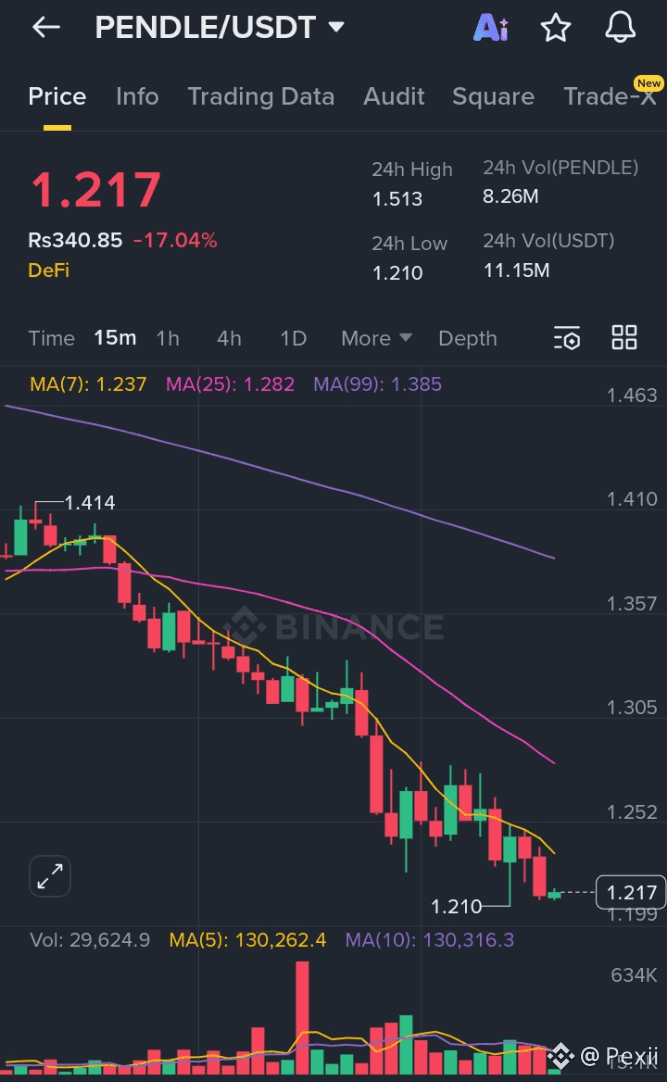
2
188

·
--

ලිපිය
The Bitcoin Privacy Lie Everyone Still Believes in 2026Spoiler: Your "anonymous" crypto wallet is basically a glass house. Here's why that's actually good news.
Three words that will shatter your worldview: #Bitcoin is transparent.
Not "sort of" transparent. Not "transparent if someone tries hard enough." We're talking permanently, immutably, irrevocably transparent.
Yet in 2026, I'm still explaining this to people who think they're digital ninjas because they bought $50 of $BTC on Binance without uploading their driver's license.
Let me save you from yourself.
Myth #1: "Bitcoin is anonymous"
Reality: It's pseudonymous and that's a massive difference.
Think of your Bitcoin address like a Reddit username. Sure, it's not your real name. But post your wallet address on Twitter once, and congratulations—you've just doxxed your entire financial history.
Every. Single. Transaction. Forever.
Remember the Silk Road bust? That wasn't magic. That was blockchain analysis. Ross Ulbricht didn't get caught because Bitcoin failed. He got caught because he trusted Bitcoin's privacy without understanding it.
In 2026, blockchain forensics is a multi-billion dollar industry. Chainalysis. Elliptic. They don't need your name. They just need one slip-up—one KYC exchange, one forum post, one NFT purchase linked to your identity—and your "anonymous" wallet becomes a permanent record of everything you've ever done.
Myth #2: "Crypto is for criminals"
Reality: Criminals moved on. You're the one still using 2014 arguments.
Here's a number that should end this conversation: 0.34%.
That's the percentage of Bitcoin transactions tied to illegal activity in 2020, down from 7% in 2012. In 2026? Even lower.
Want to know what criminals actually use? Cash. Always have. Always will. The UN estimates $1.6 trillion in dirty money moves through traditional banks annually. Bitcoin's entire market cap is smaller than that.
The "crypto is for crime" narrative is dead. It died when regulators realized they could trace it better than cash. It died when exchanges implemented KYC. It died when the FBI started auctioning seized Bitcoin.
Stop repeating 2013 talking points.
Myth #3: "You can't trace Bitcoin"
Reality: You can trace it better than your bank account.
Your bank statement shows your transactions. The Bitcoin blockchain shows everyone's transactions. Forever.
Every mixer you use, every privacy coin you swap to, every "anonymous" wallet you create—it all leaves fingerprints. And in 2026, AI-powered analysis tools can connect dots humans never could.
That "untraceable" transaction from 2019? It's still there. Waiting. And when quantum computing cracks current encryption standards, today's "private" transactions might become tomorrow's public records.
So What Does This Actually Mean?
It means Bitcoin privacy isn't about hiding. It's about control.
In 2026, true privacy requires work: coinjoins, lightning network, privacy layers, operational security most people won't bother with. The default Bitcoin experience is transparent by design—and that's the point.
Transparency enables:
• Auditability (no more "where did the money go?")
• Accountability (institutions can't hide fraud)
• Trust minimization (verify, don't trust)
The criminals lost. The builders won. And the people still claiming Bitcoin is "anonymous" are either lying to you or lying to themselves.
The Takeaway
Bitcoin didn't fail at privacy. It succeeded at something better: programmable transparency.
In a world of CBDCs and financial surveillance, Bitcoin offers something radical not anonymity, but optionality. You can be transparent. You can work for privacy. The choice is yours, but the default is clear.
Stop fearing the glass house. Start understanding why it was built that way.
Want to actually understand Bitcoin privacy in 2026? Follow for the technical breakdowns they don't teach on TikTok.
#WhenWillBTCRebound
The Bitcoin Privacy Lie Everyone Still Believes in 2026
Spoiler: Your "anonymous" crypto wallet is basically a glass house. Here's why that's actually good news.
Three words that will shatter your worldview: #Bitcoin is transparent.
Not "sort of" transparent. Not "transparent if someone tries hard enough." We're talking permanently, immutably, irrevocably transparent.
Yet in 2026, I'm still explaining this to people who think they're digital ninjas because they bought $50 of $BTC on Binance without uploading their driver's license.
Let me save you from yourself.
Myth #1: "Bitcoin is anonymous"
Reality: It's pseudonymous and that's a massive difference.
Think of your Bitcoin address like a Reddit username. Sure, it's not your real name. But post your wallet address on Twitter once, and congratulations—you've just doxxed your entire financial history.
Every. Single. Transaction. Forever.
Remember the Silk Road bust? That wasn't magic. That was blockchain analysis. Ross Ulbricht didn't get caught because Bitcoin failed. He got caught because he trusted Bitcoin's privacy without understanding it.
In 2026, blockchain forensics is a multi-billion dollar industry. Chainalysis. Elliptic. They don't need your name. They just need one slip-up—one KYC exchange, one forum post, one NFT purchase linked to your identity—and your "anonymous" wallet becomes a permanent record of everything you've ever done.
Myth #2: "Crypto is for criminals"
Reality: Criminals moved on. You're the one still using 2014 arguments.
Here's a number that should end this conversation: 0.34%.
That's the percentage of Bitcoin transactions tied to illegal activity in 2020, down from 7% in 2012. In 2026? Even lower.
Want to know what criminals actually use? Cash. Always have. Always will. The UN estimates $1.6 trillion in dirty money moves through traditional banks annually. Bitcoin's entire market cap is smaller than that.
The "crypto is for crime" narrative is dead. It died when regulators realized they could trace it better than cash. It died when exchanges implemented KYC. It died when the FBI started auctioning seized Bitcoin.
Stop repeating 2013 talking points.
Myth #3: "You can't trace Bitcoin"
Reality: You can trace it better than your bank account.
Your bank statement shows your transactions. The Bitcoin blockchain shows everyone's transactions. Forever.
Every mixer you use, every privacy coin you swap to, every "anonymous" wallet you create—it all leaves fingerprints. And in 2026, AI-powered analysis tools can connect dots humans never could.
That "untraceable" transaction from 2019? It's still there. Waiting. And when quantum computing cracks current encryption standards, today's "private" transactions might become tomorrow's public records.
So What Does This Actually Mean?
It means Bitcoin privacy isn't about hiding. It's about control.
In 2026, true privacy requires work: coinjoins, lightning network, privacy layers, operational security most people won't bother with. The default Bitcoin experience is transparent by design—and that's the point.
Transparency enables:
• Auditability (no more "where did the money go?")
• Accountability (institutions can't hide fraud)
• Trust minimization (verify, don't trust)
The criminals lost. The builders won. And the people still claiming Bitcoin is "anonymous" are either lying to you or lying to themselves.
The Takeaway
Bitcoin didn't fail at privacy. It succeeded at something better: programmable transparency.
In a world of CBDCs and financial surveillance, Bitcoin offers something radical not anonymity, but optionality. You can be transparent. You can work for privacy. The choice is yours, but the default is clear.
Stop fearing the glass house. Start understanding why it was built that way.
Want to actually understand Bitcoin privacy in 2026? Follow for the technical breakdowns they don't teach on TikTok.
#WhenWillBTCRebound
Three words that will shatter your worldview: #Bitcoin is transparent.
Not "sort of" transparent. Not "transparent if someone tries hard enough." We're talking permanently, immutably, irrevocably transparent.
Yet in 2026, I'm still explaining this to people who think they're digital ninjas because they bought $50 of $BTC on Binance without uploading their driver's license.
Let me save you from yourself.
Myth #1: "Bitcoin is anonymous"
Reality: It's pseudonymous and that's a massive difference.
Think of your Bitcoin address like a Reddit username. Sure, it's not your real name. But post your wallet address on Twitter once, and congratulations—you've just doxxed your entire financial history.
Every. Single. Transaction. Forever.
Remember the Silk Road bust? That wasn't magic. That was blockchain analysis. Ross Ulbricht didn't get caught because Bitcoin failed. He got caught because he trusted Bitcoin's privacy without understanding it.
In 2026, blockchain forensics is a multi-billion dollar industry. Chainalysis. Elliptic. They don't need your name. They just need one slip-up—one KYC exchange, one forum post, one NFT purchase linked to your identity—and your "anonymous" wallet becomes a permanent record of everything you've ever done.
Myth #2: "Crypto is for criminals"
Reality: Criminals moved on. You're the one still using 2014 arguments.
Here's a number that should end this conversation: 0.34%.
That's the percentage of Bitcoin transactions tied to illegal activity in 2020, down from 7% in 2012. In 2026? Even lower.
Want to know what criminals actually use? Cash. Always have. Always will. The UN estimates $1.6 trillion in dirty money moves through traditional banks annually. Bitcoin's entire market cap is smaller than that.
The "crypto is for crime" narrative is dead. It died when regulators realized they could trace it better than cash. It died when exchanges implemented KYC. It died when the FBI started auctioning seized Bitcoin.
Stop repeating 2013 talking points.
Myth #3: "You can't trace Bitcoin"
Reality: You can trace it better than your bank account.
Your bank statement shows your transactions. The Bitcoin blockchain shows everyone's transactions. Forever.
Every mixer you use, every privacy coin you swap to, every "anonymous" wallet you create—it all leaves fingerprints. And in 2026, AI-powered analysis tools can connect dots humans never could.
That "untraceable" transaction from 2019? It's still there. Waiting. And when quantum computing cracks current encryption standards, today's "private" transactions might become tomorrow's public records.
So What Does This Actually Mean?
It means Bitcoin privacy isn't about hiding. It's about control.
In 2026, true privacy requires work: coinjoins, lightning network, privacy layers, operational security most people won't bother with. The default Bitcoin experience is transparent by design—and that's the point.
Transparency enables:
• Auditability (no more "where did the money go?")
• Accountability (institutions can't hide fraud)
• Trust minimization (verify, don't trust)
The criminals lost. The builders won. And the people still claiming Bitcoin is "anonymous" are either lying to you or lying to themselves.
The Takeaway
Bitcoin didn't fail at privacy. It succeeded at something better: programmable transparency.
In a world of CBDCs and financial surveillance, Bitcoin offers something radical not anonymity, but optionality. You can be transparent. You can work for privacy. The choice is yours, but the default is clear.
Stop fearing the glass house. Start understanding why it was built that way.
Want to actually understand Bitcoin privacy in 2026? Follow for the technical breakdowns they don't teach on TikTok.
#WhenWillBTCRebound
6
218

·
--
බෙයාරිෂ්
Crypto Market:
A Message for Those Making Decisions in Fear and Hysteria*
If you invested a few months ago and are now selling in panic due to market downturns, it's time to rethink your trading strategy. Emotional decisions lead to financial losses and mental distress.
The harsh reality is that not every coin will rebound to its previous price. Thousands of "meme coins" and pointless projects exist that never recover once they crash. Investments made without research often suffer the same fate.
*Audit Your Investments*
Before making any decision, ask yourself:
- Why did you buy this coin?
- Does it have solid technology or a real-world use case?
- Was this decision based on your research or social media hype?
If your portfolio projects have strong fundamentals, demand may rise over time. Otherwise, expecting a comeback is a miracle.
*The Upcoming Bull Run and Selection*
Even if the market improves, not every coin will pump. The market is maturing, and only categories with real utility will rise.
*Fear vs. Opportunity (Fear & Greed Index)*
The current Fear & Greed Index is 14, indicating extreme fear. History shows that when retail traders panic sell, big investors quietly buy.
*Summary: Seek Knowledge, Not Signals*
Success comes from understanding the market, not chasing signals. Those who prioritize learning gain insights even from such writings.
The choice is yours: be an emotional trader or a conscious investor.
#CryptoStrategy #FinancialFreedom #CZBinance #WhenWillBTCRebound #USIranStandoff
Crypto Market:
A Message for Those Making Decisions in Fear and Hysteria*
If you invested a few months ago and are now selling in panic due to market downturns, it's time to rethink your trading strategy. Emotional decisions lead to financial losses and mental distress.
The harsh reality is that not every coin will rebound to its previous price. Thousands of "meme coins" and pointless projects exist that never recover once they crash. Investments made without research often suffer the same fate.
*Audit Your Investments*
Before making any decision, ask yourself:
- Why did you buy this coin?
- Does it have solid technology or a real-world use case?
- Was this decision based on your research or social media hype?
If your portfolio projects have strong fundamentals, demand may rise over time. Otherwise, expecting a comeback is a miracle.
*The Upcoming Bull Run and Selection*
Even if the market improves, not every coin will pump. The market is maturing, and only categories with real utility will rise.
*Fear vs. Opportunity (Fear & Greed Index)*
The current Fear & Greed Index is 14, indicating extreme fear. History shows that when retail traders panic sell, big investors quietly buy.
*Summary: Seek Knowledge, Not Signals*
Success comes from understanding the market, not chasing signals. Those who prioritize learning gain insights even from such writings.
The choice is yours: be an emotional trader or a conscious investor.
#CryptoStrategy #FinancialFreedom #CZBinance #WhenWillBTCRebound #USIranStandoff
A Message for Those Making Decisions in Fear and Hysteria*
If you invested a few months ago and are now selling in panic due to market downturns, it's time to rethink your trading strategy. Emotional decisions lead to financial losses and mental distress.
The harsh reality is that not every coin will rebound to its previous price. Thousands of "meme coins" and pointless projects exist that never recover once they crash. Investments made without research often suffer the same fate.
*Audit Your Investments*
Before making any decision, ask yourself:
- Why did you buy this coin?
- Does it have solid technology or a real-world use case?
- Was this decision based on your research or social media hype?
If your portfolio projects have strong fundamentals, demand may rise over time. Otherwise, expecting a comeback is a miracle.
*The Upcoming Bull Run and Selection*
Even if the market improves, not every coin will pump. The market is maturing, and only categories with real utility will rise.
*Fear vs. Opportunity (Fear & Greed Index)*
The current Fear & Greed Index is 14, indicating extreme fear. History shows that when retail traders panic sell, big investors quietly buy.
*Summary: Seek Knowledge, Not Signals*
Success comes from understanding the market, not chasing signals. Those who prioritize learning gain insights even from such writings.
The choice is yours: be an emotional trader or a conscious investor.
#CryptoStrategy #FinancialFreedom #CZBinance #WhenWillBTCRebound #USIranStandoff
22

·
--
උසබ තත්ත්වය
BREAKING: Michael Saylor wants more orange. He has shared Strategy's #Bitcoin tracker.
"Orange Dots Matter"
Strategy now holds 713,502 Bitcoins. How many Bitcoins do you think he'll buy tomorrow?
#USIranStandoff #BitcoinGoogleSearchesSurge #RiskAssetsMarketShock #WhenWillBTCRebound
BREAKING: Michael Saylor wants more orange. He has shared Strategy's #Bitcoin tracker.
"Orange Dots Matter"
Strategy now holds 713,502 Bitcoins. How many Bitcoins do you think he'll buy tomorrow?
#USIranStandoff #BitcoinGoogleSearchesSurge #RiskAssetsMarketShock #WhenWillBTCRebound
"Orange Dots Matter"
Strategy now holds 713,502 Bitcoins. How many Bitcoins do you think he'll buy tomorrow?
#USIranStandoff #BitcoinGoogleSearchesSurge #RiskAssetsMarketShock #WhenWillBTCRebound
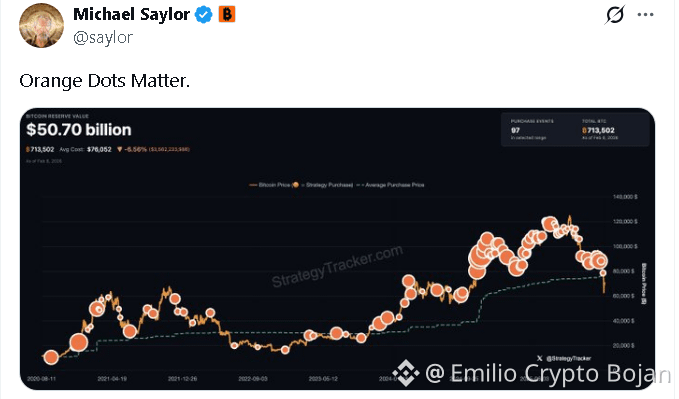
13
6.8k
තවත් අන්තර්ගතයන් ගවේෂණය කිරීමට ඇතුල් වන්න
Binance චතුරශ්රය හි ගෝලීය ක්රිප්ටෝ පරිශීලකයින් හා එක්වන්න
⚡️ ක්රිප්ටෝ පිළිබඳ නවතම සහ ප්රයෝජනවත් තොරතුරු ලබා ගන්න.
💬 ලොව විශාලතම ක්රිප්ටෝ හුවමාරුව මගින් විශ්වාස කෙරේ.
👍 සත්යායනය කරන ලද නිර්මාණකරුවන්ගෙන් සැබෑ විදසුන් සොයා ගන්න.
විද්යුත් තැපෑල / දුරකථන අංකය
නැගී එන මාතෘකා
1
#BitwiseFilesFinalNEARSpotETFProspectus
741 views
95 සාකච්ඡා කරමින්
2
#BitgetHackerMoves$83MStolenXRP
8,229 views
70 සාකච්ඡා කරමින්
3
#SOLSpotETFWeeklyInflow$188M
3,285 views
60 සාකච්ඡා කරමින්
4
#DogecoinETFsPostBiggestWeekSinceLaunch
4,897 views
208 සාකච්ඡා කරමින්
5
#StrategyStriveAdd2305BitcoinThisWeek
54,552 views
1,253 සාකච්ඡා කරමින්
6
#TrumpRejectsIranHormuzReopening
53,360 views
994 සාකච්ඡා කරමින්
7
#CircleTetherFreezeBitgetHackerWallet
64,334 views
995 සාකච්ඡා කරමින්
8
#SECSaysTokenBuybacksNotAutoSecurities
34,355 views
586 සාකච්ඡා කරමින්
9
#ChinaUSAgreeOn$30BTariffCut
2,897 views
34 සාකච්ඡා කරමින්
10
#CoinMarketCapCompletesCoinglassAcquisition
48,900 views
708 සාකච්ඡා කරමින්