
#ccp
ccp
217 නැරඹීම්
4 සාකච්ඡා කරමින්
උණුසුම්
නවතම

Bank of England expect CCPs to test market depth and conversion friction for tokenized collateralThe Bank of England (BoE) expects Central Counterparties (CCPs) to evaluate market depth and conversion friction for tokenized collateral in its exact tokenized form, rather than assuming it will behave identically to its traditional underlying counterparty asset.
In its supervisory guidance, the Bank makes clear that faster transfers during normal conditions do not guarantee rapid liquidation or liquidity following a clearing member default. To meet regulatory requirements, CCPs must stress test tokenized collateral under the following specific framework:
Key Requirements for Testing Market Depth & Friction
1. In-Asset Price Formation & Market Depth Analysis
Tokenized-Specific Liquidity: CCPs cannot rely on the liquidity, depth, or trading volume of conventional underlying securities (e.g., non-tokenized gilts). Stress tests must model the secondary market order books, bid-ask spreads, and trading venues specific to the tokenized wrapper.Conservative Valuations for Native Tokens: Where no conventional equivalent asset exists (such as natively issued DLT bonds or tokenized money market fund units), the BoE expects a conservative valuation methodology that accounts for low liquidity in tail-risk scenarios.Off-Market & 24/7 Pricing CCPs must prove that price discovery and valuation feeds remain accurate and unmanipulated during weekend/after-hours windows or periods of extreme network traffic.
2. Measuring Operational Conversion Frictions
On/Off-Ramp Bottlenecks: Stress testing must explicitly measure the time, cost, and operational steps required to convert a token back into cash or conventional securities during a crisis.Dependency Chain Failure: CCP liquidity stress models must factor in potential delays caused by third parties in the ecosystem—such as primary tokenizers, atomic conversion bridges, smart contract protocols, or wallet infrastructure providers.Smart Contract & Settlement Frictions: Tests must evaluate whether technical execution features (e.g., mint/burn mechanics, permissioning checks, or protocol gas fees) slow down asset liquidation during peak market stress.
3. Default Management & Redemption Fire-Sales
Default Waterfall Simulation: In a clearing member default scenario, the CCP must demonstrate how quickly it can seize, transfer, and liquidate tokenized collateral without causing self-induced market impact.Redemption Timeline Frictions: For assets like tokenized Money Market Funds (tMMFs), the CCP’s stress testing must account for redemption gates, liquidity fees, or time lags embedded in the underlying fund structure that could prevent instant access to cash.Haircut Adjustments: If stress tests reveal conversion bottlenecks or shallow token-specific market depth, the BoE expects the CCP to apply conservative haircut multipliers to cover potential liquidation slippage.
#CCP #MMF代币化
Bank of England expect CCPs to test market depth and conversion friction for tokenized collateral
The Bank of England (BoE) expects Central Counterparties (CCPs) to evaluate market depth and conversion friction for tokenized collateral in its exact tokenized form, rather than assuming it will behave identically to its traditional underlying counterparty asset.
In its supervisory guidance, the Bank makes clear that faster transfers during normal conditions do not guarantee rapid liquidation or liquidity following a clearing member default. To meet regulatory requirements, CCPs must stress test tokenized collateral under the following specific framework:
Key Requirements for Testing Market Depth & Friction
1. In-Asset Price Formation & Market Depth Analysis
Tokenized-Specific Liquidity: CCPs cannot rely on the liquidity, depth, or trading volume of conventional underlying securities (e.g., non-tokenized gilts). Stress tests must model the secondary market order books, bid-ask spreads, and trading venues specific to the tokenized wrapper.Conservative Valuations for Native Tokens: Where no conventional equivalent asset exists (such as natively issued DLT bonds or tokenized money market fund units), the BoE expects a conservative valuation methodology that accounts for low liquidity in tail-risk scenarios.Off-Market & 24/7 Pricing CCPs must prove that price discovery and valuation feeds remain accurate and unmanipulated during weekend/after-hours windows or periods of extreme network traffic.
2. Measuring Operational Conversion Frictions
On/Off-Ramp Bottlenecks: Stress testing must explicitly measure the time, cost, and operational steps required to convert a token back into cash or conventional securities during a crisis.Dependency Chain Failure: CCP liquidity stress models must factor in potential delays caused by third parties in the ecosystem—such as primary tokenizers, atomic conversion bridges, smart contract protocols, or wallet infrastructure providers.Smart Contract & Settlement Frictions: Tests must evaluate whether technical execution features (e.g., mint/burn mechanics, permissioning checks, or protocol gas fees) slow down asset liquidation during peak market stress.
3. Default Management & Redemption Fire-Sales
Default Waterfall Simulation: In a clearing member default scenario, the CCP must demonstrate how quickly it can seize, transfer, and liquidate tokenized collateral without causing self-induced market impact.Redemption Timeline Frictions: For assets like tokenized Money Market Funds (tMMFs), the CCP’s stress testing must account for redemption gates, liquidity fees, or time lags embedded in the underlying fund structure that could prevent instant access to cash.Haircut Adjustments: If stress tests reveal conversion bottlenecks or shallow token-specific market depth, the BoE expects the CCP to apply conservative haircut multipliers to cover potential liquidation slippage.
#CCP #MMF代币化
In its supervisory guidance, the Bank makes clear that faster transfers during normal conditions do not guarantee rapid liquidation or liquidity following a clearing member default. To meet regulatory requirements, CCPs must stress test tokenized collateral under the following specific framework:
Key Requirements for Testing Market Depth & Friction
1. In-Asset Price Formation & Market Depth Analysis
Tokenized-Specific Liquidity: CCPs cannot rely on the liquidity, depth, or trading volume of conventional underlying securities (e.g., non-tokenized gilts). Stress tests must model the secondary market order books, bid-ask spreads, and trading venues specific to the tokenized wrapper.Conservative Valuations for Native Tokens: Where no conventional equivalent asset exists (such as natively issued DLT bonds or tokenized money market fund units), the BoE expects a conservative valuation methodology that accounts for low liquidity in tail-risk scenarios.Off-Market & 24/7 Pricing CCPs must prove that price discovery and valuation feeds remain accurate and unmanipulated during weekend/after-hours windows or periods of extreme network traffic.
2. Measuring Operational Conversion Frictions
On/Off-Ramp Bottlenecks: Stress testing must explicitly measure the time, cost, and operational steps required to convert a token back into cash or conventional securities during a crisis.Dependency Chain Failure: CCP liquidity stress models must factor in potential delays caused by third parties in the ecosystem—such as primary tokenizers, atomic conversion bridges, smart contract protocols, or wallet infrastructure providers.Smart Contract & Settlement Frictions: Tests must evaluate whether technical execution features (e.g., mint/burn mechanics, permissioning checks, or protocol gas fees) slow down asset liquidation during peak market stress.
3. Default Management & Redemption Fire-Sales
Default Waterfall Simulation: In a clearing member default scenario, the CCP must demonstrate how quickly it can seize, transfer, and liquidate tokenized collateral without causing self-induced market impact.Redemption Timeline Frictions: For assets like tokenized Money Market Funds (tMMFs), the CCP’s stress testing must account for redemption gates, liquidity fees, or time lags embedded in the underlying fund structure that could prevent instant access to cash.Haircut Adjustments: If stress tests reveal conversion bottlenecks or shallow token-specific market depth, the BoE expects the CCP to apply conservative haircut multipliers to cover potential liquidation slippage.
#CCP #MMF代币化
28

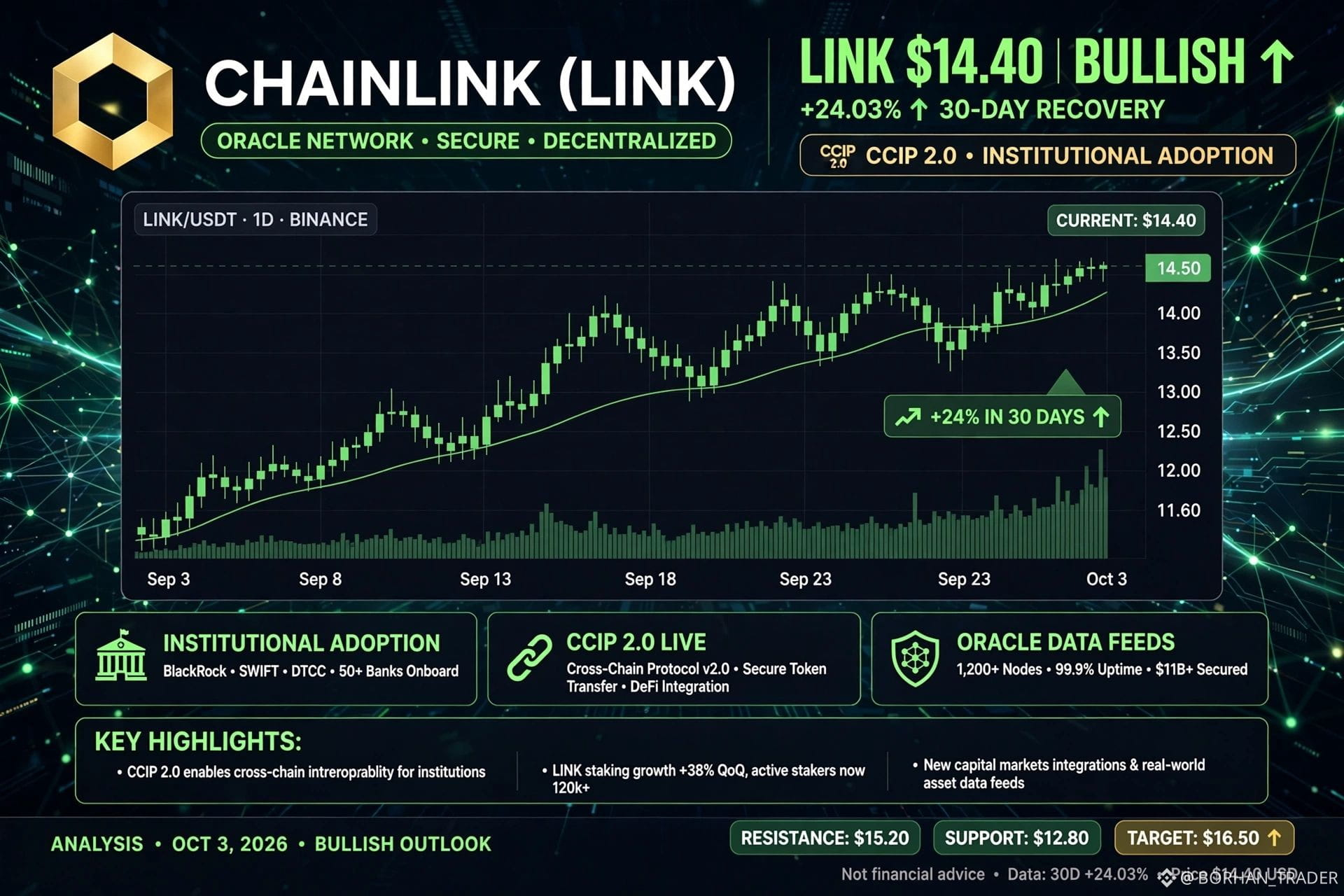
> 🔗 *CHAINLINK (LINK) – The Sleeping Giant Waking Up!*
>
> $LINK now $14.40 🔥 +24% recovery in 30 days from $11!
> Today -4% correction but the trend is still BULLISH 💚
>
> *Keno Bullish?*
> ✅ CCIP 2.0 Launch – 50+ major institutions onboard including SWIFT, DTCC, ANZ Bank
> ✅ 6.12M LINK deposit in Reserve – 75k-140k $LINK buy every week
> ✅ $10.8B Market Cap, ATH from $52.70 still at 73% discount!
>
> *My Levels:*
> Resistance: $15.20
> Support: $12.80
>Target: $16.50 🚀
>
> DeFi is dead without Oracle, and Chainlink is the King of Oracle 👑
> Patience over prediction!
>
> Where are the $LINK
{spot}(LINKUSDT)
Holders? 👇> #link #chinlink #ccp #crypto #bullish
> 🔗 *CHAINLINK (LINK) – The Sleeping Giant Waking Up!*
>
> $LINK now $14.40 🔥 +24% recovery in 30 days from $11!
> Today -4% correction but the trend is still BULLISH 💚
>
> *Keno Bullish?*
> ✅ CCIP 2.0 Launch – 50+ major institutions onboard including SWIFT, DTCC, ANZ Bank
> ✅ 6.12M LINK deposit in Reserve – 75k-140k $LINK buy every week
> ✅ $10.8B Market Cap, ATH from $52.70 still at 73% discount!
>
> *My Levels:*
> Resistance: $15.20
> Support: $12.80
>Target: $16.50 🚀
>
> DeFi is dead without Oracle, and Chainlink is the King of Oracle 👑
> Patience over prediction!
>
> Where are the $LINK
Holders? 👇> #link #chinlink #ccp #crypto #bullish
>
> $LINK now $14.40 🔥 +24% recovery in 30 days from $11!
> Today -4% correction but the trend is still BULLISH 💚
>
> *Keno Bullish?*
> ✅ CCIP 2.0 Launch – 50+ major institutions onboard including SWIFT, DTCC, ANZ Bank
> ✅ 6.12M LINK deposit in Reserve – 75k-140k $LINK buy every week
> ✅ $10.8B Market Cap, ATH from $52.70 still at 73% discount!
>
> *My Levels:*
> Resistance: $15.20
> Support: $12.80
>Target: $16.50 🚀
>
> DeFi is dead without Oracle, and Chainlink is the King of Oracle 👑
> Patience over prediction!
>
> Where are the $LINK
Holders? 👇> #link #chinlink #ccp #crypto #bullish
1
148
තවත් අන්තර්ගතයන් ගවේෂණය කිරීමට ඇතුල් වන්න
Binance චතුරශ්රය හි ගෝලීය ක්රිප්ටෝ පරිශීලකයින් හා එක්වන්න
⚡️ ක්රිප්ටෝ පිළිබඳ නවතම සහ ප්රයෝජනවත් තොරතුරු ලබා ගන්න.
💬 ලොව විශාලතම ක්රිප්ටෝ හුවමාරුව මගින් විශ්වාස කෙරේ.
👍 සත්යායනය කරන ලද නිර්මාණකරුවන්ගෙන් සැබෑ විදසුන් සොයා ගන්න.
විද්යුත් තැපෑල / දුරකථන අංකය
නැගී එන මාතෘකා
1
#CanBTCReboundAfterFallingBelow60K?
120,239 නැරඹීම්
530 සාකච්ඡා කරමින්
2
#GlobalStocksFaceLongestLosingStreakSince2023
52,266 නැරඹීම්
509 සාකච්ඡා කරමින්
3
#AnthropicPlungesTowardIPOPriceonDay2
17,921 නැරඹීම්
209 සාකච්ඡා කරමින්
4
#GaoTengBitcoinETFListsOnHKEX
37,335 නැරඹීම්
389 සාකච්ඡා කරමින්
5
#TradFiForBeginners
1M නැරඹීම්
5,834 සාකච්ඡා කරමින්
6
#NvidiaBoardReportedlySplitOverHuang’sReturn
401,728 නැරඹීම්
2,583 සාකච්ඡා කරමින්
7
#TetherBurns8BillionUSDTInPast20Days
44,980 නැරඹීම්
164 සාකච්ඡා කරමින්
8
#BitcoinWalletSignatureFlawExploitableWithinSeconds
12,437 නැරඹීම්
79 සාකච්ඡා කරමින්
9
#CanGTA6'sLaunchLiftTTWOShares?
337,653 නැරඹීම්
1,811 සාකච්ඡා කරමින්
10
#HongKongProposesSFCLicensingForFourVirtualAssetServices
2,159 නැරඹීම්
36 සාකච්ඡා කරමින්