

#candlestickpatterns
candlestickpatterns
1.6M නැරඹීම්
818 සාකච්ඡා කරමින්
උණුසුම්
නවතම

·
--
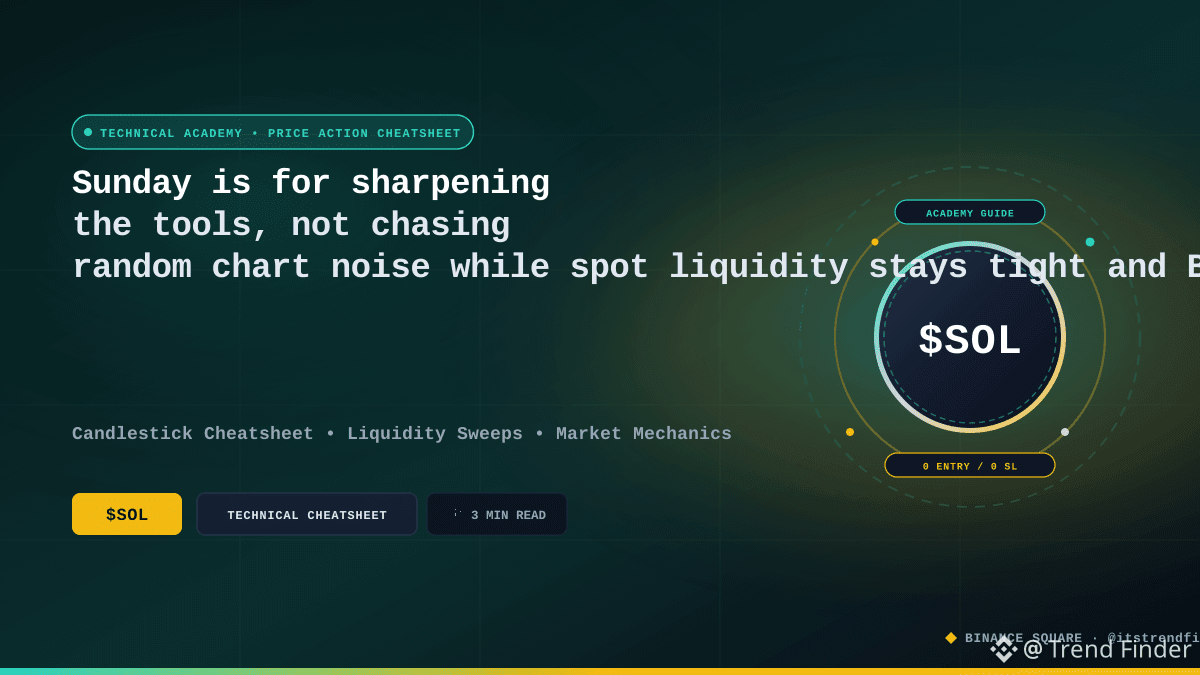
Sunday is for sharpening the tools, not chasing random chart noise while spot liquidity stays tight and BTC dominance keeps altcoins compressed. With $SOL hovering near 101.93 against a circulating float of roughly 474 million tokens, it is a textbook asset for dissecting how institutional footprints actually look on a chart before the Monday open.
Let us break down the mechanics of price action without any noise. When mapping market structure, a clean Break of Structure confirms a shift in momentum when price invalidates a previous pivot. Smart money leaves distinct architectural clues behind, and spotting them separates reactive retail traders from proactive researchers.
Candlestick anatomy tells the real story of supply and demand absorption. A long wick on a pin bar shows aggressive rejection of lower prices, especially when it taps directly into a validated order block. Combine that with fair value gaps, those efficiency imbalances left behind during rapid impulse moves where institutional capital often returns to mitigate risk, and your charting starts to look less like guessing and more like reading a ledger.
Wyckoff accumulation and distribution schemes are currently playing out across multiple timeframes. Spotting how institutional hands absorb retail panic supply tells you everything about who is actually holding the heavy float. It is all about mapping the battlefield where big capital operates rather than staring blindly at the next candle close.
How are you approaching your technical study sessions this weekend while the broader market stays range-bound?
#TechnicalAnalysis #CandlestickPatterns
Sunday is for sharpening the tools, not chasing random chart noise while spot liquidity stays tight and BTC dominance keeps altcoins compressed. With $SOL hovering near 101.93 against a circulating float of roughly 474 million tokens, it is a textbook asset for dissecting how institutional footprints actually look on a chart before the Monday open.
Let us break down the mechanics of price action without any noise. When mapping market structure, a clean Break of Structure confirms a shift in momentum when price invalidates a previous pivot. Smart money leaves distinct architectural clues behind, and spotting them separates reactive retail traders from proactive researchers.
Candlestick anatomy tells the real story of supply and demand absorption. A long wick on a pin bar shows aggressive rejection of lower prices, especially when it taps directly into a validated order block. Combine that with fair value gaps, those efficiency imbalances left behind during rapid impulse moves where institutional capital often returns to mitigate risk, and your charting starts to look less like guessing and more like reading a ledger.
Wyckoff accumulation and distribution schemes are currently playing out across multiple timeframes. Spotting how institutional hands absorb retail panic supply tells you everything about who is actually holding the heavy float. It is all about mapping the battlefield where big capital operates rather than staring blindly at the next candle close.
How are you approaching your technical study sessions this weekend while the broader market stays range-bound?
#TechnicalAnalysis #CandlestickPatterns
Let us break down the mechanics of price action without any noise. When mapping market structure, a clean Break of Structure confirms a shift in momentum when price invalidates a previous pivot. Smart money leaves distinct architectural clues behind, and spotting them separates reactive retail traders from proactive researchers.
Candlestick anatomy tells the real story of supply and demand absorption. A long wick on a pin bar shows aggressive rejection of lower prices, especially when it taps directly into a validated order block. Combine that with fair value gaps, those efficiency imbalances left behind during rapid impulse moves where institutional capital often returns to mitigate risk, and your charting starts to look less like guessing and more like reading a ledger.
Wyckoff accumulation and distribution schemes are currently playing out across multiple timeframes. Spotting how institutional hands absorb retail panic supply tells you everything about who is actually holding the heavy float. It is all about mapping the battlefield where big capital operates rather than staring blindly at the next candle close.
How are you approaching your technical study sessions this weekend while the broader market stays range-bound?
#TechnicalAnalysis #CandlestickPatterns
1
1
·
--
Decoding Ethereum Market Footprints: The Weekend Structural Playbook
Weekend trading across crypto markets is notoriously thin, but the quiet price action hovering near 2387.49 for $ETH offers a clean canvas to study structural footprints before Monday volatility kicks in. When liquidity drops, institutional signatures become far more visible on higher timeframes. Instead of getting caught up in minor fluctuations, focus on candlestick anatomy. A long lower wick paired with a small upper body indicates aggressive supply absorption by larger participants. Patterns like bullish engulfing candles or morning stars lose their retail randomness when they form directly inside an established demand area, signaling a legitimate momentum shift rather than a temporary bounce.
Under Smart Money Concepts, we focus on Fair Value Gaps and institutional order blocks. A Fair Value Gap represents an efficiency imbalance created during rapid market expansion. Price regularly revisits these imbalances to sweep resting liquidity before initiating the next major move. When an efficiency gap aligns perfectly with an unmitigated order block, algorithmic execution points become clearly visible.
Structure is ultimate context. A Break of Structure confirms ongoing trend continuation, while a Market Structure Shift warns that a prior high or low has failed to hold, marking a potential trend reversal. Mapping these structural pivots against Wyckoff accumulation or distribution models helps clarify whether ETH is undergoing institutional re-accumulation or quietly distributing before a deeper macroeconomic reset. Watching tokenomics and circulating float behavior during quiet hours sets up your week far better than chasing Sunday noise.
Are you spotting any distinct order block retests or fair value gap fills on your higher timeframe ETH charts this weekend?
#TechnicalAnalysis #CandlestickPatterns
Decoding Ethereum Market Footprints: The Weekend Structural Playbook
Weekend trading across crypto markets is notoriously thin, but the quiet price action hovering near 2387.49 for $ETH offers a clean canvas to study structural footprints before Monday volatility kicks in. When liquidity drops, institutional signatures become far more visible on higher timeframes. Instead of getting caught up in minor fluctuations, focus on candlestick anatomy. A long lower wick paired with a small upper body indicates aggressive supply absorption by larger participants. Patterns like bullish engulfing candles or morning stars lose their retail randomness when they form directly inside an established demand area, signaling a legitimate momentum shift rather than a temporary bounce.
Under Smart Money Concepts, we focus on Fair Value Gaps and institutional order blocks. A Fair Value Gap represents an efficiency imbalance created during rapid market expansion. Price regularly revisits these imbalances to sweep resting liquidity before initiating the next major move. When an efficiency gap aligns perfectly with an unmitigated order block, algorithmic execution points become clearly visible.
Structure is ultimate context. A Break of Structure confirms ongoing trend continuation, while a Market Structure Shift warns that a prior high or low has failed to hold, marking a potential trend reversal. Mapping these structural pivots against Wyckoff accumulation or distribution models helps clarify whether ETH is undergoing institutional re-accumulation or quietly distributing before a deeper macroeconomic reset. Watching tokenomics and circulating float behavior during quiet hours sets up your week far better than chasing Sunday noise.
Are you spotting any distinct order block retests or fair value gap fills on your higher timeframe ETH charts this weekend?
#TechnicalAnalysis #CandlestickPatterns
Weekend trading across crypto markets is notoriously thin, but the quiet price action hovering near 2387.49 for $ETH offers a clean canvas to study structural footprints before Monday volatility kicks in. When liquidity drops, institutional signatures become far more visible on higher timeframes. Instead of getting caught up in minor fluctuations, focus on candlestick anatomy. A long lower wick paired with a small upper body indicates aggressive supply absorption by larger participants. Patterns like bullish engulfing candles or morning stars lose their retail randomness when they form directly inside an established demand area, signaling a legitimate momentum shift rather than a temporary bounce.
Under Smart Money Concepts, we focus on Fair Value Gaps and institutional order blocks. A Fair Value Gap represents an efficiency imbalance created during rapid market expansion. Price regularly revisits these imbalances to sweep resting liquidity before initiating the next major move. When an efficiency gap aligns perfectly with an unmitigated order block, algorithmic execution points become clearly visible.
Structure is ultimate context. A Break of Structure confirms ongoing trend continuation, while a Market Structure Shift warns that a prior high or low has failed to hold, marking a potential trend reversal. Mapping these structural pivots against Wyckoff accumulation or distribution models helps clarify whether ETH is undergoing institutional re-accumulation or quietly distributing before a deeper macroeconomic reset. Watching tokenomics and circulating float behavior during quiet hours sets up your week far better than chasing Sunday noise.
Are you spotting any distinct order block retests or fair value gap fills on your higher timeframe ETH charts this weekend?
#TechnicalAnalysis #CandlestickPatterns

1
1

·
--
Hanging Man Alert ⚠️
@Square-Creator-905762059
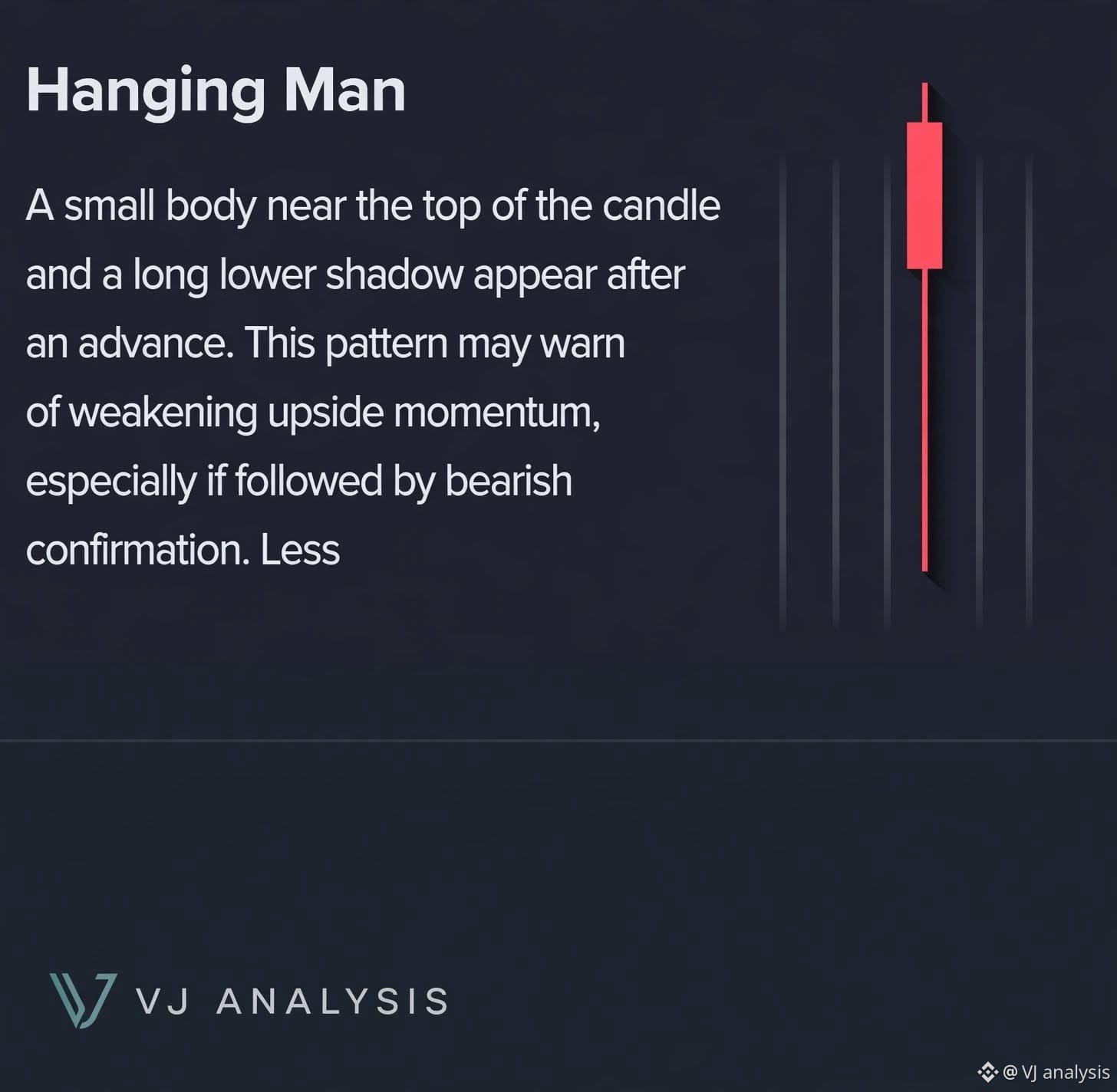
A small body near the top with a long lower shadow appears after an advance. This warns of weakening upside momentum — sellers stepping in.
If followed by bearish confirmation, expect potential reversal. Watch your longs, tighten stops, and wait for confirmation before flipping.
#VJAnalysis #CandlestickPatterns
Hanging Man Alert ⚠️
@VJ analysis
A small body near the top with a long lower shadow appears after an advance. This warns of weakening upside momentum — sellers stepping in.
If followed by bearish confirmation, expect potential reversal. Watch your longs, tighten stops, and wait for confirmation before flipping.
#VJAnalysis #CandlestickPatterns
@VJ analysis
A small body near the top with a long lower shadow appears after an advance. This warns of weakening upside momentum — sellers stepping in.
If followed by bearish confirmation, expect potential reversal. Watch your longs, tighten stops, and wait for confirmation before flipping.
#VJAnalysis #CandlestickPatterns
485

·
--
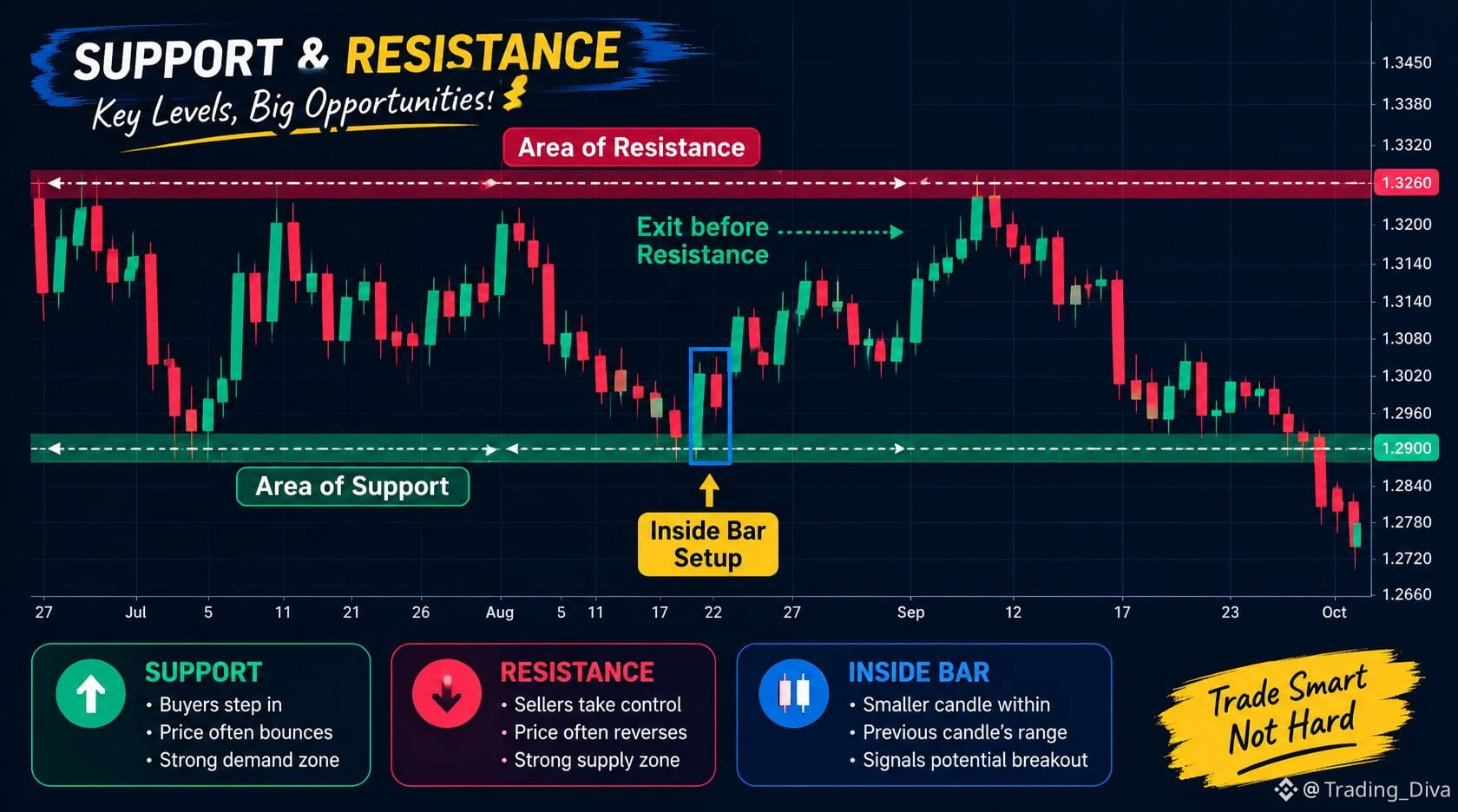
📈 BULLISH INSIDE BAR PATTERN: A POTENTIAL TREND REVERSAL SIGNAL! 🚀
A Bullish Inside Bar is a candlestick pattern that traders watch for signs of a possible shift from bearish momentum to bullish price action.
🔍 How Does It Work?
This setup involves two candlesticks:
🟥 First Candle: A bearish candle that reflects selling pressure.
🟩 Second Candle: A smaller bullish candle that remains within the real body of the previous bearish candle, staying between its opening and closing prices.
📊 What Does It Indicate?
The pattern may suggest that selling pressure is weakening and buyers are beginning to gain strength. However, it does not guarantee a trend reversal.
🎯 Trading Tip:
Wait for price confirmation before entering a trade. Analyze the surrounding market structure, key support and resistance levels, and trading volume where available. Always manage your risk and avoid making decisions based on a single candlestick pattern.
📸 Live Chart Example: Look for a bearish candle followed by a smaller bullish candle forming inside its real body.
💬 Question for Traders: Have you spotted a Bullish Inside Bar on a live chart recently? Share your thoughts below!
#BinanceSquare #CryptoTrading. #CandlestickPatterns #priceaction #TechnicalAnalysis
📈 BULLISH INSIDE BAR PATTERN: A POTENTIAL TREND REVERSAL SIGNAL! 🚀
A Bullish Inside Bar is a candlestick pattern that traders watch for signs of a possible shift from bearish momentum to bullish price action.
🔍 How Does It Work?
This setup involves two candlesticks:
🟥 First Candle: A bearish candle that reflects selling pressure.
🟩 Second Candle: A smaller bullish candle that remains within the real body of the previous bearish candle, staying between its opening and closing prices.
📊 What Does It Indicate?
The pattern may suggest that selling pressure is weakening and buyers are beginning to gain strength. However, it does not guarantee a trend reversal.
🎯 Trading Tip:
Wait for price confirmation before entering a trade. Analyze the surrounding market structure, key support and resistance levels, and trading volume where available. Always manage your risk and avoid making decisions based on a single candlestick pattern.
📸 Live Chart Example: Look for a bearish candle followed by a smaller bullish candle forming inside its real body.
💬 Question for Traders: Have you spotted a Bullish Inside Bar on a live chart recently? Share your thoughts below!
#BinanceSquare #CryptoTrading. #CandlestickPatterns #priceaction #TechnicalAnalysis
A Bullish Inside Bar is a candlestick pattern that traders watch for signs of a possible shift from bearish momentum to bullish price action.
🔍 How Does It Work?
This setup involves two candlesticks:
🟥 First Candle: A bearish candle that reflects selling pressure.
🟩 Second Candle: A smaller bullish candle that remains within the real body of the previous bearish candle, staying between its opening and closing prices.
📊 What Does It Indicate?
The pattern may suggest that selling pressure is weakening and buyers are beginning to gain strength. However, it does not guarantee a trend reversal.
🎯 Trading Tip:
Wait for price confirmation before entering a trade. Analyze the surrounding market structure, key support and resistance levels, and trading volume where available. Always manage your risk and avoid making decisions based on a single candlestick pattern.
📸 Live Chart Example: Look for a bearish candle followed by a smaller bullish candle forming inside its real body.
💬 Question for Traders: Have you spotted a Bullish Inside Bar on a live chart recently? Share your thoughts below!
#BinanceSquare #CryptoTrading. #CandlestickPatterns #priceaction #TechnicalAnalysis
60
·
--
Mastering the Anatomy of $BNB: A Sunday Deep Dive into Market Structure
The weekend provides a rare window to strip away the emotional noise of the weekday charts and focus on the cold, hard mechanics of the ledger. While BNB holds its ground around the 722.44 level, the real story isn't found in the current spot price, but in how the candles interact with the supply zones established by the approximately 147.58 million tokens in circulation. This is the time to analyze the architecture before the Monday volatility returns.
When we look at candle anatomy, the body tells us where the consensus settled, but the wicks reveal where the liquidity was hunted. A long wick rejection on the daily timeframe usually indicates that institutional limit orders are absorbing aggressive selling pressure. I pay close attention to Fair Value Gaps, or FVGs, which act like magnets. These are imbalances where price moved too fast for the market to facilitate two-way trade. Eventually, price tends to return to these zones to seek structural equilibrium.
Moving beyond individual candles, understanding the difference between a Break of Structure and a Market Structure Shift is what separates researchers from gamblers. A clean break confirms the trend, while a shift suggests a reversal is brewing. Right now, the Wyckoff cycle points toward a sophisticated tug-of-war between accumulation and distribution. Large holders are showing a preference for locking assets, likely driven by the consistent deflationary pressure of the quarterly burn mechanics rather than short-term flips.
As we approach the Monday open, I am watching how the price interacts with the most recent order blocks. These zones represent where smart money left its footprint. If the market respects these structural levels, it confirms a solid foundation for the week ahead.
How are you mapping out the liquidity zones on your charts before the weekly close?
_
#TechnicalAnalysis #CandlestickPatterns
Mastering the Anatomy of $BNB : A Sunday Deep Dive into Market Structure
The weekend provides a rare window to strip away the emotional noise of the weekday charts and focus on the cold, hard mechanics of the ledger. While BNB holds its ground around the 722.44 level, the real story isn't found in the current spot price, but in how the candles interact with the supply zones established by the approximately 147.58 million tokens in circulation. This is the time to analyze the architecture before the Monday volatility returns.
When we look at candle anatomy, the body tells us where the consensus settled, but the wicks reveal where the liquidity was hunted. A long wick rejection on the daily timeframe usually indicates that institutional limit orders are absorbing aggressive selling pressure. I pay close attention to Fair Value Gaps, or FVGs, which act like magnets. These are imbalances where price moved too fast for the market to facilitate two-way trade. Eventually, price tends to return to these zones to seek structural equilibrium.
Moving beyond individual candles, understanding the difference between a Break of Structure and a Market Structure Shift is what separates researchers from gamblers. A clean break confirms the trend, while a shift suggests a reversal is brewing. Right now, the Wyckoff cycle points toward a sophisticated tug-of-war between accumulation and distribution. Large holders are showing a preference for locking assets, likely driven by the consistent deflationary pressure of the quarterly burn mechanics rather than short-term flips.
As we approach the Monday open, I am watching how the price interacts with the most recent order blocks. These zones represent where smart money left its footprint. If the market respects these structural levels, it confirms a solid foundation for the week ahead.
How are you mapping out the liquidity zones on your charts before the weekly close?
_
#TechnicalAnalysis #CandlestickPatterns
The weekend provides a rare window to strip away the emotional noise of the weekday charts and focus on the cold, hard mechanics of the ledger. While BNB holds its ground around the 722.44 level, the real story isn't found in the current spot price, but in how the candles interact with the supply zones established by the approximately 147.58 million tokens in circulation. This is the time to analyze the architecture before the Monday volatility returns.
When we look at candle anatomy, the body tells us where the consensus settled, but the wicks reveal where the liquidity was hunted. A long wick rejection on the daily timeframe usually indicates that institutional limit orders are absorbing aggressive selling pressure. I pay close attention to Fair Value Gaps, or FVGs, which act like magnets. These are imbalances where price moved too fast for the market to facilitate two-way trade. Eventually, price tends to return to these zones to seek structural equilibrium.
Moving beyond individual candles, understanding the difference between a Break of Structure and a Market Structure Shift is what separates researchers from gamblers. A clean break confirms the trend, while a shift suggests a reversal is brewing. Right now, the Wyckoff cycle points toward a sophisticated tug-of-war between accumulation and distribution. Large holders are showing a preference for locking assets, likely driven by the consistent deflationary pressure of the quarterly burn mechanics rather than short-term flips.
As we approach the Monday open, I am watching how the price interacts with the most recent order blocks. These zones represent where smart money left its footprint. If the market respects these structural levels, it confirms a solid foundation for the week ahead.
How are you mapping out the liquidity zones on your charts before the weekly close?
_
#TechnicalAnalysis #CandlestickPatterns

1
5
·
--
The Sunday Liquidity Playbook: Decoding BTC Price Action and Smart Money Concepts Before Monday
Sunday morning hours present the ideal window to evaluate raw market structure before institutional algorithms reactivate for the weekly open. With $BTC floating near 81507.32, current price action demonstrates a classic consolidation phase where reading structural intent matters far more than tracking short-term noise.
Understanding price action begins with candlestick anatomy. A small body with an extended lower wick on daily charts signals aggressive seller absorption at key support zones. These wicks frequently sweep liquidity resting beneath high-volume areas, effectively validating historical Order Blocks where institutional order flow resides. When price leaves behind an unfilled Fair Value Gap right above an established Order Block, the market naturally gravitates back toward that inefficient zone to restore balance before continuing its primary trend.
Mapping macro bias requires tracking structural shifts using Wyckoff principles. A Break of Structure confirms trend continuation as price closes past prior swing highs with strong momentum. However, if price fails to form higher highs following a Break of Structure, a Market Structure Shift often signals an impending transition from re-accumulation into a local distribution scheme.
Tokenomics quietly reinforce these technical setups. Despite Bitcoin having nearly its full circulating float active in the market, restricted exchange supply and long-term holder retention dictate how deep those wicks sweep local lows during weekend washouts. Institutions analyze monthly volume profiles and fair value nodes rather than reacting to minor intraday fluctuations.
Mastering these foundational mechanics ensures you remain aligned with smart money positioning when global markets reopen.
Which technical pattern do you find yourself relying on the most when reading messy weekend price action?
#TechnicalAnalysis #CandlestickPatterns
The Sunday Liquidity Playbook: Decoding BTC Price Action and Smart Money Concepts Before Monday
Sunday morning hours present the ideal window to evaluate raw market structure before institutional algorithms reactivate for the weekly open. With $BTC floating near 81507.32, current price action demonstrates a classic consolidation phase where reading structural intent matters far more than tracking short-term noise.
Understanding price action begins with candlestick anatomy. A small body with an extended lower wick on daily charts signals aggressive seller absorption at key support zones. These wicks frequently sweep liquidity resting beneath high-volume areas, effectively validating historical Order Blocks where institutional order flow resides. When price leaves behind an unfilled Fair Value Gap right above an established Order Block, the market naturally gravitates back toward that inefficient zone to restore balance before continuing its primary trend.
Mapping macro bias requires tracking structural shifts using Wyckoff principles. A Break of Structure confirms trend continuation as price closes past prior swing highs with strong momentum. However, if price fails to form higher highs following a Break of Structure, a Market Structure Shift often signals an impending transition from re-accumulation into a local distribution scheme.
Tokenomics quietly reinforce these technical setups. Despite Bitcoin having nearly its full circulating float active in the market, restricted exchange supply and long-term holder retention dictate how deep those wicks sweep local lows during weekend washouts. Institutions analyze monthly volume profiles and fair value nodes rather than reacting to minor intraday fluctuations.
Mastering these foundational mechanics ensures you remain aligned with smart money positioning when global markets reopen.
Which technical pattern do you find yourself relying on the most when reading messy weekend price action?
#TechnicalAnalysis #CandlestickPatterns
Sunday morning hours present the ideal window to evaluate raw market structure before institutional algorithms reactivate for the weekly open. With $BTC floating near 81507.32, current price action demonstrates a classic consolidation phase where reading structural intent matters far more than tracking short-term noise.
Understanding price action begins with candlestick anatomy. A small body with an extended lower wick on daily charts signals aggressive seller absorption at key support zones. These wicks frequently sweep liquidity resting beneath high-volume areas, effectively validating historical Order Blocks where institutional order flow resides. When price leaves behind an unfilled Fair Value Gap right above an established Order Block, the market naturally gravitates back toward that inefficient zone to restore balance before continuing its primary trend.
Mapping macro bias requires tracking structural shifts using Wyckoff principles. A Break of Structure confirms trend continuation as price closes past prior swing highs with strong momentum. However, if price fails to form higher highs following a Break of Structure, a Market Structure Shift often signals an impending transition from re-accumulation into a local distribution scheme.
Tokenomics quietly reinforce these technical setups. Despite Bitcoin having nearly its full circulating float active in the market, restricted exchange supply and long-term holder retention dictate how deep those wicks sweep local lows during weekend washouts. Institutions analyze monthly volume profiles and fair value nodes rather than reacting to minor intraday fluctuations.
Mastering these foundational mechanics ensures you remain aligned with smart money positioning when global markets reopen.
Which technical pattern do you find yourself relying on the most when reading messy weekend price action?
#TechnicalAnalysis #CandlestickPatterns
1
49
·
--
The Sunday Order Book Playbook: Reading BNB's Price Action Before Monday Open
When liquidity thins out over the weekend, chart movements become surprisingly pure. With $BNB floating near 722.74, spot trading volume drops, giving us a clean lens to examine mechanical price action before traditional global markets react on Monday.
Understanding candlestick anatomy is the foundation of institutional tape reading. A long wick rejection is rarely a random event; it reflects a targeted liquidity sweep by market makers filling large counter-party orders. When these rejections align with an established Order Block, you are observing zones where institutional interest previously triggered aggressive moves. Parallel to this, Fair Value Gaps mark sudden structural imbalances where one-sided aggressive buying or selling left inefficient voids. Price naturally gravitates back to these gaps to complete unfinished auctions.
Tracking structural transitions requires separating noise from true shifts. A Break of Structure confirms continuation along the prevailing direction, whereas a Market Structure Shift signals potential exhaustion when price fails to record a new swing high and instead pierces a vital swing low. Applying this to BNB through a Wyckoff framework provides valuable perspective. Given its circulating supply of roughly 147.5 million tokens, moving price requires heavy capital absorption. During low-volume weekend sessions, sideways ranges often reveal whether large float is being steadily absorbed by smart money or quietly distributed into passive bids.
Studying historical structure always beats chasing real-time noise. By mastering these core price action principles, you prepare yourself to read the tape rather than react emotionally when Monday volatility arrives. Which price action setup do you trust the most when mapping out your weekly chart preparation?
#TechnicalAnalysis #CandlestickPatterns
The Sunday Order Book Playbook: Reading BNB's Price Action Before Monday Open
When liquidity thins out over the weekend, chart movements become surprisingly pure. With $BNB floating near 722.74, spot trading volume drops, giving us a clean lens to examine mechanical price action before traditional global markets react on Monday.
Understanding candlestick anatomy is the foundation of institutional tape reading. A long wick rejection is rarely a random event; it reflects a targeted liquidity sweep by market makers filling large counter-party orders. When these rejections align with an established Order Block, you are observing zones where institutional interest previously triggered aggressive moves. Parallel to this, Fair Value Gaps mark sudden structural imbalances where one-sided aggressive buying or selling left inefficient voids. Price naturally gravitates back to these gaps to complete unfinished auctions.
Tracking structural transitions requires separating noise from true shifts. A Break of Structure confirms continuation along the prevailing direction, whereas a Market Structure Shift signals potential exhaustion when price fails to record a new swing high and instead pierces a vital swing low. Applying this to BNB through a Wyckoff framework provides valuable perspective. Given its circulating supply of roughly 147.5 million tokens, moving price requires heavy capital absorption. During low-volume weekend sessions, sideways ranges often reveal whether large float is being steadily absorbed by smart money or quietly distributed into passive bids.
Studying historical structure always beats chasing real-time noise. By mastering these core price action principles, you prepare yourself to read the tape rather than react emotionally when Monday volatility arrives. Which price action setup do you trust the most when mapping out your weekly chart preparation?
#TechnicalAnalysis #CandlestickPatterns
When liquidity thins out over the weekend, chart movements become surprisingly pure. With $BNB floating near 722.74, spot trading volume drops, giving us a clean lens to examine mechanical price action before traditional global markets react on Monday.
Understanding candlestick anatomy is the foundation of institutional tape reading. A long wick rejection is rarely a random event; it reflects a targeted liquidity sweep by market makers filling large counter-party orders. When these rejections align with an established Order Block, you are observing zones where institutional interest previously triggered aggressive moves. Parallel to this, Fair Value Gaps mark sudden structural imbalances where one-sided aggressive buying or selling left inefficient voids. Price naturally gravitates back to these gaps to complete unfinished auctions.
Tracking structural transitions requires separating noise from true shifts. A Break of Structure confirms continuation along the prevailing direction, whereas a Market Structure Shift signals potential exhaustion when price fails to record a new swing high and instead pierces a vital swing low. Applying this to BNB through a Wyckoff framework provides valuable perspective. Given its circulating supply of roughly 147.5 million tokens, moving price requires heavy capital absorption. During low-volume weekend sessions, sideways ranges often reveal whether large float is being steadily absorbed by smart money or quietly distributed into passive bids.
Studying historical structure always beats chasing real-time noise. By mastering these core price action principles, you prepare yourself to read the tape rather than react emotionally when Monday volatility arrives. Which price action setup do you trust the most when mapping out your weekly chart preparation?
#TechnicalAnalysis #CandlestickPatterns
1

SHELLUSDT | October 14, 2026: A Narrow Upper Wick and a Close Near the Low
Using the rounded historical candle values, SHELL opened around $0.0221 and reached a high near $0.0223 before closing around $0.0213.
The difference between the open and high was approximately 0.0002. The close was also only about 0.0002 above the session low of 0.0211.
The candle therefore finished near the bottom of its recorded range, with relatively little distance between the opening price and the high.
This is a descriptive reading of the completed candle. It does not guarantee that the next candle will repeat the same structure.
#SHELL #CandlestickPatterns #PriceStructure BinanceSquare WhaleOnLand
SHELLUSDT | October 14, 2026: A Narrow Upper Wick and a Close Near the Low
Using the rounded historical candle values, SHELL opened around $0.0221 and reached a high near $0.0223 before closing around $0.0213.
The difference between the open and high was approximately 0.0002. The close was also only about 0.0002 above the session low of 0.0211.
The candle therefore finished near the bottom of its recorded range, with relatively little distance between the opening price and the high.
This is a descriptive reading of the completed candle. It does not guarantee that the next candle will repeat the same structure.
#SHELL #CandlestickPatterns #PriceStructure BinanceSquare WhaleOnLand
Using the rounded historical candle values, SHELL opened around $0.0221 and reached a high near $0.0223 before closing around $0.0213.
The difference between the open and high was approximately 0.0002. The close was also only about 0.0002 above the session low of 0.0211.
The candle therefore finished near the bottom of its recorded range, with relatively little distance between the opening price and the high.
This is a descriptive reading of the completed candle. It does not guarantee that the next candle will repeat the same structure.
#SHELL #CandlestickPatterns #PriceStructure BinanceSquare WhaleOnLand

19

{spot}(BTCUSDT)
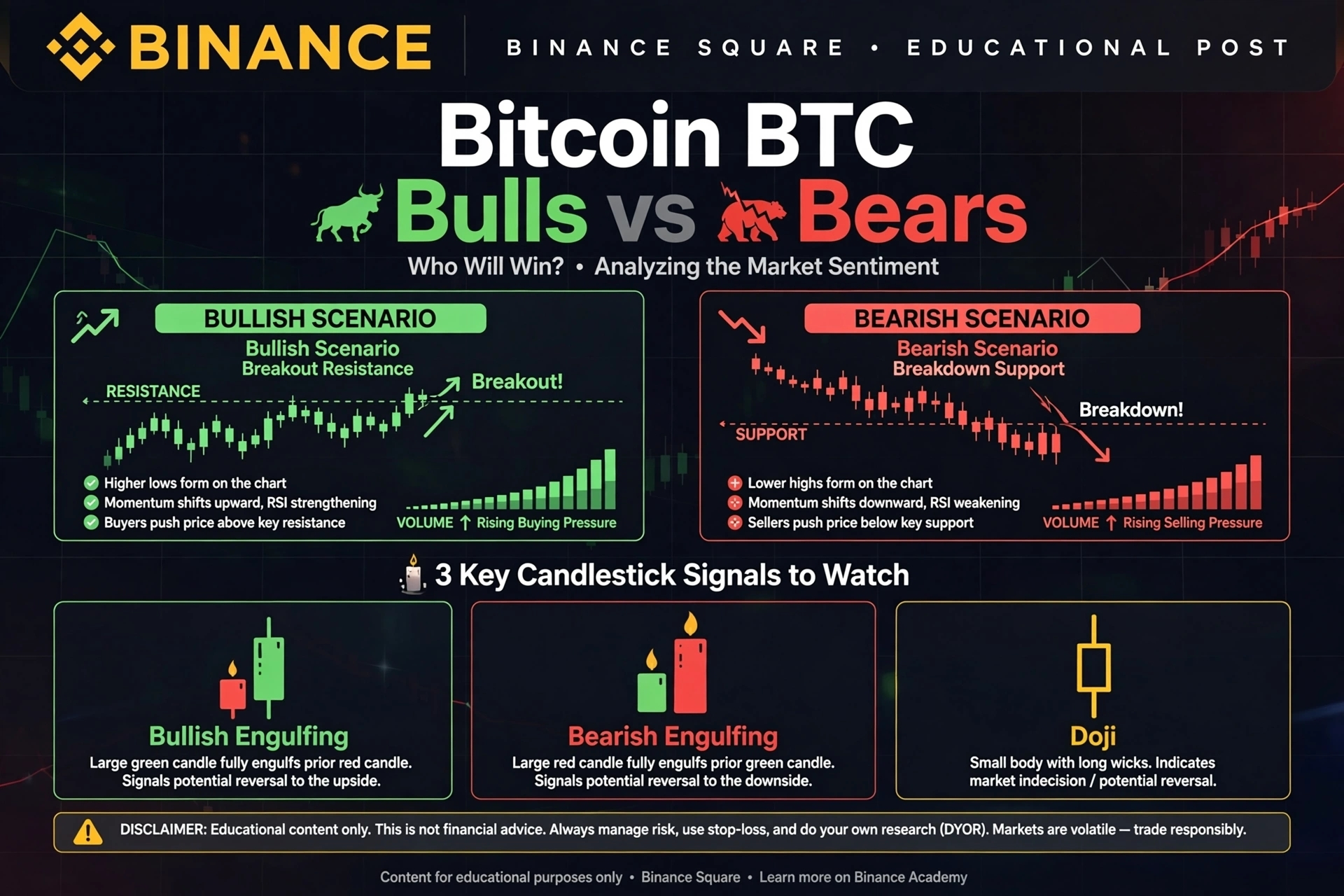
Bitcoin (BTC): Bulls vs Bears — Who Will Win the Next Move? 📊
Bitcoin's price action tells an important story, but the key is to wait for confirmation instead of guessing the next move.
🔍 What Should Traders Watch?
🟢 Bullish Scenario
If BTC breaks above a key resistance level and holds it, buyers may gain strength. Look for a strong candle close and increasing trading volume before considering this scenario.
🔴 Bearish Scenario
If BTC fails to break resistance and falls below support, selling pressure may increase. A confirmed breakdown could signal further weakness.
📈 3 Important Candlestick Signals
1. Bullish Engulfing: May indicate buyers are gaining control.
2. Bearish Engulfing: May indicate increasing selling pressure.
3. Doji Candle: Shows indecision between buyers and sellers.
⚠️ My Trading Rule
Never enter a trade based on one candle alone. Confirm the trend, check volume, manage risk, and always use a stop-loss when appropriate.
💬 Your Opinion Matters!
Are you currently bullish or bearish on Bitcoin?
Comment below: 🟢 BULLISH or 🔴 BEARISH!
#Bitcoin #BTC #BinanceSquare #CryptoAnalysis #CandlestickPatterns #CryptoTrading
Bitcoin (BTC): Bulls vs Bears — Who Will Win the Next Move? 📊
Bitcoin's price action tells an important story, but the key is to wait for confirmation instead of guessing the next move.
🔍 What Should Traders Watch?
🟢 Bullish Scenario
If BTC breaks above a key resistance level and holds it, buyers may gain strength. Look for a strong candle close and increasing trading volume before considering this scenario.
🔴 Bearish Scenario
If BTC fails to break resistance and falls below support, selling pressure may increase. A confirmed breakdown could signal further weakness.
📈 3 Important Candlestick Signals
1. Bullish Engulfing: May indicate buyers are gaining control.
2. Bearish Engulfing: May indicate increasing selling pressure.
3. Doji Candle: Shows indecision between buyers and sellers.
⚠️ My Trading Rule
Never enter a trade based on one candle alone. Confirm the trend, check volume, manage risk, and always use a stop-loss when appropriate.
💬 Your Opinion Matters!
Are you currently bullish or bearish on Bitcoin?
Comment below: 🟢 BULLISH or 🔴 BEARISH!
#Bitcoin #BTC #BinanceSquare #CryptoAnalysis #CandlestickPatterns #CryptoTrading
Bitcoin's price action tells an important story, but the key is to wait for confirmation instead of guessing the next move.
🔍 What Should Traders Watch?
🟢 Bullish Scenario
If BTC breaks above a key resistance level and holds it, buyers may gain strength. Look for a strong candle close and increasing trading volume before considering this scenario.
🔴 Bearish Scenario
If BTC fails to break resistance and falls below support, selling pressure may increase. A confirmed breakdown could signal further weakness.
📈 3 Important Candlestick Signals
1. Bullish Engulfing: May indicate buyers are gaining control.
2. Bearish Engulfing: May indicate increasing selling pressure.
3. Doji Candle: Shows indecision between buyers and sellers.
⚠️ My Trading Rule
Never enter a trade based on one candle alone. Confirm the trend, check volume, manage risk, and always use a stop-loss when appropriate.
💬 Your Opinion Matters!
Are you currently bullish or bearish on Bitcoin?
Comment below: 🟢 BULLISH or 🔴 BEARISH!
#Bitcoin #BTC #BinanceSquare #CryptoAnalysis #CandlestickPatterns #CryptoTrading
1
1
143

·
--
#tradding
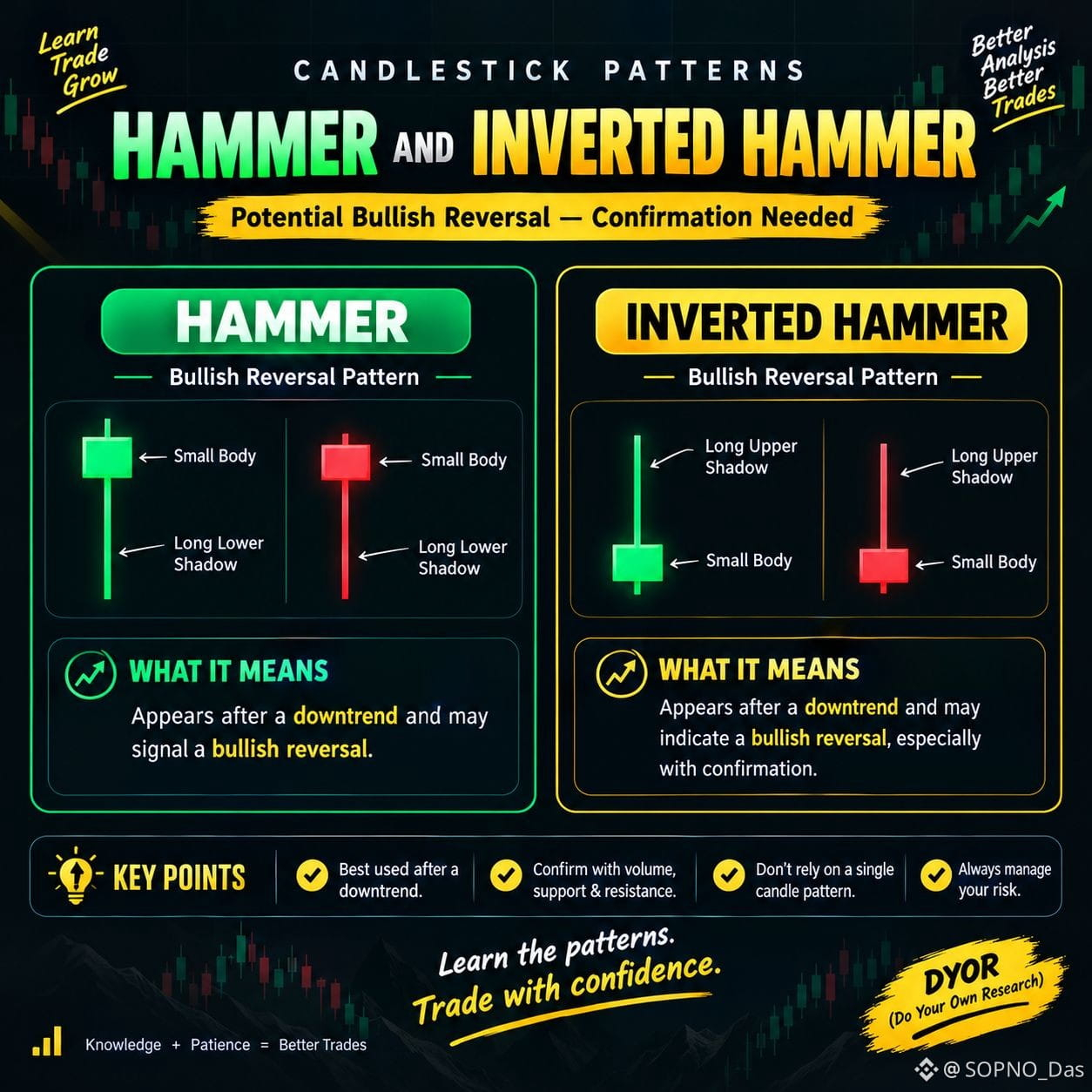
📊 HAMMER vs INVERTED HAMMER 🔨🚀
Do you know how to spot a potential market reversal? 👀
🔨 Hammer Pattern 🟢
A Hammer often appears after a downtrend and may signal a bullish reversal.
🔻 Inverted Hammer 🟡
An Inverted Hammer appears after a downtrend and may indicate a potential bullish reversal, especially with confirmation.
💡 Pro Tips:
✅ Check the overall market trend.
✅ Confirm with volume and support levels.
✅ Never trade based on a single candle pattern.
✅ Always manage your risk.
📈 Learn the patterns. Understand the market. Trade smarter!
What do you think—Hammer or Inverted Hammer? 👇
#BinanceSquare #cryptotrading #CandlestickPatterns #TechnicalAnalysis
#tradding
📊 HAMMER vs INVERTED HAMMER 🔨🚀
Do you know how to spot a potential market reversal? 👀
🔨 Hammer Pattern 🟢
A Hammer often appears after a downtrend and may signal a bullish reversal.
🔻 Inverted Hammer 🟡
An Inverted Hammer appears after a downtrend and may indicate a potential bullish reversal, especially with confirmation.
💡 Pro Tips:
✅ Check the overall market trend.
✅ Confirm with volume and support levels.
✅ Never trade based on a single candle pattern.
✅ Always manage your risk.
📈 Learn the patterns. Understand the market. Trade smarter!
What do you think—Hammer or Inverted Hammer? 👇
#BinanceSquare #cryptotrading #CandlestickPatterns #TechnicalAnalysis
📊 HAMMER vs INVERTED HAMMER 🔨🚀
Do you know how to spot a potential market reversal? 👀
🔨 Hammer Pattern 🟢
A Hammer often appears after a downtrend and may signal a bullish reversal.
🔻 Inverted Hammer 🟡
An Inverted Hammer appears after a downtrend and may indicate a potential bullish reversal, especially with confirmation.
💡 Pro Tips:
✅ Check the overall market trend.
✅ Confirm with volume and support levels.
✅ Never trade based on a single candle pattern.
✅ Always manage your risk.
📈 Learn the patterns. Understand the market. Trade smarter!
What do you think—Hammer or Inverted Hammer? 👇
#BinanceSquare #cryptotrading #CandlestickPatterns #TechnicalAnalysis
42
·
--
Structural Mastery: Decoding the Layers of ARB Market Geometry
Sitting at my desk at 11:56:58 PM IST, the weekend lull is finally here. This is the time when the noise dies down and we can actually look at the structural bones of the market. For $ARB, currently navigating the 0.1984 range, the story is written in the candles.
Candlestick anatomy is the language of the tape. When you see a long wick after a short body, you are seeing a battle for liquidity. That 11.4 percent drop over 34 hours was not just a price dip; it was a test of absorption. This weekend, the focus should be on whether those weekly candles are showing buyer exhaustion or if we are seeing a strategic floor being built.
When we look at Smart Money Concepts like Order Blocks, we see where the big players have left their mark. With a circulating supply of 6.79 billion out of 10 billion, ARB has a significant float that demands heavy capital to move. The 15.56 million withdrawal from Coinbase by a VC-linked wallet in July created a massive footprint. These zones often act as magnets for price action.
The recent emergency pause of Stylus on October 2 and the drop in Robinhood Chain activity by 42 percent have created visible Market Structure Shifts. Even though the MACD turned positive on October 6, we are still looking for a clear Break of Structure to confirm a trend reversal. We also have a supply wall of 92.65 million tokens hitting the market on October 16. These upcoming unlocks usually force a decision between distribution or re-accumulation within Wyckoff cycles.
The goal is to understand the context of these layers before the Monday open. Are you seeing these same structural shifts appearing on your charts for other assets this weekend?
#TechnicalAnalysis #CandlestickPatterns
Structural Mastery: Decoding the Layers of ARB Market Geometry
Sitting at my desk at 11:56:58 PM IST, the weekend lull is finally here. This is the time when the noise dies down and we can actually look at the structural bones of the market. For $ARB , currently navigating the 0.1984 range, the story is written in the candles.
Candlestick anatomy is the language of the tape. When you see a long wick after a short body, you are seeing a battle for liquidity. That 11.4 percent drop over 34 hours was not just a price dip; it was a test of absorption. This weekend, the focus should be on whether those weekly candles are showing buyer exhaustion or if we are seeing a strategic floor being built.
When we look at Smart Money Concepts like Order Blocks, we see where the big players have left their mark. With a circulating supply of 6.79 billion out of 10 billion, ARB has a significant float that demands heavy capital to move. The 15.56 million withdrawal from Coinbase by a VC-linked wallet in July created a massive footprint. These zones often act as magnets for price action.
The recent emergency pause of Stylus on October 2 and the drop in Robinhood Chain activity by 42 percent have created visible Market Structure Shifts. Even though the MACD turned positive on October 6, we are still looking for a clear Break of Structure to confirm a trend reversal. We also have a supply wall of 92.65 million tokens hitting the market on October 16. These upcoming unlocks usually force a decision between distribution or re-accumulation within Wyckoff cycles.
The goal is to understand the context of these layers before the Monday open. Are you seeing these same structural shifts appearing on your charts for other assets this weekend?
#TechnicalAnalysis #CandlestickPatterns
Sitting at my desk at 11:56:58 PM IST, the weekend lull is finally here. This is the time when the noise dies down and we can actually look at the structural bones of the market. For $ARB , currently navigating the 0.1984 range, the story is written in the candles.
Candlestick anatomy is the language of the tape. When you see a long wick after a short body, you are seeing a battle for liquidity. That 11.4 percent drop over 34 hours was not just a price dip; it was a test of absorption. This weekend, the focus should be on whether those weekly candles are showing buyer exhaustion or if we are seeing a strategic floor being built.
When we look at Smart Money Concepts like Order Blocks, we see where the big players have left their mark. With a circulating supply of 6.79 billion out of 10 billion, ARB has a significant float that demands heavy capital to move. The 15.56 million withdrawal from Coinbase by a VC-linked wallet in July created a massive footprint. These zones often act as magnets for price action.
The recent emergency pause of Stylus on October 2 and the drop in Robinhood Chain activity by 42 percent have created visible Market Structure Shifts. Even though the MACD turned positive on October 6, we are still looking for a clear Break of Structure to confirm a trend reversal. We also have a supply wall of 92.65 million tokens hitting the market on October 16. These upcoming unlocks usually force a decision between distribution or re-accumulation within Wyckoff cycles.
The goal is to understand the context of these layers before the Monday open. Are you seeing these same structural shifts appearing on your charts for other assets this weekend?
#TechnicalAnalysis #CandlestickPatterns

1
25
·
--
Solana’s Weekend Anatomy: Beyond the Surface of the 109 LevelSolana’s Weekend Anatomy: Beyond the Surface of the 109 Level
Weekend charts are notoriously quiet, but that silence is exactly where the most valuable information hides. While the spot price for $SOL sits near 109.47, the real story isn't just the price movement; it is the structural shift happening behind the scenes. We aren't just looking at red and green boxes here; we are looking at the psychology of institutional players.
When you look at a candle, the body represents the finality of the session, but the wicks tell the story of the battle. A long lower wick indicates that buyers are aggressively defending a level, whereas long upper wicks suggest sell pressure is too heavy to overcome. Right now, SOL is showing signs of these rejection signals as volume thins out during these low-liquidity hours.
Smart Money Concepts give us a deeper layer. We look for Fair Value Gaps, which are essentially price imbalances where the market moved too fast. These zones act like magnets, often pulling price back to fill the inefficiency before a real move starts. This is often coupled with Order Blocks, which are specific areas where large institutional orders were likely triggered. With 589.05 million tokens in circulating supply, these liquidity pools are essential to watch to understand where the big money is resting.
We also need to distinguish between a Market Structure Shift and a simple Break of Structure. If we see SOL break a significant swing high with momentum, that is our confirmation of a new trend. However, without that follow-through, it might just be a liquidity sweep. This ties directly into Wyckoff phases. Are we seeing accumulation, where big players quietly absorb the circulating float, or distribution, where they are offloading? The recent 40M USDT withdrawal from Coinbase suggests some players are moving capital off-exchange, which usually points toward accumulation.
What specific structural signals are you watching on the four-hour chart before the Monday open?
_
#TechnicalAnalysis #CandlestickPatterns
Solana’s Weekend Anatomy: Beyond the Surface of the 109 Level
Solana’s Weekend Anatomy: Beyond the Surface of the 109 Level
Weekend charts are notoriously quiet, but that silence is exactly where the most valuable information hides. While the spot price for $SOL sits near 109.47, the real story isn't just the price movement; it is the structural shift happening behind the scenes. We aren't just looking at red and green boxes here; we are looking at the psychology of institutional players.
When you look at a candle, the body represents the finality of the session, but the wicks tell the story of the battle. A long lower wick indicates that buyers are aggressively defending a level, whereas long upper wicks suggest sell pressure is too heavy to overcome. Right now, SOL is showing signs of these rejection signals as volume thins out during these low-liquidity hours.
Smart Money Concepts give us a deeper layer. We look for Fair Value Gaps, which are essentially price imbalances where the market moved too fast. These zones act like magnets, often pulling price back to fill the inefficiency before a real move starts. This is often coupled with Order Blocks, which are specific areas where large institutional orders were likely triggered. With 589.05 million tokens in circulating supply, these liquidity pools are essential to watch to understand where the big money is resting.
We also need to distinguish between a Market Structure Shift and a simple Break of Structure. If we see SOL break a significant swing high with momentum, that is our confirmation of a new trend. However, without that follow-through, it might just be a liquidity sweep. This ties directly into Wyckoff phases. Are we seeing accumulation, where big players quietly absorb the circulating float, or distribution, where they are offloading? The recent 40M USDT withdrawal from Coinbase suggests some players are moving capital off-exchange, which usually points toward accumulation.
What specific structural signals are you watching on the four-hour chart before the Monday open?
_
#TechnicalAnalysis #CandlestickPatterns
Weekend charts are notoriously quiet, but that silence is exactly where the most valuable information hides. While the spot price for $SOL sits near 109.47, the real story isn't just the price movement; it is the structural shift happening behind the scenes. We aren't just looking at red and green boxes here; we are looking at the psychology of institutional players.
When you look at a candle, the body represents the finality of the session, but the wicks tell the story of the battle. A long lower wick indicates that buyers are aggressively defending a level, whereas long upper wicks suggest sell pressure is too heavy to overcome. Right now, SOL is showing signs of these rejection signals as volume thins out during these low-liquidity hours.
Smart Money Concepts give us a deeper layer. We look for Fair Value Gaps, which are essentially price imbalances where the market moved too fast. These zones act like magnets, often pulling price back to fill the inefficiency before a real move starts. This is often coupled with Order Blocks, which are specific areas where large institutional orders were likely triggered. With 589.05 million tokens in circulating supply, these liquidity pools are essential to watch to understand where the big money is resting.
We also need to distinguish between a Market Structure Shift and a simple Break of Structure. If we see SOL break a significant swing high with momentum, that is our confirmation of a new trend. However, without that follow-through, it might just be a liquidity sweep. This ties directly into Wyckoff phases. Are we seeing accumulation, where big players quietly absorb the circulating float, or distribution, where they are offloading? The recent 40M USDT withdrawal from Coinbase suggests some players are moving capital off-exchange, which usually points toward accumulation.
What specific structural signals are you watching on the four-hour chart before the Monday open?
_
#TechnicalAnalysis #CandlestickPatterns
1
15
·
--
Weekend Candlestick Masterclass: Reading Gold Price Action and On-Chain Realities in PAXGWeekend Candlestick Masterclass: Reading Gold Price Action and On-Chain Realities in PAXG
Taking time over the weekend to analyze structural price action usually pays off when global markets reopen. While traditional commodity desks are dark, digital order books on Binance keep running, giving us a real-time pulse on tokenized gold through $PAXG. Trading near a 4193.6 USD reference point, its price action reflects physical spot gold holding resilience around 4140 USD per ounce and silver at 60.27 USD, keeping the Gold Silver Ratio near 68.5.
When examining weekend candlestick patterns on tokenized metals, understanding market mechanics is vital. Unlike legacy futures, PAXG operates with 24/7 liquidity, which creates unique long-wick candlestick formations during thin weekend volume. These wicks often show localized liquidity sweeps rather than immediate trend shifts. Beneath these candles lies an elastic mint and burn tokenomic model backed by physical London Good Delivery gold, with a total circulating float sitting at 292.982K tokens.
A major technical factor to factor into your chart reading is whale concentration. On-chain data confirms that the top 100 wallets control over 55% of the total circulating market cap. When these heavy accounts rebalance or transfer inventory, it can create sharp lower wicks or sudden absorption candles that standard gold traders might misinterpret as macro shifts.
Macro fundamentals remain supportive as central banks continue acquiring roughly 1,000 tonnes of physical gold annually, while the Dollar Index hovering around 102.21 provides underlying stability. Combining traditional candlestick analysis with on-chain metrics like wallet concentration gives you a far clearer picture of where true institutional support sits.
How are you interpreting these weekend candlestick wicks on PAXG before Monday open?
#TechnicalAnalysis #CandlestickPatterns
Weekend Candlestick Masterclass: Reading Gold Price Action and On-Chain Realities in PAXG
Weekend Candlestick Masterclass: Reading Gold Price Action and On-Chain Realities in PAXG
Taking time over the weekend to analyze structural price action usually pays off when global markets reopen. While traditional commodity desks are dark, digital order books on Binance keep running, giving us a real-time pulse on tokenized gold through $PAXG . Trading near a 4193.6 USD reference point, its price action reflects physical spot gold holding resilience around 4140 USD per ounce and silver at 60.27 USD, keeping the Gold Silver Ratio near 68.5.
When examining weekend candlestick patterns on tokenized metals, understanding market mechanics is vital. Unlike legacy futures, PAXG operates with 24/7 liquidity, which creates unique long-wick candlestick formations during thin weekend volume. These wicks often show localized liquidity sweeps rather than immediate trend shifts. Beneath these candles lies an elastic mint and burn tokenomic model backed by physical London Good Delivery gold, with a total circulating float sitting at 292.982K tokens.
A major technical factor to factor into your chart reading is whale concentration. On-chain data confirms that the top 100 wallets control over 55% of the total circulating market cap. When these heavy accounts rebalance or transfer inventory, it can create sharp lower wicks or sudden absorption candles that standard gold traders might misinterpret as macro shifts.
Macro fundamentals remain supportive as central banks continue acquiring roughly 1,000 tonnes of physical gold annually, while the Dollar Index hovering around 102.21 provides underlying stability. Combining traditional candlestick analysis with on-chain metrics like wallet concentration gives you a far clearer picture of where true institutional support sits.
How are you interpreting these weekend candlestick wicks on PAXG before Monday open?
#TechnicalAnalysis #CandlestickPatterns
Taking time over the weekend to analyze structural price action usually pays off when global markets reopen. While traditional commodity desks are dark, digital order books on Binance keep running, giving us a real-time pulse on tokenized gold through $PAXG . Trading near a 4193.6 USD reference point, its price action reflects physical spot gold holding resilience around 4140 USD per ounce and silver at 60.27 USD, keeping the Gold Silver Ratio near 68.5.
When examining weekend candlestick patterns on tokenized metals, understanding market mechanics is vital. Unlike legacy futures, PAXG operates with 24/7 liquidity, which creates unique long-wick candlestick formations during thin weekend volume. These wicks often show localized liquidity sweeps rather than immediate trend shifts. Beneath these candles lies an elastic mint and burn tokenomic model backed by physical London Good Delivery gold, with a total circulating float sitting at 292.982K tokens.
A major technical factor to factor into your chart reading is whale concentration. On-chain data confirms that the top 100 wallets control over 55% of the total circulating market cap. When these heavy accounts rebalance or transfer inventory, it can create sharp lower wicks or sudden absorption candles that standard gold traders might misinterpret as macro shifts.
Macro fundamentals remain supportive as central banks continue acquiring roughly 1,000 tonnes of physical gold annually, while the Dollar Index hovering around 102.21 provides underlying stability. Combining traditional candlestick analysis with on-chain metrics like wallet concentration gives you a far clearer picture of where true institutional support sits.
How are you interpreting these weekend candlestick wicks on PAXG before Monday open?
#TechnicalAnalysis #CandlestickPatterns
1
25
·
--
Decoding DOGE: The Weekend Price Action & Candlestick Anatomy Masterclass
Sunday charts for $DOGE are moving in a vacuum today, hovering near 0.08551 while traditional financial markets sit idle. With a massive circulating float exceeding 146 billion tokens, price movements are rarely driven by retail hype during quiet hours. Instead, institutional capital uses this illiquid window to hunt resting liquidity pools across key structural levels.
Understanding chart mechanics starts with candlestick anatomy. Look closely at higher timeframe candles. A long lower wick printed during a downtrend isn't random noise; it marks heavy supply absorption by smart money. When a sweep of recent lows is immediately followed by a powerful bullish engulfing pattern, you are observing a textbook Market Structure Shift. This differs from a routine Break of Structure, as it signals a structural change in institutional order flow rather than a simple trend continuation.
Smart Money Concepts teach us to look past candle bodies and locate Fair Value Gaps. These structural price imbalances act like financial magnets. When market price retraces into an unfilled gap, it tests whether real liquidity exists to sustain the broader trend. If DOGE holds its structural foundation through the weekend lull, a Wyckoff accumulation phase may be underway. Watch for classic spring behavior, where price briefly dips below established support to shake out weak hands before markup occurs.
Always prioritize high-timeframe order blocks over low-timeframe noise. Macro supply and demand zones provide the true roadmap once global volume returns.
Which candle patterns are you tracking on your charts today, and are you spotting any Wyckoff accumulation signals in DOGE right now?
#TechnicalAnalysis #CandlestickPatterns
Decoding DOGE: The Weekend Price Action & Candlestick Anatomy Masterclass
Sunday charts for $DOGE are moving in a vacuum today, hovering near 0.08551 while traditional financial markets sit idle. With a massive circulating float exceeding 146 billion tokens, price movements are rarely driven by retail hype during quiet hours. Instead, institutional capital uses this illiquid window to hunt resting liquidity pools across key structural levels.
Understanding chart mechanics starts with candlestick anatomy. Look closely at higher timeframe candles. A long lower wick printed during a downtrend isn't random noise; it marks heavy supply absorption by smart money. When a sweep of recent lows is immediately followed by a powerful bullish engulfing pattern, you are observing a textbook Market Structure Shift. This differs from a routine Break of Structure, as it signals a structural change in institutional order flow rather than a simple trend continuation.
Smart Money Concepts teach us to look past candle bodies and locate Fair Value Gaps. These structural price imbalances act like financial magnets. When market price retraces into an unfilled gap, it tests whether real liquidity exists to sustain the broader trend. If DOGE holds its structural foundation through the weekend lull, a Wyckoff accumulation phase may be underway. Watch for classic spring behavior, where price briefly dips below established support to shake out weak hands before markup occurs.
Always prioritize high-timeframe order blocks over low-timeframe noise. Macro supply and demand zones provide the true roadmap once global volume returns.
Which candle patterns are you tracking on your charts today, and are you spotting any Wyckoff accumulation signals in DOGE right now?
#TechnicalAnalysis #CandlestickPatterns
Sunday charts for $DOGE are moving in a vacuum today, hovering near 0.08551 while traditional financial markets sit idle. With a massive circulating float exceeding 146 billion tokens, price movements are rarely driven by retail hype during quiet hours. Instead, institutional capital uses this illiquid window to hunt resting liquidity pools across key structural levels.
Understanding chart mechanics starts with candlestick anatomy. Look closely at higher timeframe candles. A long lower wick printed during a downtrend isn't random noise; it marks heavy supply absorption by smart money. When a sweep of recent lows is immediately followed by a powerful bullish engulfing pattern, you are observing a textbook Market Structure Shift. This differs from a routine Break of Structure, as it signals a structural change in institutional order flow rather than a simple trend continuation.
Smart Money Concepts teach us to look past candle bodies and locate Fair Value Gaps. These structural price imbalances act like financial magnets. When market price retraces into an unfilled gap, it tests whether real liquidity exists to sustain the broader trend. If DOGE holds its structural foundation through the weekend lull, a Wyckoff accumulation phase may be underway. Watch for classic spring behavior, where price briefly dips below established support to shake out weak hands before markup occurs.
Always prioritize high-timeframe order blocks over low-timeframe noise. Macro supply and demand zones provide the true roadmap once global volume returns.
Which candle patterns are you tracking on your charts today, and are you spotting any Wyckoff accumulation signals in DOGE right now?
#TechnicalAnalysis #CandlestickPatterns

46
·
--
The Architecture of Rejection: Building a Price Action Framework for the SUI Market
Saturday nights are for the students of the tape, not the gamblers. While the rest of the market chases ghost pumps on thin order books, the real edge comes from dissecting how price actually moves across the chart. Right now, $SUI is hovering around 1.12, providing a clean canvas to look at the structural architecture of the market without the noise of intraday news.
Stop looking at candles as just red or green boxes. Think of them as a battle for liquidity. Those long wicks you see at the top of a rally are not just lines; they represent aggressive rejection where supply completely overwhelmed demand. In Smart Money terms, we look for Fair Value Gaps (FVG) where price moves so fast it leaves an imbalance. These gaps often act like magnets because the market seeks efficient delivery. When you see an FVG align with a previous Order Block—the last candle before an impulsive break—you are looking at where the big players have left their footprints.
Understanding the difference between a Break of Structure (BOS) and a Market Structure Shift (MSS) is what separates a veteran from a novice. A BOS tells you the trend is healthy, while an MSS is your first warning that the tide is turning. With a circulating float of roughly 4.12 billion tokens against a 10 billion total supply, the way SUI handles these structural shifts is heavily influenced by supply dynamics. We know from historical data that token unlocks, like the Community Reserve release scheduled for November 1, 2026, often create psychological volatility. Past events have shown us that supply expansion can trigger 5-14% retracements as the market absorbs new liquid float. Mastering these concepts allows you to stop reacting and start anticipating.
Which part of the Price Action Academy are you spending your weekend studying to prepare for the Monday open?
#TechnicalAnalysis #CandlestickPatterns
The Architecture of Rejection: Building a Price Action Framework for the SUI Market
Saturday nights are for the students of the tape, not the gamblers. While the rest of the market chases ghost pumps on thin order books, the real edge comes from dissecting how price actually moves across the chart. Right now, $SUI is hovering around 1.12, providing a clean canvas to look at the structural architecture of the market without the noise of intraday news.
Stop looking at candles as just red or green boxes. Think of them as a battle for liquidity. Those long wicks you see at the top of a rally are not just lines; they represent aggressive rejection where supply completely overwhelmed demand. In Smart Money terms, we look for Fair Value Gaps (FVG) where price moves so fast it leaves an imbalance. These gaps often act like magnets because the market seeks efficient delivery. When you see an FVG align with a previous Order Block—the last candle before an impulsive break—you are looking at where the big players have left their footprints.
Understanding the difference between a Break of Structure (BOS) and a Market Structure Shift (MSS) is what separates a veteran from a novice. A BOS tells you the trend is healthy, while an MSS is your first warning that the tide is turning. With a circulating float of roughly 4.12 billion tokens against a 10 billion total supply, the way SUI handles these structural shifts is heavily influenced by supply dynamics. We know from historical data that token unlocks, like the Community Reserve release scheduled for November 1, 2026, often create psychological volatility. Past events have shown us that supply expansion can trigger 5-14% retracements as the market absorbs new liquid float. Mastering these concepts allows you to stop reacting and start anticipating.
Which part of the Price Action Academy are you spending your weekend studying to prepare for the Monday open?
#TechnicalAnalysis #CandlestickPatterns
Saturday nights are for the students of the tape, not the gamblers. While the rest of the market chases ghost pumps on thin order books, the real edge comes from dissecting how price actually moves across the chart. Right now, $SUI is hovering around 1.12, providing a clean canvas to look at the structural architecture of the market without the noise of intraday news.
Stop looking at candles as just red or green boxes. Think of them as a battle for liquidity. Those long wicks you see at the top of a rally are not just lines; they represent aggressive rejection where supply completely overwhelmed demand. In Smart Money terms, we look for Fair Value Gaps (FVG) where price moves so fast it leaves an imbalance. These gaps often act like magnets because the market seeks efficient delivery. When you see an FVG align with a previous Order Block—the last candle before an impulsive break—you are looking at where the big players have left their footprints.
Understanding the difference between a Break of Structure (BOS) and a Market Structure Shift (MSS) is what separates a veteran from a novice. A BOS tells you the trend is healthy, while an MSS is your first warning that the tide is turning. With a circulating float of roughly 4.12 billion tokens against a 10 billion total supply, the way SUI handles these structural shifts is heavily influenced by supply dynamics. We know from historical data that token unlocks, like the Community Reserve release scheduled for November 1, 2026, often create psychological volatility. Past events have shown us that supply expansion can trigger 5-14% retracements as the market absorbs new liquid float. Mastering these concepts allows you to stop reacting and start anticipating.
Which part of the Price Action Academy are you spending your weekend studying to prepare for the Monday open?
#TechnicalAnalysis #CandlestickPatterns

16
·
--
Weekend Technical Academy: Decoding the $GOLD Accumulation Signal Before the Monday Bell
While the traditional bullion desks in London and New York are closed, the tokenized gold market provides a persistent heartbeat that smart money uses to front-run the weekly open. Currently, we are tracking spot levels around 4193.6, but the real story is hidden in the liquidity profiles of on-chain assets. This weekend, the 4-hour chart printed a significant Inverted Hammer near the 4114.01 support zone, which typically suggests that sellers have exhausted their momentum and a reversal is brewing.
What makes this technical setup particularly interesting is the underlying macro strength. Global gold ETFs pulled in over 31 billion in the third quarter alone, marking a record shift in institutional sentiment. Central banks are not slowing down either, with the World Gold Council reporting that 89 percent of reserve managers expect global holdings to continue climbing through 2026. This creates a massive floor for the asset regardless of short-term volatility.
From a candlestick cheatsheet perspective, the current positioning of the SMA20 and VWAP below the market price indicates that the bulls have successfully reclaimed the short-term trend. The MACD is trending higher in positive territory, and the RSI is holding steady at 58, which leaves plenty of room for upward movement before hitting overbought conditions. Meanwhile, the Gold/Silver Ratio at 68.5 suggests we are seeing a focused flight to quality rather than a broad speculative commodity rally.
With tokenized real-world assets seeing a 930 percent explosion in growth over the last three years, the integration of physical bullion into DeFi vaults is fundamentally changing the liquidity map. As we approach the Sunday night session, watch how the EMA50 acts as a pivot point for the next leg of this consolidation.
Are you holding physical bullion or do you prefer the 24/7 liquidity of tokenized gold on the blockchain?
#TechnicalAnalysis #CandlestickPatterns
Weekend Technical Academy: Decoding the $GOLD Accumulation Signal Before the Monday Bell
While the traditional bullion desks in London and New York are closed, the tokenized gold market provides a persistent heartbeat that smart money uses to front-run the weekly open. Currently, we are tracking spot levels around 4193.6, but the real story is hidden in the liquidity profiles of on-chain assets. This weekend, the 4-hour chart printed a significant Inverted Hammer near the 4114.01 support zone, which typically suggests that sellers have exhausted their momentum and a reversal is brewing.
What makes this technical setup particularly interesting is the underlying macro strength. Global gold ETFs pulled in over 31 billion in the third quarter alone, marking a record shift in institutional sentiment. Central banks are not slowing down either, with the World Gold Council reporting that 89 percent of reserve managers expect global holdings to continue climbing through 2026. This creates a massive floor for the asset regardless of short-term volatility.
From a candlestick cheatsheet perspective, the current positioning of the SMA20 and VWAP below the market price indicates that the bulls have successfully reclaimed the short-term trend. The MACD is trending higher in positive territory, and the RSI is holding steady at 58, which leaves plenty of room for upward movement before hitting overbought conditions. Meanwhile, the Gold/Silver Ratio at 68.5 suggests we are seeing a focused flight to quality rather than a broad speculative commodity rally.
With tokenized real-world assets seeing a 930 percent explosion in growth over the last three years, the integration of physical bullion into DeFi vaults is fundamentally changing the liquidity map. As we approach the Sunday night session, watch how the EMA50 acts as a pivot point for the next leg of this consolidation.
Are you holding physical bullion or do you prefer the 24/7 liquidity of tokenized gold on the blockchain?
#TechnicalAnalysis #CandlestickPatterns
While the traditional bullion desks in London and New York are closed, the tokenized gold market provides a persistent heartbeat that smart money uses to front-run the weekly open. Currently, we are tracking spot levels around 4193.6, but the real story is hidden in the liquidity profiles of on-chain assets. This weekend, the 4-hour chart printed a significant Inverted Hammer near the 4114.01 support zone, which typically suggests that sellers have exhausted their momentum and a reversal is brewing.
What makes this technical setup particularly interesting is the underlying macro strength. Global gold ETFs pulled in over 31 billion in the third quarter alone, marking a record shift in institutional sentiment. Central banks are not slowing down either, with the World Gold Council reporting that 89 percent of reserve managers expect global holdings to continue climbing through 2026. This creates a massive floor for the asset regardless of short-term volatility.
From a candlestick cheatsheet perspective, the current positioning of the SMA20 and VWAP below the market price indicates that the bulls have successfully reclaimed the short-term trend. The MACD is trending higher in positive territory, and the RSI is holding steady at 58, which leaves plenty of room for upward movement before hitting overbought conditions. Meanwhile, the Gold/Silver Ratio at 68.5 suggests we are seeing a focused flight to quality rather than a broad speculative commodity rally.
With tokenized real-world assets seeing a 930 percent explosion in growth over the last three years, the integration of physical bullion into DeFi vaults is fundamentally changing the liquidity map. As we approach the Sunday night session, watch how the EMA50 acts as a pivot point for the next leg of this consolidation.
Are you holding physical bullion or do you prefer the 24/7 liquidity of tokenized gold on the blockchain?
#TechnicalAnalysis #CandlestickPatterns
8
·
--
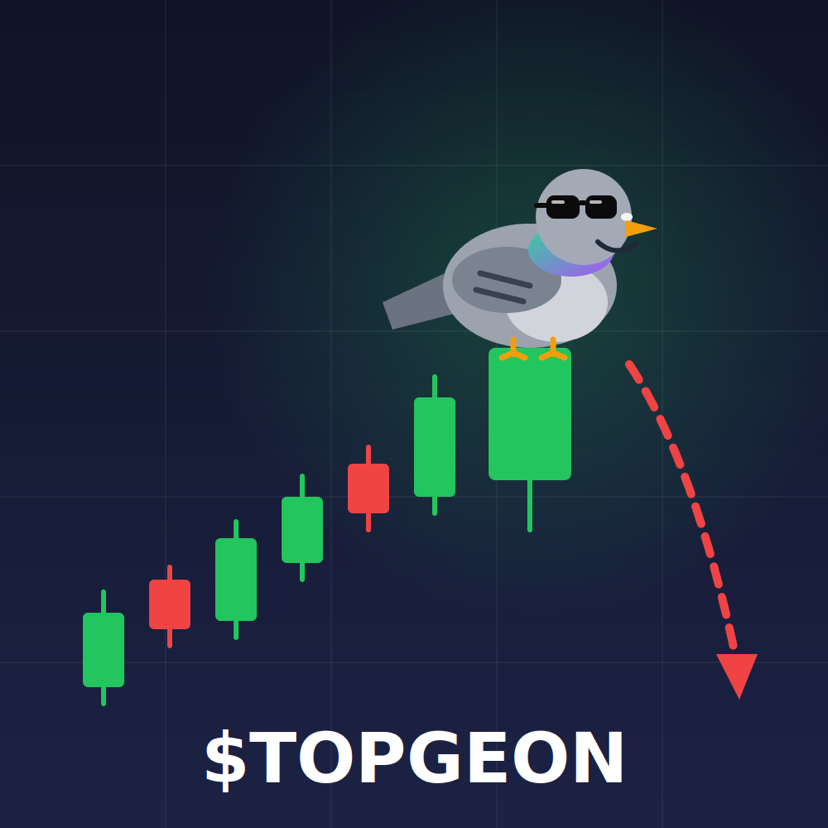
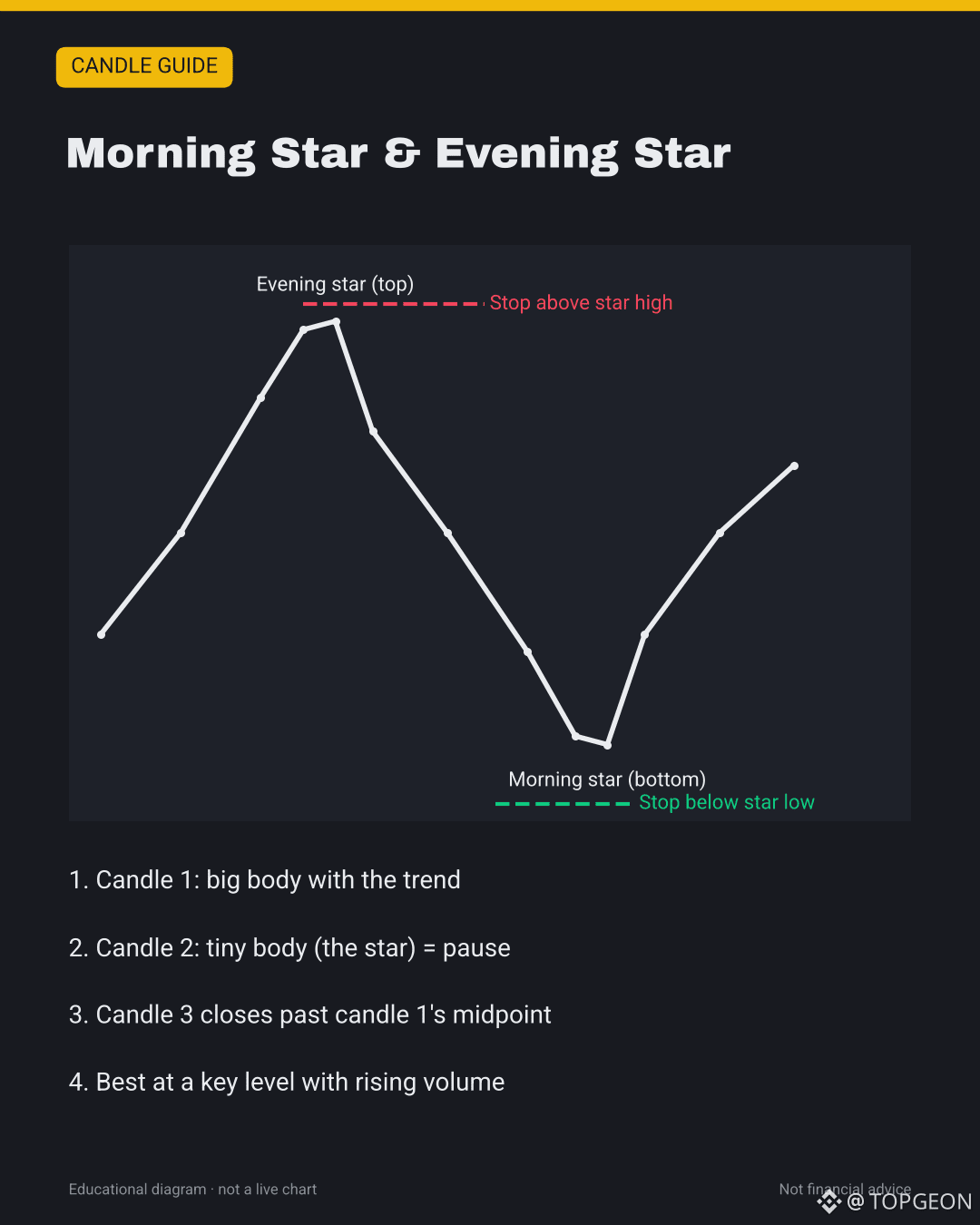
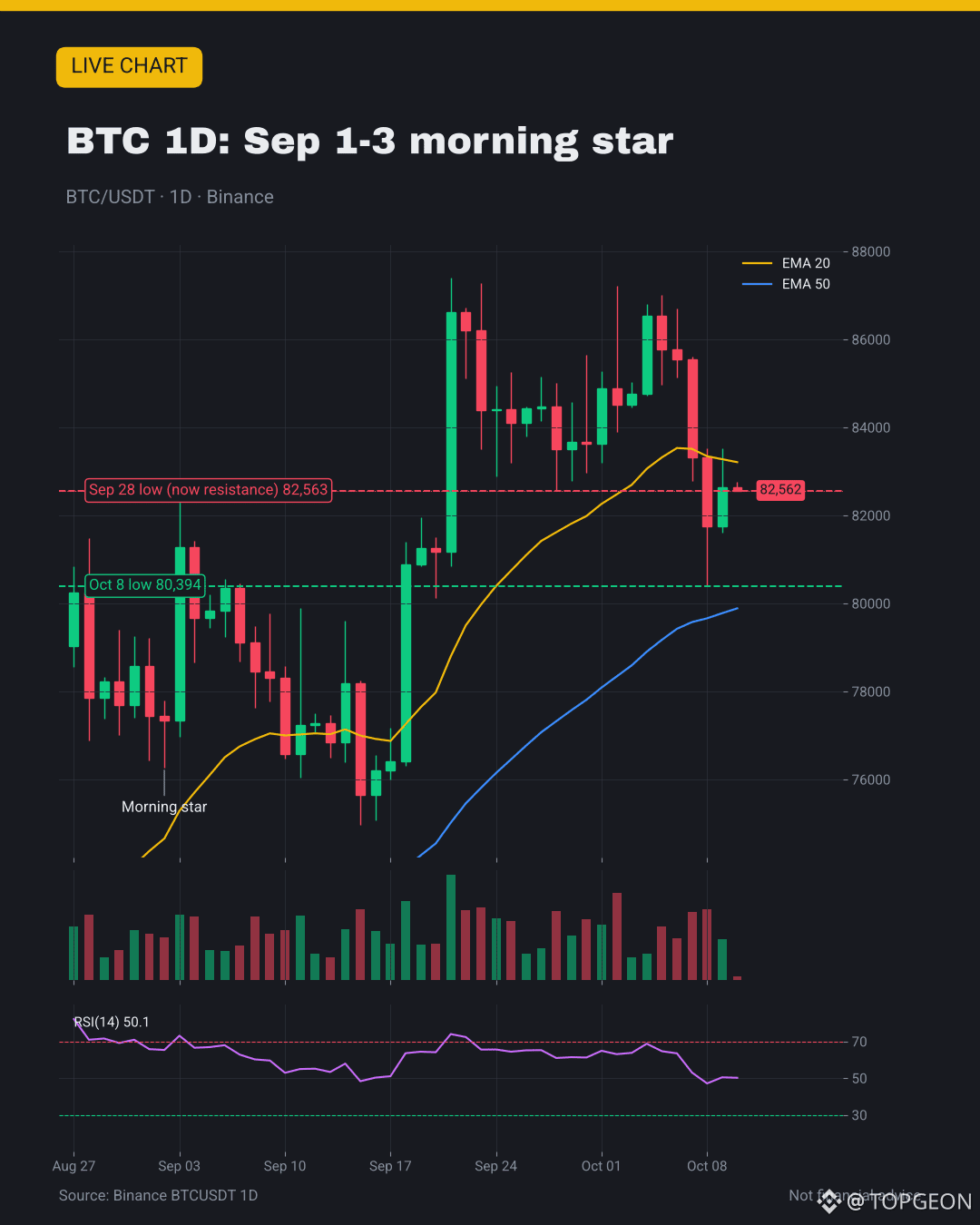
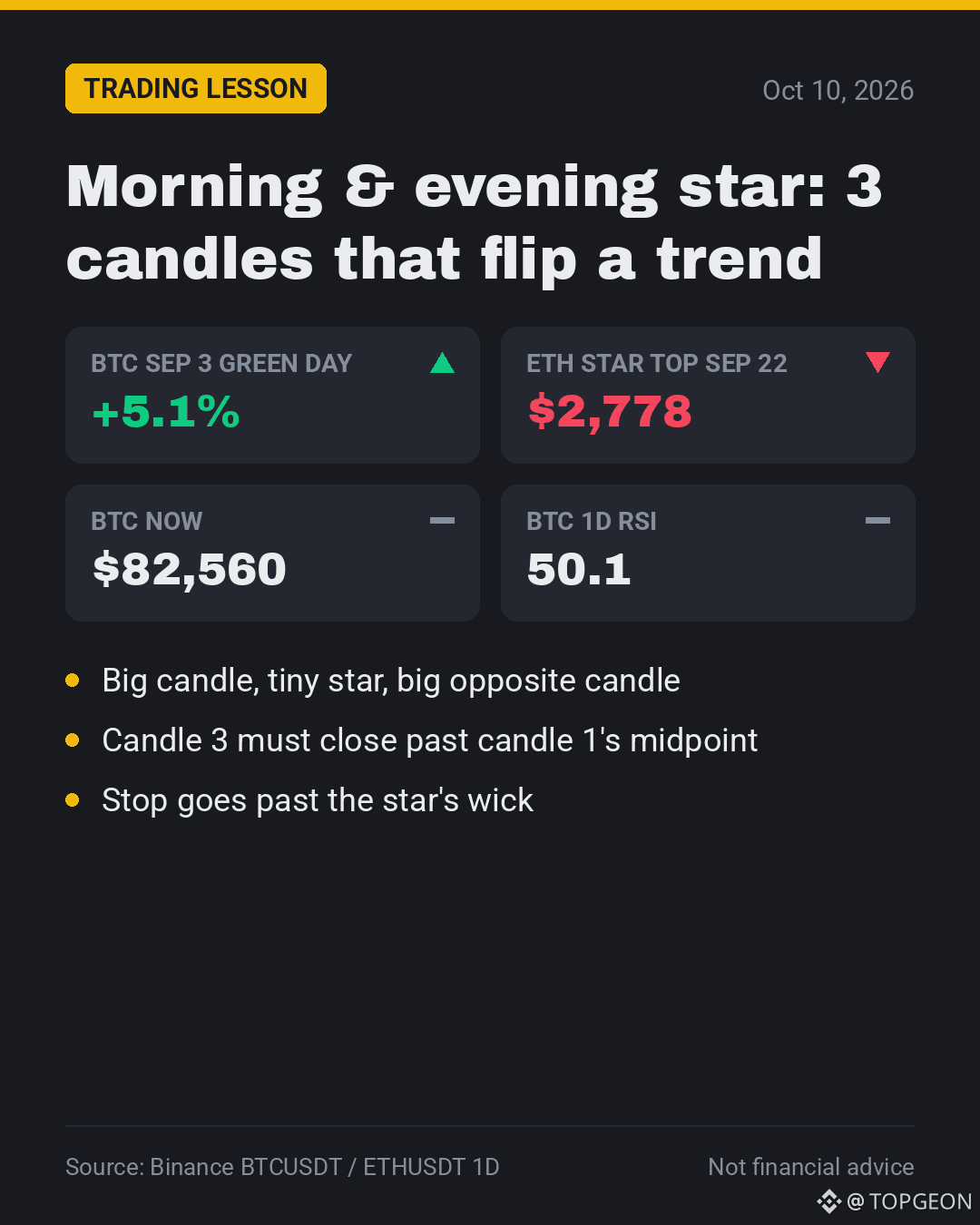
🌅 3 things to know about the $BTC morning star from Sep 1-3
1️⃣ Star day body only ~$100, wick to $76,264
2️⃣ Next day +5.1% to $81,270 on 1.4x volume
3️⃣ Still failed: BTC hit $74,968 by Sep 15, stop saved it
🌆 Evening star on $ETH at $2,778 capped the top for 2 weeks
🎯 My take: no star on BTC now; watch $80,394 for one
💬 Do you wait for candle 3 to close, or enter early? 👇
📖 Full lesson: https://app.binance.com/uni-qr/cart/375657524509678
#CandlestickPatterns #TechnicalAnalysis #TradingLessons
🌅 3 things to know about the $BTC morning star from Sep 1-3
1️⃣ Star day body only ~$100, wick to $76,264
2️⃣ Next day +5.1% to $81,270 on 1.4x volume
3️⃣ Still failed: BTC hit $74,968 by Sep 15, stop saved it
🌆 Evening star on $ETH at $2,778 capped the top for 2 weeks
🎯 My take: no star on BTC now; watch $80,394 for one
💬 Do you wait for candle 3 to close, or enter early? 👇
📖 Full lesson: https://app.binance.com/uni-qr/cart/375657524509678
#CandlestickPatterns #TechnicalAnalysis #TradingLessons
1️⃣ Star day body only ~$100, wick to $76,264
2️⃣ Next day +5.1% to $81,270 on 1.4x volume
3️⃣ Still failed: BTC hit $74,968 by Sep 15, stop saved it
🌆 Evening star on $ETH at $2,778 capped the top for 2 weeks
🎯 My take: no star on BTC now; watch $80,394 for one
💬 Do you wait for candle 3 to close, or enter early? 👇
📖 Full lesson: https://app.binance.com/uni-qr/cart/375657524509678
#CandlestickPatterns #TechnicalAnalysis #TradingLessons
52
·
--
Strip Away the Noise: Reading BNB Weekly Market Skeleton Before the Open
With $BNB hovering around 745.62 as Sunday settles in, the weekend offers the ideal window to step back from the high-frequency churn and examine pure market anatomy. While retail traders often chase intraday noise, institutional algorithms operate on structural mechanics that leave unmistakable footprints across higher timeframes.
Start by breaking down candlestick anatomy. A long upper or lower wick rejection on a weekly candle signals a classic liquidity sweep where passive market orders get absorbed before price resets. The candle body shows where buyers or sellers maintained dominance into the close, but the wicks expose where institutional volume tapped into liquidity pools.
Smart Money Concepts allow us to read these footprints deeper. When aggressive impulsive expansion occurs, it often leaves behind a Fair Value Gap. This inefficiency acts like a vacuum, pulling price back to seek balance. Within these zones, institutional Order Blocks frequently sit as the origin of the move, waiting for mitigation.
Tracking market structure requires observing Break of Structure versus Market Structure Shifts. A genuine Break of Structure confirms that higher highs or lower lows are backed by real spot and derivatives liquidity rather than thin order book manipulation. When combining this with Wyckoff theory, we evaluate whether mid-range volatility represents true re-accumulation or hidden distribution. With BNB maintaining a relatively tight circulating float of roughly 147 million tokens alongside systematic burn mechanics, supply-side tightness amplifies these structural moves.
Never force a narrative onto a naked chart. Allow the price action to tell you if institutional capital is accumulating or distributing before Monday morning liquidity arrives. What key structural levels are you tracking on your charts heading into the new week?
#TechnicalAnalysis #CandlestickPatterns
Strip Away the Noise: Reading BNB Weekly Market Skeleton Before the Open
With $BNB hovering around 745.62 as Sunday settles in, the weekend offers the ideal window to step back from the high-frequency churn and examine pure market anatomy. While retail traders often chase intraday noise, institutional algorithms operate on structural mechanics that leave unmistakable footprints across higher timeframes.
Start by breaking down candlestick anatomy. A long upper or lower wick rejection on a weekly candle signals a classic liquidity sweep where passive market orders get absorbed before price resets. The candle body shows where buyers or sellers maintained dominance into the close, but the wicks expose where institutional volume tapped into liquidity pools.
Smart Money Concepts allow us to read these footprints deeper. When aggressive impulsive expansion occurs, it often leaves behind a Fair Value Gap. This inefficiency acts like a vacuum, pulling price back to seek balance. Within these zones, institutional Order Blocks frequently sit as the origin of the move, waiting for mitigation.
Tracking market structure requires observing Break of Structure versus Market Structure Shifts. A genuine Break of Structure confirms that higher highs or lower lows are backed by real spot and derivatives liquidity rather than thin order book manipulation. When combining this with Wyckoff theory, we evaluate whether mid-range volatility represents true re-accumulation or hidden distribution. With BNB maintaining a relatively tight circulating float of roughly 147 million tokens alongside systematic burn mechanics, supply-side tightness amplifies these structural moves.
Never force a narrative onto a naked chart. Allow the price action to tell you if institutional capital is accumulating or distributing before Monday morning liquidity arrives. What key structural levels are you tracking on your charts heading into the new week?
#TechnicalAnalysis #CandlestickPatterns
With $BNB hovering around 745.62 as Sunday settles in, the weekend offers the ideal window to step back from the high-frequency churn and examine pure market anatomy. While retail traders often chase intraday noise, institutional algorithms operate on structural mechanics that leave unmistakable footprints across higher timeframes.
Start by breaking down candlestick anatomy. A long upper or lower wick rejection on a weekly candle signals a classic liquidity sweep where passive market orders get absorbed before price resets. The candle body shows where buyers or sellers maintained dominance into the close, but the wicks expose where institutional volume tapped into liquidity pools.
Smart Money Concepts allow us to read these footprints deeper. When aggressive impulsive expansion occurs, it often leaves behind a Fair Value Gap. This inefficiency acts like a vacuum, pulling price back to seek balance. Within these zones, institutional Order Blocks frequently sit as the origin of the move, waiting for mitigation.
Tracking market structure requires observing Break of Structure versus Market Structure Shifts. A genuine Break of Structure confirms that higher highs or lower lows are backed by real spot and derivatives liquidity rather than thin order book manipulation. When combining this with Wyckoff theory, we evaluate whether mid-range volatility represents true re-accumulation or hidden distribution. With BNB maintaining a relatively tight circulating float of roughly 147 million tokens alongside systematic burn mechanics, supply-side tightness amplifies these structural moves.
Never force a narrative onto a naked chart. Allow the price action to tell you if institutional capital is accumulating or distributing before Monday morning liquidity arrives. What key structural levels are you tracking on your charts heading into the new week?
#TechnicalAnalysis #CandlestickPatterns
37

·
--
🚨 MASTER THE CANDLESTICKS, MASTER THE MARKET! 📊🔥
Candlestick patterns can help traders spot potential BUY 🟢 and SELL 🔴 signals, identify trend reversals, and understand market momentum.
From Hammer & Morning Star to Three Black Crows & Dark Cloud Cover — learn the patterns before you trade. 👀📈$BNB
⚠️ Remember: No candlestick pattern is 100% reliable. Always confirm with support/resistance, volume, trend, and risk management.
💬 Which candlestick pattern do you use most?
👇 Comment below & Follow + Share for more trading content!
#crypto #trading #CandlestickPatterns #bitcoin #BinanceSquare
{spot}(BNBUSDT)
🚨 MASTER THE CANDLESTICKS, MASTER THE MARKET! 📊🔥
Candlestick patterns can help traders spot potential BUY 🟢 and SELL 🔴 signals, identify trend reversals, and understand market momentum.
From Hammer & Morning Star to Three Black Crows & Dark Cloud Cover — learn the patterns before you trade. 👀📈$BNB
⚠️ Remember: No candlestick pattern is 100% reliable. Always confirm with support/resistance, volume, trend, and risk management.
💬 Which candlestick pattern do you use most?
👇 Comment below & Follow + Share for more trading content!
#crypto #trading #CandlestickPatterns #bitcoin #BinanceSquare
Candlestick patterns can help traders spot potential BUY 🟢 and SELL 🔴 signals, identify trend reversals, and understand market momentum.
From Hammer & Morning Star to Three Black Crows & Dark Cloud Cover — learn the patterns before you trade. 👀📈$BNB
⚠️ Remember: No candlestick pattern is 100% reliable. Always confirm with support/resistance, volume, trend, and risk management.
💬 Which candlestick pattern do you use most?
👇 Comment below & Follow + Share for more trading content!
#crypto #trading #CandlestickPatterns #bitcoin #BinanceSquare
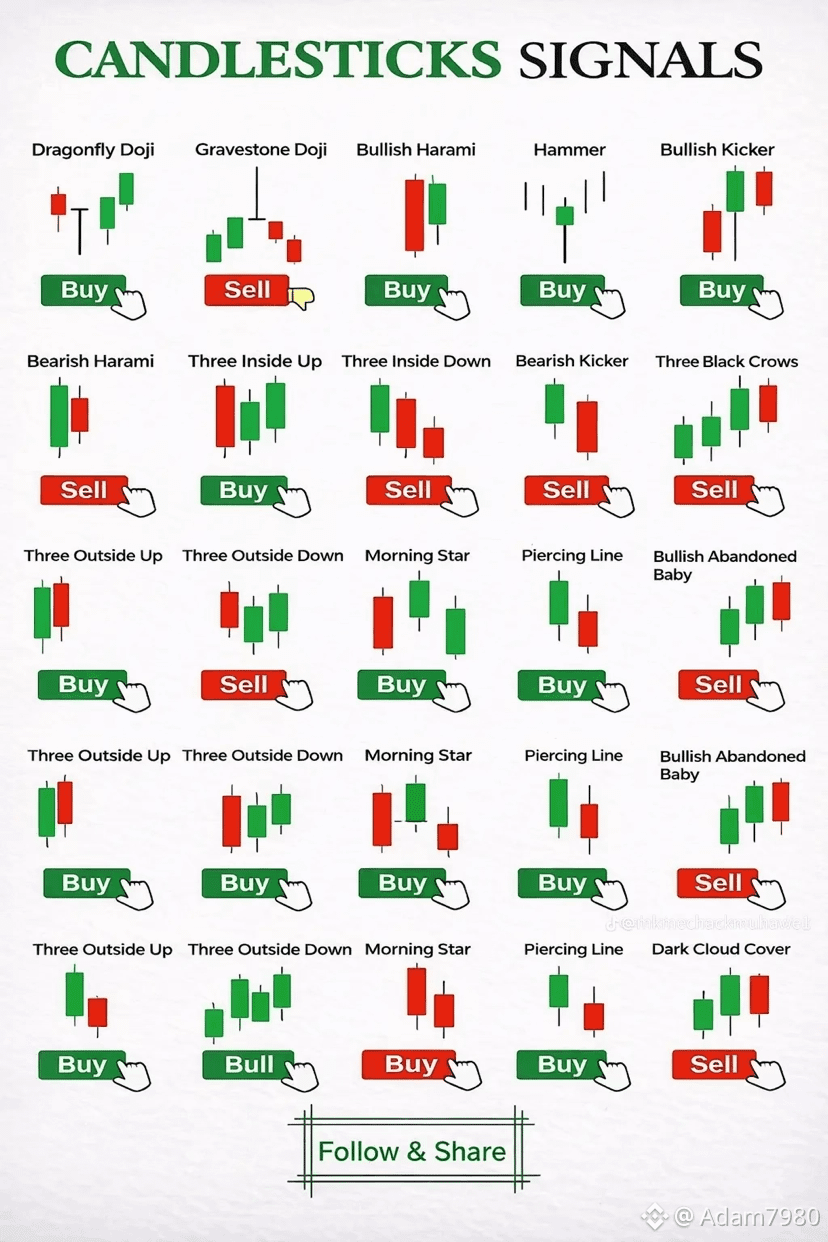
3
167
·
--
Unlocking Solana's Structural Blueprint: A Masterclass for the Weekend Lull
Clocking in at 06:04:09 PM IST, it is time to step away from the dopamine hit of the 1-minute chart and look at the raw mechanics of $SOL. When the weekend volume thins out, it is the best time to study the footprints left by the heavy hitters without the distraction of volatile swings.
Everything starts with candlestick anatomy. A candle is more than just green or red; it is a visual representation of a completed auction. Long wicks on SOL at higher levels aren't just lines; they represent aggressive rejection where the sellers overwhelmed the buyers. Conversely, an engulfing candle that completely covers the previous range shows a clear shift in dominance. These are the basic building blocks of market sentiment.
Moving deeper, we look for Fair Value Gaps and Order Blocks. These are essentially the fingerprints of institutional algorithms. An FVG occurs when price moves so fast that it creates an imbalance, often seen as a gap between the first and third candle in a sequence. Price loves to revisit these areas to fill that inefficiency. With SOL currently hovering around 121.49, identifying where these gaps sit in relation to previous order blocks is how we anticipate where the next big move originates.
We also need to watch Market Structure Shifts. A Break of Structure is the first signal that the previous trend is exhausted. This usually happens during Wyckoff accumulation phases, where smart money quietly absorbs supply during sideways movement. On-chain data shows a circulating supply of roughly 588 million tokens with an annual inflation rate of 3.618%. Seeing nearly 116 million worth of SOL unstaked recently reminds us that supply dynamics are always shifting. Whether this leads to distribution or further accumulation depends on how price respects these structural levels during the next high-volume window.
How do you handle the quiet hours of the weekend to sharpen your charting skills?
#TechnicalAnalysis #CandlestickPatterns
Unlocking Solana's Structural Blueprint: A Masterclass for the Weekend Lull
Clocking in at 06:04:09 PM IST, it is time to step away from the dopamine hit of the 1-minute chart and look at the raw mechanics of $SOL . When the weekend volume thins out, it is the best time to study the footprints left by the heavy hitters without the distraction of volatile swings.
Everything starts with candlestick anatomy. A candle is more than just green or red; it is a visual representation of a completed auction. Long wicks on SOL at higher levels aren't just lines; they represent aggressive rejection where the sellers overwhelmed the buyers. Conversely, an engulfing candle that completely covers the previous range shows a clear shift in dominance. These are the basic building blocks of market sentiment.
Moving deeper, we look for Fair Value Gaps and Order Blocks. These are essentially the fingerprints of institutional algorithms. An FVG occurs when price moves so fast that it creates an imbalance, often seen as a gap between the first and third candle in a sequence. Price loves to revisit these areas to fill that inefficiency. With SOL currently hovering around 121.49, identifying where these gaps sit in relation to previous order blocks is how we anticipate where the next big move originates.
We also need to watch Market Structure Shifts. A Break of Structure is the first signal that the previous trend is exhausted. This usually happens during Wyckoff accumulation phases, where smart money quietly absorbs supply during sideways movement. On-chain data shows a circulating supply of roughly 588 million tokens with an annual inflation rate of 3.618%. Seeing nearly 116 million worth of SOL unstaked recently reminds us that supply dynamics are always shifting. Whether this leads to distribution or further accumulation depends on how price respects these structural levels during the next high-volume window.
How do you handle the quiet hours of the weekend to sharpen your charting skills?
#TechnicalAnalysis #CandlestickPatterns
Clocking in at 06:04:09 PM IST, it is time to step away from the dopamine hit of the 1-minute chart and look at the raw mechanics of $SOL . When the weekend volume thins out, it is the best time to study the footprints left by the heavy hitters without the distraction of volatile swings.
Everything starts with candlestick anatomy. A candle is more than just green or red; it is a visual representation of a completed auction. Long wicks on SOL at higher levels aren't just lines; they represent aggressive rejection where the sellers overwhelmed the buyers. Conversely, an engulfing candle that completely covers the previous range shows a clear shift in dominance. These are the basic building blocks of market sentiment.
Moving deeper, we look for Fair Value Gaps and Order Blocks. These are essentially the fingerprints of institutional algorithms. An FVG occurs when price moves so fast that it creates an imbalance, often seen as a gap between the first and third candle in a sequence. Price loves to revisit these areas to fill that inefficiency. With SOL currently hovering around 121.49, identifying where these gaps sit in relation to previous order blocks is how we anticipate where the next big move originates.
We also need to watch Market Structure Shifts. A Break of Structure is the first signal that the previous trend is exhausted. This usually happens during Wyckoff accumulation phases, where smart money quietly absorbs supply during sideways movement. On-chain data shows a circulating supply of roughly 588 million tokens with an annual inflation rate of 3.618%. Seeing nearly 116 million worth of SOL unstaked recently reminds us that supply dynamics are always shifting. Whether this leads to distribution or further accumulation depends on how price respects these structural levels during the next high-volume window.
How do you handle the quiet hours of the weekend to sharpen your charting skills?
#TechnicalAnalysis #CandlestickPatterns
1
21
තවත් අන්තර්ගතයන් ගවේෂණය කිරීමට ඇතුල් වන්න
Binance චතුරශ්රය හි ගෝලීය ක්රිප්ටෝ පරිශීලකයින් හා එක්වන්න
⚡️ ක්රිප්ටෝ පිළිබඳ නවතම සහ ප්රයෝජනවත් තොරතුරු ලබා ගන්න.
💬 ලොව විශාලතම ක්රිප්ටෝ හුවමාරුව මගින් විශ්වාස කෙරේ.
👍 සත්යායනය කරන ලද නිර්මාණකරුවන්ගෙන් සැබෑ විදසුන් සොයා ගන්න.
විද්යුත් තැපෑල / දුරකථන අංකය
නැගී එන මාතෘකා
1
#CanMicrosoftDeliverOnAI
2,369 නැරඹීම්
109 සාකච්ඡා කරමින්
2
#CanGoogleDefindItsCore
1,882 නැරඹීම්
108 සාකච්ඡා කරමින්
3
#FOMCWatch
9M නැරඹීම්
27,263 සාකච්ඡා කරමින්
4
#EthereumDropsBelow$2300
5,655 නැරඹීම්
116 සාකච්ඡා කරමින්
5
#BitcoinSlipsBelow$80KAgain
18,429 නැරඹීම්
83 සාකච්ඡා කරමින්
6
#ThailandLaunchesWORPTStablecoinToQRPaymentApp
32,544 නැරඹීම්
542 සාකච්ඡා කරමින්
7
#StrategySkipsBitcoinPurchasesSpends$205MOnSTRCBuybacks
8,114 නැරඹීම්
84 සාකච්ඡා කරමින්
8
#BitmineAdds10452ETH
70,987 නැරඹීම්
934 සාකච්ඡා කරමින්
9
#SouthKoreaConsidersEducationTaxOnCryptoExchanges
38,099 නැරඹීම්
697 සාකච්ඡා කරමින්
10
#OCCUrgesCommunityBanksToEnterStablecoinPayments
29,658 නැරඹීම්
492 සාකච්ඡා කරමින්