
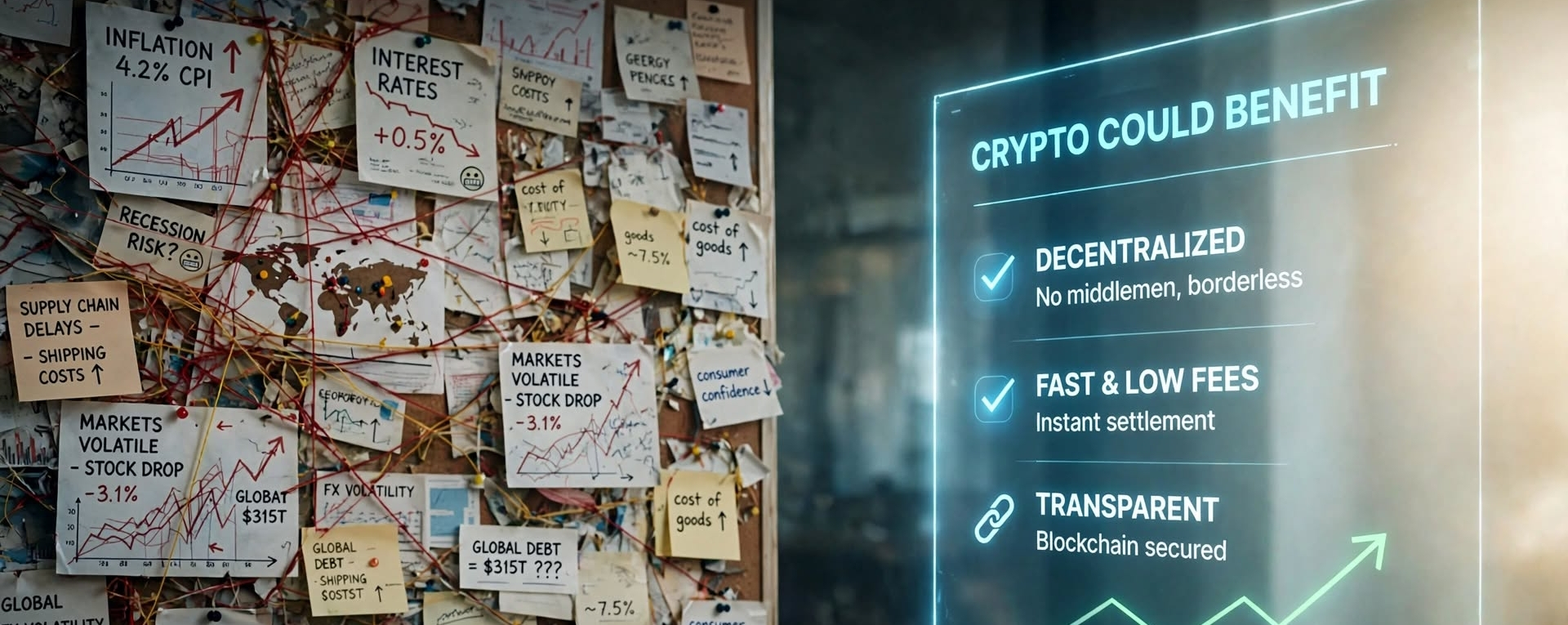


Right now, the global economy is sending mixed signals.
Growth is holding up, but inflation has started becoming sticky again. Energy prices are creating fresh pressure, governments are carrying heavy debt, and central banks still have to balance inflation against economic growth.
The IMF currently projects global growth at 3.0% in 2026 and 3.4% in 2027, while warning that disinflation has stalled and that geopolitical and financial-market risks remain.
So where does crypto fit into all of this?
Here’s where it gets interesting. 👇
1️⃣ CRYPTO MOVES WITH GLOBAL LIQUIDITY
Crypto is extremely sensitive to liquidity and risk appetite.
When financial conditions become easier, investors generally have more room to move into riskier assets.
When conditions tighten, crypto can feel the pressure very quickly.
That makes monetary policy, bond yields, inflation and liquidity some of the most important things to watch—not just Bitcoin's chart.
And this is important:
A weak economy doesn't automatically mean crypto goes up.
What matters is how policymakers respond to that weakness.
2️⃣ BITCOIN DOESN'T BELONG TO ONE ECONOMY
Bitcoin isn't issued by the U.S. government, the European Union, Nigeria, China or any other single country.
Its network operates globally. That doesn't make BTC immune to economic shocks. Far from it.
But it gives Bitcoin a different monetary structure from traditional fiat currencies, particularly because its protocol has a predetermined issuance schedule.
For investors thinking about long-term monetary uncertainty, that's an important distinction.
3️⃣ THEN THERE'S THE STABLECOIN STORY
This part doesn't get enough attention.
Crypto isn't only about Bitcoin and altcoins anymore, Stablecoins are increasingly being used as digital representations of dollar value across blockchain networks.
The BIS says approximately 98% of stablecoin value is dollar-denominated, meaning stablecoins could actually reinforce the role of the U.S. dollar in parts of the digital economy.
Think about what that means:
Dollar + internet + blockchain = money that can move globally through digital rails.
That's a very different financial infrastructure from traditional correspondent banking and for emerging markets, that could become particularly important.
4️⃣ TOKENIZATION COULD BE THE BIGGER STORY
Here's where crypto starts touching traditional finance.
The IMF says tokenization could enable faster settlement, programmable assets and changes to how financial markets operate.
Imagine a world where a financial asset can be: created → traded → settled → transferred
almost simultaneously on a shared digital infrastructure.
That's not simply about buying a token and hoping its price rises, It's about potentially changing how financial assets move.
5️⃣ BUT THERE'S A BIG CATCH ⚠️
Crypto's advantages don't mean crypto is risk-free.The same global connectivity that allows money to move into crypto quickly also allows it to leave quickly.
And stablecoins have their own risks.
The BIS has warned that widespread stablecoin adoption could create challenges for monetary policy and financial stability, particularly in emerging markets.
So this isn't a story of: “Traditional finance is dying. Crypto is taking over.”
It's much more complicated than that.We're watching two financial systems increasingly interact with each other.
6️⃣ THE REAL OPPORTUNITY MAY BE THE INFRASTRUCTURE
This is the part I'm watching most closely.
Bitcoin gives us a scarce digital asset.
Stablecoins provide digital dollar rails.
Blockchains provide programmable settlement.
Tokenization brings traditional assets onto those rails.
And institutions are increasingly exploring how these pieces can fit together.
That doesn't guarantee higher crypto prices.
But it does explain why crypto remains relevant even while the global economy is dealing with inflation, geopolitical uncertainty and slower growth.
🌍 SO WHAT SHOULD WE WATCH?
Instead of looking only at the BTC chart, watch the bigger picture:
Inflation
⬇️
Interest rates
⬇️
Global liquidity
⬇️
Dollar strength
⬇️
Institutional adoption
⬇️
Stablecoin growth
⬇️
Tokenization
These forces could tell us much more about crypto's next phase than headlines alone.
The global economy isn't necessarily collapsing. It's changing.
And crypto is increasingly becoming part of that change. The biggest question isn't simply
“Will crypto go up?”
It's: “What role will blockchain-based finance play in the global financial system we're building next?”