
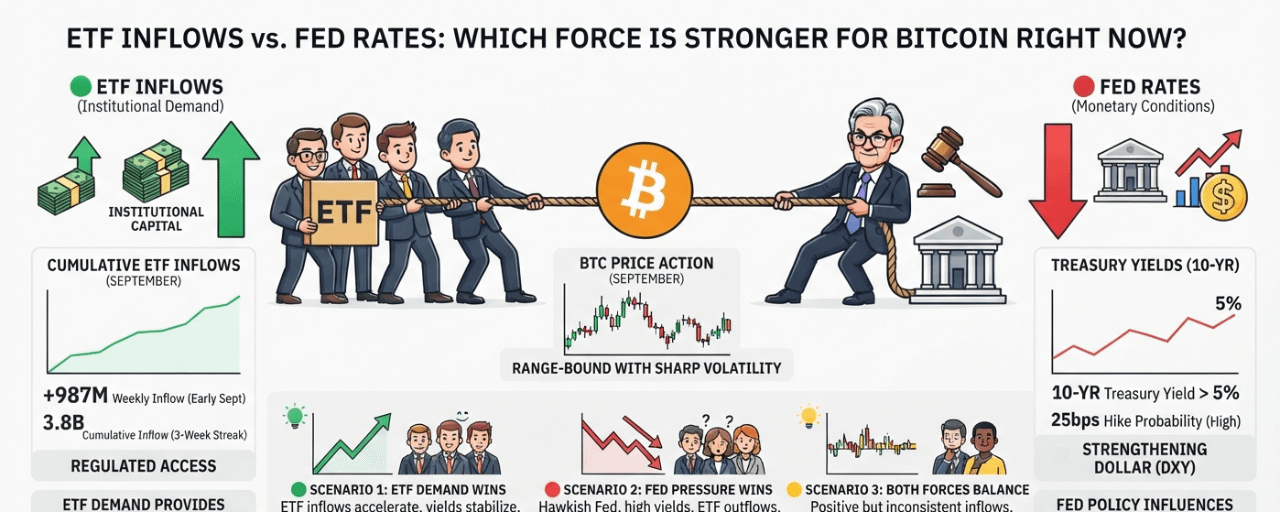

ETF Inflows vs. Fed Rates: Which Force Is Stronger for Bitcoin Right Now?
#FedRateWatch | Bitcoin Market Analysis
Bitcoin has a new tug-of-war.
On one side are Bitcoin ETF inflows — billions of dollars of regulated capital seeking exposure to BTC.
On the other is the Federal Reserve — influencing the cost of money, Treasury yields, the U.S. dollar and global risk appetite.
So which force matters more for Bitcoin right now?
The answer isn't as simple as choosing one.
ETF flows can create direct demand for Bitcoin exposure, while Fed policy can change the broader financial environment in which that demand operates.
And right now, these two forces are pulling in different directions.
Table of Contents
The Bitcoin tug-of-war
Why ETF inflows matter
Why Fed rates matter
What the latest ETF data tells us
Treasury yields: the bridge between the Fed and BTC
Three possible Bitcoin scenarios
Which signal should traders watch?
What investors and spot traders can learn
The bigger Bitcoin picture
1. The Bitcoin Tug-of-War
Our previous #FedRateWatch articles looked at the possible Fed hike and what it could mean for BTC, technology stocks and gold.
Now we can look at the other side of the equation.
What happens when institutional Bitcoin demand meets tighter monetary conditions?
This is particularly relevant today.
Markets are pricing a high probability of a 25-basis-point Fed hike, while the U.S. 10-year Treasury yield has recently moved above 5%.
At the same time, Bitcoin ETF flows have shown that institutional demand can be substantial — but also volatile.
That creates the central question:
Can ETF demand absorb the pressure created by tighter monetary policy?
2. Why Do Bitcoin ETF Inflows Matter?
A spot Bitcoin ETF gives traditional investors a regulated way to obtain Bitcoin exposure without directly holding BTC in a personal wallet.
When spot Bitcoin ETFs experience sustained net inflows, it indicates that more capital is entering these investment products than leaving them.
That makes ETF flows an important demand indicator.
In early September, U.S. spot Bitcoin ETFs recorded approximately $987 million of inflows in one week, extending a three-week positive streak.
Other market data showed approximately $3.8 billion of cumulative inflows over a three-week period into U.S. spot Bitcoin ETFs during the late-August/early-September rally.
That's significant.
But there is an important warning:
ETF inflows do not guarantee that Bitcoin will rise.
BTC can still fall because of leverage, profit-taking, macroeconomic pressure, futures positioning, regulatory developments or other sources of selling.
ETF flows are a signal — not a crystal ball.
3. Why Do Fed Rates Matter?
The Federal Reserve influences Bitcoin indirectly but powerfully.
When rates rise or markets expect additional tightening:
Interest rates ↑
↓
Bond yields can rise
↓
Cash and fixed-income assets become relatively more attractive
↓
Risk appetite can weaken
↓
Pressure can reach assets such as technology stocks and Bitcoin
The U.S. dollar can also strengthen when markets expect tighter monetary policy.
That can create another headwind for Bitcoin because BTC is globally priced in dollars.
The current environment demonstrates why this matters: markets are watching the Fed while Treasury yields remain elevated and oil prices have added to inflation concerns.
So the Fed doesn't need to sell Bitcoin to influence Bitcoin.
It changes the financial environment around Bitcoin.
4. What Are the Latest ETF Flows Telling Us?
This is where the story becomes much more interesting.
ETF demand was strong earlier in September.
But more recently, flows became considerably less consistent.
U.S. spot Bitcoin ETFs recorded approximately $462.7 million in net outflows from September 8–11, ending a three-week streak of inflows.
Then, after a reported $159.9 million inflow on September 14, another roughly $450.4 million of net outflows was reported on September 15.
This tells us something important:
Institutional demand is not one-directional.
Investors can move money into Bitcoin ETFs when they want exposure — and reduce exposure when macro conditions change.
That is why looking at only the strongest inflow day can create a misleading picture.
The trend matters more than one day's number.
5. Treasury Yields: The Bridge Between the Fed and Bitcoin
This may be the missing link in the ETF-vs-Fed debate.
Imagine two investors.
Investor A sees strong Bitcoin ETF inflows and thinks:
“Institutional demand is strong.”
Investor B sees a 5% Treasury yield and thinks:
“I can earn a relatively attractive yield without taking Bitcoin's volatility.”
Both observations can be correct.
This is why Treasury yields deserve close attention.
If yields rise sharply, Bitcoin may need stronger demand to overcome the increased opportunity cost of holding a volatile asset.
If yields stabilize or fall, the pressure from this channel could ease.
Recent market reporting has placed the 10-year Treasury yield around or above 5% as investors await the Fed decision.
So instead of asking only:
“Are ETF inflows bullish?”
we should ask:
“Are ETF inflows strong enough to offset the macro pressure?”
6. Three Possible Bitcoin Scenarios
🟢 Scenario 1: ETF Demand Wins
Suppose ETF inflows accelerate again while Treasury yields stabilize.
That combination could provide a stronger demand backdrop for BTC.
The potential sequence:
ETF inflows ↑ → spot demand ↑ → BTC support strengthens → resistance gets tested
In this environment, Bitcoin could attempt to reclaim important price levels.
But confirmation would still matter.
🔴 Scenario 2: Fed Pressure Wins
Now imagine the opposite.
The Fed remains hawkish, Treasury yields stay elevated, the dollar strengthens and ETF flows remain weak.
The sequence could become:
Yields ↑ → risk appetite ↓ → ETF outflows → BTC selling pressure ↑
That could make important support levels more vulnerable.
This is particularly relevant while BTC is trading near major technical levels.
🟡 Scenario 3: Both Forces Balance
This may be the most interesting scenario.
ETF flows remain positive but inconsistent.
The Fed remains restrictive.
Treasury yields stay elevated.
Bitcoin doesn't collapse — but it also struggles to establish a strong breakout.
The result could be:
Range-bound BTC + sharp short-term volatility.
For spot traders, this can be a frustrating environment.
For long-term investors, it can create opportunities for staggered accumulation — provided risk is managed carefully.
7. Which Signal Should Traders Watch?
Rather than choosing ETF flows or Fed policy, I would watch them together.
Here are six signals worth monitoring:
1. ETF net flows
Are several consecutive sessions showing inflows or outflows?
2. Treasury yields
Are yields rising or falling?
3. U.S. dollar
Is the dollar strengthening or weakening?
4. BTC spot volume
Is actual buying/selling activity confirming the price move?
5. Futures leverage
Is the move being driven by spot demand or excessive leverage?
6. BTC reaction to macro news
This may be the most revealing signal.
If bad macro news arrives and BTC barely falls, buyers may be absorbing the pressure.
If good news arrives and BTC still cannot rally, demand may be weaker than it appears.
8. What Can Investors and Spot Traders Learn?
For long-term investors
Don't treat one ETF inflow number as a reason to buy.
Look for a sustained pattern.
A disciplined approach could include:
• Staggering purchases
• Keeping capital available for corrections
• Avoiding all-in entries around major macro events
• Watching ETF flows over several sessions
• Considering the broader economic environment
For spot traders
The lesson is even simpler:
Don't trade the headline. Trade the confirmed reaction.
If ETF inflows rise but BTC cannot break resistance, wait.
If ETF outflows rise but BTC holds support, watch for confirmation.
If BTC breaks support on heavy volume, don't assume it must immediately recover.
And always account for fees before deciding whether a small price move is actually profitable.
9. The Bigger Bitcoin Picture
So, which force is stronger right now?
I don't think there is a permanent winner.
ETF flows represent direct demand for Bitcoin exposure.
Fed policy influences the liquidity and risk environment surrounding that demand.
One can strengthen while the other weakens.
That is exactly what makes the current market so interesting.
If ETF demand continues while monetary conditions become less restrictive, Bitcoin could receive support from both sides.
If ETF demand weakens while yields and the dollar rise, BTC could face a much tougher environment.
And if the two forces remain balanced, Bitcoin could continue moving violently between support and resistance without establishing a clear trend.
The signal I would watch most closely?
Not one day's ETF flow.
Not one Fed headline.
Not one Bitcoin candle.
I would watch whether sustained ETF demand can continue while Treasury yields remain elevated.
That tells us whether institutional buyers are willing to keep adding Bitcoin exposure even when the macro environment becomes more expensive.
That's the real battle.
ETF money is buying Bitcoin.
The Fed is changing the price of money.
Bitcoin's next major move may depend on which force becomes stronger — and whether the market has already priced it in.
#FedRateWatch #Bitcoin #BTC #BitcoinETF #ETFInflows #FederalReserve #CryptoMarket #BitcoinInvesting #SpotTrading #BTCUSD