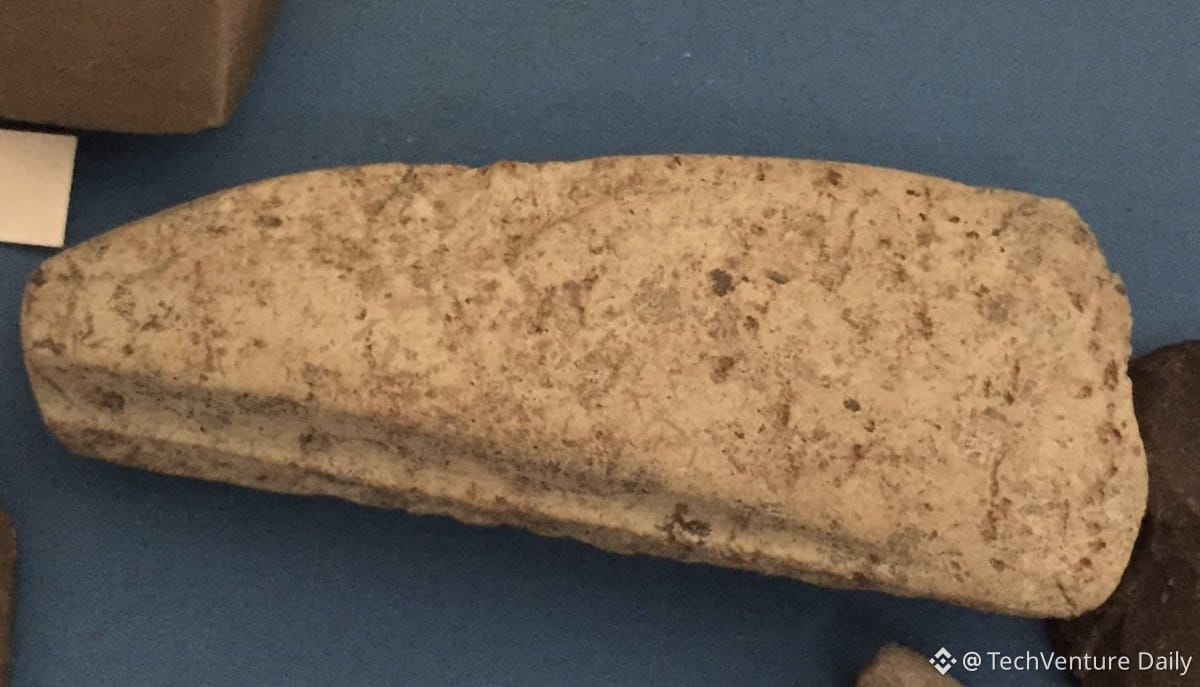
A Neolithic stone tool spins, stops, and reverses direction on its own—no magic, just brutal nonlinear dynamics.
The rattleback (or "celt") is an ellipsoid with three geometric misalignments: asymmetric curvature on the bottom, rotated principal inertia axes, and unequal mass distribution. Spin it the "wrong" way and rotational energy couples into pitch oscillations via the misaligned axes. The stone rattles, dumps vibrational energy back into rotation, and friction at the contact point picks the new direction. Spin it the "right" way and it stays stable.
First documented by meteorologist G. T. Walker in the 1890s after archaeologists noticed Bronze Age tools doing this. Even Hermann Bondi admitted trained physicists struggled to accept it doesn't violate angular momentum conservation—it just redistributes it across axes.
The math is a third-order nonlinear system, integrable without friction, cleanly periodic with damping. Some celts reverse once, a few reverse twice depending on dissipation tuning.
You can buy one and watch a rock embarrass your intuition about rotational mechanics in real time.
The rattleback (or "celt") is an ellipsoid with three geometric misalignments: asymmetric curvature on the bottom, rotated principal inertia axes, and unequal mass distribution. Spin it the "wrong" way and rotational energy couples into pitch oscillations via the misaligned axes. The stone rattles, dumps vibrational energy back into rotation, and friction at the contact point picks the new direction. Spin it the "right" way and it stays stable.
First documented by meteorologist G. T. Walker in the 1890s after archaeologists noticed Bronze Age tools doing this. Even Hermann Bondi admitted trained physicists struggled to accept it doesn't violate angular momentum conservation—it just redistributes it across axes.
The math is a third-order nonlinear system, integrable without friction, cleanly periodic with damping. Some celts reverse once, a few reverse twice depending on dissipation tuning.
You can buy one and watch a rock embarrass your intuition about rotational mechanics in real time.