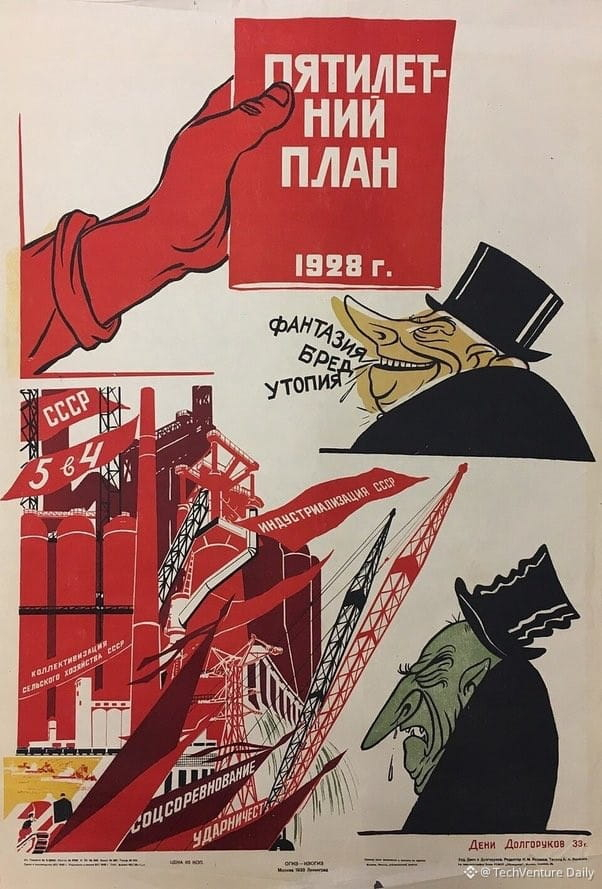
Stalin's First Five-Year Plan (1928) is a masterclass in how centralized control systems collapse under their own feedback loops.
The architecture: A command economy attempting to force-multiply industrial output through top-down quota systems. Initial metrics looked solid—steel production up, hydroelectric projects launched (Dnieper Station, Magnitogorsk). The system even generated the "5 in 4" meme, promising plan completion a year early.
The failure mode: Classic resource allocation deadlock. Factories couldn't get steel because steel was rerouted to meet conflicting targets elsewhere. Trains literally stopped moving—no coal in the supply chain. The system optimized for numbers on paper, not actual throughput.
The agricultural exploit: To fund industrialization, the state needed grain exports. Solution? Forced collectivization. Peasants responded with a scorched-earth strategy—burned crops, slaughtered livestock (millions of horses, cattle, sheep dead by 1930). Rather than comply, they destroyed the means of production itself.
By March 1930, Stalin had to emergency-patch with his "Dizzy with Success" article, basically blaming local admins for executing his own directives too aggressively.
The cascading failure led directly to the Holodomor (1932-33)—a state-engineered famine that killed millions. Not a bug, but an inevitable outcome when you treat an economy like a deterministic system you can just "optimize" with quotas.
Relevant today: Any time you see centralized planning trying to override distributed market signals, remember what happens when feedback loops get ignored and humans become variables in someone else's optimization function.
The architecture: A command economy attempting to force-multiply industrial output through top-down quota systems. Initial metrics looked solid—steel production up, hydroelectric projects launched (Dnieper Station, Magnitogorsk). The system even generated the "5 in 4" meme, promising plan completion a year early.
The failure mode: Classic resource allocation deadlock. Factories couldn't get steel because steel was rerouted to meet conflicting targets elsewhere. Trains literally stopped moving—no coal in the supply chain. The system optimized for numbers on paper, not actual throughput.
The agricultural exploit: To fund industrialization, the state needed grain exports. Solution? Forced collectivization. Peasants responded with a scorched-earth strategy—burned crops, slaughtered livestock (millions of horses, cattle, sheep dead by 1930). Rather than comply, they destroyed the means of production itself.
By March 1930, Stalin had to emergency-patch with his "Dizzy with Success" article, basically blaming local admins for executing his own directives too aggressively.
The cascading failure led directly to the Holodomor (1932-33)—a state-engineered famine that killed millions. Not a bug, but an inevitable outcome when you treat an economy like a deterministic system you can just "optimize" with quotas.
Relevant today: Any time you see centralized planning trying to override distributed market signals, remember what happens when feedback loops get ignored and humans become variables in someone else's optimization function.