
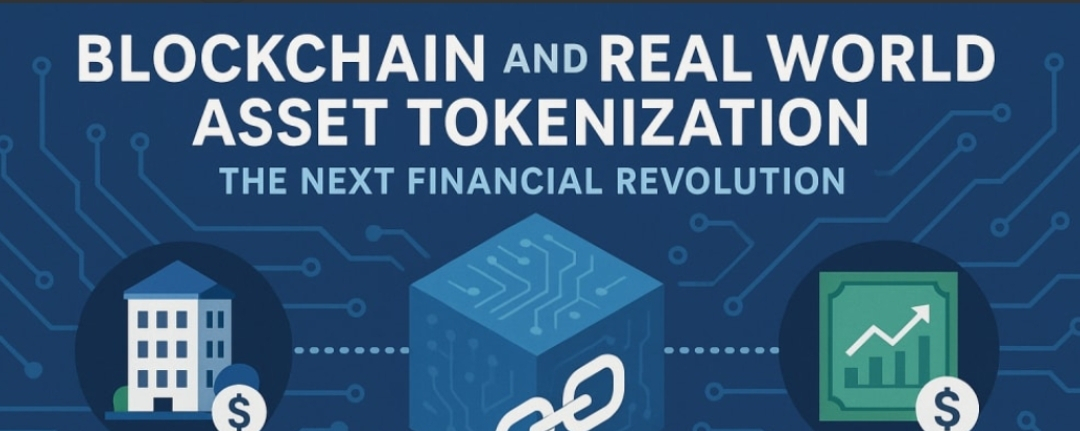


Tokenization is quickly becoming one of the biggest stories in crypto.
The idea is simple: take real-world assets like stocks, bonds, property, funds, or commodities and represent them digitally on a blockchain.
If this market grows toward the trillion-dollar level, the big question for crypto investors is not just how big tokenization becomes.
The more important question is: where does all that value actually go?
What Is Tokenization?
Imagine owning a small piece of an expensive asset without buying the whole thing.
Tokenization can divide an asset into digital tokens that represent ownership or economic rights connected to that asset.
These tokens can then potentially be transferred or traded using blockchain infrastructure.
This could make some financial markets faster, more accessible, and easier to operate.
But tokenization isn't simply about creating another crypto coin.
It is about bringing traditional assets onto blockchain-based systems.
Why Is Wall Street Interested?
Traditional finance involves many different companies and systems working together.
Trading, settlement, record keeping, custody and payments can all involve separate processes.
Blockchain technology could potentially connect some of these processes more efficiently.
That is why major financial companies are experimenting with tokenized funds, bonds and other assets.
For crypto, this matters because blockchain could become part of the infrastructure behind traditional finance rather than existing as a completely separate market.
Ethereum Could Be One Major Beneficiary
Ethereum already has a large ecosystem built around smart contracts, stablecoins and decentralized finance.
That gives it an important position in the tokenization race.
If more real-world assets move on-chain, they need networks where those assets can be issued, transferred and connected with other financial applications.
Ethereum is one possible home for that activity.
But it won't automatically capture everything.
Other blockchains are competing on transaction costs, speed, scalability and institutional features.
Layer-2 Networks Could Play a Bigger Role
Moving large amounts of financial activity directly through a busy blockchain can become expensive or inefficient.
Layer-2 networks are designed to help process transactions while still connecting back to larger blockchain ecosystems.
If tokenized assets reach millions of users, scalable infrastructure becomes extremely important.
This means the tokenization opportunity may benefit not only the main blockchain but also the networks and technology built around it.
Stablecoins Could Be the Quiet Winner
Tokenized assets still need an easy way to move money.
That is where stablecoins become important.
If someone buys a tokenized stock or bond on-chain, using blockchain-based dollars could make settlement much easier.
Stablecoins can act as the cash layer connecting different tokenized markets.
So even if investors focus on flashy RWA tokens, stablecoins may quietly become one of the most important pieces of the entire system.
DeFi Could Connect Everything
This is where things get even more interesting.
Imagine tokenized bonds, funds or other assets being connected with lending, borrowing and trading applications.
Instead of DeFi dealing mainly with crypto-native assets, real-world assets could potentially become part of the same financial ecosystem.
That could create new markets and new sources of liquidity.
However, regulations will play a major role in determining how far this integration can actually go.
Oracles Could Become Essential
Blockchains cannot automatically know what is happening outside their networks.
A tokenized real-world asset may need reliable information about prices, interest rates, asset values or other external data.
Oracle networks help bring this information on-chain.
If trillions of dollars of real-world value eventually interact with blockchain, accurate data becomes extremely important.
Bad data in a large financial system can create serious problems.
This makes blockchain data infrastructure another area worth watching.
Will Every RWA Token Benefit?
Probably not.
This is one of the biggest mistakes investors can make with a growing narrative.
A huge tokenization market does not mean every cryptocurrency with "RWA" attached to its story will become valuable.
A project still needs users, liquidity, useful technology and a reason for its token to exist.
There is also an important difference between a blockchain becoming widely used and its native token automatically increasing in value.
Investors need to understand how network growth actually creates demand for the token.
Traditional Finance Could Capture Much of the Value
There is another possibility that crypto investors should not ignore.
Banks, exchanges and asset managers could use blockchain technology while keeping much of the economic value inside traditional financial companies.
In that scenario, blockchain adoption could explode without every crypto token benefiting.
This is why the tokenization story is more complicated than simply buying a basket of RWA coins.
The winners could include blockchains, stablecoins, DeFi infrastructure, oracle networks, financial institutions and technology companies.
The Bigger Picture
Tokenization could become one of the strongest bridges between traditional finance and crypto.
If the market eventually reaches the trillion-dollar scale, it could bring enormous amounts of assets onto blockchain infrastructure.
But that does not mean $1.6 trillion will suddenly flow into cryptocurrencies.
The real opportunity is understanding which infrastructure becomes necessary when real-world assets move on-chain.
Ethereum and other smart-contract networks could benefit. Layer-2 networks could handle activity. Stablecoins could provide settlement. DeFi could create new financial markets, and oracles could provide essential data.
The biggest winner might not be the token currently getting the most hype.
It could be the infrastructure quietly powering everything behind it.
So if tokenization becomes a trillion-dollar industry, which part of crypto do you think captures the most value?