
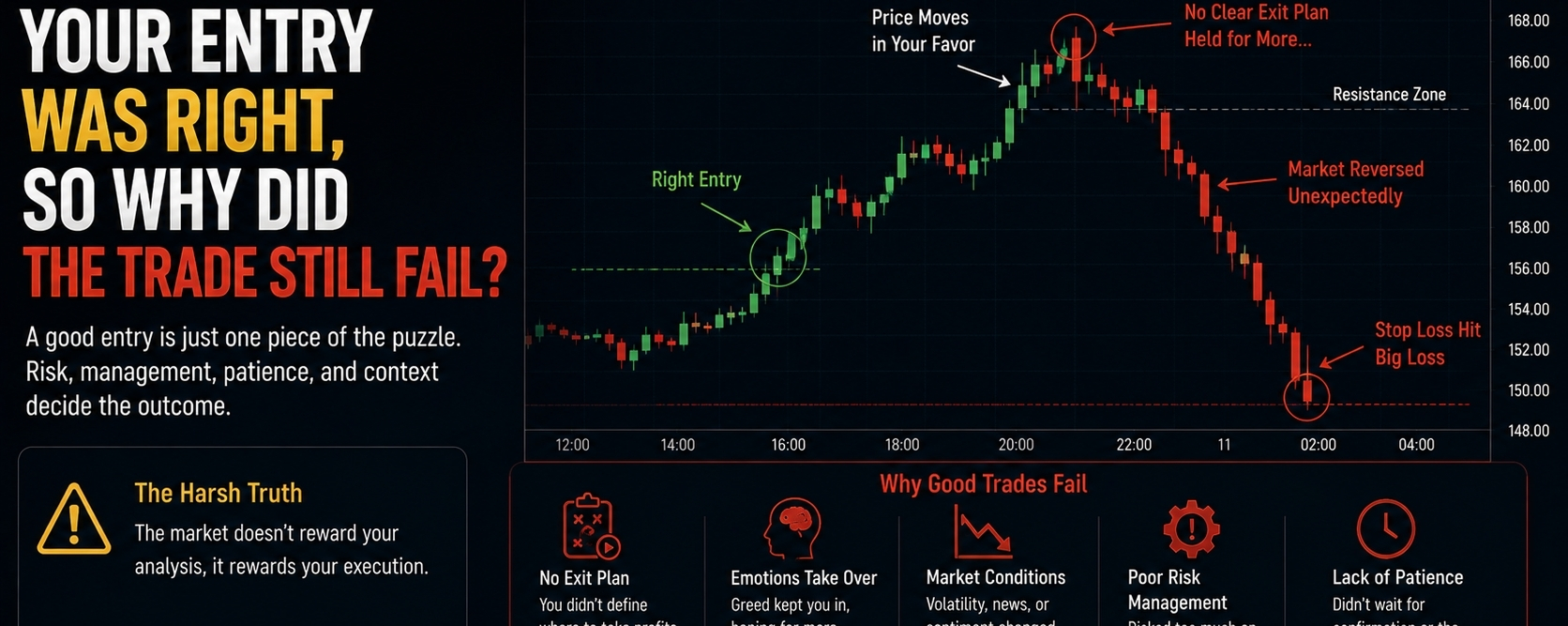


You found support. You waited for confirmation. Your entry looked almost perfect.
Price even moved in your direction.
Then suddenly the market reversed, hit your stop, and the trade failed.
If the entry was good, what went wrong?
The answer is simple: a good entry is only one part of a successful trade.
A Good Setup Can Still Lose
One of the hardest lessons in crypto trading is that no setup works every time.
You can identify support correctly, read the trend correctly and enter at a reasonable price — yet unexpected selling pressure can still invalidate the idea.
Trading is based on probabilities, not guarantees.
A losing trade doesn't automatically mean your analysis was bad. The real question is whether you followed a repeatable process and controlled the risk.
You Focused Too Much on Entry
Many traders spend most of their time searching for the perfect entry.
They draw support zones, trendlines, Fibonacci levels and indicators, trying to find the exact price where the market will reverse.
But what happens after entering is equally important.
Where will you take profit? Where is your idea invalid? What will you do if price moves sideways? How much are you risking?
Without answers to those questions, even an excellent entry can turn into a poor trade.
Your Stop-Loss Was Too Tight
Imagine correctly identifying a major support zone.
You enter near support but place your stop extremely close to your entry. Normal volatility pushes price slightly lower, triggers your stop, and then the market reverses in the direction you originally expected.
Your market idea may have been right, but your risk structure didn't leave enough room for normal price movement.
That doesn't mean stops should simply be made wider. The stop should make sense based on where the trade idea becomes invalid.
You Used Too Much Leverage
Leverage can make a reasonable setup much less forgiving.
The higher the leverage, the more sensitive your position becomes to relatively small price movements. Crypto is already volatile, so excessive leverage can turn ordinary market noise into a major loss.
A strong entry cannot compensate for uncontrolled position size.
Sometimes the problem isn't where you entered. It's how much risk you attached to that entry.
You Ignored the Bigger Trend
A perfect-looking long setup can still struggle when the broader market is strongly bearish.
The same applies to shorts during powerful bullish momentum.
A support bounce on a five-minute chart might look attractive, but if the higher-timeframe structure is breaking down, that support may not survive.
Before entering, zoom out.
Understanding the bigger trend can provide context that a single timeframe cannot.
Bitcoin Changed Direction
Altcoin traders sometimes focus entirely on the coin they are trading.
Then Bitcoin makes a sudden move.
Because $BTC still has a major influence on overall crypto sentiment, a sharp Bitcoin decline can drag altcoins down even when their individual setups previously looked strong.
Your altcoin analysis might have been reasonable, but the broader market environment changed.
You Didn't Take Profit When the Market Gave It
Another common mistake happens after the entry actually works.
The trade moves into profit, but the trader keeps increasing the target because they want more.
Then momentum fades.
Price reverses, the unrealized profit disappears, and sometimes the position eventually becomes a loss.
Having a profit-taking plan before entering can reduce emotional decision-making once the trade starts moving.
One Loss Doesn't Define Your Strategy
This may be the most important point.
A single losing trade tells you very little about whether a strategy works.
Even strong strategies can experience consecutive losses. What matters is how the strategy performs across many trades while keeping risk controlled.
Constantly changing your entire strategy after every loss can make consistency almost impossible.
The Real Goal
Trading isn't about being right every time.
It's about building a process where your winners have the opportunity to matter while your mistakes remain manageable.
A strong entry helps.
But position size, stop placement, market structure, leverage, profit management and discipline determine what happens after you press the button.
So when your next “perfect” setup fails, don't immediately ask:
“Why was my entry wrong?”
Ask:
“Was the entry wrong or was something else in my trade management the real problem?”
That question can teach you far more than chasing another indicator ever will.