
Crypto trading has spent years pretending that more infrastructure automatically means a better experience. More chains. More bridges. More aggregators. More wallets. More routing layers. More dashboards.
And somehow, despite all of that, actually trading on-chain can still feel like plumbing work.
You find an opportunity, open three tabs, check which chain the asset is on, move funds, approve a token, sign a transaction, wait for confirmation, hope the price hasn't moved too far, and then repeat the whole process when you want to exit. On a quiet day, it's annoying. During a volatile market, it can become the difference between catching a move and watching it happen from the sidelines.
That's the problem Genius Terminal is trying to address.
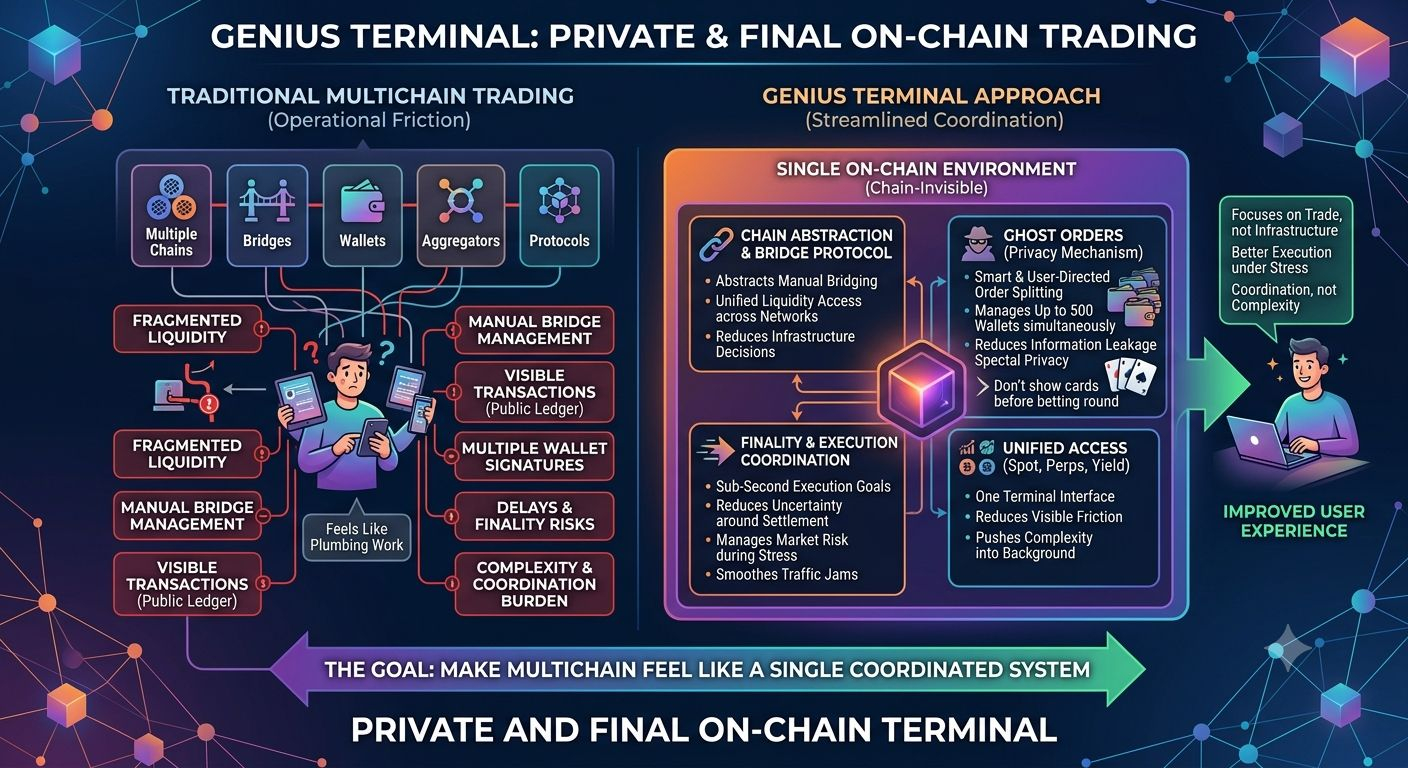
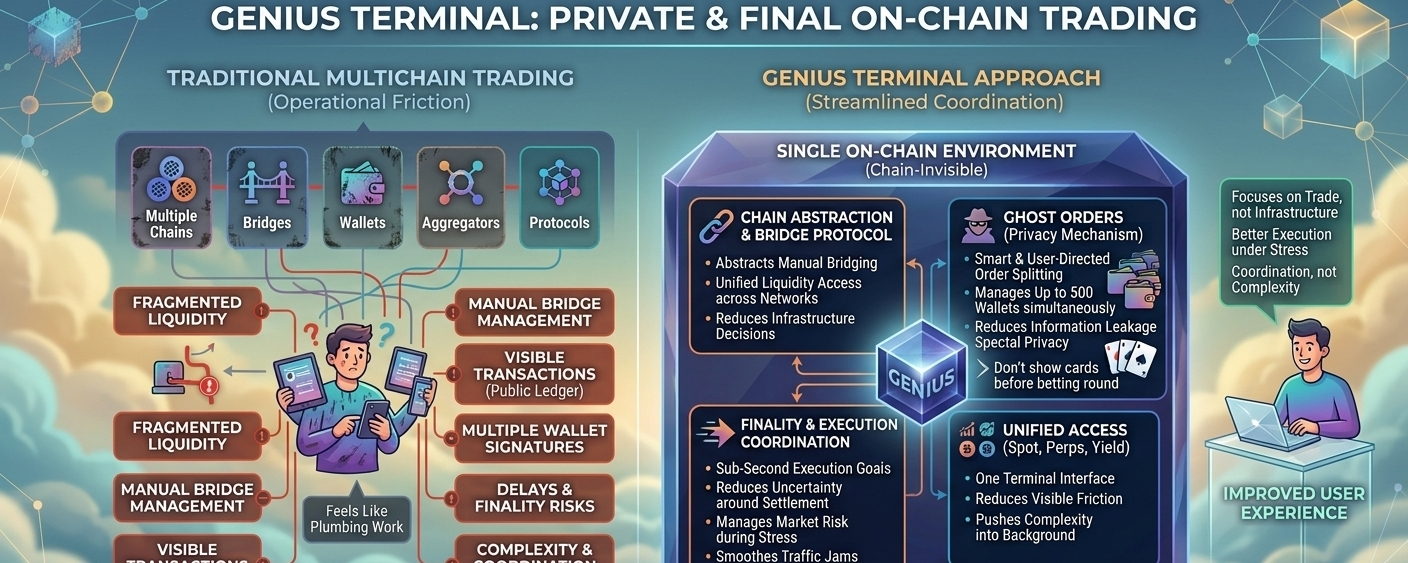
The project's central idea is simple: create a single on-chain trading environment where the complexity of chains, bridges, wallets, and individual protocols is pushed into the background. Genius describes itself as a private and final on-chain terminal, designed to unify trading activity across different markets and networks while reducing the visible friction that usually comes with decentralized finance. Its documentation frames the product as a terminal rather than just another aggregator or wallet extension, with access spanning spot markets, perpetuals, pre-launch opportunities, and yield products.
The interesting part isn't simply that Genius wants to put more things into one interface. Plenty of crypto products have tried that. The harder question is whether combining those things actually improves execution when the market becomes difficult.
Because calm markets are misleading.
Almost every trading system looks reasonable when nothing is happening. Liquidity appears deep. Transactions confirm normally. Bridges are functioning. Prices are relatively stable. Users have time to click through several steps.
Then something breaks.
A major token starts moving twenty percent in minutes. A network becomes congested. Gas spikes. Liquidity disappears from one venue and migrates somewhere else. Traders rush toward the same assets at the same time. Suddenly, the friendly interface that worked perfectly an hour ago is asking users to make five decisions they don't have time to think about.
I've seen this pattern repeatedly in crypto. The problem usually isn't that users don't understand the technology. The problem is that the technology asks them to coordinate too many moving parts precisely when coordination is hardest.
That's where the idea of a terminal becomes more important than it initially sounds.
A good terminal should reduce the number of infrastructure decisions a trader has to make during execution. The user should be thinking about the trade, not whether USDC needs to be bridged, whether a token requires another approval, or which network currently holds the usable balance.
Genius calls this approach chain-invisible. According to its documentation, the system is designed to abstract away much of the manual bridging and asset-wrapping process that normally separates liquidity across networks. The underlying Genius Bridge Protocol is described in the project's whitepaper as a non-custodial cross-chain intent system intended to support cross-chain execution and liquidity coordination without forcing users to manually manage every infrastructure step themselves.
That sounds good in theory. But the real reason abstraction matters is operational.
Imagine a city where every neighborhood has its own currency and every time you cross a bridge, you have to exchange money, fill out paperwork, and wait for approval. Technically, the city is connected. Practically, moving through it is exhausting.
That's roughly how multichain crypto can feel.
The existence of bridges does not automatically create a seamless market. In fact, bridges can introduce their own risks and delays. Funds may need to move before trading can happen. Liquidity may be fragmented across chains. Different networks have different confirmation times and congestion patterns. A trader can have significant capital spread across multiple ecosystems while still being unable to use that capital efficiently in the moment they need it.
The goal of a unified terminal is to make those boundaries less visible.
But there is another layer to the Genius thesis that is arguably more important: privacy.
Public blockchains are transparent. That's one of their defining features. Transactions can be verified, balances can often be inspected, and activity can be followed across the network.
Transparency is useful for auditability. It is less convenient when you're trying to execute a large position.
If a trader is moving meaningful size into or out of a market, broadcasting every part of that behavior can create problems. Other participants may monitor wallet activity. Bots may react to visible transactions. Large concentrated positions can become signals. The transaction itself can become part of the market information environment before the trade has fully played out.
Genius is attempting to address this with what it calls Ghost Orders. Its public site says the privacy mechanism can use smart and user-directed order splitting across multiple wallets, with support for managing up to 500 wallets simultaneously. The stated goal is to reduce visible concentration and make large movements less directly attributable to a single obvious on-chain position.
This is where it's important to stay realistic.
Privacy does not mean invisibility in the absolute sense.
On-chain systems still leave traces. Blockchain analysis is sophisticated. Patterns can sometimes be reconstructed. Timing, transaction behavior, counterparties, and other forms of metadata can reveal relationships that aren't obvious at first glance.
Splitting activity across multiple wallets can reduce direct concentration visibility, but it does not magically remove every possible method of analysis. Anyone evaluating privacy infrastructure should understand that privacy exists on a spectrum.
Still, reducing unnecessary information leakage can matter.
Think about a poker game. You don't need to become literally invisible to have an advantage. You simply don't want to show everyone your cards before the betting round is over.
The same basic logic applies to execution.
If a trader can reduce the amount of actionable information exposed while entering or exiting a position, that may reduce some forms of adverse behavior around the transaction. It doesn't guarantee a better price. It doesn't prevent the market from moving. It doesn't create liquidity where none exists.
But it can change the conditions under which the order reaches the market.
The other word in Genius Terminal's positioning is “final.”
Finality is easy to ignore until it becomes a problem.
A transaction can be submitted without being immediately settled. A trade can appear to be progressing while underlying infrastructure is still catching up. Cross-chain systems add additional coordination steps. One side of an operation may complete before another. Different networks may have different assumptions around confirmation and settlement.
During normal conditions, these delays can feel like minor inconveniences.
During stress, they compound.
Suppose a trader executes a position and expects to immediately hedge exposure elsewhere. If settlement is uncertain, the hedge may be delayed. If the hedge is delayed, market risk increases. If market risk increases, liquidity providers may widen spreads or reduce their willingness to quote size.
One delay becomes another delay.
This is why infrastructure problems often behave less like isolated bugs and more like traffic jams. Nobody plans for the entire system to fail. Instead, each participant responds rationally to a small amount of uncertainty. Then those responses pile up.
The road isn't closed. Everyone is just braking at the same time.
Genius is trying to build around that reality by presenting a more centralized trading experience at the interface level while retaining on-chain execution and non-custodial architecture underneath. The project's website emphasizes sub-second execution goals, advanced order types, cross-chain functionality, and integration with a large number of decentralized venues. Its public materials also describe the system as non-custodial, with key management infrastructure designed so the platform itself does not simply take control of a user's assets in the traditional centralized-exchange sense.
That design choice is interesting because it acknowledges something the crypto industry has occasionally been reluctant to admit.
Users don't necessarily want more interfaces.
They want fewer things to go wrong.
For years, decentralized finance has often treated complexity as a kind of badge of honor. If a user understands liquidity pools, bridges, RPC endpoints, approvals, gas optimization, wallet permissions, and transaction routing, then great. They're considered sophisticated.
But infrastructure shouldn't require users to become infrastructure engineers.
A person using electricity doesn't need to understand how the power grid balances load. A driver doesn't need to understand how traffic lights coordinate across an entire city. These systems are complicated precisely so the experience on top of them can remain relatively simple.
Crypto has not always reached that stage.
Genius Terminal's broader argument is that the terminal itself should become the main user-facing product. Protocols, bridges, liquidity sources, and other infrastructure can continue existing underneath, but the user shouldn't have to manually assemble them every time they want to make a trade.
That's a reasonable direction. But it comes with trade-offs.
Abstraction is useful until something goes wrong.
When a user manually controls every step, they can see every dependency. When those dependencies are hidden behind a cleaner interface, the system becomes easier to use but potentially harder for the average person to diagnose during a failure.
If a bridge experiences delays, the terminal cannot simply wish the delay away. If an underlying blockchain is congested, the interface cannot create block space out of nothing. If liquidity disappears across integrated venues, routing technology cannot force market makers to provide quotes.
This is the limitation of every abstraction layer.
A modern car hides an enormous amount of mechanical complexity from the driver. That's great when the car is working. When something fails, however, the driver may only see a warning light and have little idea what is actually happening underneath.
On-chain terminals face a similar challenge. The better the abstraction, the more responsibility the system takes for coordinating complexity correctly.
That means reliability matters.
Routing matters.
Security matters.
The handling of failure states matters.
And honestly, these things matter more than a beautiful interface.
Genius has positioned itself as security-focused, publicly describing audits, penetration testing, passkey support, and non-custodial infrastructure. Those are useful signals, but they should not be interpreted as guarantees. Audits can reduce risk without eliminating vulnerabilities. Penetration testing can identify weaknesses without finding every possible attack path. Non-custodial architecture can reduce one category of counterparty risk while leaving users exposed to smart contract risks, infrastructure failures, market volatility, and their own operational mistakes.
That's just the reality of crypto.
There is no terminal that can prevent a bad trade.
There is no routing engine that can guarantee liquidity during a market panic.
There is no privacy layer that makes all activity permanently unknowable.
And there is no cross-chain system that completely removes the risk introduced by the networks and protocols it depends on.
The more honest way to evaluate Genius Terminal is not to ask whether it solves crypto.
It doesn't.
The better question is whether it reduces enough of the unnecessary friction that has become normal in on-chain trading.
That is a more practical standard.
The project is building toward a model where users can access multiple forms of on-chain activity from a consolidated environment. Genius publicly highlights spot trading, perpetual markets, yield products, market analytics, cross-chain execution, and privacy-oriented order management as parts of that environment. The idea is that a trader's portfolio should feel more unified even when the underlying assets, liquidity, and protocols remain distributed.
There is a logic to that.
Markets are becoming more fragmented, not less. New chains continue appearing. Liquidity moves. Trading venues specialize. Perpetuals, spot markets, prediction markets, token launches, and yield products increasingly exist in separate places.
The naive answer is to keep adding more tabs.
The more interesting answer is to build better coordination.
That seems to be the core of what Genius Terminal is attempting.
Not a new chain. Not necessarily another isolated exchange. More like an operating layer between the trader and the growing mess of decentralized infrastructure underneath.
Whether that approach succeeds will depend on execution in the boring sense of the word.
Can orders route reliably?
Can the system maintain speed when demand increases?
Can privacy mechanisms provide meaningful protection without creating unacceptable complexity?
Can cross-chain coordination work consistently under stress?
Can the terminal remain understandable as more protocols and features are added?
Those questions matter more than the slogan.
Because the crypto industry is full of products that work beautifully in demos and struggle when actual users arrive at the same time.
Stress changes the rules.
A trading terminal should be judged when liquidity is moving, networks are busy, and users are trying to make decisions quickly. That's when coordination failures become visible. That's when latency becomes expensive. That's when trust in the system is tested.
Genius Terminal's thesis is compelling precisely because it focuses on some of those pressure points. Privacy addresses the problem of exposing too much trading information. Finality addresses the problem of uncertainty around completed actions. Chain abstraction addresses the friction of fragmented liquidity. A unified interface addresses the operational burden placed on users.
None of these ideas are magic.
And that's fine.
Infrastructure doesn't need to be magical. It needs to work when the environment becomes inconvenient.
The strongest interpretation of Genius Terminal is not that it promises to make decentralized finance perfect. The underlying markets will still be volatile. Protocol risks will still exist. Networks will still have limits. Liquidity will still disappear when fear becomes more valuable than yield.
What Genius is trying to do is make the infrastructure feel less like a collection of disconnected machines and more like a coordinated system.
That may sound like a small distinction.
It isn't.
In a calm market, almost any interface can look efficient. In a stressed market, the number of decisions a user has to make becomes painfully obvious. Every extra signature, bridge, approval, wallet switch, confirmation, and routing decision is another potential point of failure.
The future of on-chain trading probably won't belong to the system with the most visible complexity.
It will belong to the systems that understand complexity well enough to keep it out of the user's way.
Genius Terminal is making a serious attempt at that model through privacy-oriented execution, unified cross-chain access, and a focus on finality and trading coordination. Whether it ultimately delivers on every technical promise is something that will only be proven through real-world use, especially when markets become hostile rather than cooperative.
But the problem it is targeting is absolutely real.
Crypto doesn't necessarily need another place to click buttons.
It needs infrastructure that behaves better when everything else starts getting messy.
@GeniusOfficial $GENIUS #genius