
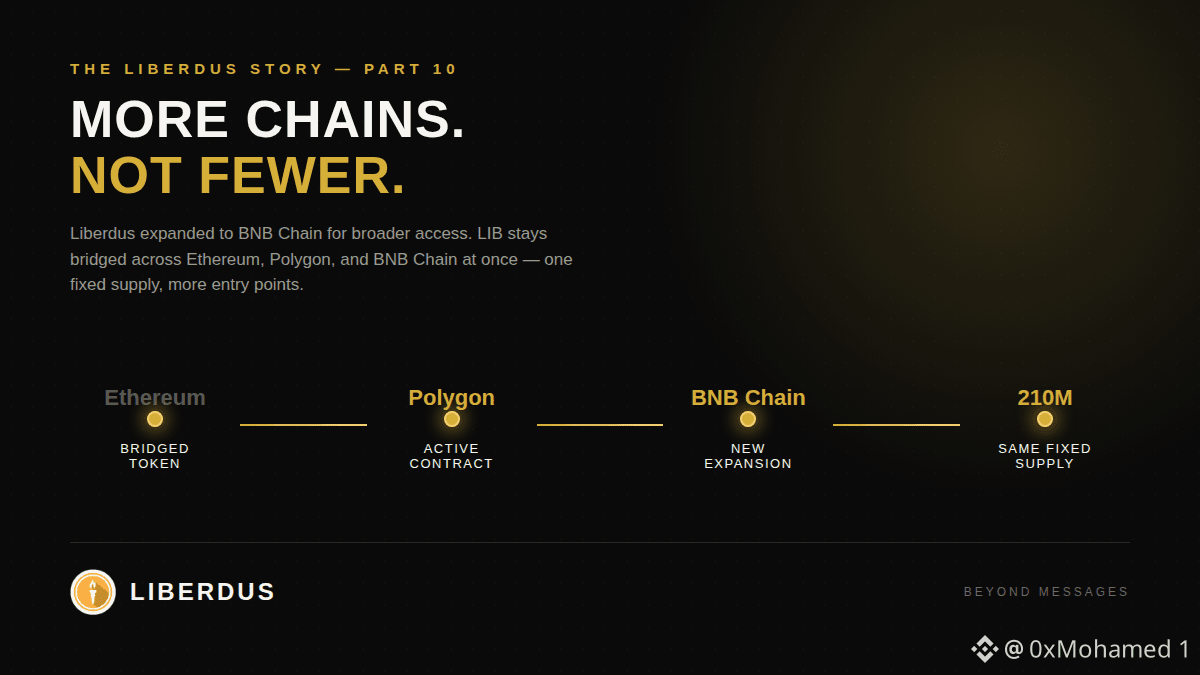
More chains, not fewer An earlier draft of this series treated Liberdus's move onto $BNB Chain as a migration away from Polygon. That assumption doesn't hold up against the record, and it's worth correcting in the open rather than quietly. Liberdus announced it was expanding to $BNB Chain for broader access, not replacing its Polygon deployment. LIB functions as a coin on the Liberdus network itself and as a bridged token on smart contract platforms including Ethereum, BNB Chain, and Polygon. Both chains carry live, distinct contract addresses today: BNB Chain contract at 0x5AfdCC93D794762C785Ec14Fb2a24c4aBDbB8aaa, and a Polygon contract at 0x693ed886545970F0a3ADf8C59af5cCdb6dDF0a76. A fixed 210 million supply bridged across three chains isn't three separate token pools; it's one fixed supply made accessible wherever liquidity and users already are. LIB can be bought and sold through DeFi aggregators like DefiLlama, or through Liberdus's own OTC and WhaleSwap platforms for larger amounts, across whichever chain is most convenient. Adding a chain instead of switching chains is a small distinction with a real consequence: it doesn't fragment liquidity into a before and after, it widens where the same fixed supply can be reached. I don't have confirmed details beyond the expansion announcement itself, so I'll stop there rather than speculate on internal reasoning. Tomorrow: how messaging and payments combine into a single transaction, and what that actually looks like in practice. #Liberdus @Liberdus $POL #BNB

Посты
Включает адреса смарт-контрактов. Торгуйте с осторожностью.
Отказ от ответственности. Содержит мнения третьих сторон. Не является рекомендацией. Binance AI не предоставляет гарантий. См. Правила и условия.