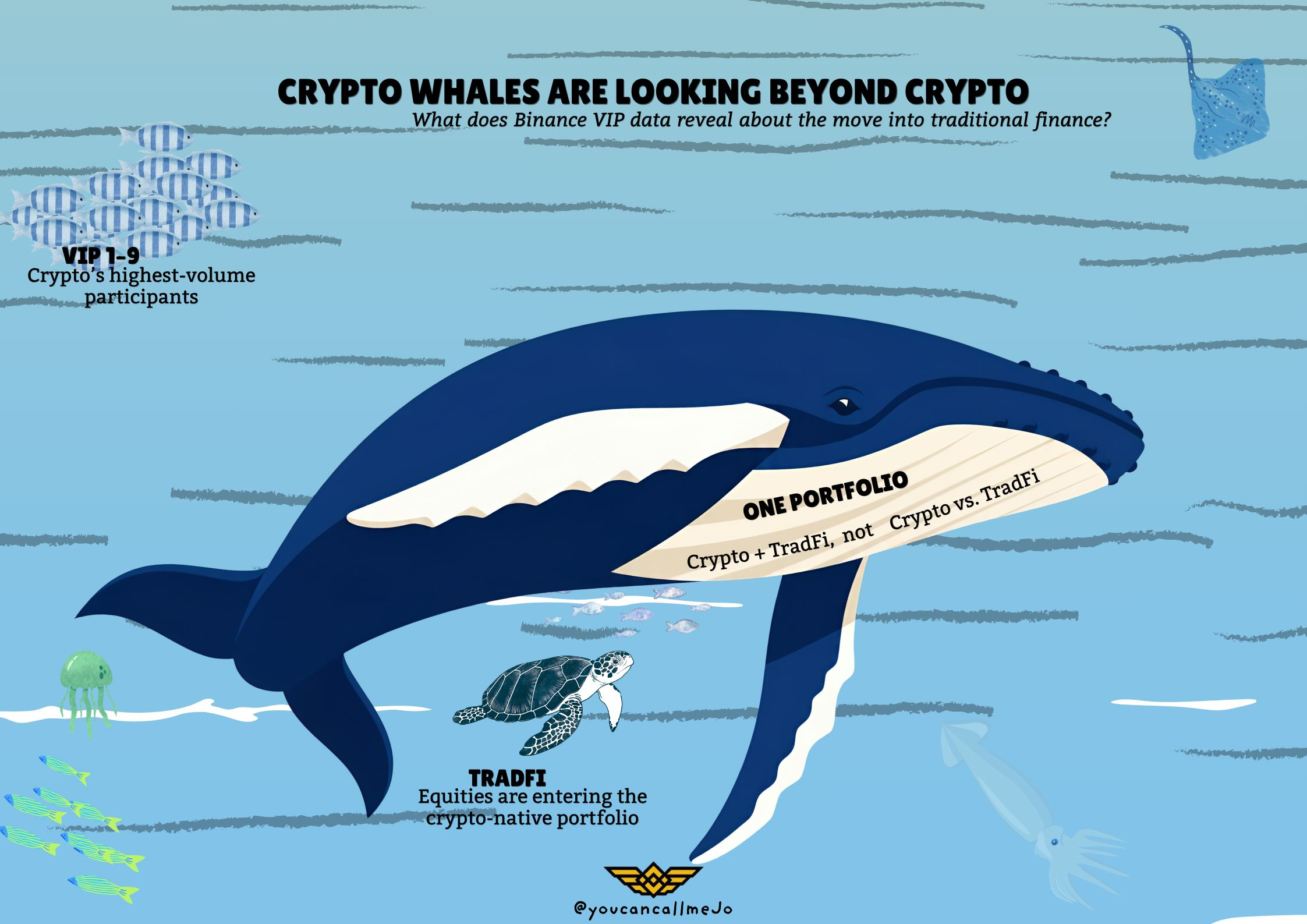

For years, the typical crypto investor has been viewed as someone who lives almost entirely inside the crypto market. Bitcoin, Ethereum, altcoins, stablecoins, DeFi, and perpetual futures were assumed to make up most of their financial world. But that picture becomes much more interesting when we look at the users sitting at the opposite end of the spectrum: Binance’s highest-tier users, from VIP 1 through VIP 9. These are the most active and sophisticated participants on the platform, including high-volume traders and professional trading operations. Looking at how this group interacts with traditional financial assets can help answer a bigger question: Are crypto’s most experienced participants beginning to treat traditional equities as part of the same portfolio rather than as a completely separate investment world?
Why VIP Tier Matters
Binance VIP levels are primarily associated with trading activity and volume, so VIP status should not automatically be interpreted as a direct measurement of someone's total wealth. A high-tier account can represent an individual trader, a professional investor, a market-making operation, or another sophisticated participant. That distinction matters when interpreting the data. However, the value of studying these users is that they represent a particularly active segment of the crypto ecosystem. Their portfolios and trading decisions can reveal how experienced crypto participants interact with other asset classes when they have access to them through the same financial platform. This creates an interesting comparison. Instead of asking whether a traditional investor is entering crypto, we can reverse the question: What happens when a crypto-native investor starts gaining exposure to traditional finance?
From Crypto-Only to Multi-Asset
The first important idea is that diversification does not necessarily mean abandoning crypto. A professional crypto trader who begins allocating to U.S. equities is not necessarily becoming less interested in Bitcoin. They may simply be expanding the set of assets they use to manage risk, express market views, or capture opportunities across different market cycles. Consider a hypothetical crypto-native investor whose portfolio is heavily exposed to digital assets. During a period when crypto markets become particularly volatile, traditional equities could provide a different source of exposure. The investor could also use equities to express views on sectors such as technology, semiconductors, energy, or consumer spending without taking the same type of direct crypto exposure. The important shift is therefore not “crypto whales are leaving crypto.” It is potentially “crypto whales are becoming multi-asset investors.” That is a much more interesting development.
Why Traditional Equities Could Attract Crypto’s Largest Participants
Professional investors generally have more reasons to diversify than simply chasing the asset with the highest recent return. Different markets provide different types of exposure, liquidity, volatility, and risk characteristics.
U.S. equities, for example, provide access to companies generating revenues and profits from sectors that are increasingly connected to major technological and economic trends. A crypto-native investor interested in artificial intelligence can gain exposure through technology companies. Someone interested in consumer demand can look toward retail stocks. Another investor interested in the energy requirements of data centers could approach the theme through energy or infrastructure companies. This allows the same macro thesis to be expressed through completely different assets. A trader who believes AI adoption will accelerate does not have to express that view only through a crypto token associated with the AI sector. They could also look at semiconductor companies, cloud providers, or other traditional businesses benefiting from the same structural trend.
That is where the boundary between crypto investing and traditional investing starts to become less meaningful.
The Importance of Seeing Both Sides
There is something particularly interesting about Binance's position in this analysis. A traditional brokerage can observe how its equity investors behave, but it does not necessarily have the same visibility into their crypto activity. A crypto-native platform can see the opposite side of the equation, but the ability to connect crypto activity with TradFi allocation creates a broader picture of investor behavior. This does not mean every individual user's complete financial portfolio is visible or that VIP users should be treated as a single homogeneous group. It means platform-level behavioral data can reveal patterns across users who are already active within the ecosystem. That makes the question much more useful than simply asking how many crypto users have bought stocks.
We can instead ask: As crypto participants become more sophisticated, does their relationship with traditional finance change?
And if it does, what does that tell us about the evolution of crypto itself?
Whales May Be Thinking in Themes, Not Asset Classes
One of the most interesting ways to interpret cross-market allocation is to stop thinking in terms of crypto versus stocks and start thinking in terms of investment themes.
Imagine an investor believes that artificial intelligence will transform the global economy. That investor could hold Bitcoin because they believe digital assets will benefit from increased technological adoption. They could simultaneously hold technology stocks because they expect corporate AI spending to increase. They could hold semiconductor exposure because AI requires computing infrastructure. These are different assets, but they can all represent parts of the same investment thesis. The same applies to macroeconomic views. An investor anticipating lower interest rates might express that view through equities, crypto, bonds, or combinations of these assets. The instruments are different, but the underlying thesis can be connected. This is one reason why the movement of crypto-native capital into TradFi should not automatically be interpreted as a loss of conviction in crypto. It could instead indicate a broader investment framework.
The Professionalization Question
There is another important implication. Crypto has spent years moving from a niche technological experiment toward a financial market with increasingly sophisticated participants. If its most active users are also allocating across traditional assets, that could represent another stage of market maturation. Professional investors rarely think about markets as isolated boxes.
They compare correlations. They monitor liquidity. They manage exposure. They look at volatility. They hedge. They rotate capital between opportunities. They consider how one asset behaves when another moves.
The more crypto participants adopt this approach, the more the distinction between a “crypto trader” and a “financial market participant” begins to disappear. The investor may still spend most of their time analyzing Bitcoin, but their decision-making framework becomes broader.
VIP Doesn't Automatically Mean “Whale”
This is an important analytical caveat. The word “whale” is useful for describing the idea of large or sophisticated crypto participants, but VIP level itself should not be treated as a perfect measurement of net worth. Binance VIP tiers are based on factors such as trading volume and other eligibility criteria. Someone can therefore achieve a high VIP level because they trade substantial volumes without necessarily holding an enormous long-term portfolio. This distinction prevents us from making an exaggerated conclusion from the data. The useful takeaway is not that every VIP 9 user is a billionaire with a massive stock portfolio. The useful takeaway is that high-volume and professional crypto participants provide an interesting population for studying cross-asset behavior. That is where the data becomes meaningful.
What Would It Mean If TradFi Becomes a Core Allocation?
Suppose the data shows that higher-tier Binance users increasingly allocate meaningful portions of their activity or capital toward traditional equities. That would suggest something larger than simple product adoption. It could indicate that sophisticated crypto participants are beginning to view traditional financial assets as complementary components of their broader portfolios. In other words, equities would no longer necessarily be seen as something that exists outside the crypto ecosystem. They could become another tool inside a larger investment strategy. That would be significant because it changes the question from “Will crypto replace traditional finance?” to something much more realistic: “How will crypto and traditional finance coexist inside the same portfolio?”
And This Could Change How We Define a Crypto Investor
The term “crypto investor” increasingly describes a broader group than it did several years ago. It could mean someone who holds only Bitcoin. It could mean an active futures trader. It could mean a DeFi participant. It could mean someone holding stablecoins and traditional equities. Or it could describe a professional investor who moves between multiple markets depending on liquidity and opportunity. This evolution matters because financial platforms are increasingly competing not simply for someone's crypto transactions, but for a larger share of their overall financial activity. If users can research, trade, manage digital assets, access traditional financial products, and monitor markets within the same ecosystem, the platform becomes less of a crypto exchange and more of a multi-asset financial interface. That is a much bigger transformation.
The Real Question Isn't “Stocks or Crypto?”
I think the most interesting question emerging from this type of data is not whether crypto's wealthiest participants prefer stocks over crypto. It is whether they still think about the two as separate categories at all. A sophisticated investor may look at Bitcoin, Nvidia, a broad-market ETF, stablecoins, and other assets through the same lens: What exposure does each one give me, what risk does it introduce, and how does it fit with everything else I own? That is fundamentally different from the mindset of choosing one market and ignoring everything else. It is portfolio thinking rather than asset-class thinking. And if Binance's highest-tier users increasingly behave this way, it could be an important signal about where the broader crypto industry is heading.
What This Could Mean for the Future
If this cross-asset behavior continues, one possible long-term outcome is a gradual convergence between crypto and traditional finance. The distinction between a “crypto portfolio” and a “traditional portfolio” could become increasingly difficult to maintain as investors gain access to both types of assets through connected infrastructure.
For crypto-native investors, this could mean greater diversification and more ways to express investment views. For traditional investors, it could mean greater exposure to digital assets without having to completely abandon familiar financial instruments. The result would not necessarily be one market replacing another. It could be something more subtle: the creation of investors who naturally operate across both. And that may ultimately be one of the most important signs of crypto's maturation. The industry does not necessarily need to replace traditional finance to transform it. Sometimes, transformation happens when investors simply stop seeing a wall between the two. Crypto's whales may not be choosing between crypto and TradFi. They may simply be building portfolios where both belong.
#Binance
#BinanceVIP
#TradFi
#CryptoInvesting
#CryptoWhales