#dusk $DUSK @Dusk At first I assumed a privacy blockchain should hide everything. While studying Dusk, I realized that might actually be the wrong design question.
The better question is: which parts of a financial transaction should remain visible?
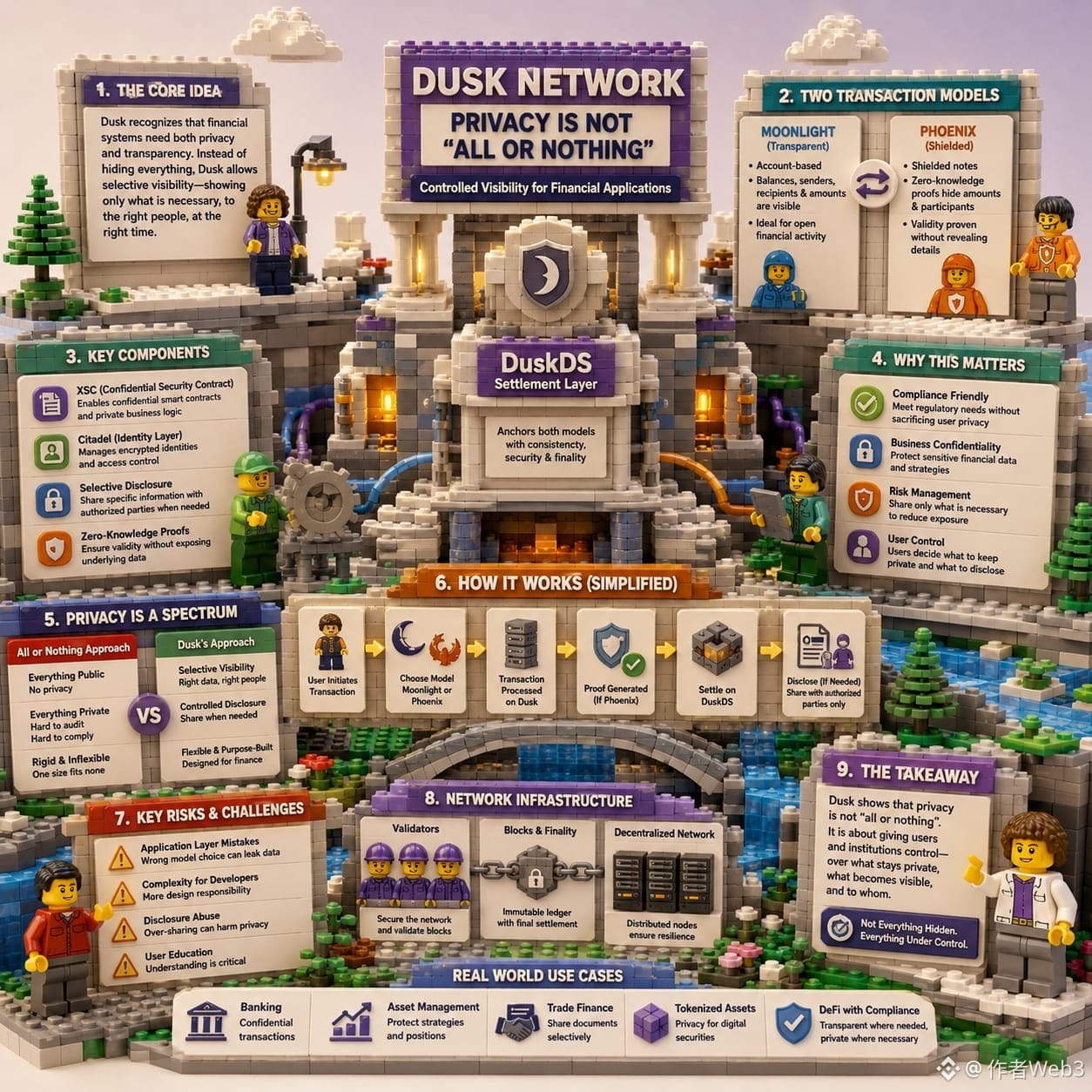
Dusk separates those requirements. Moonlight supports transparent account-based transactions, while Phoenix uses shielded notes and zero-knowledge proofs to conceal transaction details while proving validity. Both models settle through DuskDS.
That creates an interesting dependency.
Financial applications may need confidentiality for sensitive positions, but regulators or counterparties can still require specific information. Dusk therefore approaches privacy as controlled disclosure rather than permanent secrecy.
I think that is where the architecture gets interesting.
The cryptography can protect shielded data, but it cannot decide whether an application chose the right transaction model or accidentally revealed information through its surrounding logic.
So the limitation isn't necessarily the privacy primitive itself. It is the complexity of managing visibility correctly.
Dusk gets something important right: privacy doesn't have to be all-or-nothing.
The question I’m watching now is simpler:
Can developers consistently control what becomes visible, to whom, and under which conditions? $DUSK
The better question is: which parts of a financial transaction should remain visible?
Dusk separates those requirements. Moonlight supports transparent account-based transactions, while Phoenix uses shielded notes and zero-knowledge proofs to conceal transaction details while proving validity. Both models settle through DuskDS.
That creates an interesting dependency.
Financial applications may need confidentiality for sensitive positions, but regulators or counterparties can still require specific information. Dusk therefore approaches privacy as controlled disclosure rather than permanent secrecy.
I think that is where the architecture gets interesting.
The cryptography can protect shielded data, but it cannot decide whether an application chose the right transaction model or accidentally revealed information through its surrounding logic.
So the limitation isn't necessarily the privacy primitive itself. It is the complexity of managing visibility correctly.
Dusk gets something important right: privacy doesn't have to be all-or-nothing.
The question I’m watching now is simpler:
Can developers consistently control what becomes visible, to whom, and under which conditions? $DUSK