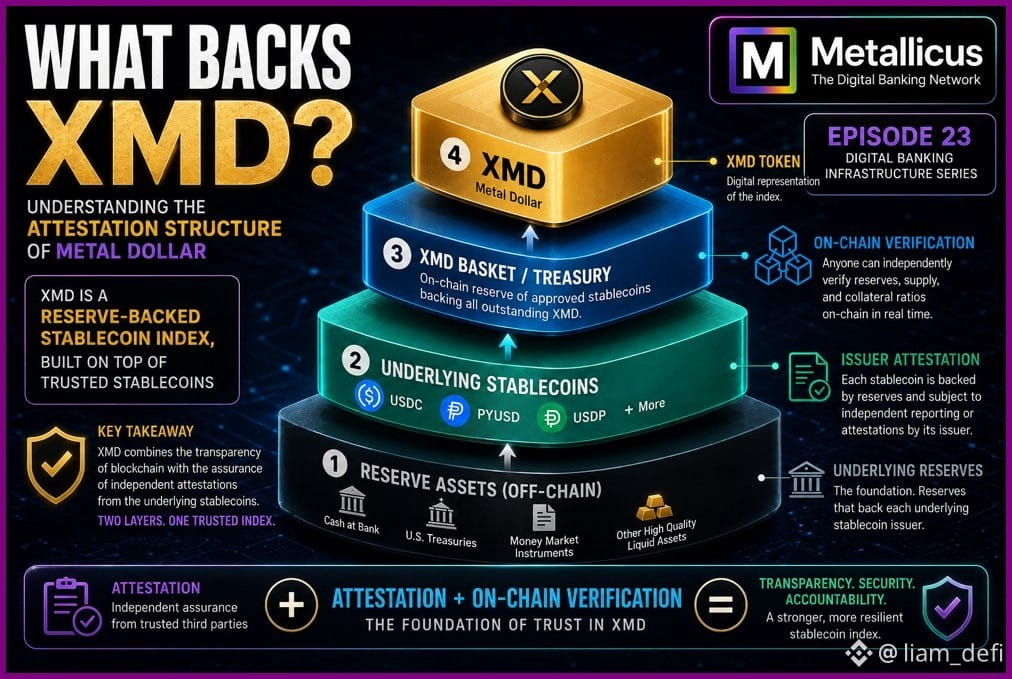
What actually backs $XMD?
Most people skip this question. Don't.
$XMD isn't a single-issuer stablecoin. It's a reserve-backed stablecoin index. Different game, different risks.
Two verification layers you need to understand:
1. Reserves backing the underlying stablecoins in the basket
2. Independent attestations + on-chain proof of XMD reserves vs supply
Here's what actually matters beyond the marketing:
Reserve quality
Jurisdiction
Liquidity depth
Peg stability track record
Redemption mechanics
Market stress behavior
Attestation reports mean nothing if the underlying assets are trash or locked in sketchy jurisdictions.
The real alpha: Can $XMD merge traditional third-party assurance with real-time on-chain transparency?
That's the architecture worth paying attention to. Not just another stablecoin narrative.
Two layers of verification. One index. Do your own research on what's actually in the basket.
Most people skip this question. Don't.
$XMD isn't a single-issuer stablecoin. It's a reserve-backed stablecoin index. Different game, different risks.
Two verification layers you need to understand:
1. Reserves backing the underlying stablecoins in the basket
2. Independent attestations + on-chain proof of XMD reserves vs supply
Here's what actually matters beyond the marketing:
Reserve quality
Jurisdiction
Liquidity depth
Peg stability track record
Redemption mechanics
Market stress behavior
Attestation reports mean nothing if the underlying assets are trash or locked in sketchy jurisdictions.
The real alpha: Can $XMD merge traditional third-party assurance with real-time on-chain transparency?
That's the architecture worth paying attention to. Not just another stablecoin narrative.
Two layers of verification. One index. Do your own research on what's actually in the basket.