
The clean “1B fixed supply, no inflation” narrative for $TMX is easy to repeat. It looks good on a slide. But in DeFi, supply mechanics are only half the story. The other half is behavior.
So the question I keep coming back to is: how many wallets actually fund positions, hold through maturity, collect their TMX yield, and then commit that capital again into TermMax markets?
Retention and redeployment is the real signal. If users are just farming, dumping, and leaving, then fixed supply doesn’t create scarcity. It just creates a smaller float that rotates faster. If users are looping capital back in, compounding, and treating TermMax like a core allocation instead of a one-off trade, then demand starts to look real. Without that data, we’re just guessing. Supply is measurable. Demand is messy.
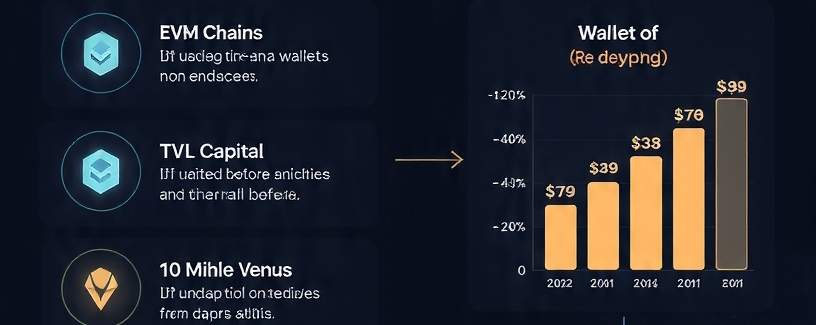
The same logic applies to the multichain expansion. Ten EVM chains sounds impressive. It sounds like “wide access” and “more users.” But zoom in and the average does the opposite of impressing. Rough math: if total TVL is split across 10 chains, that’s about $9M per chain on average.
$9M isn’t nothing, but for fixed-rate markets it’s thin. Fixed-term lending and borrowing need depth to work well. You need tight spreads, enough counterparties on both sides, and minimal slippage when someone wants to enter or exit a term. Deployment addresses across chains don’t automatically equal liquidity. Sometimes they just mean fragmentation.
Expansion can absolutely improve access. A user on Chain B might never have touched TermMax if it was only on Chain A. That’s valid. But access without depth creates a different problem: rates that swing wildly, failed matches, and capital that sits waiting instead of working. Some fragmentation is normal in early stages. The question is whether TermMax can concentrate liquidity over time instead of just spraying it across more networks.
Which brings me to the third number I’d watch: the idle capital ratio.
Here’s the uncomfortable one. If ∼40% of vault assets are currently sitting in Aave, Morpho, or Venus instead of being deployed into TermMax’s own fixed-term markets, what does that actually mean?
One read is “efficient routing.” Maybe the protocol is parking capital in money markets when native borrower demand is low, to avoid zero yield. That’s prudent treasury management.
The other read is tougher: it could be evidence that native borrower demand is still thin. If borrowers aren’t showing up at the rates lenders want, capital has nowhere to go inside TermMax, so it leaks out to other protocols. That’s not a failure, but it is a signal. Fixed-rate markets only work when both sides show up consistently.
So I’m less focused on the 1B cap right now and more focused on these three things:
1. Wallet retention: fund → earn TMX → redeploy.
2. Depth per chain: not just 10 deployments, but real liquidity in each.
3. Idle ratio: how much capital is actually working inside TermMax vs parked elsewhere.