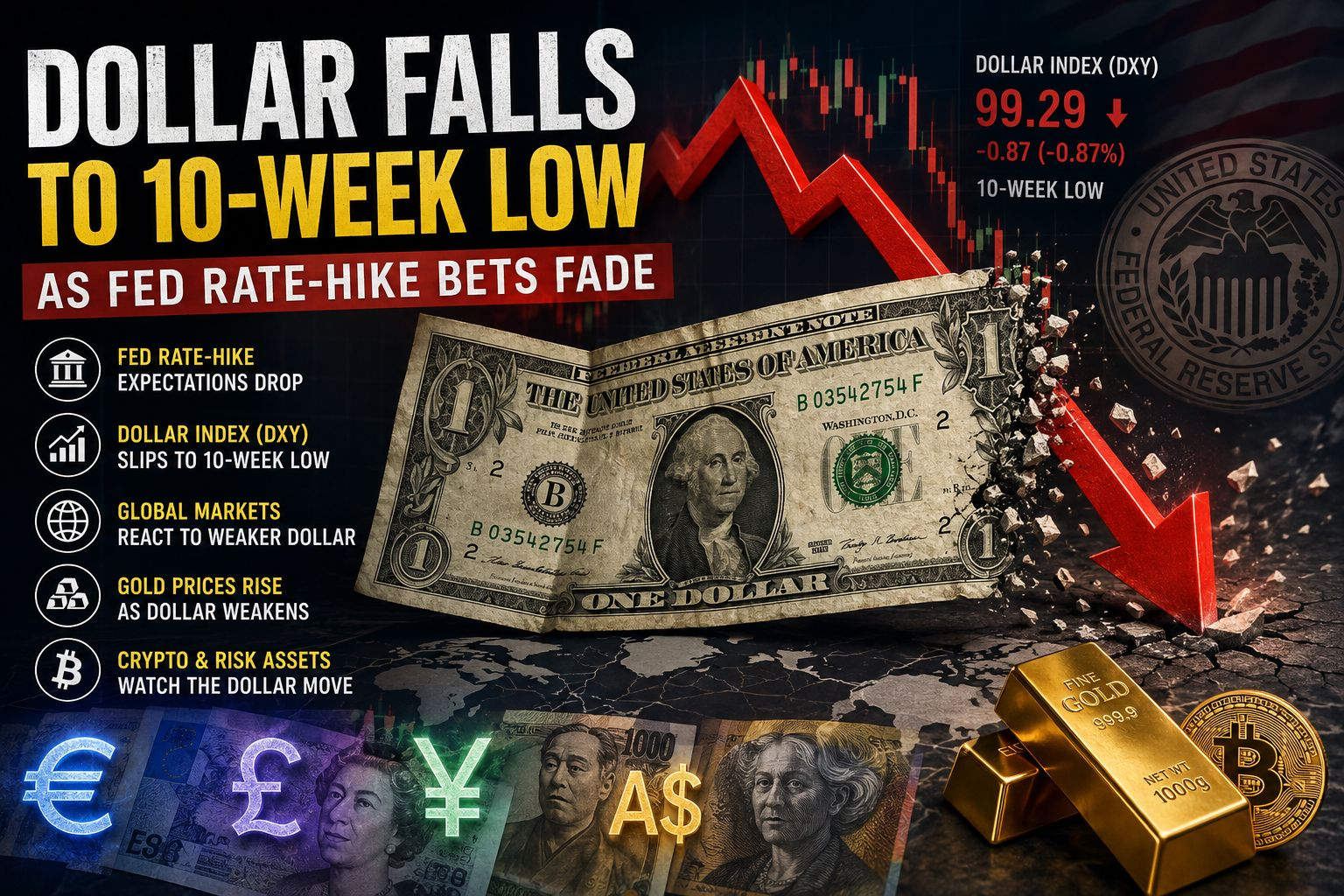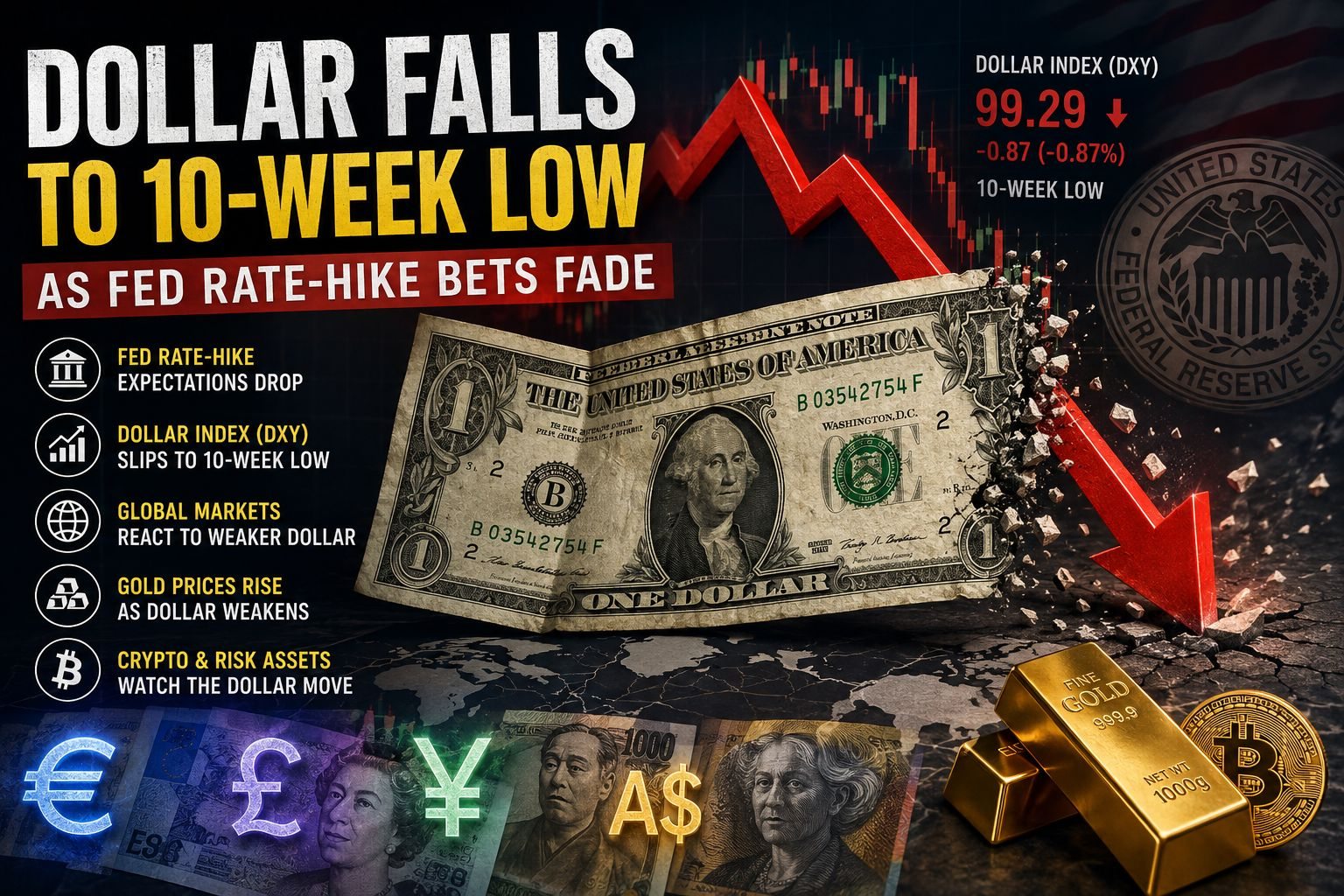
The U.S. dollar has come under renewed pressure, falling to a 10-week low against a basket of major currencies as investors increasingly scale back expectations for another Federal Reserve interest-rate hike. The move highlights growing concerns about the strength of the U.S. economy and could have important consequences for stocks, commodities, cryptocurrencies and emerging-market currencies.
The Dollar Index (DXY) recently slipped to around 99.29, its weakest level in roughly 10 weeks, as traders reacted to softer U.S. economic data and changing expectations for Federal Reserve policy.
Why Is the Dollar Falling?
One of the biggest drivers behind the latest dollar weakness is the changing outlook for U.S. interest rates.
Recent economic indicators have failed to provide the strong growth and inflation signals that would normally support expectations for higher interest rates. U.S. retail sales unexpectedly declined in July, while inflation remained relatively subdued. These developments have encouraged traders to reduce bets that the Federal Reserve will raise rates in the near term.
Markets are now assigning significantly lower odds to a September rate hike. Reuters reported that expectations for a September increase had fallen to around 35%, compared with more than 50% just a week earlier.
Lower interest-rate expectations generally reduce demand for a currency because investors may receive less return from dollar-denominated assets.
Fed Policy Is Becoming the Main Market Driver
The Federal Reserve has become the center of attention for currency traders.
When investors expect U.S. interest rates to remain high or move higher, the dollar can benefit because higher yields make U.S. assets more attractive. But when expectations shift toward unchanged or lower rates, demand for the dollar can weaken.
That is exactly what markets are currently watching.
The latest economic data have made traders more cautious about the possibility of another Fed hike. At the same time, investors are waiting for additional economic data and the Federal Reserve's meeting minutes for clues about the central bank's next move.
What Happens to Other Currencies?
A weaker dollar can provide breathing room for major currencies such as the euro, British pound and Australian dollar.
When the dollar declines, currencies traded against it can rise mechanically. But the moves also reflect expectations about monetary policy in other economies.
For example, expectations surrounding the European Central Bank and Bank of England can influence whether investors prefer European currencies over the U.S. dollar. Recent market activity has already shown strength in several major currencies as dollar-rate expectations have weakened.
The Canadian dollar has also recently traded near a two-month high against the U.S. dollar, helped in part by higher oil prices and domestic inflation developments.
Could a Weaker Dollar Boost Gold?
The dollar's decline is also important for the commodities market.
Gold is traditionally sensitive to movements in the U.S. currency. Because gold is priced internationally in dollars, a weaker greenback can make the metal relatively cheaper for buyers using other currencies.
Gold has already been trading near historically elevated levels, while investors continue to monitor inflation, interest rates, geopolitical risks and central-bank demand.
However, the relationship is not automatic. A major geopolitical shock could simultaneously increase demand for both gold and the dollar because investors often seek traditional safe-haven assets during periods of uncertainty.
What About Bitcoin and Crypto?
The dollar's direction is also closely watched by cryptocurrency investors.
When the dollar weakens and financial conditions become more supportive of risk assets, cryptocurrencies such as Bitcoin can potentially benefit from increased liquidity and investor risk appetite.
However, crypto markets remain highly sensitive to Federal Reserve policy, Treasury yields, global liquidity and broader risk sentiment. A weaker dollar by itself does not guarantee a Bitcoin rally.
For crypto traders, the key question is whether the dollar decline represents a temporary move or the beginning of a longer-lasting trend.
Geopolitical Risks Could Change the Picture
Despite the dollar's recent weakness, there are still significant risks that could reverse the move.
Geopolitical tensions remain an important factor. Reuters reported that escalating tensions involving Iran and disruptions around the Strait of Hormuz have contributed to higher oil prices and renewed inflation concerns.
A major escalation could trigger a flight toward safe-haven assets, potentially supporting the U.S. dollar even if economic data remain soft.
Higher oil prices could also complicate the Federal Reserve's policy outlook because an energy-driven inflation increase could make policymakers more cautious about easing financial conditions.
What Investors Should Watch Next
The dollar's next major move will likely depend on several factors:
- Federal Reserve interest-rate expectations
- U.S. inflation data
- Employment and economic-growth figures
- Treasury bond yields
- Oil prices
- Geopolitical developments
- Strength of the European and British economies
- Global risk appetite
If U.S. economic data continue to weaken and inflation remains controlled, markets could continue reducing expectations for additional Fed tightening. That scenario could keep pressure on the dollar.
On the other hand, stronger economic data, rising inflation or a major geopolitical shock could quickly revive demand for the greenback.
Final Takeaway
The dollar's move to a 10-week low is more than a simple currency-market fluctuation. It reflects a major shift in expectations surrounding U.S. monetary policy and the health of the world's largest economy.
For investors, the key issue is whether the recent weakness becomes a sustained trend or simply another temporary correction.
A prolonged dollar decline could influence everything from gold and oil to emerging-market currencies, stocks and cryptocurrencies. But with the Federal Reserve, inflation and geopolitical risks still dominating markets, traders should expect volatility to remain high.
The dollar may be weakening today—but the next major economic data releases could determine whether this becomes the beginning of a bigger trend or just another chapter in the currency market's ongoing battle.