
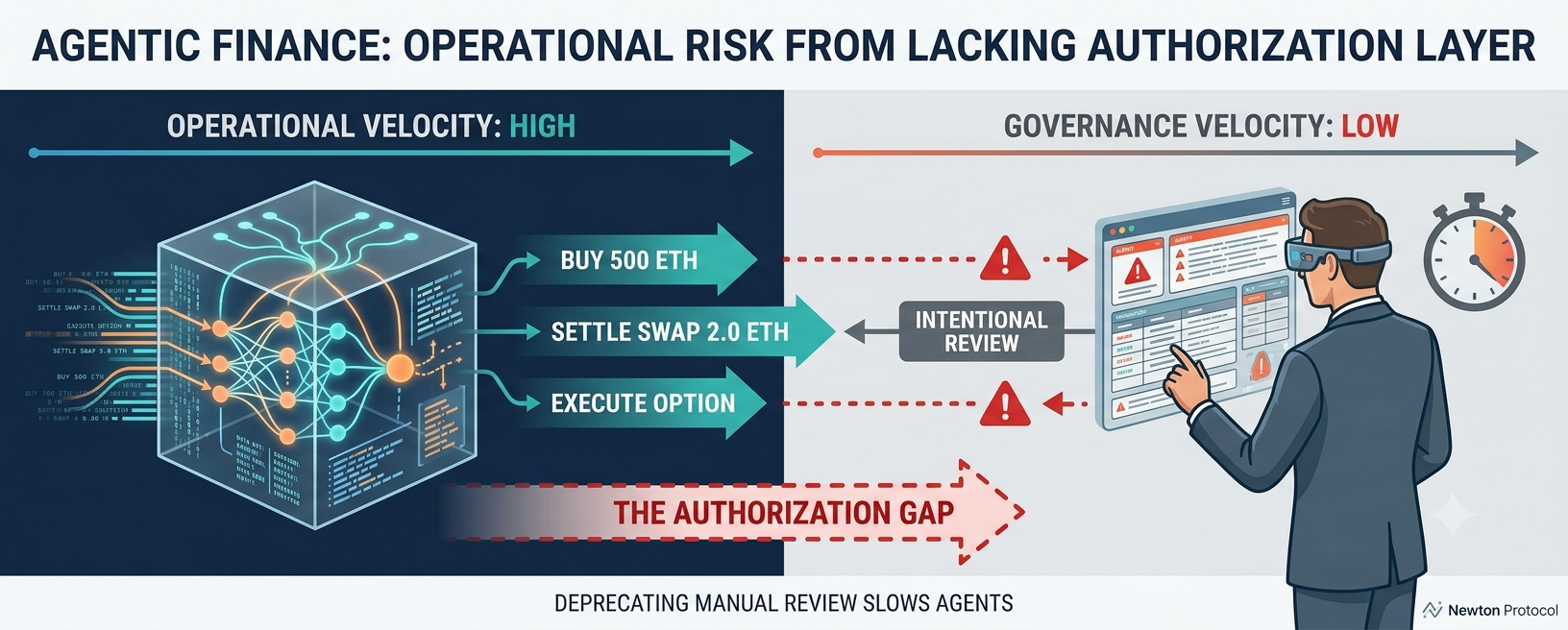
The deployment of AI agents in onchain finance is moving faster than the authorization infrastructure designed to govern them. That gap is not yet expensive enough to have forced a solution, but the trajectory is clear: as autonomous systems take on more consequential financial roles, the absence of a reliable authorization layer will become a significant operational risk. The authorization problem with AI agents is specific. A human executing a transaction has at least the possibility of intentional review at the moment of signing. The human sees the destination, the amount, and the conditions, and chooses to proceed. An autonomous agent executing the same transaction has no moment of intentional review. It acts based on its instruction set and the conditions it observes, which may or may not align with what the human principal intended when they configured the agent. The current approach to managing this risk is primarily through the agent's instruction set — defining what the agent is authorized to do at configuration time and trusting that the agent will operate within those parameters. That approach has obvious limitations. Instruction sets can be ambiguous. Edge cases that were not anticipated at configuration time can produce unexpected behavior. Agents that have been operating within parameters for a long time may encounter novel conditions that the original instructions did not contemplate. Newton's conditional execution model provides an alternative approach.
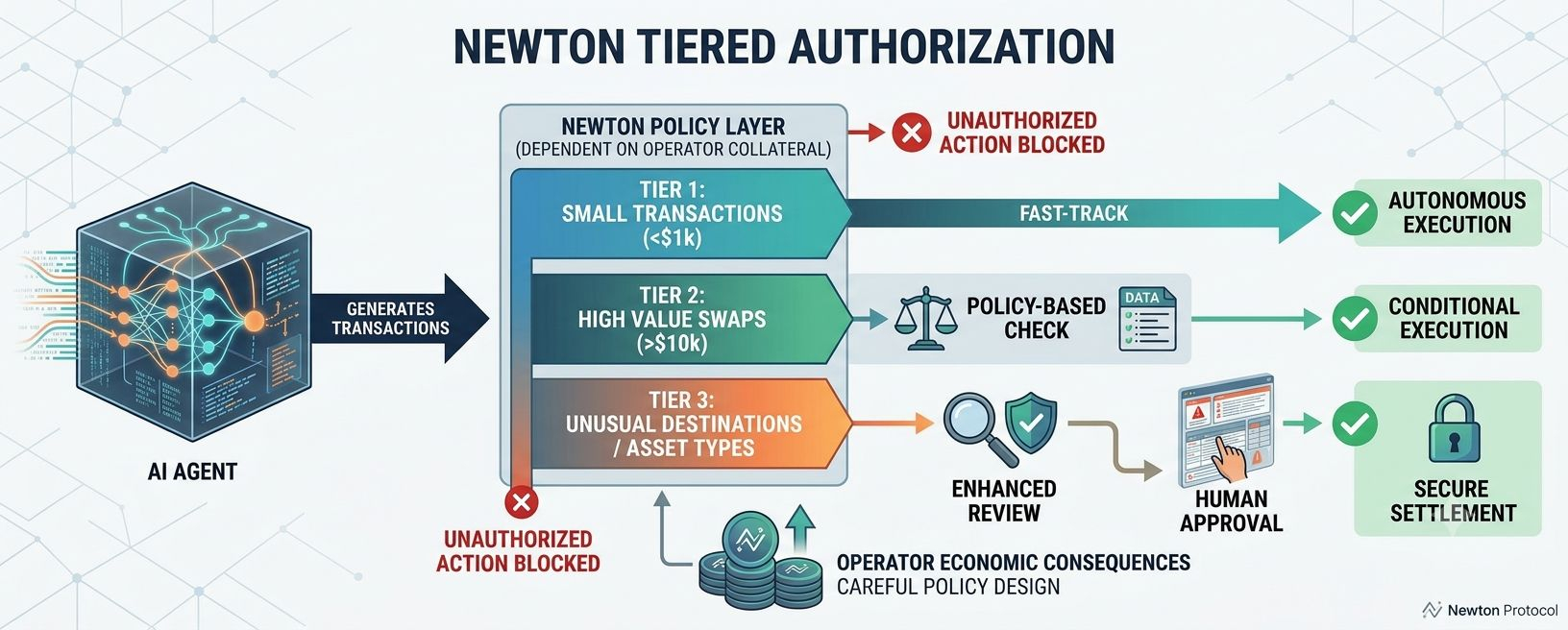
Rather than relying entirely on the agent's internal instruction set, the system can enforce authorization policies at the execution layer that are independent of the agent. An agent that is correctly configured and operating as intended will pass policy checks and execute normally. An agent that attempts to act outside authorized parameters will have its transaction blocked before settlement occurs, regardless of why it attempted the unauthorized action. The practical configuration for agentic finance involves tiered authorization. Small transactions within normal operating parameters execute autonomously without additional checks. Transactions above a defined threshold require additional authorization — either a policy-based check that evaluates specific conditions, or a human approval that confirms the action was intended. Transactions involving unusual destinations, asset types, or amounts trigger enhanced review before execution is permitted. This tiered approach preserves the efficiency advantage of autonomous execution for routine operations while adding meaningful oversight for exceptional cases. The policy layer does not eliminate the value of AI agents. It channels that value into contexts where autonomous execution is appropriate and adds friction where it is not. The NEWT operator collateral model is relevant here too. Operators who define authorization policies for agentic finance applications stake capital behind those policies. If a policy allows an agent to execute a transaction that should have been blocked, the operator bears economic consequences. That accountability creates incentives for careful policy design that pure technical enforcement cannot replicate. Whether the agentic finance market develops fast enough to make Newton's authorization infrastructure urgently necessary in the near term is uncertain. What is clear is that the problem is real and will only grow as autonomous financial systems become more capable and more widely deployed. #newt $NEWT @NewtonProtocol