
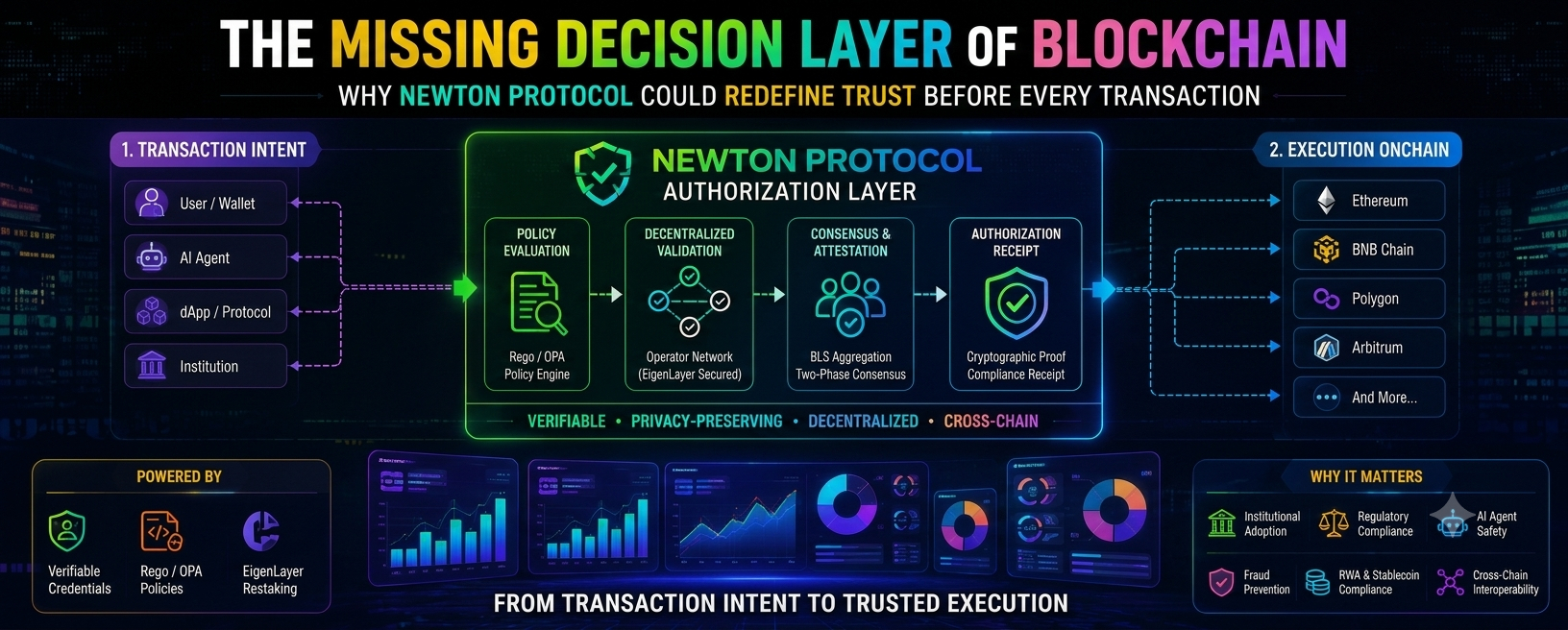
I've spent the last few days digging into Newton Protocol's whitepaper, and one idea kept coming back to me.
Blockchain has mastered settlement—but it has never truly mastered decision-making.
every transaction today proves who signed it, but that doesn't necessarily prove why it should happen. As crypto moves beyond retail users and starts serving banks, tokenized assets, stablecoins, and AI agents, that distinction suddenly becomes critical.
That's exactly where I think Newton Protocol is trying to change the conversation.
Instead of competing with Layer 1s or building another DeFi application, Newton introduces an authorization layer that sits between transaction intent and blockchain execution. Before assets move, policies can evaluate whether the transaction satisfies predefined requirements such as sanctions screening, investor eligibility, jurisdiction rules, spending limits, or AI operating constraints. Only after those checks pass does the protocol generate a cryptographic authorization that smart contracts can verify.
What makes this approach interesting isn't compliance itself. Compliance already exists.
The difference is where it happens.
Most blockchain applications either rely on centralized APIs or perform checks in the frontend. Both approaches can be bypassed. Newton shifts those decisions into decentralized, programmable infrastructure where authorization becomes part of the transaction flow instead of an optional recommendation. That feels like a meaningful architectural shift rather than another feature upgrade.
Another reason I find the design compelling is its flexibility. Developers aren't locked into one policy. They can build their own rules using Rego, combining KYC requirements, transaction velocity limits, source-of-funds analysis, Travel Rule obligations, or custom business logic into a single authorization process. The protocol doesn't dictate policy—it verifies that the chosen policy was actually enforced.
The AI angle also deserves attention.
Everyone talks about AI agents managing wallets, executing trades, and automating financial workflows. Very few people ask the harder question:
Who verifies that those agents stay within acceptable boundaries?
Newton's authorization model gives AI systems programmable guardrails that operate at machine speed. Instead of relying on human approval for every action, policies define the limits while cryptographic proofs demonstrate that those limits were respected. That could become increasingly valuable as autonomous finance evolves.
Privacy is another area where the protocol stands out. Users don't have to expose sensitive identity information directly on-chain. Through verifiable credentials, encrypted data handling, and privacy-focused verification, applications can confirm eligibility while revealing only the minimum information necessary. That balance between compliance and user privacy is something Web3 has struggled to achieve for years.
My biggest takeaway after reading the whitepaper isn't that Newton promises faster transactions or lower fees.
It's that the next infrastructure race may not be about execution at all.
It may be about proving, with cryptographic evidence, that every important transaction deserved to happen before it ever reached the blockchain.
If that idea gains traction, Newton Protocol won't simply introduce another blockchain product. It could establish authorization as a fundamental building block of the next generation of on-chain finance—and that's a narrative worth paying attention to.