
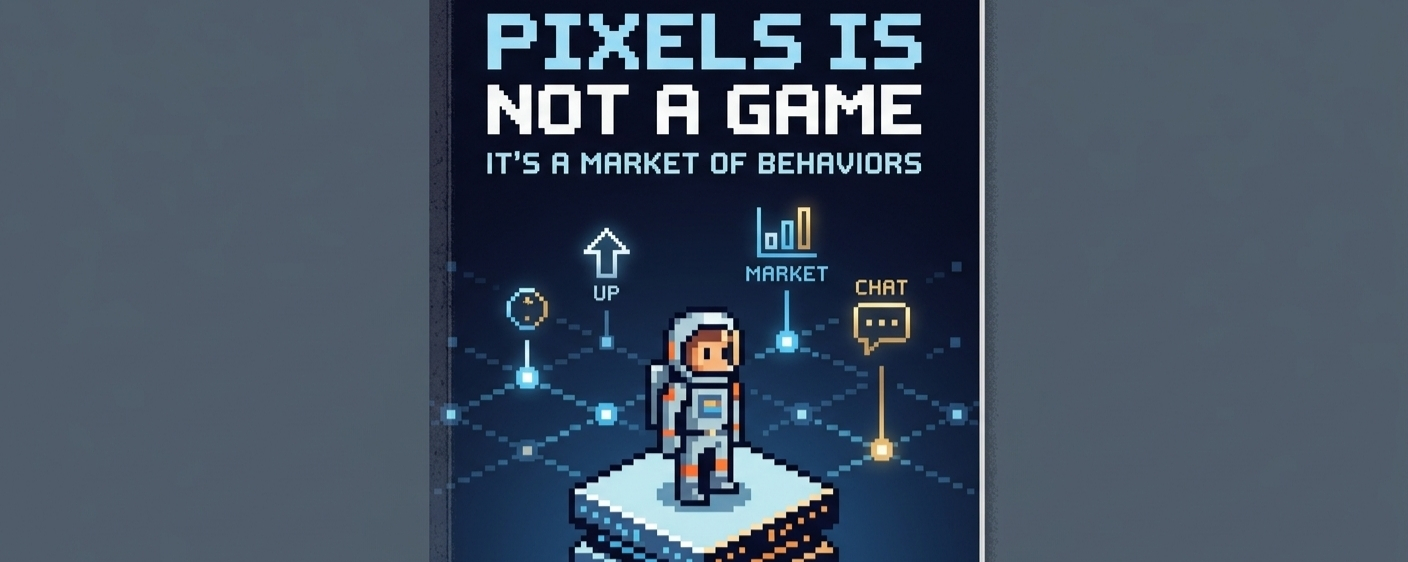

I’ve gotta be real with you. You know that weird feeling when you’re deep inside something—a game, a chat, a market—and you suddenly realize you’re not actually playing what you thought you were? That hit me like a ton of bricks three weeks ago inside Pixels.
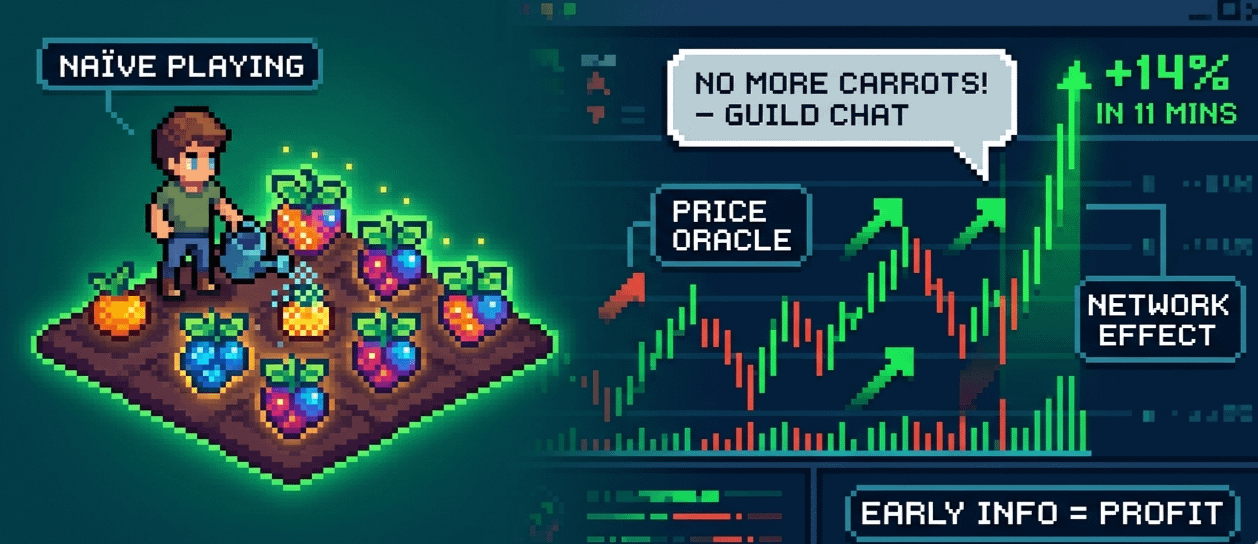
I’m telling you, it’s not the cute farming simulator anymore. Forget the “build your land, plant your berries, chill with your guild” vibe. That’s the surface. I was staring at my screen, watching a price rip 14% in literally eleven minutes just because one guy typed two sentences in Discord. And I swear, nothing in the official docs prepares you for that. Let me walk you through what I’m actually seeing. Not the press release, not the tokenomics diagram—the real, gritty layer.
I used to think "social features" in Web3 games were just fluff, you know? Friends lists, maybe some emoji reactions, guild drama. But inside Pixels? The chat is a leading indicator. It’s basically a price oracle. I started noticing this pattern around my second month of the grind. Someone would casually drop, “Man, nobody’s growing carrots anymore, I can’t find any for the stew quest,” and within 10 to 20 minutes, the price of carrots on the market would jump 20%. I’m not even kidding. Then, maybe an hour later, it settles into a new normal.
I thought it was a glitch or bots at first, but then it clicked: the information itself is the trigger. It’s not a formal announcement; it’s just awareness spreading through the network like wildfire. In a normal game, you see a shortage and you adapt. Here, the mention of the shortage moves the price faster than any individual player can react. The solo player—the one who doesn't read chat and just plays—they see the price after the move. They’re already late. They’re just outside the flow. And that changes everything for me. It’s not about how well you farm; it’s about who talks, who answers, and who shares.
Honestly, it makes me think back to the early airdrop days. Remember when the first people to catch wind of a snapshot made 5x or 10x? Then the news spread, and by the time the "how to get the airdrop" YouTube videos dropped, the yield was already cooked. Pixels is doing the exact same thing. The person who knows before the crowd extracts the value. Everyone else? They’re just filling the exit liquidity, even if they don’t realize it. It’s the same architecture as DeFi. High yields appear early, capital floods in, yields compress, and the window slams shut. Pixels is just a closed-loop version of that. But because it’s in a game, you don’t feel like you’re trading; you feel like you’re playing. That’s the psychological trap. You’re not holding a perpetual swap; you’re holding pumpkins. But the logic? It’s identical.
What really bothers me—and I mean genuinely bothers me in that "I'm watching the world go by" kind of way—is the quiet unfairness of it all. The game never tells you, “Hey, build a network or you’re going to lose money.” It doesn’t have to. The system just rewards the networked player by default. The new guy who just connects a wallet has no clue that the price he sees is already stale. He doesn't know the shortage was called out two hours ago in a private guild channel. It’s an information gap, and in Pixels, information converts to currency faster than any tool you can buy. If you play without a network, you’re basically subsidizing the people who have one. You’re providing liquidity for them. Nobody talks about this because it sounds elitist, but look, that’s just how it works.
I’ve had to change how I play. I don't ask “what’s the best crop to plant today?” anymore. I ask, “Who is talking? Who is usually right? Is this rumor real or is someone just testing the market?” That shift—moving from a player to an observer of information flows—changed everything. The game feels less like Stardew Valley and more like a mini trading desk now. Not because I want it to be, but because the structure forces it. If you ignore the social layer, you’re playing at a massive disadvantage.
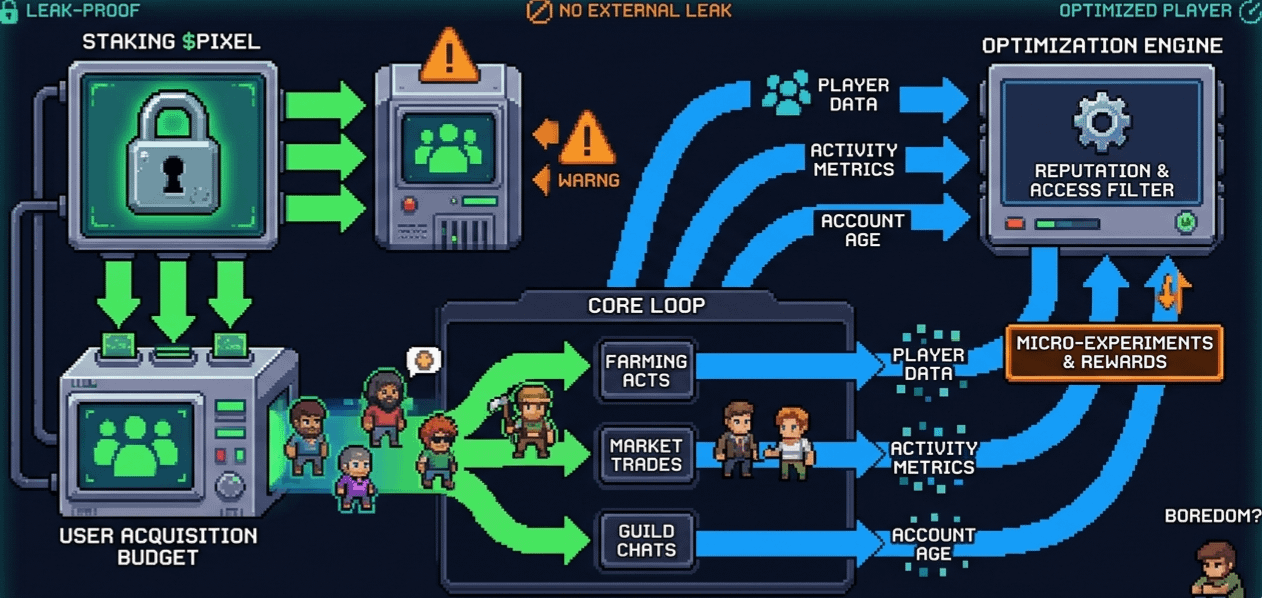
Then I started looking under the hood at things like staking $PIXEL. At first, I thought it was just “support the project, get rewards.” Nope. It’s a budget allocation mechanism. When you stake into a specific area, you’re directing where the incentive budgets go. It’s like a decentralized growth budget. The community doesn't vote with words; they vote with capital on where to send the user acquisition money. It’s a circular system: staking generates budgets, budgets attract players, players perform behaviors, and those behaviors generate data that refines the next set of incentives. The money doesn't leak out to Google Ads; it stays inside and circulates. It’s a controlled fiscal system.
It gets almost creepy when you look at the rewards. They aren't prizes; they’re micro-experiments. Most games just give you tokens for playing. Pixels gives you targeted incentives with perfect attribution. They know how long you played, what you bought, and whether you’re likely to quit. They redistribute rewards based on value, not just volume. That’s why reputation exists. It’s not a badge; it’s an economic filter that controls your withdrawals and market access. Not every wallet has the same rights. It’s intentional.
Look at VIP and vPIXEL too. VIP isn’t just a subscription; it’s a behavioral loop. You have to keep participating or you lose the edge. And vPIXEL? It’s a non-tradeable, leak-proof container designed to keep value circulating inside the walls. It’s smarter than it looks and more controlling than it admits. But again, I’m not saying it’s evil—it’s just the architecture. The big shift is moving away from “everyone gets something” to “only the most valuable behaviors get rewarded.” If you’re outside that loop, you’re basically providing free data.
The part no one talks about is the risk. If this system becomes too efficient, something is going to break. When every action is measured, rewarded, or punished, and every player is just a data point in a yield model... the fun disappears. I mean the messy, human joy of just playing without feeling like you’re being optimized. There’s a version of this that’s too cold and too rational. When that happens, people don't leave because they’re mad; they leave because they’re bored. That’s the real danger. Not a hack, not a crash—just boredom. No incentive replaces the feeling of discovery.
So, I’m not here to sell you on Pixels or scare you off. I’m just telling you what I see: a game that turned into an information market, then a capital engine, then a behavioral filter. It’s not just a game anymore; it’s a mirror. And the more I watch, the less I’m sure if I’m playing or if I’m the one being played. But I’m paying attention. For now, that’s enough.
