
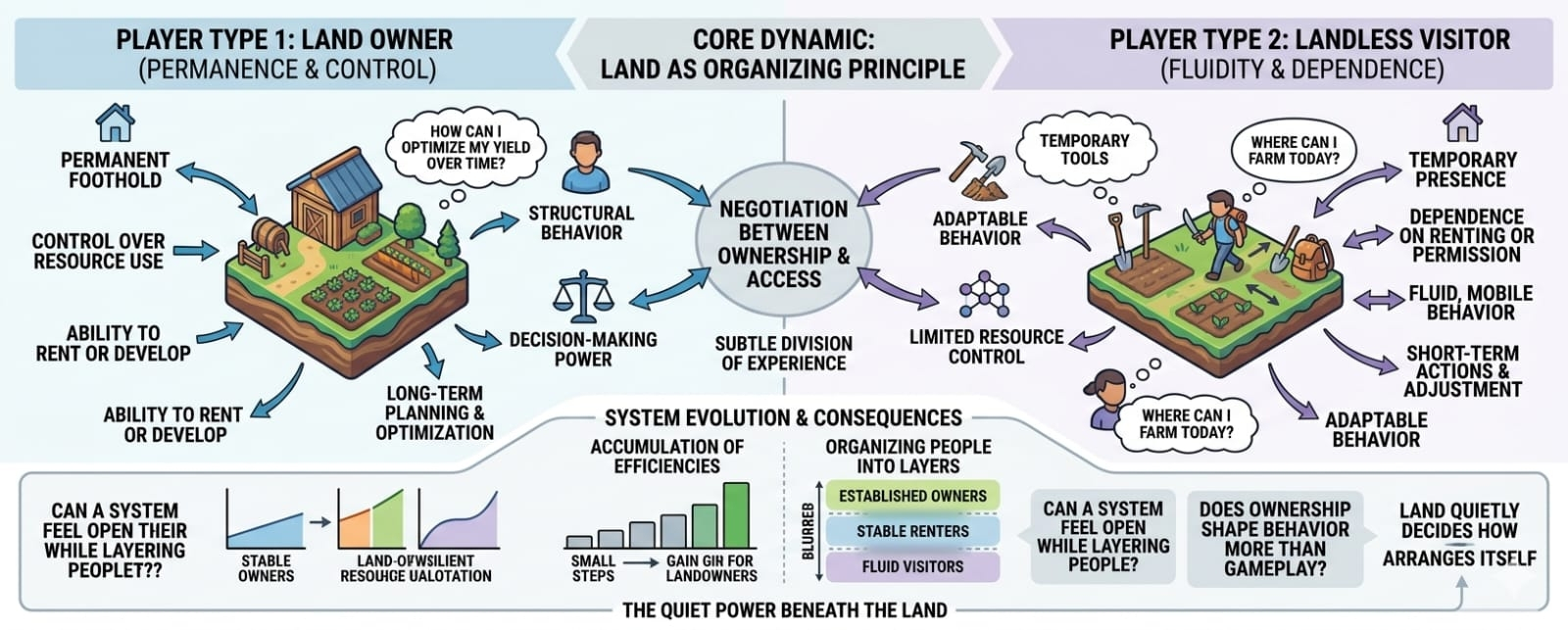

I didn’t notice land at first in Pixels. It blended into everything else trees, crops, small routines repeating across a soft-colored world. Players moved around freely, farming, crafting, talking. It all felt open. But after a while, I started seeing something I had missed: not everyone was standing on the same kind of ground.
Some players stayed in one place longer. Their setups looked more permanent, more intentional. Others, including me at times, felt like visitors moving, adjusting, never fully rooted. That difference didn’t come from skill or time alone. It came from land.
And that made me pause.
If a game allows everyone to participate, then why does ownership still quietly divide experience? It’s not a loud division. No barriers block you from playing. But there’s a subtle shift between using space and controlling it. And once I noticed it, I couldn’t unsee it.
Because Pixels runs on the Ronin Network, land isn’t just decorative. It’s fixed, owned, and transferable. That permanence gives it weight. But what interested me wasn’t ownership itself it was what ownership does to relationships inside the game.
When land can be rented, it creates an interesting middle ground. You don’t need to own to benefit, but you’re still operating within someone else’s space. That raises a quiet question: is access enough, or does control always sit one layer above it?
I started noticing how different players approached the game depending on their position. Those with land seemed to think ahead. Their actions felt structured, almost like they were managing something larger than themselves. Players without land felt more fluid, but also less anchored. It wasn’t better or worse—just different.
But difference, over time, becomes structure.
And structure leads to another question: does land ownership shape behavior more than the game itself does?
It might. Ownership encourages planning, optimization, even a sense of responsibility. But it also introduces something else—decision-making power. Who gets to use the land? Under what terms? Even in a relaxed farming world, these decisions quietly define interactions.
What struck me is how softly this power is presented. There’s no dramatic imbalance, no obvious dominance. Instead, it shows up in small efficiencies. A better setup here, a smoother loop there. Nothing extreme, but enough to accumulate over time.
That accumulation is where things get interesting.
Because once small advantages stack, they begin to influence the pace of progress. Not in a way that excludes others, but in a way that subtly guides who moves faster, who settles deeper, and who remains on the edges.
So I found myself asking something I didn’t expect to ask in a game like this: can a system feel open while still organizing people into layers?
Pixels doesn’t force that outcome, but it doesn’t fully prevent it either. And maybe that’s intentional. After all, real systems rarely operate on perfect equality. They evolve through access, ownership, and the spaces in between.
Even the connection to broader ecosystems like Ethereum reinforces this idea. When assets persist beyond a single session or server, they start carrying meaning. They stop being temporary tools and become positions within a system.
And positions change how people act.
What I find most compelling is that none of this disrupts the calm surface of the game. Farming still feels peaceful. Exploration still feels open. But underneath, there’s a quiet layer of negotiation between ownership and access, stability and movement.
It doesn’t announce itself. It doesn’t need to.
By the time I fully understood it, I realized land in Pixels isn’t just something you use. It’s something that quietly decides how the world arranges itself who stays, who moves, and who, without realizing it, is simply passing through.