
The cryptocurrency market is one that is known for its volatility, with prices fluctuating wildly and sometimes without warning. It can be challenging for investors to determine when the right time is to buy or sell. This is where the Crypto Fear and Greed Index comes in. In this article, we will take a closer look at this index and how it works.
What is the Fear and Greed Index?
The Crypto Fear and Greed Index is a tool that investors use to measure the sentiment of the cryptocurrency market. It analyzes different sources of data to determine whether investors are feeling bullish or bearish about the market. The index ranges from 0 to 100, with a score of 0 indicating extreme fear and a score of 100 indicating extreme greed.
How Does It Work?
The Crypto Fear and Greed Index takes into account a wide range of factors to determine its score. Some of these factors include social media activity, market volatility, trading volume, and survey data. The index uses a proprietary algorithm to analyze these factors and generate a score. This score is then used to gauge investor sentiment and provide insight into the current state of the market.
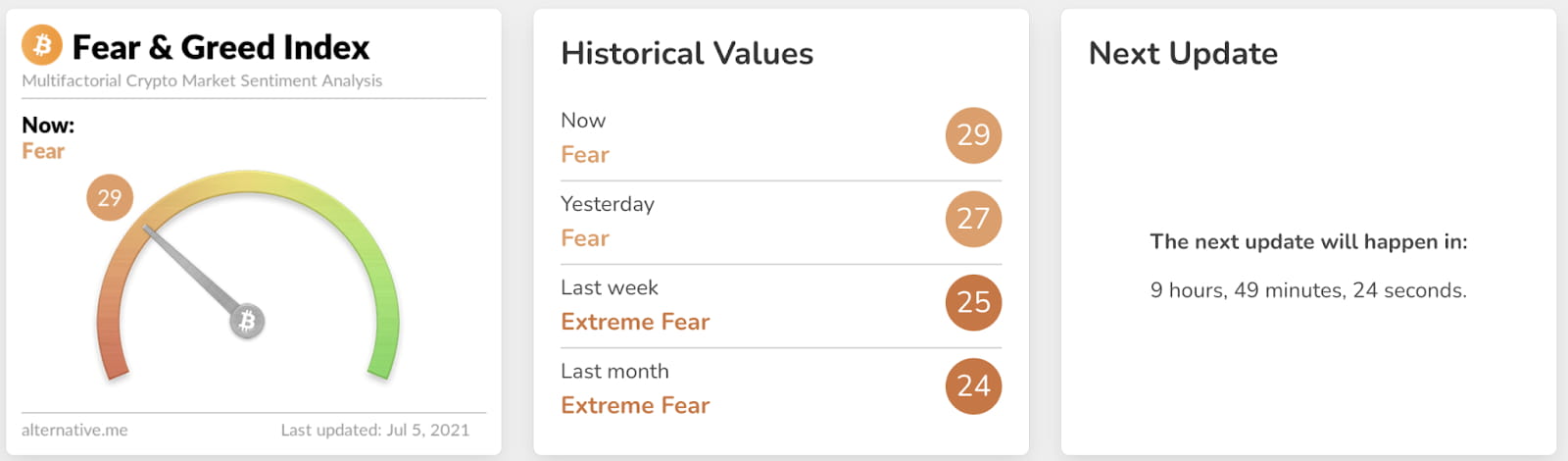
The Crypto Fear and Greed Index operates by calculating a daily value between 0 and 100. The index's scale is divided into four categories based on its score:
Extreme fear (orange) ranges from 0 to 24.
Fear (amber/yellow) ranges from 25 to 49.
Greed (light green) ranges from 50 to 74.
Extreme greed (green) ranges from 75 to 100.
To calculate the index value, Alternative.me combines five different market factors, each weighted differently. As of July 2021, the index focuses exclusively on Bitcoin-related data due to its strong correlation with the overall cryptocurrency market's price and sentiment. However, the company plans to expand its coverage to include other major cryptocurrencies in the future, such as Ether (ETH) and BNB.
The five market factors used in the index are:
Volatility (25% of the index) measures the current value of Bitcoin with averages from the last 30 and 90 days. Here, the index uses volatility as a stand-in for uncertainty in the market.
Market momentum/volume (25% of the index) compares Bitcoin's current trading volume and market momentum to previous 30 and 90-day averages and combines them. Consistent high-volume buying suggests positive or greedy market sentiment.
Social media (15% of the index) looks at the number of Twitter hashtags related to Bitcoin and its interaction rate. A constant and unusually high number of interactions typically indicates market greed rather than fear.
Bitcoin dominance (10% of the index) measures BTC's dominance of the market. Increased market dominance shows new investment into the coin and the possible reallocation of funds from altcoins.
Google Trends (10% of the index) uses Google Trends data for Bitcoin-related search queries to provide insights into market sentiment. For example, an increase in "Bitcoin Scam" searches would indicate more fear in the market.
Survey results (15% Index Score) - Currently paused and has been for some time.
The Crypto Fear and Greed Index provides valuable insights into market sentiment and has gained popularity among traders and investors in the cryptocurrency industry. However, it is important to note that the index should not be the sole factor in investment decisions and should be used in conjunction with other analytical tools.
Who created and maintains the Crypto Fear and Greed Index
The Crypto Fear and Greed Index is created and maintained by an independent financial analytics firm called Alternative.me. The company was founded in 2017 and is based in Vienna, Austria. The team behind the index includes financial analysts, software developers, and data scientists who are dedicated to providing accurate and insightful market analysis to investors. The index has gained popularity among traders and investors in the cryptocurrency industry and is now widely used as a tool for gauging market sentiment.
What influences the Crypto Fear and Greed Index?
There are several factors that can influence the Crypto Fear and Greed Index. These include market news, political events, and economic data. For example, if there is negative news about a particular cryptocurrency or a major hack occurs, this can cause investors to feel fearful and lower the index score. On the other hand, if there is positive news or a major development in the industry, this can cause investors to feel greedy and increase the index score.
What Is The Index Made Up Of?
The Crypto Fear and Greed Index is made up of a variety of metrics, including market momentum, trading volume, social media sentiment, and surveys of investors. These metrics are combined using a proprietary algorithm to generate the final score. The index is updated daily and provides investors with a real-time snapshot of market sentiment.
Is The Index Trustworthy?
The Crypto Fear and Greed Index has become a popular tool among investors, but it is important to understand that it is not infallible. Like any tool, it should be used in conjunction with other indicators and analysis. Additionally, the index is only as reliable as the data that is used to generate it. If the data sources are flawed or biased, this can impact the accuracy of the index score.
Conclusion
The Crypto Fear and Greed Index is a valuable tool for investors who want to stay on top of the cryptocurrency market. It provides a real-time snapshot of investor sentiment and can be used to inform trading decisions. However, it is important to use this tool in conjunction with other analysis and to understand its limitations. By doing so, investors can make informed decisions and navigate the volatility of the cryptocurrency market with greater confidence.


