

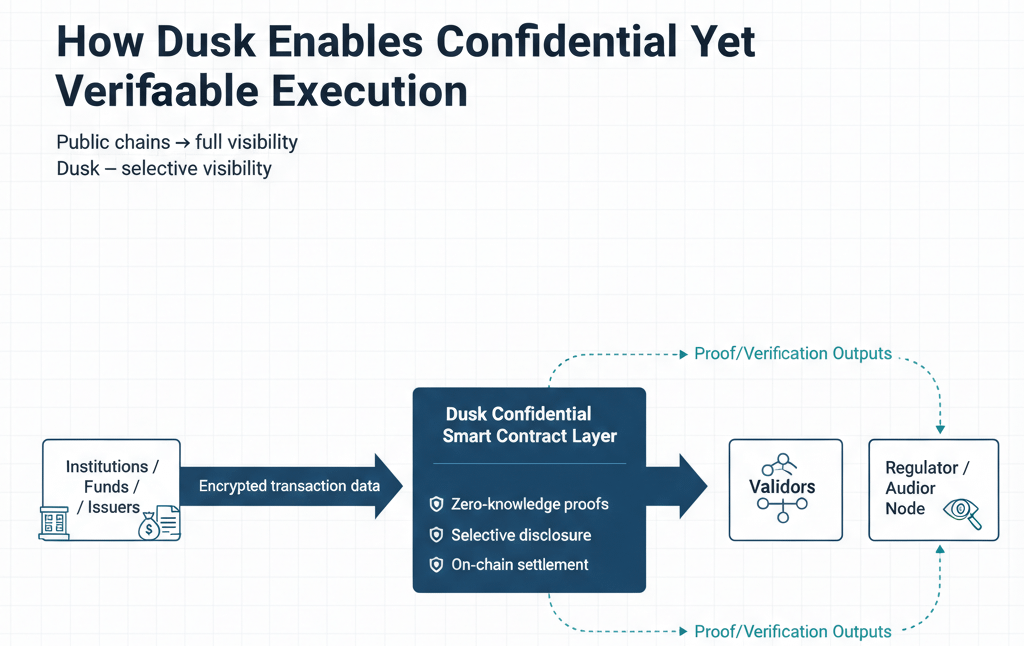
While many blockchain projects chase app counts or flashy features, Dusk has followed a quieter path. Its focus isn’t on headlines — it’s on execution discipline, a subtle but critical signal that becomes clearer when you read the conversation around the network.
This isn’t about getting the next viral narrative. It’s about building technology that answers one of the oldest unresolved gaps in blockchain: how to balance privacy and compliance in a way that real institutions can use without abandoning decentralization.
What Sets Dusk’s Design Apart
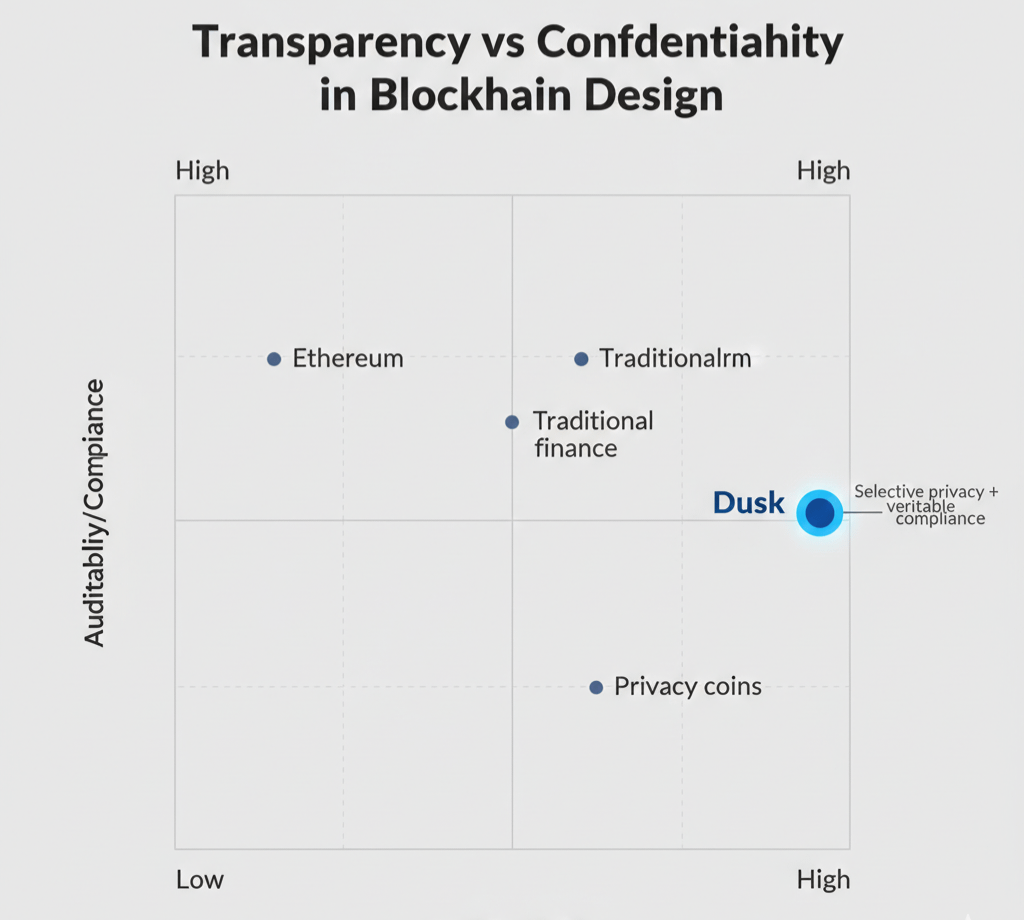
Most public blockchains embrace transparency as a core value. That’s good for decentralization, but it introduces a real problem for regulated financial use cases. Banks, funds, and other professional entities can’t just broadcast every transaction to the public. Privacy isn’t a luxury for them — it’s a requirement.
Dusk builds with this reality at the center. Instead of treating privacy as a layer added later, it embeds selective confidentiality into the protocol itself — while still allowing verification where accountability matters. It’s an attempt to reconcile two forces that often feel opposed: confidentiality and auditability.
This design isn’t a marketing talking point.
It’s a structural choice — and discussions in posts about Dusk emphasize that execution discipline is now the real axis for evaluation, not superficial metrics.
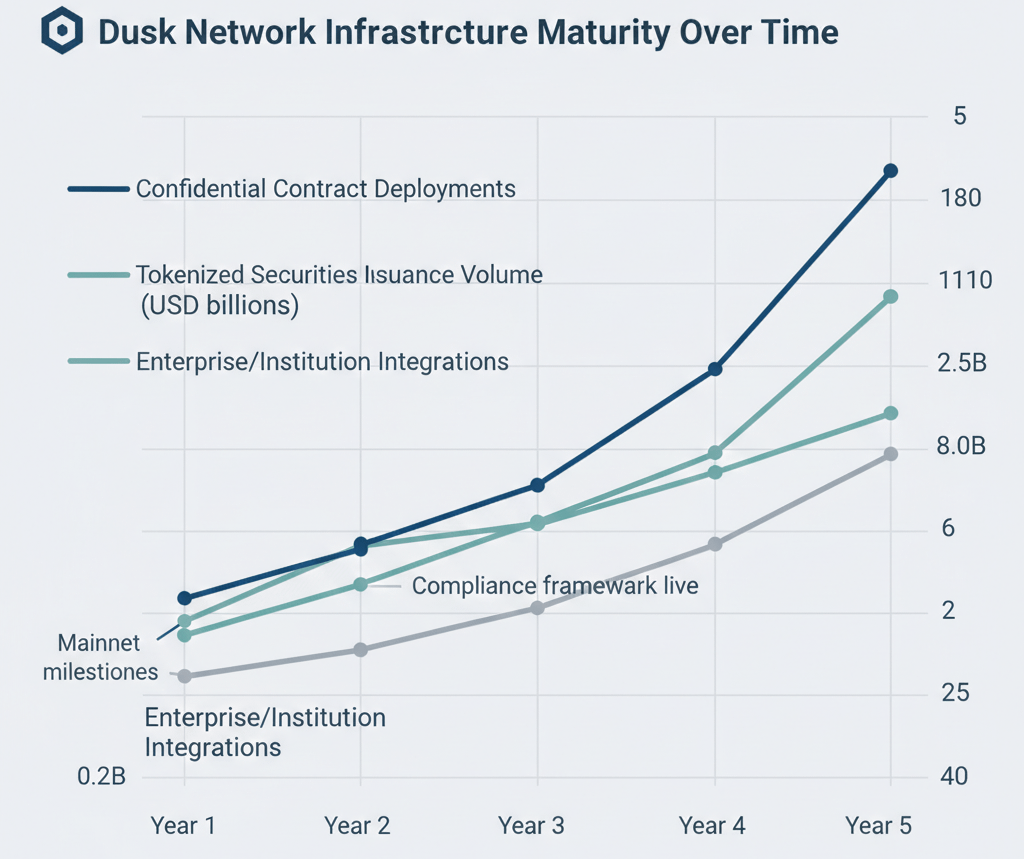
Privacy Infrastructure Isn’t a Contradiction — It’s a Demand
What most observers miss is that privacy isn’t just for individual users. Institutional actors actively need systems where transaction details can stay confidential but still provably correct when regulators or counterparties need oversight. Fully transparent chains fail this test; fully opaque protocols fail compliance. What Dusk tries to bridge here is practical confidentiality.
In traditional finance, regulated entities operate with rules and disclosures. Dusk’s approach isn’t to ignore that — it’s to build with it, not around it. This isn’t accidental. It reflects a deeper understanding that any blockchain aiming for institutional activity must design for both privacy and accountability simultaneously.
Where $DUSK Fits Into Real-World Use Cases
Dusk isn’t focused on being “another DeFi playground.” Its positioning lies in:
• Confidential smart contracts that handle sensitive financial logic.
• Tokenized securities issuance and settlement with private transaction data.
• Reducing the securities clearing cycle from traditional latency to near-real-time on chain.
That’s not easy. It demands more than a whitepaper. It demands discipline in execution — the same discipline Cas points to when he argues Dusk must be judged by how it delivers technology, not how many apps it accumulates.
Token Role and Structural Significance
$DUSK isn’t designed to be a speculative ticket. Its role is foundational: supporting a blockchain that prioritizes privacy as infrastructure, not an add-on. The token secures the network and aligns stakeholders toward long-term use cases that structurally depend on the protocol’s unique properties, not just liquidity metrics.
Here, the narrative isn’t about price spikes. It’s about whether the chain can persist in delivering the foundational characteristics it promises. And so far, the focus on quality over noise — fixing real technical challenges before hyping features — has followed directly from how Dusk’s communications and ecosystem updates have been framed.
Why Execution Discipline Matters More Than App Counts
Cas’s framing of Dusk isn’t incidental. In an era where most chains chase superficial adoption numbers, he points out an industry truth: the boundary between concept and usable infrastructure is execution discipline, not hype.
Dusk is pursuing that boundary. It doesn’t mean immediate network effects. It means real structural problems are being confronted head-on:
privacy without losing auditability
institutional requirements without abandoning decentralization
confidential settlement logic without leaving regulators in the dark
That’s harder than it sounds — and rarer than it should be in blockchain.
Final Thought
In the long run, blockchain for regulated financial systems won’t be judged on token metrics alone. It will be judged on whether institutions can run private yet accountable systems on them. That’s where Dusk is positioning itself — not for hype, not for headlines, but for infrastructure that may one day sit beneath regulated markets, quietly moving confidential value where transparency and privacy both matter.
