

TopCryptoNews
10.1k Публикации

TopCryptoNews
 Square Verified+
Отправить жалобу
Заблокировать пользователя
Lastest News | Technical Analysis | Signals | Web3 | Advertise | Top News on Crypto World | Projects | Business Offer

Creator Awards 2024

#BinanceTurns7

Excellence Award (Top Voice)
35 подписок(и/а)
295.8K+ подписчиков(а)
339.7K+ понравилось
7 Значки
Посты
Все
Цитирования
Видео
Активно
PINNED
🔴 FSB placed Pavel Durov under international arrest warrant
The founder of Telegram, Pavel Durov, has been placed under international arrest warrant for aiding terrorism, report media citing the Russian FSB.
According to the FSB, Ukrainian special services allegedly used Telegram chat bots to recruit Russian citizens. The agency claims that the Telegram administration did not remove the service after it was added to the registry of banned resources, which became the basis for the charges.
At the time of publication, no official comments from Pavel Durov had been received.
#PavelDurov | #TON | $TON
🔴 FSB placed Pavel Durov under international arrest warrant
The founder of Telegram, Pavel Durov, has been placed under international arrest warrant for aiding terrorism, report media citing the Russian FSB.
According to the FSB, Ukrainian special services allegedly used Telegram chat bots to recruit Russian citizens. The agency claims that the Telegram administration did not remove the service after it was added to the registry of banned resources, which became the basis for the charges.
At the time of publication, no official comments from Pavel Durov had been received.
#PavelDurov | #TON | $TON
The founder of Telegram, Pavel Durov, has been placed under international arrest warrant for aiding terrorism, report media citing the Russian FSB.
According to the FSB, Ukrainian special services allegedly used Telegram chat bots to recruit Russian citizens. The agency claims that the Telegram administration did not remove the service after it was added to the registry of banned resources, which became the basis for the charges.
At the time of publication, no official comments from Pavel Durov had been received.
#PavelDurov | #TON | $TON

32
8
210
434.7k
PINNED
Проверено
🌕 CZ-owned Trust Wallet launches AI agents that can execute crypto trades
The digital wallet owned by Binance founder Changpeng Zhao, which has more than 220 million customers, said Thursday that users can now employ artificial intelligence-powered agents to perform a variety of crypto transactions.
"Today, Trust Wallet launches the Trust Wallet Agent Kit (TWAK) — infrastructure that lets AI agents execute real crypto transactions, across more than 25 blockchains, within rules that users define and control," the company said in a blog post. The agents can handle cross-chain swaps across several networks, including Solana and Bitcoin, in addition to managing recurring buys.
Crypto firms are increasingly experimenting with AI-powered automation, aiming to allow users to enlist agents that can actively manage portfolios and execute trades.
The new toolkit offers two ways to operate, one where the AI agent has its own wallet and can execute trades automatically based on set rules, and the other where it suggests transactions that users then need to approve.
"Trust Wallet has always been built on a single principle: your keys, your crypto. TWAK extends that principle into the age of AI agents," also according to the blog post. "With WalletConnect mode, an AI can help you act on your portfolio — research, propose, execute — without ever holding your keys. You stay in control."
While the cryptocurrency exchange initially bought Trust Wallet in 2018, it now operates as an independent company.
#CZ | #AI
🌕 CZ-owned Trust Wallet launches AI agents that can execute crypto trades
The digital wallet owned by Binance founder Changpeng Zhao, which has more than 220 million customers, said Thursday that users can now employ artificial intelligence-powered agents to perform a variety of crypto transactions.
"Today, Trust Wallet launches the Trust Wallet Agent Kit (TWAK) — infrastructure that lets AI agents execute real crypto transactions, across more than 25 blockchains, within rules that users define and control," the company said in a blog post. The agents can handle cross-chain swaps across several networks, including Solana and Bitcoin, in addition to managing recurring buys.
Crypto firms are increasingly experimenting with AI-powered automation, aiming to allow users to enlist agents that can actively manage portfolios and execute trades.
The new toolkit offers two ways to operate, one where the AI agent has its own wallet and can execute trades automatically based on set rules, and the other where it suggests transactions that users then need to approve.
"Trust Wallet has always been built on a single principle: your keys, your crypto. TWAK extends that principle into the age of AI agents," also according to the blog post. "With WalletConnect mode, an AI can help you act on your portfolio — research, propose, execute — without ever holding your keys. You stay in control."
While the cryptocurrency exchange initially bought Trust Wallet in 2018, it now operates as an independent company.
#CZ | #AI
The digital wallet owned by Binance founder Changpeng Zhao, which has more than 220 million customers, said Thursday that users can now employ artificial intelligence-powered agents to perform a variety of crypto transactions.
"Today, Trust Wallet launches the Trust Wallet Agent Kit (TWAK) — infrastructure that lets AI agents execute real crypto transactions, across more than 25 blockchains, within rules that users define and control," the company said in a blog post. The agents can handle cross-chain swaps across several networks, including Solana and Bitcoin, in addition to managing recurring buys.
Crypto firms are increasingly experimenting with AI-powered automation, aiming to allow users to enlist agents that can actively manage portfolios and execute trades.
The new toolkit offers two ways to operate, one where the AI agent has its own wallet and can execute trades automatically based on set rules, and the other where it suggests transactions that users then need to approve.
"Trust Wallet has always been built on a single principle: your keys, your crypto. TWAK extends that principle into the age of AI agents," also according to the blog post. "With WalletConnect mode, an AI can help you act on your portfolio — research, propose, execute — without ever holding your keys. You stay in control."
While the cryptocurrency exchange initially bought Trust Wallet in 2018, it now operates as an independent company.
#CZ | #AI

113
48
454
100.4k
·
--
Рост
🚀 Day 7 | Take Mega Drop 🎁 Click Vote and Take your BIG $ prize
HOW? Click [VOTE HERE](https://www.binance.com/en/square/blockchain-100-2026?username=776) after click on Vote, after Voting go to comments and write "YES" and Claim
Thank you very much for all Votes !!!
#Binance #BinanceSquareCreatorAward #Blockchain100 $BNB
{spot}(BNBUSDT)
🚀 Day 7 | Take Mega Drop 🎁 Click Vote and Take your BIG $ prize
HOW? Click VOTE HERE after click on Vote, after Voting go to comments and write "YES" and Claim
Thank you very much for all Votes !!!
#Binance #BinanceSquareCreatorAward #Blockchain100 $BNB
HOW? Click VOTE HERE after click on Vote, after Voting go to comments and write "YES" and Claim
Thank you very much for all Votes !!!
#Binance #BinanceSquareCreatorAward #Blockchain100 $BNB

80
17
730
·
--
Рост
🚀 Day 6 | Take Mega Drop 🎁 Click Vote and Take your BIG $ prize
HOW? Click [VOTE HERE](https://www.binance.com/en/square/blockchain-100-2026?username=776) after click on Vote, after Voting go to comments and write "YES" and Claim
Thank you very much for all Votes !!!
#Binance #BinanceSquareCreatorAward #Blockchain100 $BNB
{spot}(BNBUSDT)
🚀 Day 6 | Take Mega Drop 🎁 Click Vote and Take your BIG $ prize
HOW? Click VOTE HERE after click on Vote, after Voting go to comments and write "YES" and Claim
Thank you very much for all Votes !!!
#Binance #BinanceSquareCreatorAward #Blockchain100 $BNB
HOW? Click VOTE HERE after click on Vote, after Voting go to comments and write "YES" and Claim
Thank you very much for all Votes !!!
#Binance #BinanceSquareCreatorAward #Blockchain100 $BNB

109
1
12
823
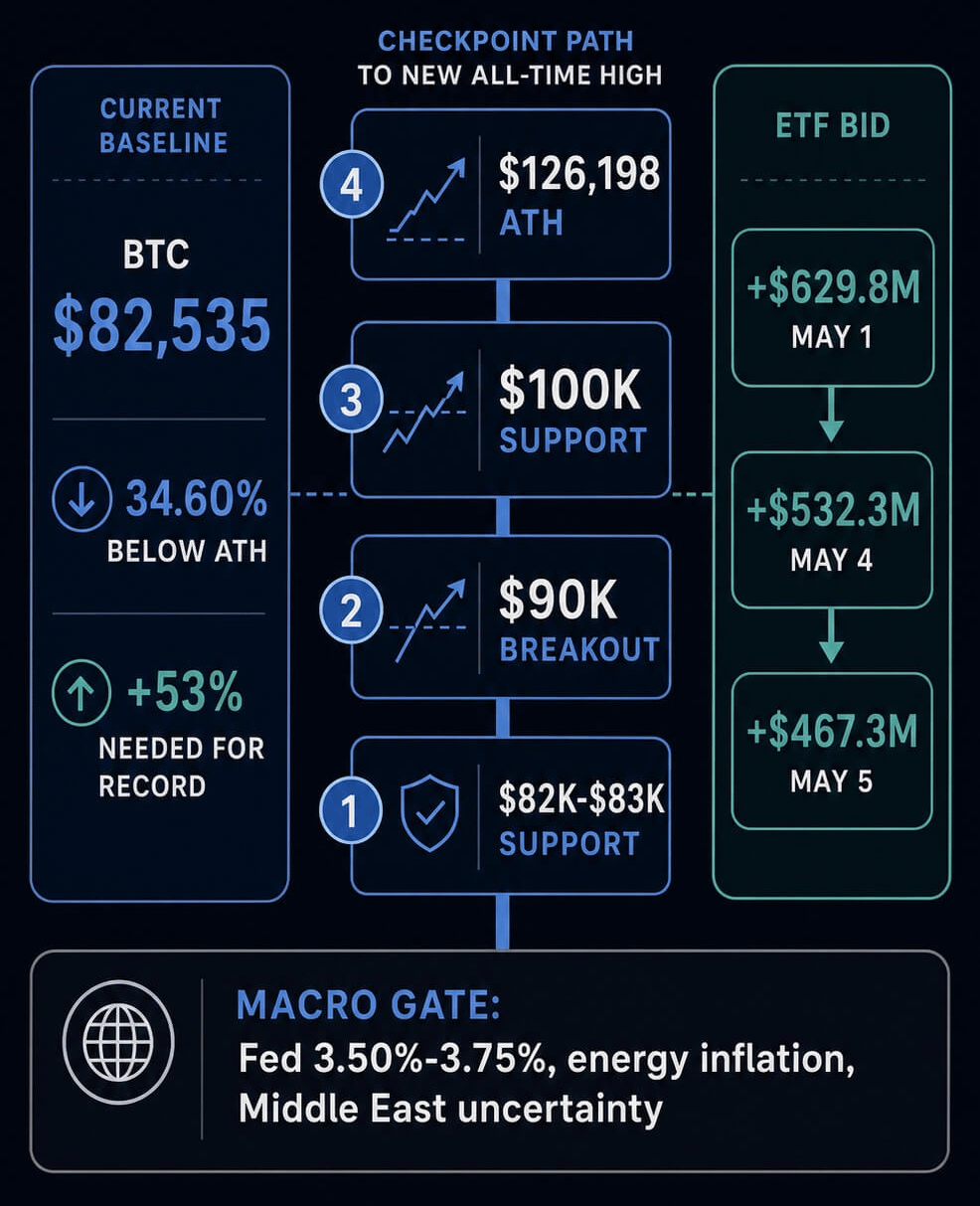
How long will it take for Bitcoin to return to $126k? 🤔️️️️️️
It has been almost a year since the all-time high (ATH). Currently, the price is 34% below the peak, but it is already 43% above the July low of $58k. If we analyze the infographic above, which shows the relationship between the depth of the decline and the duration of the recovery, we can see the following:
🔘 Historically, after a drop of 50-55%, it has taken 60-230 days from the bottom to return to the previous ATH.
🔘 Approximately 114 days have passed since the July low.
🔘 If $58k was indeed the bottom, the historical recovery window falls between December 2026 and February 2027.
What are the possible scenarios?
🟢 Optimistic: A breakout above $95-$100k in November would accelerate the recovery, and BTC could reach a new ATH before the end of the year.
🟠 Moderate: Consolidation in the $85-$90k range, with a return to $126k in early 2027.
💭 For now, Bitcoin is close to the median line of the historical recovery model. The next few months will show whether the market can maintain this pace.
#BTC | #Bitcoin | $BTC
{spot}(BTCUSDT)
How long will it take for Bitcoin to return to $126k? 🤔️️️️️️
It has been almost a year since the all-time high (ATH). Currently, the price is 34% below the peak, but it is already 43% above the July low of $58k. If we analyze the infographic above, which shows the relationship between the depth of the decline and the duration of the recovery, we can see the following:
🔘 Historically, after a drop of 50-55%, it has taken 60-230 days from the bottom to return to the previous ATH.
🔘 Approximately 114 days have passed since the July low.
🔘 If $58k was indeed the bottom, the historical recovery window falls between December 2026 and February 2027.
What are the possible scenarios?
🟢 Optimistic: A breakout above $95-$100k in November would accelerate the recovery, and BTC could reach a new ATH before the end of the year.
🟠 Moderate: Consolidation in the $85-$90k range, with a return to $126k in early 2027.
💭 For now, Bitcoin is close to the median line of the historical recovery model. The next few months will show whether the market can maintain this pace.
#BTC | #Bitcoin | $BTC
It has been almost a year since the all-time high (ATH). Currently, the price is 34% below the peak, but it is already 43% above the July low of $58k. If we analyze the infographic above, which shows the relationship between the depth of the decline and the duration of the recovery, we can see the following:
🔘 Historically, after a drop of 50-55%, it has taken 60-230 days from the bottom to return to the previous ATH.
🔘 Approximately 114 days have passed since the July low.
🔘 If $58k was indeed the bottom, the historical recovery window falls between December 2026 and February 2027.
What are the possible scenarios?
🟢 Optimistic: A breakout above $95-$100k in November would accelerate the recovery, and BTC could reach a new ATH before the end of the year.
🟠 Moderate: Consolidation in the $85-$90k range, with a return to $126k in early 2027.
💭 For now, Bitcoin is close to the median line of the historical recovery model. The next few months will show whether the market can maintain this pace.
#BTC | #Bitcoin | $BTC
5
2.1k
·
--
Рост
🚀 Day 5 | Take Mega Drop 🎁 Click Vote and Take your BIG $ prize
HOW? Click [VOTE HERE](https://www.binance.com/en/square/blockchain-100-2026?username=776) after click on Vote, after Voting go to comments and write "YES" and Claim
Thank you very much for all Votes !!!
#Binance #BinanceSquareCreatorAward #Blockchain100 $BNB
{spot}(BNBUSDT)
🚀 Day 5 | Take Mega Drop 🎁 Click Vote and Take your BIG $ prize
HOW? Click VOTE HERE after click on Vote, after Voting go to comments and write "YES" and Claim
Thank you very much for all Votes !!!
#Binance #BinanceSquareCreatorAward #Blockchain100 $BNB
HOW? Click VOTE HERE after click on Vote, after Voting go to comments and write "YES" and Claim
Thank you very much for all Votes !!!
#Binance #BinanceSquareCreatorAward #Blockchain100 $BNB

93
17
941
January 13 – a good time to buy based on the US election pattern 🇺🇸
After US midterm elections, Bitcoin reached its bottom in the following timeframes:
🔘 2014 – 71 days after the elections
🔘 2018 – 39 days
🔘 2022 – 13 days
And what happened next? Over the following 12 months, BTC grew:
📈 2014: +25%
📈 2018: +45%
📈 2022: +92%
The next US midterm elections will take place on November 3, 2026. If we use the 71-day interval as a reference, the potential date is January 13, 2027.
🤔️️️️️️ Save this and let's see if the scenario repeats this time.
#BTC | #Bitcoin | $BTC
January 13 – a good time to buy based on the US election pattern 🇺🇸
After US midterm elections, Bitcoin reached its bottom in the following timeframes:
🔘 2014 – 71 days after the elections
🔘 2018 – 39 days
🔘 2022 – 13 days
And what happened next? Over the following 12 months, BTC grew:
📈 2014: +25%
📈 2018: +45%
📈 2022: +92%
The next US midterm elections will take place on November 3, 2026. If we use the 71-day interval as a reference, the potential date is January 13, 2027.
🤔️️️️️️ Save this and let's see if the scenario repeats this time.
#BTC | #Bitcoin | $BTC
After US midterm elections, Bitcoin reached its bottom in the following timeframes:
🔘 2014 – 71 days after the elections
🔘 2018 – 39 days
🔘 2022 – 13 days
And what happened next? Over the following 12 months, BTC grew:
📈 2014: +25%
📈 2018: +45%
📈 2022: +92%
The next US midterm elections will take place on November 3, 2026. If we use the 71-day interval as a reference, the potential date is January 13, 2027.
🤔️️️️️️ Save this and let's see if the scenario repeats this time.
#BTC | #Bitcoin | $BTC
9
3.1k
🟢 Can Near Protocol (NEAR) Recover? Main Resistance Threshold Is Clear Now
NEAR Protocol trades around $4.97 after a sharp pullback from its latest high. The token climbed from approximately $1.60 in August to nearly $6.00 in mid-October, one of the most powerful runs among large altcoins this year. Since then, the price has moved sideways, and investors are now asking whether NEAR can recover and push higher.
🔸 Next major barrier established
The main resistance now sits between $5.40 and $5.60. NEAR has failed to close above this area several times in recent weeks. Each attempt ended with a long upper shadow on the daily candle, which indicates that sellers step in quickly when the price gets close. Above that zone, the $6.00 peak is the next major barrier.
Support is easier to identify. The short-term moving average near $4.83 has held the price up in recent sessions, and buyers continue to defend the $4.80 level. If that fails, the next area to watch is around $4.30, where the price bounced earlier in October. That level also lines up with the 50-day moving average at approximately $4.27, which makes it a strong floor.
🔸 The trend remains healthy
The bigger trend still looks healthy. All the major moving averages point up, and the price remains well above each of them. The 200-day average near $2.80 is far below the current price, which shows how far NEAR has moved in a short time. A drop toward the middle averages would be a normal cooldown and would not damage the larger uptrend.
Momentum has cooled. The RSI fell from extreme overbought levels above 85 in late September to approximately 50 today. This is a reset, not a warning signal. It means the market has had time to rest, and there is room for a new push if buyers return. Trading volume has declined during the consolidation. Lower volume in a tight range often comes before a bigger move, but it also indicates that investors are not fully convinced yet.
#NEAR | $NEAR
{spot}(NEARUSDT)
🟢 Can Near Protocol (NEAR) Recover? Main Resistance Threshold Is Clear Now
NEAR Protocol trades around $4.97 after a sharp pullback from its latest high. The token climbed from approximately $1.60 in August to nearly $6.00 in mid-October, one of the most powerful runs among large altcoins this year. Since then, the price has moved sideways, and investors are now asking whether NEAR can recover and push higher.
🔸 Next major barrier established
The main resistance now sits between $5.40 and $5.60. NEAR has failed to close above this area several times in recent weeks. Each attempt ended with a long upper shadow on the daily candle, which indicates that sellers step in quickly when the price gets close. Above that zone, the $6.00 peak is the next major barrier.
Support is easier to identify. The short-term moving average near $4.83 has held the price up in recent sessions, and buyers continue to defend the $4.80 level. If that fails, the next area to watch is around $4.30, where the price bounced earlier in October. That level also lines up with the 50-day moving average at approximately $4.27, which makes it a strong floor.
🔸 The trend remains healthy
The bigger trend still looks healthy. All the major moving averages point up, and the price remains well above each of them. The 200-day average near $2.80 is far below the current price, which shows how far NEAR has moved in a short time. A drop toward the middle averages would be a normal cooldown and would not damage the larger uptrend.
Momentum has cooled. The RSI fell from extreme overbought levels above 85 in late September to approximately 50 today. This is a reset, not a warning signal. It means the market has had time to rest, and there is room for a new push if buyers return. Trading volume has declined during the consolidation. Lower volume in a tight range often comes before a bigger move, but it also indicates that investors are not fully convinced yet.
#NEAR | $NEAR
NEAR Protocol trades around $4.97 after a sharp pullback from its latest high. The token climbed from approximately $1.60 in August to nearly $6.00 in mid-October, one of the most powerful runs among large altcoins this year. Since then, the price has moved sideways, and investors are now asking whether NEAR can recover and push higher.
🔸 Next major barrier established
The main resistance now sits between $5.40 and $5.60. NEAR has failed to close above this area several times in recent weeks. Each attempt ended with a long upper shadow on the daily candle, which indicates that sellers step in quickly when the price gets close. Above that zone, the $6.00 peak is the next major barrier.
Support is easier to identify. The short-term moving average near $4.83 has held the price up in recent sessions, and buyers continue to defend the $4.80 level. If that fails, the next area to watch is around $4.30, where the price bounced earlier in October. That level also lines up with the 50-day moving average at approximately $4.27, which makes it a strong floor.
🔸 The trend remains healthy
The bigger trend still looks healthy. All the major moving averages point up, and the price remains well above each of them. The 200-day average near $2.80 is far below the current price, which shows how far NEAR has moved in a short time. A drop toward the middle averages would be a normal cooldown and would not damage the larger uptrend.
Momentum has cooled. The RSI fell from extreme overbought levels above 85 in late September to approximately 50 today. This is a reset, not a warning signal. It means the market has had time to rest, and there is room for a new push if buyers return. Trading volume has declined during the consolidation. Lower volume in a tight range often comes before a bigger move, but it also indicates that investors are not fully convinced yet.
#NEAR | $NEAR

3
1.1k
·
--
Рост
🚀 Day 4 | Take Big Drop 🎁 Click Vote and Take your BIG $ prize
HOW? Click [VOTE HERE](https://www.binance.com/en/square/blockchain-100-2026?username=776) after click on Vote, after Voting go to comments and write "YES" and Claim
Thank you very much for all Votes !!!
#Binance #BinanceSquareCreatorAward #Blockchain100 $BNB
{spot}(BNBUSDT)
🚀 Day 4 | Take Big Drop 🎁 Click Vote and Take your BIG $ prize
HOW? Click VOTE HERE after click on Vote, after Voting go to comments and write "YES" and Claim
Thank you very much for all Votes !!!
#Binance #BinanceSquareCreatorAward #Blockchain100 $BNB
HOW? Click VOTE HERE after click on Vote, after Voting go to comments and write "YES" and Claim
Thank you very much for all Votes !!!
#Binance #BinanceSquareCreatorAward #Blockchain100 $BNB

116
2
23
1.1k
Проверено
🔘 Arbitrum Active Addresses Hit 30-Day High, Then Retreat
Arbitrum One recorded 571,767 daily active addresses on Oct. 21, its highest count in 30 days and nearly five times the preceding week's median, according to growthepie's daily series. The burst had faded by the following morning.
The Ethereum Layer 2's address count rose from 201,145 on Oct. 20, while transactions increased much less sharply—from 1,505,085 to 1,660,573, according to growthepie's transaction series. That divergence matters for readers tracking network adoption: more active addresses did not translate into a comparable expansion in transactions.
Hourly data show the surge was short-lived. Arbitrum exceeded 104,000 active addresses in each of the three hours beginning at 14:00 UTC on Oct. 21. In the first nine hourly observations on Oct. 22, counts were back below 10,000. These are addresses, not a count of individual people, and the data do not establish whether bots or an incentive campaign drove the increase.
🔸 Arbitrum's Address Burst Fades
The daily count was about 393% above the median of 116,048 for Oct. 14–20, The Defiant calculated from growthepie's seven daily observations. It also surpassed the previous high within the 30-day window, 353,177 on Oct. 6. All daily comparisons use complete UTC days.
The jump was not confined to Arbitrum. Base rose from 344,705 active addresses on Oct. 20 to 629,142 on Oct. 21, remaining above Arbitrum. OP Mainnet increased from 12,740 to 15,844 over the same dates. Those same-provider comparisons establish simultaneous increases, not a shared cause.
Growthepie's metric documentation describes active addresses as an address-level activity proxy, not exact unique users. The daily totals alone cannot distinguish broad participation from activity spread across multiple wallets.
#ARB | #Arbitrum | $ARB
{spot}(ARBUSDT)
🔘 Arbitrum Active Addresses Hit 30-Day High, Then Retreat
Arbitrum One recorded 571,767 daily active addresses on Oct. 21, its highest count in 30 days and nearly five times the preceding week's median, according to growthepie's daily series. The burst had faded by the following morning.
The Ethereum Layer 2's address count rose from 201,145 on Oct. 20, while transactions increased much less sharply—from 1,505,085 to 1,660,573, according to growthepie's transaction series. That divergence matters for readers tracking network adoption: more active addresses did not translate into a comparable expansion in transactions.
Hourly data show the surge was short-lived. Arbitrum exceeded 104,000 active addresses in each of the three hours beginning at 14:00 UTC on Oct. 21. In the first nine hourly observations on Oct. 22, counts were back below 10,000. These are addresses, not a count of individual people, and the data do not establish whether bots or an incentive campaign drove the increase.
🔸 Arbitrum's Address Burst Fades
The daily count was about 393% above the median of 116,048 for Oct. 14–20, The Defiant calculated from growthepie's seven daily observations. It also surpassed the previous high within the 30-day window, 353,177 on Oct. 6. All daily comparisons use complete UTC days.
The jump was not confined to Arbitrum. Base rose from 344,705 active addresses on Oct. 20 to 629,142 on Oct. 21, remaining above Arbitrum. OP Mainnet increased from 12,740 to 15,844 over the same dates. Those same-provider comparisons establish simultaneous increases, not a shared cause.
Growthepie's metric documentation describes active addresses as an address-level activity proxy, not exact unique users. The daily totals alone cannot distinguish broad participation from activity spread across multiple wallets.
#ARB | #Arbitrum | $ARB
Arbitrum One recorded 571,767 daily active addresses on Oct. 21, its highest count in 30 days and nearly five times the preceding week's median, according to growthepie's daily series. The burst had faded by the following morning.
The Ethereum Layer 2's address count rose from 201,145 on Oct. 20, while transactions increased much less sharply—from 1,505,085 to 1,660,573, according to growthepie's transaction series. That divergence matters for readers tracking network adoption: more active addresses did not translate into a comparable expansion in transactions.
Hourly data show the surge was short-lived. Arbitrum exceeded 104,000 active addresses in each of the three hours beginning at 14:00 UTC on Oct. 21. In the first nine hourly observations on Oct. 22, counts were back below 10,000. These are addresses, not a count of individual people, and the data do not establish whether bots or an incentive campaign drove the increase.
🔸 Arbitrum's Address Burst Fades
The daily count was about 393% above the median of 116,048 for Oct. 14–20, The Defiant calculated from growthepie's seven daily observations. It also surpassed the previous high within the 30-day window, 353,177 on Oct. 6. All daily comparisons use complete UTC days.
The jump was not confined to Arbitrum. Base rose from 344,705 active addresses on Oct. 20 to 629,142 on Oct. 21, remaining above Arbitrum. OP Mainnet increased from 12,740 to 15,844 over the same dates. Those same-provider comparisons establish simultaneous increases, not a shared cause.
Growthepie's metric documentation describes active addresses as an address-level activity proxy, not exact unique users. The daily totals alone cannot distinguish broad participation from activity spread across multiple wallets.
#ARB | #Arbitrum | $ARB
4
2k
·
--
Рост
🚀 Day 3 | Good evening friends, Click Vote and Take your BIG $ prize
HOW? Click [VOTE HERE](https://www.binance.com/en/square/blockchain-100-2026?username=776) after click on Vote, after Voting go to comments and write "YES" and Claim
Thank you very much for all Votes !!!
#Binance #BinanceSquareCreatorAward #BNB #Blockchain100
🚀 Day 3 | Good evening friends, Click Vote and Take your BIG $ prize
HOW? Click VOTE HERE after click on Vote, after Voting go to comments and write "YES" and Claim
Thank you very much for all Votes !!!
#Binance #BinanceSquareCreatorAward #BNB #Blockchain100
HOW? Click VOTE HERE after click on Vote, after Voting go to comments and write "YES" and Claim
Thank you very much for all Votes !!!
#Binance #BinanceSquareCreatorAward #BNB #Blockchain100

52
1
12
845
🚀 Day 2 | Good morning friends, Click Vote and Take your BIG $ prize
HOW? Go to my profile @TopCryptoNews after click on Vote, after Voting go to comments and write "YES" and Claim
Thank you very much for all Votes !!!
#Binance #BinanceSquareCreatorAward #BNB
🚀 Day 2 | Good morning friends, Click Vote and Take your BIG $ prize
HOW? Go to my profile @TopCryptoNews after click on Vote, after Voting go to comments and write "YES" and Claim
Thank you very much for all Votes !!!
#Binance #BinanceSquareCreatorAward #BNB
HOW? Go to my profile @TopCryptoNews after click on Vote, after Voting go to comments and write "YES" and Claim
Thank you very much for all Votes !!!
#Binance #BinanceSquareCreatorAward #BNB

12
1
6
653
·
--
Рост
🔵 Cardano Price Prediction: ADA Risks Falling to $0.19 After Resistance Rejection
Widely followed crypto analyst Tony has predicted that Cardano could decline toward $0.19 after failing to break above a key resistance level.
In his latest update, Tony warned that Cardano could be gearing up for a move toward $0.19 following $ADA’s rejection above the $0.23 resistance zone. His chart suggests that the token has struggled to sustain its recovery, raising the possibility of another decline.
At the time of the projection, ADA had fallen below $0.22 as the broader cryptocurrency market faced renewed selling pressure.
🔸 ADA Chart Highlights Potential Retest of $0.19 Support
The accompanying daily ADA/USDT chart on Bybit shows that Cardano rallied from around $0.14 in late June to $0.28 in early October. However, the recovery lost momentum after ADA encountered resistance near the $0.28 region.
The token subsequently reversed lower, breaking below $0.23 and extending its decline toward $0.2174 in the hours leading up to press time. Consequently, the $0.23 zone has become a key resistance level that ADA must reclaim to strengthen its recovery prospects.
Against this backdrop, Tony’s projection points to a potential decline toward horizontal support around $0.19 before another recovery attempt. The white arrows on his chart illustrate a possible move below this support area, followed by a rebound toward $0.22.
Nevertheless, the chart outlines a potential scenario rather than a confirmed price movement. If selling pressure pushes ADA decisively below $0.19, the token could face further downside. Conversely, a rebound would depend on renewed buying pressure and the market’s ability to sustain a recovery.
#ADA | #Cardano | $ADA
{spot}(ADAUSDT)
🔵 Cardano Price Prediction: ADA Risks Falling to $0.19 After Resistance Rejection
Widely followed crypto analyst Tony has predicted that Cardano could decline toward $0.19 after failing to break above a key resistance level.
In his latest update, Tony warned that Cardano could be gearing up for a move toward $0.19 following $ADA ’s rejection above the $0.23 resistance zone. His chart suggests that the token has struggled to sustain its recovery, raising the possibility of another decline.
At the time of the projection, ADA had fallen below $0.22 as the broader cryptocurrency market faced renewed selling pressure.
🔸 ADA Chart Highlights Potential Retest of $0.19 Support
The accompanying daily ADA/USDT chart on Bybit shows that Cardano rallied from around $0.14 in late June to $0.28 in early October. However, the recovery lost momentum after ADA encountered resistance near the $0.28 region.
The token subsequently reversed lower, breaking below $0.23 and extending its decline toward $0.2174 in the hours leading up to press time. Consequently, the $0.23 zone has become a key resistance level that ADA must reclaim to strengthen its recovery prospects.
Against this backdrop, Tony’s projection points to a potential decline toward horizontal support around $0.19 before another recovery attempt. The white arrows on his chart illustrate a possible move below this support area, followed by a rebound toward $0.22.
Nevertheless, the chart outlines a potential scenario rather than a confirmed price movement. If selling pressure pushes ADA decisively below $0.19, the token could face further downside. Conversely, a rebound would depend on renewed buying pressure and the market’s ability to sustain a recovery.
#ADA | #Cardano | $ADA
Widely followed crypto analyst Tony has predicted that Cardano could decline toward $0.19 after failing to break above a key resistance level.
In his latest update, Tony warned that Cardano could be gearing up for a move toward $0.19 following $ADA ’s rejection above the $0.23 resistance zone. His chart suggests that the token has struggled to sustain its recovery, raising the possibility of another decline.
At the time of the projection, ADA had fallen below $0.22 as the broader cryptocurrency market faced renewed selling pressure.
🔸 ADA Chart Highlights Potential Retest of $0.19 Support
The accompanying daily ADA/USDT chart on Bybit shows that Cardano rallied from around $0.14 in late June to $0.28 in early October. However, the recovery lost momentum after ADA encountered resistance near the $0.28 region.
The token subsequently reversed lower, breaking below $0.23 and extending its decline toward $0.2174 in the hours leading up to press time. Consequently, the $0.23 zone has become a key resistance level that ADA must reclaim to strengthen its recovery prospects.
Against this backdrop, Tony’s projection points to a potential decline toward horizontal support around $0.19 before another recovery attempt. The white arrows on his chart illustrate a possible move below this support area, followed by a rebound toward $0.22.
Nevertheless, the chart outlines a potential scenario rather than a confirmed price movement. If selling pressure pushes ADA decisively below $0.19, the token could face further downside. Conversely, a rebound would depend on renewed buying pressure and the market’s ability to sustain a recovery.
#ADA | #Cardano | $ADA

3
1.1k
·
--
Рост
🚀 Good morning friends, Click Vote and Take your BIG $ prize
HOW? Go to my profile @TopCryptoNews after click on Vote, after Voting go to comments and write "YES" and Claim
Thank you very much for all Votes !!!
#Binance #BinanceSquareCreatorAward #BNB
🚀 Good morning friends, Click Vote and Take your BIG $ prize
HOW? Go to my profile @TopCryptoNews after click on Vote, after Voting go to comments and write "YES" and Claim
Thank you very much for all Votes !!!
#Binance #BinanceSquareCreatorAward #BNB
HOW? Go to my profile @TopCryptoNews after click on Vote, after Voting go to comments and write "YES" and Claim
Thank you very much for all Votes !!!
#Binance #BinanceSquareCreatorAward #BNB

57
10
614
·
--
Рост
Проверено
🔥 US-Iran War Deal Expected This Week, Can Bitcoin Price Reclaim $90K?
A US-Iran war deal could be announced this week as mediators seek an agreement between Washington and Tehran, according to Al-Araby Al-Jadeed. The breakthrough comes as Bitcoin trades near $82,500, with investors watching whether easing tensions could support a recovery toward $90,000.
#BTC | #Bitcoin | $BTC
{spot}(BTCUSDT)
🔥 US-Iran War Deal Expected This Week, Can Bitcoin Price Reclaim $90K?
A US-Iran war deal could be announced this week as mediators seek an agreement between Washington and Tehran, according to Al-Araby Al-Jadeed. The breakthrough comes as Bitcoin trades near $82,500, with investors watching whether easing tensions could support a recovery toward $90,000.
#BTC | #Bitcoin | $BTC
A US-Iran war deal could be announced this week as mediators seek an agreement between Washington and Tehran, according to Al-Araby Al-Jadeed. The breakthrough comes as Bitcoin trades near $82,500, with investors watching whether easing tensions could support a recovery toward $90,000.
#BTC | #Bitcoin | $BTC
3
1.7k
Частичная правда
🔘 Will APT’s price clear $0.87 after Aptos’s launch of Block-STM v2 upgrade?
Aptos [APT] rebounded by over 13% in 24 hours as the wider market recovered. Altcoins took the lead on this recovery as the total market cap of all cryptos surpassed $2.77 trillion, up by more than 2.21%.
At the time of writing, APTs daily trading volume was $100 million, primarily driven by the hype around the upgrade of the ecosystem. What are the final details of the update though?
🔸 Aptos Labs announces upgrade as network reacts
Aptos Labs announced the upgrade of Block-STM, which has been running in parallel on Aptos since the mainnet. This upgrade was completed on 15th October and was named Block-STM v2, with other chains building on it.
This upgrade has since increased transaction throughput and scalability. In fact, this process was explained by Aptos Labs’ Head of Research Alexander Spiegelman and Near Protocol [NEAR] co-founder Illia Polosukhin.
As a result, the throughput and network activity responded instantly. For instance, the chain’s TPS hit a peak value of 1,308 while the real-time throughput was 174. This revealed that there was a difference between the theoretical and real values.
Additionally, Daily Active Accounts rose from 46,670 to 49,385, a 5.82% uptick.
🔸 Why are bulls struggling to break resistance level?
However, on the 4-hour chart, APT's price was rising but facing a huge blockade at $0.8777. Every time the price hit this level, it got rejected and even had a fake breakout five days ago.
At press time, APT was trading above $0.8777, with the same faintly flipping the SuperTrend indicator to bullish. Still, it wasn’t confirmation if the altcoin’s bulls can keep it out of this consolidation.
This may be why the RSI Divergence has been bearish. However, it broke above the neutral level with a reading of 62.41.
#APT | #Aptos | $APT
{spot}(APTUSDT)
🔘 Will APT’s price clear $0.87 after Aptos’s launch of Block-STM v2 upgrade?
Aptos [APT] rebounded by over 13% in 24 hours as the wider market recovered. Altcoins took the lead on this recovery as the total market cap of all cryptos surpassed $2.77 trillion, up by more than 2.21%.
At the time of writing, APTs daily trading volume was $100 million, primarily driven by the hype around the upgrade of the ecosystem. What are the final details of the update though?
🔸 Aptos Labs announces upgrade as network reacts
Aptos Labs announced the upgrade of Block-STM, which has been running in parallel on Aptos since the mainnet. This upgrade was completed on 15th October and was named Block-STM v2, with other chains building on it.
This upgrade has since increased transaction throughput and scalability. In fact, this process was explained by Aptos Labs’ Head of Research Alexander Spiegelman and Near Protocol [NEAR] co-founder Illia Polosukhin.
As a result, the throughput and network activity responded instantly. For instance, the chain’s TPS hit a peak value of 1,308 while the real-time throughput was 174. This revealed that there was a difference between the theoretical and real values.
Additionally, Daily Active Accounts rose from 46,670 to 49,385, a 5.82% uptick.
🔸 Why are bulls struggling to break resistance level?
However, on the 4-hour chart, APT's price was rising but facing a huge blockade at $0.8777. Every time the price hit this level, it got rejected and even had a fake breakout five days ago.
At press time, APT was trading above $0.8777, with the same faintly flipping the SuperTrend indicator to bullish. Still, it wasn’t confirmation if the altcoin’s bulls can keep it out of this consolidation.
This may be why the RSI Divergence has been bearish. However, it broke above the neutral level with a reading of 62.41.
#APT | #Aptos | $APT
Aptos [APT] rebounded by over 13% in 24 hours as the wider market recovered. Altcoins took the lead on this recovery as the total market cap of all cryptos surpassed $2.77 trillion, up by more than 2.21%.
At the time of writing, APTs daily trading volume was $100 million, primarily driven by the hype around the upgrade of the ecosystem. What are the final details of the update though?
🔸 Aptos Labs announces upgrade as network reacts
Aptos Labs announced the upgrade of Block-STM, which has been running in parallel on Aptos since the mainnet. This upgrade was completed on 15th October and was named Block-STM v2, with other chains building on it.
This upgrade has since increased transaction throughput and scalability. In fact, this process was explained by Aptos Labs’ Head of Research Alexander Spiegelman and Near Protocol [NEAR] co-founder Illia Polosukhin.
As a result, the throughput and network activity responded instantly. For instance, the chain’s TPS hit a peak value of 1,308 while the real-time throughput was 174. This revealed that there was a difference between the theoretical and real values.
Additionally, Daily Active Accounts rose from 46,670 to 49,385, a 5.82% uptick.
🔸 Why are bulls struggling to break resistance level?
However, on the 4-hour chart, APT's price was rising but facing a huge blockade at $0.8777. Every time the price hit this level, it got rejected and even had a fake breakout five days ago.
At press time, APT was trading above $0.8777, with the same faintly flipping the SuperTrend indicator to bullish. Still, it wasn’t confirmation if the altcoin’s bulls can keep it out of this consolidation.
This may be why the RSI Divergence has been bearish. However, it broke above the neutral level with a reading of 62.41.
#APT | #Aptos | $APT

6
1.3k
💥 Tokenized Tesla surges as Elon Musk unveils SpaceX-powered flying Roadster prototype
Traders rushed into Tesla-linked crypto markets overnight after Elon Musk unveiled a flying version of the Roadster, with trading on Hyperliquid jumping while U.S. stock markets were closed.
The surge shows how crypto exchanges that never close are becoming the first place investors react to news about traditional companies.
Musk demonstrated the prototype, which uses SpaceX thruster technology, on Oct. 15, after Tesla TSLA shares closed at $362.44. Hyperliquid’s TSLA perpetual contract rose about 4.9% to roughly $378, and hourly trading volume leapt about 1,580%, from $2.8 million to $47 million.
It is already the contract’s second-busiest day since listing a year ago, with the daily candle only nine hours old. Binance remained the largest venue, with $279 million in 24-hour volume versus Hyperliquid’s $159 million, according to RootData, but Hyperliquid held the most open interest, at $99 million. Tesla shares were up about 4.5% in premarket trading.
Hyperliquid’s contract, listed through Trade.xyz, is a perpetual future that tracks Tesla’s stock price rather than a tokenized share. It settles in USDC, allows up to 20x leverage and requires no brokerage account. The contract trades around the clock, so it was one of the few ways to bet on Tesla’s price while Nasdaq was closed. Tesla is due to report third-quarter earnings on Oct. 21.
#Tesla | #TSLA | #ElonMusk | $TSLA
{future}(TSLAUSDT)
💥 Tokenized Tesla surges as Elon Musk unveils SpaceX-powered flying Roadster prototype
Traders rushed into Tesla-linked crypto markets overnight after Elon Musk unveiled a flying version of the Roadster, with trading on Hyperliquid jumping while U.S. stock markets were closed.
The surge shows how crypto exchanges that never close are becoming the first place investors react to news about traditional companies.
Musk demonstrated the prototype, which uses SpaceX thruster technology, on Oct. 15, after Tesla TSLA shares closed at $362.44. Hyperliquid’s TSLA perpetual contract rose about 4.9% to roughly $378, and hourly trading volume leapt about 1,580%, from $2.8 million to $47 million.
It is already the contract’s second-busiest day since listing a year ago, with the daily candle only nine hours old. Binance remained the largest venue, with $279 million in 24-hour volume versus Hyperliquid’s $159 million, according to RootData, but Hyperliquid held the most open interest, at $99 million. Tesla shares were up about 4.5% in premarket trading.
Hyperliquid’s contract, listed through Trade.xyz, is a perpetual future that tracks Tesla’s stock price rather than a tokenized share. It settles in USDC, allows up to 20x leverage and requires no brokerage account. The contract trades around the clock, so it was one of the few ways to bet on Tesla’s price while Nasdaq was closed. Tesla is due to report third-quarter earnings on Oct. 21.
#Tesla | #TSLA | #ElonMusk | $TSLA
Traders rushed into Tesla-linked crypto markets overnight after Elon Musk unveiled a flying version of the Roadster, with trading on Hyperliquid jumping while U.S. stock markets were closed.
The surge shows how crypto exchanges that never close are becoming the first place investors react to news about traditional companies.
Musk demonstrated the prototype, which uses SpaceX thruster technology, on Oct. 15, after Tesla TSLA shares closed at $362.44. Hyperliquid’s TSLA perpetual contract rose about 4.9% to roughly $378, and hourly trading volume leapt about 1,580%, from $2.8 million to $47 million.
It is already the contract’s second-busiest day since listing a year ago, with the daily candle only nine hours old. Binance remained the largest venue, with $279 million in 24-hour volume versus Hyperliquid’s $159 million, according to RootData, but Hyperliquid held the most open interest, at $99 million. Tesla shares were up about 4.5% in premarket trading.
Hyperliquid’s contract, listed through Trade.xyz, is a perpetual future that tracks Tesla’s stock price rather than a tokenized share. It settles in USDC, allows up to 20x leverage and requires no brokerage account. The contract trades around the clock, so it was one of the few ways to bet on Tesla’s price while Nasdaq was closed. Tesla is due to report third-quarter earnings on Oct. 21.
#Tesla | #TSLA | #ElonMusk | $TSLA

1
8
3k
Войдите, чтобы посмотреть больше материала
Присоединяйтесь к пользователям криптовалют по всему миру на Binance Square
⚡️ Получайте новейшую и полезную информацию о криптоактивах.
💬 Нам доверяет крупнейшая в мире криптобиржа.
👍 Получите достоверные аналитические данные от верифицированных создателей контента.
Эл. почта/номер телефона
В тренде
BinancePick
Просмотров: 3.3M
161,908 обсуждают
Join #EarningsSeason: Predict Earnings on Binance Pick, Share Your Take on Binance Square!
Binance Square Official
·Лайков: 417
·Просмотров: 344.7k
EarningsSeason
Просмотров: 5.4M
26,590 обсуждают
StrategySkipsBitcoinPurchasesSpends$205MOnSTRCBuybacks
Просмотров: 102
6 обсуждают