
ZIA BARKI
36 Публикации

ZIA BARKI
Отправить жалобу
Заблокировать пользователя
18 подписок(и/а)
1 подписчиков(а)
0 понравилось
Посты
·
--
WHAT IS LIQUIDITY AND WHY DOES IT MATTERLiquidity is one of the most important ideas in trading and investing, yet it is easy to overlook. In simple terms, liquidity is how quickly and easily you can turn an asset into cash, or swap it for another asset, without moving its price by much. When you trade a cryptocurrency, a stock, or a currency pair, the level of liquidity shapes how much you pay, how fast your order fills, and how stable the price stays.
This article explains what liquidity is, how it works, how you can measure it, and why it matters.
What Is Liquidity?
Liquidity refers to the ease with which an asset can be converted into cash or exchanged for another asset at a stable price. An asset is considered highly liquid when there are many buyers and sellers ready to trade at any given moment. It is considered illiquid when finding a counterparty is difficult and trades can move the price significantly.
Cash is usually described as the most liquid asset because it is already the medium that most other things are measured against. You can use it almost instantly. At the other end of the scale, assets like real estate, fine art, or a rare collectible can take weeks or months to sell, and the final price may differ a lot from the asking price. These are highly illiquid assets.
How Liquidity Works
On most trading platforms, liquidity is provided by the buy and sell orders sitting in the order book. Buyers place bids and sellers place asks. When the two sides overlap, a trade takes place. The more orders resting close to the current price, the deeper the market, and the easier it is to trade a large amount without pushing the price around.
Think of it this way. In a busy market with many buyers and sellers, you can sell an item quickly at a fair price because someone is almost always willing to trade. In a quiet market with few participants, you might have to lower your price by a lot to attract a buyer, or wait a long time to make a sale. Financial markets behave the same way.
How to Measure Liquidity
There is no single number that captures liquidity, but a few indicators are commonly used together to get a clear picture.
Trading volume
Trading volume is the total amount of an asset traded over a set period, such as 24 hours. Higher volume usually points to more active participation and deeper liquidity, though it can spike temporarily during periods of heightened attention.
Bid-ask spread and slippage
The bid-ask spread and slippage are two closely related signals. Spread is the gap between the highest price a buyer will pay and the lowest price a seller will accept. In liquid markets the spread is usually narrow. Slippage is the difference between the price you expect and the price you actually get. A market order placed in a thin market can fill at a worse price than expected, which is a common sign of low liquidity.
Market depth
Market depth looks at how many orders are stacked at different price levels. A deep market can absorb large orders with little price impact, while a shallow market may move sharply when a big order comes in.
Why Does Liquidity Matter?
Liquidity affects nearly every part of a trade. In a liquid market, you can generally enter and exit positions quickly, pay tighter spreads, and face less slippage. This tends to lower your overall trading costs and makes prices more predictable.
In an illiquid market, the opposite is true. Spreads widen, slippage grows, and a single large trade can move the price against you. Prices can also be more volatile, since it takes fewer orders to shift the market. For these reasons, many traders check liquidity before entering a position, especially when dealing with smaller assets or larger order sizes.
Liquidity in Crypto Markets
Crypto liquidity is often measured on the spot market, where assets are bought and sold for immediate settlement. Large-cap assets like Bitcoin and Ether generally enjoy deep liquidity, while smaller tokens can see much thinner liquidity and be more prone to sharp price moves.
Stablecoins have become an important source of on-chain liquidity. Total stablecoin supply surpassed $300 billion in 2025 and has hovered around this level in 2026. Because stablecoins hold a steady value, they are often used as the base pair for trades and as a way to move liquidity between venues.
WHAT IS LIQUIDITY AND WHY DOES IT MATTER
Liquidity is one of the most important ideas in trading and investing, yet it is easy to overlook. In simple terms, liquidity is how quickly and easily you can turn an asset into cash, or swap it for another asset, without moving its price by much. When you trade a cryptocurrency, a stock, or a currency pair, the level of liquidity shapes how much you pay, how fast your order fills, and how stable the price stays.
This article explains what liquidity is, how it works, how you can measure it, and why it matters.
What Is Liquidity?
Liquidity refers to the ease with which an asset can be converted into cash or exchanged for another asset at a stable price. An asset is considered highly liquid when there are many buyers and sellers ready to trade at any given moment. It is considered illiquid when finding a counterparty is difficult and trades can move the price significantly.
Cash is usually described as the most liquid asset because it is already the medium that most other things are measured against. You can use it almost instantly. At the other end of the scale, assets like real estate, fine art, or a rare collectible can take weeks or months to sell, and the final price may differ a lot from the asking price. These are highly illiquid assets.
How Liquidity Works
On most trading platforms, liquidity is provided by the buy and sell orders sitting in the order book. Buyers place bids and sellers place asks. When the two sides overlap, a trade takes place. The more orders resting close to the current price, the deeper the market, and the easier it is to trade a large amount without pushing the price around.
Think of it this way. In a busy market with many buyers and sellers, you can sell an item quickly at a fair price because someone is almost always willing to trade. In a quiet market with few participants, you might have to lower your price by a lot to attract a buyer, or wait a long time to make a sale. Financial markets behave the same way.
How to Measure Liquidity
There is no single number that captures liquidity, but a few indicators are commonly used together to get a clear picture.
Trading volume
Trading volume is the total amount of an asset traded over a set period, such as 24 hours. Higher volume usually points to more active participation and deeper liquidity, though it can spike temporarily during periods of heightened attention.
Bid-ask spread and slippage
The bid-ask spread and slippage are two closely related signals. Spread is the gap between the highest price a buyer will pay and the lowest price a seller will accept. In liquid markets the spread is usually narrow. Slippage is the difference between the price you expect and the price you actually get. A market order placed in a thin market can fill at a worse price than expected, which is a common sign of low liquidity.
Market depth
Market depth looks at how many orders are stacked at different price levels. A deep market can absorb large orders with little price impact, while a shallow market may move sharply when a big order comes in.
Why Does Liquidity Matter?
Liquidity affects nearly every part of a trade. In a liquid market, you can generally enter and exit positions quickly, pay tighter spreads, and face less slippage. This tends to lower your overall trading costs and makes prices more predictable.
In an illiquid market, the opposite is true. Spreads widen, slippage grows, and a single large trade can move the price against you. Prices can also be more volatile, since it takes fewer orders to shift the market. For these reasons, many traders check liquidity before entering a position, especially when dealing with smaller assets or larger order sizes.
Liquidity in Crypto Markets
Crypto liquidity is often measured on the spot market, where assets are bought and sold for immediate settlement. Large-cap assets like Bitcoin and Ether generally enjoy deep liquidity, while smaller tokens can see much thinner liquidity and be more prone to sharp price moves.
Stablecoins have become an important source of on-chain liquidity. Total stablecoin supply surpassed $300 billion in 2025 and has hovered around this level in 2026. Because stablecoins hold a steady value, they are often used as the base pair for trades and as a way to move liquidity between venues.
This article explains what liquidity is, how it works, how you can measure it, and why it matters.
What Is Liquidity?
Liquidity refers to the ease with which an asset can be converted into cash or exchanged for another asset at a stable price. An asset is considered highly liquid when there are many buyers and sellers ready to trade at any given moment. It is considered illiquid when finding a counterparty is difficult and trades can move the price significantly.
Cash is usually described as the most liquid asset because it is already the medium that most other things are measured against. You can use it almost instantly. At the other end of the scale, assets like real estate, fine art, or a rare collectible can take weeks or months to sell, and the final price may differ a lot from the asking price. These are highly illiquid assets.
How Liquidity Works
On most trading platforms, liquidity is provided by the buy and sell orders sitting in the order book. Buyers place bids and sellers place asks. When the two sides overlap, a trade takes place. The more orders resting close to the current price, the deeper the market, and the easier it is to trade a large amount without pushing the price around.
Think of it this way. In a busy market with many buyers and sellers, you can sell an item quickly at a fair price because someone is almost always willing to trade. In a quiet market with few participants, you might have to lower your price by a lot to attract a buyer, or wait a long time to make a sale. Financial markets behave the same way.
How to Measure Liquidity
There is no single number that captures liquidity, but a few indicators are commonly used together to get a clear picture.
Trading volume
Trading volume is the total amount of an asset traded over a set period, such as 24 hours. Higher volume usually points to more active participation and deeper liquidity, though it can spike temporarily during periods of heightened attention.
Bid-ask spread and slippage
The bid-ask spread and slippage are two closely related signals. Spread is the gap between the highest price a buyer will pay and the lowest price a seller will accept. In liquid markets the spread is usually narrow. Slippage is the difference between the price you expect and the price you actually get. A market order placed in a thin market can fill at a worse price than expected, which is a common sign of low liquidity.
Market depth
Market depth looks at how many orders are stacked at different price levels. A deep market can absorb large orders with little price impact, while a shallow market may move sharply when a big order comes in.
Why Does Liquidity Matter?
Liquidity affects nearly every part of a trade. In a liquid market, you can generally enter and exit positions quickly, pay tighter spreads, and face less slippage. This tends to lower your overall trading costs and makes prices more predictable.
In an illiquid market, the opposite is true. Spreads widen, slippage grows, and a single large trade can move the price against you. Prices can also be more volatile, since it takes fewer orders to shift the market. For these reasons, many traders check liquidity before entering a position, especially when dealing with smaller assets or larger order sizes.
Liquidity in Crypto Markets
Crypto liquidity is often measured on the spot market, where assets are bought and sold for immediate settlement. Large-cap assets like Bitcoin and Ether generally enjoy deep liquidity, while smaller tokens can see much thinner liquidity and be more prone to sharp price moves.
Stablecoins have become an important source of on-chain liquidity. Total stablecoin supply surpassed $300 billion in 2025 and has hovered around this level in 2026. Because stablecoins hold a steady value, they are often used as the base pair for trades and as a way to move liquidity between venues.
6
·
--
$ETH
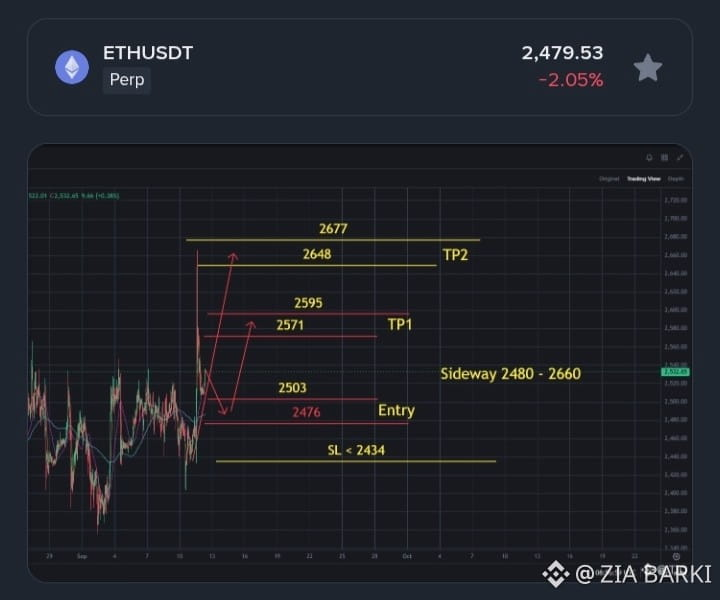
TECHNICAL ANALYSIS $ETH Detailed Technical Breakdown #Ethereum
💥 Price remains contained within a broad sideways consolidation structure between 2480 - 2660. Rather than entering mid range where risk to reward is unfavorable, the high confluence setup anticipates a pullback into lower key demand support to establish a higher low before building momentum for another leg up
👉 Primary Entry: 2476 - 2503 (Key demand block at the lower range boundary to execute Long orders)
👉 Key Invalidation (SL): A clean breakdown and candle close below 2434 invalidates this Long scenario, signaling a deeper structural collapse below range support
📌 Trading Plan (Long Setup):
👉 Long Entry Zone: 2476 - 2503 (Wait for price to test into support to capture low-risk, high-reward Long entries)
👉 Stop Loss (SL): < 2434 (Strict invalidation level below structural swing support to protect trading capital)
🎯 Take Profit Targets:
🎉 TP1: 2571 - 2595 (First major resistance block inside the range; lock in partial profits and move SL to breakeven)
🎉 TP2: 2648 - 2677 (Major expansion target zone testing key overhead supply and recent swing
{future}(ETHUSDT)
$ETH
TECHNICAL ANALYSIS $ETH Detailed Technical Breakdown #Ethereum
💥 Price remains contained within a broad sideways consolidation structure between 2480 - 2660. Rather than entering mid range where risk to reward is unfavorable, the high confluence setup anticipates a pullback into lower key demand support to establish a higher low before building momentum for another leg up
👉 Primary Entry: 2476 - 2503 (Key demand block at the lower range boundary to execute Long orders)
👉 Key Invalidation (SL): A clean breakdown and candle close below 2434 invalidates this Long scenario, signaling a deeper structural collapse below range support
📌 Trading Plan (Long Setup):
👉 Long Entry Zone: 2476 - 2503 (Wait for price to test into support to capture low-risk, high-reward Long entries)
👉 Stop Loss (SL): < 2434 (Strict invalidation level below structural swing support to protect trading capital)
🎯 Take Profit Targets:
🎉 TP1: 2571 - 2595 (First major resistance block inside the range; lock in partial profits and move SL to breakeven)
🎉 TP2: 2648 - 2677 (Major expansion target zone testing key overhead supply and recent swing
TECHNICAL ANALYSIS $ETH Detailed Technical Breakdown #Ethereum
💥 Price remains contained within a broad sideways consolidation structure between 2480 - 2660. Rather than entering mid range where risk to reward is unfavorable, the high confluence setup anticipates a pullback into lower key demand support to establish a higher low before building momentum for another leg up
👉 Primary Entry: 2476 - 2503 (Key demand block at the lower range boundary to execute Long orders)
👉 Key Invalidation (SL): A clean breakdown and candle close below 2434 invalidates this Long scenario, signaling a deeper structural collapse below range support
📌 Trading Plan (Long Setup):
👉 Long Entry Zone: 2476 - 2503 (Wait for price to test into support to capture low-risk, high-reward Long entries)
👉 Stop Loss (SL): < 2434 (Strict invalidation level below structural swing support to protect trading capital)
🎯 Take Profit Targets:
🎉 TP1: 2571 - 2595 (First major resistance block inside the range; lock in partial profits and move SL to breakeven)
🎉 TP2: 2648 - 2677 (Major expansion target zone testing key overhead supply and recent swing
35
·
--
WHAT ARE TOKEN STANDARDSA token standard is a set of rules and specifications that dictate how tokens operate and function on the blockchain. These guidelines ensure that different software programs, such as wallets and applications, can interact with the token predictably, without needing to understand the underlying code. Token standards differ depending on the blockchain they are built on and their intended use cases. Tokens created under different standards have varying guidelines governing them, making them incompatible. However, they can either be traded as wrapped tokens, even if they are on a different blockchain and have different standards, or through a blockchain bridge.
Wrapped tokens allow for efficient token exchange and enable the trade of different tokens on other blockchains. These tokens represent other assets on a different blockchain and are created by depositing the original asset into a smart contract, which then issues an equivalent amount of the wrapped token on the target blockchain. This allows assets from one blockchain to be used on another, creating interoperability between different decentralized finance platforms and ecosystems.
Also, blockchain bridges facilitate interoperability between tokens of different standards or smart contracts. They are often used to connect separate blockchains operating on different protocols or functionalities. Bridges facilitate the transfer of assets or data between otherwise isolated blockchain ecosystems. They typically involve smart contracts or other decentralized protocols to ensure security and trustlessness in the transfer process.
Overall, token standards follow an agreement process to be approved by the community before they can be
used.
WHAT ARE TOKEN STANDARDS
A token standard is a set of rules and specifications that dictate how tokens operate and function on the blockchain. These guidelines ensure that different software programs, such as wallets and applications, can interact with the token predictably, without needing to understand the underlying code. Token standards differ depending on the blockchain they are built on and their intended use cases. Tokens created under different standards have varying guidelines governing them, making them incompatible. However, they can either be traded as wrapped tokens, even if they are on a different blockchain and have different standards, or through a blockchain bridge.
Wrapped tokens allow for efficient token exchange and enable the trade of different tokens on other blockchains. These tokens represent other assets on a different blockchain and are created by depositing the original asset into a smart contract, which then issues an equivalent amount of the wrapped token on the target blockchain. This allows assets from one blockchain to be used on another, creating interoperability between different decentralized finance platforms and ecosystems.
Also, blockchain bridges facilitate interoperability between tokens of different standards or smart contracts. They are often used to connect separate blockchains operating on different protocols or functionalities. Bridges facilitate the transfer of assets or data between otherwise isolated blockchain ecosystems. They typically involve smart contracts or other decentralized protocols to ensure security and trustlessness in the transfer process.
Overall, token standards follow an agreement process to be approved by the community before they can be
used.
Wrapped tokens allow for efficient token exchange and enable the trade of different tokens on other blockchains. These tokens represent other assets on a different blockchain and are created by depositing the original asset into a smart contract, which then issues an equivalent amount of the wrapped token on the target blockchain. This allows assets from one blockchain to be used on another, creating interoperability between different decentralized finance platforms and ecosystems.
Also, blockchain bridges facilitate interoperability between tokens of different standards or smart contracts. They are often used to connect separate blockchains operating on different protocols or functionalities. Bridges facilitate the transfer of assets or data between otherwise isolated blockchain ecosystems. They typically involve smart contracts or other decentralized protocols to ensure security and trustlessness in the transfer process.
Overall, token standards follow an agreement process to be approved by the community before they can be
used.
37
·
--
WHAT IS BLOCK CHAIN AND HOW DOES IT WORK.Blockchain is a decentralized digital database or ledger that securely stores records across a network of computers in a way that is transparent, immutable, and resistant to tampering. Each "block" contains data, and the blocks are linked in a chronological "chain."
Key Takeaways
Blockchain is a type of shared database that differs from a typical database in the way it stores information; blockchains store data in blocks linked together via cryptography.
Different types of information can be stored on a blockchain, but the most common use has been as a transaction ledger.
In Bitcoin’s case, the blockchain is decentralized, so no single person or group has control—instead, all users collectively retain control.
Decentralized blockchains are immutable, which means that the data entered is irreversible. For Bitcoin, transactions are permanently recorded and viewable to anyone.
Get personalized, AI-powered answers built on 27+ years of trusted expertise.
Ask anything to get started...
Ask anything to get started...
ASK
What are blockchain's benefits for improving medical records in healthcare?
What are the hurdles to blockchain's widespread adoption in banking?
Can blockchain technology combat corruption in financial systems?
What are blockchain's benefits for improving medical records in healthcare?
What are the hurdles to blockchain's widespread adoption in banking?
Can blockchain technology combat corruption in financial systems?
What Is a Blockchain?
A blockchain is a distributed database or ledger shared across a computer network's nodes. While it is best known for its crucial role in cryptocurrency systems, maintaining a secure and decentralized record of transactions, blockchains are not limited to cryptocurrency uses. Blockchains can be used to make data in any industry immutable, meaning it cannot be altered.
Since a block can’t be changed, the only trust needed is at the point where a user or program enters data. This reduces the need for trusted third parties, such as auditors or other humans, who add costs and can make mistakes.
Since Bitcoin's introduction in 2009, blockchain use has exploded due to the creation of various cryptocurrencies, decentralized finance (DeFi) applications, non-fungible tokens (NFTs), and smart contracts. Bitcoin and other popular cryptocurrencies, such as Ethereum and Solana, can be purchased through leading crypto exchanges.
Illustration depicting blockchain concept with interconnected nodes and symbols like lock envelope magnifying glass and speech bubble
Blockchains are versatile technologies that can be used for cryptocurrencies, payments, decentralized apps, supply chain tracking, and verifying identities.
Investopedia / Xiaojie Liu
How Does a Blockchain Work?
You might be familiar with spreadsheets or databases. A blockchain is somewhat similar because it is a database where information is entered and stored. The key difference between a traditional database or spreadsheet and a blockchain is how the data is structured and accessed.
A blockchain consists of programs called scripts that conduct the tasks you usually would in a database: entering and accessing information, and saving and storing it somewhere. A blockchain is distributed, meaning multiple copies are saved on many machines and must match for it to be valid.
The Bitcoin blockchain collects transaction information and enters it into a 4MB file called a block (different blockchains have different-sized blocks). Once the block is full, the block data is run through a cryptographic hash function, which creates a hexadecimal number called the block header hash.
The hash is then entered into the following block header and encrypted with the other information in that block's header, creating a chain of blocks, hence the name “blockchain.”
Transaction Process
Transactions follow a specific process, depending on the blockchain. For example, on Bitcoin's blockchain, if you initiate a transaction using your cryptocurrency wallet—the application that provides an interface for the blockchain—it starts a sequence of events.
In Bitcoin, your transaction is sent to a memory pool, where it is stored and queued until a miner picks it up. Once it is entered into a block and the block fills up with transactions, it is closed, and the mining begins.
Illustration depicting the blockchain transaction process including steps such as transaction creation validation and block formation
Investopedia
Every node in the network proposes its own blocks in this way because it chooses different transactions. Each works on their own blocks, trying to find a solution to the difficulty target, using the "nonce," short for number used once.
The nonce value is a field in the block header that is changeable, and its value incrementally increases with every mining attempt. If the resulting hash isn't equal to or less than the target hash, a value of one is added to the nonce, a new hash is generated, and so on. The nonce rolls over about every 4.5 billion attempts (which takes less than one second) and uses another value called the extra nonce as an additional counter. This continues until a miner generates a valid hash, winning the race and receiving the reward.
Fast Fact
Generating these hashes until a specific value is found is the proof-of-work, which proves the miner did the work. The sheer amount of work required to validate the hash is why the Bitcoin network consumes as much computational power and energy.
1
Once a block is closed, a transaction is complete. But the block isn't confirmed until five other blocks are validated. Confirmation takes about one hour to complete because it averages just under 10 minutes per block (the first block with your transaction and five following blocks multiplied by 10 equals 60 minutes).
2
Not all blockchains follow this process. For instance, the Ethereum network randomly chooses one validator from all users with ether staked to validate blocks, which are then confirmed by the network.
3
It's a faster and less energy-intensive process than Bitcoin's.
Blockchain Decentralization
A blockchain allows the data in a database to be spread out among several network nodes—computers or devices running software for the blockchain—at various locations.
4
This creates redundancy and maintains the fidelity of the data. For example, if someone tries to alter a record on one node, the other nodes would prevent it from happening by comparing block hashes. This way, no single node can alter information within the chain.
Because of this distribution—and the encrypted proof that work was done—the blockchain data, such as transaction history, becomes irreversible. Such a record could be a list of transactions, but private blockchains can also hold a variety of other information, like legal contracts, state identifications, or a company's inventory. Most blockchains wouldn't "store" these items directly; they would likely be sent through a hashing algorithm and represented on the blockchain by a token.
Blockchain Transparency
The Bitcoin blockchain is decentralized, so all transactions are transparently viewable by downloading and inspecting them or by using blockchain explorers that permit anyone to see live transactions. Each node has its own copy of the updated chain as fresh blocks are confirmed and added. This means that if you wanted to, you could track a bitcoin wherever it goes.
For example, crypto exchanges have been hacked in the past, resulting in the loss of large amounts of cryptocurrency. Although anonymous (except for their wallet address), the crypto that hackers extracted is easily traceable because the wallet addresses are stored on the blockchain.
2
Of course, the records stored in the Bitcoin blockchain (as well as most others) are encrypted. This means that only the person assigned an address can reveal their identity. As a result, blockchain users can remain anonymous while preserving transparency.
Is Blockchain Secure?
Blockchain technology achieves decentralized security and trust in several ways. To begin, new blocks are always stored linearly and chronologically. That is, they are always added to the "end" of the blockchain. After a block has been added to the end of the blockchain, previous blocks cannot be altered.
A change in any data changes the hash of the block it was in.
4
Because each block contains the previous block's hash, a change in one would change the following blocks. The network would generally reject an altered block because the hashes would not match. However, a change can be accomplished on smaller blockchain networks.
Fast Fact
Not all blockchains are 100% impenetrable. They are distributed ledgers that use code to create the security level they have become known for. If there are vulnerabilities in the coding, they can be exploited.
A new and smaller chain might be susceptible to this kind of attack, but the attacker would need at least half of the network's computational power (a 51% attack). On the Bitcoin and other larger blockchains, this is nearly impossible. By the time the hacker takes any action, the network is likely to have moved past the blocks they were trying to alter. This is because the rate at which these networks hash is exceptionally rapid—the Bitcoin network hashed at a rate of around 850 exahashes per second as of May 12, 2026.
5
The Ethereum blockchain is not likely to be hacked either—again, the attackers would need to control more than half of the blockchain's staked ether. As of May 12, 2026, approximately 39.06 million ETH were staked by more than one million validators.
6
An attacker or group would need to own about 20 million ETH and be randomly selected to validate blocks enough to get their blocks implemented.
Bitcoin vs. Blockchain
Blockchain technology was first outlined in 1991 by Stuart Haber and W. Scott Stornetta, two researchers who wanted to implement a system where document timestamps couldn't be tampered with.
7
But it wasn’t until almost two decades later, with the launch of Bitcoin in January 2009, that blockchain had its first real-world application.
Bitcoin
The Bitcoin protocol is built on a blockchain. In a research paper introducing the digital currency, Bitcoin’s pseudonymous creator, Satoshi Nakamoto, referred to it as “a new electronic cash system that’s fully peer-to-peer, with no trusted third party.”
8
The key thing to understand is that Bitcoin uses blockchain to transparently record a ledger of payments or other transactions between parties.
9
Blockchain
Blockchain can be used to immutably record any number of data points. The data can be transactions, votes in an election, product inventories, state identifications, deeds to homes, and much more.
Currently, tens of thousands of projects are looking to implement blockchains in various ways to help society, other than just recording transactions—for example, as a way to vote securely in democratic elections.
The nature of blockchain's immutability means that fraudulent voting would become far more difficult. For example, a voting system could work such that each country's citizens would be issued a single cryptocurrency or token.
Each candidate could then be given a specific wallet address, and the voters would send their token or crypto to the address of whichever candidate they wish to vote for. The transparent and traceable nature of blockchain would eliminate the need for human vote counting and the ability of bad actors to tamper with physical ballots.
Blockchain vs. Banks
Blockchains have been heralded as a disruptive force in the finance sector, especially with the functions of payments and banking. However, banks and decentralized blockchains are vastly different.
To see how a bank differs from blockchain, let’s compare the banking system to Bitcoin’s blockchain implementation.
How Are Blockchains Used?
As we now know, blocks on Bitcoin’s blockchain store transactional data. Today, tens of thousands of other cryptocurrencies run on a blockchain. However, blockchain can also be a reliable way to store other types of data.
Some companies that are experimenting with blockchain include Walmart, Pfizer, AIG, Siemens, Unilever, and others. For example, IBM's Food Trust blockchain can trace the journey of food products through the supply chain, showing their point of origin and the path between suppliers.
10
This can improve transparency in food safety investigations.
The food industry experienced many outbreaks of E. coli, Salmonella, and Listeria, and, in some cases, the introduction of hazardous materials to food products.
11
It took weeks to trace where the outbreaks started in the past without this technology.
Using blockchain allows brands to track a food product’s route from its origin through each step in the supply chain, up to and including delivery. This helps companies quickly identify affected products when there are food safety issues, reducing the potential for harm. This is one example of blockchain in practice, with many other implementations already in use or under development.
Banking and Finance
Perhaps no industry stands to benefit from integrating blockchain into its business operations more than personal banking. Financial institutions only operate during business hours, usually five days a week. That means if you try to deposit a check on Friday at 6 p.m., you will likely have to wait until Monday morning to see the money in your account.
Even if you make your deposit during business hours, the transaction can still take one to three days to verify due to the sheer volume of transactions that banks need to settle. Blockchain, on the other hand, never sleeps.
By integrating blockchain into banks, consumers might see their transactions processed in minutes or seconds—the time it takes to add a block to the blockchain, regardless of holidays or the time of day or week. With blockchain, banks also have the opportunity to exchange funds between institutions more quickly and securely. Given the sums involved, even the few days the money is in transit can carry high costs and risks for banks.
The settlement and clearing process for stock traders can take up to one day for settlement (or longer if trading internationally), meaning that the money and shares are frozen for that period.
12
Blockchain can, in theory, drastically reduce that time.
Currency
Blockchain forms the bedrock for cryptocurrencies like Bitcoin. This design also allows for easier cross-border transactions because it bypasses currency restrictions, instabilities, or lack of infrastructure by using a distributed network that can reach anyone with an internet connection.
Healthcare
Healthcare providers can leverage blockchain to store their patients’ medical records securely.
13
When a medical record is generated and signed, it can be written into the blockchain, which provides patients with proof and confidence that the record cannot be changed. These personal health records could be encoded and stored on the blockchain with a private key so that they are only accessible to specific individuals, thereby ensuring privacy.
Property Records
If you have ever spent time in your local Recorder’s Office, you will know that recording property rights can sometimes be burdensome and inefficient. Deeds need to be delivered to a government employee at the local recording office, where it is manually entered into the county’s central database and public index. Some municipalities require that this be done in person, but others, such as New York City, offer online options.
14
In the case of a property dispute, claims to the property must be reconciled with the public index.
This process is not only costly and time-consuming but also prone to human error. Each inaccuracy makes tracking property ownership less efficient. Blockchain has the potential to eliminate the need for scanning documents and tracking down physical files in a local recording office. If property ownership is stored and verified on the blockchain, owners can trust that their deed is accurate and permanently recorded.
Proving property ownership can be nearly impossible in war-torn countries or areas with little to no government or financial infrastructure and no Recorder’s Office. If a group of people living in such an area can leverage blockchain, then transparent and clear timelines of property ownership could be maintained.
Smart Contracts
A smart contract is computer code that can be built into the blockchain to facilitate transactions. It operates under a set of conditions to which users agree. When those conditions are met, the smart contract conducts the transaction for the users.
Supply Chains
Suppliers can use blockchain to record the origins of materials they purchase. This would allow companies to verify the authenticity of not only their products but also common labels, such as “Organic,” “Local,” and “Fair Trade.”
The food industry is increasingly adopting blockchain to track the path and safety of food throughout the farm-to-user journey.
15
Voting
As mentioned above, blockchain could facilitate a modern voting system. Voting with blockchain carries the potential to eliminate election fraud and boost voter turnout, as was tested in the November 2018 midterm elections in West Virginia.
16
Using blockchain like this would make votes nearly tamper-proof. The blockchain protocol would also maintain transparency in the electoral process, reducing the personnel needed to conduct an election and providing officials with nearly instant results. This would eliminate the need for recounts or any real concern that fraud might threaten the election.
Pros and Cons of Blockchain
For all of its complexity, blockchain’s potential as a decentralized form of record-keeping is almost without limit. From greater user privacy and heightened security to lower processing fees and fewer errors, blockchain technology may very well see applications beyond those outlined above. But there are also some disadvantages.
Pros
Improved accuracy by removing human involvement in verification
Cost reductions by eliminating third-party verification
Decentralization makes it harder to tamper with
Transactions are secure, private, and efficient
Transparent technology
Provides a banking alternative and a way to secure personal information for citizens of countries with unstable or underdeveloped governments
Cons
Significant technology cost associated with some blockchains
Low number of transactions per second
History of use in illicit activities, such as on the dark web
Regulation varies by jurisdiction and remains uncertain
Data storage limitations
Pros Explained
Accuracy: Transactions on the blockchain network are approved by thousands of computers and devices. This removes almost all people from the verification process, resulting in less human error and an accurate record of information. Even if a computer on the network made a computational mistake, the error would only be made to one copy of the blockchain and not be accepted by the rest of the network.
2
Cost Reductions: Consumers typically pay a bank to verify a transaction or a notary to sign a document. Blockchain eliminates the need for third-party verification—and, with it, their associated costs. For example, business owners incur a small fee when they accept credit card payments because banks and payment-processing companies have to process those transactions.
17
Bitcoin, on the other hand, doesn't have a central authority and has limited transaction fees.
18
19
Decentralization: Blockchain does not store any information in a central location. Instead, it is copied and spread across a network of computers. Whenever a new block is added to the blockchain, every computer on the network updates its blockchain to reflect the change. By spreading that information across a network, rather than storing it in one central database
WHAT IS BLOCK CHAIN AND HOW DOES IT WORK.
Blockchain is a decentralized digital database or ledger that securely stores records across a network of computers in a way that is transparent, immutable, and resistant to tampering. Each "block" contains data, and the blocks are linked in a chronological "chain."
Key Takeaways
Blockchain is a type of shared database that differs from a typical database in the way it stores information; blockchains store data in blocks linked together via cryptography.
Different types of information can be stored on a blockchain, but the most common use has been as a transaction ledger.
In Bitcoin’s case, the blockchain is decentralized, so no single person or group has control—instead, all users collectively retain control.
Decentralized blockchains are immutable, which means that the data entered is irreversible. For Bitcoin, transactions are permanently recorded and viewable to anyone.
Get personalized, AI-powered answers built on 27+ years of trusted expertise.
Ask anything to get started...
Ask anything to get started...
ASK
What are blockchain's benefits for improving medical records in healthcare?
What are the hurdles to blockchain's widespread adoption in banking?
Can blockchain technology combat corruption in financial systems?
What are blockchain's benefits for improving medical records in healthcare?
What are the hurdles to blockchain's widespread adoption in banking?
Can blockchain technology combat corruption in financial systems?
What Is a Blockchain?
A blockchain is a distributed database or ledger shared across a computer network's nodes. While it is best known for its crucial role in cryptocurrency systems, maintaining a secure and decentralized record of transactions, blockchains are not limited to cryptocurrency uses. Blockchains can be used to make data in any industry immutable, meaning it cannot be altered.
Since a block can’t be changed, the only trust needed is at the point where a user or program enters data. This reduces the need for trusted third parties, such as auditors or other humans, who add costs and can make mistakes.
Since Bitcoin's introduction in 2009, blockchain use has exploded due to the creation of various cryptocurrencies, decentralized finance (DeFi) applications, non-fungible tokens (NFTs), and smart contracts. Bitcoin and other popular cryptocurrencies, such as Ethereum and Solana, can be purchased through leading crypto exchanges.
Illustration depicting blockchain concept with interconnected nodes and symbols like lock envelope magnifying glass and speech bubble
Blockchains are versatile technologies that can be used for cryptocurrencies, payments, decentralized apps, supply chain tracking, and verifying identities.
Investopedia / Xiaojie Liu
How Does a Blockchain Work?
You might be familiar with spreadsheets or databases. A blockchain is somewhat similar because it is a database where information is entered and stored. The key difference between a traditional database or spreadsheet and a blockchain is how the data is structured and accessed.
A blockchain consists of programs called scripts that conduct the tasks you usually would in a database: entering and accessing information, and saving and storing it somewhere. A blockchain is distributed, meaning multiple copies are saved on many machines and must match for it to be valid.
The Bitcoin blockchain collects transaction information and enters it into a 4MB file called a block (different blockchains have different-sized blocks). Once the block is full, the block data is run through a cryptographic hash function, which creates a hexadecimal number called the block header hash.
The hash is then entered into the following block header and encrypted with the other information in that block's header, creating a chain of blocks, hence the name “blockchain.”
Transaction Process
Transactions follow a specific process, depending on the blockchain. For example, on Bitcoin's blockchain, if you initiate a transaction using your cryptocurrency wallet—the application that provides an interface for the blockchain—it starts a sequence of events.
In Bitcoin, your transaction is sent to a memory pool, where it is stored and queued until a miner picks it up. Once it is entered into a block and the block fills up with transactions, it is closed, and the mining begins.
Illustration depicting the blockchain transaction process including steps such as transaction creation validation and block formation
Investopedia
Every node in the network proposes its own blocks in this way because it chooses different transactions. Each works on their own blocks, trying to find a solution to the difficulty target, using the "nonce," short for number used once.
The nonce value is a field in the block header that is changeable, and its value incrementally increases with every mining attempt. If the resulting hash isn't equal to or less than the target hash, a value of one is added to the nonce, a new hash is generated, and so on. The nonce rolls over about every 4.5 billion attempts (which takes less than one second) and uses another value called the extra nonce as an additional counter. This continues until a miner generates a valid hash, winning the race and receiving the reward.
Fast Fact
Generating these hashes until a specific value is found is the proof-of-work, which proves the miner did the work. The sheer amount of work required to validate the hash is why the Bitcoin network consumes as much computational power and energy.
1
Once a block is closed, a transaction is complete. But the block isn't confirmed until five other blocks are validated. Confirmation takes about one hour to complete because it averages just under 10 minutes per block (the first block with your transaction and five following blocks multiplied by 10 equals 60 minutes).
2
Not all blockchains follow this process. For instance, the Ethereum network randomly chooses one validator from all users with ether staked to validate blocks, which are then confirmed by the network.
3
It's a faster and less energy-intensive process than Bitcoin's.
Blockchain Decentralization
A blockchain allows the data in a database to be spread out among several network nodes—computers or devices running software for the blockchain—at various locations.
4
This creates redundancy and maintains the fidelity of the data. For example, if someone tries to alter a record on one node, the other nodes would prevent it from happening by comparing block hashes. This way, no single node can alter information within the chain.
Because of this distribution—and the encrypted proof that work was done—the blockchain data, such as transaction history, becomes irreversible. Such a record could be a list of transactions, but private blockchains can also hold a variety of other information, like legal contracts, state identifications, or a company's inventory. Most blockchains wouldn't "store" these items directly; they would likely be sent through a hashing algorithm and represented on the blockchain by a token.
Blockchain Transparency
The Bitcoin blockchain is decentralized, so all transactions are transparently viewable by downloading and inspecting them or by using blockchain explorers that permit anyone to see live transactions. Each node has its own copy of the updated chain as fresh blocks are confirmed and added. This means that if you wanted to, you could track a bitcoin wherever it goes.
For example, crypto exchanges have been hacked in the past, resulting in the loss of large amounts of cryptocurrency. Although anonymous (except for their wallet address), the crypto that hackers extracted is easily traceable because the wallet addresses are stored on the blockchain.
2
Of course, the records stored in the Bitcoin blockchain (as well as most others) are encrypted. This means that only the person assigned an address can reveal their identity. As a result, blockchain users can remain anonymous while preserving transparency.
Is Blockchain Secure?
Blockchain technology achieves decentralized security and trust in several ways. To begin, new blocks are always stored linearly and chronologically. That is, they are always added to the "end" of the blockchain. After a block has been added to the end of the blockchain, previous blocks cannot be altered.
A change in any data changes the hash of the block it was in.
4
Because each block contains the previous block's hash, a change in one would change the following blocks. The network would generally reject an altered block because the hashes would not match. However, a change can be accomplished on smaller blockchain networks.
Fast Fact
Not all blockchains are 100% impenetrable. They are distributed ledgers that use code to create the security level they have become known for. If there are vulnerabilities in the coding, they can be exploited.
A new and smaller chain might be susceptible to this kind of attack, but the attacker would need at least half of the network's computational power (a 51% attack). On the Bitcoin and other larger blockchains, this is nearly impossible. By the time the hacker takes any action, the network is likely to have moved past the blocks they were trying to alter. This is because the rate at which these networks hash is exceptionally rapid—the Bitcoin network hashed at a rate of around 850 exahashes per second as of May 12, 2026.
5
The Ethereum blockchain is not likely to be hacked either—again, the attackers would need to control more than half of the blockchain's staked ether. As of May 12, 2026, approximately 39.06 million ETH were staked by more than one million validators.
6
An attacker or group would need to own about 20 million ETH and be randomly selected to validate blocks enough to get their blocks implemented.
Bitcoin vs. Blockchain
Blockchain technology was first outlined in 1991 by Stuart Haber and W. Scott Stornetta, two researchers who wanted to implement a system where document timestamps couldn't be tampered with.
7
But it wasn’t until almost two decades later, with the launch of Bitcoin in January 2009, that blockchain had its first real-world application.
Bitcoin
The Bitcoin protocol is built on a blockchain. In a research paper introducing the digital currency, Bitcoin’s pseudonymous creator, Satoshi Nakamoto, referred to it as “a new electronic cash system that’s fully peer-to-peer, with no trusted third party.”
8
The key thing to understand is that Bitcoin uses blockchain to transparently record a ledger of payments or other transactions between parties.
9
Blockchain
Blockchain can be used to immutably record any number of data points. The data can be transactions, votes in an election, product inventories, state identifications, deeds to homes, and much more.
Currently, tens of thousands of projects are looking to implement blockchains in various ways to help society, other than just recording transactions—for example, as a way to vote securely in democratic elections.
The nature of blockchain's immutability means that fraudulent voting would become far more difficult. For example, a voting system could work such that each country's citizens would be issued a single cryptocurrency or token.
Each candidate could then be given a specific wallet address, and the voters would send their token or crypto to the address of whichever candidate they wish to vote for. The transparent and traceable nature of blockchain would eliminate the need for human vote counting and the ability of bad actors to tamper with physical ballots.
Blockchain vs. Banks
Blockchains have been heralded as a disruptive force in the finance sector, especially with the functions of payments and banking. However, banks and decentralized blockchains are vastly different.
To see how a bank differs from blockchain, let’s compare the banking system to Bitcoin’s blockchain implementation.
How Are Blockchains Used?
As we now know, blocks on Bitcoin’s blockchain store transactional data. Today, tens of thousands of other cryptocurrencies run on a blockchain. However, blockchain can also be a reliable way to store other types of data.
Some companies that are experimenting with blockchain include Walmart, Pfizer, AIG, Siemens, Unilever, and others. For example, IBM's Food Trust blockchain can trace the journey of food products through the supply chain, showing their point of origin and the path between suppliers.
10
This can improve transparency in food safety investigations.
The food industry experienced many outbreaks of E. coli, Salmonella, and Listeria, and, in some cases, the introduction of hazardous materials to food products.
11
It took weeks to trace where the outbreaks started in the past without this technology.
Using blockchain allows brands to track a food product’s route from its origin through each step in the supply chain, up to and including delivery. This helps companies quickly identify affected products when there are food safety issues, reducing the potential for harm. This is one example of blockchain in practice, with many other implementations already in use or under development.
Banking and Finance
Perhaps no industry stands to benefit from integrating blockchain into its business operations more than personal banking. Financial institutions only operate during business hours, usually five days a week. That means if you try to deposit a check on Friday at 6 p.m., you will likely have to wait until Monday morning to see the money in your account.
Even if you make your deposit during business hours, the transaction can still take one to three days to verify due to the sheer volume of transactions that banks need to settle. Blockchain, on the other hand, never sleeps.
By integrating blockchain into banks, consumers might see their transactions processed in minutes or seconds—the time it takes to add a block to the blockchain, regardless of holidays or the time of day or week. With blockchain, banks also have the opportunity to exchange funds between institutions more quickly and securely. Given the sums involved, even the few days the money is in transit can carry high costs and risks for banks.
The settlement and clearing process for stock traders can take up to one day for settlement (or longer if trading internationally), meaning that the money and shares are frozen for that period.
12
Blockchain can, in theory, drastically reduce that time.
Currency
Blockchain forms the bedrock for cryptocurrencies like Bitcoin. This design also allows for easier cross-border transactions because it bypasses currency restrictions, instabilities, or lack of infrastructure by using a distributed network that can reach anyone with an internet connection.
Healthcare
Healthcare providers can leverage blockchain to store their patients’ medical records securely.
13
When a medical record is generated and signed, it can be written into the blockchain, which provides patients with proof and confidence that the record cannot be changed. These personal health records could be encoded and stored on the blockchain with a private key so that they are only accessible to specific individuals, thereby ensuring privacy.
Property Records
If you have ever spent time in your local Recorder’s Office, you will know that recording property rights can sometimes be burdensome and inefficient. Deeds need to be delivered to a government employee at the local recording office, where it is manually entered into the county’s central database and public index. Some municipalities require that this be done in person, but others, such as New York City, offer online options.
14
In the case of a property dispute, claims to the property must be reconciled with the public index.
This process is not only costly and time-consuming but also prone to human error. Each inaccuracy makes tracking property ownership less efficient. Blockchain has the potential to eliminate the need for scanning documents and tracking down physical files in a local recording office. If property ownership is stored and verified on the blockchain, owners can trust that their deed is accurate and permanently recorded.
Proving property ownership can be nearly impossible in war-torn countries or areas with little to no government or financial infrastructure and no Recorder’s Office. If a group of people living in such an area can leverage blockchain, then transparent and clear timelines of property ownership could be maintained.
Smart Contracts
A smart contract is computer code that can be built into the blockchain to facilitate transactions. It operates under a set of conditions to which users agree. When those conditions are met, the smart contract conducts the transaction for the users.
Supply Chains
Suppliers can use blockchain to record the origins of materials they purchase. This would allow companies to verify the authenticity of not only their products but also common labels, such as “Organic,” “Local,” and “Fair Trade.”
The food industry is increasingly adopting blockchain to track the path and safety of food throughout the farm-to-user journey.
15
Voting
As mentioned above, blockchain could facilitate a modern voting system. Voting with blockchain carries the potential to eliminate election fraud and boost voter turnout, as was tested in the November 2018 midterm elections in West Virginia.
16
Using blockchain like this would make votes nearly tamper-proof. The blockchain protocol would also maintain transparency in the electoral process, reducing the personnel needed to conduct an election and providing officials with nearly instant results. This would eliminate the need for recounts or any real concern that fraud might threaten the election.
Pros and Cons of Blockchain
For all of its complexity, blockchain’s potential as a decentralized form of record-keeping is almost without limit. From greater user privacy and heightened security to lower processing fees and fewer errors, blockchain technology may very well see applications beyond those outlined above. But there are also some disadvantages.
Pros
Improved accuracy by removing human involvement in verification
Cost reductions by eliminating third-party verification
Decentralization makes it harder to tamper with
Transactions are secure, private, and efficient
Transparent technology
Provides a banking alternative and a way to secure personal information for citizens of countries with unstable or underdeveloped governments
Cons
Significant technology cost associated with some blockchains
Low number of transactions per second
History of use in illicit activities, such as on the dark web
Regulation varies by jurisdiction and remains uncertain
Data storage limitations
Pros Explained
Accuracy: Transactions on the blockchain network are approved by thousands of computers and devices. This removes almost all people from the verification process, resulting in less human error and an accurate record of information. Even if a computer on the network made a computational mistake, the error would only be made to one copy of the blockchain and not be accepted by the rest of the network.
2
Cost Reductions: Consumers typically pay a bank to verify a transaction or a notary to sign a document. Blockchain eliminates the need for third-party verification—and, with it, their associated costs. For example, business owners incur a small fee when they accept credit card payments because banks and payment-processing companies have to process those transactions.
17
Bitcoin, on the other hand, doesn't have a central authority and has limited transaction fees.
18
19
Decentralization: Blockchain does not store any information in a central location. Instead, it is copied and spread across a network of computers. Whenever a new block is added to the blockchain, every computer on the network updates its blockchain to reflect the change. By spreading that information across a network, rather than storing it in one central database
Key Takeaways
Blockchain is a type of shared database that differs from a typical database in the way it stores information; blockchains store data in blocks linked together via cryptography.
Different types of information can be stored on a blockchain, but the most common use has been as a transaction ledger.
In Bitcoin’s case, the blockchain is decentralized, so no single person or group has control—instead, all users collectively retain control.
Decentralized blockchains are immutable, which means that the data entered is irreversible. For Bitcoin, transactions are permanently recorded and viewable to anyone.
Get personalized, AI-powered answers built on 27+ years of trusted expertise.
Ask anything to get started...
Ask anything to get started...
ASK
What are blockchain's benefits for improving medical records in healthcare?
What are the hurdles to blockchain's widespread adoption in banking?
Can blockchain technology combat corruption in financial systems?
What are blockchain's benefits for improving medical records in healthcare?
What are the hurdles to blockchain's widespread adoption in banking?
Can blockchain technology combat corruption in financial systems?
What Is a Blockchain?
A blockchain is a distributed database or ledger shared across a computer network's nodes. While it is best known for its crucial role in cryptocurrency systems, maintaining a secure and decentralized record of transactions, blockchains are not limited to cryptocurrency uses. Blockchains can be used to make data in any industry immutable, meaning it cannot be altered.
Since a block can’t be changed, the only trust needed is at the point where a user or program enters data. This reduces the need for trusted third parties, such as auditors or other humans, who add costs and can make mistakes.
Since Bitcoin's introduction in 2009, blockchain use has exploded due to the creation of various cryptocurrencies, decentralized finance (DeFi) applications, non-fungible tokens (NFTs), and smart contracts. Bitcoin and other popular cryptocurrencies, such as Ethereum and Solana, can be purchased through leading crypto exchanges.
Illustration depicting blockchain concept with interconnected nodes and symbols like lock envelope magnifying glass and speech bubble
Blockchains are versatile technologies that can be used for cryptocurrencies, payments, decentralized apps, supply chain tracking, and verifying identities.
Investopedia / Xiaojie Liu
How Does a Blockchain Work?
You might be familiar with spreadsheets or databases. A blockchain is somewhat similar because it is a database where information is entered and stored. The key difference between a traditional database or spreadsheet and a blockchain is how the data is structured and accessed.
A blockchain consists of programs called scripts that conduct the tasks you usually would in a database: entering and accessing information, and saving and storing it somewhere. A blockchain is distributed, meaning multiple copies are saved on many machines and must match for it to be valid.
The Bitcoin blockchain collects transaction information and enters it into a 4MB file called a block (different blockchains have different-sized blocks). Once the block is full, the block data is run through a cryptographic hash function, which creates a hexadecimal number called the block header hash.
The hash is then entered into the following block header and encrypted with the other information in that block's header, creating a chain of blocks, hence the name “blockchain.”
Transaction Process
Transactions follow a specific process, depending on the blockchain. For example, on Bitcoin's blockchain, if you initiate a transaction using your cryptocurrency wallet—the application that provides an interface for the blockchain—it starts a sequence of events.
In Bitcoin, your transaction is sent to a memory pool, where it is stored and queued until a miner picks it up. Once it is entered into a block and the block fills up with transactions, it is closed, and the mining begins.
Illustration depicting the blockchain transaction process including steps such as transaction creation validation and block formation
Investopedia
Every node in the network proposes its own blocks in this way because it chooses different transactions. Each works on their own blocks, trying to find a solution to the difficulty target, using the "nonce," short for number used once.
The nonce value is a field in the block header that is changeable, and its value incrementally increases with every mining attempt. If the resulting hash isn't equal to or less than the target hash, a value of one is added to the nonce, a new hash is generated, and so on. The nonce rolls over about every 4.5 billion attempts (which takes less than one second) and uses another value called the extra nonce as an additional counter. This continues until a miner generates a valid hash, winning the race and receiving the reward.
Fast Fact
Generating these hashes until a specific value is found is the proof-of-work, which proves the miner did the work. The sheer amount of work required to validate the hash is why the Bitcoin network consumes as much computational power and energy.
1
Once a block is closed, a transaction is complete. But the block isn't confirmed until five other blocks are validated. Confirmation takes about one hour to complete because it averages just under 10 minutes per block (the first block with your transaction and five following blocks multiplied by 10 equals 60 minutes).
2
Not all blockchains follow this process. For instance, the Ethereum network randomly chooses one validator from all users with ether staked to validate blocks, which are then confirmed by the network.
3
It's a faster and less energy-intensive process than Bitcoin's.
Blockchain Decentralization
A blockchain allows the data in a database to be spread out among several network nodes—computers or devices running software for the blockchain—at various locations.
4
This creates redundancy and maintains the fidelity of the data. For example, if someone tries to alter a record on one node, the other nodes would prevent it from happening by comparing block hashes. This way, no single node can alter information within the chain.
Because of this distribution—and the encrypted proof that work was done—the blockchain data, such as transaction history, becomes irreversible. Such a record could be a list of transactions, but private blockchains can also hold a variety of other information, like legal contracts, state identifications, or a company's inventory. Most blockchains wouldn't "store" these items directly; they would likely be sent through a hashing algorithm and represented on the blockchain by a token.
Blockchain Transparency
The Bitcoin blockchain is decentralized, so all transactions are transparently viewable by downloading and inspecting them or by using blockchain explorers that permit anyone to see live transactions. Each node has its own copy of the updated chain as fresh blocks are confirmed and added. This means that if you wanted to, you could track a bitcoin wherever it goes.
For example, crypto exchanges have been hacked in the past, resulting in the loss of large amounts of cryptocurrency. Although anonymous (except for their wallet address), the crypto that hackers extracted is easily traceable because the wallet addresses are stored on the blockchain.
2
Of course, the records stored in the Bitcoin blockchain (as well as most others) are encrypted. This means that only the person assigned an address can reveal their identity. As a result, blockchain users can remain anonymous while preserving transparency.
Is Blockchain Secure?
Blockchain technology achieves decentralized security and trust in several ways. To begin, new blocks are always stored linearly and chronologically. That is, they are always added to the "end" of the blockchain. After a block has been added to the end of the blockchain, previous blocks cannot be altered.
A change in any data changes the hash of the block it was in.
4
Because each block contains the previous block's hash, a change in one would change the following blocks. The network would generally reject an altered block because the hashes would not match. However, a change can be accomplished on smaller blockchain networks.
Fast Fact
Not all blockchains are 100% impenetrable. They are distributed ledgers that use code to create the security level they have become known for. If there are vulnerabilities in the coding, they can be exploited.
A new and smaller chain might be susceptible to this kind of attack, but the attacker would need at least half of the network's computational power (a 51% attack). On the Bitcoin and other larger blockchains, this is nearly impossible. By the time the hacker takes any action, the network is likely to have moved past the blocks they were trying to alter. This is because the rate at which these networks hash is exceptionally rapid—the Bitcoin network hashed at a rate of around 850 exahashes per second as of May 12, 2026.
5
The Ethereum blockchain is not likely to be hacked either—again, the attackers would need to control more than half of the blockchain's staked ether. As of May 12, 2026, approximately 39.06 million ETH were staked by more than one million validators.
6
An attacker or group would need to own about 20 million ETH and be randomly selected to validate blocks enough to get their blocks implemented.
Bitcoin vs. Blockchain
Blockchain technology was first outlined in 1991 by Stuart Haber and W. Scott Stornetta, two researchers who wanted to implement a system where document timestamps couldn't be tampered with.
7
But it wasn’t until almost two decades later, with the launch of Bitcoin in January 2009, that blockchain had its first real-world application.
Bitcoin
The Bitcoin protocol is built on a blockchain. In a research paper introducing the digital currency, Bitcoin’s pseudonymous creator, Satoshi Nakamoto, referred to it as “a new electronic cash system that’s fully peer-to-peer, with no trusted third party.”
8
The key thing to understand is that Bitcoin uses blockchain to transparently record a ledger of payments or other transactions between parties.
9
Blockchain
Blockchain can be used to immutably record any number of data points. The data can be transactions, votes in an election, product inventories, state identifications, deeds to homes, and much more.
Currently, tens of thousands of projects are looking to implement blockchains in various ways to help society, other than just recording transactions—for example, as a way to vote securely in democratic elections.
The nature of blockchain's immutability means that fraudulent voting would become far more difficult. For example, a voting system could work such that each country's citizens would be issued a single cryptocurrency or token.
Each candidate could then be given a specific wallet address, and the voters would send their token or crypto to the address of whichever candidate they wish to vote for. The transparent and traceable nature of blockchain would eliminate the need for human vote counting and the ability of bad actors to tamper with physical ballots.
Blockchain vs. Banks
Blockchains have been heralded as a disruptive force in the finance sector, especially with the functions of payments and banking. However, banks and decentralized blockchains are vastly different.
To see how a bank differs from blockchain, let’s compare the banking system to Bitcoin’s blockchain implementation.
How Are Blockchains Used?
As we now know, blocks on Bitcoin’s blockchain store transactional data. Today, tens of thousands of other cryptocurrencies run on a blockchain. However, blockchain can also be a reliable way to store other types of data.
Some companies that are experimenting with blockchain include Walmart, Pfizer, AIG, Siemens, Unilever, and others. For example, IBM's Food Trust blockchain can trace the journey of food products through the supply chain, showing their point of origin and the path between suppliers.
10
This can improve transparency in food safety investigations.
The food industry experienced many outbreaks of E. coli, Salmonella, and Listeria, and, in some cases, the introduction of hazardous materials to food products.
11
It took weeks to trace where the outbreaks started in the past without this technology.
Using blockchain allows brands to track a food product’s route from its origin through each step in the supply chain, up to and including delivery. This helps companies quickly identify affected products when there are food safety issues, reducing the potential for harm. This is one example of blockchain in practice, with many other implementations already in use or under development.
Banking and Finance
Perhaps no industry stands to benefit from integrating blockchain into its business operations more than personal banking. Financial institutions only operate during business hours, usually five days a week. That means if you try to deposit a check on Friday at 6 p.m., you will likely have to wait until Monday morning to see the money in your account.
Even if you make your deposit during business hours, the transaction can still take one to three days to verify due to the sheer volume of transactions that banks need to settle. Blockchain, on the other hand, never sleeps.
By integrating blockchain into banks, consumers might see their transactions processed in minutes or seconds—the time it takes to add a block to the blockchain, regardless of holidays or the time of day or week. With blockchain, banks also have the opportunity to exchange funds between institutions more quickly and securely. Given the sums involved, even the few days the money is in transit can carry high costs and risks for banks.
The settlement and clearing process for stock traders can take up to one day for settlement (or longer if trading internationally), meaning that the money and shares are frozen for that period.
12
Blockchain can, in theory, drastically reduce that time.
Currency
Blockchain forms the bedrock for cryptocurrencies like Bitcoin. This design also allows for easier cross-border transactions because it bypasses currency restrictions, instabilities, or lack of infrastructure by using a distributed network that can reach anyone with an internet connection.
Healthcare
Healthcare providers can leverage blockchain to store their patients’ medical records securely.
13
When a medical record is generated and signed, it can be written into the blockchain, which provides patients with proof and confidence that the record cannot be changed. These personal health records could be encoded and stored on the blockchain with a private key so that they are only accessible to specific individuals, thereby ensuring privacy.
Property Records
If you have ever spent time in your local Recorder’s Office, you will know that recording property rights can sometimes be burdensome and inefficient. Deeds need to be delivered to a government employee at the local recording office, where it is manually entered into the county’s central database and public index. Some municipalities require that this be done in person, but others, such as New York City, offer online options.
14
In the case of a property dispute, claims to the property must be reconciled with the public index.
This process is not only costly and time-consuming but also prone to human error. Each inaccuracy makes tracking property ownership less efficient. Blockchain has the potential to eliminate the need for scanning documents and tracking down physical files in a local recording office. If property ownership is stored and verified on the blockchain, owners can trust that their deed is accurate and permanently recorded.
Proving property ownership can be nearly impossible in war-torn countries or areas with little to no government or financial infrastructure and no Recorder’s Office. If a group of people living in such an area can leverage blockchain, then transparent and clear timelines of property ownership could be maintained.
Smart Contracts
A smart contract is computer code that can be built into the blockchain to facilitate transactions. It operates under a set of conditions to which users agree. When those conditions are met, the smart contract conducts the transaction for the users.
Supply Chains
Suppliers can use blockchain to record the origins of materials they purchase. This would allow companies to verify the authenticity of not only their products but also common labels, such as “Organic,” “Local,” and “Fair Trade.”
The food industry is increasingly adopting blockchain to track the path and safety of food throughout the farm-to-user journey.
15
Voting
As mentioned above, blockchain could facilitate a modern voting system. Voting with blockchain carries the potential to eliminate election fraud and boost voter turnout, as was tested in the November 2018 midterm elections in West Virginia.
16
Using blockchain like this would make votes nearly tamper-proof. The blockchain protocol would also maintain transparency in the electoral process, reducing the personnel needed to conduct an election and providing officials with nearly instant results. This would eliminate the need for recounts or any real concern that fraud might threaten the election.
Pros and Cons of Blockchain
For all of its complexity, blockchain’s potential as a decentralized form of record-keeping is almost without limit. From greater user privacy and heightened security to lower processing fees and fewer errors, blockchain technology may very well see applications beyond those outlined above. But there are also some disadvantages.
Pros
Improved accuracy by removing human involvement in verification
Cost reductions by eliminating third-party verification
Decentralization makes it harder to tamper with
Transactions are secure, private, and efficient
Transparent technology
Provides a banking alternative and a way to secure personal information for citizens of countries with unstable or underdeveloped governments
Cons
Significant technology cost associated with some blockchains
Low number of transactions per second
History of use in illicit activities, such as on the dark web
Regulation varies by jurisdiction and remains uncertain
Data storage limitations
Pros Explained
Accuracy: Transactions on the blockchain network are approved by thousands of computers and devices. This removes almost all people from the verification process, resulting in less human error and an accurate record of information. Even if a computer on the network made a computational mistake, the error would only be made to one copy of the blockchain and not be accepted by the rest of the network.
2
Cost Reductions: Consumers typically pay a bank to verify a transaction or a notary to sign a document. Blockchain eliminates the need for third-party verification—and, with it, their associated costs. For example, business owners incur a small fee when they accept credit card payments because banks and payment-processing companies have to process those transactions.
17
Bitcoin, on the other hand, doesn't have a central authority and has limited transaction fees.
18
19
Decentralization: Blockchain does not store any information in a central location. Instead, it is copied and spread across a network of computers. Whenever a new block is added to the blockchain, every computer on the network updates its blockchain to reflect the change. By spreading that information across a network, rather than storing it in one central database
84
·
--
BEST BLOCK CHAIN FOR BUILDING AI IN 2026Articles
Courses
Learn & Earn
Partnership
Developer Academy
Theme
English
Earn FREE Crypto While You Learn
AIBlockchain
Best Blockchains for Building AI Applications in 2026
Home
Articles
Best Blockchains for Building AI Applications in 2026
Best Blockchains for Building AI Applications in 2026
Intermediate
Updated Sep 10, 2026
9m
Key Takeaways
There is no single best blockchain for artificial intelligence (AI). The right choice depends on what your application needs to do, such as running computation, coordinating AI agents, or settling payments.
Decentralized AI projects tend to specialize in one layer of the stack: compute, model or intelligence markets, agent frameworks, or general-purpose app hosting.
Key factors when choosing include throughput and speed, transaction costs, developer tools, the maturity of the ecosystem, and whether the chain is built for AI-specific tasks.
Networks often discussed for AI in 2026 include Bittensor, NEAR Protocol, Solana, Ethereum, Render, Fetch.ai, and BNB Chain, each aimed at a different part of the problem.
The strongest approach is to match the blockchain to your workload rather than looking for one chain that does everything.
Binance Academy courses banner
Introduction
If you want to build an application that combines blockchain and AI, one of the first questions is which blockchain to build on. The honest answer is that there is no single winner. Different networks are designed for different jobs, so the best choice depends on what your application actually needs to do.
This article explains the main factors to weigh, then compares several of the blockchains most often associated with AI in 2026. The goal is to help you understand the trade-offs, not to recommend any specific network or token.
How Blockchains Support AI Applications
Blockchains can support AI in several ways. They can host smart contracts that let autonomous agents hold funds and act on rules. They can coordinate networks of independent computers that provide computing power or machine-learning models. And they can record transactions and outputs in a transparent, verifiable way.
Because these are different tasks, most projects focus on one part of the stack. Some provide raw computing power. Some run marketplaces for machine intelligence. Others are general-purpose networks where developers build agent-based apps. Understanding which layer you need is the first step in choosing a chain.
What to Consider When Choosing a Blockchain for AI
Before comparing specific networks, it helps to know the criteria that matter most for AI workloads.
Throughput and speed
AI applications, especially those with many agents acting at once, can generate a lot of activity. A network needs to handle high volume and confirm actions quickly. This is where scaling design, including the difference between Layer 1 and Layer 2 networks, becomes important.
Transaction costs
If an agent performs many small actions, high transaction fees can quickly make an application impractical. Lower and more predictable costs are usually better for high-frequency AI activity.
Purpose-built features
Some networks add features specifically for AI, such as tools for building agents, secure off-chain computation, or built-in incentive systems for machine-learning work. These can save developers significant time compared to building everything from scratch.
Ecosystem and tools
A mature ecosystem with good documentation, active developers, and ready-made components makes building faster and easier. A network that is technically capable but hard to develop on can slow a project down.
Comparing Leading Blockchains for AI in 2026
The networks below are frequently discussed in the context of AI. Each is strongest at a different task, which is why they are often seen as complementary rather than direct competitors.
Bittensor
Bittensor (TAO) is a network built around decentralized machine learning. It uses specialized subnetworks, called subnets, where participants contribute models, data, or computation and earn rewards for useful work. You can think of Bittensor (TAO) as a marketplace for machine intelligence rather than a general-purpose app platform. It tends to fit projects focused on model training and intelligence markets.
NEAR Protocol
NEAR Protocol is often described as an AI-friendly, agent-focused platform. It emphasizes features like chain abstraction, which aims to let agents and users interact across multiple blockchains without dealing with the usual technical friction. NEAR advertises very high throughput on its own website, though some third-party sources note this is a claimed peak capacity rather than typical real-world usage. It tends to suit developers building user-facing agent applications.
Solana
Solana is known for high throughput and fast, low-cost transactions. That makes it attractive for applications where many agents need to transact frequently, such as payments and other high-volume, on-chain activity. Its strength is speed and scale rather than AI-specific compute or model marketplaces.
Ethereum
Ethereum is the largest smart contract platform and is often framed as a settlement layer, including for AI agents that manage funds or financial actions. Its main trade-off is that activity on the base layer can be more expensive than on faster networks, so many high-frequency uses happen on Layer 2 networks built on top of it.
Render and Fetch.ai
Two other projects appear often in AI discussions. Render is commonly grouped as a decentralized computing network that connects unused graphics processing power to workloads that need it. Fetch.ai, part of the broader Artificial Superintelligence Alliance (ASI), focuses on frameworks for building autonomous agents. Both address specific layers, compute and agent tooling, rather than serving as a complete stack on their own.
BNB Chain
BNB Chain is a smart contract platform known for low fees and high throughput, qualities that suit applications where AI agents transact often. It has also added developer tooling aimed at agents, such as BNB Agent Studio, which lets developers build and deploy on-chain agents. Agent Studio provides a simple language interface via any existing IDE (like Claude, Cursor, or Gemini) to enable developers to build fully autonomous agents from a single prompt.
In 2026, BNB Chain reported a large number of on-chain AI agent deployments, and it has published plans for a new network focused specifically on high-frequency and agent activity.
It is also worth knowing that AI features are appearing inside crypto products themselves, not just at the network layer. One example is Binance AI Agent Skills, which connect AI tools to on-chain data and other tasks.
Another is Binance Agent OS, a platform that lets AI agents connect to Binance services and act within user-defined limits. It is not a blockchain itself, but it shows how AI and blockchain are converging at both the infrastructure level and the application level.
Matching the Blockchain to Your Application
A practical way to choose is to start from your workload. For decentralized model training or an intelligence marketplace, a network like Bittensor is often cited. For user-facing agent decentralized applications (DApps), an agent-focused platform may fit better. For high-volume transactions, a fast, low-cost network is usually preferred, and for financial settlement, an established smart contract chain is common.
Many real applications end up using more than one network, each for the part of the job it does best. Rather than searching for a single best chain, it is often more useful to map your requirements first, then pick the network, or combination of networks, that meets them.
FAQ
Which blockchain is best for building an AI application?
There is no single best blockchain for AI. The right choice depends on your needs. Networks focused on decentralized computing suit heavy computation, agent-focused platforms suit user-facing applications, and fast, low-cost networks suit high-volume transactions. Matching the chain to your workload is more useful than looking for one universal answer.
Do I need a special blockchain to build AI apps?
Not necessarily. General-purpose smart contract platforms can host many AI-related applications, especially those involving autonomous agents that hold and move funds. Purpose-built AI networks can help with specific tasks such as decentralized model training or computing, but they are not required for every project.
Why do AI applications use blockchains at all?
Blockchains can give AI applications transparency, verifiable records, and a way for autonomous agents to hold value and act under clear rules without a central operator. This can be useful when trust, openness, or automated coordination between independent parties matters.
What matters most when choosing a blockchain for AI?
The main factors are throughput and speed, transaction costs, whether the network offers AI-specific tools, and the maturity of its developer ecosystem. The relative importance of each depends on the type of application you are building.
Closing Thoughts
Choosing a blockchain for an AI application comes down to understanding your own requirements. Different networks specialize in different layers, from computing power and machine-intelligence markets to agent frameworks and general-purpose app hosting.
Before making a decision, consider factors like throughput, cost, purpose-built features, and ecosystem maturity. From there, you can start matching each factor to your specific needs and workload.
Further Reading
Top 6 Artificial Intelligence (AI) Cryptocurrencies
How to Use AI for Crypto Trading
What Is a Blockchain Consensus Algorithm?
What Is a Decentralized Exchange (DEX)?
Disclaimer: Your use of Binance AI, including any Binance AI Service, is at your own risk. It is provided to you on an “as is” and “as available” basis, without representation or warranty of any kind. You are solely responsible for all of your Prompts. Prompts may be used for training purposes. AI Inputs may include various unvetted third party sourced content. Any sourced content is provided “as is” without any guarantee. Binance may restrict or alter sourced content based on various compliance safety filters, however this is not absolute. Binance does not endorse or guarantee any AI Outputs. AI Outputs may include or reflect content, positions, views and opinions of third parties unknown to Binance, which may also include errors, biases, synthetic data and or outdated information. Any AI Output should not be solely relied on for decision making. AI Outputs do not constitute any kind of advice by Binance nor any other intermediary services. Binance AI may use or make available third party AI Tools without any guarantee and subject to third party terms. Where AI Tools are configured by yourself or a third-party, you indemnify Binance against all liability. Binance does not guarantee any AI Tools. Binance AI may respond to your requests, but without any guarantee that your request will be fulfilled satisfactorily or at all. Digital asset prices can be volatile. You are solely responsible for your investment decisions and Binance is not liable for any losses. Digital asset prices can be volatile. DYOR. Use of Binance AI may be subject to additional Binance Product Terms, where applicable. For more information, see our Terms of Use, Risk Warning and AI Policy and Terms.
Share Posts
Related Articles
How Are Cryptocurrency Transactions Verified?
Binance AI Agent Skills: How to Install and Use Them
How to Use AI for Crypto Trading?
Register an account
Put your knowledge into practice by opening a Binance account today.
Register Now
Explore all of our content
Community
English
USD
About Us
Products
Business
Learn
Service
Support
Disclaimer: This content is presented to you on an “as is” basis for general information and educational purposes only, without representation or warranty of any kind. It should not be construed as financial, legal, or other professional advice, nor is it intended to recommend the purchase of any specific product or service. You should seek your own advice from appropriate professional advisors. Where the content is contributed by a third-party contributor, please note that those views expressed belong to the third-party contributor, and do not necessarily reflect those of Binance Academy. Digital asset prices can be volatile. The value of your investment may go down or up and you may not get back the amount invested. You are solely responsible for your investment decisions and Binance Academy is not liable for any losses you may incur. For more information, see our Terms of Use, Risk Warning and Binance Academy Terms.
Binance© 2026
Cookie Preferences
BEST BLOCK CHAIN FOR BUILDING AI IN 2026
Articles
Courses
Learn & Earn
Partnership
Developer Academy
Theme
English
Earn FREE Crypto While You Learn
AIBlockchain
Best Blockchains for Building AI Applications in 2026
Home
Articles
Best Blockchains for Building AI Applications in 2026
Best Blockchains for Building AI Applications in 2026
Intermediate
Updated Sep 10, 2026
9m
Key Takeaways
There is no single best blockchain for artificial intelligence (AI). The right choice depends on what your application needs to do, such as running computation, coordinating AI agents, or settling payments.
Decentralized AI projects tend to specialize in one layer of the stack: compute, model or intelligence markets, agent frameworks, or general-purpose app hosting.
Key factors when choosing include throughput and speed, transaction costs, developer tools, the maturity of the ecosystem, and whether the chain is built for AI-specific tasks.
Networks often discussed for AI in 2026 include Bittensor, NEAR Protocol, Solana, Ethereum, Render, Fetch.ai, and BNB Chain, each aimed at a different part of the problem.
The strongest approach is to match the blockchain to your workload rather than looking for one chain that does everything.
Binance Academy courses banner
Introduction
If you want to build an application that combines blockchain and AI, one of the first questions is which blockchain to build on. The honest answer is that there is no single winner. Different networks are designed for different jobs, so the best choice depends on what your application actually needs to do.
This article explains the main factors to weigh, then compares several of the blockchains most often associated with AI in 2026. The goal is to help you understand the trade-offs, not to recommend any specific network or token.
How Blockchains Support AI Applications
Blockchains can support AI in several ways. They can host smart contracts that let autonomous agents hold funds and act on rules. They can coordinate networks of independent computers that provide computing power or machine-learning models. And they can record transactions and outputs in a transparent, verifiable way.
Because these are different tasks, most projects focus on one part of the stack. Some provide raw computing power. Some run marketplaces for machine intelligence. Others are general-purpose networks where developers build agent-based apps. Understanding which layer you need is the first step in choosing a chain.
What to Consider When Choosing a Blockchain for AI
Before comparing specific networks, it helps to know the criteria that matter most for AI workloads.
Throughput and speed
AI applications, especially those with many agents acting at once, can generate a lot of activity. A network needs to handle high volume and confirm actions quickly. This is where scaling design, including the difference between Layer 1 and Layer 2 networks, becomes important.
Transaction costs
If an agent performs many small actions, high transaction fees can quickly make an application impractical. Lower and more predictable costs are usually better for high-frequency AI activity.
Purpose-built features
Some networks add features specifically for AI, such as tools for building agents, secure off-chain computation, or built-in incentive systems for machine-learning work. These can save developers significant time compared to building everything from scratch.
Ecosystem and tools
A mature ecosystem with good documentation, active developers, and ready-made components makes building faster and easier. A network that is technically capable but hard to develop on can slow a project down.
Comparing Leading Blockchains for AI in 2026
The networks below are frequently discussed in the context of AI. Each is strongest at a different task, which is why they are often seen as complementary rather than direct competitors.
Bittensor
Bittensor (TAO) is a network built around decentralized machine learning. It uses specialized subnetworks, called subnets, where participants contribute models, data, or computation and earn rewards for useful work. You can think of Bittensor (TAO) as a marketplace for machine intelligence rather than a general-purpose app platform. It tends to fit projects focused on model training and intelligence markets.
NEAR Protocol
NEAR Protocol is often described as an AI-friendly, agent-focused platform. It emphasizes features like chain abstraction, which aims to let agents and users interact across multiple blockchains without dealing with the usual technical friction. NEAR advertises very high throughput on its own website, though some third-party sources note this is a claimed peak capacity rather than typical real-world usage. It tends to suit developers building user-facing agent applications.
Solana
Solana is known for high throughput and fast, low-cost transactions. That makes it attractive for applications where many agents need to transact frequently, such as payments and other high-volume, on-chain activity. Its strength is speed and scale rather than AI-specific compute or model marketplaces.
Ethereum
Ethereum is the largest smart contract platform and is often framed as a settlement layer, including for AI agents that manage funds or financial actions. Its main trade-off is that activity on the base layer can be more expensive than on faster networks, so many high-frequency uses happen on Layer 2 networks built on top of it.
Render and Fetch.ai
Two other projects appear often in AI discussions. Render is commonly grouped as a decentralized computing network that connects unused graphics processing power to workloads that need it. Fetch.ai, part of the broader Artificial Superintelligence Alliance (ASI), focuses on frameworks for building autonomous agents. Both address specific layers, compute and agent tooling, rather than serving as a complete stack on their own.
BNB Chain
BNB Chain is a smart contract platform known for low fees and high throughput, qualities that suit applications where AI agents transact often. It has also added developer tooling aimed at agents, such as BNB Agent Studio, which lets developers build and deploy on-chain agents. Agent Studio provides a simple language interface via any existing IDE (like Claude, Cursor, or Gemini) to enable developers to build fully autonomous agents from a single prompt.
In 2026, BNB Chain reported a large number of on-chain AI agent deployments, and it has published plans for a new network focused specifically on high-frequency and agent activity.
It is also worth knowing that AI features are appearing inside crypto products themselves, not just at the network layer. One example is Binance AI Agent Skills, which connect AI tools to on-chain data and other tasks.
Another is Binance Agent OS, a platform that lets AI agents connect to Binance services and act within user-defined limits. It is not a blockchain itself, but it shows how AI and blockchain are converging at both the infrastructure level and the application level.
Matching the Blockchain to Your Application
A practical way to choose is to start from your workload. For decentralized model training or an intelligence marketplace, a network like Bittensor is often cited. For user-facing agent decentralized applications (DApps), an agent-focused platform may fit better. For high-volume transactions, a fast, low-cost network is usually preferred, and for financial settlement, an established smart contract chain is common.
Many real applications end up using more than one network, each for the part of the job it does best. Rather than searching for a single best chain, it is often more useful to map your requirements first, then pick the network, or combination of networks, that meets them.
FAQ
Which blockchain is best for building an AI application?
There is no single best blockchain for AI. The right choice depends on your needs. Networks focused on decentralized computing suit heavy computation, agent-focused platforms suit user-facing applications, and fast, low-cost networks suit high-volume transactions. Matching the chain to your workload is more useful than looking for one universal answer.
Do I need a special blockchain to build AI apps?
Not necessarily. General-purpose smart contract platforms can host many AI-related applications, especially those involving autonomous agents that hold and move funds. Purpose-built AI networks can help with specific tasks such as decentralized model training or computing, but they are not required for every project.
Why do AI applications use blockchains at all?
Blockchains can give AI applications transparency, verifiable records, and a way for autonomous agents to hold value and act under clear rules without a central operator. This can be useful when trust, openness, or automated coordination between independent parties matters.
What matters most when choosing a blockchain for AI?
The main factors are throughput and speed, transaction costs, whether the network offers AI-specific tools, and the maturity of its developer ecosystem. The relative importance of each depends on the type of application you are building.
Closing Thoughts
Choosing a blockchain for an AI application comes down to understanding your own requirements. Different networks specialize in different layers, from computing power and machine-intelligence markets to agent frameworks and general-purpose app hosting.
Before making a decision, consider factors like throughput, cost, purpose-built features, and ecosystem maturity. From there, you can start matching each factor to your specific needs and workload.
Further Reading
Top 6 Artificial Intelligence (AI) Cryptocurrencies
How to Use AI for Crypto Trading
What Is a Blockchain Consensus Algorithm?
What Is a Decentralized Exchange (DEX)?
Disclaimer: Your use of Binance AI, including any Binance AI Service, is at your own risk. It is provided to you on an “as is” and “as available” basis, without representation or warranty of any kind. You are solely responsible for all of your Prompts. Prompts may be used for training purposes. AI Inputs may include various unvetted third party sourced content. Any sourced content is provided “as is” without any guarantee. Binance may restrict or alter sourced content based on various compliance safety filters, however this is not absolute. Binance does not endorse or guarantee any AI Outputs. AI Outputs may include or reflect content, positions, views and opinions of third parties unknown to Binance, which may also include errors, biases, synthetic data and or outdated information. Any AI Output should not be solely relied on for decision making. AI Outputs do not constitute any kind of advice by Binance nor any other intermediary services. Binance AI may use or make available third party AI Tools without any guarantee and subject to third party terms. Where AI Tools are configured by yourself or a third-party, you indemnify Binance against all liability. Binance does not guarantee any AI Tools. Binance AI may respond to your requests, but without any guarantee that your request will be fulfilled satisfactorily or at all. Digital asset prices can be volatile. You are solely responsible for your investment decisions and Binance is not liable for any losses. Digital asset prices can be volatile. DYOR. Use of Binance AI may be subject to additional Binance Product Terms, where applicable. For more information, see our Terms of Use, Risk Warning and AI Policy and Terms.
Share Posts
Related Articles
How Are Cryptocurrency Transactions Verified?
Binance AI Agent Skills: How to Install and Use Them
How to Use AI for Crypto Trading?
Register an account
Put your knowledge into practice by opening a Binance account today.
Register Now
Explore all of our content
Community
English
USD
About Us
Products
Business
Learn
Service
Support
Disclaimer: This content is presented to you on an “as is” basis for general information and educational purposes only, without representation or warranty of any kind. It should not be construed as financial, legal, or other professional advice, nor is it intended to recommend the purchase of any specific product or service. You should seek your own advice from appropriate professional advisors. Where the content is contributed by a third-party contributor, please note that those views expressed belong to the third-party contributor, and do not necessarily reflect those of Binance Academy. Digital asset prices can be volatile. The value of your investment may go down or up and you may not get back the amount invested. You are solely responsible for your investment decisions and Binance Academy is not liable for any losses you may incur. For more information, see our Terms of Use, Risk Warning and Binance Academy Terms.
Binance© 2026
Cookie Preferences
Courses
Learn & Earn
Partnership
Developer Academy
Theme
English
Earn FREE Crypto While You Learn
AIBlockchain
Best Blockchains for Building AI Applications in 2026
Home
Articles
Best Blockchains for Building AI Applications in 2026
Best Blockchains for Building AI Applications in 2026
Intermediate
Updated Sep 10, 2026
9m
Key Takeaways
There is no single best blockchain for artificial intelligence (AI). The right choice depends on what your application needs to do, such as running computation, coordinating AI agents, or settling payments.
Decentralized AI projects tend to specialize in one layer of the stack: compute, model or intelligence markets, agent frameworks, or general-purpose app hosting.
Key factors when choosing include throughput and speed, transaction costs, developer tools, the maturity of the ecosystem, and whether the chain is built for AI-specific tasks.
Networks often discussed for AI in 2026 include Bittensor, NEAR Protocol, Solana, Ethereum, Render, Fetch.ai, and BNB Chain, each aimed at a different part of the problem.
The strongest approach is to match the blockchain to your workload rather than looking for one chain that does everything.
Binance Academy courses banner
Introduction
If you want to build an application that combines blockchain and AI, one of the first questions is which blockchain to build on. The honest answer is that there is no single winner. Different networks are designed for different jobs, so the best choice depends on what your application actually needs to do.
This article explains the main factors to weigh, then compares several of the blockchains most often associated with AI in 2026. The goal is to help you understand the trade-offs, not to recommend any specific network or token.
How Blockchains Support AI Applications
Blockchains can support AI in several ways. They can host smart contracts that let autonomous agents hold funds and act on rules. They can coordinate networks of independent computers that provide computing power or machine-learning models. And they can record transactions and outputs in a transparent, verifiable way.
Because these are different tasks, most projects focus on one part of the stack. Some provide raw computing power. Some run marketplaces for machine intelligence. Others are general-purpose networks where developers build agent-based apps. Understanding which layer you need is the first step in choosing a chain.
What to Consider When Choosing a Blockchain for AI
Before comparing specific networks, it helps to know the criteria that matter most for AI workloads.
Throughput and speed
AI applications, especially those with many agents acting at once, can generate a lot of activity. A network needs to handle high volume and confirm actions quickly. This is where scaling design, including the difference between Layer 1 and Layer 2 networks, becomes important.
Transaction costs
If an agent performs many small actions, high transaction fees can quickly make an application impractical. Lower and more predictable costs are usually better for high-frequency AI activity.
Purpose-built features
Some networks add features specifically for AI, such as tools for building agents, secure off-chain computation, or built-in incentive systems for machine-learning work. These can save developers significant time compared to building everything from scratch.
Ecosystem and tools
A mature ecosystem with good documentation, active developers, and ready-made components makes building faster and easier. A network that is technically capable but hard to develop on can slow a project down.
Comparing Leading Blockchains for AI in 2026
The networks below are frequently discussed in the context of AI. Each is strongest at a different task, which is why they are often seen as complementary rather than direct competitors.
Bittensor
Bittensor (TAO) is a network built around decentralized machine learning. It uses specialized subnetworks, called subnets, where participants contribute models, data, or computation and earn rewards for useful work. You can think of Bittensor (TAO) as a marketplace for machine intelligence rather than a general-purpose app platform. It tends to fit projects focused on model training and intelligence markets.
NEAR Protocol
NEAR Protocol is often described as an AI-friendly, agent-focused platform. It emphasizes features like chain abstraction, which aims to let agents and users interact across multiple blockchains without dealing with the usual technical friction. NEAR advertises very high throughput on its own website, though some third-party sources note this is a claimed peak capacity rather than typical real-world usage. It tends to suit developers building user-facing agent applications.
Solana
Solana is known for high throughput and fast, low-cost transactions. That makes it attractive for applications where many agents need to transact frequently, such as payments and other high-volume, on-chain activity. Its strength is speed and scale rather than AI-specific compute or model marketplaces.
Ethereum
Ethereum is the largest smart contract platform and is often framed as a settlement layer, including for AI agents that manage funds or financial actions. Its main trade-off is that activity on the base layer can be more expensive than on faster networks, so many high-frequency uses happen on Layer 2 networks built on top of it.
Render and Fetch.ai
Two other projects appear often in AI discussions. Render is commonly grouped as a decentralized computing network that connects unused graphics processing power to workloads that need it. Fetch.ai, part of the broader Artificial Superintelligence Alliance (ASI), focuses on frameworks for building autonomous agents. Both address specific layers, compute and agent tooling, rather than serving as a complete stack on their own.
BNB Chain
BNB Chain is a smart contract platform known for low fees and high throughput, qualities that suit applications where AI agents transact often. It has also added developer tooling aimed at agents, such as BNB Agent Studio, which lets developers build and deploy on-chain agents. Agent Studio provides a simple language interface via any existing IDE (like Claude, Cursor, or Gemini) to enable developers to build fully autonomous agents from a single prompt.
In 2026, BNB Chain reported a large number of on-chain AI agent deployments, and it has published plans for a new network focused specifically on high-frequency and agent activity.
It is also worth knowing that AI features are appearing inside crypto products themselves, not just at the network layer. One example is Binance AI Agent Skills, which connect AI tools to on-chain data and other tasks.
Another is Binance Agent OS, a platform that lets AI agents connect to Binance services and act within user-defined limits. It is not a blockchain itself, but it shows how AI and blockchain are converging at both the infrastructure level and the application level.
Matching the Blockchain to Your Application
A practical way to choose is to start from your workload. For decentralized model training or an intelligence marketplace, a network like Bittensor is often cited. For user-facing agent decentralized applications (DApps), an agent-focused platform may fit better. For high-volume transactions, a fast, low-cost network is usually preferred, and for financial settlement, an established smart contract chain is common.
Many real applications end up using more than one network, each for the part of the job it does best. Rather than searching for a single best chain, it is often more useful to map your requirements first, then pick the network, or combination of networks, that meets them.
FAQ
Which blockchain is best for building an AI application?
There is no single best blockchain for AI. The right choice depends on your needs. Networks focused on decentralized computing suit heavy computation, agent-focused platforms suit user-facing applications, and fast, low-cost networks suit high-volume transactions. Matching the chain to your workload is more useful than looking for one universal answer.
Do I need a special blockchain to build AI apps?
Not necessarily. General-purpose smart contract platforms can host many AI-related applications, especially those involving autonomous agents that hold and move funds. Purpose-built AI networks can help with specific tasks such as decentralized model training or computing, but they are not required for every project.
Why do AI applications use blockchains at all?
Blockchains can give AI applications transparency, verifiable records, and a way for autonomous agents to hold value and act under clear rules without a central operator. This can be useful when trust, openness, or automated coordination between independent parties matters.
What matters most when choosing a blockchain for AI?
The main factors are throughput and speed, transaction costs, whether the network offers AI-specific tools, and the maturity of its developer ecosystem. The relative importance of each depends on the type of application you are building.
Closing Thoughts
Choosing a blockchain for an AI application comes down to understanding your own requirements. Different networks specialize in different layers, from computing power and machine-intelligence markets to agent frameworks and general-purpose app hosting.
Before making a decision, consider factors like throughput, cost, purpose-built features, and ecosystem maturity. From there, you can start matching each factor to your specific needs and workload.
Further Reading
Top 6 Artificial Intelligence (AI) Cryptocurrencies
How to Use AI for Crypto Trading
What Is a Blockchain Consensus Algorithm?
What Is a Decentralized Exchange (DEX)?
Disclaimer: Your use of Binance AI, including any Binance AI Service, is at your own risk. It is provided to you on an “as is” and “as available” basis, without representation or warranty of any kind. You are solely responsible for all of your Prompts. Prompts may be used for training purposes. AI Inputs may include various unvetted third party sourced content. Any sourced content is provided “as is” without any guarantee. Binance may restrict or alter sourced content based on various compliance safety filters, however this is not absolute. Binance does not endorse or guarantee any AI Outputs. AI Outputs may include or reflect content, positions, views and opinions of third parties unknown to Binance, which may also include errors, biases, synthetic data and or outdated information. Any AI Output should not be solely relied on for decision making. AI Outputs do not constitute any kind of advice by Binance nor any other intermediary services. Binance AI may use or make available third party AI Tools without any guarantee and subject to third party terms. Where AI Tools are configured by yourself or a third-party, you indemnify Binance against all liability. Binance does not guarantee any AI Tools. Binance AI may respond to your requests, but without any guarantee that your request will be fulfilled satisfactorily or at all. Digital asset prices can be volatile. You are solely responsible for your investment decisions and Binance is not liable for any losses. Digital asset prices can be volatile. DYOR. Use of Binance AI may be subject to additional Binance Product Terms, where applicable. For more information, see our Terms of Use, Risk Warning and AI Policy and Terms.
Share Posts
Related Articles
How Are Cryptocurrency Transactions Verified?
Binance AI Agent Skills: How to Install and Use Them
How to Use AI for Crypto Trading?
Register an account
Put your knowledge into practice by opening a Binance account today.
Register Now
Explore all of our content
Community
English
USD
About Us
Products
Business
Learn
Service
Support
Disclaimer: This content is presented to you on an “as is” basis for general information and educational purposes only, without representation or warranty of any kind. It should not be construed as financial, legal, or other professional advice, nor is it intended to recommend the purchase of any specific product or service. You should seek your own advice from appropriate professional advisors. Where the content is contributed by a third-party contributor, please note that those views expressed belong to the third-party contributor, and do not necessarily reflect those of Binance Academy. Digital asset prices can be volatile. The value of your investment may go down or up and you may not get back the amount invested. You are solely responsible for your investment decisions and Binance Academy is not liable for any losses you may incur. For more information, see our Terms of Use, Risk Warning and Binance Academy Terms.
Binance© 2026
Cookie Preferences
170
·
--
$RAY $RAY — Raydium Technical Analysis | 12 Sep 2026
Current price: around $1.70, with RAY up strongly over the last 24 hours. �
TradingView
Level
Zone
🟢 Low support
$1.49–$1.55
🟢 Strong support
$1.38–$1.45
🟡 Intermediate resistance
$1.73–$1.75
🔴 Strong resistance
$1.85–$2.00
🚀 Major breakout zone
$2.12
🐂 Bullish scenario
A sustained move above $1.75 could keep momentum positive. A clean breakout through $2.00–$2.12 would strengthen the bullish structure and potentially open the way toward higher levels. �
Coinpedia Fintech News +1
🐻 Bearish scenario
If RAY is rejected around $1.73–$1.75, a pullback toward $1.50 is possible. Losing the $1.38–$1.45 area would weaken the short-term bullish setup.
Summary: RAY is showing strong momentum, but after a sharp move higher, volatility ca
{spot}(RAYUSDT)
#USCoreCPIRises0.3%InAugustBeatingForecasts #SpotGoldRises0.87%SilverGains1.13% n be significant. Watch $1.75 as the immediate breakout/rejection area and $1.45–$1.50
$RAY $RAY — Raydium Technical Analysis | 12 Sep 2026
Current price: around $1.70, with RAY up strongly over the last 24 hours. �
TradingView
Level
Zone
🟢 Low support
$1.49–$1.55
🟢 Strong support
$1.38–$1.45
🟡 Intermediate resistance
$1.73–$1.75
🔴 Strong resistance
$1.85–$2.00
🚀 Major breakout zone
$2.12
🐂 Bullish scenario
A sustained move above $1.75 could keep momentum positive. A clean breakout through $2.00–$2.12 would strengthen the bullish structure and potentially open the way toward higher levels. �
Coinpedia Fintech News +1
🐻 Bearish scenario
If RAY is rejected around $1.73–$1.75, a pullback toward $1.50 is possible. Losing the $1.38–$1.45 area would weaken the short-term bullish setup.
Summary: RAY is showing strong momentum, but after a sharp move higher, volatility ca
#USCoreCPIRises0.3%InAugustBeatingForecasts #SpotGoldRises0.87%SilverGains1.13% n be significant. Watch $1.75 as the immediate breakout/rejection area and $1.45–$1.50
Current price: around $1.70, with RAY up strongly over the last 24 hours. �
TradingView
Level
Zone
🟢 Low support
$1.49–$1.55
🟢 Strong support
$1.38–$1.45
🟡 Intermediate resistance
$1.73–$1.75
🔴 Strong resistance
$1.85–$2.00
🚀 Major breakout zone
$2.12
🐂 Bullish scenario
A sustained move above $1.75 could keep momentum positive. A clean breakout through $2.00–$2.12 would strengthen the bullish structure and potentially open the way toward higher levels. �
Coinpedia Fintech News +1
🐻 Bearish scenario
If RAY is rejected around $1.73–$1.75, a pullback toward $1.50 is possible. Losing the $1.38–$1.45 area would weaken the short-term bullish setup.
Summary: RAY is showing strong momentum, but after a sharp move higher, volatility ca
#USCoreCPIRises0.3%InAugustBeatingForecasts #SpotGoldRises0.87%SilverGains1.13% n be significant. Watch $1.75 as the immediate breakout/rejection area and $1.45–$1.50
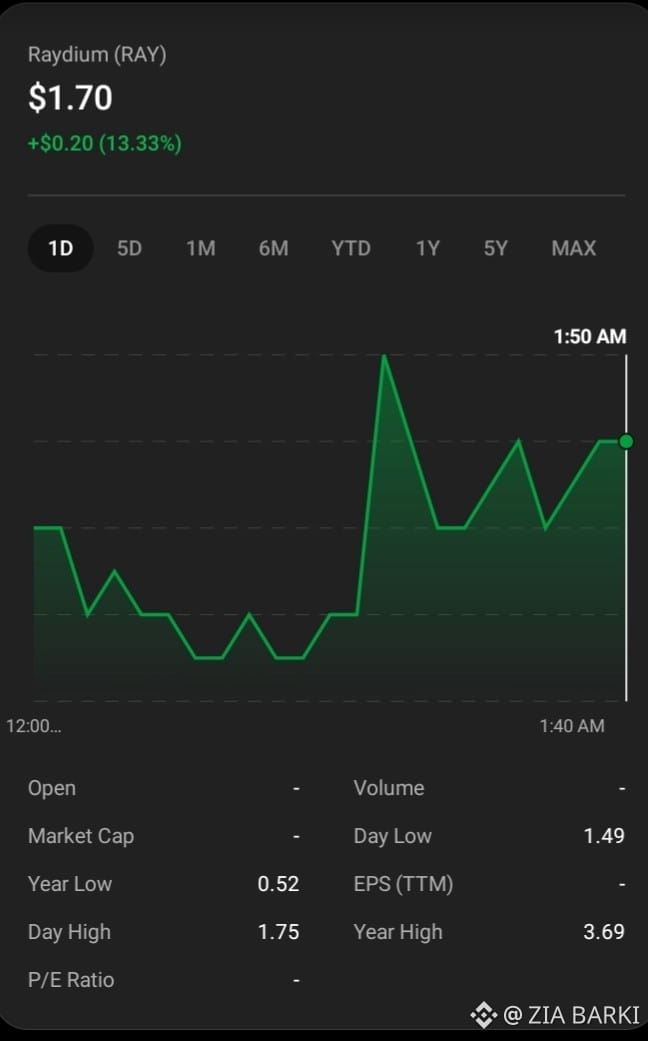
104
·
--
$BNB BToken BNB
Price $712.4333
down -0.68%
Market Cap $ 94,868,422,228.21
24h Volume $ 1,512,963,461.5218
Circulating Supply 133,161,128BNB experienced a prolonged markdown phase following its October 2025 peak, bottoming out near the $535 support zone by the end of H1 2026.
A strong rebound initiated in July and extended to $725 by late August, allowing price action to reclaim short-term moving averages and cross above the long-term 200-day EMA band, signaling a shift in market momentum.
In early September it pushed to $780 and sustained around $725. If bullish momentum continues through September, BNB price could push past $780, with a successful breakout it might pave the way for a rally toward $850. These key horizontal and dynamic levels represent significant supply zones moving forward. Also, the golden cross has formed between 50-day and 200-day EMA bay#SpotGoldRises0.87%SilverGains1.13% #USCoreCPIRises0.3%InAugustBeatingForecasts ynd that confirm the bullish trend has begun.
Conversely, if in case sell pressure outweighs bullish pressure then failing to sustain upside momentum could result in a rejection, if $700 loses as a support level. Then a breakdown may invalidate the recent recovery structure, that could expose BNB to downside risk and a potential retest of the foundational $535 demand level.
Binance Coin (BNB) Price Prediction September 2026.85
Total Supply 133,161,128.85
All-Time High $ 1,370.5460 on 13 October 2025
All-Time Low $ 0.0961 on 01 August 2017
{future}(BNBUSDT)
$BNB BToken BNB
Price $712.4333
down -0.68%
Market Cap $ 94,868,422,228.21
24h Volume $ 1,512,963,461.5218
Circulating Supply 133,161,128BNB experienced a prolonged markdown phase following its October 2025 peak, bottoming out near the $535 support zone by the end of H1 2026.
A strong rebound initiated in July and extended to $725 by late August, allowing price action to reclaim short-term moving averages and cross above the long-term 200-day EMA band, signaling a shift in market momentum.
In early September it pushed to $780 and sustained around $725. If bullish momentum continues through September, BNB price could push past $780, with a successful breakout it might pave the way for a rally toward $850. These key horizontal and dynamic levels represent significant supply zones moving forward. Also, the golden cross has formed between 50-day and 200-day EMA bay#SpotGoldRises0.87%SilverGains1.13% #USCoreCPIRises0.3%InAugustBeatingForecasts ynd that confirm the bullish trend has begun.
Conversely, if in case sell pressure outweighs bullish pressure then failing to sustain upside momentum could result in a rejection, if $700 loses as a support level. Then a breakdown may invalidate the recent recovery structure, that could expose BNB to downside risk and a potential retest of the foundational $535 demand level.
Binance Coin (BNB) Price Prediction September 2026.85
Total Supply 133,161,128.85
All-Time High $ 1,370.5460 on 13 October 2025
All-Time Low $ 0.0961 on 01 August 2017
Price $712.4333
down -0.68%
Market Cap $ 94,868,422,228.21
24h Volume $ 1,512,963,461.5218
Circulating Supply 133,161,128BNB experienced a prolonged markdown phase following its October 2025 peak, bottoming out near the $535 support zone by the end of H1 2026.
A strong rebound initiated in July and extended to $725 by late August, allowing price action to reclaim short-term moving averages and cross above the long-term 200-day EMA band, signaling a shift in market momentum.
In early September it pushed to $780 and sustained around $725. If bullish momentum continues through September, BNB price could push past $780, with a successful breakout it might pave the way for a rally toward $850. These key horizontal and dynamic levels represent significant supply zones moving forward. Also, the golden cross has formed between 50-day and 200-day EMA bay#SpotGoldRises0.87%SilverGains1.13% #USCoreCPIRises0.3%InAugustBeatingForecasts ynd that confirm the bullish trend has begun.
Conversely, if in case sell pressure outweighs bullish pressure then failing to sustain upside momentum could result in a rejection, if $700 loses as a support level. Then a breakdown may invalidate the recent recovery structure, that could expose BNB to downside risk and a potential retest of the foundational $535 demand level.
Binance Coin (BNB) Price Prediction September 2026.85
Total Supply 133,161,128.85
All-Time High $ 1,370.5460 on 13 October 2025
All-Time Low $ 0.0961 on 01 August 2017
60
·
--
$ETH 💥✅ Ethereum ($ETH ) Live Price Prediction – September 12, 2025🙏🙏🙏
💥Current Price: ~$4,610
💥👉Support Levels🔥
Support 1: $4,500
Support 2: $4,400
Strong Support: $4,200
💥👉Resistance 🔥
Resistance 1: $4,650
Resistance 2: $4,700
Major Resistance: $4,800
💥👉 Short-Term Price Outlook (Next 24–48 hours):
Likely to test support at $4,500 before attempting to break $4,650.
If support holds, we may see a bounce towards $4,700 in the next 1–2 days.
💥👉Medium-Term Target (Next 1 week)🔥
Bullish momentum may push ETH toward $4,750 – $4,800, provided $4,650 resistance breaks cleanly.
💥👉Bearish Scenario🔥
If ETH breaks below $4,500 support, price may slide toward $4,400, or lower toward $4,200.
In that case, the downtrend could accelerate.
💥👉Bullish Scenari🔥
Strong buying pressure keeps ETH above $4,600.
Targets: $4,700 → $4,750 → $4,800.
🔥💥⚡ Summary🙏🙏🙏
ETH is trading around $4,610.
Support to watch: $4,500, $4,400.
Resistance to watch: $4,650, $4,700, $4,800.
Next big move depends on whether ETH can stay above $4,500 or break through $4,650.
#bearishmomentum
#bulishmoment
$ETH 💥✅ Ethereum ($ETH ) Live Price Prediction – September 12, 2025🙏🙏🙏
💥Current Price: ~$4,610
💥👉Support Levels🔥
Support 1: $4,500
Support 2: $4,400
Strong Support: $4,200
💥👉Resistance 🔥
Resistance 1: $4,650
Resistance 2: $4,700
Major Resistance: $4,800
💥👉 Short-Term Price Outlook (Next 24–48 hours):
Likely to test support at $4,500 before attempting to break $4,650.
If support holds, we may see a bounce towards $4,700 in the next 1–2 days.
💥👉Medium-Term Target (Next 1 week)🔥
Bullish momentum may push ETH toward $4,750 – $4,800, provided $4,650 resistance breaks cleanly.
💥👉Bearish Scenario🔥
If ETH breaks below $4,500 support, price may slide toward $4,400, or lower toward $4,200.
In that case, the downtrend could accelerate.
💥👉Bullish Scenari🔥
Strong buying pressure keeps ETH above $4,600.
Targets: $4,700 → $4,750 → $4,800.
🔥💥⚡ Summary🙏🙏🙏
ETH is trading around $4,610.
Support to watch: $4,500, $4,400.
Resistance to watch: $4,650, $4,700, $4,800.
Next big move depends on whether ETH can stay above $4,500 or break through $4,650.
#bearishmomentum
#bulishmoment
💥Current Price: ~$4,610
💥👉Support Levels🔥
Support 1: $4,500
Support 2: $4,400
Strong Support: $4,200
💥👉Resistance 🔥
Resistance 1: $4,650
Resistance 2: $4,700
Major Resistance: $4,800
💥👉 Short-Term Price Outlook (Next 24–48 hours):
Likely to test support at $4,500 before attempting to break $4,650.
If support holds, we may see a bounce towards $4,700 in the next 1–2 days.
💥👉Medium-Term Target (Next 1 week)🔥
Bullish momentum may push ETH toward $4,750 – $4,800, provided $4,650 resistance breaks cleanly.
💥👉Bearish Scenario🔥
If ETH breaks below $4,500 support, price may slide toward $4,400, or lower toward $4,200.
In that case, the downtrend could accelerate.
💥👉Bullish Scenari🔥
Strong buying pressure keeps ETH above $4,600.
Targets: $4,700 → $4,750 → $4,800.
🔥💥⚡ Summary🙏🙏🙏
ETH is trading around $4,610.
Support to watch: $4,500, $4,400.
Resistance to watch: $4,650, $4,700, $4,800.
Next big move depends on whether ETH can stay above $4,500 or break through $4,650.
#bearishmomentum
#bulishmoment
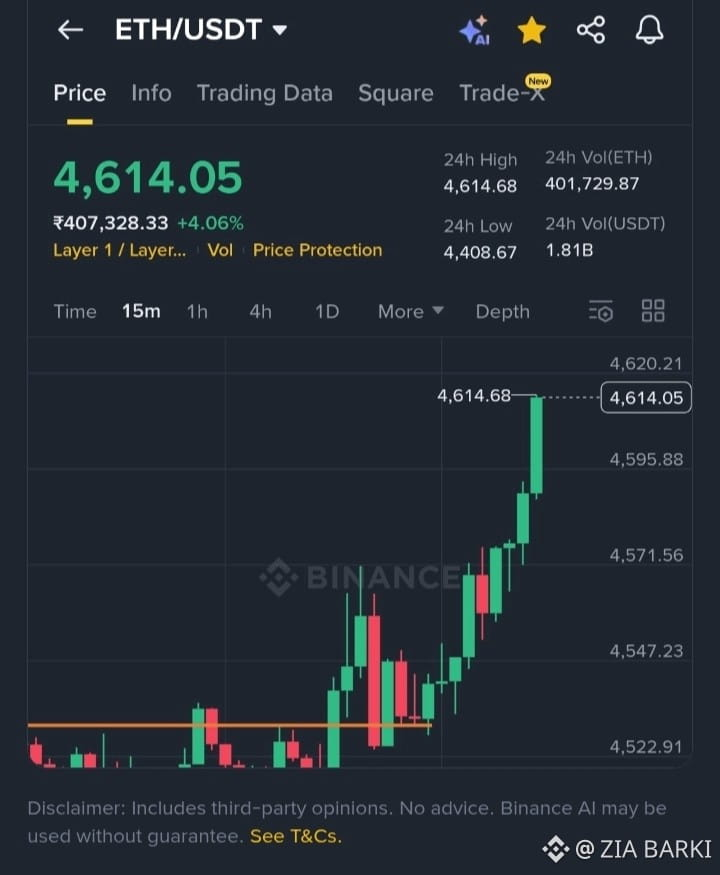
1.1k
·
--
$ZEC Zcash (ZEC) gained 16.5% on Sept. 3, making it the top performer among the top 50 cryptocurrencies by market cap. Cardano (ADA) rose 13%, while Dogecoin (DOGE) and CRAP each climbed roughly 10%. Bitcoin (BTC) traded near $81,460, up 5.4% on the day.
Those moves pushed the global crypto market capitalization to $2.82 trillion, the highest level in more than seven months. The reading marks a recovery from the sell-off that began in mid-January, when the total market cap fell from around $3.4 trillion to roughly $2.3 trillion in the first week of February.
{future}(ZECUSDT)
$ZEC Zcash (ZEC) gained 16.5% on Sept. 3, making it the top performer among the top 50 cryptocurrencies by market cap. Cardano (ADA) rose 13%, while Dogecoin (DOGE) and CRAP each climbed roughly 10%. Bitcoin (BTC) traded near $81,460, up 5.4% on the day.
Those moves pushed the global crypto market capitalization to $2.82 trillion, the highest level in more than seven months. The reading marks a recovery from the sell-off that began in mid-January, when the total market cap fell from around $3.4 trillion to roughly $2.3 trillion in the first week of February.
Those moves pushed the global crypto market capitalization to $2.82 trillion, the highest level in more than seven months. The reading marks a recovery from the sell-off that began in mid-January, when the total market cap fell from around $3.4 trillion to roughly $2.3 trillion in the first week of February.
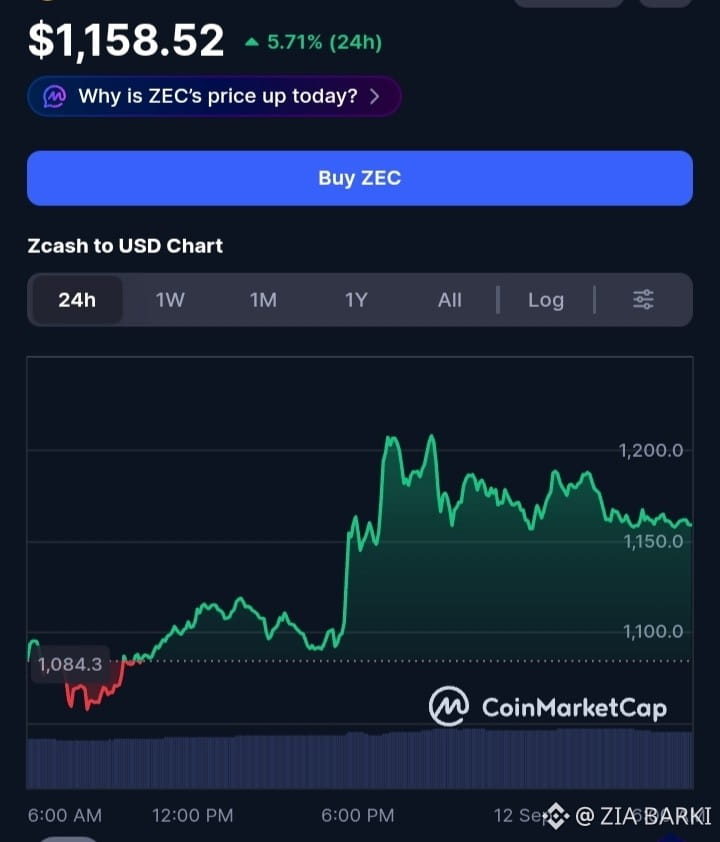
182
·
--
$ZEC Why Is Zcash (ZEC) Down Today?
Zcash (ZEC)'s price declined by 12.42% over the past 24h, possibly reflecting reduced trading activity and broader market caution affecting crypto assets.
Recent market activity suggests moderating buying momentum, which may reflect short-term adjustments in trading activity following recent price movements.
At the same time, broader trends across the crypto market may be contributing to normal price fluctuations, influencing Zcash (ZEC)'s performance alongside other digital assets.
{future}(ZECUSDT)
#OracleJumpsOver6%OnEarningsBeat
$ZEC Why Is Zcash (ZEC) Down Today?
Zcash (ZEC)'s price declined by 12.42% over the past 24h, possibly reflecting reduced trading activity and broader market caution affecting crypto assets.
Recent market activity suggests moderating buying momentum, which may reflect short-term adjustments in trading activity following recent price movements.
At the same time, broader trends across the crypto market may be contributing to normal price fluctuations, influencing Zcash (ZEC)'s performance alongside other digital assets.
#OracleJumpsOver6%OnEarningsBeat
Zcash (ZEC)'s price declined by 12.42% over the past 24h, possibly reflecting reduced trading activity and broader market caution affecting crypto assets.
Recent market activity suggests moderating buying momentum, which may reflect short-term adjustments in trading activity following recent price movements.
At the same time, broader trends across the crypto market may be contributing to normal price fluctuations, influencing Zcash (ZEC)'s performance alongside other digital assets.
#OracleJumpsOver6%OnEarningsBeat
91
·
--
$BNB Why Is BNB (BNB) Down Today?
BNB (BNB)'s price declined by 0.5% over the past 24h, possibly reflecting reduced trading activity and broader market caution affecting crypto assets.
Recent market activity suggests moderating buying momentum, which may reflect short-term adjustments in trading activity following recent price movements.
At the same time, broader trends across the crypto market may be contributing to normal price fluctuations, influencing BNB (BNB)'s performance alongside other digital assets.
{future}(BNBUSDT)
#AppleRises3.56%AfterIPhoneDuoLaunch ##CPIWatch
$BNB Why Is BNB (BNB) Down Today?
BNB (BNB)'s price declined by 0.5% over the past 24h, possibly reflecting reduced trading activity and broader market caution affecting crypto assets.
Recent market activity suggests moderating buying momentum, which may reflect short-term adjustments in trading activity following recent price movements.
At the same time, broader trends across the crypto market may be contributing to normal price fluctuations, influencing BNB (BNB)'s performance alongside other digital assets.
#AppleRises3.56%AfterIPhoneDuoLaunch ##CPIWatch
BNB (BNB)'s price declined by 0.5% over the past 24h, possibly reflecting reduced trading activity and broader market caution affecting crypto assets.
Recent market activity suggests moderating buying momentum, which may reflect short-term adjustments in trading activity following recent price movements.
At the same time, broader trends across the crypto market may be contributing to normal price fluctuations, influencing BNB (BNB)'s performance alongside other digital assets.
#AppleRises3.56%AfterIPhoneDuoLaunch ##CPIWatch

28
·
--
$MARSCOIN MarsCoin is up 15.27% to $0.116 in 24h, strongly outperforming a down market where Bitcoin fell 1.78%. The move is primarily driven by momentum from its recent Binance listing and associated social media hype.
Primary reason: Binance spot listing catalyst, driving accessibility and speculative interest.
Secondary reasons: Social media narrative comparing it to past meme rallies like SHIB.
Near-term market outlook: If MarsCoin holds above $0.10 support, it could retest the $0.15 a
{future}(MARSCOINUSDT)
#SaudiCrudeOutputHitsLowestSince1990 rea; a break below risks a deeper pullback toward $0.08.
$MARSCOIN MarsCoin is up 15.27% to $0.116 in 24h, strongly outperforming a down market where Bitcoin fell 1.78%. The move is primarily driven by momentum from its recent Binance listing and associated social media hype.
Primary reason: Binance spot listing catalyst, driving accessibility and speculative interest.
Secondary reasons: Social media narrative comparing it to past meme rallies like SHIB.
Near-term market outlook: If MarsCoin holds above $0.10 support, it could retest the $0.15 a
#SaudiCrudeOutputHitsLowestSince1990 rea; a break below risks a deeper pullback toward $0.08.
Primary reason: Binance spot listing catalyst, driving accessibility and speculative interest.
Secondary reasons: Social media narrative comparing it to past meme rallies like SHIB.
Near-term market outlook: If MarsCoin holds above $0.10 support, it could retest the $0.15 a
#SaudiCrudeOutputHitsLowestSince1990 rea; a break below risks a deeper pullback toward $0.08.
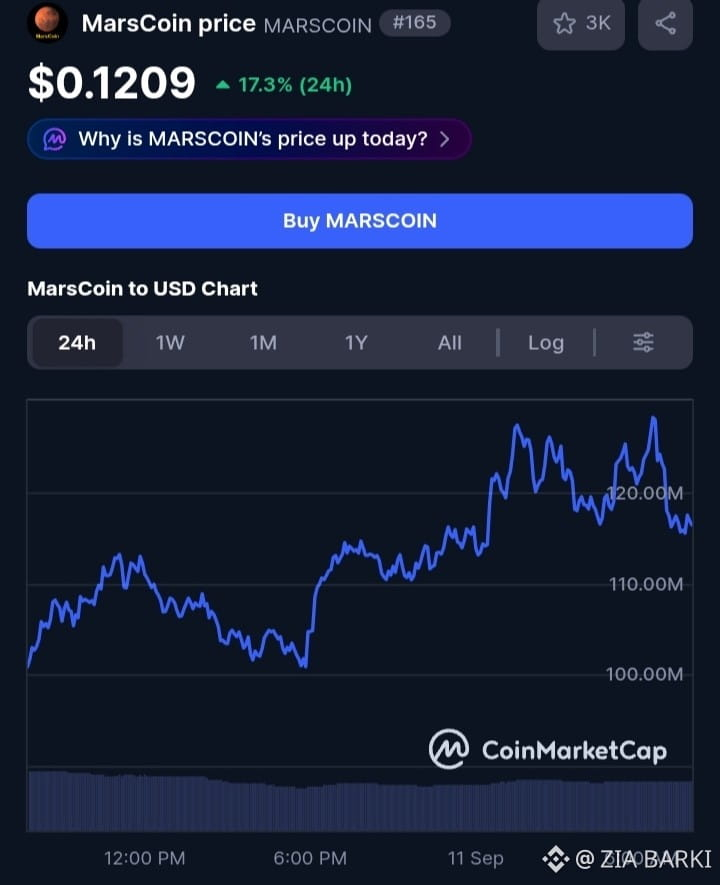
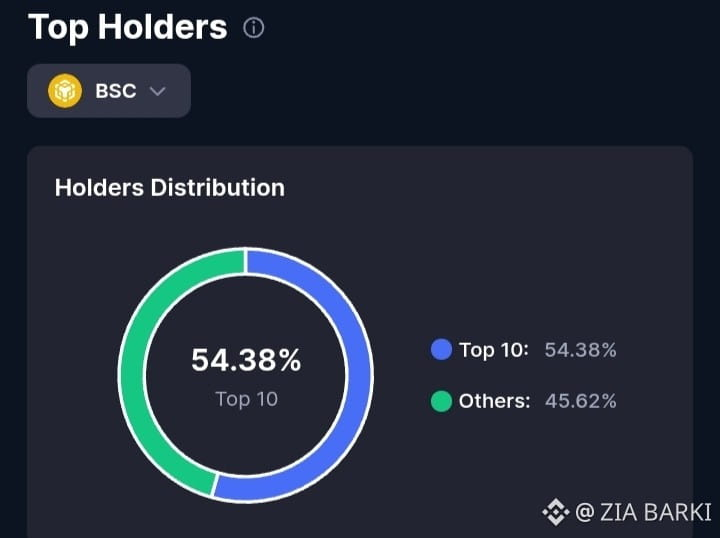
98
·
--
#Top7AssetsHold92.1%OfCryptoTop100 $SUI.US Why Is Sui (SUI) Up Today?
Sui (SUI)'s price rose by 1.29% in the past 24h, potentially influenced by improving market sentiment and increased trading activity.
Recent market data suggests growing buying interest, which may indicate traders entering new positions or responding to recent market momentum.
In addition, broader market trends and positive sentiment across digital assets may be contributing to short-term price strength, supporting gains in Sui (SUI) along with the wider crypto market.
{future}(SUIUSDT)
#Top7AssetsHold92.1%OfCryptoTop100 $SUI.US Why Is Sui (SUI) Up Today?
Sui (SUI)'s price rose by 1.29% in the past 24h, potentially influenced by improving market sentiment and increased trading activity.
Recent market data suggests growing buying interest, which may indicate traders entering new positions or responding to recent market momentum.
In addition, broader market trends and positive sentiment across digital assets may be contributing to short-term price strength, supporting gains in Sui (SUI) along with the wider crypto market.
Sui (SUI)'s price rose by 1.29% in the past 24h, potentially influenced by improving market sentiment and increased trading activity.
Recent market data suggests growing buying interest, which may indicate traders entering new positions or responding to recent market momentum.
In addition, broader market trends and positive sentiment across digital assets may be contributing to short-term price strength, supporting gains in Sui (SUI) along with the wider crypto market.
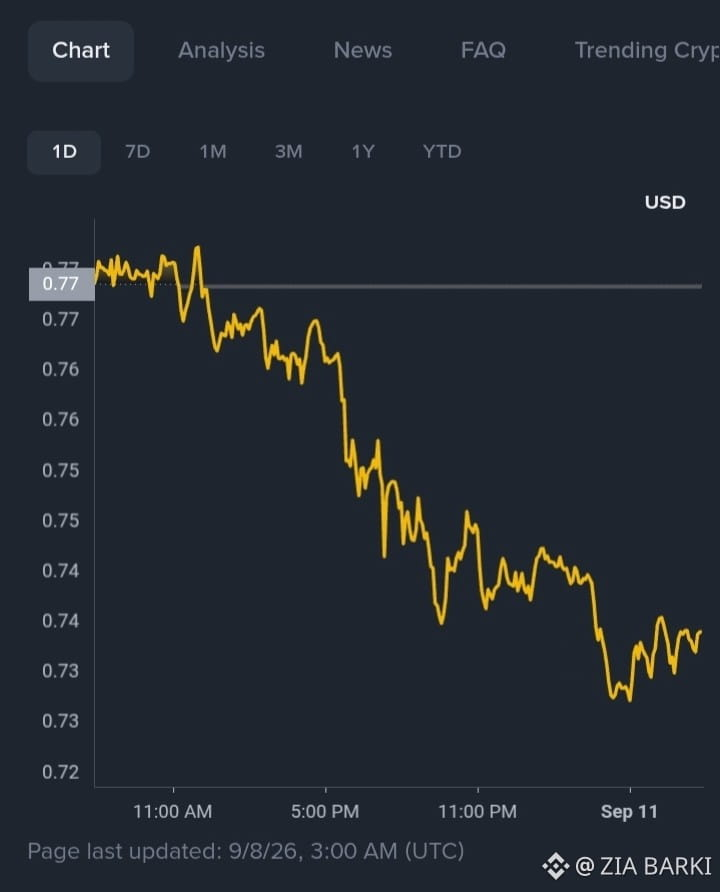
SUIUS-0,37%
56
·
--
$ZEC (ZEC)'s price declined by 0.96% over the past 24h, possibly reflecting reduced trading activity and broader market caution affecting crypto assets.
Recent market activity suggests moderating buying momentum, which may reflect short-term adjustments in trading activity following recent price movements.
At the same time, broader trends across the crypto market may be contributing to normal price fluctuations, influencing Zcash (ZEC)'s performance alongside other digital assets.
{future}(ZECUSDT)
#CryptoSectorsFallSecondDay #IranBlocksStraitOfHormuz #Top7AssetsHold92.1%OfCryptoTop100
$ZEC (ZEC)'s price declined by 0.96% over the past 24h, possibly reflecting reduced trading activity and broader market caution affecting crypto assets.
Recent market activity suggests moderating buying momentum, which may reflect short-term adjustments in trading activity following recent price movements.
At the same time, broader trends across the crypto market may be contributing to normal price fluctuations, influencing Zcash (ZEC)'s performance alongside other digital assets.
#CryptoSectorsFallSecondDay #IranBlocksStraitOfHormuz #Top7AssetsHold92.1%OfCryptoTop100
Recent market activity suggests moderating buying momentum, which may reflect short-term adjustments in trading activity following recent price movements.
At the same time, broader trends across the crypto market may be contributing to normal price fluctuations, influencing Zcash (ZEC)'s performance alongside other digital assets.
#CryptoSectorsFallSecondDay #IranBlocksStraitOfHormuz #Top7AssetsHold92.1%OfCryptoTop100


177
·
--
{future}(BTCUSDT)
#USADPWeeklyEmploymentRises12000 $BTC Bitcoin is trading around $79K, with recent data showing a 24-hour range roughly between $77.6K and $79.7K. �
The Agent Times +1
Technical snapshot
Trend: Sideways / volatile near $79K
Support: ~$77.6K–$78K
Resistance: ~$79.7K–$80K
Key level: A sustained move above $80K would strengthen the bullish picture; losing ~$77.6K would weaken it.
Market risk: Rising oil prices, Treasury yields and uncertainty around the upcoming Fed decision are creating pressure on risk assets. �
Reuters +1
Important: These are market levels, not guarantees buy/sell signals.
#USADPWeeklyEmploymentRises12000 $BTC Bitcoin is trading around $79K, with recent data showing a 24-hour range roughly between $77.6K and $79.7K. �
The Agent Times +1
Technical snapshot
Trend: Sideways / volatile near $79K
Support: ~$77.6K–$78K
Resistance: ~$79.7K–$80K
Key level: A sustained move above $80K would strengthen the bullish picture; losing ~$77.6K would weaken it.
Market risk: Rising oil prices, Treasury yields and uncertainty around the upcoming Fed decision are creating pressure on risk assets. �
Reuters +1
Important: These are market levels, not guarantees buy/sell signals.
The Agent Times +1
Technical snapshot
Trend: Sideways / volatile near $79K
Support: ~$77.6K–$78K
Resistance: ~$79.7K–$80K
Key level: A sustained move above $80K would strengthen the bullish picture; losing ~$77.6K would weaken it.
Market risk: Rising oil prices, Treasury yields and uncertainty around the upcoming Fed decision are creating pressure on risk assets. �
Reuters +1
Important: These are market levels, not guarantees buy/sell signals.
16
·
--

Статья
NEAR PROTOCOL COMPLETE OVERVIEWWriting
NEAR Protocol: Complete Overview and Fundamental Analysis
Introduction
NEAR Protocol is a blockchain platform designed to make decentralized applications faster, cheaper, and easier to use. Unlike many early blockchain networks that focused primarily on payments or basic smart contracts, NEAR has increasingly positioned itself around scalability, cross-chain applications, and the emerging AI-agent economy.
Its architecture is based on sharding, allowing network activity to be processed across multiple shards rather than forcing every validator to process all activity. NEAR's current architecture highlights 600 ms block times, approximately 1.2-second finality, and scalability through sharding.
What Is NEAR Protocol?
NEAR Protocol is a Layer-1 blockchain that provides infrastructure for developers to build decentralized applications and smart contracts.
The project was co-founded by Illia Polosukhin, one of the researchers associated with the Transformer architecture that became foundational to modern AI. NEAR's current strategy therefore places significant emphasis on connecting blockchain infrastructure with AI applications and autonomous agents.
The native cryptocurrency of the network is NEAR. It is used within the ecosystem for network operations, staking and other protocol functions.
NEAR's Core Technology
1. Nightshade Sharding
One of NEAR's most important technological features is Nightshade, its sharding architecture.
Sharding divides blockchain workload across multiple parts of the network. Instead of requiring every participant to process everything, different shards can handle different portions of activity. NEAR's updated Nightshade design incorporates stateless validation and is intended to allow the network to scale horizontally as demand increases.
This gives NEAR an important potential advantage: increasing network capacity without simply requiring every individual validator to become increasingly powerful.
2. Fast Finality
NEAR currently advertises approximately 600 ms block times and 1.2-second finality. These characteristics are important for applications that require quick confirmation, particularly financial applications and applications involving frequent user interactions.
3. Developer-Friendly Design
NEAR focuses heavily on reducing the complexity of blockchain applications. Its developer platform supports familiar programming environments, human-readable accounts and mechanisms that can make applications easier for mainstream users to interact with.
NEAR Intents
One of the most important developments in the NEAR ecosystem is NEAR Intents.
NEAR Intents is designed to simplify transactions across different blockchain networks. Instead of requiring users or applications to manually manage bridges, different gas assets and fragmented liquidity, users can specify the desired outcome while specialized solvers compete to execute the transaction.
The project currently describes Intents as a universal liquidity and transaction layer, supporting cross-chain swaps and other forms of execution. Its official site reports more than $27 billion in cumulative volume across 34 chains.
This is significant because blockchain users often face a fragmented ecosystem containing many independent networks. If NEAR can become an effective abstraction layer between these networks, its utility could extend well beyond applications running directly on NEAR.
NEAR and Artificial Intelligence
AI has become a central part of NEAR's current strategy.
The project's 2026 roadmap describes two major pillars: cross-chain financial infrastructure through NEAR Intents and autonomous AI agents through NEAR AI.
The idea is that AI agents could eventually perform tasks such as interacting with applications, managing digital assets, executing transactions and coordinating economic activity.
NEAR is also developing infrastructure around private AI inference and secure environments. Its blockchain platform highlights confidential execution and private infrastructure intended for applications where sensitive information should not simply be exposed publicly.
This gives NEAR exposure to two major narratives at once:
Blockchain + AI + Cross-chain infrastructure
However, an important distinction should be made: having an AI-focused narrative does not automatically mean that the network will achieve large-scale AI adoption. Long-term fundamentals will depend on actual users, developers, applications, transaction activity and sustainable revenue.
Chain Abstraction
Another major component of NEAR's strategy is chain abstraction.
The objective is to make blockchain technology feel less fragmented to users. Instead of requiring someone to understand which blockchain an asset belongs to, which network should be selected, or which token is required for fees, applications can abstract much of this complexity.
NEAR's Chain Abstraction ecosystem combines technologies such as Chain Signatures, Omnibridge and NEAR Intents to facilitate cross-chain interactions.
If successful, this approach could help blockchain applications become more accessible to mainstream users.
NEAR Tokenomics
The NEAR token is the native asset of the NEAR ecosystem.
The token has roles connected to network economics, including transaction fees and staking. NEAR's current website also describes a tokenomics model in which protocol revenue contributes to NEAR buybacks and characterizes the token's supply trajectory as deflationary.
For fundamental analysis, however, token utility should be separated from speculation.
A strong blockchain does not necessarily guarantee strong token performance. Investors and analysts generally need to consider whether increasing network activity actually creates sustainable demand for the token.
Ecosystem and Adoption
NEAR has developed an ecosystem of decentralized applications, infrastructure providers, wallets and developer tools.
The project's developer center reports more than 3.34 billion transactions processed, while highlighting low fees and approximately 1.09-second average block times. These are figures reported by NEAR itself and should therefore be treated as project-reported metrics rather than independent verification.
NEAR Intents also provides an important adoption signal because it connects activity across multiple blockchain ecosystems rather than relying exclusively on NEAR-native applications.
Competitive Landscape
NEAR operates in a highly competitive Layer-1 and blockchain-infrastructure market.
It competes indirectly or directly with ecosystems such as:
Ethereum
Solana
BNB Chain
Avalanche
Sui
Aptos
Other high-throughput Layer-1 and interoperability networks
NEAR's differentiation is therefore not simply speed.
Its stronger strategic argument is the combination of:
Sharding + chain abstraction + cross-chain execution + AI infrastructure.
The challenge is proving that this combination can attract enough users and developers to create durable network effects.
Major Strengths
Scalability
NEAR's sharded architecture is designed to increase capacity as demand grows.
Fast transactions
The network advertises fast block production and finality, making it suitable for applications requiring rapid confirmation.
Cross-chain functionality
NEAR Intents and Chain Abstraction attempt to solve one of crypto's biggest usability problems: fragmentation between blockchains.
AI positioning
NEAR is building infrastructure specifically around autonomous agents and private AI applications, giving the ecosystem exposure to a potentially important technological trend.
Developer experience
NEAR emphasizes low fees, familiar development tools and simplified user experiences.
Major Risks
Strong competition
The blockchain sector is extremely competitive. Ethereum, Solana and other networks have large developer and user communities.
AI narrative risk
AI is currently a powerful technology narrative, but the long-term value of an AI-focused blockchain depends on real adoption rather than marketing.
Adoption risk
Technology alone does not guarantee success. NEAR needs continued growth in developers, users, applications, transaction activity and economic value.
Token-value risk
Growth in the NEAR ecosystem does not automatically translate into proportional appreciation of the NEAR token. Token economics and actual value capture remain important factors to monitor.
Market volatility
Cryptocurrency markets can experience significant price fluctuations. Fundamental improvements can coexist with substantial short-term price declines.
Future Outlook
NEAR's 2026 roadmap is focused on building what it calls an agentic economy, combining cross-chain financial infrastructure with autonomous AI agents.
The long-term thesis is ambitious:
AI agents could become economic participants that need secure identities, payments, assets, computation and cross-chain execution.
If that model becomes widespread, infrastructure capable of allowing agents to transact autonomously could become increasingly valuable.
NEAR is attempting to position itself as one such infrastructure layer.
Fundamental Conclusion
NEAR Protocol is more than a conventional Layer-1 blockchain. Its fundamental thesis has evolved toward scalable blockchain infrastructure, cross-chain abstraction and AI-agent applications.
Its strongest characteristics are its sharded architecture, fast finality, developer-oriented design and growing emphasis on cross-chain execution through NEAR Intents.
The biggest question is not whether NEAR has sophisticated technology—it clearly does. The key question is whether that technology can translate into sustained adoption, meaningful economic activity and durable value capture for the NEAR ecosystem and token.
Overall, NEAR presents an interesting but high-risk long-term blockchain thesis, particularly for people studying the intersection of AI and Web3. It should be evaluated alongside competing ecosystems and with attention to actual adoption metrics rather than narrative alone.
If you want, I can also �turn this into a Binance-s
{future}(NEARUSDT)
t##yle #yle a 5-line summary.
NEAR PROTOCOL COMPLETE OVERVIEW
Writing
NEAR Protocol: Complete Overview and Fundamental Analysis
Introduction
NEAR Protocol is a blockchain platform designed to make decentralized applications faster, cheaper, and easier to use. Unlike many early blockchain networks that focused primarily on payments or basic smart contracts, NEAR has increasingly positioned itself around scalability, cross-chain applications, and the emerging AI-agent economy.
Its architecture is based on sharding, allowing network activity to be processed across multiple shards rather than forcing every validator to process all activity. NEAR's current architecture highlights 600 ms block times, approximately 1.2-second finality, and scalability through sharding.
What Is NEAR Protocol?
NEAR Protocol is a Layer-1 blockchain that provides infrastructure for developers to build decentralized applications and smart contracts.
The project was co-founded by Illia Polosukhin, one of the researchers associated with the Transformer architecture that became foundational to modern AI. NEAR's current strategy therefore places significant emphasis on connecting blockchain infrastructure with AI applications and autonomous agents.
The native cryptocurrency of the network is NEAR. It is used within the ecosystem for network operations, staking and other protocol functions.
NEAR's Core Technology
1. Nightshade Sharding
One of NEAR's most important technological features is Nightshade, its sharding architecture.
Sharding divides blockchain workload across multiple parts of the network. Instead of requiring every participant to process everything, different shards can handle different portions of activity. NEAR's updated Nightshade design incorporates stateless validation and is intended to allow the network to scale horizontally as demand increases.
This gives NEAR an important potential advantage: increasing network capacity without simply requiring every individual validator to become increasingly powerful.
2. Fast Finality
NEAR currently advertises approximately 600 ms block times and 1.2-second finality. These characteristics are important for applications that require quick confirmation, particularly financial applications and applications involving frequent user interactions.
3. Developer-Friendly Design
NEAR focuses heavily on reducing the complexity of blockchain applications. Its developer platform supports familiar programming environments, human-readable accounts and mechanisms that can make applications easier for mainstream users to interact with.
NEAR Intents
One of the most important developments in the NEAR ecosystem is NEAR Intents.
NEAR Intents is designed to simplify transactions across different blockchain networks. Instead of requiring users or applications to manually manage bridges, different gas assets and fragmented liquidity, users can specify the desired outcome while specialized solvers compete to execute the transaction.
The project currently describes Intents as a universal liquidity and transaction layer, supporting cross-chain swaps and other forms of execution. Its official site reports more than $27 billion in cumulative volume across 34 chains.
This is significant because blockchain users often face a fragmented ecosystem containing many independent networks. If NEAR can become an effective abstraction layer between these networks, its utility could extend well beyond applications running directly on NEAR.
NEAR and Artificial Intelligence
AI has become a central part of NEAR's current strategy.
The project's 2026 roadmap describes two major pillars: cross-chain financial infrastructure through NEAR Intents and autonomous AI agents through NEAR AI.
The idea is that AI agents could eventually perform tasks such as interacting with applications, managing digital assets, executing transactions and coordinating economic activity.
NEAR is also developing infrastructure around private AI inference and secure environments. Its blockchain platform highlights confidential execution and private infrastructure intended for applications where sensitive information should not simply be exposed publicly.
This gives NEAR exposure to two major narratives at once:
Blockchain + AI + Cross-chain infrastructure
However, an important distinction should be made: having an AI-focused narrative does not automatically mean that the network will achieve large-scale AI adoption. Long-term fundamentals will depend on actual users, developers, applications, transaction activity and sustainable revenue.
Chain Abstraction
Another major component of NEAR's strategy is chain abstraction.
The objective is to make blockchain technology feel less fragmented to users. Instead of requiring someone to understand which blockchain an asset belongs to, which network should be selected, or which token is required for fees, applications can abstract much of this complexity.
NEAR's Chain Abstraction ecosystem combines technologies such as Chain Signatures, Omnibridge and NEAR Intents to facilitate cross-chain interactions.
If successful, this approach could help blockchain applications become more accessible to mainstream users.
NEAR Tokenomics
The NEAR token is the native asset of the NEAR ecosystem.
The token has roles connected to network economics, including transaction fees and staking. NEAR's current website also describes a tokenomics model in which protocol revenue contributes to NEAR buybacks and characterizes the token's supply trajectory as deflationary.
For fundamental analysis, however, token utility should be separated from speculation.
A strong blockchain does not necessarily guarantee strong token performance. Investors and analysts generally need to consider whether increasing network activity actually creates sustainable demand for the token.
Ecosystem and Adoption
NEAR has developed an ecosystem of decentralized applications, infrastructure providers, wallets and developer tools.
The project's developer center reports more than 3.34 billion transactions processed, while highlighting low fees and approximately 1.09-second average block times. These are figures reported by NEAR itself and should therefore be treated as project-reported metrics rather than independent verification.
NEAR Intents also provides an important adoption signal because it connects activity across multiple blockchain ecosystems rather than relying exclusively on NEAR-native applications.
Competitive Landscape
NEAR operates in a highly competitive Layer-1 and blockchain-infrastructure market.
It competes indirectly or directly with ecosystems such as:
Ethereum
Solana
BNB Chain
Avalanche
Sui
Aptos
Other high-throughput Layer-1 and interoperability networks
NEAR's differentiation is therefore not simply speed.
Its stronger strategic argument is the combination of:
Sharding + chain abstraction + cross-chain execution + AI infrastructure.
The challenge is proving that this combination can attract enough users and developers to create durable network effects.
Major Strengths
Scalability
NEAR's sharded architecture is designed to increase capacity as demand grows.
Fast transactions
The network advertises fast block production and finality, making it suitable for applications requiring rapid confirmation.
Cross-chain functionality
NEAR Intents and Chain Abstraction attempt to solve one of crypto's biggest usability problems: fragmentation between blockchains.
AI positioning
NEAR is building infrastructure specifically around autonomous agents and private AI applications, giving the ecosystem exposure to a potentially important technological trend.
Developer experience
NEAR emphasizes low fees, familiar development tools and simplified user experiences.
Major Risks
Strong competition
The blockchain sector is extremely competitive. Ethereum, Solana and other networks have large developer and user communities.
AI narrative risk
AI is currently a powerful technology narrative, but the long-term value of an AI-focused blockchain depends on real adoption rather than marketing.
Adoption risk
Technology alone does not guarantee success. NEAR needs continued growth in developers, users, applications, transaction activity and economic value.
Token-value risk
Growth in the NEAR ecosystem does not automatically translate into proportional appreciation of the NEAR token. Token economics and actual value capture remain important factors to monitor.
Market volatility
Cryptocurrency markets can experience significant price fluctuations. Fundamental improvements can coexist with substantial short-term price declines.
Future Outlook
NEAR's 2026 roadmap is focused on building what it calls an agentic economy, combining cross-chain financial infrastructure with autonomous AI agents.
The long-term thesis is ambitious:
AI agents could become economic participants that need secure identities, payments, assets, computation and cross-chain execution.
If that model becomes widespread, infrastructure capable of allowing agents to transact autonomously could become increasingly valuable.
NEAR is attempting to position itself as one such infrastructure layer.
Fundamental Conclusion
NEAR Protocol is more than a conventional Layer-1 blockchain. Its fundamental thesis has evolved toward scalable blockchain infrastructure, cross-chain abstraction and AI-agent applications.
Its strongest characteristics are its sharded architecture, fast finality, developer-oriented design and growing emphasis on cross-chain execution through NEAR Intents.
The biggest question is not whether NEAR has sophisticated technology—it clearly does. The key question is whether that technology can translate into sustained adoption, meaningful economic activity and durable value capture for the NEAR ecosystem and token.
Overall, NEAR presents an interesting but high-risk long-term blockchain thesis, particularly for people studying the intersection of AI and Web3. It should be evaluated alongside competing ecosystems and with attention to actual adoption metrics rather than narrative alone.
If you want, I can also �turn this into a Binance-s
t##yle #yle a 5-line summary.
NEAR Protocol: Complete Overview and Fundamental Analysis
Introduction
NEAR Protocol is a blockchain platform designed to make decentralized applications faster, cheaper, and easier to use. Unlike many early blockchain networks that focused primarily on payments or basic smart contracts, NEAR has increasingly positioned itself around scalability, cross-chain applications, and the emerging AI-agent economy.
Its architecture is based on sharding, allowing network activity to be processed across multiple shards rather than forcing every validator to process all activity. NEAR's current architecture highlights 600 ms block times, approximately 1.2-second finality, and scalability through sharding.
What Is NEAR Protocol?
NEAR Protocol is a Layer-1 blockchain that provides infrastructure for developers to build decentralized applications and smart contracts.
The project was co-founded by Illia Polosukhin, one of the researchers associated with the Transformer architecture that became foundational to modern AI. NEAR's current strategy therefore places significant emphasis on connecting blockchain infrastructure with AI applications and autonomous agents.
The native cryptocurrency of the network is NEAR. It is used within the ecosystem for network operations, staking and other protocol functions.
NEAR's Core Technology
1. Nightshade Sharding
One of NEAR's most important technological features is Nightshade, its sharding architecture.
Sharding divides blockchain workload across multiple parts of the network. Instead of requiring every participant to process everything, different shards can handle different portions of activity. NEAR's updated Nightshade design incorporates stateless validation and is intended to allow the network to scale horizontally as demand increases.
This gives NEAR an important potential advantage: increasing network capacity without simply requiring every individual validator to become increasingly powerful.
2. Fast Finality
NEAR currently advertises approximately 600 ms block times and 1.2-second finality. These characteristics are important for applications that require quick confirmation, particularly financial applications and applications involving frequent user interactions.
3. Developer-Friendly Design
NEAR focuses heavily on reducing the complexity of blockchain applications. Its developer platform supports familiar programming environments, human-readable accounts and mechanisms that can make applications easier for mainstream users to interact with.
NEAR Intents
One of the most important developments in the NEAR ecosystem is NEAR Intents.
NEAR Intents is designed to simplify transactions across different blockchain networks. Instead of requiring users or applications to manually manage bridges, different gas assets and fragmented liquidity, users can specify the desired outcome while specialized solvers compete to execute the transaction.
The project currently describes Intents as a universal liquidity and transaction layer, supporting cross-chain swaps and other forms of execution. Its official site reports more than $27 billion in cumulative volume across 34 chains.
This is significant because blockchain users often face a fragmented ecosystem containing many independent networks. If NEAR can become an effective abstraction layer between these networks, its utility could extend well beyond applications running directly on NEAR.
NEAR and Artificial Intelligence
AI has become a central part of NEAR's current strategy.
The project's 2026 roadmap describes two major pillars: cross-chain financial infrastructure through NEAR Intents and autonomous AI agents through NEAR AI.
The idea is that AI agents could eventually perform tasks such as interacting with applications, managing digital assets, executing transactions and coordinating economic activity.
NEAR is also developing infrastructure around private AI inference and secure environments. Its blockchain platform highlights confidential execution and private infrastructure intended for applications where sensitive information should not simply be exposed publicly.
This gives NEAR exposure to two major narratives at once:
Blockchain + AI + Cross-chain infrastructure
However, an important distinction should be made: having an AI-focused narrative does not automatically mean that the network will achieve large-scale AI adoption. Long-term fundamentals will depend on actual users, developers, applications, transaction activity and sustainable revenue.
Chain Abstraction
Another major component of NEAR's strategy is chain abstraction.
The objective is to make blockchain technology feel less fragmented to users. Instead of requiring someone to understand which blockchain an asset belongs to, which network should be selected, or which token is required for fees, applications can abstract much of this complexity.
NEAR's Chain Abstraction ecosystem combines technologies such as Chain Signatures, Omnibridge and NEAR Intents to facilitate cross-chain interactions.
If successful, this approach could help blockchain applications become more accessible to mainstream users.
NEAR Tokenomics
The NEAR token is the native asset of the NEAR ecosystem.
The token has roles connected to network economics, including transaction fees and staking. NEAR's current website also describes a tokenomics model in which protocol revenue contributes to NEAR buybacks and characterizes the token's supply trajectory as deflationary.
For fundamental analysis, however, token utility should be separated from speculation.
A strong blockchain does not necessarily guarantee strong token performance. Investors and analysts generally need to consider whether increasing network activity actually creates sustainable demand for the token.
Ecosystem and Adoption
NEAR has developed an ecosystem of decentralized applications, infrastructure providers, wallets and developer tools.
The project's developer center reports more than 3.34 billion transactions processed, while highlighting low fees and approximately 1.09-second average block times. These are figures reported by NEAR itself and should therefore be treated as project-reported metrics rather than independent verification.
NEAR Intents also provides an important adoption signal because it connects activity across multiple blockchain ecosystems rather than relying exclusively on NEAR-native applications.
Competitive Landscape
NEAR operates in a highly competitive Layer-1 and blockchain-infrastructure market.
It competes indirectly or directly with ecosystems such as:
Ethereum
Solana
BNB Chain
Avalanche
Sui
Aptos
Other high-throughput Layer-1 and interoperability networks
NEAR's differentiation is therefore not simply speed.
Its stronger strategic argument is the combination of:
Sharding + chain abstraction + cross-chain execution + AI infrastructure.
The challenge is proving that this combination can attract enough users and developers to create durable network effects.
Major Strengths
Scalability
NEAR's sharded architecture is designed to increase capacity as demand grows.
Fast transactions
The network advertises fast block production and finality, making it suitable for applications requiring rapid confirmation.
Cross-chain functionality
NEAR Intents and Chain Abstraction attempt to solve one of crypto's biggest usability problems: fragmentation between blockchains.
AI positioning
NEAR is building infrastructure specifically around autonomous agents and private AI applications, giving the ecosystem exposure to a potentially important technological trend.
Developer experience
NEAR emphasizes low fees, familiar development tools and simplified user experiences.
Major Risks
Strong competition
The blockchain sector is extremely competitive. Ethereum, Solana and other networks have large developer and user communities.
AI narrative risk
AI is currently a powerful technology narrative, but the long-term value of an AI-focused blockchain depends on real adoption rather than marketing.
Adoption risk
Technology alone does not guarantee success. NEAR needs continued growth in developers, users, applications, transaction activity and economic value.
Token-value risk
Growth in the NEAR ecosystem does not automatically translate into proportional appreciation of the NEAR token. Token economics and actual value capture remain important factors to monitor.
Market volatility
Cryptocurrency markets can experience significant price fluctuations. Fundamental improvements can coexist with substantial short-term price declines.
Future Outlook
NEAR's 2026 roadmap is focused on building what it calls an agentic economy, combining cross-chain financial infrastructure with autonomous AI agents.
The long-term thesis is ambitious:
AI agents could become economic participants that need secure identities, payments, assets, computation and cross-chain execution.
If that model becomes widespread, infrastructure capable of allowing agents to transact autonomously could become increasingly valuable.
NEAR is attempting to position itself as one such infrastructure layer.
Fundamental Conclusion
NEAR Protocol is more than a conventional Layer-1 blockchain. Its fundamental thesis has evolved toward scalable blockchain infrastructure, cross-chain abstraction and AI-agent applications.
Its strongest characteristics are its sharded architecture, fast finality, developer-oriented design and growing emphasis on cross-chain execution through NEAR Intents.
The biggest question is not whether NEAR has sophisticated technology—it clearly does. The key question is whether that technology can translate into sustained adoption, meaningful economic activity and durable value capture for the NEAR ecosystem and token.
Overall, NEAR presents an interesting but high-risk long-term blockchain thesis, particularly for people studying the intersection of AI and Web3. It should be evaluated alongside competing ecosystems and with attention to actual adoption metrics rather than narrative alone.
If you want, I can also �turn this into a Binance-s
t##yle #yle a 5-line summary.
22
·
--
$ZEC As of September 9, 2026, ZEC is trading around $1,177, after a very strong recent rally. �
CentralCharts +1
Trend: 🟢 Strongly bullish — price remains well above major moving averages. �
Moneycontrol +1
Momentum: RSI is around 71–76, indicating strong momentum but also overbought conditions. �
Moneycontrol +1
Resistance: $1,214–$1,252; a sustained break could open the way toward higher levels. �
CentralCharts
Support: $1,112, followed by roughly $1,050. �
CentralCharts
Risk: After such a rapid rally, profit-taking and sharp volatility are possible. Z
{future}(ZECUSDT)
EC recently reached around $1,249 before consolidating. �
crypto.news
📊 Quick outlook
Bullish above $1,112 → potential test of $1,214–$1,252.
Below $1,112 → momentum could weaken and a deeper pullback becomes more likely#RippleLobbiesToAdvanceCLARITYActVote #USStrikesTargetsNearHormuzAndJask #AEROSurges17%In24Hours .
$ZEC As of September 9, 2026, ZEC is trading around $1,177, after a very strong recent rally. �
CentralCharts +1
Trend: 🟢 Strongly bullish — price remains well above major moving averages. �
Moneycontrol +1
Momentum: RSI is around 71–76, indicating strong momentum but also overbought conditions. �
Moneycontrol +1
Resistance: $1,214–$1,252; a sustained break could open the way toward higher levels. �
CentralCharts
Support: $1,112, followed by roughly $1,050. �
CentralCharts
Risk: After such a rapid rally, profit-taking and sharp volatility are possible. Z
EC recently reached around $1,249 before consolidating. �
crypto.news
📊 Quick outlook
Bullish above $1,112 → potential test of $1,214–$1,252.
Below $1,112 → momentum could weaken and a deeper pullback becomes more likely#RippleLobbiesToAdvanceCLARITYActVote #USStrikesTargetsNearHormuzAndJask #AEROSurges17%In24Hours .
CentralCharts +1
Trend: 🟢 Strongly bullish — price remains well above major moving averages. �
Moneycontrol +1
Momentum: RSI is around 71–76, indicating strong momentum but also overbought conditions. �
Moneycontrol +1
Resistance: $1,214–$1,252; a sustained break could open the way toward higher levels. �
CentralCharts
Support: $1,112, followed by roughly $1,050. �
CentralCharts
Risk: After such a rapid rally, profit-taking and sharp volatility are possible. Z
EC recently reached around $1,249 before consolidating. �
crypto.news
📊 Quick outlook
Bullish above $1,112 → potential test of $1,214–$1,252.
Below $1,112 → momentum could weaken and a deeper pullback becomes more likely#RippleLobbiesToAdvanceCLARITYActVote #USStrikesTargetsNearHormuzAndJask #AEROSurges17%In24Hours .
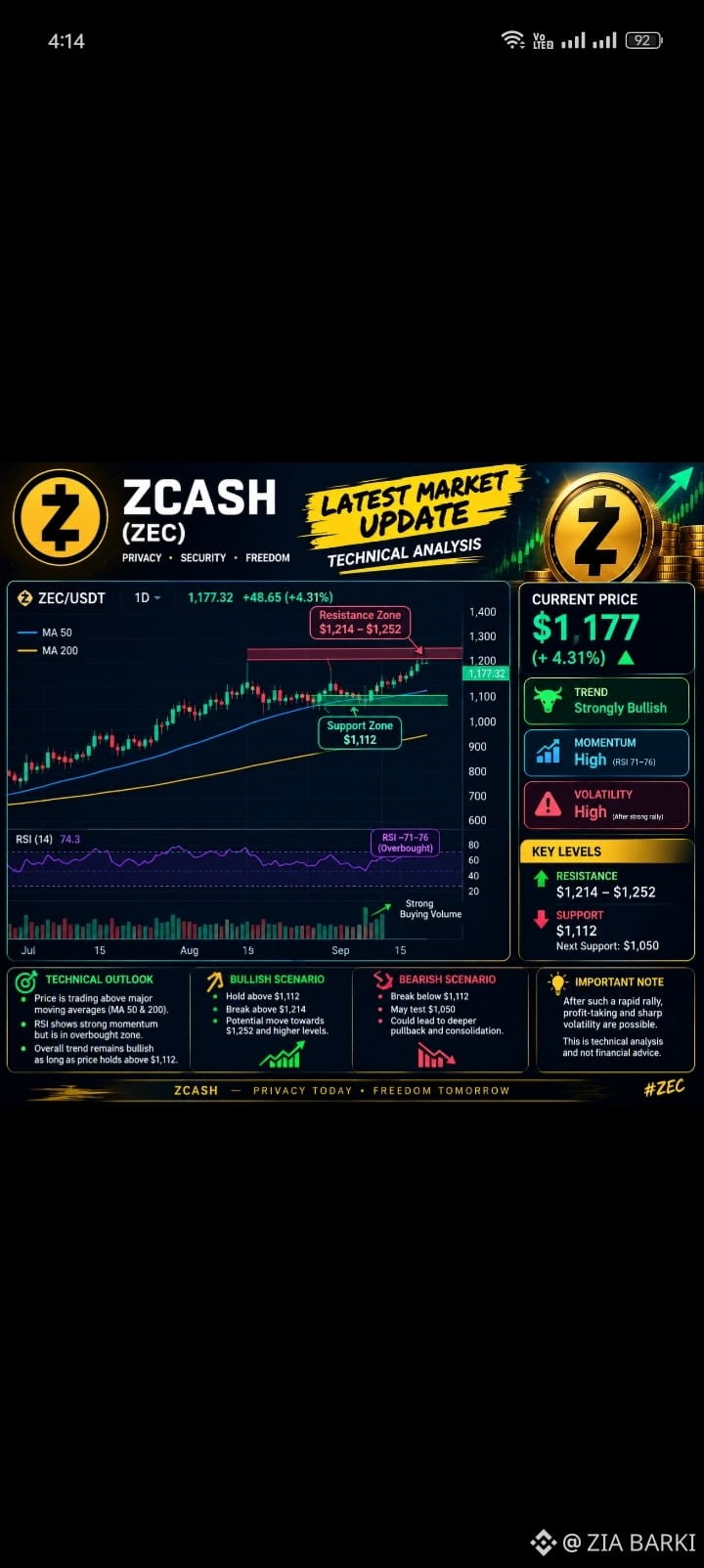
25
·
--
$BTC ₿ BTC — Latest Market Update
Bitcoin is trading around $78.9K, up modestly today. �
CoinDesk +1
Short-term trend: Consolidation with a slight recovery bias.
Support: ~$77K–$78K
Resistance: ~$80K, then ~$81K–$81.5K
Market risk: Rising oil prices and uncertainty around the upcoming U.S. Fed decisions
{future}(BTCUSDT)
#USStrikesTargetsNearHormuzAndJask #RippleLobbiesToAdvanceCLARITYActVote #ChinaAugustCPIRises0.8%YoY are keeping volatility elevated. �
Reuters +1
Overall: BTC remains range-bound; holding the $77K area keeps the near-term structure relatively constructive, while a sustained break above $80K would strengthen momentum. This is market analysis, not financial advice.
$BTC ₿ BTC — Latest Market Update
Bitcoin is trading around $78.9K, up modestly today. �
CoinDesk +1
Short-term trend: Consolidation with a slight recovery bias.
Support: ~$77K–$78K
Resistance: ~$80K, then ~$81K–$81.5K
Market risk: Rising oil prices and uncertainty around the upcoming U.S. Fed decisions
#USStrikesTargetsNearHormuzAndJask #RippleLobbiesToAdvanceCLARITYActVote #ChinaAugustCPIRises0.8%YoY are keeping volatility elevated. �
Reuters +1
Overall: BTC remains range-bound; holding the $77K area keeps the near-term structure relatively constructive, while a sustained break above $80K would strengthen momentum. This is market analysis, not financial advice.
Bitcoin is trading around $78.9K, up modestly today. �
CoinDesk +1
Short-term trend: Consolidation with a slight recovery bias.
Support: ~$77K–$78K
Resistance: ~$80K, then ~$81K–$81.5K
Market risk: Rising oil prices and uncertainty around the upcoming U.S. Fed decisions
#USStrikesTargetsNearHormuzAndJask #RippleLobbiesToAdvanceCLARITYActVote #ChinaAugustCPIRises0.8%YoY are keeping volatility elevated. �
Reuters +1
Overall: BTC remains range-bound; holding the $77K area keeps the near-term structure relatively constructive, while a sustained break above $80K would strengthen momentum. This is market analysis, not financial advice.
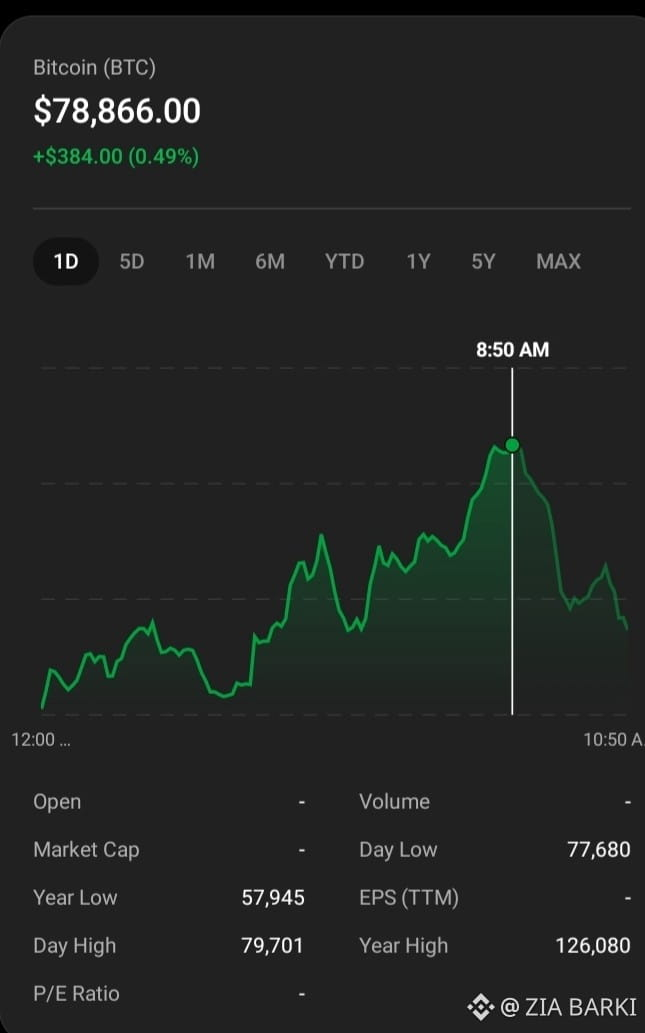
26
·
--
$ZEC $ZEC Latest Market Update — 9 September 2026 📊
ZEC is around $1,183, up roughly 4.8% today, with an intra day range of about $1,119–$1,210. �
CoinGecko
Momentum is extremely strong: ZEC is up about 43% over the past 7 days and has recently reached its highest levels since 2016. �
CoinGecko +1
The rally has been supported by institutional interest, including the Grayscale ZCASH ETF, alongside strong interest in privacy-focused cryptocurrency essays. �
Coin market cap
Key technical area: ~$1,020–$1,000 is an important previous breakout/support zone; holding above it would keep the broader bullish structure stronger. �
CoinDesk
{spot}(ZECUSDT)
#USStocksCloseLowerIntelRises9% +1
Risk: After such a rapid rally, volatility and profit-taking can be significant. A sustained move above recent highs would strengthen momentum, while losing major support could trigger a deeper correction.
Bottom line: 🔥 ZEC remains strongly bullish but highly volatile. The major question now is whether fresh buying can sustain the rally after its huge recent advance. �
CoinGecko
$ZEC $ZEC Latest Market Update — 9 September 2026 📊
ZEC is around $1,183, up roughly 4.8% today, with an intra day range of about $1,119–$1,210. �
CoinGecko
Momentum is extremely strong: ZEC is up about 43% over the past 7 days and has recently reached its highest levels since 2016. �
CoinGecko +1
The rally has been supported by institutional interest, including the Grayscale ZCASH ETF, alongside strong interest in privacy-focused cryptocurrency essays. �
Coin market cap
Key technical area: ~$1,020–$1,000 is an important previous breakout/support zone; holding above it would keep the broader bullish structure stronger. �
CoinDesk
#USStocksCloseLowerIntelRises9% +1
Risk: After such a rapid rally, volatility and profit-taking can be significant. A sustained move above recent highs would strengthen momentum, while losing major support could trigger a deeper correction.
Bottom line: 🔥 ZEC remains strongly bullish but highly volatile. The major question now is whether fresh buying can sustain the rally after its huge recent advance. �
CoinGecko
ZEC is around $1,183, up roughly 4.8% today, with an intra day range of about $1,119–$1,210. �
CoinGecko
Momentum is extremely strong: ZEC is up about 43% over the past 7 days and has recently reached its highest levels since 2016. �
CoinGecko +1
The rally has been supported by institutional interest, including the Grayscale ZCASH ETF, alongside strong interest in privacy-focused cryptocurrency essays. �
Coin market cap
Key technical area: ~$1,020–$1,000 is an important previous breakout/support zone; holding above it would keep the broader bullish structure stronger. �
CoinDesk
#USStocksCloseLowerIntelRises9% +1
Risk: After such a rapid rally, volatility and profit-taking can be significant. A sustained move above recent highs would strengthen momentum, while losing major support could trigger a deeper correction.
Bottom line: 🔥 ZEC remains strongly bullish but highly volatile. The major question now is whether fresh buying can sustain the rally after its huge recent advance. �
CoinGecko
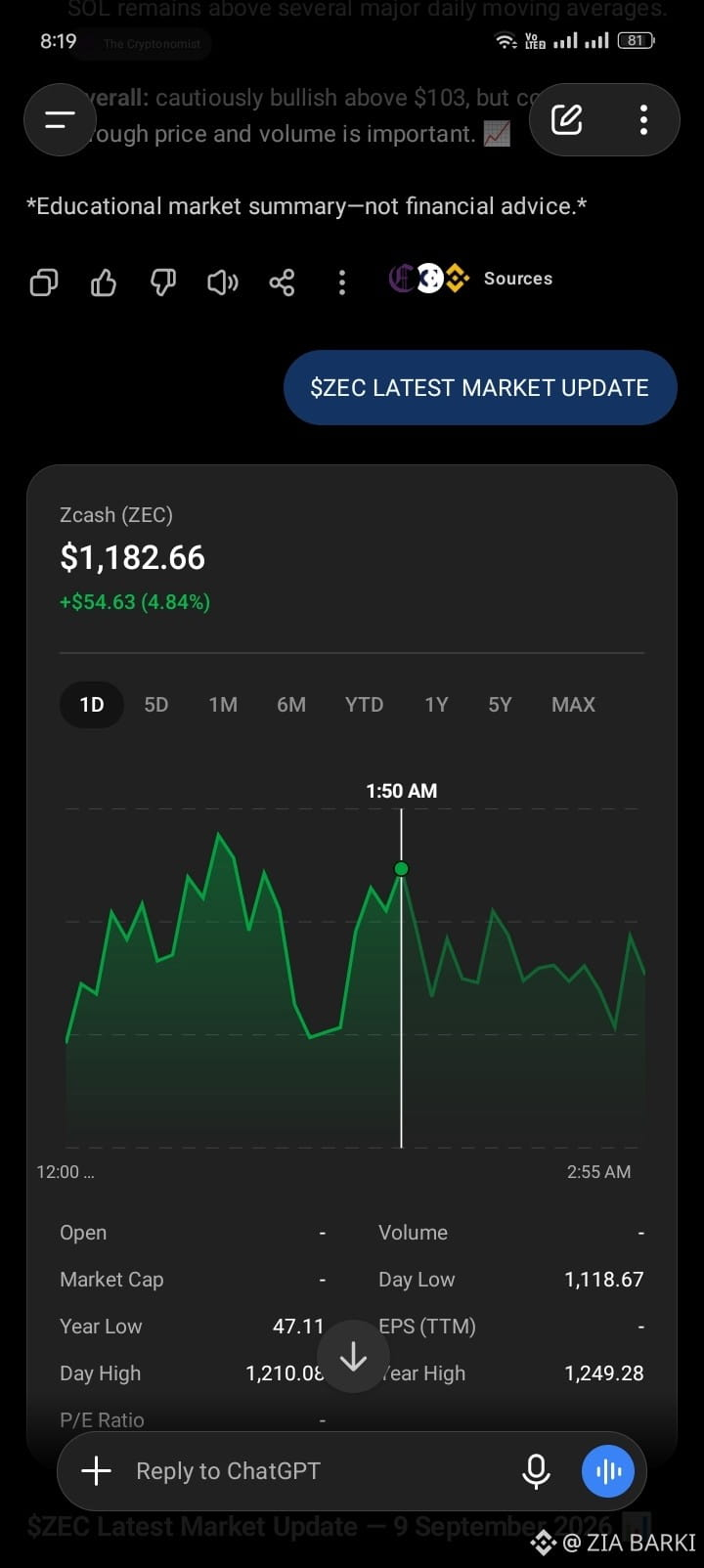
44
·
--
ETHERIUM ETH/USDT Comprehensive Market Update — September 9, 2026
ETH/USDT represents Ethereum priceETH/USDT represents Ethereum priced in Tether (USDT). Ethereum remains one of the most important assets in the crypto market because its ecosystem supports smart contracts, decentralized applications, stablecoins, tokenized assets, and Layer-2 networks.
Current market picture
Recent market data places Ethereum around $2,480–$2,500, with CoinDesk reporting approximately $2,485 and 24-hour trading volume of about $5.83 billion. � Ethereum is therefore trading well below its previous record high near $4,946, leaving the market in a recovery/consolidation phase rather than at an all-time high. �
CoinDesk
CoinGecko
📊 Technical outlook
The $2,500 area is currently an important psychological zone. Ethereum's recent price action has been characterized by consolidation around this level.
Immediate resistance: ~$2,500–$2,535
First support: ~$2,438–$2,450
Stronger support: around the lower $2,300s
A convincing move above resistance could improve bullish momentum.
Failure to hold the support region could increase short-term selling pressure.
These are market-observation levels, not guaranteed targets.
🔥 What is driving ETH?
1. U.S. monetary-policy expectations
Crypto markets remain sensitive to expectations surrounding U.S. interest rates. Recent reporting put Bitcoin near $80,000 and Ethereum around $2,500 as investors continued assessing changing rate expectations. �
The Economic Times
2. Institutional access
Ethereum's investment-product market continues to develop. For example, Hargreaves Lansdown recently began offering crypto ETNs, including Ether products, to eligible sophisticated investors after the UK's retail-access restrictions were eased. �
Financial Times
3. Ethereum network development
Ethereum's roadmap continues to focus on cheaper transactions, scaling, security and improved user experience. � Recent reporting also says Ethereum developers are increasingly prioritizing quantum resistance, with a 2029 security target being discussed. �
Ethereum
CoinDesk
4. Stablecoins and Ethereum's ecosystem
Stablecoins remain an important part of Ethereum's broader utility. Regulatory developments around stablecoins could influence the wider digital-asset ecosystem and demand for blockchain infrastructure. �
Reuters
🐂 Bullish scenario
If ETH establishes itself above the $2,500–$2,535 area with strong market participation, sentiment could improve and the market could begin looking toward higher resistance zones.
The important confirmation would be sustained price acceptance above resistance, rather than a brief move above it.
🐻 Bearish scenario
If ETH repeatedly fails around $2,500 and loses the $2,438–$2,450 support area, sellers could regain control. A deeper decline would make the next lower support zones increasingly important.
🌐 Bigger picture
Ethereum's long-term story is broader than its price. The network is being developed as infrastructure for decentralized applications, stablecoins, tokenized assets and scaling solutions. Its roadmap emphasizes improving scalability, transaction costs, security and user experience. �
Ethereum
At the same time, ETH remains highly sensitive to Bitcoin's direction, global liquidity, interest-rate expectations, institutional flows and overall risk sentiment. Today's broader market is also being affected by geopolitical tensions and higher oil prices, which can create additional volatility across risk assets. �
Reuters +1
📌 Bottom line
ETH/USDT is currently in a key consolidation zone around $2,500. The next major question is whether buyers can turn the $2,500–$2,535 region into support. A successful breakout could strengthen the recovery structure, while a breakdown below ~$2,440 would make the short-term outlook more cautious.
For a Binance-style post:
🚨 ETH/USDT MARKET UPDATE
Ethereum is consolidating around $2.5K, with bulls testing a major resistance zone. A confirmed breakout above $2,500–$2,535 could strengthen bullish momentum, while $2,438–$2,450 remains an important support area. With U.S. rate expectations and broader market volatility still influencing crypto, ETH traders should
{spot}(ETHUSDT)
#IranSaysItStruckTwoUSDestroyers #DowFallsOver600Points watch volume and confirmation closely. �
ETHERIUM ETH/USDT Comprehensive Market Update — September 9, 2026 ETH/USDT represents Ethereum price
ETH/USDT represents Ethereum priced in Tether (USDT). Ethereum remains one of the most important assets in the crypto market because its ecosystem supports smart contracts, decentralized applications, stablecoins, tokenized assets, and Layer-2 networks.
Current market picture
Recent market data places Ethereum around $2,480–$2,500, with CoinDesk reporting approximately $2,485 and 24-hour trading volume of about $5.83 billion. � Ethereum is therefore trading well below its previous record high near $4,946, leaving the market in a recovery/consolidation phase rather than at an all-time high. �
CoinDesk
CoinGecko
📊 Technical outlook
The $2,500 area is currently an important psychological zone. Ethereum's recent price action has been characterized by consolidation around this level.
Immediate resistance: ~$2,500–$2,535
First support: ~$2,438–$2,450
Stronger support: around the lower $2,300s
A convincing move above resistance could improve bullish momentum.
Failure to hold the support region could increase short-term selling pressure.
These are market-observation levels, not guaranteed targets.
🔥 What is driving ETH?
1. U.S. monetary-policy expectations
Crypto markets remain sensitive to expectations surrounding U.S. interest rates. Recent reporting put Bitcoin near $80,000 and Ethereum around $2,500 as investors continued assessing changing rate expectations. �
The Economic Times
2. Institutional access
Ethereum's investment-product market continues to develop. For example, Hargreaves Lansdown recently began offering crypto ETNs, including Ether products, to eligible sophisticated investors after the UK's retail-access restrictions were eased. �
Financial Times
3. Ethereum network development
Ethereum's roadmap continues to focus on cheaper transactions, scaling, security and improved user experience. � Recent reporting also says Ethereum developers are increasingly prioritizing quantum resistance, with a 2029 security target being discussed. �
Ethereum
CoinDesk
4. Stablecoins and Ethereum's ecosystem
Stablecoins remain an important part of Ethereum's broader utility. Regulatory developments around stablecoins could influence the wider digital-asset ecosystem and demand for blockchain infrastructure. �
Reuters
🐂 Bullish scenario
If ETH establishes itself above the $2,500–$2,535 area with strong market participation, sentiment could improve and the market could begin looking toward higher resistance zones.
The important confirmation would be sustained price acceptance above resistance, rather than a brief move above it.
🐻 Bearish scenario
If ETH repeatedly fails around $2,500 and loses the $2,438–$2,450 support area, sellers could regain control. A deeper decline would make the next lower support zones increasingly important.
🌐 Bigger picture
Ethereum's long-term story is broader than its price. The network is being developed as infrastructure for decentralized applications, stablecoins, tokenized assets and scaling solutions. Its roadmap emphasizes improving scalability, transaction costs, security and user experience. �
Ethereum
At the same time, ETH remains highly sensitive to Bitcoin's direction, global liquidity, interest-rate expectations, institutional flows and overall risk sentiment. Today's broader market is also being affected by geopolitical tensions and higher oil prices, which can create additional volatility across risk assets. �
Reuters +1
📌 Bottom line
ETH/USDT is currently in a key consolidation zone around $2,500. The next major question is whether buyers can turn the $2,500–$2,535 region into support. A successful breakout could strengthen the recovery structure, while a breakdown below ~$2,440 would make the short-term outlook more cautious.
For a Binance-style post:
🚨 ETH/USDT MARKET UPDATE
Ethereum is consolidating around $2.5K, with bulls testing a major resistance zone. A confirmed breakout above $2,500–$2,535 could strengthen bullish momentum, while $2,438–$2,450 remains an important support area. With U.S. rate expectations and broader market volatility still influencing crypto, ETH traders should
#IranSaysItStruckTwoUSDestroyers #DowFallsOver600Points watch volume and confirmation closely. �
Current market picture
Recent market data places Ethereum around $2,480–$2,500, with CoinDesk reporting approximately $2,485 and 24-hour trading volume of about $5.83 billion. � Ethereum is therefore trading well below its previous record high near $4,946, leaving the market in a recovery/consolidation phase rather than at an all-time high. �
CoinDesk
CoinGecko
📊 Technical outlook
The $2,500 area is currently an important psychological zone. Ethereum's recent price action has been characterized by consolidation around this level.
Immediate resistance: ~$2,500–$2,535
First support: ~$2,438–$2,450
Stronger support: around the lower $2,300s
A convincing move above resistance could improve bullish momentum.
Failure to hold the support region could increase short-term selling pressure.
These are market-observation levels, not guaranteed targets.
🔥 What is driving ETH?
1. U.S. monetary-policy expectations
Crypto markets remain sensitive to expectations surrounding U.S. interest rates. Recent reporting put Bitcoin near $80,000 and Ethereum around $2,500 as investors continued assessing changing rate expectations. �
The Economic Times
2. Institutional access
Ethereum's investment-product market continues to develop. For example, Hargreaves Lansdown recently began offering crypto ETNs, including Ether products, to eligible sophisticated investors after the UK's retail-access restrictions were eased. �
Financial Times
3. Ethereum network development
Ethereum's roadmap continues to focus on cheaper transactions, scaling, security and improved user experience. � Recent reporting also says Ethereum developers are increasingly prioritizing quantum resistance, with a 2029 security target being discussed. �
Ethereum
CoinDesk
4. Stablecoins and Ethereum's ecosystem
Stablecoins remain an important part of Ethereum's broader utility. Regulatory developments around stablecoins could influence the wider digital-asset ecosystem and demand for blockchain infrastructure. �
Reuters
🐂 Bullish scenario
If ETH establishes itself above the $2,500–$2,535 area with strong market participation, sentiment could improve and the market could begin looking toward higher resistance zones.
The important confirmation would be sustained price acceptance above resistance, rather than a brief move above it.
🐻 Bearish scenario
If ETH repeatedly fails around $2,500 and loses the $2,438–$2,450 support area, sellers could regain control. A deeper decline would make the next lower support zones increasingly important.
🌐 Bigger picture
Ethereum's long-term story is broader than its price. The network is being developed as infrastructure for decentralized applications, stablecoins, tokenized assets and scaling solutions. Its roadmap emphasizes improving scalability, transaction costs, security and user experience. �
Ethereum
At the same time, ETH remains highly sensitive to Bitcoin's direction, global liquidity, interest-rate expectations, institutional flows and overall risk sentiment. Today's broader market is also being affected by geopolitical tensions and higher oil prices, which can create additional volatility across risk assets. �
Reuters +1
📌 Bottom line
ETH/USDT is currently in a key consolidation zone around $2,500. The next major question is whether buyers can turn the $2,500–$2,535 region into support. A successful breakout could strengthen the recovery structure, while a breakdown below ~$2,440 would make the short-term outlook more cautious.
For a Binance-style post:
🚨 ETH/USDT MARKET UPDATE
Ethereum is consolidating around $2.5K, with bulls testing a major resistance zone. A confirmed breakout above $2,500–$2,535 could strengthen bullish momentum, while $2,438–$2,450 remains an important support area. With U.S. rate expectations and broader market volatility still influencing crypto, ETH traders should
#IranSaysItStruckTwoUSDestroyers #DowFallsOver600Points watch volume and confirmation closely. �
80
Войдите, чтобы посмотреть больше материала
Присоединяйтесь к пользователям криптовалют по всему миру на Binance Square
⚡️ Получайте новейшую и полезную информацию о криптоактивах.
💬 Нам доверяет крупнейшая в мире криптобиржа.
👍 Получите достоверные аналитические данные от верифицированных создателей контента.
Эл. почта/номер телефона
В тренде
SECReceivesGrayscaleLitecoinTrustETFFiling
Просмотров: 88,010
1,421 обсуждают
#secreceivesgrayscalelitecointrustetffiling
SEC RECEIVES GRAYSCALE LITECOIN ETF FILING: LTC JUST GOT ANOTHER SPOTLIGHT 🚨
The market was moving quietly when another Litecoin headline landed. For traders watching from the sidelines, it was the kind of filing that makes you pause and ask: is institutional access getting closer?
Grayscale’s Litecoin Trust has taken another step toward an ETF structure, with recent filings tied to the proposed transition and NYSE Arca listing process. The SEC’s record shows earlier proceedings around Grayscale’s Litecoin proposal, while the latest filing activity keeps the story alive.
The important point is that a filing is not an approval. Investors should separate regulatory progress from expectations of an immediate ETF launch.
My take: the bigger story is accessibility. An ETF structure can potentially make exposure to LTC easier for traditional investors who prefer regulated market products rather than directly holding cryptocurrency.
Litecoin is currently trading around $53.69 on Binance, with the asset showing modest 24-hour movement. That makes the regulatory development more interesting than simply chasing a headline-driven price reaction.
The real test comes next: regulatory decisions, market demand, liquidity, and whether institutional interest actually follows the paperwork.
A filing can open the door, but demand decides what happens after it opens.
❓Do you think a Grayscale Litecoin ETF could materially change LTC’s institutional demand?
Disclaimer: This is for informational purposes only and not financial advice. Crypto assets are volatile, and regulatory outcomes are uncertain.
#Litecoin #CryptoETF #GrowWithSAC $LTC $ETH $SOL
#SECReceivesGrayscaleLitecoinTrustETFFiling
Sienna Leo-你真棒-带我走
·Лайков: 3
·Просмотров: 2.3k
ClarityActFacesProceduralVoteSept15
Просмотров: 210,716
2,330 обсуждают
US10YearTreasuryYieldNears5%
Просмотров: 75,123
1,286 обсуждают