

明月Míngyuè
5k Публикации

明月Míngyuè
Отправить жалобу
Заблокировать пользователя
Открытая сделка
Трейдер с регулярными сделками
1.8 г
2.2K+ подписок(и/а)
9.6K+ подписчиков(а)
2.3K+ понравилось
Посты
Портфель
Все
Цитирования
Активно

·
--
Рост
#dusk $DUSK @Dusk_Foundation
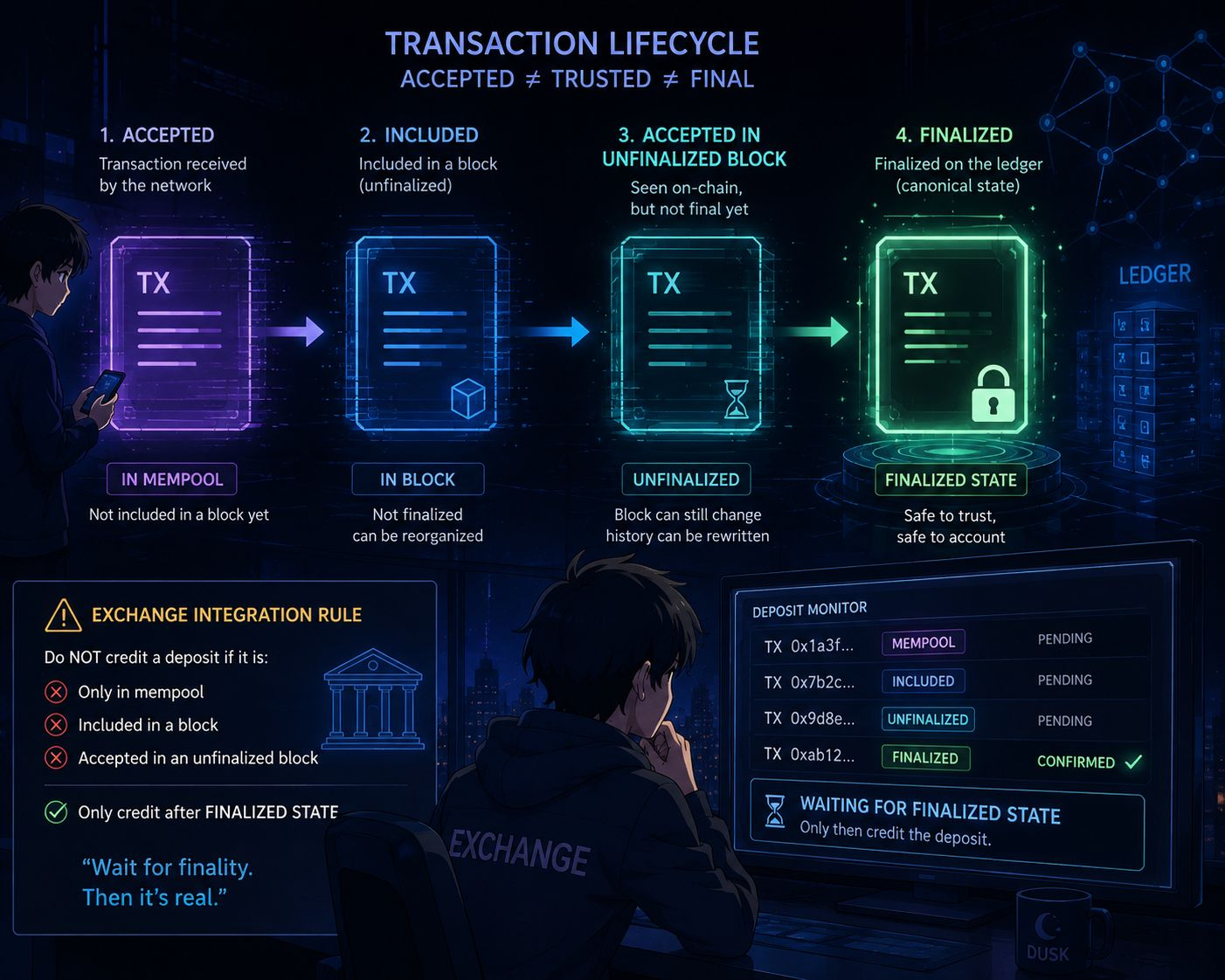
I was going through Dusk’s transaction docs when one small detail caught my attention.
Boreas introduced explicit boundaries between a transaction accepted from a client, its canonical representation, and the version committed to the ledger. The reason is pretty simple: different parts of the network shouldn’t interpret the same transaction differently.
Then I noticed something more practical in Dusk’s exchange integration docs.
An exchange is explicitly told not to credit a deposit just because it appeared in the mempool, was included, or was accepted in an unfinalized block. It has to wait for finalized state.
That made the Boreas change make more sense to me.
For financial infrastructure, consistency isn’t just about nodes agreeing with each other. It eventually becomes an accounting problem: when can another system safely treat an on-chain event as real?
I hadn’t really thought about the transaction lifecycle from that side before. Maybe the difficult part of putting financial activity on-chain isn’t recording the transaction. It’s knowing exactly when every system is allowed to trust it.
#Dusk $BTC $DUSK
#dusk $DUSK @Dusk
I was going through Dusk’s transaction docs when one small detail caught my attention.
Boreas introduced explicit boundaries between a transaction accepted from a client, its canonical representation, and the version committed to the ledger. The reason is pretty simple: different parts of the network shouldn’t interpret the same transaction differently.
Then I noticed something more practical in Dusk’s exchange integration docs.
An exchange is explicitly told not to credit a deposit just because it appeared in the mempool, was included, or was accepted in an unfinalized block. It has to wait for finalized state.
That made the Boreas change make more sense to me.
For financial infrastructure, consistency isn’t just about nodes agreeing with each other. It eventually becomes an accounting problem: when can another system safely treat an on-chain event as real?
I hadn’t really thought about the transaction lifecycle from that side before. Maybe the difficult part of putting financial activity on-chain isn’t recording the transaction. It’s knowing exactly when every system is allowed to trust it.
#Dusk $BTC $DUSK
I was going through Dusk’s transaction docs when one small detail caught my attention.
Boreas introduced explicit boundaries between a transaction accepted from a client, its canonical representation, and the version committed to the ledger. The reason is pretty simple: different parts of the network shouldn’t interpret the same transaction differently.
Then I noticed something more practical in Dusk’s exchange integration docs.
An exchange is explicitly told not to credit a deposit just because it appeared in the mempool, was included, or was accepted in an unfinalized block. It has to wait for finalized state.
That made the Boreas change make more sense to me.
For financial infrastructure, consistency isn’t just about nodes agreeing with each other. It eventually becomes an accounting problem: when can another system safely treat an on-chain event as real?
I hadn’t really thought about the transaction lifecycle from that side before. Maybe the difficult part of putting financial activity on-chain isn’t recording the transaction. It’s knowing exactly when every system is allowed to trust it.
#Dusk $BTC $DUSK
2
3
152
·
--
Рост
#dusk $DUSK @Dusk_Foundation
I used to think that once a transaction was accepted, it was basically done. Then I looked closer at Dusk’s transaction lifecycle and found a distinction I hadn’t really considered: submitted, accepted, and finalized aren’t necessarily the same moment.
That sounds like a technical detail until a financial application starts acting on that transaction.
If an asset transfer, payment, or another instruction depends on it, acting before finality could mean building the next step on a state that isn’t actually settled yet. What I find interesting is that Dusk treats deterministic finality as part of the infrastructure needed for financial applications, rather than just another blockchain performance metric.
At what point should a financial application stop asking “was it accepted?” and start asking “is it final?”
@Dusk_Foundation #dusk $BTC $BNB
#dusk $DUSK @Dusk
I used to think that once a transaction was accepted, it was basically done. Then I looked closer at Dusk’s transaction lifecycle and found a distinction I hadn’t really considered: submitted, accepted, and finalized aren’t necessarily the same moment.
That sounds like a technical detail until a financial application starts acting on that transaction.
If an asset transfer, payment, or another instruction depends on it, acting before finality could mean building the next step on a state that isn’t actually settled yet. What I find interesting is that Dusk treats deterministic finality as part of the infrastructure needed for financial applications, rather than just another blockchain performance metric.
At what point should a financial application stop asking “was it accepted?” and start asking “is it final?”
@Dusk #dusk $BTC $BNB
I used to think that once a transaction was accepted, it was basically done. Then I looked closer at Dusk’s transaction lifecycle and found a distinction I hadn’t really considered: submitted, accepted, and finalized aren’t necessarily the same moment.
That sounds like a technical detail until a financial application starts acting on that transaction.
If an asset transfer, payment, or another instruction depends on it, acting before finality could mean building the next step on a state that isn’t actually settled yet. What I find interesting is that Dusk treats deterministic finality as part of the infrastructure needed for financial applications, rather than just another blockchain performance metric.
At what point should a financial application stop asking “was it accepted?” and start asking “is it final?”
@Dusk #dusk $BTC $BNB
2
4
226
·
--
@Dusk_Foundation #dusk
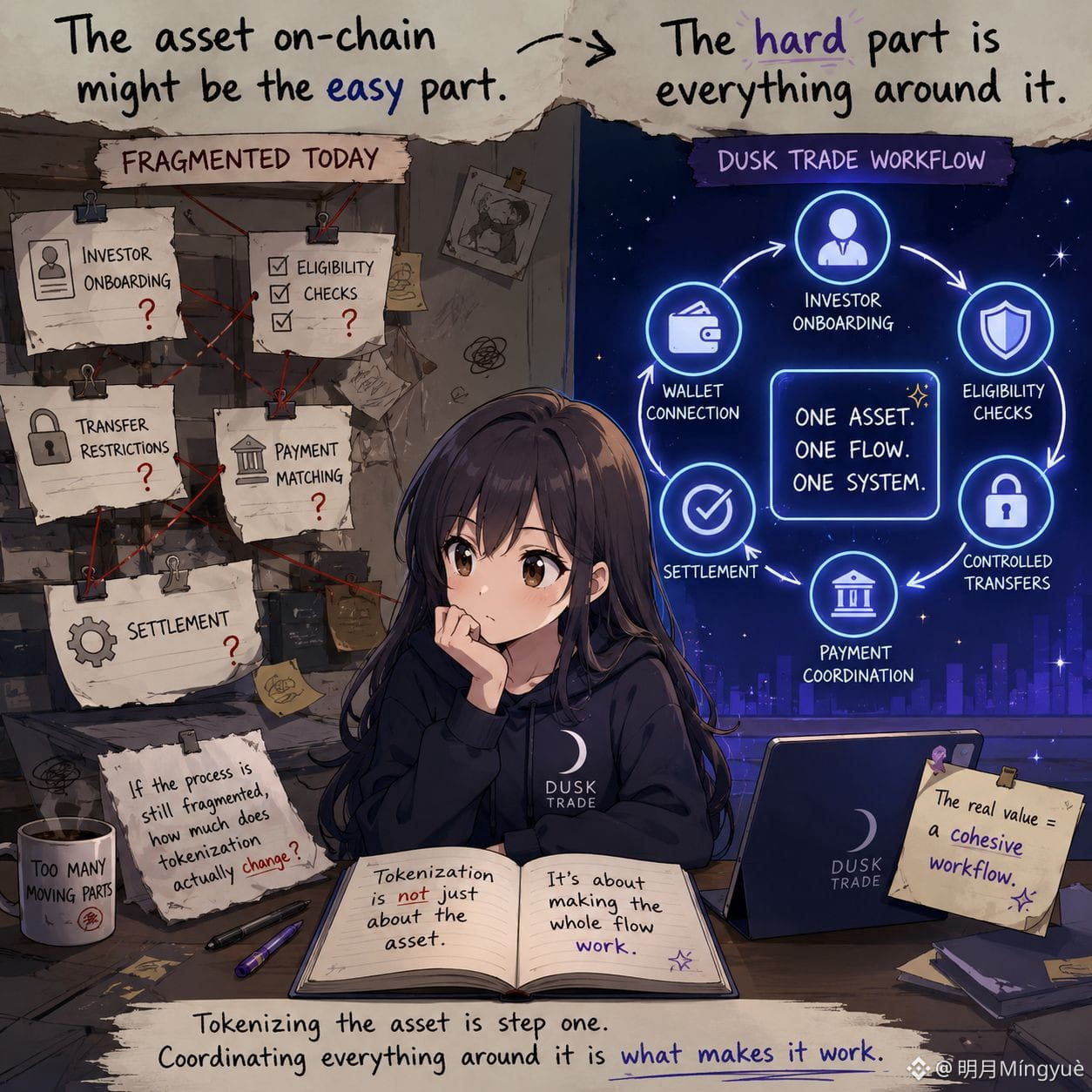
The more I look at tokenized finance, the more I think putting the asset on-chain might be the easy part.
The harder part is everything that happens around it.
An investor still needs to be on-boarded. Their eligibility may need to be checked. Transfers can have restrictions. The payment leg has to match the asset leg. And eventually, everything still needs to settle correctly.
That’s what made @Dusk_Foundation Trade more interesting to me.
It isn’t being built around simply listing tokenized assets. The workflow includes investor onboarding, wallet connection, controlled transfers, payment coordination, and settlement.
So maybe the real value of tokenization isn’t just turning an asset into a token. Maybe it’s whether the fragmented process around that asset can become one coherent workflow.
If that coordination remains fragmented, how much does tokenization actually change?
#dusk $DUSK $BTC $BNB
@Dusk #dusk
The more I look at tokenized finance, the more I think putting the asset on-chain might be the easy part.
The harder part is everything that happens around it.
An investor still needs to be on-boarded. Their eligibility may need to be checked. Transfers can have restrictions. The payment leg has to match the asset leg. And eventually, everything still needs to settle correctly.
That’s what made @Dusk Trade more interesting to me.
It isn’t being built around simply listing tokenized assets. The workflow includes investor onboarding, wallet connection, controlled transfers, payment coordination, and settlement.
So maybe the real value of tokenization isn’t just turning an asset into a token. Maybe it’s whether the fragmented process around that asset can become one coherent workflow.
If that coordination remains fragmented, how much does tokenization actually change?
#dusk $DUSK $BTC $BNB
The more I look at tokenized finance, the more I think putting the asset on-chain might be the easy part.
The harder part is everything that happens around it.
An investor still needs to be on-boarded. Their eligibility may need to be checked. Transfers can have restrictions. The payment leg has to match the asset leg. And eventually, everything still needs to settle correctly.
That’s what made @Dusk Trade more interesting to me.
It isn’t being built around simply listing tokenized assets. The workflow includes investor onboarding, wallet connection, controlled transfers, payment coordination, and settlement.
So maybe the real value of tokenization isn’t just turning an asset into a token. Maybe it’s whether the fragmented process around that asset can become one coherent workflow.
If that coordination remains fragmented, how much does tokenization actually change?
#dusk $DUSK $BTC $BNB
23
14
287
·
--
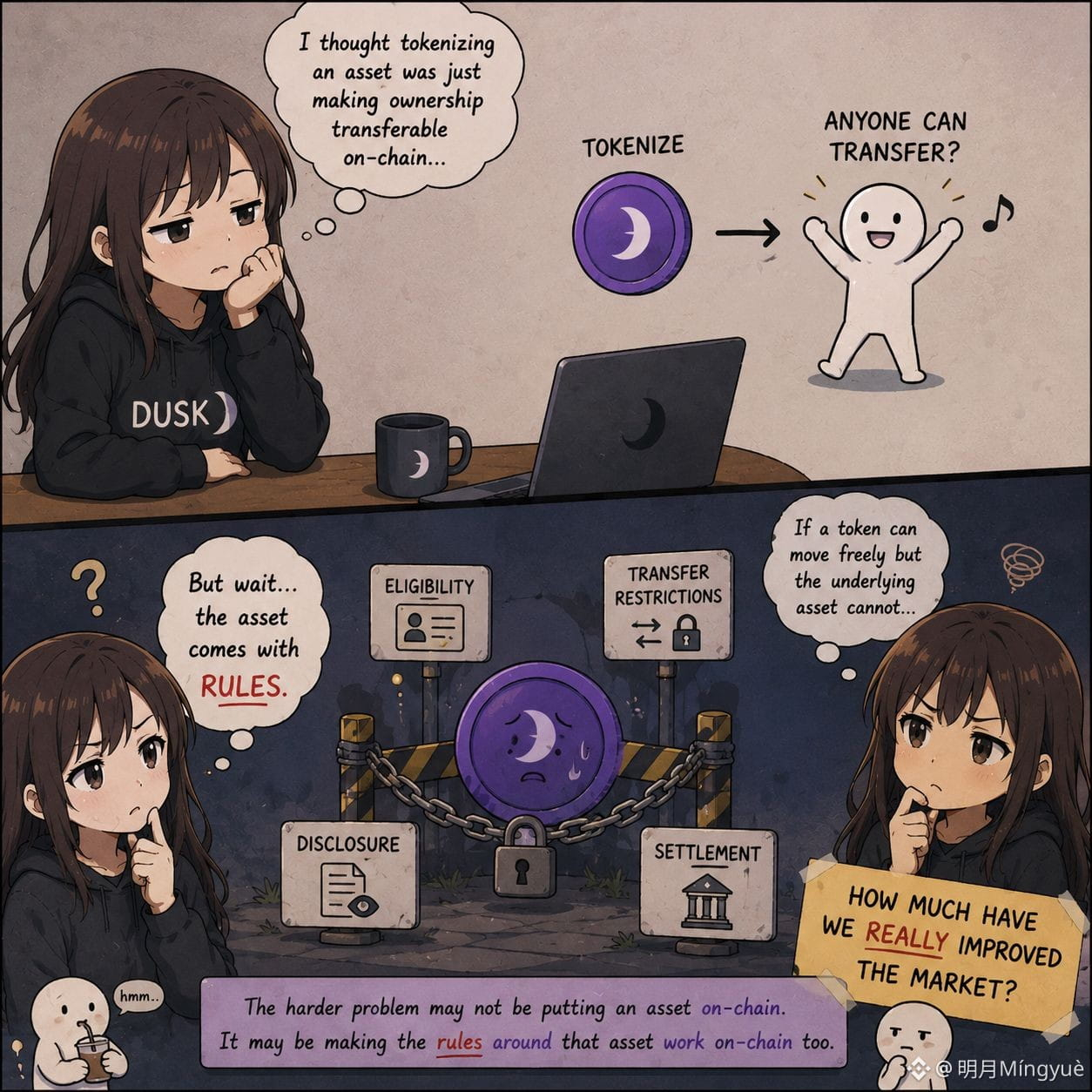
I used to think tokenizing an asset was mostly about making ownership transferable on-chain. But that assumption starts to break down when the asset itself comes with rules.
A regulated security may not be something anyone should be able to buy, hold, or transfer. Eligibility, transfer restrictions, disclosure, and settlement can all matter.
That’s what I find interesting about Dusk.
The token isn’t treated as the whole product. The workflow around it can include access controls, investor eligibility, controlled transfers and settlement coordination. It makes me think the harder problem in tokenized finance may not be putting an asset on-chain. It may be making the rules around that asset work on-chain too.
And that raises a question for me:
If a token can move freely but the underlying asset cannot, how much have we actually improved the market?
#Dusk $DUSK @Dusk_Foundation
I used to think tokenizing an asset was mostly about making ownership transferable on-chain. But that assumption starts to break down when the asset itself comes with rules.
A regulated security may not be something anyone should be able to buy, hold, or transfer. Eligibility, transfer restrictions, disclosure, and settlement can all matter.
That’s what I find interesting about Dusk.
The token isn’t treated as the whole product. The workflow around it can include access controls, investor eligibility, controlled transfers and settlement coordination. It makes me think the harder problem in tokenized finance may not be putting an asset on-chain. It may be making the rules around that asset work on-chain too.
And that raises a question for me:
If a token can move freely but the underlying asset cannot, how much have we actually improved the market?
#Dusk $DUSK @Dusk
A regulated security may not be something anyone should be able to buy, hold, or transfer. Eligibility, transfer restrictions, disclosure, and settlement can all matter.
That’s what I find interesting about Dusk.
The token isn’t treated as the whole product. The workflow around it can include access controls, investor eligibility, controlled transfers and settlement coordination. It makes me think the harder problem in tokenized finance may not be putting an asset on-chain. It may be making the rules around that asset work on-chain too.
And that raises a question for me:
If a token can move freely but the underlying asset cannot, how much have we actually improved the market?
#Dusk $DUSK @Dusk
31
11
223
·
--
The more I look at financial markets on-chain, the more I think transparency and visibility are not the same thing.
A regulated market needs to verify things like eligibility and compliance, but that doesn't mean every detail should be exposed publicly.
That’s what I find interesting about Dusk’s selective disclosure approach.
The idea isn't simply to hide information. It’s to prove what needs to be proven while keeping information that doesn't need to be public private.
For normal crypto transactions, this distinction can feel less important.
For regulated financial assets, it could be one of the things that makes on-chain markets actually workable.
Maybe the goal shouldn't be maximum transparency.
Maybe it should be maximum verifiability with only the necessary information exposed.
#dusk $DUSK @Dusk_Foundation
The more I look at financial markets on-chain, the more I think transparency and visibility are not the same thing.
A regulated market needs to verify things like eligibility and compliance, but that doesn't mean every detail should be exposed publicly.
That’s what I find interesting about Dusk’s selective disclosure approach.
The idea isn't simply to hide information. It’s to prove what needs to be proven while keeping information that doesn't need to be public private.
For normal crypto transactions, this distinction can feel less important.
For regulated financial assets, it could be one of the things that makes on-chain markets actually workable.
Maybe the goal shouldn't be maximum transparency.
Maybe it should be maximum verifiability with only the necessary information exposed.
#dusk $DUSK @Dusk
A regulated market needs to verify things like eligibility and compliance, but that doesn't mean every detail should be exposed publicly.
That’s what I find interesting about Dusk’s selective disclosure approach.
The idea isn't simply to hide information. It’s to prove what needs to be proven while keeping information that doesn't need to be public private.
For normal crypto transactions, this distinction can feel less important.
For regulated financial assets, it could be one of the things that makes on-chain markets actually workable.
Maybe the goal shouldn't be maximum transparency.
Maybe it should be maximum verifiability with only the necessary information exposed.
#dusk $DUSK @Dusk
1
2
144
·
--
I used to think fixed-rate lending was basically a waiting game.
You lend, lock in the terms, and wait for maturity.
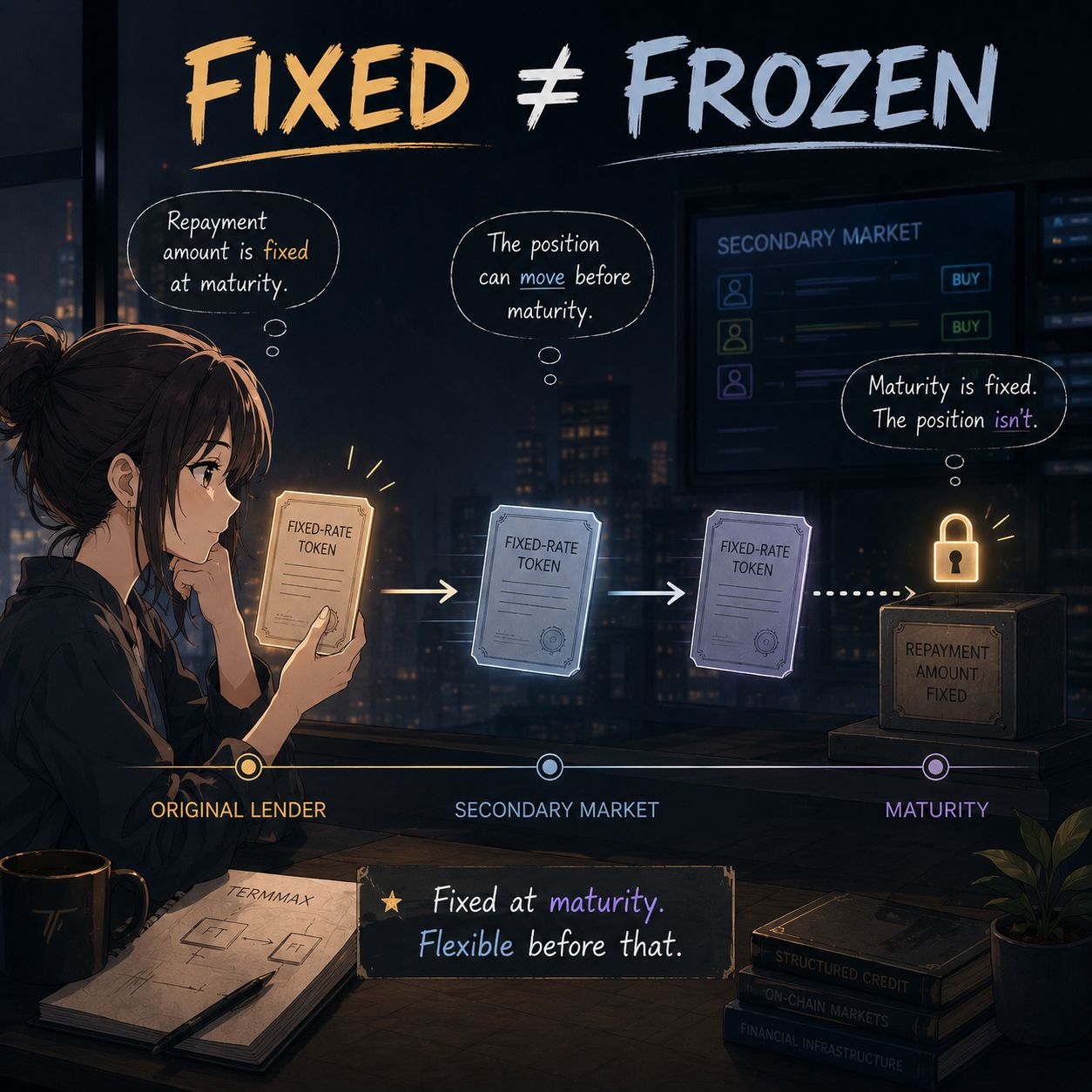
Then I came across something about TermMax that made me look at it differently: its Fixed-Rate Token (FT) can be traded before maturity. That sounds simple, but I think there’s a bigger idea behind it.
The repayment amount at maturity can be fixed, while the position itself doesn’t necessarily have to stay with the original lender until then. So a fixed-term loan doesn’t automatically mean a completely fixed position.
You could hold the claim toward maturity, but there can also be a market for that claim before the maturity date. That made me rethink what “fixed” actually means in fixed-rate lending.
Maybe the interesting part isn’t only making the return predictable. It’s making the credit position itself transferable while keeping the original maturity structure intact.
If the repayment is fixed, but the position can trade before maturity, what exactly is fixed?
@termmax #TermMax
I used to think fixed-rate lending was basically a waiting game.
You lend, lock in the terms, and wait for maturity.
Then I came across something about TermMax that made me look at it differently: its Fixed-Rate Token (FT) can be traded before maturity. That sounds simple, but I think there’s a bigger idea behind it.
The repayment amount at maturity can be fixed, while the position itself doesn’t necessarily have to stay with the original lender until then. So a fixed-term loan doesn’t automatically mean a completely fixed position.
You could hold the claim toward maturity, but there can also be a market for that claim before the maturity date. That made me rethink what “fixed” actually means in fixed-rate lending.
Maybe the interesting part isn’t only making the return predictable. It’s making the credit position itself transferable while keeping the original maturity structure intact.
If the repayment is fixed, but the position can trade before maturity, what exactly is fixed?
@TermMax #TermMax
You lend, lock in the terms, and wait for maturity.
Then I came across something about TermMax that made me look at it differently: its Fixed-Rate Token (FT) can be traded before maturity. That sounds simple, but I think there’s a bigger idea behind it.
The repayment amount at maturity can be fixed, while the position itself doesn’t necessarily have to stay with the original lender until then. So a fixed-term loan doesn’t automatically mean a completely fixed position.
You could hold the claim toward maturity, but there can also be a market for that claim before the maturity date. That made me rethink what “fixed” actually means in fixed-rate lending.
Maybe the interesting part isn’t only making the return predictable. It’s making the credit position itself transferable while keeping the original maturity structure intact.
If the repayment is fixed, but the position can trade before maturity, what exactly is fixed?
@TermMax #TermMax
29
11
188
·
--
One thing I keep thinking about with onchain finance is that “programmable” doesn’t always have to mean completely open. With regulated assets, there are rules around who can hold them, who can transfer them and what information should actually be visible. That creates an interesting problem: how do you keep financial assets programmable while still respecting those rules?
That’s where Dusk caught my attention.
Its infrastructure includes access controls and transfer restrictions for regulated assets, while Citadel supports identity and selective disclosure. So instead of treating compliance as something that happens outside the chain, these requirements can become part of the asset workflow itself.
I find that distinction more interesting than simply saying “RWAs are coming on-chain.”
Because the real challenge isn't just making an asset programmable.
It’s making it usable within the rules that come with the asset.
And I think that’s one of the more interesting things to watch with Dusk: can financial assets remain programmable while the controls around them become part of the same onchain system?
#dusk $DUSK @Dusk_Foundation
One thing I keep thinking about with onchain finance is that “programmable” doesn’t always have to mean completely open. With regulated assets, there are rules around who can hold them, who can transfer them and what information should actually be visible. That creates an interesting problem: how do you keep financial assets programmable while still respecting those rules?
That’s where Dusk caught my attention.
Its infrastructure includes access controls and transfer restrictions for regulated assets, while Citadel supports identity and selective disclosure. So instead of treating compliance as something that happens outside the chain, these requirements can become part of the asset workflow itself.
I find that distinction more interesting than simply saying “RWAs are coming on-chain.”
Because the real challenge isn't just making an asset programmable.
It’s making it usable within the rules that come with the asset.
And I think that’s one of the more interesting things to watch with Dusk: can financial assets remain programmable while the controls around them become part of the same onchain system?
#dusk $DUSK @Dusk
That’s where Dusk caught my attention.
Its infrastructure includes access controls and transfer restrictions for regulated assets, while Citadel supports identity and selective disclosure. So instead of treating compliance as something that happens outside the chain, these requirements can become part of the asset workflow itself.
I find that distinction more interesting than simply saying “RWAs are coming on-chain.”
Because the real challenge isn't just making an asset programmable.
It’s making it usable within the rules that come with the asset.
And I think that’s one of the more interesting things to watch with Dusk: can financial assets remain programmable while the controls around them become part of the same onchain system?
#dusk $DUSK @Dusk
2
155
·
--
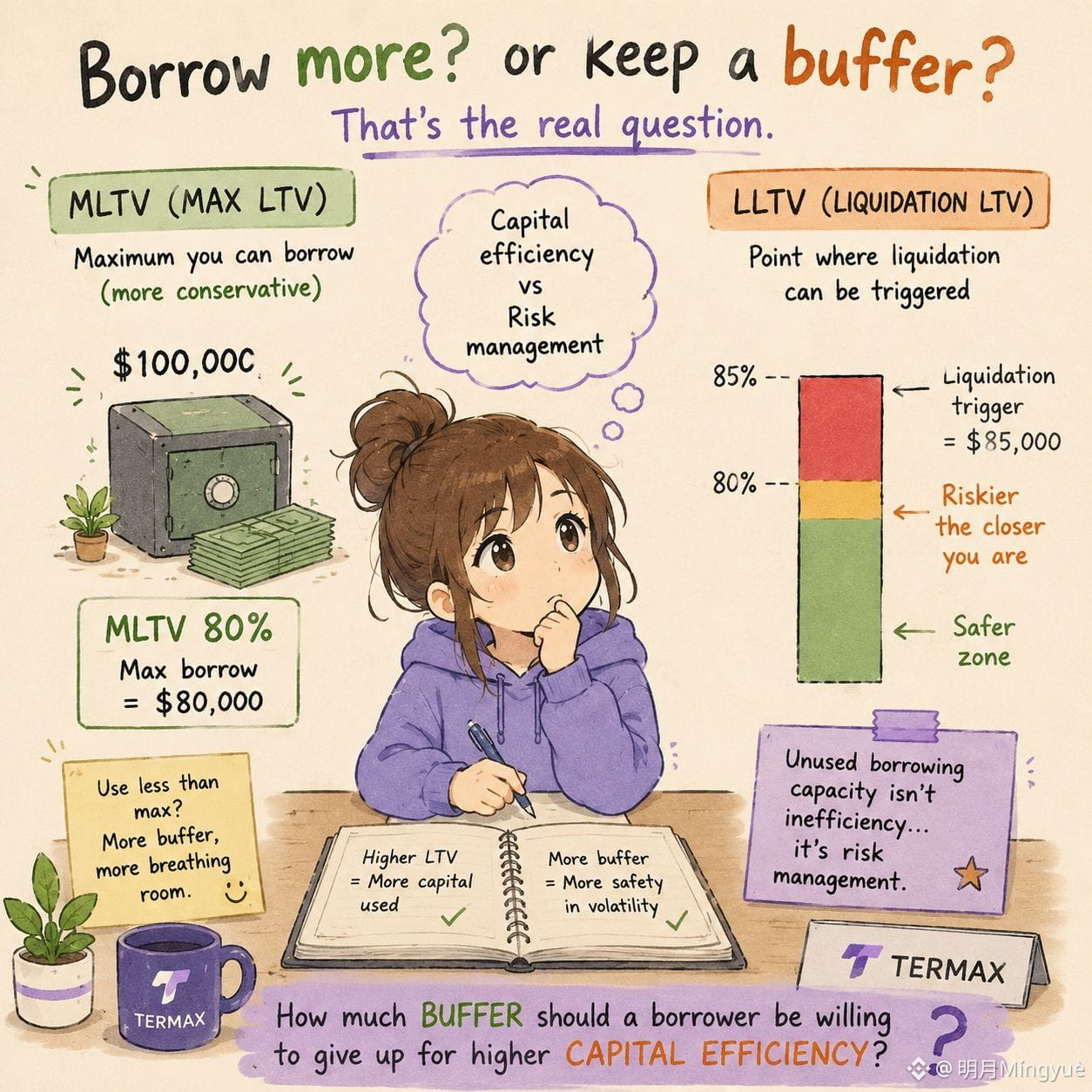
Something I noticed while looking at @termmax ’s collateral model: the amount you can borrow and the point where liquidation starts aren’t the same thing.
Say I have $100K worth of collateral. My first thought would probably be to borrow as close to the limit as possible. But that also means leaving less room if the collateral price moves against me.
TermMax separates these two points with MLTV and LLTV. MLTV is the more conservative borrowing limit, while LLTV is the point where liquidation can be triggered. What I find interesting is the space between them.
That gap is basically a buffer. I’m not using every possible dollar of borrowing capacity just because my collateral technically allows it. And that made me think differently about “capital efficiency.”
We usually treat higher LTV as better because more capital is being put to work.
But if using that extra capacity also leaves the position much closer to liquidation, is it really more efficient?
Maybe there’s a point where unused borrowing capacity isn’t inefficiency. it’s risk management.
How much buffer should a borrower actually be willing to give up for higher capital efficiency?
#TermMax @termmax
Something I noticed while looking at @TermMax ’s collateral model: the amount you can borrow and the point where liquidation starts aren’t the same thing.
Say I have $100K worth of collateral. My first thought would probably be to borrow as close to the limit as possible. But that also means leaving less room if the collateral price moves against me.
TermMax separates these two points with MLTV and LLTV. MLTV is the more conservative borrowing limit, while LLTV is the point where liquidation can be triggered. What I find interesting is the space between them.
That gap is basically a buffer. I’m not using every possible dollar of borrowing capacity just because my collateral technically allows it. And that made me think differently about “capital efficiency.”
We usually treat higher LTV as better because more capital is being put to work.
But if using that extra capacity also leaves the position much closer to liquidation, is it really more efficient?
Maybe there’s a point where unused borrowing capacity isn’t inefficiency. it’s risk management.
How much buffer should a borrower actually be willing to give up for higher capital efficiency?
#TermMax @TermMax
Say I have $100K worth of collateral. My first thought would probably be to borrow as close to the limit as possible. But that also means leaving less room if the collateral price moves against me.
TermMax separates these two points with MLTV and LLTV. MLTV is the more conservative borrowing limit, while LLTV is the point where liquidation can be triggered. What I find interesting is the space between them.
That gap is basically a buffer. I’m not using every possible dollar of borrowing capacity just because my collateral technically allows it. And that made me think differently about “capital efficiency.”
We usually treat higher LTV as better because more capital is being put to work.
But if using that extra capacity also leaves the position much closer to liquidation, is it really more efficient?
Maybe there’s a point where unused borrowing capacity isn’t inefficiency. it’s risk management.
How much buffer should a borrower actually be willing to give up for higher capital efficiency?
#TermMax @TermMax
15
10
180
·
--
The more I look at @termmax 's Range Orders, the more I question the idea of a single lending rate.
Say I’m willing to lend $100K at 8%.
Would I really price the next $900K of my liquidity at the same 8%?
Probably not.
The more of my capital gets committed, the more I have to think about concentration, liquidity and what else that capital could be doing. So for me, the interesting part of a Range Order isn’t simply that I can choose a rate.
It’s that I can make my rate change as more of my liquidity gets taken.
That feels closer to how capital is actually priced.
The first $100K can be relatively cheap. If the market wants another $400K, maybe my required return moves higher. Instead of placing five different orders to express that preference, the curve itself can carry it.
But there’s a trade-off here too.
A more expressive order gives the liquidity provider more control, but it also means more responsibility for deciding where that curve should sit.
And that makes me wonder:
Are we moving from markets where liquidity has one price to markets where liquidity itself can have a pricing strategy?
That feels like a much bigger shift than just adding another order type.
#termmax @termmax
The more I look at @TermMax 's Range Orders, the more I question the idea of a single lending rate.
Say I’m willing to lend $100K at 8%.
Would I really price the next $900K of my liquidity at the same 8%?
Probably not.
The more of my capital gets committed, the more I have to think about concentration, liquidity and what else that capital could be doing. So for me, the interesting part of a Range Order isn’t simply that I can choose a rate.
It’s that I can make my rate change as more of my liquidity gets taken.
That feels closer to how capital is actually priced.
The first $100K can be relatively cheap. If the market wants another $400K, maybe my required return moves higher. Instead of placing five different orders to express that preference, the curve itself can carry it.
But there’s a trade-off here too.
A more expressive order gives the liquidity provider more control, but it also means more responsibility for deciding where that curve should sit.
And that makes me wonder:
Are we moving from markets where liquidity has one price to markets where liquidity itself can have a pricing strategy?
That feels like a much bigger shift than just adding another order type.
#termmax @TermMax
Say I’m willing to lend $100K at 8%.
Would I really price the next $900K of my liquidity at the same 8%?
Probably not.
The more of my capital gets committed, the more I have to think about concentration, liquidity and what else that capital could be doing. So for me, the interesting part of a Range Order isn’t simply that I can choose a rate.
It’s that I can make my rate change as more of my liquidity gets taken.
That feels closer to how capital is actually priced.
The first $100K can be relatively cheap. If the market wants another $400K, maybe my required return moves higher. Instead of placing five different orders to express that preference, the curve itself can carry it.
But there’s a trade-off here too.
A more expressive order gives the liquidity provider more control, but it also means more responsibility for deciding where that curve should sit.
And that makes me wonder:
Are we moving from markets where liquidity has one price to markets where liquidity itself can have a pricing strategy?
That feels like a much bigger shift than just adding another order type.
#termmax @TermMax
2
59
·
--
Торговля за 30 дней $DUSK 231.4 USDT
The more I looked into Dusk, the more I started thinking that tokenizing an asset might actually be the easy part.
Putting an asset on-chain sounds great, but then the real questions start. Who can access it? Who can transfer it? What information should be visible? And once it trades, how does everything actually settle?
That’s the part of Dusk I found more interesting.
Instead of leaving compliance and market rules somewhere outside the blockchain, Dusk is building them into the infrastructure itself. Citadel handles identity and access with selective disclosure, while DuskDS provides the underlying settlement and data-availability layer.
And NPEX makes this more than just an interesting architecture on paper. It’s a regulated Dutch trading venue, and Dusk is working with NPEX around bringing regulated securities and RWA workflows on-chain.
So now I don't really ask, “Can we tokenize this asset?”
That part is already understood.
I’m more interested in whether the rules, trading and settlement around that asset can actually work on-chain.
That’s where Dusk gets interesting to me.
@Dusk_Foundation #dusk $DUSK
The more I looked into Dusk, the more I started thinking that tokenizing an asset might actually be the easy part.
Putting an asset on-chain sounds great, but then the real questions start. Who can access it? Who can transfer it? What information should be visible? And once it trades, how does everything actually settle?
That’s the part of Dusk I found more interesting.
Instead of leaving compliance and market rules somewhere outside the blockchain, Dusk is building them into the infrastructure itself. Citadel handles identity and access with selective disclosure, while DuskDS provides the underlying settlement and data-availability layer.
And NPEX makes this more than just an interesting architecture on paper. It’s a regulated Dutch trading venue, and Dusk is working with NPEX around bringing regulated securities and RWA workflows on-chain.
So now I don't really ask, “Can we tokenize this asset?”
That part is already understood.
I’m more interested in whether the rules, trading and settlement around that asset can actually work on-chain.
That’s where Dusk gets interesting to me.
@Dusk #dusk $DUSK
Putting an asset on-chain sounds great, but then the real questions start. Who can access it? Who can transfer it? What information should be visible? And once it trades, how does everything actually settle?
That’s the part of Dusk I found more interesting.
Instead of leaving compliance and market rules somewhere outside the blockchain, Dusk is building them into the infrastructure itself. Citadel handles identity and access with selective disclosure, while DuskDS provides the underlying settlement and data-availability layer.
And NPEX makes this more than just an interesting architecture on paper. It’s a regulated Dutch trading venue, and Dusk is working with NPEX around bringing regulated securities and RWA workflows on-chain.
So now I don't really ask, “Can we tokenize this asset?”
That part is already understood.
I’m more interested in whether the rules, trading and settlement around that asset can actually work on-chain.
That’s where Dusk gets interesting to me.
@Dusk #dusk $DUSK

3
131
·
--
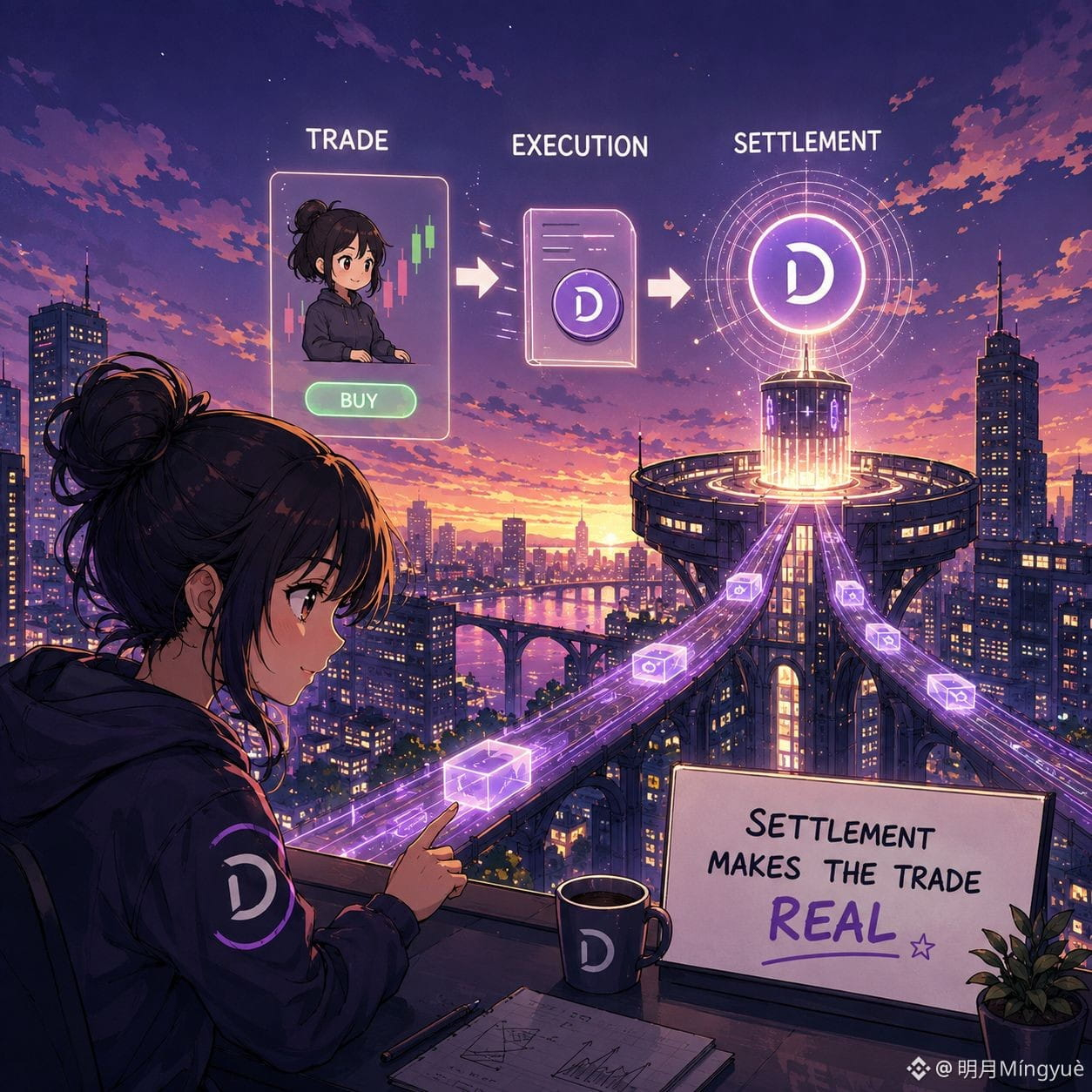
The more I look at on-chain finance, the more one thing feels underrated- settlement.
Tokenizing an asset sounds impressive, but that’s only one part of the story. The real test starts after the trade. when the transaction has to settle, the network has to agree on the final state, and the whole process has to work reliably for actual financial markets.
That’s one reason Dusk caught my attention.
Its architecture separates execution from the settlement layer, with DuskDS handling consensus, data availability and settlement. So the focus isn't simply “let’s put financial assets on a blockchain.” It’s about building infrastructure where the market activity around those assets can actually settle on-chain.
And I think this is an easy part to overlook because tokenization is much easier to talk about.
A token is visible.
Settlement is what makes the token useful.
So when people ask what Dusk is bringing on-chain, I think there’s a better question:
Are we just putting financial assets on-chain, or are we actually rebuilding the market infrastructure around them?
#dusk $DUSK @Dusk_Foundation
The more I look at on-chain finance, the more one thing feels underrated- settlement.
Tokenizing an asset sounds impressive, but that’s only one part of the story. The real test starts after the trade. when the transaction has to settle, the network has to agree on the final state, and the whole process has to work reliably for actual financial markets.
That’s one reason Dusk caught my attention.
Its architecture separates execution from the settlement layer, with DuskDS handling consensus, data availability and settlement. So the focus isn't simply “let’s put financial assets on a blockchain.” It’s about building infrastructure where the market activity around those assets can actually settle on-chain.
And I think this is an easy part to overlook because tokenization is much easier to talk about.
A token is visible.
Settlement is what makes the token useful.
So when people ask what Dusk is bringing on-chain, I think there’s a better question:
Are we just putting financial assets on-chain, or are we actually rebuilding the market infrastructure around them?
#dusk $DUSK @Dusk
Tokenizing an asset sounds impressive, but that’s only one part of the story. The real test starts after the trade. when the transaction has to settle, the network has to agree on the final state, and the whole process has to work reliably for actual financial markets.
That’s one reason Dusk caught my attention.
Its architecture separates execution from the settlement layer, with DuskDS handling consensus, data availability and settlement. So the focus isn't simply “let’s put financial assets on a blockchain.” It’s about building infrastructure where the market activity around those assets can actually settle on-chain.
And I think this is an easy part to overlook because tokenization is much easier to talk about.
A token is visible.
Settlement is what makes the token useful.
So when people ask what Dusk is bringing on-chain, I think there’s a better question:
Are we just putting financial assets on-chain, or are we actually rebuilding the market infrastructure around them?
#dusk $DUSK @Dusk
4
5
159
·
--
I went a little deeper into TermMax today.
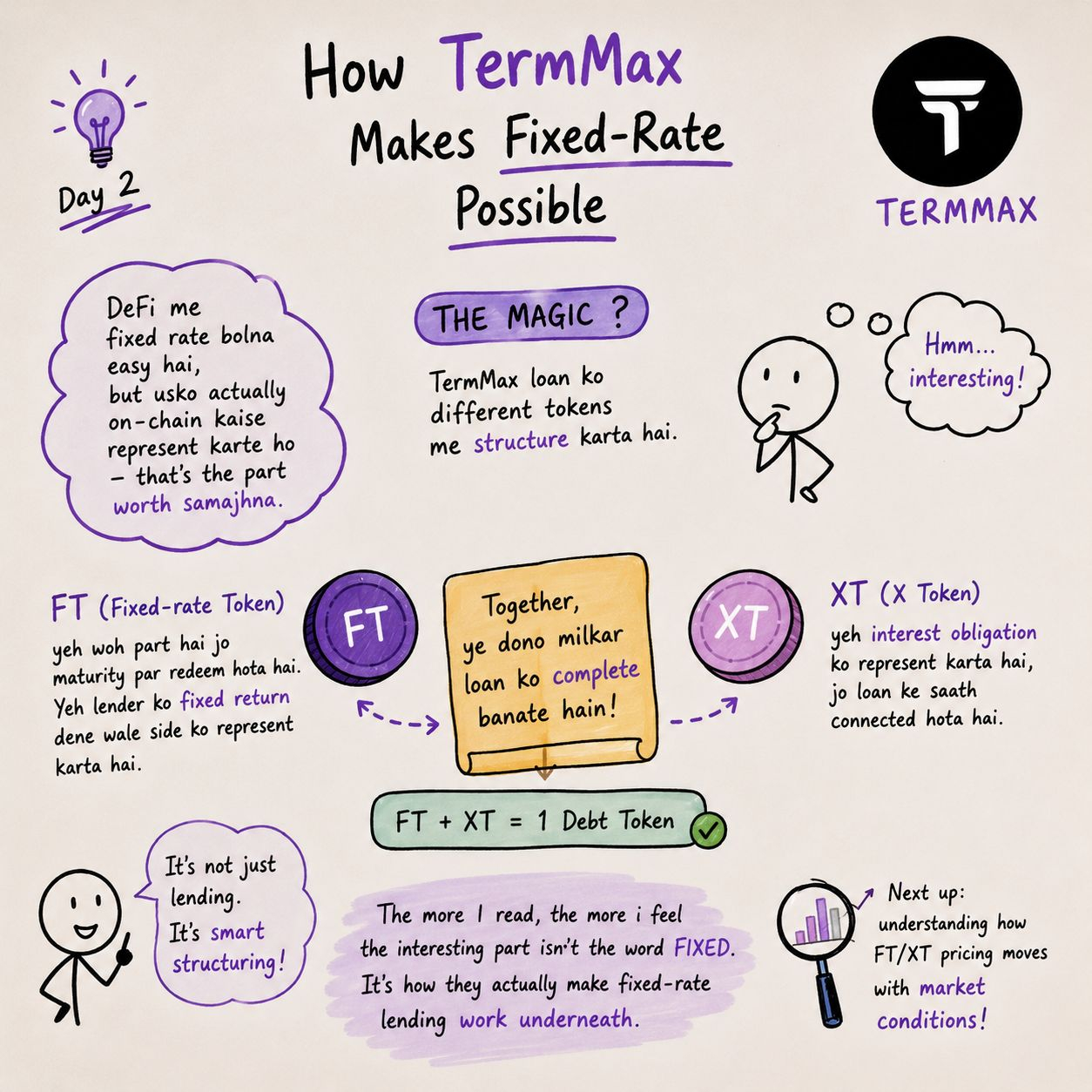
Yesterday I was mainly looking at the fixed-rate part. Aaj thoda mechanism samajhne ki koshish ki, and that’s where FT and XT caught my attention.
TermMax doesn’t just say “this loan has a fixed rate” and leave it there. The debt itself is structured through different tokens.
FT, the Fixed-rate Token, represents the amount that can be redeemed at maturity. It’s the part that gives the lender that fixed-return side.
XT is basically the other side of that structure — it represents the interest obligation connected to the loan.
What I found interesting is that these aren’t just random extra tokens. They’re actually part of how TermMax turns a fixed-rate loan into something that can exist and be traded on-chain.
Thoda technical hai, but this is the kind of thing I wanted to understand before just calling TermMax “another lending protocol.”
The more I read, the more I feel the interesting part isn't the word fixed.
It’s how they actually make fixed-rate lending work underneath.
#termmax @termmax
I went a little deeper into TermMax today.
Yesterday I was mainly looking at the fixed-rate part. Aaj thoda mechanism samajhne ki koshish ki, and that’s where FT and XT caught my attention.
TermMax doesn’t just say “this loan has a fixed rate” and leave it there. The debt itself is structured through different tokens.
FT, the Fixed-rate Token, represents the amount that can be redeemed at maturity. It’s the part that gives the lender that fixed-return side.
XT is basically the other side of that structure — it represents the interest obligation connected to the loan.
What I found interesting is that these aren’t just random extra tokens. They’re actually part of how TermMax turns a fixed-rate loan into something that can exist and be traded on-chain.
Thoda technical hai, but this is the kind of thing I wanted to understand before just calling TermMax “another lending protocol.”
The more I read, the more I feel the interesting part isn't the word fixed.
It’s how they actually make fixed-rate lending work underneath.
#termmax @TermMax
Yesterday I was mainly looking at the fixed-rate part. Aaj thoda mechanism samajhne ki koshish ki, and that’s where FT and XT caught my attention.
TermMax doesn’t just say “this loan has a fixed rate” and leave it there. The debt itself is structured through different tokens.
FT, the Fixed-rate Token, represents the amount that can be redeemed at maturity. It’s the part that gives the lender that fixed-return side.
XT is basically the other side of that structure — it represents the interest obligation connected to the loan.
What I found interesting is that these aren’t just random extra tokens. They’re actually part of how TermMax turns a fixed-rate loan into something that can exist and be traded on-chain.
Thoda technical hai, but this is the kind of thing I wanted to understand before just calling TermMax “another lending protocol.”
The more I read, the more I feel the interesting part isn't the word fixed.
It’s how they actually make fixed-rate lending work underneath.
#termmax @TermMax
6
6
170
·
--
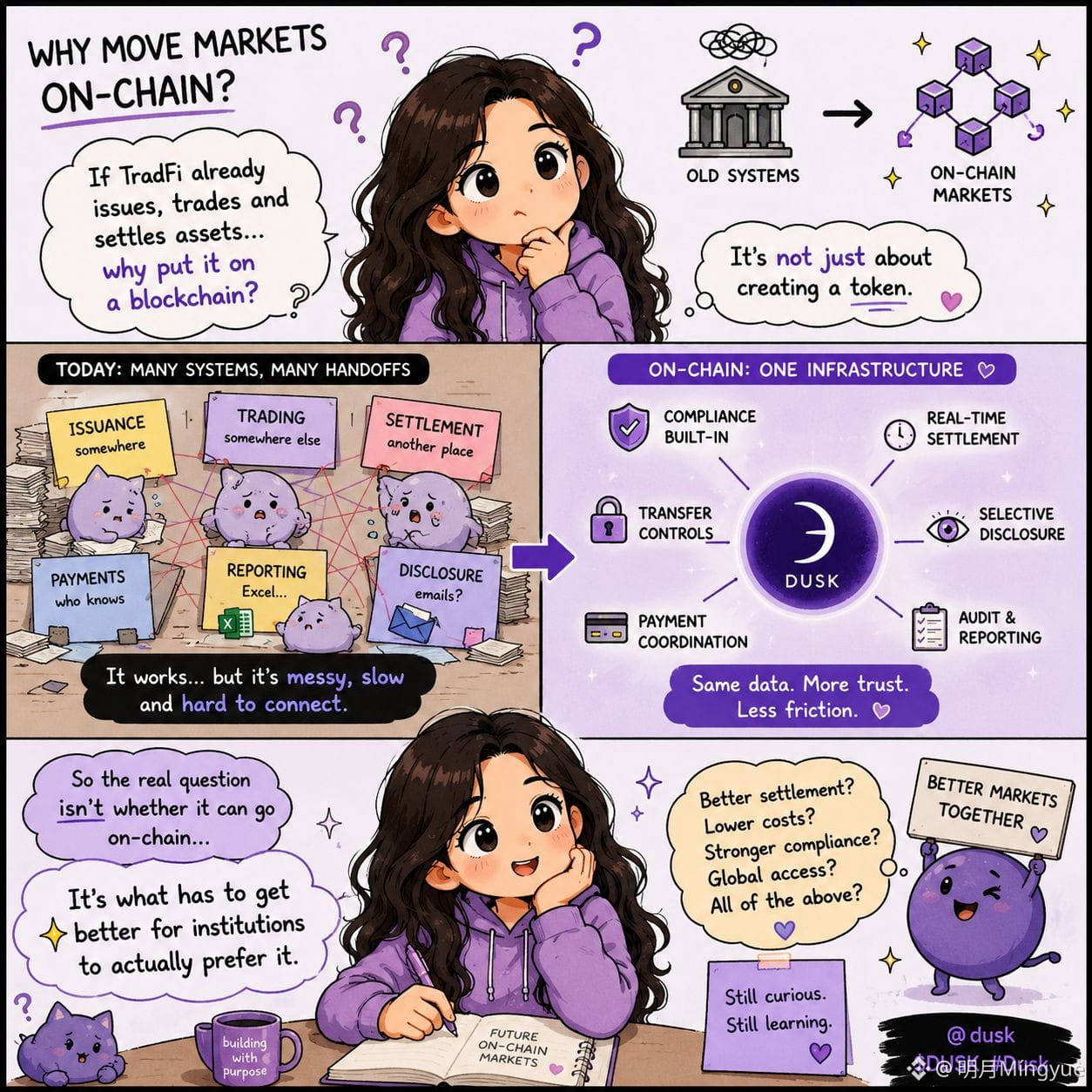
I kept wondering about one thing with on-chain finance, if traditional markets already have systems for issuing, trading and settling assets, why move those workflows onto a blockchain at all?
Looking into Dusk and NPEX made the question more interesting. NPEX is a regulated Dutch trading venue, and the partnership is focused on issuing, trading and tokenizing regulated financial instruments through blockchain infrastructure.
But putting a market on-chain isn't just about creating a token. Dusk's own market-infrastructure model includes investor eligibility, transfer controls, payment coordination, settlement, reporting and selective disclosure.
That made me think the real point isn't simply “put securities on a blockchain.”
It's whether several parts of the market that currently depend on separate systems can actually work around the same infrastructure.
And that's where I'm still curious.
If the existing system already works, what would need to improve enough for institutions to genuinely prefer an on-chain market?
@Dusk_Foundation $DUSK #dusk
I kept wondering about one thing with on-chain finance, if traditional markets already have systems for issuing, trading and settling assets, why move those workflows onto a blockchain at all?
Looking into Dusk and NPEX made the question more interesting. NPEX is a regulated Dutch trading venue, and the partnership is focused on issuing, trading and tokenizing regulated financial instruments through blockchain infrastructure.
But putting a market on-chain isn't just about creating a token. Dusk's own market-infrastructure model includes investor eligibility, transfer controls, payment coordination, settlement, reporting and selective disclosure.
That made me think the real point isn't simply “put securities on a blockchain.”
It's whether several parts of the market that currently depend on separate systems can actually work around the same infrastructure.
And that's where I'm still curious.
If the existing system already works, what would need to improve enough for institutions to genuinely prefer an on-chain market?
@Dusk $DUSK #dusk
Looking into Dusk and NPEX made the question more interesting. NPEX is a regulated Dutch trading venue, and the partnership is focused on issuing, trading and tokenizing regulated financial instruments through blockchain infrastructure.
But putting a market on-chain isn't just about creating a token. Dusk's own market-infrastructure model includes investor eligibility, transfer controls, payment coordination, settlement, reporting and selective disclosure.
That made me think the real point isn't simply “put securities on a blockchain.”
It's whether several parts of the market that currently depend on separate systems can actually work around the same infrastructure.
And that's where I'm still curious.
If the existing system already works, what would need to improve enough for institutions to genuinely prefer an on-chain market?
@Dusk $DUSK #dusk
5
7
183
·
--
I keep seeing RWAs described as simply “putting real-world assets on-chain,” but the more I looked into it, the less simple that sounded.
If an existing asset gets a token on a blockchain while custody, settlement, investor records and other parts of its lifecycle still depend on separate systems, then the token is really only one piece of the process.
Dusk makes a distinction here that I found interesting: tokenization can represent an existing asset on-chain, while native issuance means the asset itself can be created and managed around on-chain workflows, including issuance, transfers and settlement.
That made me wonder whether we're sometimes measuring RWA adoption too early.
Counting how many assets have been tokenized tells us something, but it doesn't necessarily tell us how much of the actual financial workflow has moved on-chain.
Maybe the harder milestone isn't getting an asset onto a blockchain.
It's getting the asset's lifecycle there too.
How much of today's RWA activity is really changing financial infrastructure, rather than just adding a blockchain representation to an existing process?
#dusk $DUSK @Dusk_Foundation
I keep seeing RWAs described as simply “putting real-world assets on-chain,” but the more I looked into it, the less simple that sounded.
If an existing asset gets a token on a blockchain while custody, settlement, investor records and other parts of its lifecycle still depend on separate systems, then the token is really only one piece of the process.
Dusk makes a distinction here that I found interesting: tokenization can represent an existing asset on-chain, while native issuance means the asset itself can be created and managed around on-chain workflows, including issuance, transfers and settlement.
That made me wonder whether we're sometimes measuring RWA adoption too early.
Counting how many assets have been tokenized tells us something, but it doesn't necessarily tell us how much of the actual financial workflow has moved on-chain.
Maybe the harder milestone isn't getting an asset onto a blockchain.
It's getting the asset's lifecycle there too.
How much of today's RWA activity is really changing financial infrastructure, rather than just adding a blockchain representation to an existing process?
#dusk $DUSK @Dusk
If an existing asset gets a token on a blockchain while custody, settlement, investor records and other parts of its lifecycle still depend on separate systems, then the token is really only one piece of the process.
Dusk makes a distinction here that I found interesting: tokenization can represent an existing asset on-chain, while native issuance means the asset itself can be created and managed around on-chain workflows, including issuance, transfers and settlement.
That made me wonder whether we're sometimes measuring RWA adoption too early.
Counting how many assets have been tokenized tells us something, but it doesn't necessarily tell us how much of the actual financial workflow has moved on-chain.
Maybe the harder milestone isn't getting an asset onto a blockchain.
It's getting the asset's lifecycle there too.
How much of today's RWA activity is really changing financial infrastructure, rather than just adding a blockchain representation to an existing process?
#dusk $DUSK @Dusk
1
7
158
·
--
Проверено
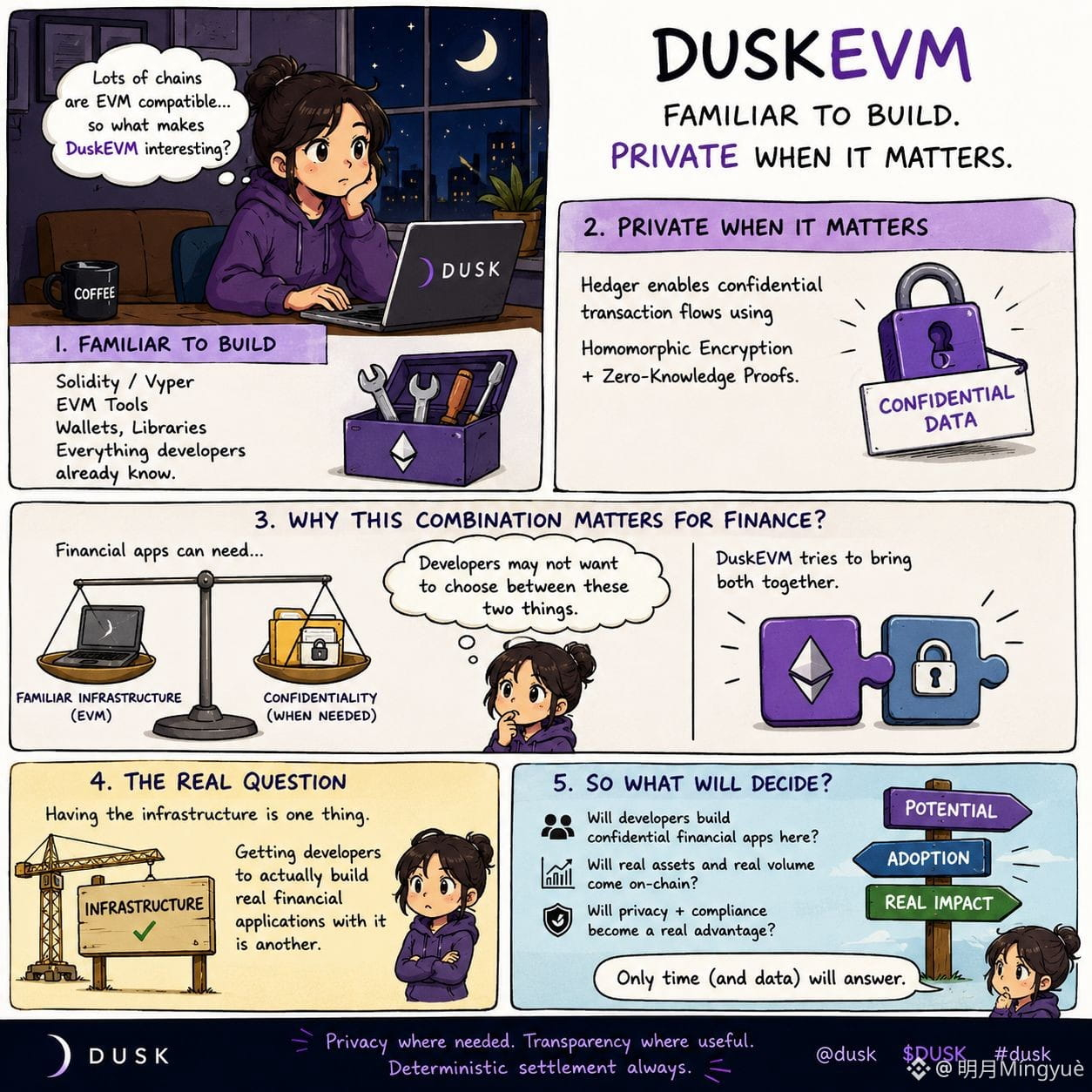
I’ve seen plenty of projects use EVM compatibility as a selling point, so at first I didn’t think there was much to dig into there.
Then I looked closer at how Dusk’s EVM-compatible layer is positioned.
It gives developers the familiar Solidity/Viper and EVM tooling they already know, but the interesting part is that it also has a route toward confidential workflows through Hedger. Hedger uses homomorphic encryption and zero-knowledge proofs for confidential transaction flows.
That creates an interesting trade-off.
EVM compatibility is supposed to make things easier to build and integrate. Financial applications, however, can have information that shouldn't simply become public just because the application is on-chain. Dusk's own use-case material specifically points to balances, positions, counterparties and business logic as information that may need protection.
So I’m less interested in asking whether Dusk’s EVM-compatible layer is “another EVM.”
The more interesting question for me is whether familiar EVM infrastructure plus confidential execution can actually make on-chain finance practical for applications that can't operate with full public visibility.
Because having the tools is one thing.
Getting developers to actually build the financial applications that need them is another.
@Dusk_Foundation $DUSK #Dusk
{spot}(DUSKUSDT)
I’ve seen plenty of projects use EVM compatibility as a selling point, so at first I didn’t think there was much to dig into there.
Then I looked closer at how Dusk’s EVM-compatible layer is positioned.
It gives developers the familiar Solidity/Viper and EVM tooling they already know, but the interesting part is that it also has a route toward confidential workflows through Hedger. Hedger uses homomorphic encryption and zero-knowledge proofs for confidential transaction flows.
That creates an interesting trade-off.
EVM compatibility is supposed to make things easier to build and integrate. Financial applications, however, can have information that shouldn't simply become public just because the application is on-chain. Dusk's own use-case material specifically points to balances, positions, counterparties and business logic as information that may need protection.
So I’m less interested in asking whether Dusk’s EVM-compatible layer is “another EVM.”
The more interesting question for me is whether familiar EVM infrastructure plus confidential execution can actually make on-chain finance practical for applications that can't operate with full public visibility.
Because having the tools is one thing.
Getting developers to actually build the financial applications that need them is another.
@Dusk $DUSK #Dusk
Then I looked closer at how Dusk’s EVM-compatible layer is positioned.
It gives developers the familiar Solidity/Viper and EVM tooling they already know, but the interesting part is that it also has a route toward confidential workflows through Hedger. Hedger uses homomorphic encryption and zero-knowledge proofs for confidential transaction flows.
That creates an interesting trade-off.
EVM compatibility is supposed to make things easier to build and integrate. Financial applications, however, can have information that shouldn't simply become public just because the application is on-chain. Dusk's own use-case material specifically points to balances, positions, counterparties and business logic as information that may need protection.
So I’m less interested in asking whether Dusk’s EVM-compatible layer is “another EVM.”
The more interesting question for me is whether familiar EVM infrastructure plus confidential execution can actually make on-chain finance practical for applications that can't operate with full public visibility.
Because having the tools is one thing.
Getting developers to actually build the financial applications that need them is another.
@Dusk $DUSK #Dusk
8
5
142
·
--
Проверено
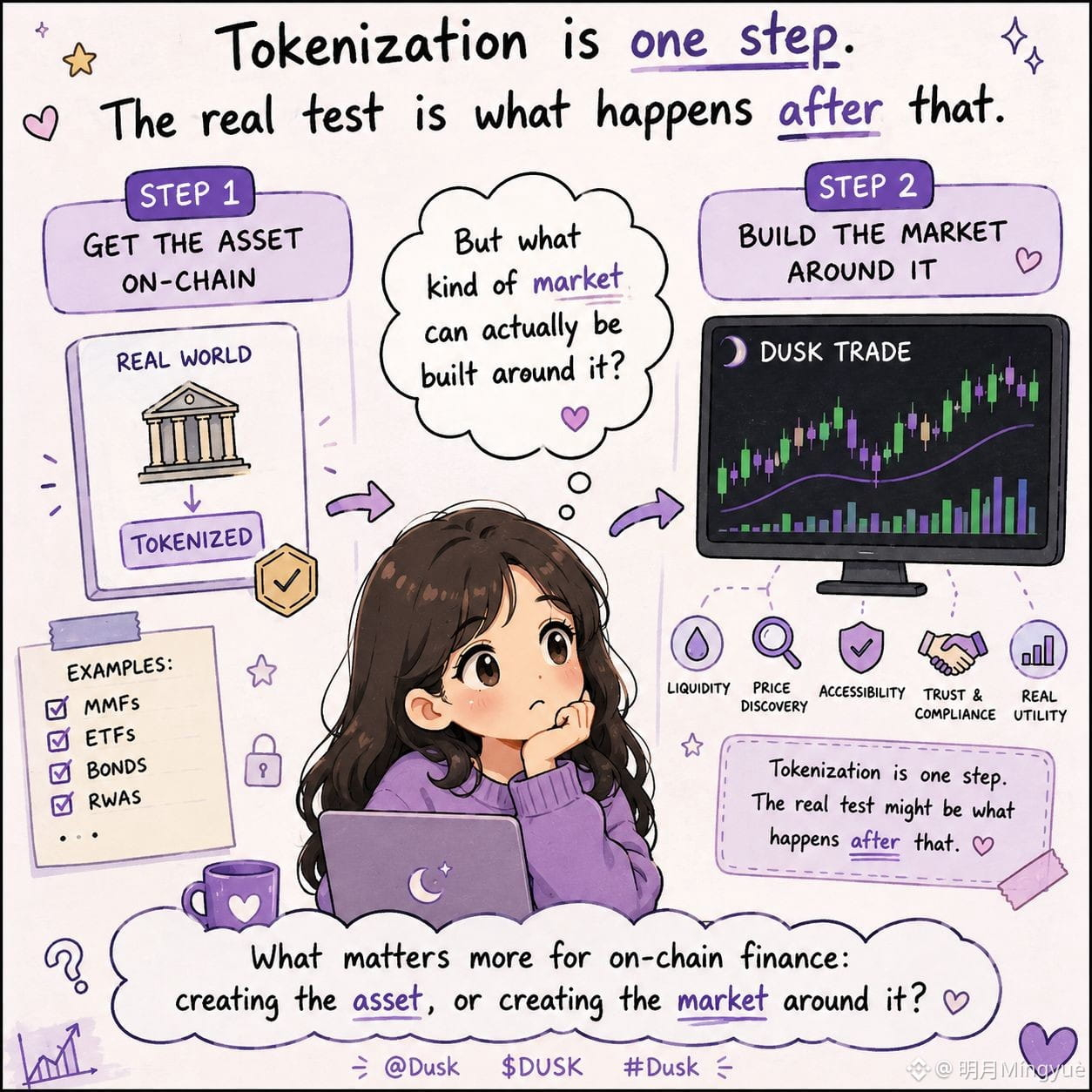
I used to think the difficult part of tokenized assets was simply getting them on-chain. Looking at Dusk Trade made me question that.
Dusk describes Dusk Trade as an application layer for tokenized financial assets on Dusk, focused on things like investor onboarding, trading, payment coordination and settlement.
But that raises a more interesting question for me: once an asset is tokenized, what kind of market can actually be built around it?
Tokenization is one step. The real test might be what happens after that.
@Dusk_Foundation $DUSK #Dusk
What matters more for on-chain finance: creating the asset, or creating the market around it?
I used to think the difficult part of tokenized assets was simply getting them on-chain. Looking at Dusk Trade made me question that.
Dusk describes Dusk Trade as an application layer for tokenized financial assets on Dusk, focused on things like investor onboarding, trading, payment coordination and settlement.
But that raises a more interesting question for me: once an asset is tokenized, what kind of market can actually be built around it?
Tokenization is one step. The real test might be what happens after that.
@Dusk $DUSK #Dusk
What matters more for on-chain finance: creating the asset, or creating the market around it?
Dusk describes Dusk Trade as an application layer for tokenized financial assets on Dusk, focused on things like investor onboarding, trading, payment coordination and settlement.
But that raises a more interesting question for me: once an asset is tokenized, what kind of market can actually be built around it?
Tokenization is one step. The real test might be what happens after that.
@Dusk $DUSK #Dusk
What matters more for on-chain finance: creating the asset, or creating the market around it?
2
3
172
Войдите, чтобы посмотреть больше материала
Присоединяйтесь к пользователям криптовалют по всему миру на Binance Square
⚡️ Получайте новейшую и полезную информацию о криптоактивах.
💬 Нам доверяет крупнейшая в мире криптобиржа.
👍 Получите достоверные аналитические данные от верифицированных создателей контента.
Эл. почта/номер телефона
В тренде
BitcoinParesGainsAfterRallyTo$86.5K
Просмотров: 8,684
56 обсуждают
🔥 $BTC on the Edge: $86K Showdown!
Nurul Hasnat Samir
·Лайков: 0
·Просмотров: 150
CerebrasSinksNearly20%OnReportNvidiaToPowerOpenAI
Просмотров: 18,231
264 обсуждают
SECProposesCryptoCustodyRules
Просмотров: 43,581
440 обсуждают