
SAIIFY
2.5k Публикации

SAIIFY
Отправить жалобу
Заблокировать пользователя
Nothing To Show
Трейдер с регулярными сделками
1.5 г
738 подписок(и/а)
24.1K+ подписчиков(а)
5.1K+ понравилось
Посты
Все
Цитирования
Активно
·
--
Рост
Told y'all $PHA was gonna blast off and I got laughed at 😂
Bought in at $0.0229. Check the chart today — we're already up 65%+ and this is just getting started.
Who's laughing now? 👀📈
Not financial advice, just vibes and conviction. $PHA to the moon 🚀
#PHA #PhalaNetwork #Binance #Altcoins
Told y'all $PHA was gonna blast off and I got laughed at 😂
Bought in at $0.0229. Check the chart today — we're already up 65%+ and this is just getting started.
Who's laughing now? 👀📈
Not financial advice, just vibes and conviction. $PHA to the moon 🚀
#PHA #PhalaNetwork #Binance #Altcoins
Bought in at $0.0229. Check the chart today — we're already up 65%+ and this is just getting started.
Who's laughing now? 👀📈
Not financial advice, just vibes and conviction. $PHA to the moon 🚀
#PHA #PhalaNetwork #Binance #Altcoins
2
182
·
--
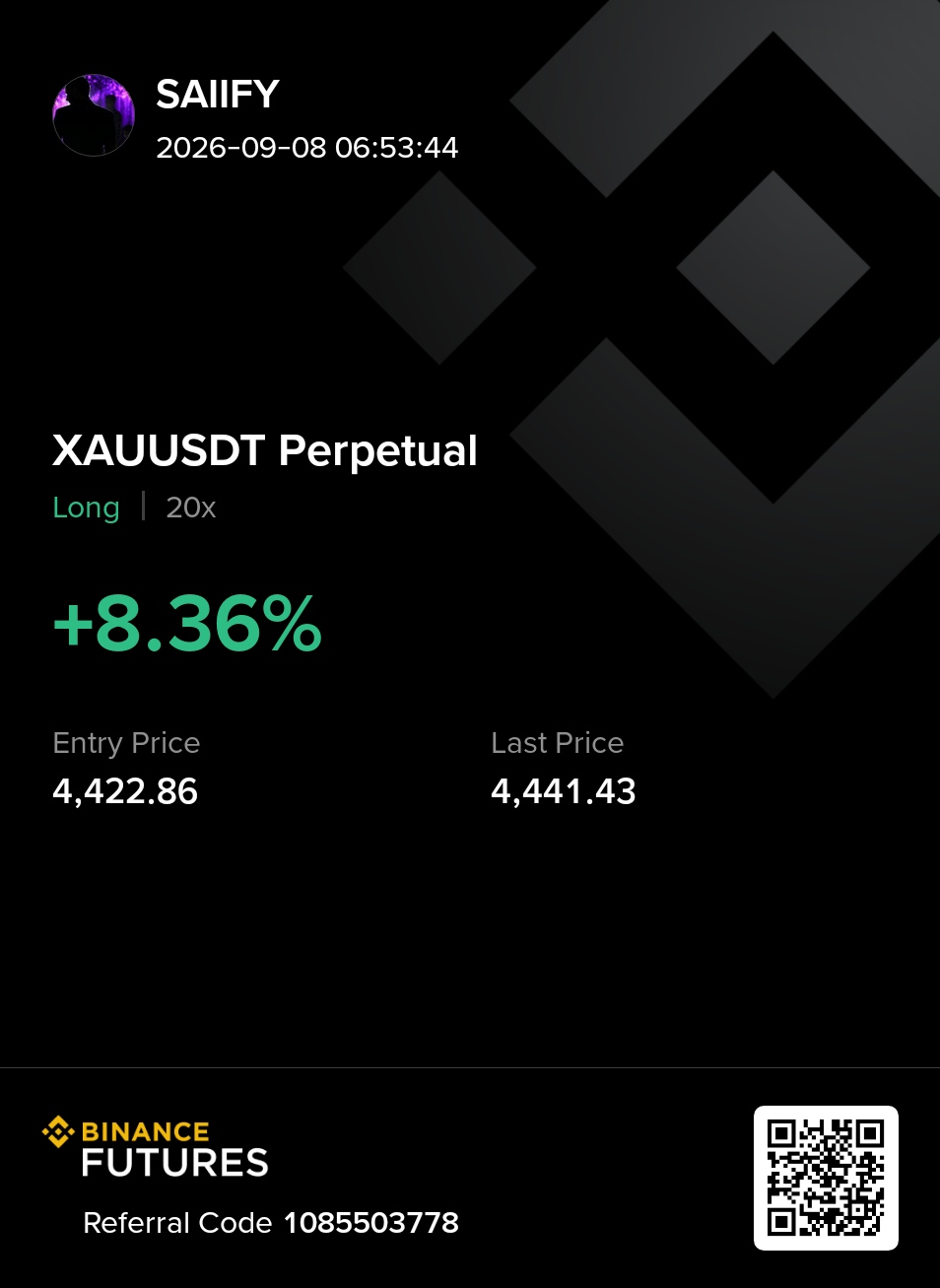
I'm not really into futures trading... but when I do, this happens 😅📈
$XAU Perpetual | Long 20x
Entry: 4,422.86 → Last: 4,441.43
+8.36% 🟢
Sometimes the market just says "trust me" 🔥
#Binance #BinanceFutures #XAUUSDT
{future}(XAUTUSDT)
I'm not really into futures trading... but when I do, this happens 😅📈
$XAU Perpetual | Long 20x
Entry: 4,422.86 → Last: 4,441.43
+8.36% 🟢
Sometimes the market just says "trust me" 🔥
#Binance #BinanceFutures #XAUUSDT
$XAU Perpetual | Long 20x
Entry: 4,422.86 → Last: 4,441.43
+8.36% 🟢
Sometimes the market just says "trust me" 🔥
#Binance #BinanceFutures #XAUUSDT
104
·
--
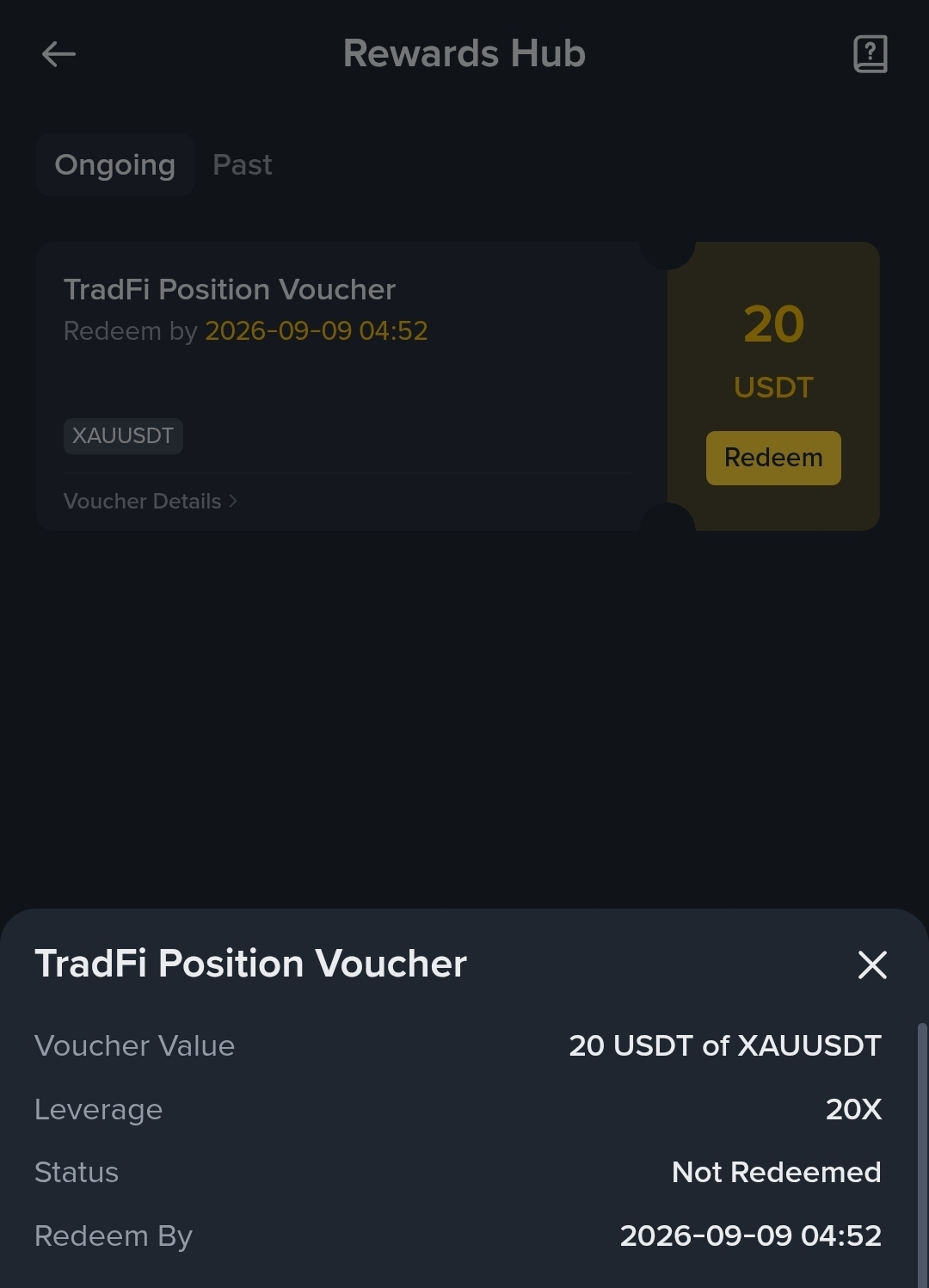
🎉 Just got a TradFi Position Voucher from #Binance 20 USDT to trade XAUUSDT with 20x leverage, on the house! 🙏
Really appreciate Binance rewarding active users like this. The Rewards Hub keeps delivering. 💛
Gold $XAU has been on everyone's radar lately with all the macro uncertainty: safe haven flows, rate cut speculation, and central bank buying keeping it in focus.
I went ahead and started a long trade with it. Let's see what happens with me now! 📈✨
Not financial advice, just excited to trade smart with a little extra boost. Thanks again, Binance! 🚀
#Binance #XAUUSDT #Gold #CryptoTrading
🎉 Just got a TradFi Position Voucher from #Binance 20 USDT to trade XAUUSDT with 20x leverage, on the house! 🙏
Really appreciate Binance rewarding active users like this. The Rewards Hub keeps delivering. 💛
Gold $XAU has been on everyone's radar lately with all the macro uncertainty: safe haven flows, rate cut speculation, and central bank buying keeping it in focus.
I went ahead and started a long trade with it. Let's see what happens with me now! 📈✨
Not financial advice, just excited to trade smart with a little extra boost. Thanks again, Binance! 🚀
#Binance #XAUUSDT #Gold #CryptoTrading
Really appreciate Binance rewarding active users like this. The Rewards Hub keeps delivering. 💛
Gold $XAU has been on everyone's radar lately with all the macro uncertainty: safe haven flows, rate cut speculation, and central bank buying keeping it in focus.
I went ahead and started a long trade with it. Let's see what happens with me now! 📈✨
Not financial advice, just excited to trade smart with a little extra boost. Thanks again, Binance! 🚀
#Binance #XAUUSDT #Gold #CryptoTrading
4
970
·
--
Crypto Market Right Now: Choppy, Nervous, and Still Not Boring
!!If you've checked your portfolio every day this week and felt a little seasick, you're not imagining things. Bitcoin has been swinging between roughly $76,000 and $82,000 over the past several days, up on a Friday, down by Tuesday, up again by Thursday. It's the kind of week that makes you want to close the app and go for a walk. So let's actually talk about what's happening, without the hype and without the doom.
Where things stand today
Bitcoin is trading in the high-$70,000s to low-$80,000s range, having briefly poked above $82,000 before slipping back below the psychologically important $80,000 level. Ethereum is sitting around $2,400, XRP near $1.30 to $1.40, and overall crypto dominance has actually been rising, meaning money is rotating into Bitcoin and out of smaller altcoins. That's usually a sign of nervous money looking for the "safest" seat on the crypto bus, not a sign of confident risk-taking.
Zoom out a bit and the picture gets more interesting. Bitcoin is up more than 20% over the past month, even after this week's wobble. So despite the daily whiplash, the medium-term trend is still pointed up. It's just climbing a wall of worry instead of a smooth staircase.
What's actually driving the noise
A few real-world forces are yanking the market around right now.
The Fed is playing hard to get. Comments from Federal Reserve officials about possibly holding interest rates steady, or even raising them if next week's inflation report runs hot, have been enough to spook traders. Crypto, like tech stocks, tends to get twitchy whenever "higher for longer" rate talk resurfaces, because tighter money makes risk assets less attractive.
Geopolitics keeps interrupting the party. Renewed conflict involving Iran and U.S. military action rattled markets earlier this week, causing a sharp pullback. Crypto often reacts to geopolitical shocks the same way stocks do initially, with a knee-jerk selloff, before deciding whether the event actually changes anything fundamental.
But institutions haven't left. Strategy (the company formerly known as MicroStrategy) just resumed its Bitcoin buying after a two-month pause, scooping up a few hundred million dollars' worth. ETF flows have also seen some of their strongest days in months. That's a meaningful signal: the big, patient money isn't running for the exits, even while retail sentiment gets rattled by headlines.
Momentum is cooling, not collapsing. Technical indicators show Bitcoin still trading above its key moving averages, which is generally a bullish structural sign. But momentum gauges have started to flatten, suggesting the recent rally is pausing to catch its breath rather than reversing outright. Think of it less like a car crash and more like a runner stopping to retie their shoes mid-race.
So, what's the next move?
Nobody, not me, not the loudest voice on crypto Twitter, not the analyst with the fanciest chart, actually knows for certain. But here's the honest, level-headed read on the setup.
Short term. Expect continued chop in the $76,000 to $82,000 range for Bitcoin. The market is waiting on next week's inflation data and any further Fed commentary before it commits to a direction. Don't be surprised by more 2 to 5% daily swings in either direction.
The level to watch. $80,000 has become the line in the sand. Reclaiming it and holding above it would likely reopen the path toward retesting recent highs. Losing $78,500 support convincingly could open the door to a deeper pullback.
Medium term. If inflation data cooperates and the Fed signals a cut rather than a hold, that's historically been rocket fuel for crypto. If the data comes in hot, expect another leg of profit-taking and de-risking.
The bigger picture. Institutional accumulation, continued ETF interest, and rising Bitcoin dominance suggest that even amid short-term jitters, the underlying appetite for crypto as an asset class hasn't disappeared. It's just gotten more selective and more macro-sensitive than it used to be.
This isn't a market screaming "buy everything" or "sell everything." It's a market paying very close attention to interest rates and headlines, while the bigger players quietly keep accumulating in the background. If you're a long-term holder, this kind of range-bound tug-of-war is honestly pretty normal. It's the market digesting a big move before deciding what to do next. If you're trading short-term, the $78,500 to $80,000 zone is your battleground to watch.
As always: crypto is volatile, headlines move fast, and nothing here is financial advice, just a clear-eyed read on where things stand right now. Do your own research, size your positions sensibly, and try not to let a red day (Or A Green One) talk you into a decision you'll regret next week.
#BTC #BNB #XRP
{future}(BTCUSDT)
{future}(BNBUSDT)
{future}(XRPUSDT)
Crypto Market Right Now: Choppy, Nervous, and Still Not Boring !!
If you've checked your portfolio every day this week and felt a little seasick, you're not imagining things. Bitcoin has been swinging between roughly $76,000 and $82,000 over the past several days, up on a Friday, down by Tuesday, up again by Thursday. It's the kind of week that makes you want to close the app and go for a walk. So let's actually talk about what's happening, without the hype and without the doom.
Where things stand today
Bitcoin is trading in the high-$70,000s to low-$80,000s range, having briefly poked above $82,000 before slipping back below the psychologically important $80,000 level. Ethereum is sitting around $2,400, XRP near $1.30 to $1.40, and overall crypto dominance has actually been rising, meaning money is rotating into Bitcoin and out of smaller altcoins. That's usually a sign of nervous money looking for the "safest" seat on the crypto bus, not a sign of confident risk-taking.
Zoom out a bit and the picture gets more interesting. Bitcoin is up more than 20% over the past month, even after this week's wobble. So despite the daily whiplash, the medium-term trend is still pointed up. It's just climbing a wall of worry instead of a smooth staircase.
What's actually driving the noise
A few real-world forces are yanking the market around right now.
The Fed is playing hard to get. Comments from Federal Reserve officials about possibly holding interest rates steady, or even raising them if next week's inflation report runs hot, have been enough to spook traders. Crypto, like tech stocks, tends to get twitchy whenever "higher for longer" rate talk resurfaces, because tighter money makes risk assets less attractive.
Geopolitics keeps interrupting the party. Renewed conflict involving Iran and U.S. military action rattled markets earlier this week, causing a sharp pullback. Crypto often reacts to geopolitical shocks the same way stocks do initially, with a knee-jerk selloff, before deciding whether the event actually changes anything fundamental.
But institutions haven't left. Strategy (the company formerly known as MicroStrategy) just resumed its Bitcoin buying after a two-month pause, scooping up a few hundred million dollars' worth. ETF flows have also seen some of their strongest days in months. That's a meaningful signal: the big, patient money isn't running for the exits, even while retail sentiment gets rattled by headlines.
Momentum is cooling, not collapsing. Technical indicators show Bitcoin still trading above its key moving averages, which is generally a bullish structural sign. But momentum gauges have started to flatten, suggesting the recent rally is pausing to catch its breath rather than reversing outright. Think of it less like a car crash and more like a runner stopping to retie their shoes mid-race.
So, what's the next move?
Nobody, not me, not the loudest voice on crypto Twitter, not the analyst with the fanciest chart, actually knows for certain. But here's the honest, level-headed read on the setup.
Short term. Expect continued chop in the $76,000 to $82,000 range for Bitcoin. The market is waiting on next week's inflation data and any further Fed commentary before it commits to a direction. Don't be surprised by more 2 to 5% daily swings in either direction.
The level to watch. $80,000 has become the line in the sand. Reclaiming it and holding above it would likely reopen the path toward retesting recent highs. Losing $78,500 support convincingly could open the door to a deeper pullback.
Medium term. If inflation data cooperates and the Fed signals a cut rather than a hold, that's historically been rocket fuel for crypto. If the data comes in hot, expect another leg of profit-taking and de-risking.
The bigger picture. Institutional accumulation, continued ETF interest, and rising Bitcoin dominance suggest that even amid short-term jitters, the underlying appetite for crypto as an asset class hasn't disappeared. It's just gotten more selective and more macro-sensitive than it used to be.
This isn't a market screaming "buy everything" or "sell everything." It's a market paying very close attention to interest rates and headlines, while the bigger players quietly keep accumulating in the background. If you're a long-term holder, this kind of range-bound tug-of-war is honestly pretty normal. It's the market digesting a big move before deciding what to do next. If you're trading short-term, the $78,500 to $80,000 zone is your battleground to watch.
As always: crypto is volatile, headlines move fast, and nothing here is financial advice, just a clear-eyed read on where things stand right now. Do your own research, size your positions sensibly, and try not to let a red day (Or A Green One) talk you into a decision you'll regret next week.
#BTC #BNB #XRP
Where things stand today
Bitcoin is trading in the high-$70,000s to low-$80,000s range, having briefly poked above $82,000 before slipping back below the psychologically important $80,000 level. Ethereum is sitting around $2,400, XRP near $1.30 to $1.40, and overall crypto dominance has actually been rising, meaning money is rotating into Bitcoin and out of smaller altcoins. That's usually a sign of nervous money looking for the "safest" seat on the crypto bus, not a sign of confident risk-taking.
Zoom out a bit and the picture gets more interesting. Bitcoin is up more than 20% over the past month, even after this week's wobble. So despite the daily whiplash, the medium-term trend is still pointed up. It's just climbing a wall of worry instead of a smooth staircase.
What's actually driving the noise
A few real-world forces are yanking the market around right now.
The Fed is playing hard to get. Comments from Federal Reserve officials about possibly holding interest rates steady, or even raising them if next week's inflation report runs hot, have been enough to spook traders. Crypto, like tech stocks, tends to get twitchy whenever "higher for longer" rate talk resurfaces, because tighter money makes risk assets less attractive.
Geopolitics keeps interrupting the party. Renewed conflict involving Iran and U.S. military action rattled markets earlier this week, causing a sharp pullback. Crypto often reacts to geopolitical shocks the same way stocks do initially, with a knee-jerk selloff, before deciding whether the event actually changes anything fundamental.
But institutions haven't left. Strategy (the company formerly known as MicroStrategy) just resumed its Bitcoin buying after a two-month pause, scooping up a few hundred million dollars' worth. ETF flows have also seen some of their strongest days in months. That's a meaningful signal: the big, patient money isn't running for the exits, even while retail sentiment gets rattled by headlines.
Momentum is cooling, not collapsing. Technical indicators show Bitcoin still trading above its key moving averages, which is generally a bullish structural sign. But momentum gauges have started to flatten, suggesting the recent rally is pausing to catch its breath rather than reversing outright. Think of it less like a car crash and more like a runner stopping to retie their shoes mid-race.
So, what's the next move?
Nobody, not me, not the loudest voice on crypto Twitter, not the analyst with the fanciest chart, actually knows for certain. But here's the honest, level-headed read on the setup.
Short term. Expect continued chop in the $76,000 to $82,000 range for Bitcoin. The market is waiting on next week's inflation data and any further Fed commentary before it commits to a direction. Don't be surprised by more 2 to 5% daily swings in either direction.
The level to watch. $80,000 has become the line in the sand. Reclaiming it and holding above it would likely reopen the path toward retesting recent highs. Losing $78,500 support convincingly could open the door to a deeper pullback.
Medium term. If inflation data cooperates and the Fed signals a cut rather than a hold, that's historically been rocket fuel for crypto. If the data comes in hot, expect another leg of profit-taking and de-risking.
The bigger picture. Institutional accumulation, continued ETF interest, and rising Bitcoin dominance suggest that even amid short-term jitters, the underlying appetite for crypto as an asset class hasn't disappeared. It's just gotten more selective and more macro-sensitive than it used to be.
This isn't a market screaming "buy everything" or "sell everything." It's a market paying very close attention to interest rates and headlines, while the bigger players quietly keep accumulating in the background. If you're a long-term holder, this kind of range-bound tug-of-war is honestly pretty normal. It's the market digesting a big move before deciding what to do next. If you're trading short-term, the $78,500 to $80,000 zone is your battleground to watch.
As always: crypto is volatile, headlines move fast, and nothing here is financial advice, just a clear-eyed read on where things stand right now. Do your own research, size your positions sensibly, and try not to let a red day (Or A Green One) talk you into a decision you'll regret next week.
#BTC #BNB #XRP
1
2
111
·
--
Binance Just Signed Three Deals With Kazakhstan. Here's What It Actually Means for BNBYes, it's real, and yes, it's bigger than a single headline. On September 4, #Binance signed three separate memoranda of understanding with Kazakhstan's government, and together they read like a blueprint for turning the country into a crypto payments hub for Central Asia.
Who signed what
The National Bank of Kazakhstan, the Ministry of Artificial Intelligence and Digital Development, and the Astana International Financial Centre all inked agreements with Binance on the same day, during a meeting in Baku that included founder Changpeng Zhao. Deputy Governor Binur Zhalenov signed on behalf of the central bank and later described the arrangement on LinkedIn as essentially building "A Payments Bank" minus the deposit-taking and lending.
What it actually unlocks
The headline piece is a path toward a Category 1 non-bank Payment Service Provider license. That's a regulatory category built specifically to let crypto and regular fiat currency move through the same pipes: converting between the two, processing payments, and settling transactions. It does not let Binance take deposits or issue loans, so this isn't Binance becoming a bank. It's Binance becoming licensed plumbing.
The second thread is more interesting long term: exploratory talks around a local, Kazakhstani stablecoin. Nothing is confirmed yet, no issuer, no structure, no launch date, so treat this as an idea on the table rather than a done deal. But it fits a pattern. Kazakhstan already has a CBDC pilot in motion, and neighboring Kyrgyzstan rolled out its own som-pegged stablecoin, KGST, after similar cooperation with Zhao.
The third piece covers digital asset investment infrastructure through the AIFC, Kazakhstan's financial free zone that already granted Binance a full digital asset trading license back in 2024. So this isn't Binance parachuting into a brand-new market. It's deepening a relationship that's been building for a couple of years.
Why Kazakhstan, why now
Officials have been explicit about the ambition here: position Kazakhstan as a launchpad for the Commonwealth of Independent States, a bloc of roughly 240 million people. If Binance can route crypto-to-fiat payments through a regulated Kazakh entity, that becomes a template it can extend across neighboring markets rather than negotiating country by country. It's the same playbook Binance has already run in Kyrgyzstan and Vietnam: build institutional trust in one country, use it as a base to expand regionally.
What it means for #BNB
Here's the honest part. $BNB is trading in the mid $600s right now, and multiple outlets covering the news specifically noted there's no confirmed price reaction tied to the announcement. This is a Binance-the-company story first and a BNB-the-token story second, and the two don't always move in lockstep.
That said, it's not irrelevant to holders. These deals are the kind of slow-burn catalyst that matters more over months than over hours. A real payments license, a functioning crypto-fiat gateway, and a possible regional stablecoin all being built on top of Binance's infrastructure add up to more institutional legitimacy and more real-world usage for the ecosystem BNB sits inside. None of that shows up on a candlestick chart today. It shows up later, if and when the license is actually granted and the stablecoin conversation turns into something shipped.
The bottom line
This is three MoUs, not three finished products. Memoranda of understanding are intentions, not licenses in hand. But the direction is clear: Binance keeps choosing the compliance-first, government-partnership route in emerging markets rather than fighting regulators, and Kazakhstan keeps positioning itself as the region's crypto-friendly on-ramp. Worth watching for follow-through on the actual PSP license and any concrete stablecoin details, rather than trading the headline itself.
@heyi @CZ @richardteng
Binance Just Signed Three Deals With Kazakhstan. Here's What It Actually Means for BNB
Yes, it's real, and yes, it's bigger than a single headline. On September 4, #Binance signed three separate memoranda of understanding with Kazakhstan's government, and together they read like a blueprint for turning the country into a crypto payments hub for Central Asia.
Who signed what
The National Bank of Kazakhstan, the Ministry of Artificial Intelligence and Digital Development, and the Astana International Financial Centre all inked agreements with Binance on the same day, during a meeting in Baku that included founder Changpeng Zhao. Deputy Governor Binur Zhalenov signed on behalf of the central bank and later described the arrangement on LinkedIn as essentially building "A Payments Bank" minus the deposit-taking and lending.
What it actually unlocks
The headline piece is a path toward a Category 1 non-bank Payment Service Provider license. That's a regulatory category built specifically to let crypto and regular fiat currency move through the same pipes: converting between the two, processing payments, and settling transactions. It does not let Binance take deposits or issue loans, so this isn't Binance becoming a bank. It's Binance becoming licensed plumbing.
The second thread is more interesting long term: exploratory talks around a local, Kazakhstani stablecoin. Nothing is confirmed yet, no issuer, no structure, no launch date, so treat this as an idea on the table rather than a done deal. But it fits a pattern. Kazakhstan already has a CBDC pilot in motion, and neighboring Kyrgyzstan rolled out its own som-pegged stablecoin, KGST, after similar cooperation with Zhao.
The third piece covers digital asset investment infrastructure through the AIFC, Kazakhstan's financial free zone that already granted Binance a full digital asset trading license back in 2024. So this isn't Binance parachuting into a brand-new market. It's deepening a relationship that's been building for a couple of years.
Why Kazakhstan, why now
Officials have been explicit about the ambition here: position Kazakhstan as a launchpad for the Commonwealth of Independent States, a bloc of roughly 240 million people. If Binance can route crypto-to-fiat payments through a regulated Kazakh entity, that becomes a template it can extend across neighboring markets rather than negotiating country by country. It's the same playbook Binance has already run in Kyrgyzstan and Vietnam: build institutional trust in one country, use it as a base to expand regionally.
What it means for #BNB
Here's the honest part. $BNB is trading in the mid $600s right now, and multiple outlets covering the news specifically noted there's no confirmed price reaction tied to the announcement. This is a Binance-the-company story first and a BNB-the-token story second, and the two don't always move in lockstep.
That said, it's not irrelevant to holders. These deals are the kind of slow-burn catalyst that matters more over months than over hours. A real payments license, a functioning crypto-fiat gateway, and a possible regional stablecoin all being built on top of Binance's infrastructure add up to more institutional legitimacy and more real-world usage for the ecosystem BNB sits inside. None of that shows up on a candlestick chart today. It shows up later, if and when the license is actually granted and the stablecoin conversation turns into something shipped.
The bottom line
This is three MoUs, not three finished products. Memoranda of understanding are intentions, not licenses in hand. But the direction is clear: Binance keeps choosing the compliance-first, government-partnership route in emerging markets rather than fighting regulators, and Kazakhstan keeps positioning itself as the region's crypto-friendly on-ramp. Worth watching for follow-through on the actual PSP license and any concrete stablecoin details, rather than trading the headline itself.
@Yi He @CZ @Richard Teng
Who signed what
The National Bank of Kazakhstan, the Ministry of Artificial Intelligence and Digital Development, and the Astana International Financial Centre all inked agreements with Binance on the same day, during a meeting in Baku that included founder Changpeng Zhao. Deputy Governor Binur Zhalenov signed on behalf of the central bank and later described the arrangement on LinkedIn as essentially building "A Payments Bank" minus the deposit-taking and lending.
What it actually unlocks
The headline piece is a path toward a Category 1 non-bank Payment Service Provider license. That's a regulatory category built specifically to let crypto and regular fiat currency move through the same pipes: converting between the two, processing payments, and settling transactions. It does not let Binance take deposits or issue loans, so this isn't Binance becoming a bank. It's Binance becoming licensed plumbing.
The second thread is more interesting long term: exploratory talks around a local, Kazakhstani stablecoin. Nothing is confirmed yet, no issuer, no structure, no launch date, so treat this as an idea on the table rather than a done deal. But it fits a pattern. Kazakhstan already has a CBDC pilot in motion, and neighboring Kyrgyzstan rolled out its own som-pegged stablecoin, KGST, after similar cooperation with Zhao.
The third piece covers digital asset investment infrastructure through the AIFC, Kazakhstan's financial free zone that already granted Binance a full digital asset trading license back in 2024. So this isn't Binance parachuting into a brand-new market. It's deepening a relationship that's been building for a couple of years.
Why Kazakhstan, why now
Officials have been explicit about the ambition here: position Kazakhstan as a launchpad for the Commonwealth of Independent States, a bloc of roughly 240 million people. If Binance can route crypto-to-fiat payments through a regulated Kazakh entity, that becomes a template it can extend across neighboring markets rather than negotiating country by country. It's the same playbook Binance has already run in Kyrgyzstan and Vietnam: build institutional trust in one country, use it as a base to expand regionally.
What it means for #BNB
Here's the honest part. $BNB is trading in the mid $600s right now, and multiple outlets covering the news specifically noted there's no confirmed price reaction tied to the announcement. This is a Binance-the-company story first and a BNB-the-token story second, and the two don't always move in lockstep.
That said, it's not irrelevant to holders. These deals are the kind of slow-burn catalyst that matters more over months than over hours. A real payments license, a functioning crypto-fiat gateway, and a possible regional stablecoin all being built on top of Binance's infrastructure add up to more institutional legitimacy and more real-world usage for the ecosystem BNB sits inside. None of that shows up on a candlestick chart today. It shows up later, if and when the license is actually granted and the stablecoin conversation turns into something shipped.
The bottom line
This is three MoUs, not three finished products. Memoranda of understanding are intentions, not licenses in hand. But the direction is clear: Binance keeps choosing the compliance-first, government-partnership route in emerging markets rather than fighting regulators, and Kazakhstan keeps positioning itself as the region's crypto-friendly on-ramp. Worth watching for follow-through on the actual PSP license and any concrete stablecoin details, rather than trading the headline itself.
@Yi He @CZ @Richard Teng
1
110
·
--
"Dusk Network" does not exist anymore. Even the name changed once the pitch shifted toward institutions. I dont think thats a coincidence.
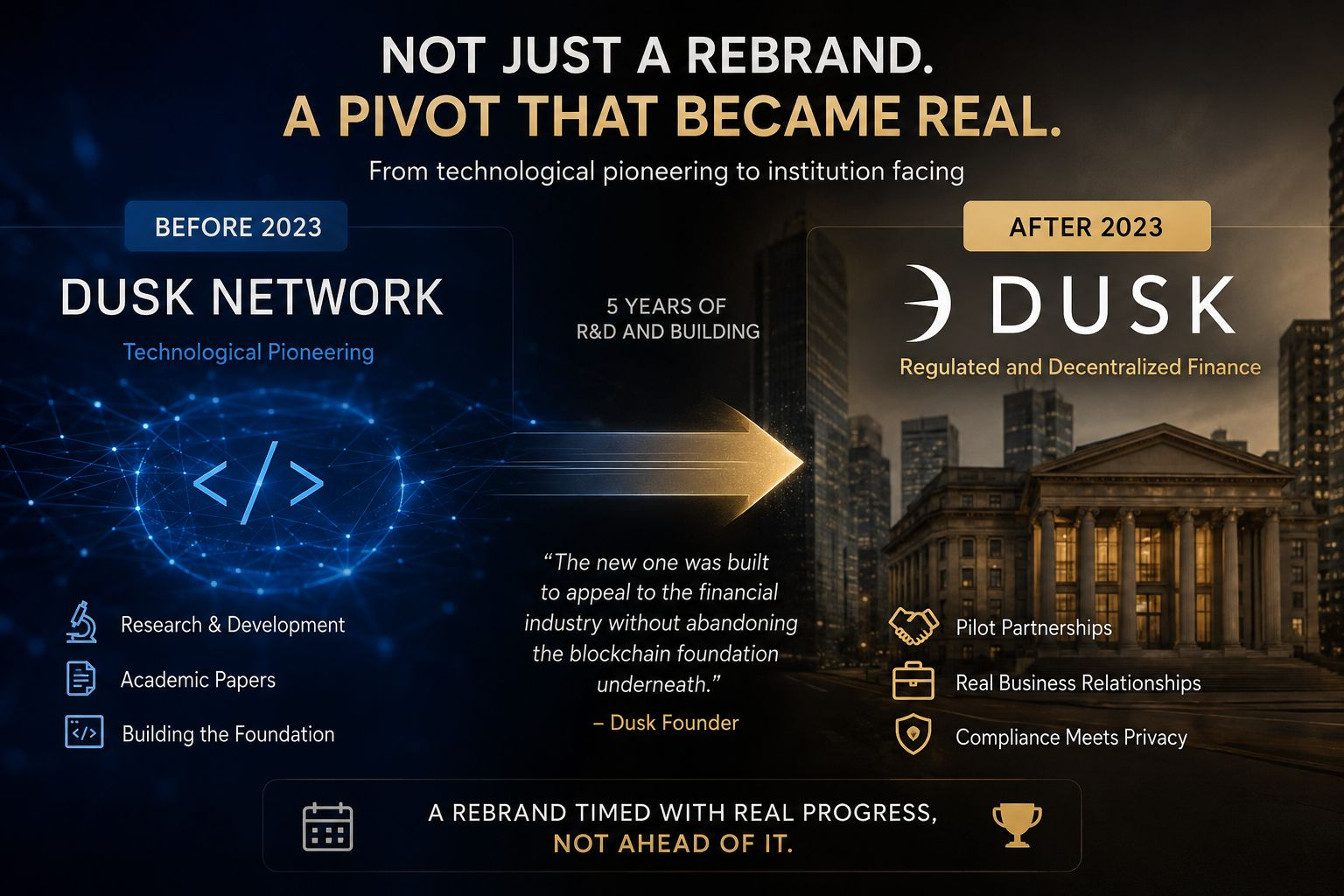
Small thing I noticed while reading old announcements. Back in 2023, the project dropped "Network" from its name entirely, rebranding to just #dusk , with a new tagline: Regulated and Decentralized Finance. At first I read that as a cosmetic refresh, companies do this constantly. Then I read why, straight from their own announcement, and it lined up with something bigger than branding.
The founder said it plainly. The old brand read as technological pioneering. The new one was built to appeal to the financial industry without abandoning the blockchain foundation underneath. Thats not subtle. Thats a project explicitly repositioning itself from crypto native to institution facing, and choosing to signal that shift through the name itself, not just the marketing copy around it.
Heres why the timing actually matters to me. This happened five years into the project, after years of pure research and development, right as they started actually onboarding pilot partnerships and real business relationships instead of just publishing papers. The rebrand was not the beginning of a pivot. It was the visible marker of a pivot that had already been happening quietly for a while, dropped right when there was finally something real to point to.
I think this is honestly a healthy signal, not a red flag. A lot of projects rebrand when things are going badly, trying to escape a damaged reputation. This one rebranded when things started actually working, timed to match real pilots and real partnerships instead of running ahead of them.
Worth noticing the difference between a rebrand thats covering something up and one thats just catching the name up to what the project already became. $DUSK @Dusk_Foundation
{future}(DUSKUSDT)
"Dusk Network" does not exist anymore. Even the name changed once the pitch shifted toward institutions. I dont think thats a coincidence.
Small thing I noticed while reading old announcements. Back in 2023, the project dropped "Network" from its name entirely, rebranding to just #dusk , with a new tagline: Regulated and Decentralized Finance. At first I read that as a cosmetic refresh, companies do this constantly. Then I read why, straight from their own announcement, and it lined up with something bigger than branding.
The founder said it plainly. The old brand read as technological pioneering. The new one was built to appeal to the financial industry without abandoning the blockchain foundation underneath. Thats not subtle. Thats a project explicitly repositioning itself from crypto native to institution facing, and choosing to signal that shift through the name itself, not just the marketing copy around it.
Heres why the timing actually matters to me. This happened five years into the project, after years of pure research and development, right as they started actually onboarding pilot partnerships and real business relationships instead of just publishing papers. The rebrand was not the beginning of a pivot. It was the visible marker of a pivot that had already been happening quietly for a while, dropped right when there was finally something real to point to.
I think this is honestly a healthy signal, not a red flag. A lot of projects rebrand when things are going badly, trying to escape a damaged reputation. This one rebranded when things started actually working, timed to match real pilots and real partnerships instead of running ahead of them.
Worth noticing the difference between a rebrand thats covering something up and one thats just catching the name up to what the project already became. $DUSK @Dusk
Small thing I noticed while reading old announcements. Back in 2023, the project dropped "Network" from its name entirely, rebranding to just #dusk , with a new tagline: Regulated and Decentralized Finance. At first I read that as a cosmetic refresh, companies do this constantly. Then I read why, straight from their own announcement, and it lined up with something bigger than branding.
The founder said it plainly. The old brand read as technological pioneering. The new one was built to appeal to the financial industry without abandoning the blockchain foundation underneath. Thats not subtle. Thats a project explicitly repositioning itself from crypto native to institution facing, and choosing to signal that shift through the name itself, not just the marketing copy around it.
Heres why the timing actually matters to me. This happened five years into the project, after years of pure research and development, right as they started actually onboarding pilot partnerships and real business relationships instead of just publishing papers. The rebrand was not the beginning of a pivot. It was the visible marker of a pivot that had already been happening quietly for a while, dropped right when there was finally something real to point to.
I think this is honestly a healthy signal, not a red flag. A lot of projects rebrand when things are going badly, trying to escape a damaged reputation. This one rebranded when things started actually working, timed to match real pilots and real partnerships instead of running ahead of them.
Worth noticing the difference between a rebrand thats covering something up and one thats just catching the name up to what the project already became. $DUSK @Dusk
171
·
--
Торговля за 30 дней $DUSK 201.1 USDT
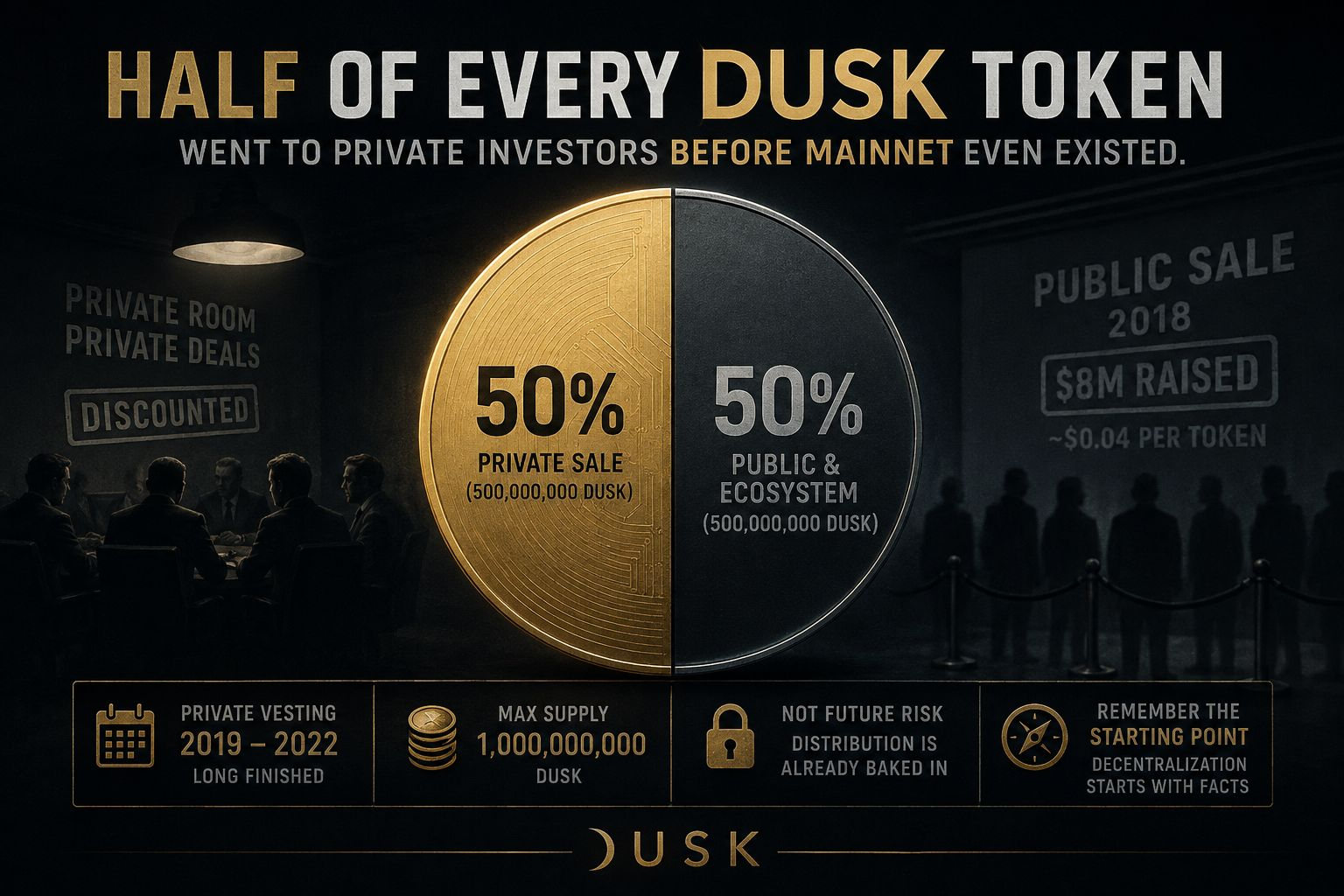
Half of every #dusk token that will ever exist went to private sale investors before mainnet even existed. Thats not a small detail.
I went digging through $DUSK own tokenomics page looking for something else and ran into a line I had to reread. Private sale tokens make up 50 percent of the entire maximum supply. Not 50 percent of what was sold in the ICO. Fifty percent of every @Dusk_Foundation token that will ever be minted, full stop, capped at one billion total.
For context, the actual public ICO back in 2018 raised 8 million dollars, tokens priced around four cents each. Thats the part most people know about, the public round. Whats less talked about is that the private allocation dwarfs it, half the entire supply, sold before public investors ever got a look, presumably at a steep discount to that four cent price. Private tokens had a vesting period running from 2019 to 2022, so this is not fresh dumping risk anymore, that window closed years ago. But the imbalance in who got access to half the networks total supply, at what price, happened long before anyone reading a coin listing today had the chance to participate.
I want to be fair here. This was 2018, private sales funding half a projects supply was not unusual then, its practically the template most L1s from that era followed. And the vesting being long finished means whatever distribution exists now is already baked in, not a future risk hanging over the price. Im not saying this makes Dusk uniquely bad.
I am saying that when a project talks about decentralization today, its worth remembering that half its total supply was allocated in a private room years before anyone outside that room got the chance to buy in. Thats just the starting point this token launched from.
Half of every #dusk token that will ever exist went to private sale investors before mainnet even existed. Thats not a small detail.
I went digging through $DUSK own tokenomics page looking for something else and ran into a line I had to reread. Private sale tokens make up 50 percent of the entire maximum supply. Not 50 percent of what was sold in the ICO. Fifty percent of every @Dusk token that will ever be minted, full stop, capped at one billion total.
For context, the actual public ICO back in 2018 raised 8 million dollars, tokens priced around four cents each. Thats the part most people know about, the public round. Whats less talked about is that the private allocation dwarfs it, half the entire supply, sold before public investors ever got a look, presumably at a steep discount to that four cent price. Private tokens had a vesting period running from 2019 to 2022, so this is not fresh dumping risk anymore, that window closed years ago. But the imbalance in who got access to half the networks total supply, at what price, happened long before anyone reading a coin listing today had the chance to participate.
I want to be fair here. This was 2018, private sales funding half a projects supply was not unusual then, its practically the template most L1s from that era followed. And the vesting being long finished means whatever distribution exists now is already baked in, not a future risk hanging over the price. Im not saying this makes Dusk uniquely bad.
I am saying that when a project talks about decentralization today, its worth remembering that half its total supply was allocated in a private room years before anyone outside that room got the chance to buy in. Thats just the starting point this token launched from.
I went digging through $DUSK own tokenomics page looking for something else and ran into a line I had to reread. Private sale tokens make up 50 percent of the entire maximum supply. Not 50 percent of what was sold in the ICO. Fifty percent of every @Dusk token that will ever be minted, full stop, capped at one billion total.
For context, the actual public ICO back in 2018 raised 8 million dollars, tokens priced around four cents each. Thats the part most people know about, the public round. Whats less talked about is that the private allocation dwarfs it, half the entire supply, sold before public investors ever got a look, presumably at a steep discount to that four cent price. Private tokens had a vesting period running from 2019 to 2022, so this is not fresh dumping risk anymore, that window closed years ago. But the imbalance in who got access to half the networks total supply, at what price, happened long before anyone reading a coin listing today had the chance to participate.
I want to be fair here. This was 2018, private sales funding half a projects supply was not unusual then, its practically the template most L1s from that era followed. And the vesting being long finished means whatever distribution exists now is already baked in, not a future risk hanging over the price. Im not saying this makes Dusk uniquely bad.
I am saying that when a project talks about decentralization today, its worth remembering that half its total supply was allocated in a private room years before anyone outside that room got the chance to buy in. Thats just the starting point this token launched from.
4
5
240
·
--
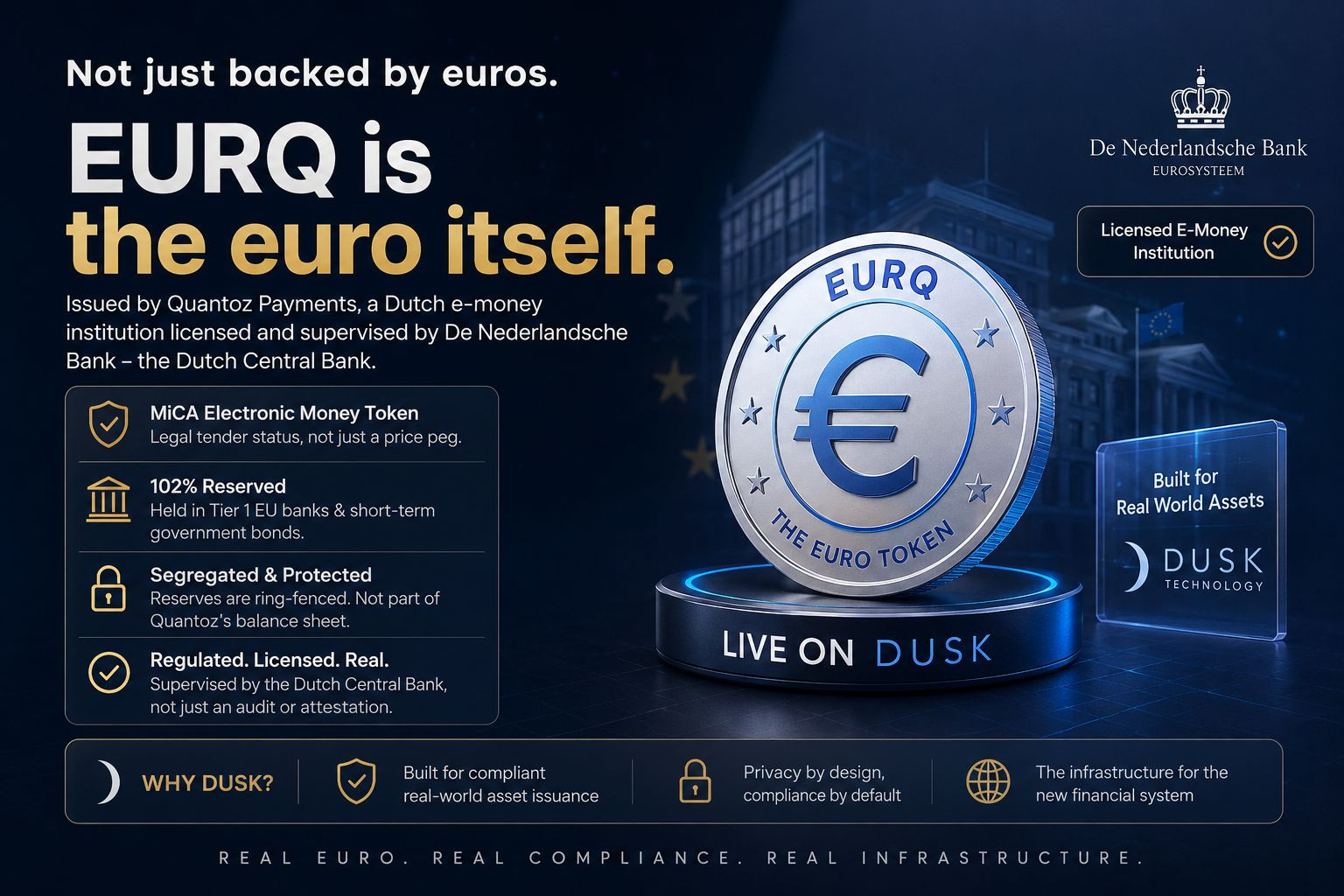
Most stablecoins are a companys promise. EURQ is legally the euro itself. Thats a bigger difference than it sounds.
I have read a lot of stablecoin pitches. Almost all of them use the same language, backed 1:1, fully reserved, audited regularly. EURQ, the euro token now live on @Dusk_Foundation , makes a different and much stronger claim, and I wanted to check whether it actually holds up.
EURQ is issued by Quantoz Payments, a Dutch electronic money institution licensed and supervised directly by De Nederlandsche Bank, the actual Dutch central bank. Thats not a self-attested audit or a third party attestation firm signing off after the fact. Thats a banking regulator granting an E-Money license the same category used for real digital cash, not a crypto side project wearing compliance language.
Heres the part that actually separates it from something like USDT or even USDC. Under MiCA, EURQ is classified as an Electronic Money Token, legal tender status, not just a price-pegged crypto asset. Reserves sit in Tier 1 European banks and short term government bonds, segregated from Quantozs own balance sheet, held at 102 percent to cover redemption even under stress. If Quantoz ran into trouble tomorrow, those reserves are not Quantozs money to touch.
Now the #dusk specific part. Dusk is not just one more chain EURQ happens to support. Out of the handful of blockchains carrying it, $DUSK is the one actually built for native real world asset issuance with compliance baked into the protocol itself, not bolted on after. Thats why NPEX picked it too, a real Euro token is the missing piece for an actual on-chain stock exchange to settle trades in something regulators recognize as genuine currency, not a synthetic stand-in for one.
I still think people should read the fine print on any stablecoin before trusting it. But EURQs fine print is a banking license, not a whitepaper. Thats a meaningfully different foundation than most of what circulates in this space.
Most stablecoins are a companys promise. EURQ is legally the euro itself. Thats a bigger difference than it sounds.
I have read a lot of stablecoin pitches. Almost all of them use the same language, backed 1:1, fully reserved, audited regularly. EURQ, the euro token now live on @Dusk , makes a different and much stronger claim, and I wanted to check whether it actually holds up.
EURQ is issued by Quantoz Payments, a Dutch electronic money institution licensed and supervised directly by De Nederlandsche Bank, the actual Dutch central bank. Thats not a self-attested audit or a third party attestation firm signing off after the fact. Thats a banking regulator granting an E-Money license the same category used for real digital cash, not a crypto side project wearing compliance language.
Heres the part that actually separates it from something like USDT or even USDC. Under MiCA, EURQ is classified as an Electronic Money Token, legal tender status, not just a price-pegged crypto asset. Reserves sit in Tier 1 European banks and short term government bonds, segregated from Quantozs own balance sheet, held at 102 percent to cover redemption even under stress. If Quantoz ran into trouble tomorrow, those reserves are not Quantozs money to touch.
Now the #dusk specific part. Dusk is not just one more chain EURQ happens to support. Out of the handful of blockchains carrying it, $DUSK is the one actually built for native real world asset issuance with compliance baked into the protocol itself, not bolted on after. Thats why NPEX picked it too, a real Euro token is the missing piece for an actual on-chain stock exchange to settle trades in something regulators recognize as genuine currency, not a synthetic stand-in for one.
I still think people should read the fine print on any stablecoin before trusting it. But EURQs fine print is a banking license, not a whitepaper. Thats a meaningfully different foundation than most of what circulates in this space.
I have read a lot of stablecoin pitches. Almost all of them use the same language, backed 1:1, fully reserved, audited regularly. EURQ, the euro token now live on @Dusk , makes a different and much stronger claim, and I wanted to check whether it actually holds up.
EURQ is issued by Quantoz Payments, a Dutch electronic money institution licensed and supervised directly by De Nederlandsche Bank, the actual Dutch central bank. Thats not a self-attested audit or a third party attestation firm signing off after the fact. Thats a banking regulator granting an E-Money license the same category used for real digital cash, not a crypto side project wearing compliance language.
Heres the part that actually separates it from something like USDT or even USDC. Under MiCA, EURQ is classified as an Electronic Money Token, legal tender status, not just a price-pegged crypto asset. Reserves sit in Tier 1 European banks and short term government bonds, segregated from Quantozs own balance sheet, held at 102 percent to cover redemption even under stress. If Quantoz ran into trouble tomorrow, those reserves are not Quantozs money to touch.
Now the #dusk specific part. Dusk is not just one more chain EURQ happens to support. Out of the handful of blockchains carrying it, $DUSK is the one actually built for native real world asset issuance with compliance baked into the protocol itself, not bolted on after. Thats why NPEX picked it too, a real Euro token is the missing piece for an actual on-chain stock exchange to settle trades in something regulators recognize as genuine currency, not a synthetic stand-in for one.
I still think people should read the fine print on any stablecoin before trusting it. But EURQs fine print is a banking license, not a whitepaper. Thats a meaningfully different foundation than most of what circulates in this space.
7
7
331
·
--
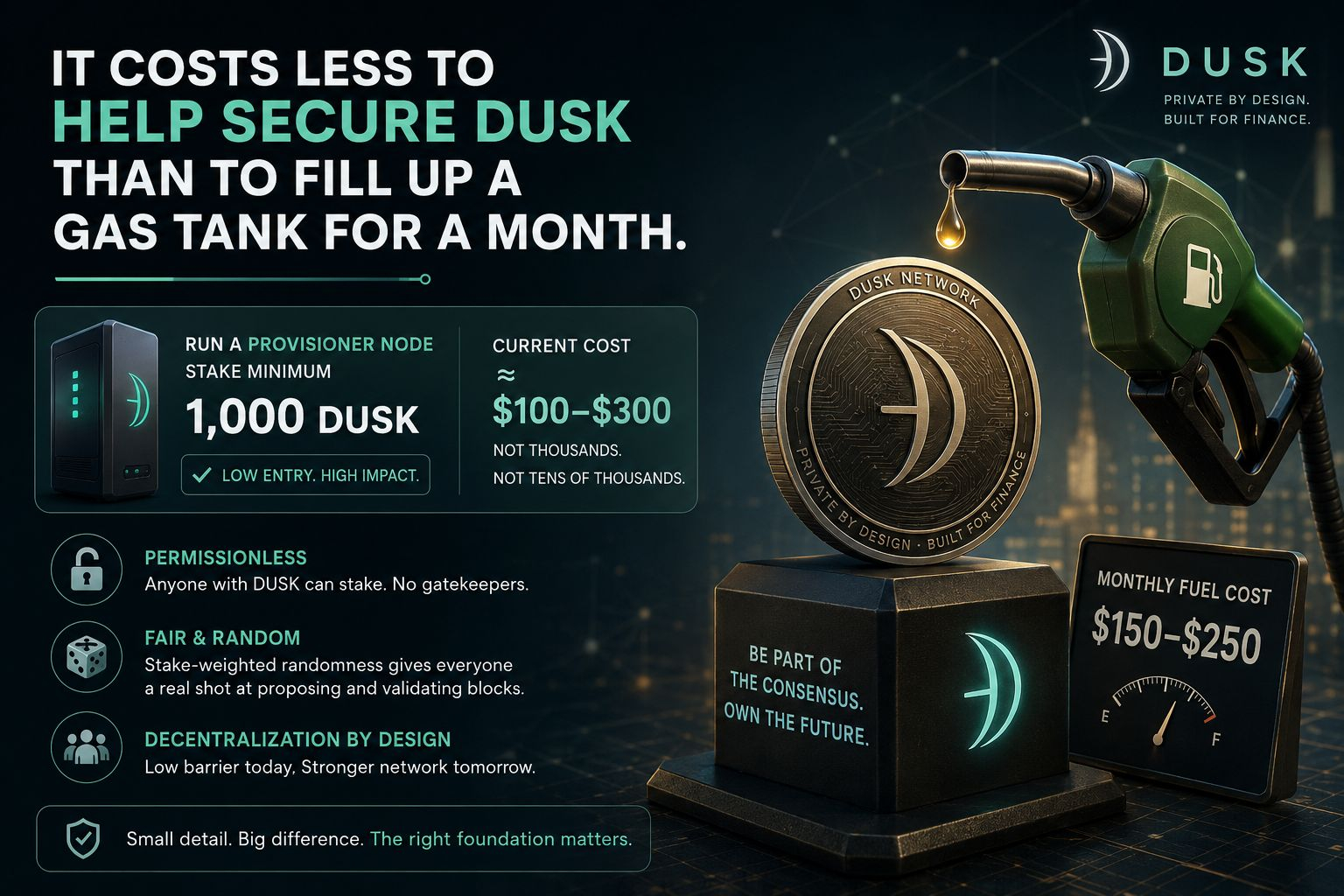
It costs less to help secure @Dusk_Foundation than it costs to fill up a gas tank for a month. That number stopped me.
I have been picking apart a lot of the rough edges in these threads, so let me flip it for a second and talk about something #dusk actually got right, because I think it gets buried under everything else.
To run a validator node on Dusk, a Provisioner, the minimum stake is 1,000 $DUSK . At current prices thats somewhere in the low hundreds of dollars, not thousands, not tens of thousands. Compare that to what it takes to run an actual validator on a lot of major proof of stake chains, where the entry ticket runs well into 5 or 6 figures once you account for the minimum stake requirement. Dusk deliberately kept that door low.
And its not just cheap, its genuinely permissionless. Anyone holding DUSK can stake and become part of the consensus set, no application, no approval, no gatekeeper deciding whos allowed to help secure the network. Selection happens through stake weighted randomness, so smaller stakers still get real, recurring chances to propose and validate blocks, not just watch from the sidelines while a handful of whales run everything.
I want to be careful not to oversell this. Low cost of entry does not automatically mean the validator set stays spread out over time, concentration can still creep in as bigger holders accumulate more influence, that risk exists on every proof of stake chain regardless of the starting minimum. But a low floor is still the right foundation to build decentralization on top of. You cant get broad participation if the entry price locks most people out before they even try, and Dusk clearly chose not to do that.
Small detail, easy to scroll past. Probably should not be.
It costs less to help secure @Dusk than it costs to fill up a gas tank for a month. That number stopped me.
I have been picking apart a lot of the rough edges in these threads, so let me flip it for a second and talk about something #dusk actually got right, because I think it gets buried under everything else.
To run a validator node on Dusk, a Provisioner, the minimum stake is 1,000 $DUSK . At current prices thats somewhere in the low hundreds of dollars, not thousands, not tens of thousands. Compare that to what it takes to run an actual validator on a lot of major proof of stake chains, where the entry ticket runs well into 5 or 6 figures once you account for the minimum stake requirement. Dusk deliberately kept that door low.
And its not just cheap, its genuinely permissionless. Anyone holding DUSK can stake and become part of the consensus set, no application, no approval, no gatekeeper deciding whos allowed to help secure the network. Selection happens through stake weighted randomness, so smaller stakers still get real, recurring chances to propose and validate blocks, not just watch from the sidelines while a handful of whales run everything.
I want to be careful not to oversell this. Low cost of entry does not automatically mean the validator set stays spread out over time, concentration can still creep in as bigger holders accumulate more influence, that risk exists on every proof of stake chain regardless of the starting minimum. But a low floor is still the right foundation to build decentralization on top of. You cant get broad participation if the entry price locks most people out before they even try, and Dusk clearly chose not to do that.
Small detail, easy to scroll past. Probably should not be.
I have been picking apart a lot of the rough edges in these threads, so let me flip it for a second and talk about something #dusk actually got right, because I think it gets buried under everything else.
To run a validator node on Dusk, a Provisioner, the minimum stake is 1,000 $DUSK . At current prices thats somewhere in the low hundreds of dollars, not thousands, not tens of thousands. Compare that to what it takes to run an actual validator on a lot of major proof of stake chains, where the entry ticket runs well into 5 or 6 figures once you account for the minimum stake requirement. Dusk deliberately kept that door low.
And its not just cheap, its genuinely permissionless. Anyone holding DUSK can stake and become part of the consensus set, no application, no approval, no gatekeeper deciding whos allowed to help secure the network. Selection happens through stake weighted randomness, so smaller stakers still get real, recurring chances to propose and validate blocks, not just watch from the sidelines while a handful of whales run everything.
I want to be careful not to oversell this. Low cost of entry does not automatically mean the validator set stays spread out over time, concentration can still creep in as bigger holders accumulate more influence, that risk exists on every proof of stake chain regardless of the starting minimum. But a low floor is still the right foundation to build decentralization on top of. You cant get broad participation if the entry price locks most people out before they even try, and Dusk clearly chose not to do that.
Small detail, easy to scroll past. Probably should not be.
11
8
360
·
--
"MiCA Compliant" gets said about @Dusk_Foundation constantly. Dusk itself does not actually hold a MiCA license. I had to read that twice.
I went looking for confirmation that #dusk itself is MiCA authorized, expecting a straightforward yes. What I found was more nuanced, and honestly more interesting than a simple yes would have been.
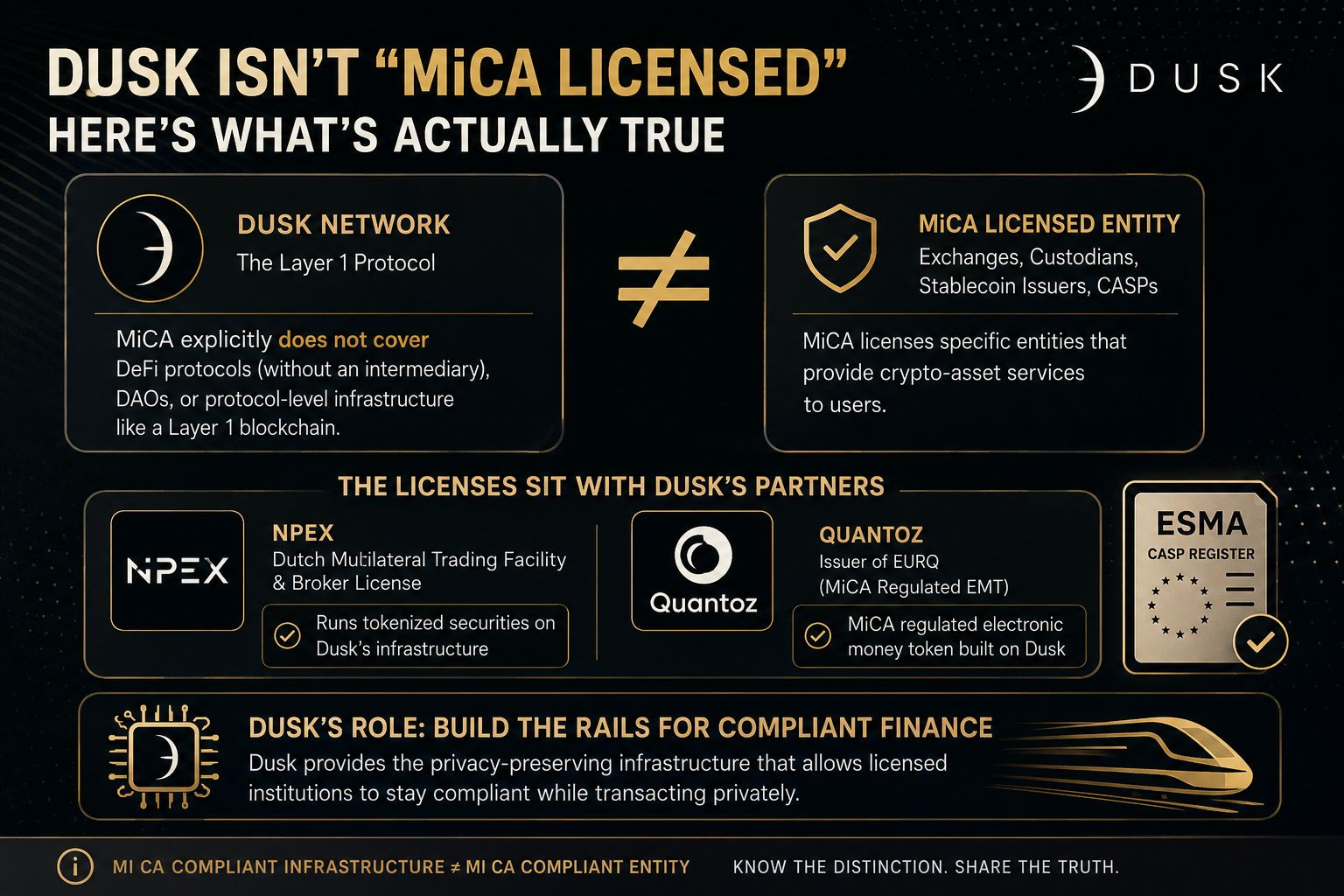
MiCA, the EUs crypto regulation framework, licenses specific things. Exchanges, custodians, stablecoin issuers, entities that are Crypto-Asset Service Providers. By Dusks own words in their own writeup, MiCA explicitly does not cover DeFi protocols without an intermediary, DAOs, or plain protocol-level infrastructure like a Layer 1 blockchain itself. So Dusk the network is not the thing getting licensed. Its the rails underneath licensed entities.
The actual licenses sit with Dusks partners. NPEX holds a Dutch Multilateral Trading Facility and broker license and runs its tokenized securities on $DUSK infrastructure. Quantoz issues EURQ, a MiCA regulated electronic money token, also built on Dusk. Both of those are real, verifiable, sitting in the ESMA CASP register. Dusk built the technology that lets licensed institutions stay compliant while transacting privately. Thats genuinely valuable. Its just a different claim than "Dusk is MiCA Compliant" as a blanket statement.
I dont think this is Dusk being dishonest, their own blog post actually spells out the distinction pretty clearly if you read past the headline. I think its more that "MiCA Compliant Infrastructure" gets shortened to "MiCA Compliant" in casual conversation and social posts, and that shortening quietly changes what's being claimed. One version says we enable compliance. The other implies we are compliant. Those are not the same sentence.
Worth knowing which one is actually true before repeating it as a selling point.
"MiCA Compliant" gets said about @Dusk constantly. Dusk itself does not actually hold a MiCA license. I had to read that twice.
I went looking for confirmation that #dusk itself is MiCA authorized, expecting a straightforward yes. What I found was more nuanced, and honestly more interesting than a simple yes would have been.
MiCA, the EUs crypto regulation framework, licenses specific things. Exchanges, custodians, stablecoin issuers, entities that are Crypto-Asset Service Providers. By Dusks own words in their own writeup, MiCA explicitly does not cover DeFi protocols without an intermediary, DAOs, or plain protocol-level infrastructure like a Layer 1 blockchain itself. So Dusk the network is not the thing getting licensed. Its the rails underneath licensed entities.
The actual licenses sit with Dusks partners. NPEX holds a Dutch Multilateral Trading Facility and broker license and runs its tokenized securities on $DUSK infrastructure. Quantoz issues EURQ, a MiCA regulated electronic money token, also built on Dusk. Both of those are real, verifiable, sitting in the ESMA CASP register. Dusk built the technology that lets licensed institutions stay compliant while transacting privately. Thats genuinely valuable. Its just a different claim than "Dusk is MiCA Compliant" as a blanket statement.
I dont think this is Dusk being dishonest, their own blog post actually spells out the distinction pretty clearly if you read past the headline. I think its more that "MiCA Compliant Infrastructure" gets shortened to "MiCA Compliant" in casual conversation and social posts, and that shortening quietly changes what's being claimed. One version says we enable compliance. The other implies we are compliant. Those are not the same sentence.
Worth knowing which one is actually true before repeating it as a selling point.
I went looking for confirmation that #dusk itself is MiCA authorized, expecting a straightforward yes. What I found was more nuanced, and honestly more interesting than a simple yes would have been.
MiCA, the EUs crypto regulation framework, licenses specific things. Exchanges, custodians, stablecoin issuers, entities that are Crypto-Asset Service Providers. By Dusks own words in their own writeup, MiCA explicitly does not cover DeFi protocols without an intermediary, DAOs, or plain protocol-level infrastructure like a Layer 1 blockchain itself. So Dusk the network is not the thing getting licensed. Its the rails underneath licensed entities.
The actual licenses sit with Dusks partners. NPEX holds a Dutch Multilateral Trading Facility and broker license and runs its tokenized securities on $DUSK infrastructure. Quantoz issues EURQ, a MiCA regulated electronic money token, also built on Dusk. Both of those are real, verifiable, sitting in the ESMA CASP register. Dusk built the technology that lets licensed institutions stay compliant while transacting privately. Thats genuinely valuable. Its just a different claim than "Dusk is MiCA Compliant" as a blanket statement.
I dont think this is Dusk being dishonest, their own blog post actually spells out the distinction pretty clearly if you read past the headline. I think its more that "MiCA Compliant Infrastructure" gets shortened to "MiCA Compliant" in casual conversation and social posts, and that shortening quietly changes what's being claimed. One version says we enable compliance. The other implies we are compliant. Those are not the same sentence.
Worth knowing which one is actually true before repeating it as a selling point.
2
126
·
--
🚀 Crypto Market Blast: Bitcoin Just Shook the Market! 🚀
Bitcoin is on an incredible run this week. It closed with a 22% weekly gain, ending near $77,000, up from about $62,800 at the start of the week. That's its strongest weekly run since 2024, and Bitcoin even broke past the $78,000 level!
What's driving the rally?
📈 Treasury Secretary Bessent's bond market intervention pushed yields down
📈 Trump has been pushing Congress to pass the Clarity Act, which would bring clarity to crypto regulation
📈 This triggered a massive short squeeze, with roughly $2.7 billion in crypto short positions liquidated
It's not just Bitcoin. Ethereum jumped 8.12% to $2,515, and XRP surged 14.61% to $1.4538, showing the rally is broad rather than a single-token move. Bitcoin Cash gained 31% in 24 hours, and Ethena rose 27%. Altcoins are joining the party too! 🎉
⚠️ Reminder: crypto is highly volatile. Do your own research and only invest what you can afford to lose.
#Bitcoin #CryptoMarket #BTC #CryptoNews #Ethereum
🚀 Crypto Market Blast: Bitcoin Just Shook the Market! 🚀
Bitcoin is on an incredible run this week. It closed with a 22% weekly gain, ending near $77,000, up from about $62,800 at the start of the week. That's its strongest weekly run since 2024, and Bitcoin even broke past the $78,000 level!
What's driving the rally?
📈 Treasury Secretary Bessent's bond market intervention pushed yields down
📈 Trump has been pushing Congress to pass the Clarity Act, which would bring clarity to crypto regulation
📈 This triggered a massive short squeeze, with roughly $2.7 billion in crypto short positions liquidated
It's not just Bitcoin. Ethereum jumped 8.12% to $2,515, and XRP surged 14.61% to $1.4538, showing the rally is broad rather than a single-token move. Bitcoin Cash gained 31% in 24 hours, and Ethena rose 27%. Altcoins are joining the party too! 🎉
⚠️ Reminder: crypto is highly volatile. Do your own research and only invest what you can afford to lose.
#Bitcoin #CryptoMarket #BTC #CryptoNews #Ethereum
Bitcoin is on an incredible run this week. It closed with a 22% weekly gain, ending near $77,000, up from about $62,800 at the start of the week. That's its strongest weekly run since 2024, and Bitcoin even broke past the $78,000 level!
What's driving the rally?
📈 Treasury Secretary Bessent's bond market intervention pushed yields down
📈 Trump has been pushing Congress to pass the Clarity Act, which would bring clarity to crypto regulation
📈 This triggered a massive short squeeze, with roughly $2.7 billion in crypto short positions liquidated
It's not just Bitcoin. Ethereum jumped 8.12% to $2,515, and XRP surged 14.61% to $1.4538, showing the rally is broad rather than a single-token move. Bitcoin Cash gained 31% in 24 hours, and Ethena rose 27%. Altcoins are joining the party too! 🎉
⚠️ Reminder: crypto is highly volatile. Do your own research and only invest what you can afford to lose.
#Bitcoin #CryptoMarket #BTC #CryptoNews #Ethereum
152
·
--
Uniswap changed how people trade tokens. @termmax is trying to do the same thing for how people borrow and lend.
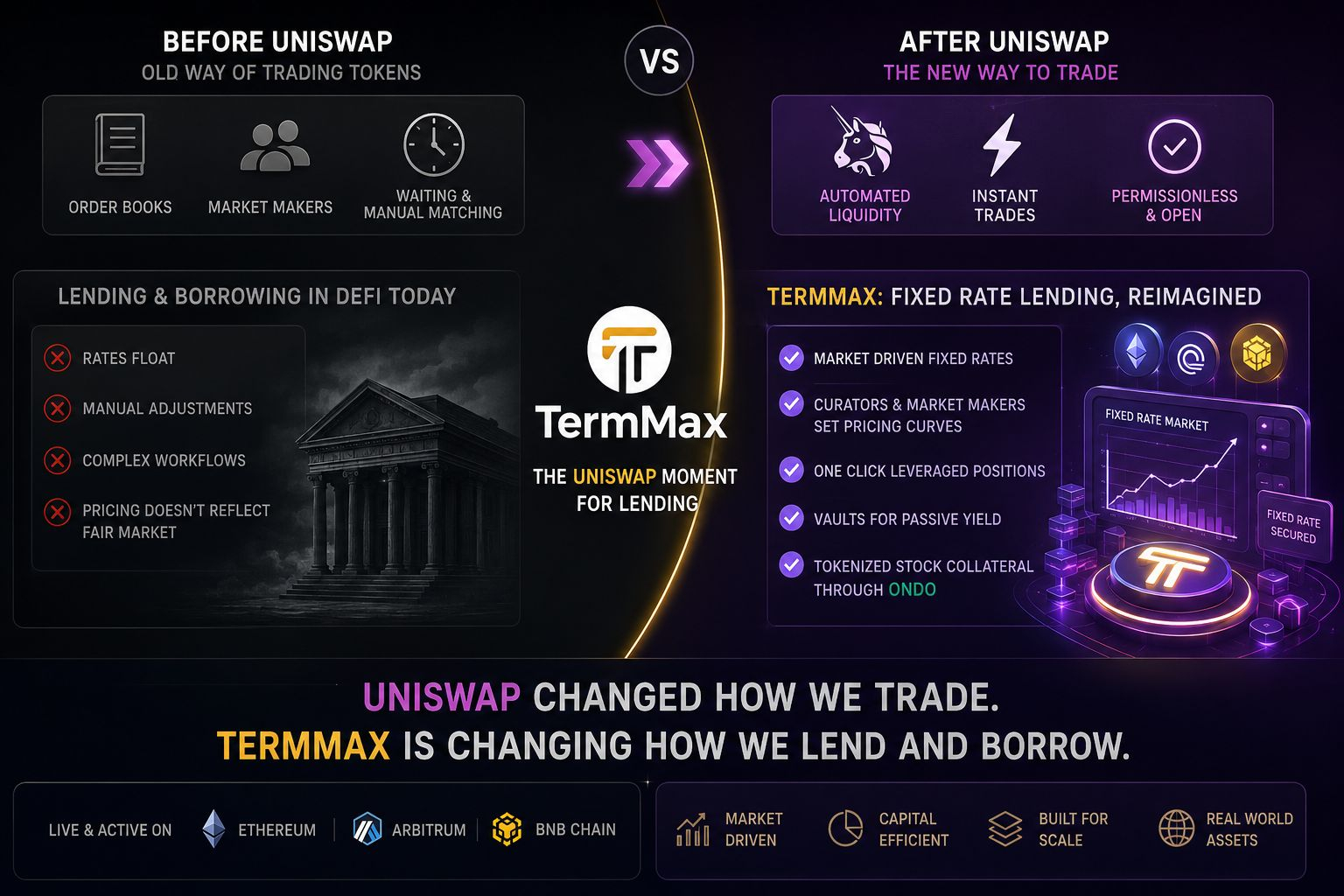
Before Uniswap, trading meant order books, market makers, and waiting for someone to match your price. Uniswap made it instant and automated. Lending and borrowing in DeFi still feels a lot like the old system. Rates float, positions need constant attention, and pricing rarely reflects what's actually fair for both sides.
#TermMax brings that same automated, market driven approach to fixed rate lending. Borrowers and lenders settle on rates through actual market mechanics, not a single algorithm trying to guess the right number for everyone. Curators and market makers set their own pricing curves through range orders, so the market adjusts itself instead of you adjusting to it.
A few reasons this is worth a closer look.
Live and active on Ethereum, Arbitrum, and BNB Chain, not just an announcement.
One click leveraged positions, so you are not stitching together five transactions across different platforms.
Vaults for people who want yield without actively managing a strategy every day.
A tokenized stock collateral market through Ondo, opening fixed rate borrowing to real world assets.
The comparison is not about hype. Its about the shift from manual, unpredictable systems to ones that just work the way markets are supposed to. Thats usually where the real growth happens.
Which part of DeFi do you think still needs its "Uniswap Moment"?
Uniswap changed how people trade tokens. @TermMax is trying to do the same thing for how people borrow and lend.
Before Uniswap, trading meant order books, market makers, and waiting for someone to match your price. Uniswap made it instant and automated. Lending and borrowing in DeFi still feels a lot like the old system. Rates float, positions need constant attention, and pricing rarely reflects what's actually fair for both sides.
#TermMax brings that same automated, market driven approach to fixed rate lending. Borrowers and lenders settle on rates through actual market mechanics, not a single algorithm trying to guess the right number for everyone. Curators and market makers set their own pricing curves through range orders, so the market adjusts itself instead of you adjusting to it.
A few reasons this is worth a closer look.
Live and active on Ethereum, Arbitrum, and BNB Chain, not just an announcement.
One click leveraged positions, so you are not stitching together five transactions across different platforms.
Vaults for people who want yield without actively managing a strategy every day.
A tokenized stock collateral market through Ondo, opening fixed rate borrowing to real world assets.
The comparison is not about hype. Its about the shift from manual, unpredictable systems to ones that just work the way markets are supposed to. Thats usually where the real growth happens.
Which part of DeFi do you think still needs its "Uniswap Moment"?
Before Uniswap, trading meant order books, market makers, and waiting for someone to match your price. Uniswap made it instant and automated. Lending and borrowing in DeFi still feels a lot like the old system. Rates float, positions need constant attention, and pricing rarely reflects what's actually fair for both sides.
#TermMax brings that same automated, market driven approach to fixed rate lending. Borrowers and lenders settle on rates through actual market mechanics, not a single algorithm trying to guess the right number for everyone. Curators and market makers set their own pricing curves through range orders, so the market adjusts itself instead of you adjusting to it.
A few reasons this is worth a closer look.
Live and active on Ethereum, Arbitrum, and BNB Chain, not just an announcement.
One click leveraged positions, so you are not stitching together five transactions across different platforms.
Vaults for people who want yield without actively managing a strategy every day.
A tokenized stock collateral market through Ondo, opening fixed rate borrowing to real world assets.
The comparison is not about hype. Its about the shift from manual, unpredictable systems to ones that just work the way markets are supposed to. Thats usually where the real growth happens.
Which part of DeFi do you think still needs its "Uniswap Moment"?
185
·
--
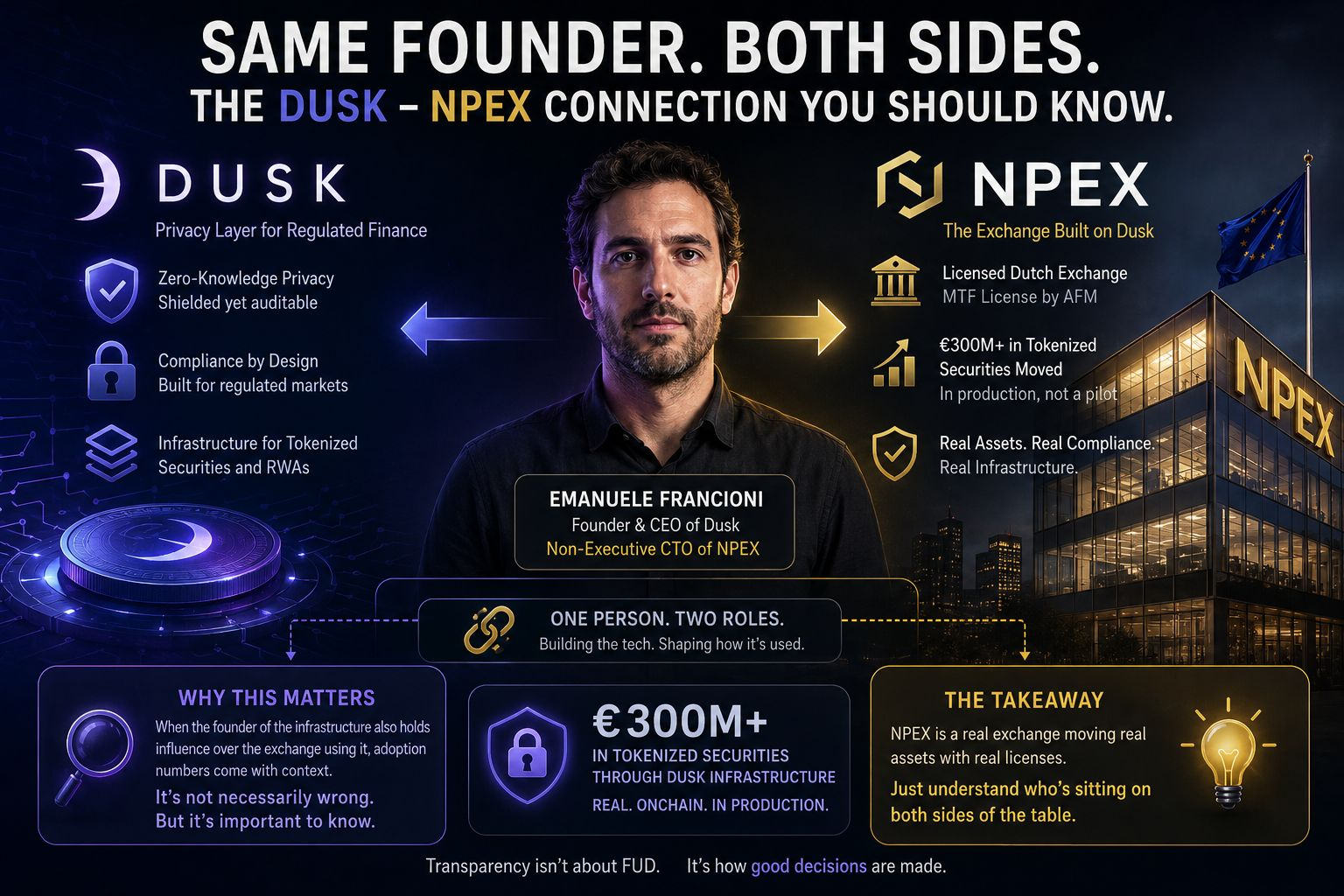
Dusks founder is also the CTO of the exchange that runs on Dusks own technology. Nobody flagged this to me until I checked myself.
I was reading through #dusk partnership news and noticed a line that made me stop. Emanuele Francioni, founder and CEO of @Dusk_Foundation , was appointed as Non-Executive CTO of NPEX, the licensed Dutch exchange that's tokenizing hundreds of millions in securities using Dusks infrastructure. Same person, sitting on both sides of whats supposed to be a partnership between two separate entities.
I want to be fair about this before jumping to conclusions. Non-Executive roles are common in this industry, Advisors sit on boards all the time, and having the actual architect of the underlying tech helping the exchange implement it correctly is not inherently sketchy. If anything, you could argue its the opposite, who better understands how to securely deploy $DUSK privacy and compliance layer than the person who built it.
But step back for a second. NPEX using Dusk is not just two companies doing business together anymore. Its a licensed exchange whose technical direction is partly steered by the same person whose company benefits directly from that Exchanges continued use of Dusk. Every reference to NPEX as proof of institutional adoption, the 300 million plus in tokenized assets, all of it carries this detail sitting quietly underneath, not hidden exactly, just rarely mentioned next to the headline number.
I dont think this makes the NPEX partnership fake or the numbers inflated. Real securities are genuinely moving through real infrastructure. I just think when a founder holds influence on both sides of a flagship adoption story, thats worth knowing before you treat it as fully independent validation, not after.
Dusks founder is also the CTO of the exchange that runs on Dusks own technology. Nobody flagged this to me until I checked myself.
I was reading through #dusk partnership news and noticed a line that made me stop. Emanuele Francioni, founder and CEO of @Dusk , was appointed as Non-Executive CTO of NPEX, the licensed Dutch exchange that's tokenizing hundreds of millions in securities using Dusks infrastructure. Same person, sitting on both sides of whats supposed to be a partnership between two separate entities.
I want to be fair about this before jumping to conclusions. Non-Executive roles are common in this industry, Advisors sit on boards all the time, and having the actual architect of the underlying tech helping the exchange implement it correctly is not inherently sketchy. If anything, you could argue its the opposite, who better understands how to securely deploy $DUSK privacy and compliance layer than the person who built it.
But step back for a second. NPEX using Dusk is not just two companies doing business together anymore. Its a licensed exchange whose technical direction is partly steered by the same person whose company benefits directly from that Exchanges continued use of Dusk. Every reference to NPEX as proof of institutional adoption, the 300 million plus in tokenized assets, all of it carries this detail sitting quietly underneath, not hidden exactly, just rarely mentioned next to the headline number.
I dont think this makes the NPEX partnership fake or the numbers inflated. Real securities are genuinely moving through real infrastructure. I just think when a founder holds influence on both sides of a flagship adoption story, thats worth knowing before you treat it as fully independent validation, not after.
I was reading through #dusk partnership news and noticed a line that made me stop. Emanuele Francioni, founder and CEO of @Dusk , was appointed as Non-Executive CTO of NPEX, the licensed Dutch exchange that's tokenizing hundreds of millions in securities using Dusks infrastructure. Same person, sitting on both sides of whats supposed to be a partnership between two separate entities.
I want to be fair about this before jumping to conclusions. Non-Executive roles are common in this industry, Advisors sit on boards all the time, and having the actual architect of the underlying tech helping the exchange implement it correctly is not inherently sketchy. If anything, you could argue its the opposite, who better understands how to securely deploy $DUSK privacy and compliance layer than the person who built it.
But step back for a second. NPEX using Dusk is not just two companies doing business together anymore. Its a licensed exchange whose technical direction is partly steered by the same person whose company benefits directly from that Exchanges continued use of Dusk. Every reference to NPEX as proof of institutional adoption, the 300 million plus in tokenized assets, all of it carries this detail sitting quietly underneath, not hidden exactly, just rarely mentioned next to the headline number.
I dont think this makes the NPEX partnership fake or the numbers inflated. Real securities are genuinely moving through real infrastructure. I just think when a founder holds influence on both sides of a flagship adoption story, thats worth knowing before you treat it as fully independent validation, not after.
1
167
·
--
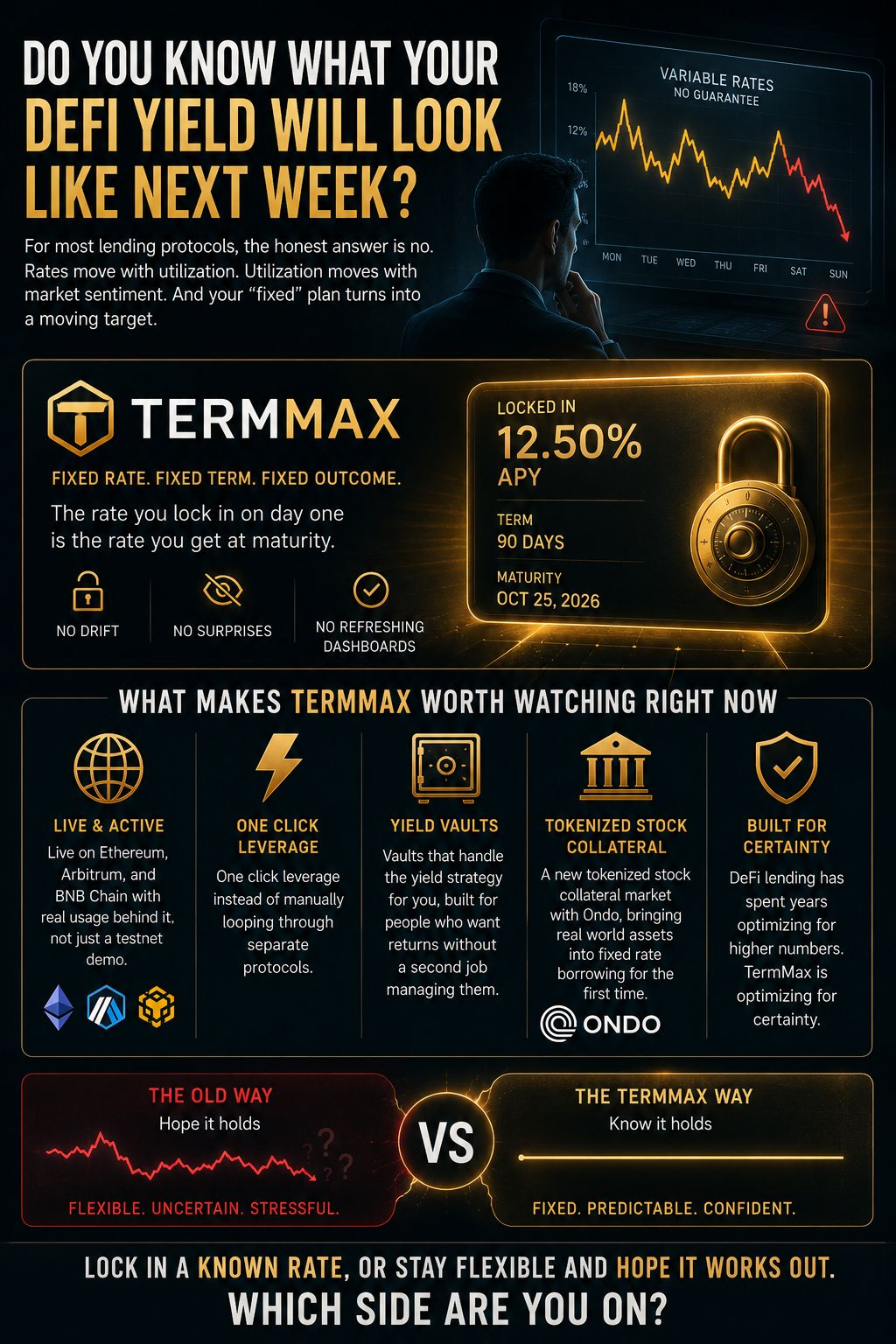
Quick question. Do you actually know what your DeFi yield will look like next week?
For most lending protocols, the honest answer is no. Rates move with utilization, utilization moves with market sentiment, and your "Fixed" plan turns into a moving target.
@termmax skips that problem entirely. Its a Fixed Rate, Fixed Term Protocol, so the rate you lock in on day one is the rate you get at maturity. No drift, no surprises, no refreshing your dashboard to see what changed overnight.
What makes it worth watching right now.
Live on Ethereum, Arbitrum, and BNB Chain with real usage behind it, not just a testnet demo.
One click leverage instead of manually looping through separate protocols.
Vaults that handle the yield strategy for you, built for people who want returns without a second job managing them.
A new tokenized stock collateral market with Ondo, which brings real world assets into fixed rate borrowing for the first time.
DeFi lending has spent years optimizing for higher numbers. #TermMax is optimizing for certainty instead, and that might matter more once serious capital starts looking for a reason to come on chain.
Locking in a known rate, or staying flexible and hoping it works out. Which side are you on?
Quick question. Do you actually know what your DeFi yield will look like next week?
For most lending protocols, the honest answer is no. Rates move with utilization, utilization moves with market sentiment, and your "Fixed" plan turns into a moving target.
@TermMax skips that problem entirely. Its a Fixed Rate, Fixed Term Protocol, so the rate you lock in on day one is the rate you get at maturity. No drift, no surprises, no refreshing your dashboard to see what changed overnight.
What makes it worth watching right now.
Live on Ethereum, Arbitrum, and BNB Chain with real usage behind it, not just a testnet demo.
One click leverage instead of manually looping through separate protocols.
Vaults that handle the yield strategy for you, built for people who want returns without a second job managing them.
A new tokenized stock collateral market with Ondo, which brings real world assets into fixed rate borrowing for the first time.
DeFi lending has spent years optimizing for higher numbers. #TermMax is optimizing for certainty instead, and that might matter more once serious capital starts looking for a reason to come on chain.
Locking in a known rate, or staying flexible and hoping it works out. Which side are you on?
For most lending protocols, the honest answer is no. Rates move with utilization, utilization moves with market sentiment, and your "Fixed" plan turns into a moving target.
@TermMax skips that problem entirely. Its a Fixed Rate, Fixed Term Protocol, so the rate you lock in on day one is the rate you get at maturity. No drift, no surprises, no refreshing your dashboard to see what changed overnight.
What makes it worth watching right now.
Live on Ethereum, Arbitrum, and BNB Chain with real usage behind it, not just a testnet demo.
One click leverage instead of manually looping through separate protocols.
Vaults that handle the yield strategy for you, built for people who want returns without a second job managing them.
A new tokenized stock collateral market with Ondo, which brings real world assets into fixed rate borrowing for the first time.
DeFi lending has spent years optimizing for higher numbers. #TermMax is optimizing for certainty instead, and that might matter more once serious capital starts looking for a reason to come on chain.
Locking in a known rate, or staying flexible and hoping it works out. Which side are you on?
350
·
--
Проверено
Do your KYC once, use it everywhere. @Dusk_Foundation built this three years ago and almost nobody talks about it anymore.
Everyones excited about DuskEVM and the price action lately, fair enough. But scrolling back through #dusk history, I found something older I think matters more than anything shipping right now. Its called Citadel. You complete KYC once, and every institution that needs to verify you afterward just checks a license instead of making you go through the whole process again.
Here is how it works. Your verified identity becomes something like a private NFT, a license, sitting on the Dusk chain, encrypted. When a platform needs to confirm you meet their requirements, accredited investor status, minimum balance, whatever it is, you don't hand over documents again. You generate a zero-knowledge proof that you hold a valid license meeting their exact requirement. Thats all they see. Not your name, not your bank statement, just a verified yes.
I like this for an obvious reason. KYC today is genuinely miserable, the same documents, the same selfie holding your ID, over and over, for every exchange and platform you touch, each one storing a fresh copy of your data somewhere. Citadel collapses all of that into one verification that gets reused, meaning one less pile of your personal documents sitting in some database waiting to leak.
Here is what gives me pause though. If your entire compliance identity boils down to one on-chain license, that license becomes an extremely valuable target. Lose control of it, or have the issuing party make a mistake, and you are not locked out of one platform, potentially all of them. Centralizing convenience and centralizing risk tend to be the same move wearing different clothes.
Three years old and I still dont see it get much attention. Might be the most underrated piece of what Dusk's actually built. $DUSK
Do your KYC once, use it everywhere. @Dusk built this three years ago and almost nobody talks about it anymore.
Everyones excited about DuskEVM and the price action lately, fair enough. But scrolling back through #dusk history, I found something older I think matters more than anything shipping right now. Its called Citadel. You complete KYC once, and every institution that needs to verify you afterward just checks a license instead of making you go through the whole process again.
Here is how it works. Your verified identity becomes something like a private NFT, a license, sitting on the Dusk chain, encrypted. When a platform needs to confirm you meet their requirements, accredited investor status, minimum balance, whatever it is, you don't hand over documents again. You generate a zero-knowledge proof that you hold a valid license meeting their exact requirement. Thats all they see. Not your name, not your bank statement, just a verified yes.
I like this for an obvious reason. KYC today is genuinely miserable, the same documents, the same selfie holding your ID, over and over, for every exchange and platform you touch, each one storing a fresh copy of your data somewhere. Citadel collapses all of that into one verification that gets reused, meaning one less pile of your personal documents sitting in some database waiting to leak.
Here is what gives me pause though. If your entire compliance identity boils down to one on-chain license, that license becomes an extremely valuable target. Lose control of it, or have the issuing party make a mistake, and you are not locked out of one platform, potentially all of them. Centralizing convenience and centralizing risk tend to be the same move wearing different clothes.
Three years old and I still dont see it get much attention. Might be the most underrated piece of what Dusk's actually built. $DUSK
Everyones excited about DuskEVM and the price action lately, fair enough. But scrolling back through #dusk history, I found something older I think matters more than anything shipping right now. Its called Citadel. You complete KYC once, and every institution that needs to verify you afterward just checks a license instead of making you go through the whole process again.
Here is how it works. Your verified identity becomes something like a private NFT, a license, sitting on the Dusk chain, encrypted. When a platform needs to confirm you meet their requirements, accredited investor status, minimum balance, whatever it is, you don't hand over documents again. You generate a zero-knowledge proof that you hold a valid license meeting their exact requirement. Thats all they see. Not your name, not your bank statement, just a verified yes.
I like this for an obvious reason. KYC today is genuinely miserable, the same documents, the same selfie holding your ID, over and over, for every exchange and platform you touch, each one storing a fresh copy of your data somewhere. Citadel collapses all of that into one verification that gets reused, meaning one less pile of your personal documents sitting in some database waiting to leak.
Here is what gives me pause though. If your entire compliance identity boils down to one on-chain license, that license becomes an extremely valuable target. Lose control of it, or have the issuing party make a mistake, and you are not locked out of one platform, potentially all of them. Centralizing convenience and centralizing risk tend to be the same move wearing different clothes.
Three years old and I still dont see it get much attention. Might be the most underrated piece of what Dusk's actually built. $DUSK
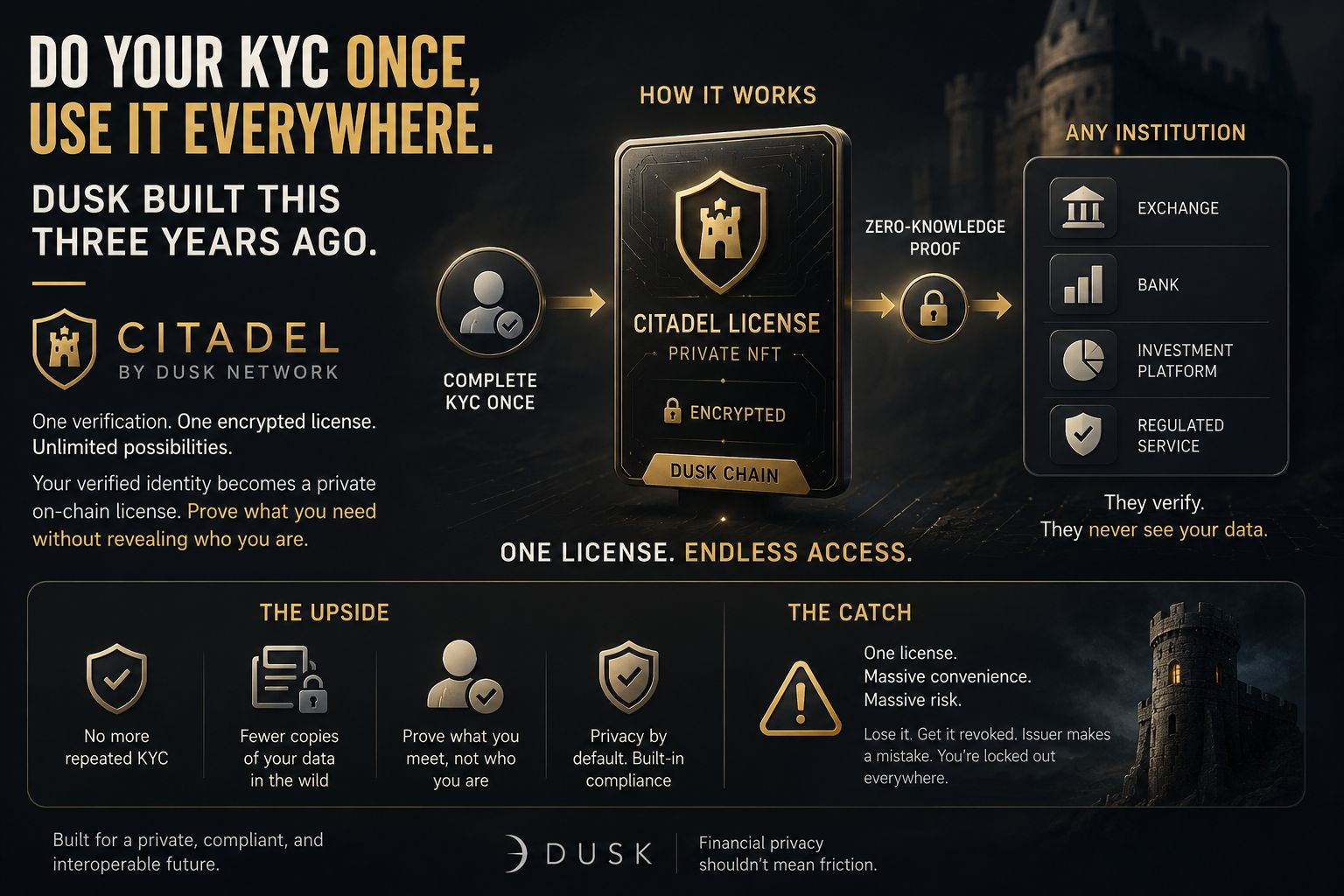
2
2
221
·
--
$DUSK just made it possible for any Ethereum Developer to build here without Learning anything new. I think this is the actual Unlock, not the price Chart.
Small headline, big implication. DuskEVM testnet went live earlier this month. What that actually means: Developers can now deploy Solidity contracts on @Dusk_Foundation using Hardhat and Foundry, the exact tools they already use on Ethereum. No new language, no rewriting a codebase from scratch, no learning #dusk Native Rust Environment just to try it out.
Why that matters more than it sounds. Privacy chains have historically had a chicken and egg problem. The tech is genuinely impressive, but almost nobody builds on it because it demands developers abandon everything familiar and start over. Dusk just removed that excuse. An existing Ethereum DeFi app can now target DuskEVM directly, keep its Solidity code, and inherit Dusks privacy and compliance layer underneath without a rewrite.
I want to be honest about what this is and is not, because the hype cycle tends to skip this part. This is a testnet. It establishes developer access, it does not prove adoption yet. Nobodys shipped a major protocol on it, no TVL has moved because of it. Access is not the same as usage, and I have watched enough testnets get treated like finished products to know the difference matters.
Still, paired with everything else stacking up, real tokenized securities running through NPEX, a live Mainnet a year old now, this is the piece that turns "Interesting Privacy Chain" into "A Chain Ethereum Builders can actually enter without Friction". Thats a bigger deal long term than another green candle.
Watching this closely, not calling it proven yet. The testnet is real. The adoption is still an open question.
$DUSK just made it possible for any Ethereum Developer to build here without Learning anything new. I think this is the actual Unlock, not the price Chart.
Small headline, big implication. DuskEVM testnet went live earlier this month. What that actually means: Developers can now deploy Solidity contracts on @Dusk using Hardhat and Foundry, the exact tools they already use on Ethereum. No new language, no rewriting a codebase from scratch, no learning #dusk Native Rust Environment just to try it out.
Why that matters more than it sounds. Privacy chains have historically had a chicken and egg problem. The tech is genuinely impressive, but almost nobody builds on it because it demands developers abandon everything familiar and start over. Dusk just removed that excuse. An existing Ethereum DeFi app can now target DuskEVM directly, keep its Solidity code, and inherit Dusks privacy and compliance layer underneath without a rewrite.
I want to be honest about what this is and is not, because the hype cycle tends to skip this part. This is a testnet. It establishes developer access, it does not prove adoption yet. Nobodys shipped a major protocol on it, no TVL has moved because of it. Access is not the same as usage, and I have watched enough testnets get treated like finished products to know the difference matters.
Still, paired with everything else stacking up, real tokenized securities running through NPEX, a live Mainnet a year old now, this is the piece that turns "Interesting Privacy Chain" into "A Chain Ethereum Builders can actually enter without Friction". Thats a bigger deal long term than another green candle.
Watching this closely, not calling it proven yet. The testnet is real. The adoption is still an open question.
Small headline, big implication. DuskEVM testnet went live earlier this month. What that actually means: Developers can now deploy Solidity contracts on @Dusk using Hardhat and Foundry, the exact tools they already use on Ethereum. No new language, no rewriting a codebase from scratch, no learning #dusk Native Rust Environment just to try it out.
Why that matters more than it sounds. Privacy chains have historically had a chicken and egg problem. The tech is genuinely impressive, but almost nobody builds on it because it demands developers abandon everything familiar and start over. Dusk just removed that excuse. An existing Ethereum DeFi app can now target DuskEVM directly, keep its Solidity code, and inherit Dusks privacy and compliance layer underneath without a rewrite.
I want to be honest about what this is and is not, because the hype cycle tends to skip this part. This is a testnet. It establishes developer access, it does not prove adoption yet. Nobodys shipped a major protocol on it, no TVL has moved because of it. Access is not the same as usage, and I have watched enough testnets get treated like finished products to know the difference matters.
Still, paired with everything else stacking up, real tokenized securities running through NPEX, a live Mainnet a year old now, this is the piece that turns "Interesting Privacy Chain" into "A Chain Ethereum Builders can actually enter without Friction". Thats a bigger deal long term than another green candle.
Watching this closely, not calling it proven yet. The testnet is real. The adoption is still an open question.
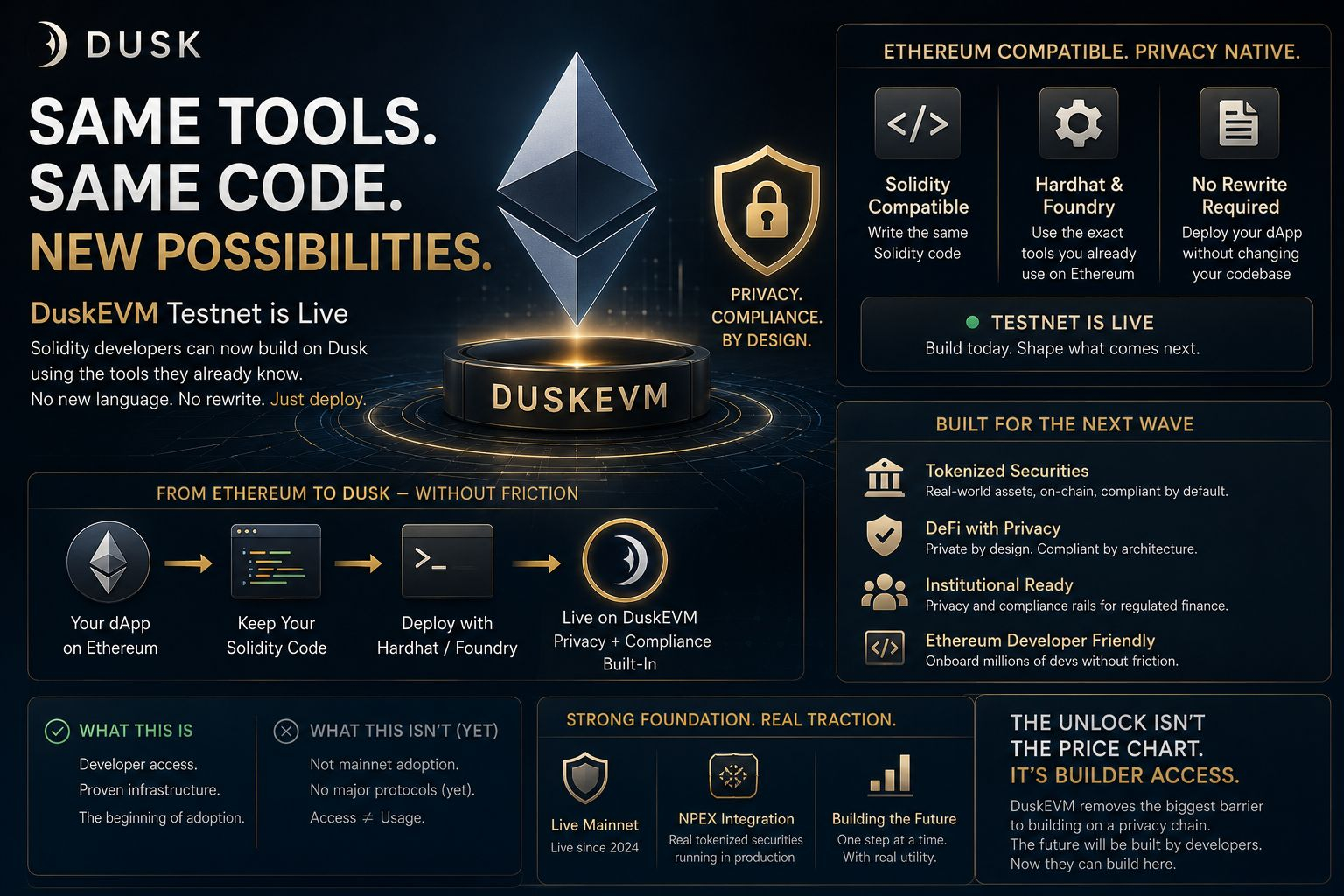
1
1
104
·
--
I used to think Fixed rates in DeFi were a nice idea that would never actually work.
Too much Liquidity Fragmentation, too many edge cases, too hard to price. Turns out I was wrong, or at least early in writing it off.
@termmax has been running fixed rate, fixed term Lending and Borrowing since April 2025, and its now sitting on close to $50M in TVL across Ethereum, Arbitrum, and BNB Chain, with over 17K daily active users and more than 100 markets live. Thats not hype numbers. Thats actual usage from people who got tired of watching their yield drift around.
Here is what changed my mind.
Instead of forcing everyone into one floating Rate curve, #TermMax lets Lenders and Borrowers agree on rates through an actual market mechanism. Curators and market makers set their own pricing and manage risk with range orders. You get real price discovery instead of a single formula trying to fit everyone.
Then they added one click leverage, so you are not chaining five transactions across different apps just to loop a position. And now they have pushed into tokenized stock collateral through Ondo, which means fixed rate borrowing against real world assets is no longer a theory, its live.
The bigger picture is simple. Fixed income is the largest asset class in traditional finance for a reason. People want to know what they are getting before they commit capital. DeFi is finally catching up to that expectation instead of asking everyone to tolerate constant rate volatility.
Still early days for the sector, but this is what Infrastructure actually being built looks like...
I used to think Fixed rates in DeFi were a nice idea that would never actually work.
Too much Liquidity Fragmentation, too many edge cases, too hard to price. Turns out I was wrong, or at least early in writing it off.
@TermMax has been running fixed rate, fixed term Lending and Borrowing since April 2025, and its now sitting on close to $50M in TVL across Ethereum, Arbitrum, and BNB Chain, with over 17K daily active users and more than 100 markets live. Thats not hype numbers. Thats actual usage from people who got tired of watching their yield drift around.
Here is what changed my mind.
Instead of forcing everyone into one floating Rate curve, #TermMax lets Lenders and Borrowers agree on rates through an actual market mechanism. Curators and market makers set their own pricing and manage risk with range orders. You get real price discovery instead of a single formula trying to fit everyone.
Then they added one click leverage, so you are not chaining five transactions across different apps just to loop a position. And now they have pushed into tokenized stock collateral through Ondo, which means fixed rate borrowing against real world assets is no longer a theory, its live.
The bigger picture is simple. Fixed income is the largest asset class in traditional finance for a reason. People want to know what they are getting before they commit capital. DeFi is finally catching up to that expectation instead of asking everyone to tolerate constant rate volatility.
Still early days for the sector, but this is what Infrastructure actually being built looks like...
Too much Liquidity Fragmentation, too many edge cases, too hard to price. Turns out I was wrong, or at least early in writing it off.
@TermMax has been running fixed rate, fixed term Lending and Borrowing since April 2025, and its now sitting on close to $50M in TVL across Ethereum, Arbitrum, and BNB Chain, with over 17K daily active users and more than 100 markets live. Thats not hype numbers. Thats actual usage from people who got tired of watching their yield drift around.
Here is what changed my mind.
Instead of forcing everyone into one floating Rate curve, #TermMax lets Lenders and Borrowers agree on rates through an actual market mechanism. Curators and market makers set their own pricing and manage risk with range orders. You get real price discovery instead of a single formula trying to fit everyone.
Then they added one click leverage, so you are not chaining five transactions across different apps just to loop a position. And now they have pushed into tokenized stock collateral through Ondo, which means fixed rate borrowing against real world assets is no longer a theory, its live.
The bigger picture is simple. Fixed income is the largest asset class in traditional finance for a reason. People want to know what they are getting before they commit capital. DeFi is finally catching up to that expectation instead of asking everyone to tolerate constant rate volatility.
Still early days for the sector, but this is what Infrastructure actually being built looks like...
155
·
--
$DUSK just did something most Privacy Coins have not managed in Years. I want to explain why it matters more than the Percentage suggests.
Everyone chases the number first. Fine, lets start there. @Dusk_Foundation ran nearly 583% in 30 days, Breaking out of a falling wedge it had been stuck in for months, hitting its Highest level in about a Year. Loud number. But loud numbers happen every week in this market and most of them mean nothing six weeks later.
Here is the part that actually made me Pay attention. On-chain data shows #dusk Crossed above its realized price, basically the average cost basis of everyone currently holding it. That flip matters more than people give it Credit for. Below that line, most holders are underwater and rallies get sold into as people rush to break even. Above it, the average holder is finally in profit, and historically that's when sell pressure eases instead of capping every bounce. It's the difference between a pump getting sold, and a trend that has room to actually continue.
And this is not happening in a vacuum. DUSK is one of the few privacy tokens actually shipping Real-World Asset (RWA) integration, Tokenized securities running through a licensed European exchange, north of 300 million Euros planned, not hypothetical.
Y Zi Labs, the fund formerly known as BINANCE Labs, has DUSK in its own portfolio. Thats not retail hype carrying this, thats a narrative Institutions are actually positioning around, privacy thats compliant enough for regulated finance to touch.
I will say the boring part too because it matters. This token is still sitting something like 90 percent below its 2022 high. A 583% move sounds massive until you remember what it's recovering from. Respect the move, dont romanticize it into something it is not yet.
Not financial Advice. Just watching a real narrative shift happen in real time and wanted to explain the mechanics behind the pump instead of just yelling the Percentage.
{future}(DUSKUSDT)
$DUSK just did something most Privacy Coins have not managed in Years. I want to explain why it matters more than the Percentage suggests.
Everyone chases the number first. Fine, lets start there. @Dusk ran nearly 583% in 30 days, Breaking out of a falling wedge it had been stuck in for months, hitting its Highest level in about a Year. Loud number. But loud numbers happen every week in this market and most of them mean nothing six weeks later.
Here is the part that actually made me Pay attention. On-chain data shows #dusk Crossed above its realized price, basically the average cost basis of everyone currently holding it. That flip matters more than people give it Credit for. Below that line, most holders are underwater and rallies get sold into as people rush to break even. Above it, the average holder is finally in profit, and historically that's when sell pressure eases instead of capping every bounce. It's the difference between a pump getting sold, and a trend that has room to actually continue.
And this is not happening in a vacuum. DUSK is one of the few privacy tokens actually shipping Real-World Asset (RWA) integration, Tokenized securities running through a licensed European exchange, north of 300 million Euros planned, not hypothetical.
Y Zi Labs, the fund formerly known as BINANCE Labs, has DUSK in its own portfolio. Thats not retail hype carrying this, thats a narrative Institutions are actually positioning around, privacy thats compliant enough for regulated finance to touch.
I will say the boring part too because it matters. This token is still sitting something like 90 percent below its 2022 high. A 583% move sounds massive until you remember what it's recovering from. Respect the move, dont romanticize it into something it is not yet.
Not financial Advice. Just watching a real narrative shift happen in real time and wanted to explain the mechanics behind the pump instead of just yelling the Percentage.
Everyone chases the number first. Fine, lets start there. @Dusk ran nearly 583% in 30 days, Breaking out of a falling wedge it had been stuck in for months, hitting its Highest level in about a Year. Loud number. But loud numbers happen every week in this market and most of them mean nothing six weeks later.
Here is the part that actually made me Pay attention. On-chain data shows #dusk Crossed above its realized price, basically the average cost basis of everyone currently holding it. That flip matters more than people give it Credit for. Below that line, most holders are underwater and rallies get sold into as people rush to break even. Above it, the average holder is finally in profit, and historically that's when sell pressure eases instead of capping every bounce. It's the difference between a pump getting sold, and a trend that has room to actually continue.
And this is not happening in a vacuum. DUSK is one of the few privacy tokens actually shipping Real-World Asset (RWA) integration, Tokenized securities running through a licensed European exchange, north of 300 million Euros planned, not hypothetical.
Y Zi Labs, the fund formerly known as BINANCE Labs, has DUSK in its own portfolio. Thats not retail hype carrying this, thats a narrative Institutions are actually positioning around, privacy thats compliant enough for regulated finance to touch.
I will say the boring part too because it matters. This token is still sitting something like 90 percent below its 2022 high. A 583% move sounds massive until you remember what it's recovering from. Respect the move, dont romanticize it into something it is not yet.
Not financial Advice. Just watching a real narrative shift happen in real time and wanted to explain the mechanics behind the pump instead of just yelling the Percentage.
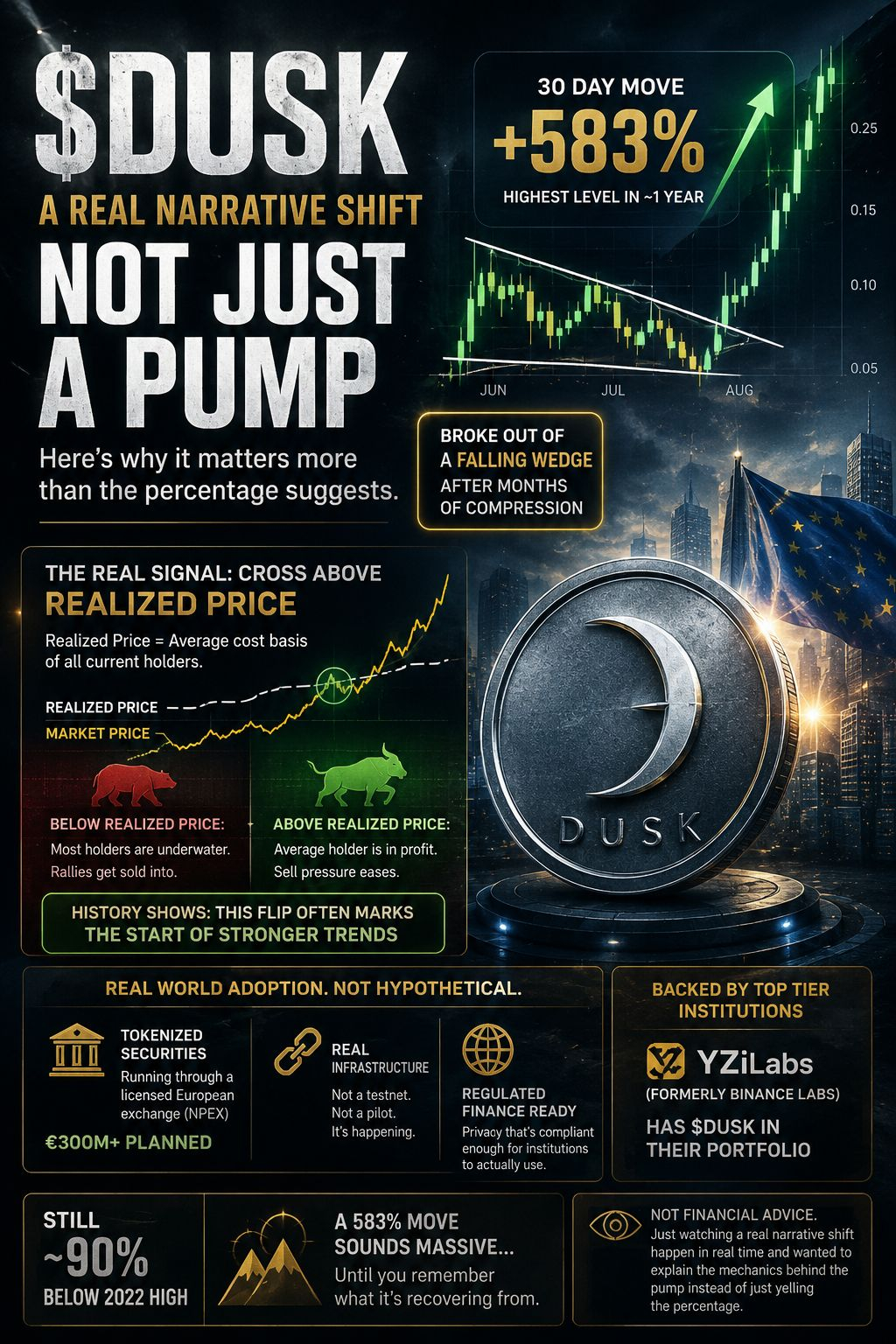
4
2
152
·
--
Most people dont realize how much they Are overpaying for uncertainty in DeFi.
You Deposit into a lending pool, the Rate looks great on day one, and then it Drifts. Borrow costs creep up. Yield quietly drops. You end up managing a position instead of actually earning from it.
@termmax takes a different approach. Its a fixed rate, fixed term lending and borrowing protocol, live on Ethereum, Arbitrum, and BNB Chain. You lock in your rate upfront and it stays that way until maturity. What you see going in is what you get coming out.
A few reasons this stands out right now.
It supports one click leveraged positions without routing through multiple protocols.
Vaults let you earn passive yield without babysitting your position every day.
It recently added tokenized stock collateral through Ondo Global Markets, which is a real step toward bringing institutional capital on chain.
Curators and market makers can set their own pricing curves through range orders, so the market stays efficient instead of relying on a single formula.
Traditional finance runs on fixed income. Bonds, term deposits, structured products. Its a market worth well over $100T. DeFis fixed rate segment is still under $20B. Thats not a weakness in the space. Its early innings.
If DeFi wants to attract capital that cant tolerate unpredictable returns, protocols like this are the ones building the actual infrastructure for it.
Whats more valuable to you long term, higher variable yield or a rate you can actually plan around? #termmax
Most people dont realize how much they Are overpaying for uncertainty in DeFi.
You Deposit into a lending pool, the Rate looks great on day one, and then it Drifts. Borrow costs creep up. Yield quietly drops. You end up managing a position instead of actually earning from it.
@TermMax takes a different approach. Its a fixed rate, fixed term lending and borrowing protocol, live on Ethereum, Arbitrum, and BNB Chain. You lock in your rate upfront and it stays that way until maturity. What you see going in is what you get coming out.
A few reasons this stands out right now.
It supports one click leveraged positions without routing through multiple protocols.
Vaults let you earn passive yield without babysitting your position every day.
It recently added tokenized stock collateral through Ondo Global Markets, which is a real step toward bringing institutional capital on chain.
Curators and market makers can set their own pricing curves through range orders, so the market stays efficient instead of relying on a single formula.
Traditional finance runs on fixed income. Bonds, term deposits, structured products. Its a market worth well over $100T. DeFis fixed rate segment is still under $20B. Thats not a weakness in the space. Its early innings.
If DeFi wants to attract capital that cant tolerate unpredictable returns, protocols like this are the ones building the actual infrastructure for it.
Whats more valuable to you long term, higher variable yield or a rate you can actually plan around? #termmax
You Deposit into a lending pool, the Rate looks great on day one, and then it Drifts. Borrow costs creep up. Yield quietly drops. You end up managing a position instead of actually earning from it.
@TermMax takes a different approach. Its a fixed rate, fixed term lending and borrowing protocol, live on Ethereum, Arbitrum, and BNB Chain. You lock in your rate upfront and it stays that way until maturity. What you see going in is what you get coming out.
A few reasons this stands out right now.
It supports one click leveraged positions without routing through multiple protocols.
Vaults let you earn passive yield without babysitting your position every day.
It recently added tokenized stock collateral through Ondo Global Markets, which is a real step toward bringing institutional capital on chain.
Curators and market makers can set their own pricing curves through range orders, so the market stays efficient instead of relying on a single formula.
Traditional finance runs on fixed income. Bonds, term deposits, structured products. Its a market worth well over $100T. DeFis fixed rate segment is still under $20B. Thats not a weakness in the space. Its early innings.
If DeFi wants to attract capital that cant tolerate unpredictable returns, protocols like this are the ones building the actual infrastructure for it.
Whats more valuable to you long term, higher variable yield or a rate you can actually plan around? #termmax
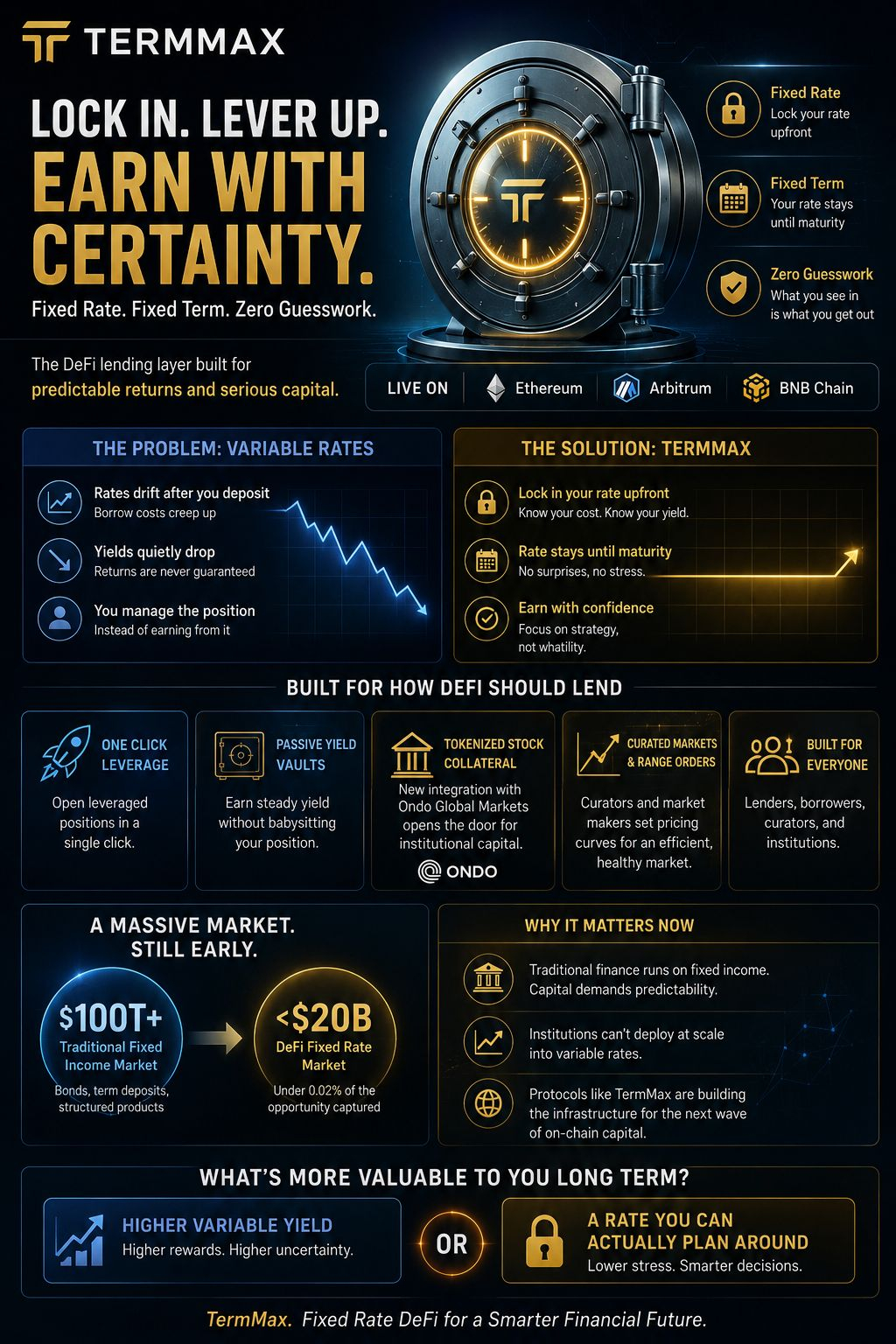
2
1
251
·
--
Fixed rates are quietly becoming DeFi's next big unlock...
Everyones chasing APY screenshots, but the real problem in DeFi lending has never been the yield. Its the uncertainty. Rates swing overnight, borrowing costs spike out of nowhere, and "Passive income" often means checking your dashboard five times a day...
Thats the gap @termmax is quietly closing.
Instead of the usual floating rate roulette, #TermMax lets you lock in a fixed rate for a fixed term. Lend, borrow, or loop leverage with a single click, and actually know your numbers going in. No guessing games. No rate anxiety.
A few things worth paying attention to:
Fixed rate and fixed maturity lending/borrowing, live on Ethereum, Arbitrum, and BNB Chain.
One click leverage without hopping across five different protocols.
Vaults for hands off yield. Set it and actually forget it.
Recently expanded into tokenized stock collateral, opening the door for RWAs and institutional grade capital.
Zoom out for a second. Traditional fixed income markets are worth over $100T. DeFi's version of that market is still under $20B. That gap isn't a flaw. Its the opportunity.
Predictability is not the exciting part of crypto, but it might be the part that finally brings serious capital on chain.
Are you team fixed rate or still riding the variable rate rollercoaster?
Fixed rates are quietly becoming DeFi's next big unlock...
Everyones chasing APY screenshots, but the real problem in DeFi lending has never been the yield. Its the uncertainty. Rates swing overnight, borrowing costs spike out of nowhere, and "Passive income" often means checking your dashboard five times a day...
Thats the gap @TermMax is quietly closing.
Instead of the usual floating rate roulette, #TermMax lets you lock in a fixed rate for a fixed term. Lend, borrow, or loop leverage with a single click, and actually know your numbers going in. No guessing games. No rate anxiety.
A few things worth paying attention to:
Fixed rate and fixed maturity lending/borrowing, live on Ethereum, Arbitrum, and BNB Chain.
One click leverage without hopping across five different protocols.
Vaults for hands off yield. Set it and actually forget it.
Recently expanded into tokenized stock collateral, opening the door for RWAs and institutional grade capital.
Zoom out for a second. Traditional fixed income markets are worth over $100T. DeFi's version of that market is still under $20B. That gap isn't a flaw. Its the opportunity.
Predictability is not the exciting part of crypto, but it might be the part that finally brings serious capital on chain.
Are you team fixed rate or still riding the variable rate rollercoaster?
Everyones chasing APY screenshots, but the real problem in DeFi lending has never been the yield. Its the uncertainty. Rates swing overnight, borrowing costs spike out of nowhere, and "Passive income" often means checking your dashboard five times a day...
Thats the gap @TermMax is quietly closing.
Instead of the usual floating rate roulette, #TermMax lets you lock in a fixed rate for a fixed term. Lend, borrow, or loop leverage with a single click, and actually know your numbers going in. No guessing games. No rate anxiety.
A few things worth paying attention to:
Fixed rate and fixed maturity lending/borrowing, live on Ethereum, Arbitrum, and BNB Chain.
One click leverage without hopping across five different protocols.
Vaults for hands off yield. Set it and actually forget it.
Recently expanded into tokenized stock collateral, opening the door for RWAs and institutional grade capital.
Zoom out for a second. Traditional fixed income markets are worth over $100T. DeFi's version of that market is still under $20B. That gap isn't a flaw. Its the opportunity.
Predictability is not the exciting part of crypto, but it might be the part that finally brings serious capital on chain.
Are you team fixed rate or still riding the variable rate rollercoaster?
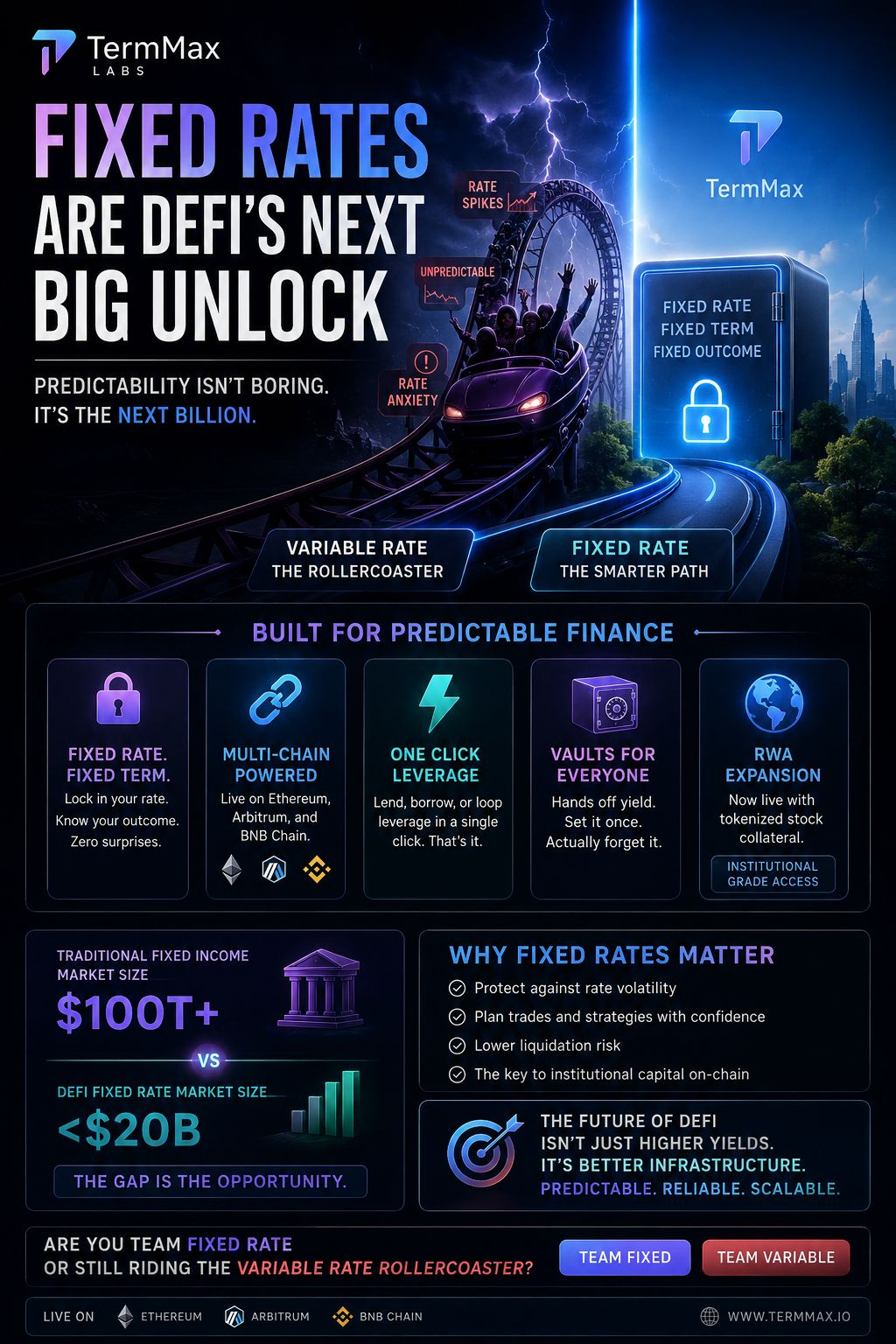
5
2
165
Войдите, чтобы посмотреть больше материала
Присоединяйтесь к пользователям криптовалют по всему миру на Binance Square
⚡️ Получайте новейшую и полезную информацию о криптоактивах.
💬 Нам доверяет крупнейшая в мире криптобиржа.
👍 Получите достоверные аналитические данные от верифицированных создателей контента.
Эл. почта/номер телефона
В тренде
US10YTreasuryYieldHitsHighestSinceNov2023
Просмотров: 0
6 обсуждают
🚨 $METAB Looks Ready for the Next Move! Will Bulls Defend Support? 👀
📍 Entry: 643 – 646
🛑 Stop Loss: 638
🎯 TP1: 652
🎯 TP2: 657
🎯 TP3: 665
📊 Strong bullish structure remains intact, and the current pullback appears to be healthy consolidation rather than a trend reversal. A bounce from support could fuel the next leg higher.
⚠️ Wait for bullish confirmation before entering. Always manage your risk.
Trade Here 👇
#meta #US10YTreasuryYieldHitsHighestSinceNov2023 #BinanceSquareTalks #USADPWeeklyEmploymentRises12000 $IOST
Adeem Jutt
·Лайков: 1
·Просмотров: 11
USTreasuryToBuyBackUpTo$6BLongDatedDebt
Просмотров: 7,087
121 обсуждают
BitcoinSurpasses$79K
Просмотров: 48,957
243 обсуждают